Teaching Reading Texts through Critical Thinking Perspective

images
Lal Bahadur Rana


In this blog post, I discuss how the core principles of critical thinking such as open-mindedness, ability to see any phenomenon through multiple perspectives, etc. can be exploited in EFL classes with a view to increasing learner-centeredness in our EFL classes and enhance learners’ critico-creative thinking.


Context for teaching and learning English
Despite the strong desire of getting mastery over English, many Nepali learners of English do not have sufficient level of English mainly because of the amount of exposure. Let me give an example of the time teacher and students spend using English throughout a year. Most of the government-aided schools in Nepal have the classes of forty minutes and six classes a week. Thus, there are spending (40 x 6) = 240 minutes in a week (240 x 4) = 960 minutes a month and (960 x 10) = 9600 minutes a year. If we change this amount of time into hours, they study 160 hours. To count in days, they study just 6.67 days a year. Hardly a week! If we deduct the time such as the use of the Nepali language, the time spent on coming and going to class, bandh days, etc. I am afraid, students might be studying in some minus days. Continue reading Teaching Reading Texts through Critical Thinking Perspective

Welcome to September Issue of ELT Choutari

Mentoring Special

Editorial: 

The Choutari Team is delighted to greet you with the September issue of ELT Choutari! This issue is focused on mentoring, which  has remained one of the core values of Choutari since its inception.  We began the Choutari Mentoring Project (CMP) as a new initiative  to enhance a collaborative learning environment among our readers seven months ago. We are excited to receive love and feedback from the students, teachers, and professionals in Nepal. The continual academic support from both the  international and local community of ELT/Applied Linguistic scholars has further encouraged us to develop other news projects in future. We are glad that many of our colleagues are enjoying the benefits of the mentoring project. We would like to thank you all who signed up and participated in this project. In the meantime, we have also received much feedback from those engaged currently in the mentoring relations. We are encouraged by your feedback and do look forward to making this project even more accessible and productive in the days to come.

The September issue of ELT Choutari was originally planned to be a forum to celebrate the mentoring relations and to formally recognize our mentors and mentees contributing to the project. However, based on the feedback we received, and with due respect to the contextual ramifications, we have decided to maintain confidentiality of the participating mentors and mentees. This has been an important learning experience from the critical mass of participants, and we are determined to move ahead with a giving spirit to our field.

This issue of ELT Choutari, however, has come out to be a special one for a special reason. We have posts from Choutari’s key personalities including founding members and past editors. We have an interview with two successful Nepali ELT mentors Ganga Ram Gautam, Reader at  Tribhuvan University, and Laxman Gnawali, PhD, Associate Professor at Kathmandu University, focused on mentoring. Their mentoring stories not only unveil mentoring culture in Nepal, but also present existing perception and attitude toward this in our context.

In the second reflective blog entitled “This is How Mentoring Worked for Me,” Bal Krishna Sharma shares his personal learning experiences from the mentoring activities — both as a mentee and as a mentor. Bal has included the names of his mentor (Elaina) and mentee (Tankia) in his story to give a real story that gives insight into how those relations are developed and sustained. Moreover, this sets a great example of how one individual can benefit from both roles.

Sajan Kumar’s take on mentoring is highly philosophical in third blog entry-“You are, therefore I am: Reciprocity, Metamorphosis, Mentorship and Beyond.” Here Sajan shares a model of mentoring that describes the mentoring process as a cyclical developmental and growth involving contemplation, meditation, mediation, and action — all converging into a transformative process. Sajan describes his mentoring journey stemming out of his intimate collaboration with his guru and the quality time he had with him during his stay at Kirtipur but then goes on to add a theoretical dimension arguing that the whole biosphere may act as the mentor for an explorer of self, such as Sajan himself. His conclusion is powerful: “One repays a teacher badly if one remains only a pupil”

Prem Phyak in the fourth blog post “Not a fix-it shop: Making mentoring productive”  is full of practical insights. Prem has offered some strategies that can be helpful to make mentoring more productive and goal-oriented. Drawing on his own experience working as a writing consultant/tutor for the Writing Center at the University of Hawaii at Manoa for two years, Prem’s post focuses on how to make mentoring more interactive, grounded/bottom-up, and collaborative rather than top-down and authoritative.

The fifth blog entry ‘Bal Ram Adhikari’s Sharing, Caring and Daring in Mentoring’ is a remarkable story of transformation whereby the writer finds himself as a deliverer of something that he had been longed for in the beginning of his teaching career. Adhikari’s experience paints a not-so-good-picture of mentoring in the context of Nepal, but is an eye opener. Having witnessed and been trampled by the “lopsided” practice of power, dominance, and authority, Adhikari’s writing is a call for an action toward a truer mentoring regime in Nepal’s ELT sector.

Finally, we have a photo blog that covers the news from Choutari’s monthly writing workshop facilitated by Hem Raj Kafle, one of founding editors of Choutari.

Here is the list of articles we have included for September Issue, especially focused on mentoring in ELT:

  1. ELT Chat with Nepali Mentors on Mentoring, by Praveen K Yadav  
  2. This is How Mentoring Worked for Me, by Bal Krishna Sharma
  3. You are, therefore I am, by Sajan Kumar
  4. Not a fix-it shop: Making mentoring productive, by Prem Phyak
  5.  Sharing, Caring and Daring in Mentoring, by Bal Ram Adhikari
  6. Choutari Writing Workshop #3: Photoblog, by Choutari Team

Together, these stories, coming straight out of the experiences of successful people in the field, serve as models to be built on. As can be seen, these stories reveal that mentoring is not about following prescriptive norms and rules — it is largely shaped by what goal, passion, philosophy and background that mentors and mentees share with each other. I believe that these stories are my stories, your stories, and everyone’s stories.

Uttam
Uttam Gaulee Editor, September 2014

P.S.: I would like to urge all our valued readers and contributors to please share these stories among your social network and leave comments.

Enjoy the readings!

ELT Chat with Nepali Mentors on Mentoring

Praveen Kumar Yadav, team coordinator for ELT Choutari, had a chit-chat with successful Nepali ELT mentors, Ganga Ram Gautam, Reader in English Education at Tribhuvan University and Dr Laxman Gnawali, Associate Professor at Kathmandu University School of Education, who are not only involved in English Language Teaching, but they has also been mentoring ELT practitioners over one and a half decade. This chat with the ELT mentors and experts delves into the tradition, practice cultural variations, and existing perception and attitude toward mentoring with reference to their own mentoring experience. Please enjoy this insightful conversation with these experts.

Choutari: Could you please briefly talk about mentorship culture in Nepalese context? How do students and teachers in Nepal perceive mentoring?

Gautam:

Gautam, Ganga - Nepal (2) (1)
Ganga Ram Gautam, Reader in ELT Tribhuvan University, Nepal


Mentorship is not a new concept in Nepal. Mentorship was an excellent way of building capacity of a person in the Gurukul education system and it continued for a long time in the tradition. Similarly, helping the young ones by the senior was in-built in our cultural system and the metaphor that we often used for mentorship is पन्थेदाउने which means training the novice person by engaging them in the work under the supervision of the seniors.

Currently, the western education system gave it a new name and it is being discussed in the education discourse. Informally, mentoring is there but at the formal level, it is not very widely used.
Gnawali: 

Laxman Gnawali, PhD                                            Associate Professor (ELT)                          Kathmandu University  School of Education
Laxman Gnawali, PhD, Associate Professor (ELT) Kathmandu University School of Education

Nepalese society had a tradition of mentoring model of education and training until the modern schooling system started for the public in the 1950s. Whether it was about the skills of family occupation and family crafts or the art of war, the experienced ones used to pass down the skills to the young generation by way of mentoring. Take for example a daughter learning to weave paddy straw mat or a tailor’s a children learning to stitch clothes or a priest’s son learning to perform rituals or a young prince learning the tactics of rule. In all cases, the knowledge transfer took place in the mentoring model. Later, the modern schooling system introduced mass education and the mentoring was no longer practicable for most trades. The teaching and learning now embraced cascade model.

From my interactions with the teachers and students, I have gathered that mentoring is not a common practice in the formal education. Though the traditional skills transfer still continues in the mentoring model, stakeholders of the mainstream education are happy to see the cascade model of knowledge transfer function. Ironically, teacher education in which mentoring model would make a difference follows a straight cascade model except in a very few cases.

Choutari: Kindly share with Choutari readers any of your mentoring experience (as a mentee) that you think has added values to your life.

Continue reading ELT Chat with Nepali Mentors on Mentoring

This is how mentoring worked for me

135615_1766463684896_7952262_o (1)
Bal Krishna Sharma,   PhD Scholar   University of Hawaii, Manoa, USA

I went to pursue my graduate studies at the University of Hawaii in 2008. Since I was in a new academic environment, any academic help extended to me would be tremendously helpful. I first had little idea on how the US academic system would work, for example, choosing academic advisers, completing assignments, presenting at conferences, finding and using scholarly resources and connecting to the local ELT professional venues. Thanks to the East-West Center, my scholarship sponsor organization, that connected me to an experienced and very helpful mentor, Elaina. Also thanks to the Second Language Studies Students’ Association that provided me an opportunity to work as a mentor for a BA student. In the following sections, I will briefly describe my experience and learning opportunities from these mentoring programs.

Being a Mentee

The East-West Center Alumni Association asked me to fill out a mentoring form providing details of my academic and professional background, academic interest and my expectations from my mentor. However, I had little idea regarding how this would work and help with my graduate studies at the university. I thought at least I would have an opportunity to connect to an ‘American’ professor. The alumni association also asked the potential mentors to fill out similar forms. By matching common interests between the two parties, I was assigned to a mentor at a local community college. I was excited. I wrote my mentor an introductory email and told her that I was her mentee and wanted to know who she was. Elaina took me to an Indian restaurant for dinner for our first meeting. We chatted about our personal and academic interests, family background and future goals. Continue reading This is how mentoring worked for me

You are, therefore I am

Reciprocity, metamorphosis, mentorship and beyond         

Sajan Kumar

‘I think, therefore I am’, declared Descartes. And I thought the same; I taught the same. You thought, therefore you were. They thought, therefore they were. Nevertheless I have been very inconsistent and unpredictable a man throughout. As time grew, I began to feel entrapped and suffocated; I could not continue to dwell in the same box and I flew away. Afterwards, I disassociated myself from Descartes and many more like him. I had been solid all along; I was liquid now. Snow must melt someday.

joint pic
Sajan Kumar                   Dr Govinda Raj Bhattarai

The story goes like this in brief. With Descartes and his ‘cogito, ergo sum’, it was thinking that ensured my existence in the world I dwelled and played my part in. I existed only because I thought. Anybody existed because they thought. Thinking was the basis for any relationship that I was in, that I wanted to be in. Everything else felt petty; everybody else felt mediocre. I had been a body all along and I was a mind now. Of the three metamorphoses that Nietzsche in his magnum opus ‘Thus Spake Zarathustra, designate of the spirit, hopefully it was one: the camel had turned into a lion. Naturally, the lion felt euphoric about the accomplishment after struggles. However, the lion still lived in an enclosure for his world was private and compartmentalized. Like a chariot horse; he could neither see left nor right but merely straight. Descartes solipsism had led him into such a cage where he saw, heard, felt, touched and smelt with mind alone. Not only that he contemplated with mind but he meditated and mediated with mind/s alone. Perhaps, he had unknowingly obliterated that he possessed a beautiful body too and the body housed a self too. His disillusionment came to an end only when he was stuck on the middle floor and out of blue regained memory of where he came from and also visualized where he was destined for.

Continue reading You are, therefore I am

Not a fix-it shop: Making mentoring productive

Prem Phyak, PhD Scholar  in Second Lang. Studies, University of Hawaii, USA

In this blog post I discuss some strategies that can be helpful to make mentoring more productive and goal-oriented. Drawing on my own experience working as a writing consultant/tutor for the Writing Center at the University of Hawaii at Manoa for two years, this post focuses on how to make mentoring more interactive, grounded/bottom-up, and collaborative rather than top-down and authoritative.

Starting the conversation

One undergraduate student came to the Writing Center and asked whether I could help him. “Yes, I am available now”, I said. After we introduced to each other, I asked what his problem was. He said, “I want to write a research paper for my political science class. But I am struggling to identify a topic. I am worried because the assignment is due next week.” His face was telling me that he was procrastinating and finding no way to move forward.” 

First, I was perplexed how I could help him as he was not sure what he was going to write about. Second, I was not sure what the student was expected to write in his  research paper. I began our mentoring session by telling him that every student faces the same problem. I gave my own example; I quite often do not know what I am going to write in the early stage of my writing projects. Continue reading Not a fix-it shop: Making mentoring productive

Sharing, Caring and Daring in Mentoring

IMG_6861
Bal Ram Adhikari Editor, ELT Choutari

I am a teacher educator and a literary translator by profession. My teaching profession took its roots two decades ago when I was first appointed as a primary teacher in the government-aided school in a remote part of Gorkha. I joined this profession before I was ‘professional’. I was qualified to teach simply becauseI had an academic certificate of Intermediate Proficiency Level in English Education and I could teach or say ‘tell’ my students what was written in the English textbook. I have not strayed from this profession ever since my first appointment.  However, my changing of institutions has been rather unpredictable and whimsical.

During this professional life I ever wished  to be intimately closer to ‘someone’ more experienced, more supportive, more understanding under whose guidance I could learn the science of teaching, feel its art in the actual classroom, and who I could turn to whenever I needed counseling on my profession. However, that ‘someone’ never turned up in my teaching career save the university teachers who observed and supervised my lessons during peer teaching, school teaching and campus teaching during the practicum. That was Okay, I call it ‘just Okay’, since the purpose was to fulfill the requirement of examinations; the process was too mechanical; the feedback for further improvement was too ritualistic. I could have grown differently in the field had I got ‘that someone’[1]. I sense that many of the pre-service teachers who I have been teaching are also longing for ‘that someone’.

‘That someone’ who I have missed in my professional life is dubbed a mentor.The me-like person who wishes to learn under ‘that more experienced one’ in the field is dubbed a mentee. The process whereby the mentor supports the mentee to grow in the field is mentoring.  I come up with certain reasons when I ponder over why I longed for mentoring and why I mentor my students these days. In my observation, this is a widespread longing in Nepal.

Why mentoring? Continue reading Sharing, Caring and Daring in Mentoring

Choutari Academic Writing Workshop: Photo Blog

For many, writing can be a very vulnerable and challenging process. However, with certain skills and motivation, an aspiring writer can come up with creative and interesting text which can engage readers from the first word to the last.

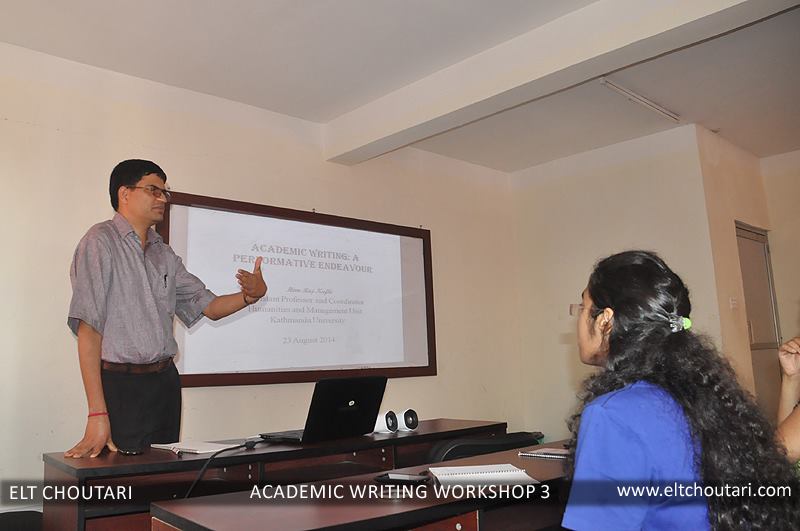
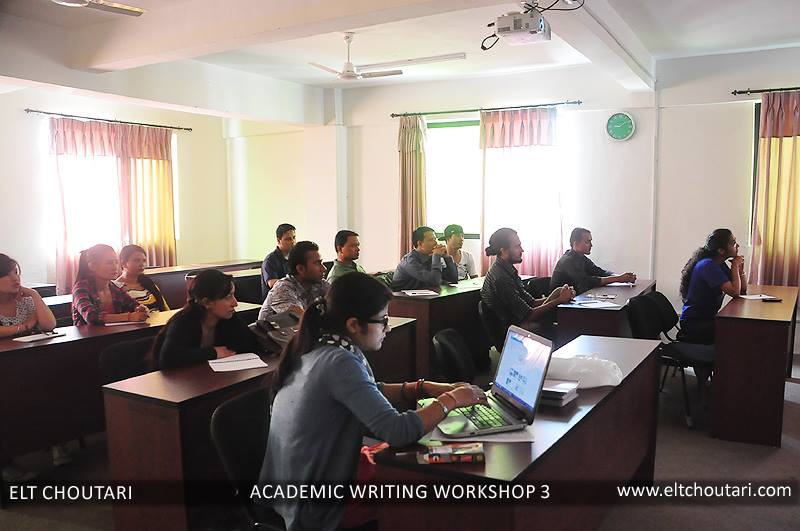
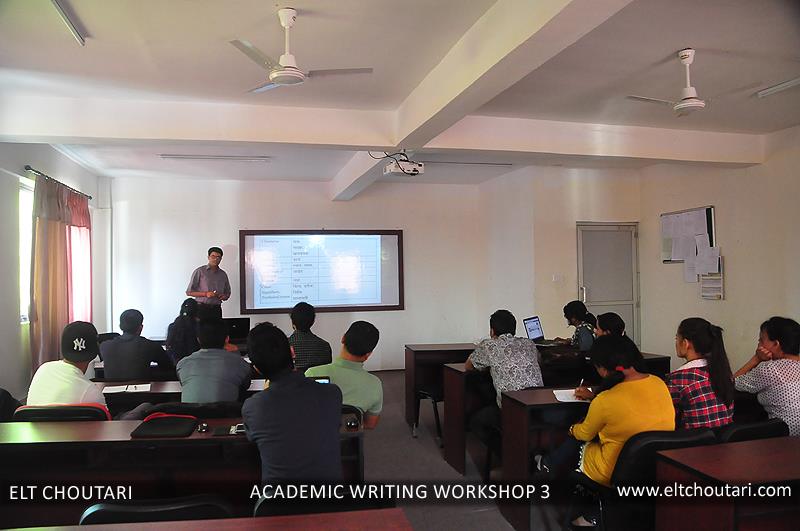
With a view to enhance the writing skills of English Language Teaching (ELT) practitioners and emerging writers, ELT Choutari organized a writing workshop titled “A Performative Endeavour in Academic Writing” on August 23 in Kathmandu.

10584076_281778798680058_1702516550106569517_n

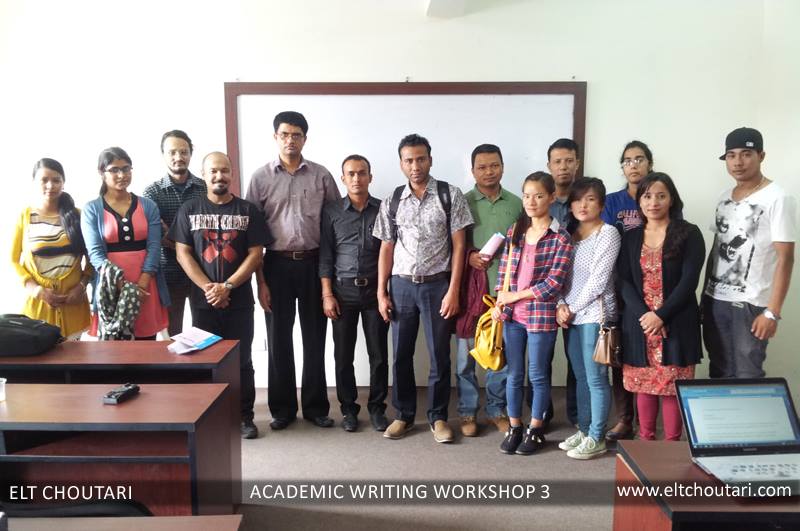
Hem Raj Kafle, assistant professor of Kathamandu University School of Engineering, and also one of the founders of ELT Choutari, facilitated the one-day workshop held at King’s College, Babarmahal, Kathmandu. Twenty emerging authors, especially teachers and students studying English from Kathmandu University and Tribhuvan University attended the program.10353003_281779022013369_3139098983756202402_n

Sharing his experience as an established writer and a prolific blogger, Kafle highlighted on significance of different components that make one’s writing interesting, authentic and reader-friendly. He divided the workshop into a series of sessions and shared some practical techniques on how to overcome writer’s block, how to start with effective beginning, argue with different elements, establish the writer’s presence, and so on.

10568933_281778998680038_6796258766935787750_n

Toward the end of the workshop, facilitator Kafle illustrated few examples of different models of same writing and through comparison, the participant writers were engaged to scrutinize those pieces of writing and pick the effective form based on the analysis.

10599522_281778962013375_6490448481590006690_n


“The workshop was very helpful for me as I want to write articles about drama and theatre; and get them published in newspapers,” said Deepesh Paudel, one of the participants from Sarwanam Theater.


Similarly, Usha Kiran Wagle, one of editors for Choutari and an M. Ed in ELT from Kathmandu University, reflected about the workshop saying that she has gained new confidence in writing.

This monthly writing workshop is a part of ELT Choutari to promote professional development of English language teachers through networking and building on local resources and knowledge in English language teaching.

For more photos: Please click here

NELTA CHOUTARI is ELT CHOUTARI Now

Welcome to August Issue of Choutari

Editorial:

Change is natural and inevitable. Change is necessary to cope with challenges, to embrace new opportunities, and to take any project to new heights.

In order to build on our success in more than a half decade, we have updated our network’s name, moving our blog to a new site within a domain of our own. Nelta Choutari is now ELT Choutari and its site is www.eltchoutari.com. As an informal, independent group of bloggers and facilitators, we continue to pursue the same goals of enhancing professional development in ELT, while we explore new avenues and make greater impact on the community.

What we had so far was a basic WordPress blog; with this site, we have the full range of functionalities that we can use as needed.

Some facts about our journey so far seem worth sharing with our readers and well-wishers. Over the half a decade, we have been positively overwhelmed by the wonderful engagement of 180,557 visits with around 500 posts and over 1100 comments as of July 31, 2014. We wanted to grow and promote such an engagement with a standard site.

Secondly, when we launched the blog in 2009, we gave it the name NeltaChoutari simply because the group was started by members of the organization NELTA and the group wanted to create an informal space similar to the public square in the countryside. This space belonged to the community, and it was characterized by freedom of expression, informal organization, lack of external supervision, welcoming acceptance of active contributors and understanding when any core member wanted to step aside, spirit of volunteerism, and a passion to give back to the community. However, as time went on, the informal group became bigger in scope and impact and more popular than we initially expected, and some confusion began about what the name meant: is it an official blog of NELTA (which it is not), or is it somehow an alternative space (it’s not that either), why is it not part of the NELTA if it bears such a name?Recently, after NELTA office launched its official blog (Nelta ELT Forum) we wanted to emphasize that Choutari is open, informal, and independent – while acknowledging the forum’s official status and a lack thereof with ours. We believe that informal and open spaces add tremendous value to any professional community. We don’t think that one is better than another, but we do think that an informal space adds a unique set of value.

Choutari continues to be dedicated to discuss, discover and deliver ELT related issues in particular and education in general–with even more energy and commitment. We encourage you to continue to contribute and benefit from the vibrant professional community on this platform.

Welcome to our new site—ELT CHOUTARI!

Here is the list of articles included for August Issue, especially focused on diversity in ELT:

  1. Diversity in English Language Classroom, by Balram Adhikari
  2. Diversity and Broader Goals of ELT, by Shyam Sharma
  3. Talking about Creative Consciousness in Teachers, Jeevan Karki
  4. Teacher Training: One of the Best Ways of Self-development, by Parista Rai
  5. Building a Community: What We Value: Reblog by Praveen, Umes & Uttam
  6. Choutari Writing Workshop #2: Photoblog, by Choutari Team

Finally, please update your bookmark and please share it among your social network. Please explore the pages from the top menu bar, and as usual, please like, share, and leave comments.

Happy Reading!

IMG_6861
Balram Adhikari

Editor for August Issue
(with Editorial Team)
ELT CHOUTARI

Diversity in English Language Classroom

1924893_829718523720484_26654504_n
BALRAM ADHIKARI

Diversity implies the state of being diverse in forms. It is the state in which multiformity exists because of co-existence of multiple, yet interconnected forms of the phenomenon.  Diversity is a reality in the English language classroom, particularly in the contexts like ours, where the classroom houses teachers and learners both from diverse linguistic, cultural, geographical, economic, and social backgrounds. Second language learning and teaching theories regard diversity as the reality of the classroom. Without delving into theories and research works that abound the field of teaching English as a foreign or second language, I would  like to  present different dimensions of diversity, most of which I have noticed in my own classroom.   I interpret diversity along the dimensions of language and culture, and cognition and creation of students.  

I teach a large class.  The classroom where I teach the master’s level course English Grammar for Teachers is cramped with the students. The number of students often exceeds ninety.  These are the prospective English teachers specializing in English education.  The size of the class has a lot to do with diversity. The larger the class it is more likely to be diverse in terms of learner differences, their educational backgrounds, geographical, cultural, linguistic experiences, and their expectations from teaching.   Continue reading Diversity in English Language Classroom

Diversity and Broader Goals of ELT

Shyam Sharma

Sitting down to write this post on diversity and ELT, I remember a story that scholar David Foster Wallace tells in a famous college graduation speech. Two younger fish ask an older one: “What the hell is water?” The point of the story is that “…the most obvious, important realities are often the ones that are hardest to see and talk about.”

The point I want to make in this post is that while we are a nation of very diverse peoples, cultures, languages, and so on, we have to pinch ourselves to remember that we are diverse. I argue that as educators, it is worth pinching ourselves and our students—intellectually, that is—into realizing the value of diversity as a broader goal of education, especially in a country like ours and an interconnected world like today’s.

[youtube=https://www.youtube.com/watch?v=DKYJVV7HuZw]
[This YouTube video is an animated version of parts of Wallace’s speech]

We’ve been told that Nepal has been a garden of “four castes and thirty-six shades” of people; indeed, within an area of 850 by 200 kilometers, we speak more than a hundred languages and are extremely diverse in a variety of ways. However, the garden metaphor was meant to drive home the value of unity more than diversity. The emphasis on nationhood and unity is usually a goodie goodie way to deny that there are deep divisions, structural injustices, and discrimination woven into the sociopolitical fabric of our society. So, it is absolutely time that we situate (even) the teaching of English within the context of seeking to promote respect for diverse peoples, cultures, languages, and epistemologies (even) in a small but complex country like ours.

Continue reading Diversity and Broader Goals of ELT

Talking about Creative Consciousness in Teachers

Jeevan Karki

I was having an informal talk with a boy of tenth grade regarding growing disinterest of students in the home assignment. To my question of why students do not show their interest in doing home assignments, he replied that home assignments are NOT interesting. He further said if the work is interesting, we simply cannot wait to complete it. We choose to do the interesting work first among others.

I pondered on his view. In fact, he is right. His views give us the insight that if teaching learning activities, including the home assignment are interesting enough, students get involved in them without knowing they are doing them. The same is the case with all of us. We all enjoy doing the compelling work because we do not feel that we are doing it rather we feel that we are riveted to it. The above instance shows that students expect some changes in our day-to-day teaching learning activities. Therefore, we need to review the activities we use in our classes and add some stimulating and compelling flavor to them. However, interesting activities should not be mistaken for some thrilling and adventurous activities. In my view, they imply the activities that are a bit challenging and allow students to use their wit, skills, imagination and innovation. It means that even usual activities that we use in our teaching learning process can be made interesting. However, there should be a little creative touch and modification from teachers, which necessitates teachers to be creative to some extent. Now my question is– can every teacher be creative? Yes, they need to be creative. Continue reading Talking about Creative Consciousness in Teachers

Teacher Training: One of the Best Ways of Self-development

-Parista Rai

Since the day I joined M.Ed. ELT program, it was my dream to be an ELT trainer and fortunately for me, it came true recently. As a part of Teacher’s Development course, I conducted training sessions in Janakpur and Tanahun in July and although it was my first experience of delivering training, I gained tremendous knowledge and experience. I experienced that conducting a teacher training session is a very challenging job where a trainer has to manage everything for the sake of in-service teachers’ satisfaction. In this article, I am very glad to share my experience.

I had heard about ELT teachers’ training before getting enrolled in Kathmandu University but when I got an opportunity to be a part of the ELT program here, I learnt many things related to English language teaching, learning and training. I neither had experience of a trainer nor a trainee but once when I got a chance to attend an in-service teacher training delivered by our seniors, I got many ideas about the teacher training and started dreaming to be a trainer. And at the same time, I became more interested in teaching and learning English as a foreign language.

Continue reading Teacher Training: One of the Best Ways of Self-development

Building a Community: What We Value [reblogged-from-EdConteXts]

Praveen K Yadav, Umes Shrestha, and Uttam Gaulee

The world is getting far more connected, but not all connections are the same. Nor do connections automatically achieve the social, professional, and other purposes that the Internet is often credited for by those who have full and unhindered access to it. So, building a professional community, developing resources for it, and engaging its members from the ground up takes a lot of time, courage, and collaboration by one or more members who can stick to it through ups and downs, excitement and frustration.

In this blog post, we’d like to share the story of how we, a group of English language teachers in Nepal gradually built an online professional development community by the name of ELT Choutari. In a sense, this post is a detailed answer to the question that was asked by a colleague who commented on a story that one of us (Praveen) wrote for EdConteXts in June: what do we value as measures of success of/in our network?

ELT Choutari is probably the first English Language Teaching (ELT) blog-zine of its kind in South Asia. To read more, click here on the post originally published on the EdConteXts recently.
——-

praveenumesuttam

Photoblog: Choutari Writing Workshop #2

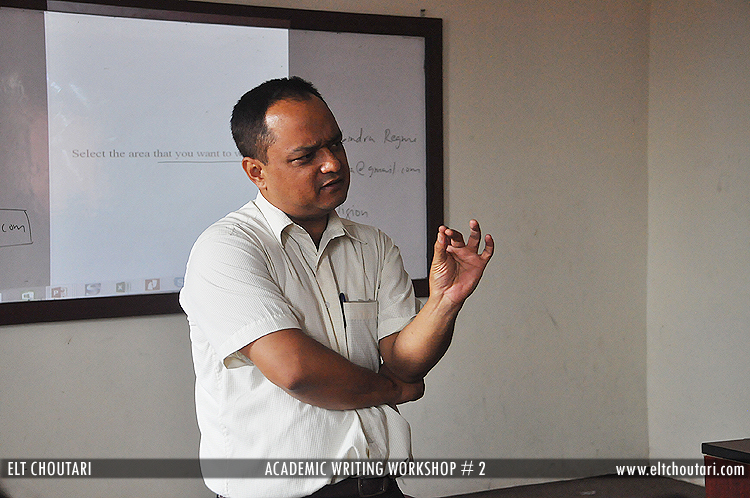
ELT Choutari organized a workshop titled “Problematising, Organising, Introduction, Conclusion and Abstract while Writing Papers”at King’s College, Babar Mahal in Kathmandu on July 26, 2014.

choutari-workshop-2-22


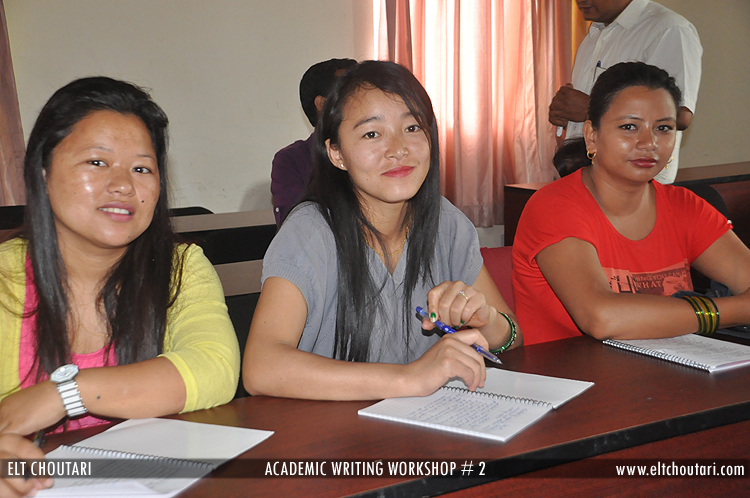
Mabindra Regmi, an adjunct lecturer of KU School of Education, facilitated the one-day workshop, attended by 18 writing enthusiasts – teachers and students from Kathmandu University and Tribhuvan University.

Regmi talked about why many researchers and novice writers get ‘stuck’ while writing the introduction, conclusion and abstract of papers and research article; and he walked through the workshop giving tips and guidelines on how to get over the obstacle.

choutari-workshop-2-01

choutari-workshop-2-05

choutari-workshop-2-13

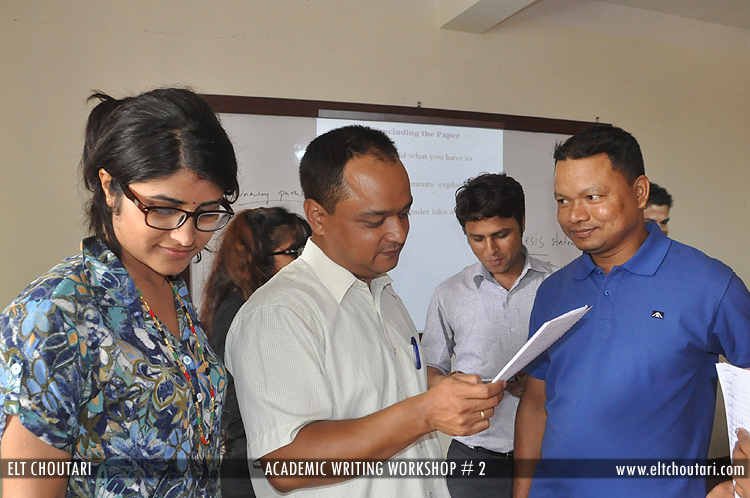
Regmi involved the participants in brainstorming and problematizing/contextualizing their interest area. Then the participants came up with a draft of the introduction for their topics and got involved in a feedback session.

Download the ELT-Choutari-Workshop2

For more: Click here
Pics by: Umes Shrestha

Welcome to the July Issue of Choutari, 2014

Editorial

Professional development is an ongoing learning process in which teachers engage voluntarily to learn how their language can be made effective in order to meet the learning needs of their students. It focuses specifically on how teachers construct their professional identities in ongoing interaction with learners, by reflecting on their actions for professional enhancement and adopting them to meet the learners’ expressed or implicit learning goals.

Reflections do not only summarize what happened, but also reflect on those experiences and report on what the authors have learned. Through reflection, language teachers share how to improve professional practice, discover what is working and what is not, and explore personal strengths and the areas of improvement. Hence, reflections are not only for action, but also are in and on action to ultimately help teachers develop their professionalism.

As continuity to the same ongoing professional development process through reflections, the July issue of Choutari includes a series of reflections on from this year’s examinations of School Leaving Certificate (SLC) and Teacher Service Commission (TSC), to other aspects of professional development such as mentoring, speakers’ club, writing and ELT.

First, Shyam Sharma expresses his deep concerns about the failed national exam of SLC in Nepal that annually labels a huge number of youth as failures. In his well-crafted piece, he argues that we are carrying SLC exams for too long for nothing. The title is obvious: Ditch it: SLC Exams but there is a lot more Mr. Sharma has to say on why SLC is “obsolete, misguided, and if you think about its purpose and effect, absurd.”

In the second post ‘How my mentor transformed me’, Priyanka Pandey shares her story of transformation from a hesitant soul to a confident teacher. Her story is extremely relevant for the useful insights for anyone in a mentoring relationship or seeking to be in one.

Likewise, Mabindra Regmi reflects on the ups and downs of his writing journey in the third entry ‘The Write Way’. Mr. Regmi’s rediscovery of his own writing not only shares useful insights on how writing can be continuously improved, but also how it can be a collaborative effort.

The fourth post is a compilation of reflections on written test of Teacher Service Commission (TSC), as told by the three successful candidates in the recent massive results. These High School English teachers’ experiences passing the national qualifying test conducted by Teacher Service Commission (TSC) is obviously useful for the incoming cohort of candidates.

“The club has made a tremendous impact on me, personally and professionally,” says a stellar writer. Wonder how? The secret is out in Umes Shrestha’s reflective piece titled Speakers’ Club for Professional Development.

The excitement brought about by the Choutari workshop is palpable in Krishna Prasad Khatiwada’s piece ‘Reflection on Choutari Workshop: Behind Academic Publishing-Why, How & What’. This reflection piece lists useful tips on finding publishing venues, to avoiding plagiarism, and overcoming procrastination.

Finally, the photo blog scribbled with texts brings alive the spirit of emerging writers participating in the academic publishing workshop organized by NeltaChoutari, and facilitated by Bal Krishna Sharma. Combining the sophisticated tools and successful tips, the participants felt equipped to produce academic writing with a fuller understanding of why, how, and what of the academic writing.

Here is the list of contents for convenient navigation:

  1. Ditch it: SLC Exams, by Shyam Sharma
  2. How my mentor transformed me, by Priyanka Pandey
  3. The Write Way, by Mabindra Regmi
  4. Reflections on written test of TSC, compiled by Choutari team
  5. Speakers’ Club for Professional Development, by Umes Shrestha
  6. Reflection on ‘Behind Academic Publishing’, by Krishna Prasad Khatiwada
  7. Choutari Workshop: Photo Blog, by Choutari team

—–

Now we would like to take this opportunity to sincerely thank all the contributors including the Choutari Team for their support and contribution and we expect more contributions of yours on Chouatri for the upcoming issues.

We always welcome your constructive feedback to make our publications more reader friendly in terms of the content and issues in ELT. Hence, we urge you to join the professional conversation on Choutari by posting comments or sharing among your circles via social media networks like facebook, twitter, google plus, pressing likes under the blog entries you have read.

Happy Reading!
Praveen and Umes
On behalf of Choutari Team

Ditch it: SLC Exams

central ideaShyam Sharma

I now teach at a prestigious university within the largest and one of the best American public university systems, the State University of New York.

But twenty-four years ago, when I first appeared the SLC, I failed.

Now, I am not about to tell you a wonderful story. Sorry, there are more stories of suicide than of success in this regard. I am instead telling my story, for the first time beyond my family, in order to make a very broad point about the SLC exam and our society. Continue reading Ditch it: SLC Exams

How my mentor transformed me

Priyanka Pandey

I feel very fortunate for getting a mentor when I started my teaching career. My mentor was an experienced and skillful teacher who guided me, changed my perceptions regarding teaching profession, and later made me determined to be in the field of ELT.

The school I worked for (Tiny Seeds Pre-school, Kathmandu) had a system of assigning two teachers in one class; a grade teacher and an assistant teacher. I was selected to be her assistant but initially it was very stressful because I didn’t have any idea about “play-way” method. Being a student of Education, I knew how to make lesson plans in theory, but I didn’t have clear idea about how to make practical lesson plans and how to teach effectively in English medium. Continue reading How my mentor transformed me

The Write Way

Mabindra Regmi

When I graduated from my high school, I thought I was a great writer. I had written for countless assignments and examinations. I had written poems and stories. I had scored relatively high marks in English during my high school final examination. How could I not be a writer? It was a bitter shock when reality crashed in and I had to redefine my so called ‘expertise’ in writing when I faced the challenge of writing a proposal for an educational endeavor. I spent many a night poring over the proposal and scribbling on a piece of paper in that pre-ubiquitous-computer era to keep my inflated writing ego alive.

When I look back in retrospect after what seems like eons, and teaching writing to students for over a decade, a few questions arise. Why did I feel that I was ‘good’ at writing when I apparently wasn’t? What were the factors that I had missed altogether to write well? What were the strategies that I had to adopt in order to enhance my writing skills? And what it takes to create your niche in the world of writing- specifically academic writing? Continue reading The Write Way

Reflections on TSC written test

Praveen Kumar Yadav

After a gap of nearly 17 years, recently Teacher Service Commission (TSC), the government body to appoint teachers for community schools, has recruited teachers for Secondary, Lower Secondary and Primary levels across the country. The process consisted of both written and oral examinations. For written examinations, a total of a total of 413,000 examinees across the country had appeared. Based on results of the written examinations, those successful candidates were called for the interview.

NeltaChoutari would like to congratulate all those who succeeded in TSC exams and have recently become teachers in government owned community schools.  

Out of those successful teachers, the three have shared their experience and reflections through this blog entry. They have been  appointed by the government to teach English in secondary levels. Specifically, they have presented their reflections under three different sections included in the written test. Continue reading Reflections on TSC written test