Category Archives: Teaching Tips

Techniques of online teaching

Thinh Le Van

Community of Learning

Garrison, Anderson and Archer (2000) presented the online teaching model as a Community of Inquiry with three main elements: Teaching presence, social presence and cognitive presence.
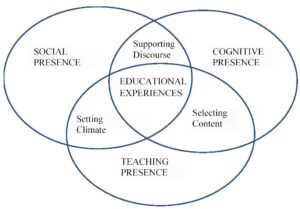
Community of Inquiry by Garrison, Anderson, and Archer (2000, p. 2)

Teaching presence is the responsibility of the teachers to select, organise materials, design the course to encourage students to interact while social presence refers is to show as a real person in the community. Cognitive presence refers to the construction of meaning by students through participating in the course. Garrison, Anderson, and Archer (2000) stated there was a correlation between these three types of presence. Since then, many studies have been conducted to examine the relationship among these three elements. Students gave a higher rate of the overall quality of interaction when instructors gave immediate feedback which means that course instructors were highly evaluated when they showed more teaching presence in an online course (Khalid & Quick, 2016; Richardson & Swan, 2003). Teaching presence was reported to be correlated with social presence because when teachers showed more teaching presence, students showed more social presence (Kanuka & Garrison, 2004; Shea & Bidjerano, 2009) and social presence was reported to correlate with learning outcomes (Hostetter & Busch, 2013; Romanov & Nevgi, 2008). These students concluded that students who participated more in the course, their learning outcomes were better than those who did not. In short, teaching presence affects social presence, or the better teaching presence is, the more social presence students will show. When students show more social presence, it will result in a better learning outcome. Therefore, the main responsibility of an online teacher is to organise the course so that students could show more social presence by joining online discussions, engaging in reading more materials. This essay will brainstorm some techniques to organise your teaching presence to improve social presence, which might result in a better cognitive presence or learning outcome.

The online teacher can engage students to do activities synchronously and asynchronously. Here are some techniques to enable students to interact asynchronously in an online course. To engage students to interact synchronously, some learning platforms such as Schoology, Edmodo or Google Classroom should be used. There are three main types of interactions: students’ interaction with materials, interaction among students, students and instructor interaction.

First, to encourage students to read materials, and watch a movie that the teacher should design a quiz to check whether students watch and understand the materials or not. This stage enables students to try to understand the materials. However, the quiz should include in the final assessment so that students will try their best to do it. By doing this step, students will interact with materials and show more social presence in the online course.

Second, after students understand the materials, they should be asked to interact with each other to share their understanding of the materials. At this step, some questions should be posted for students to share their opinions. To encourage students to interact with other students, students should be asked to reply at least two students’ posts. By doing this way, students will read other students’ posts and reply to other people post. The online forum is very important because students could reflect their ideas and show their deep understanding of the lesson.

Finally, the teacher could interact with students through an online learning platform. For example, the teacher could comment on students’ posts or give them some written feedback. If the teacher could give students some oral feedback, he could make a video by using Camtasia to upload on the learning platform.

Similarly, the teacher could interact with students synchronously. Synchronous interactions should also have three different types of interactions as described in the synchronous process. The interaction could happen through Zoom, Google Classroom or Skype. When the teacher gives students some materials, he should set up some activities for students so that they could show their understandings. Also, the teacher could create similar interactions such as group discussions for students such as Zoom breakout. Of course, during the online meeting, the teacher could have direct interactions with students.

These techniques are for online teaching; however, these also could apply in physical classes after COVID-19. The model for this kind of teaching is blended learning. The teacher could send students materials such as reading materials or videos that the teacher prepares in advance. However, to make sure that students watch the videos or read the materials, some tasks such as quizzes, questions or gap filling should be set up and these tasks should be a part of the final assessment to motivate students to complete all the tasks. These activities could be conducted online. Discussions could be carried in class when teacher and students see each other. The teacher can have more time for feedback and explore the lessons further.

In conclusion, the responsibility of the online teacher is to design the activities to encourage students to improve their interactions with materials, other students and teachers so that students could show more social presence which results in better learning outcomes.


Thinh Le Van holds a PhD degree from the University of Canterbury, New Zealand. He is an English lecturer at Banking Academy, Vietnam. His research interest is around language, learning with a focus on computer-assisted language learning (CALL). Email: lethinhpy@yahoo.com

References

Garrison, D. R., Anderson, T., & Archer, W. (2000). Critical inquiry in a text-based environment: Computer conferencing in higher education. The Internet and Higher Education, 2(2), 87-105.

Hostetter, C., & Busch, M. (2013). Community matters: Social presence and learning outcomes. Journal of the Scholarship of Teaching and Learning, 13(1), 77-86.

Kanuka, H., & Garrison, D. R. (2004). Cognitive presence in online learning. Journal of Computing in Higher Education, 15(2), 1-19.

Khalid, M. N., & Quick, D. (2016). Teaching presence influencing online students’ course satisfaction at an institution of higher education. International Education Studies, 9(3), 62-70.

Richardson, J., & Swan, K. (2003). Examing social presence in online courses in relation to students’ perceived learning and satisfaction. Journal of Asynchronous Language Networks, 7(1), 68-88.

Romanov, K., & Nevgi, A. (2008). Student activity and learning outcomes in a virtual learning environment. Learning Environments Research, 11(2), 153-162.

Shea, P., & Bidjerano, T. (2009). Community of inquiry as a theoretical framework to foster “epistemic engagement” and “cognitive presence” in online education. Computers & Education, 52(3), 543-553.


Cite as: Le Van, T. (2020). Techniques of online teaching. https://eltchoutari.com/2020/07/techniques-of-online-teaching/


E-learning is only a means but not a replacement of physical classroom – Dr. Rana

Karna Rana, PhD

Dr. Karna Rana is an Academic Coordinator [MPhil in English] at Open University Nepal and Lecturer of English at Gramin Adarsha Multiple Campus. Dr Rana facilitates teacher training for teachers and students in and about online classes and resources. He earned his PhD degree in ICT in Education at the University of Canterbury in New Zealand. He did an MA in Education (E-based learning; Inclusive education; Managing teaching and learning; Research Methodology), from the University of Bedfordshire, UK. He is one of the members of the editorial board of ELT Chourati. He has authored and co-authored several academic papers and research articles nationally and internationally. He has launched different online-based training and workshop to contribute to Nepal’s ICT enhancement procedure. His interest areas include ICT in education, digital literacy, research and education.

Our Choutari editor, Ganesh Kumar Bastola, has talked to Dr Rana about COVID-19, pandemic pedagogy and its impact in and around Nepal specifically in education and explored some useful strategies to enhance online classes and resources during pandemic. Now, here is the exclusive interview for you.

1. What can be the impact of COVID-19 pandemic in our education system?

Well, if we review the history of educational development and the impact of such crisis like World War I and II on social transformation, the rise of industrial education value dominated neo-classical education value and it gradually resulted in capitalism. Before these wars, work efficiency used to be valued more than what education qualification someone had. The current industrial education system that came out of British and American neoliberal ideologies seems to be outdated as it is eventually failing to fix issues of this crisis. If the pandemic continues throughout this year, the world will be in an economic and humanitarian crisis. Many schools and universities will be shut down. Nepal will also experience it if the situation lasts long.

2. Since the educational institutions are shut down and the ‘face-to-face’ mode is put to halt. What can be the alternatives to reach students, especially school students in this crisis?

Since the world is in lockdown, several universities and schools mostly in developed countries have switched their traditional physical classrooms to online classes or distance learning mode. Unfortunately, the majority of schools and universities might not be prepared for it. Let’s observe the context of Nepal. Except for Nepal Open University, an online university, all other universities are not fully prepared to go online. It is unlikely to move schools to online in this situation as the majority of people live outside the range of broadband internet. However, we can utilise a few potential technologies like television and radio to deliver limited courses and engage students in possible projects.

3. How can we ensure and track the learning of school students if we adopt alternatives to educate them?

Let me share how schools before 2028 BS used to educate children in villages. Even the government did not know the number of schools across Nepal but these schools had their own curriculum to meet individual as well as social needs. The majority of schools particularly primary ones were never connected with the national examination system but they were efficient to educate millions of children. It does not mean to revive the system but we can explore such efficient local schooling ideas to make schools resilient and self-efficient. That was the time when there were few literate members of the community, but now we have educated or at least literate family members who can be teachers of their children. We have municipalities to follow micro strategies to engage teachers and students from their home. Probably flexible curriculum may provide schools with opportunities for developing own learning programmes, learning materials and outcomes. Of course, national education policy can provide them guidelines to maintain the education standard. Municipalities can be a focal point to manage local resources like teacher trainers, experts, teachers, learning materials and other essential materials. The wise use of ICT in education may develop our schools and education for the growing generation. FM radios and local televisions can be utilised to reach out children and their parents can be engaged with them. In cities and towns, internet facilities can be more productive. There may be challenges for ICT illiterate teachers to gather digital content and materials for teaching and learning but they can be shortly trained through radio or television to use smart mobile or personal computer to explore online materials.

4. What are the differences between online teaching-learning materials and face-to-face teaching-learning materials? As the academic session is going to kick off soon, how can we use the existing materials and resources for teaching via online, radio, TV or so on?

Teachers can bring some laboratory works and concrete materials in the traditional physical classroom but digital learning materials can be animated or real videos, audios and audio-visual. For many learners, online materials can be more productive than what they can read in library books. Unfortunately, such online materials cannot be shared without the internet. As I said earlier, the Education Unit at municipalities can look for ICT experts across the country to train local teachers on how to use digital devices and digital materials in teaching and learning. At least local authorities can train few teachers to plan and deliver lessons on TV lively and even students can be allowed to talk to the teacher over phone. It can go live on the radio too. By listening to the radio, students can work with pen and paper. In cities and towns, teachers and students can be shortly trained to use free apps like Skype, Messenger and Viber, and to communicate through emails. Teachers can utilise these free apps and emails to share learning materials and go to live interaction. Teachers need to have minimum ICT skills to operate these technologies. Unfortunately for many teachers, these advanced technologies may be intimidating. In that case, local teachers can be allowed to choose local learning materials for students. It can develop local autonomy and students’ independent skills. Both students and teachers can use print materials as a source of content. School and local libraries can be developed as a learning hub.

5. You have been facilitating the graduates at Open University, Nepal. What particular strategies do you employ for an online-based classroom to make the students engaged and make teaching-learning activities effective?

We have basic ICT infrastructure to plan and deliver lessons. We basically use MOODLE to share digital content with students, give feedback on students’ regular works and assess their works. Microsoft Teams connects students and teachers and they have a regular video conference on it. It is a dynamic tool to share screen and present works. I can create teams of any number and schedule meeting for the team. This application is highly advanced for online teaching and learning which allows us to share heavy contents like movies or large size videos and digital books. The whole class can be recorded and students can download it whenever they want to. Students from their home or comfortable place can join the class and share ideas. Actually, everyone works on their devices while they are in an online class with their teacher and friends. I teach a research course and it requires students to work on their area of research. I provide live feedback on their works and they actually work with my feedback. It is really effective, interactive and productive as we work while we discuss. I don’t go for a lecture.

6. As the pandemic hit us, we do not seem ‘prepared’ to deliver teaching-learning using alternative means. Firstly, the majority of teachers themselves do not seem to be well-equipped to employ alternative means. So, what skills should the teachers acquire to run alternative teaching-learning and how can we develop their capacity?

Yes, we may be immature to think about moving all schools online in this situation. As I explained earlier, the majority of schools don’t have ICT infrastructure and teachers may not have minimum ICT skills. We cannot expect students to have expensive internet and computers, particularly in rural remote villages. I have reported several challenges including a lack of ICT infrastructure, teachers’ ICT literacy and government preparedness in my research publications (https://www.researchgate.net/profile/KarnaRana). I wish the government would have enacted its educational policy in ICT and plan itself without relying on I/NGOs for the past two decades. If the government has a proper plan to equip teachers with ICT, the local governments can be involved in the project. In a cluster of many teachers at the local level, they can be trained to operate a computer and use internet facilities. Teachers basically need minimum computer skills, ICT literacy, information literacy, digital literacy, media literacy and communication literacy. Unfortunately, it is unlikely to train all the teachers across the country now. The educational crisis is apparently caused by unpredicted pandemic COVID-19 and such crisis may turn up time and again. Can we think a new way of schooling much more resilient than just internet-based school?

7. People also have started speculating that the online means can replace the face-to-face mode of teaching-learning in future. To what extent is there gravity in this speculation in terms of Nepal? And to what extent do we need online means?

I don’t think so. Internet can be used as a means but not as a replacement. There are predictable challenges like network crash, piracy and cyber-attack. Internet is based on the ideology of a few developed countries and they can hold the power of it. Let’s not imagine the worst but who knows if they destroy all the mechanisms of the majority of the countries. From my knowledge in this area, I would never suggest totally going to online. Of course, we can utilise internet facilities and develop the mechanism of e-learning to complement social learning strategies. Thinking about absolutely online school in Nepal may be an immature idea. The landscape of the country, weak national economic condition and expensive technology will be great barriers ahead. Poor people cannot afford such an expensive education. There are practical issues like how we can conduct actual laboratory works, how children learn to socialise and what kind of world we expect to be. I would rather think about how to develop the best practice that suits our local context.

Note: Now the floor is open for you. We encourage you to drop your comments in the box below after reading the interview. Your constructive feedback and questions inspire the interviewee. Thank you!

[To cite it: Rana, K. (2020, April 20). E-learning is only a means but not a replacement of physical classroom [blog post]. Retrieved from: https://eltchoutari.com/2020/04/e-learning-is-only-a-means-but-not-a-replacement-of-physical-classroom-dr-rana/]

Teacher-led professional development in crisis and ever

Jeevan Karki

“In addition to taking some MOOCs (Massive Open Online Courses) on blended learning and teaching online, I’m virtually engaged to empower teachers around on how productively they can involve their students online.” –

Baman Ghimire, a high school teacher. (Ghimire. B., personal communication, 15 April, 2020)

“After the lockdown, I formed an online group of teachers and started sharing my ideas of running online classes in my district and beyond. Recently, I presented a session on Google Classroom to teachers in coordination with an English teachers’ association.” –

Bibas Jung Thapa, a lecturer (Thapa, B. J., personal communication, 14 April, 2020)


We are in isolation to fight COVID- 19, so our normal day-to-day activities are diverted in different ways and the classroom-based teaching-learning activities are halted. Amidst this circumstance, Baman and Bibas are not only engaged in their self-professional development but also in the professional development initiative of the fellow teachers using different routes i.e. virtual route. Whatever means has been adopted, the initiative to support fellow teachers is truly appreciable as the message is more important than the means, and the willingness to do is the most important thing. Moreover, this initiative will bring teachers closer during the isolation, which increases professional harmony and strengthens professionalism.

This initiative is an example of teacher-led professional development (TLPD). TLPD initiatives are led by teacher/s for the teachers. Professional development activities in our context are basically led by ‘outside experts’ and hence they are grounded on top-down approach. However TLPD initiative is bottom-up and customised (Diaz-Maggioli, 2004; Hills, 2017; Vangrieken, Meredith, Packer & Kyndt, 2017), aiming to empower teachers and enhance their knowledge and skills (Vangrieken, et al., 2017). The scope of TLPD is within the same schools and outside. For instance, a teacher (one or more teachers also can lead) from the same school can lead professional development activities for their colleagues or for the teachers beyond his/her schools (e.g. within their region, district, country or even out of the country). The example of Baman and Bibas fits for the second.

Why TLPD?

TLPD events emphasize on day-to-day teaching-learning issues of fellow teachers, which the facilitator deals based on his/her rich classroom experience. TLPD has been popular among teachers and school administrators for several reasons. For instance, Hills (2017) in her TLPD study explored that the fellow teachers enjoyed such initiatives for the diversified facilitators, neutral and non-threatening atmosphere and practical topics.

Wearers know where the shoe pinches. The teachers can better understand fellow teachers’ issues in teaching-learning and can respond accordingly. In the case of Baman and Bibas, as they have lived experiences of conducting day to day teaching learning with their students, they know what works and what does not work in a real classroom unlike the outside experts. I’m not undermining the role of the outside expert in professional development, they have their own value, which I will discuss later but there are certain things which these teacher leaders know better, deal better and do better. For instance, they can contextualise ideas to fit in the real classrooms based on the practices, which they have already tested. They can share their good practices of planning, preparation, teaching particular topics, assessment, remedial measures and so on. The participant teachers basically want the facilitators to offer hands-on solutions to deal with their pedagogical issues and the fellow teacher/s can do handle that better.

In addition, the TLPD reduces the gap and distance between facilitators and participants as they share the common ground, which results in increased openness, lively discussion and participation, and a joint effort for problem solving. In addition, TLPD are owned by teachers because they are customised, contextual, jointly developed by both facilitators and participants, and they emphasise on inquiry-based learning (Diaz-Maggioli, 2004). As a result, it can make teachers accountable.

Moreover, TLPD initiative can bridge the post training gap (Diaz-Maggioli, 2004). Generally, when an outside expert facilitates some training/workshop, there is scarce or no chance of follow up visit to provide on-site assistance to the teacher/s who is struggling to implement the newly learnt idea. Instead, when a teacher from the same school or neighbouring school/s leads the training/workshop or so on, they can be easily consulted as they share the same chiya pasal (tea shop) or same dhara (tap). They can even be asked to observe the classroom and assist the fellow teacher/s to implement the skills learnt in the training. Gradually, it leads to a better collaboration and a higher chance of training transfer in the classroom.

Teaching is not a competition with other fellow teachers but a competition with oneself, to create environment for children to learn themselves, not to teach! Every teacher is here to facilitate and support students to learn better and reach their full potential. So why competition? Instead teachers need a mutual collaboration with each other, a collaboration to share good practices and support each other to overcome the challenges associated with teaching and learning because the empowered teachers can empower students too. And the teacher-led professional development initiatives would do that because the future lies on the bottom-up approach but not on the top-down.

Roles of outside experts

At this point, question may arise, are all teachers capacitated enough to lead the professional development initiatives? Perhaps not, to give a quick answer. And now, here comes the role of the experts, trainers and teacher educator to strengthen their professional expertise to lead the cycle of TLPD. While leading the professional development events for adults, it is really important to be familiar with adult learning principles, key facilitation skills, converting contents into activities, interpersonal skills, latest research in the field and their implications, and so forth. Moreover, the teacher-leaders (the facilitators) also need support in school-based model of TLPD and its overall cycle, starting from planning and developing sessions to reflection and feedback collection. Therefore, the experts now need to groom school-based leaders to lead their professional development themselves and observe and study how it works.

How to start TLPD initiatives? 

The easy answer to this question is just start the way Baman and Bibas did. TLPD model seems to work better during this halt, where the outside experts are not easily reachable. Therefore, let’s start this with our colleagues, who are the nearest experts at the moment, just go through the Facebook friend list and make a team. Actually, I came to learn about the initiative of Baman and Bibas via Facebook. So, we can look for the teachers/colleagues teaching English (or related subject) in our friend list, create a group and start the conversation. Thereafter, we can only discuss on the issues we are facing while teaching our students and make notes of all the issues. The issues can be anything related to planning, methods, materials, assessment, teaching particular topics, and classroom management skills and other soft skills like communication, motivation or using technology in classroom. Then, the list can be shortened by removing repetition or the least important topics for the moment (through a common consensus). moving forward, we can ask each other to choose one or two topics, which we feel comfortable to lead the discussion/presentation. If all the topics are not covered, let’s not worry. We can always start with whatever we feel comfortable. Then, we can schedule the presentation and discussion using accessible and free Software like Messenger, Viber, Skype, Zoom or so on. Next, the session leader should take a good time to plan on his/her topic. Once the preparation is done, we can advertise a little via social media to invite other interested teachers to join the discussion. I’m sure we will find more than enough participants. Then, on the day of presentation, we can make some house rules to run it systematically, otherwise, it can go messy. After the presentation, we should entertain questions and open the discussion, which will help both the facilitator and fellow teachers to reflect upon the ideas shared and set direction future direction. And after we do it successfully, we can write our reflection and share, the way I’m doing here.

Before I leave

As the situation is getting worse day by day globally, we as educators can’t just keep quiet and stay at home. Baman says that the ongoing journey of professional development goes beyond the chains of any ‘lockdown’. So, we should start thinking proactively about the alternatives of educating or reaching our students. Such teacher-led professional initiatives can help us to explore multiple ideas of reaching them during this crisis.

[Note: since you have come up to here reading it, please share your feeling, feedback or any question related to it in the comment box below, which will encourage the author. Thank you!]

[To cite it: Karki, J. (2020, April 20). Teacher-led professional development in crisis and ever. [blog post]. Retrieved from: https://eltchoutari.com/2020/04/teacher-led-professional-development-in-crisis-and-ever/]

The Author: Jeevan Karki is a freelance teacher trainer, researcher and writer. He serves as an expert in designing materials and developing training for literacy program at Room to Read. He has authored several op-eds and blogs including some national and international journal articles. He is also an editor of ELT Choutari and the Editor-in-Chief at MercoCreation (http://merocreation.com/).

References:

Diaz-Maggioli, G. (2004). Professional development today. Teacher-centered professional development. Retrieved from: http://www.ascd.org/publications/books/104021/chapters/Professional-Development-Today.aspx

Hills, D., (2017). Teacher-Led Professional Development: A Proposal for a Bottom-Up Structure Approach. International Journal of Teacher Leadership. 8(1), 77- 91.

Vangrieken, K., Meredith, C., Packer, T., & Kyndt, E. (2017). Teacher communities as a context for professional development: A systematic review. Teaching and Teacher Education, 61, 47-59.

Awareness of ICT preparatory tools: Micro management and way forward

Ashok Sapkota

Prologue

I discuss the use of technology in the educational practices in general and technology, pedagogy and content knowledge (TPACK) approach in particular in this paper. It is grounded on the author’s two-decade-long experience of using technological tools for learners’ engagement, problems in micromanagement and five major fault-lines in micro-management procedures. Moreover, it integrates various assets such as management of basic functions of electronic gadgets, blending content, context and technology, differentiating hardware and software tools, updating recent innovation and threats in technology and regulating micromanagement in using technology.

Introduction

Are we really prepared to use ICT tools? This question often triggers my mind while discussing ICT tools. Recently, I shared my knowledge and key issues in Technological Pedagogical and Content Knowledge (TPACK) approach to educators around different parts of the country using zoom software. It was a wonderful sharing with them using the common tool in the lockdown period. If we relate the classroom scenario, we are shifting heavily to the use of alternatives in technology tools (Williamson & Redish, 2009) to present and to instruct different lessons in almost all the levels. Even some schools, particularly in the urban area, both developing and under developing countries, take multimedia power-point presentation as a basic tool to deliver the content practices. Few of them make the mandatory code of conduct that 50% of the classes need to conduct using power-point and other applications. In this juncture, it is essential to take the perception of students regarding the use of such a tool. Having an experience of using Microsoft tools and other tech tools nearly about one and a half-decade, I have found the mixed versions in using it. The basic applications behind shifting to the use of online applications is the way we use it. If we use the applications as a form of supposing or imitating practices or we are forced to use, the output may not be satisfactory. The awareness we need to have is on how to make it interactive, informative and engaging. The interactive helps to make it lively, blend content, context and experience to the discussion (Schrum & Levin, 2009). The contents need to be well prepared, discussed rather than simply reading the lines or flipping the slides. It is crucial to share that powerpoint presentation is not a slideshow rather it needs to be interactive and based on the time we are allocated to discuss. This article primarily focuses on five major issues or faultlines: managing basic electronic gadgets, blending content, context and technology,  differentiating software and hardware tools,  updating recent innovations and threats in technology, regulating in micromanagement in using technology.

Problems of micro-management and flipped classroom

Using the wide range of technological tools in the classroom makes less sense when the content is not well delivered and the students are not happy in using them. As one of the psychologists, David Hurlock believes that the learners’ psychology matters more in learning, the environment of the classroom depends on what we teach and how we deliver. In few cases, the content to share might be interesting but the way we deliver, the lessons bring change in the classroom (Maddux & Johnson, 2006). Here, by the term ‘the way’, I mean the strategies we adopt along the technological knowledge in the classroom. This management can be specific and creative in nature which can be called micro-management. The use of technology is not great deal than to know we can manage further continuously for the proper applications. I have seen my colleagues using the applications time often within certain period but they fail to continue and make the classroom lively in using it. This situation means we are lagged behind the micro-management and could not address the multiple layers or changes within the single classroom to make learning effective over period of time which we call flipped classroom.

Major dimensions in managing technology

This article centers with the five major faultliness based on my experiential learning in using technology. I also discuss the misconceptions I had to overcome. My focus remains mostly on three assets i.e. tech tools in professional life, classroom discussions and off classroom environment. It is not as difficult as it shared in educational forums about the use of technology if we simply manage the basic aspects of it. In doing so, I begin my sharing with managing basic functions in the upcoming section:

Managing basic functions in electronic gadgets: It is essential to know the basic software and hardware knowledge about the device we use.  No matter it could be a desktop/laptop or a mobile phone or a tab. Having proper knowledge, functions and configurations about the device develops more confidence in working it. In few stances, we work the day, shut down the computer and when we try to open it the next day or in the evening, it does not work.  This situation creates unnecessary pressure because of having less or no knowledge about the hardware of our own device. Having a computer but having no knowledge about hardware often increases unnecessary stress than having real problems. Operating a computer is not only to open and shut down the computer or to use few programmes like word, pdf or excel file. In addition, it is to know about the hardware, programming, hard drive, C file (system file) and other files. It is essential to know about  basic operating functions, such as; Better not  to work or save any files in the desktop as it consists of system files. It has higher chances to lose documents if any system problems occur in the computer. In few incidents, the files might be transformed into temporary files and be destroyed. When the problem occurs, we take it to the technician. They solve it within few minutes and regard it as a common problem. The basic understanding about the hard disk, RAM, software installed in computer, desktop management, file sharing and saving makes us in the comfort zone than taking unnecessary stress.

Blending content, context and technology: Technological knowledge is easier when we have basic idea in using it than copying the ideas or files from others. Many people often get distracted because they could not blend content, context and technology. It does not mean that we need to use every tool in the classroom. It is worthy to identify the level of knowledge of our students, technological infrastructure, managing time to use and operate it (Dudney, 2000). For example, if I try to use moodle or Microsoft team in my institution, where there is no fixing of computer in the classroom and teacher had to manage everything; from IT support to content delivery. In this context, moodle may not be an appropriate tool to use it. We can think of the alternative resource, such as the learners have mobile phones or smart phones with limited internet access. So, the applications like closed Facebook group discussion or blogging might be useful tools. Therefore, context and the skills we select shapes way forward. Despite having low resources, we can think of the alternative resources or application to manage use of the technology to the learners and teach them to use it. It is better to be practical rather than overgeneralising the condition of the students.

Differentiating software and hardware tools: It is beneficial to differentiate between the software and hardware tools in order to manage electronic devices well-functioning. People believe that having a computer has all the same functions within it, however, it consists of both software and hardware. Being more specific, the hardware and software varies based on the purpose, field of study and use. If you are working indesign programme, you might need more features like graphics, more RAM functions, specific display, large capacity of harddisk and other software skills like graphic card, advanced adobe programming, C++ programming and other essential programming. If you are an English teacher working with research, you might need the referencing software like Zotero or if you are a Mathematics teacher, you might need a software called Geozebra. Therefore, the technological device, like laptop, can be modulated differently based on the purpose and the profession we need to function further.

Updating recent innovations and threats in technology: Having updated knowledge regarding the use of technology and its updated version helps us in the comfort zone. No doubt we are accustomed to the version we install in the computer. When we install the new version, we might have some problems in the beginning. However, after using for a couple of months, we are used to it. We find many friends using the latest version of Microsoft office 2019 but some are still in windows XP or Windows 7. This shows the variation of the use of programming. It is essential to update the software in our device as per to the global changes and disciplinary changes. For this, we can explore the new resources, ask friends, for search in the open resources in the Internet search. Time and again, I hear saying that I have found in the Internet or in the Google. We might have less awareness that the Internet is not a source but a tool to explore and Google is not a book but simply a window to look in or a browse to search things.

Regulating micromanagement in using technology: Micromanagement is far forward to sharpen and develop organising skills in using technology. Having a knowledge to manage files in a computer or in a folder or in a Google drive properly can be called here as micromanagement of ICT resources. It is easier to use a tool for the first time as a trial. However, to use effectively to engage learners in the classroom within the limited resources can be a huddle for teacher educators. Therefore, I would suggest to have more in-depth knowledge in having the micro functions of any of the tools we explore to such as managing the files in the laptop, knowledge of iPods, managing files in Google drive or maintain external drive. It is not essential to use all the tools in the classroom just because others friends have used them. But, it is us that need to know the proper function as a user and the ones to whom can be used.

Conclusion

From the above discussion, we know that having knowledge about the technology and tools is always advantageous. However, we fail to sharpen our skills in managing those tools and it creates more stress in our professional life. Having the basic knowledge to operate both software and hardware tools might bring maturity in using them. So, it is better to know yourself, best use available resources, engaging students and ourselves in micromanagement of tech tools.

[Note: since you have come up to here reading it, please share your feeling, feedback or any question related to it in the comment box below, which will encourage the author. Thank you!]

[To cite it: Sapkota, A. (2020, April 20). Awareness of ICT tools: Micro-management and way forward. [blog post]. Retrieved from: https://eltchoutari.com/2020/04/awareness-of-ict-preparatory-tools-micro-management-and-way-forward/]


The Author: Ashok Sapkota is a faculty in the Department of English Education, Kirtipur, TU, and Global College of Management. He has worked in several applications in using diverse forms of technology. Having experienced of using a moodle and Microsoft team for a decade, he is one of Microsoft certified teacher trainers. He is treasurer of NELTA Centre and worked as a teacher trainer of different organisations like: Ministry of education, British council, NELTA, Global Action Nepal and other organisations. For more please explore http://assapkota.blogspot.com/


References

Dudeney, G. (2000). The Internet and the language classroom. Cambridge: Cambridge University Press.

Maddux, C.D. & Johnson, D.L. (eds.) (2006). Type II Users of technology in education: Projexts, case studies, and software applications. New York: The Haworth Press, Inc.

Schrum, L. & Levin, B.B. (2009). Leading 21st century skills Schools.  California: Corwin

Williamson, J. & Redish, T. (2009).  Technology facilitation and leadership standards.  Oregon: International Society for Technology in Education.


Quality scrutiny in materials isn’t merely a formalization process: Ganga Ram Gautam, PhD

Ganga Ram Gautam, PhD

Dr. Ganga Ram Gautam, Associate Professor of English Education and Director of Open and Distance Education Center (ODEC) at Tribhuvan University, trains English teachers of all levels of education and contributes to the development and dissemination of teacher education curricula in English Education throughout Nepal. He is one of the founding members of Nepal English Language Teachers’ Association (NELTA) and Teacher Educators’ Society Nepal (TESON). He has co-organized a number of national and international conferences and capacity building workshops for the NELTA leaders, school principals, university faculty members and trainers. Dr. Gautam has worked on a number of community development projects that focus on children’s education, school development, school governance, vocational education, women’s empowerment and girls’ education. Dr. Gautam has authored a number of articles, book chapters and presented in workshops, seminars and conferences in Nepal and abroad.

Our Choutari editor, Jeevan Karki has spoken to Dr. Gautam in the periphery of production and use of ELT materials in Nepali. Moreover, this interview also unpacks some issues like the quality of materials, teaching in low-resourced context and exploiting the online resources. Now enjoy reading this exclusive interview.

1. How is the situation of the use of resources and materials in ELT classes in Nepal at present?

There are different modes and practices regarding the use of ELT resources and materials in Nepal. In some public schools, teachers solely rely on the textbooks prepared by the government while in some other public schools, they use additional textbooks from the list provided by the Curriculum Development Center. In private schools, they use the materials of their choices. Some schools use the materials (mostly books) written and published in Nepal while some others use the textbooks from international publishing houses. So, there is no uniformity in the use of resources in the ELT classes.

Apart from the textbook, there is not much organized effort, so far, in producing, developing or preparing complementary/supplementary English language learning and teaching materials in Nepal. However, there are some organizations at the non- state level, which have been trying to produce reference materials, like reading materials. Some NGOs have produced reading materials in English and other local languages.

In terms of software or digital resources, some technology companies are digitizing the materials, both curricular and additional materials in the digital form and they’re also available in the market today, like OLE Nepal, which has digitized curriculum and textbook materials. Also, there are some commercially available digitized materials which are connected to the English language textbooks and other content area textbooks. So, there are some initiatives, but I feel that they haven’t been established as the mainstream contributors in the ELT space. Thus, there are certain very important things to be done like consolidation, streamlining, refining and polishing the materials.

2. You’ve mentioned that teachers are mostly dependent on the textbooks inside the classroom. What is the scenario of schools in the urban areas, to be specific?

I have visited some schools in urban areas too and mostly it’s upon the teachers’ proactive initiative to use the additional teaching learning materials, rather than the institutionalized efforts. So, some organizations are trying to produce the materials and resources around, but they have not been institutionally driven and guided by the system. There are also schools in urban areas, which produce their own additional materials and do not use solely the textbooks. They go for resource-based teaching. To be short, things are evolving but we need to institutionalize them and use that effort in the mainstream education.

3. How can teachers in the low resourced context give best to the students?

This is a very good question. I’ve seen that some teachers even in the rural areas are trying to find resources available online and they adapt them in their classes. At the same time, I’ve also met many teachers who only produce excuses by saying that resources are not easily available in the rural parts of Nepal.

In my observations, there are many ways teachers can give best to the students in the ELT classes, provided that teachers are aware of the availability of the resources and materials at their fingertips. Now, the mobile phone is very common across the country and internet access is very common. There are plenty of online resources teachers can access even with the low internet bandwidth. We don’t need to rely on the printed materials only. Teachers can find the materials available online and they can then connect them to the contents they teach from the textbooks. What we need to do is to orient the teachers in the low-resourced context to find those materials guide them on how they could best use those resources to integrate to the curricular contents.

4. Are we the contributors or merely the consumers of the ELT resources and materials?

Recently, there has been a growing tendency to produce the resources, particularly the textbooks, locally. But this is not adequate. We need to produce resources to teach English. We should also encourage teachers to develop their own resources in their local contexts. There are plenty of resources around and teachers can make use of those resources in their English classes but they need to be shown how they could do it. We need to develop confidence among teachers by engaging them in developing the resources, not just by asking them to do on their own. We need to mentor them and work with them so that they can gradually learn how to do it.

5. Where are the Nepali ELT scholars in terms of producing ELT resources and materials in Asia?

If we are talking about the textbooks, there are many people in Nepal who are engaged in this business. The question, however, is not a number. It’s about quality. Producing good quality materials requires a focused and systematic engagement. One has to develop expertise in it. Random picking of the texts and developing a couple of exercises from them is not materials development. There is no scrutiny in the quality aspects of the materials produced in Nepal. Without reviewing them from the rigorous quality parameters, it would be unfair to exactly say how those materials are. So, there are materials around and people have shown their interest in writing materials in Nepal but the issue of quality is still a question to be answered.

6. So, how to maintain quality in these materials?

There are quality accreditation parameters of the government. For instance, Curriculum Development Centre (CDC) has that mechanism, which consists of a subject committee and textbook writers. And the materials produced by them should go through the quality scrutiny process. However, you can obviously question about the quality of the processes itself. On the other hand, in the private publication system, there is no any established mechanism to ensure the quality of the materials produced by the local authors. If you look at the practices of the international publishing houses, they have a group of experts, who minutely go through the manuscript produced by the authors and the authors are given constructive feedback. After a series of scrutiny only, the materials are accepted and published by the publisher. Our local publishing houses have to learn many things from these practices. I’m not saying that all the materials produced by local authors so far are of low quality, what am I saying is we need to check whether the materials maintain the quality so that students learn good English.

7. Private publishers are there with a business motive. When they have a pool of experts to check the quality, that will cost money, which will affect in their profit. So, why would they go for it? In this context, what is the role of the state?

It is a managerial issue. What I’m talking about is the academic issue. So, if you ask me “Can we compromise the quality at the cost of the managerial issues?”, I would definitely go for ‘no’. So, how the private publishers maintain the quality is something they need to think of. And what the state needs to do is another crucial question. State should also develop a mechanism to check the quality of the materials produced at the non-state sector. What we have so far is only the formalizing process and preparing the list of materials from various publication. I don’t see the ‘rigour’ in this to ensure the quality of the materials.

8. How can teachers make the best use of online resources and materials in teaching learning?

Online resources could be overwhelming if teachers do not know how to use them. You can find anything online and there are so many sites where you can find the ELT resources. First of all, you need to know how you can use them to help the learners who are learning English with you. It will be unrealistic if you think that you can use the online resources as they are. Customization will be required and as teachers we need to know how we can customize them for our learners.

9. How can teachers customize these materials?

There are mainly two issues with it. Firstly, there is too much information and it’s overwhelming for teachers. It might be difficult to decide where to begin. It’s like when you have so many books on the shelf, it takes so much of your time to decide which one to start with. Secondly, in order to use the online resources, the teachers have to take a big shift from their conventional teaching approach. If you just ask them to use online materials, they don’t know how to make the shift. In order to make that big shift, moving from printed materials to online materials, they need to develop their confidence. This confidence can be developed if we can build on their existing strengths and give them some support step-wise, like Krashen’s ‘i+1’ concept. For instance, we can show them how to access the materials and resources online and download from their smart phone. So, they need a structured guidance to make the shift from print materials to online materials. Then we have to guide them to integrate and adapt the online materials with the curriculum contents.

Many teachers see and use the online resources for fun activities. They don’t see the connection between the online materials and the curriculum. Therefore, they need training/facilitation and most importantly mentoring support and guide to boost their confidence to use the online materials effectively.

10. If there are individual teachers who are trying to integrate the online resources into their curriculum, what do you suggest them?

Like there is a lesson in the textbook, which is intended to develop reading comprehension in children. So many teachers have a feeling that it’s the story they’ve to teach not the particular language skills. But if you look at the underlying principles in the curriculum, there is a particular reading agenda behind the text. There may be a reading soft skill, which is the focus of that particular story, like skimming or scanning. So if teachers understand that underlying principle behind the story, they can connect the lesson with online resources which focus on skimming or scanning reading activities. Now the teachers can take students online (if there is computer lab), find some simpler stories online, set questions based on the text and ask them to read the story and do comprehension activity. After the students do a couple of practices, now the teachers can ask them to do the same activity with their story in the textbook.

11. How can teachers utilize the online resources best for their professional development?

Online resources could contribute immensely in our professional development. We can not only enhance our English language skills but also sharpen our pedagogical skills from the online resources. There are courses for English teachers and there are online journals. We can attend the course, learn the skills that we need, publish our experiences and network with the like-minded people from around the world.

For teachers and ELT practitioners, there is a focused webinar series in Nepal, run and coordinated by Regional English Language Office of the American embassy. Teachers in Nepal can attend these webinars online and interact with the people around the world and benefit from global perspectives and ideas. Likewise, there are plenty of recorded webinars free, which focus on professional development, like the English language pedagogy of teachers and all. For example, https://americanenglish.state.gov/ and https://www.teachingenglish.org.uk/ can be helpful to them.

Apart from them, conferencing opportunities are also equally helpful for teachers’ professional development. There are online announcements of such conferences, which provide us opportunities to present our work and participate. So, teachers can explore English language education conference calendar on the web to be up-to-date with these opportunities. Moreover, there are also funding opportunities to travel to such conferences and attend. Many teachers think they may not be qualified for these opportunities. Actually, these are meant for teachers and ELT practitioners like us. We should give a try.

12. Recently TU also has announced the call for distance education. Can you explain what is it and how can teachers benefit from it?

There is Open and Distance Education Center (ODEC) in Tribhuvan University (TU), which I head currently. It also runs online Masters’ program in English language education. So, working teachers who cannot come on-campus for the Master’s program, can benefit from this course from their home. They can apply for it and sit for the entrance examination to be qualified. Then they can join our online course and learn from our virtual classrooms. In the beginning of the semester, we have a two days orientation, which introduces students to the virtual classroom and its process and procedures. After that their virtual study begins, where they study, discuss, submit their assignments and so on.

The lessons are set in weekly units and in the beginning of the week, we upload the weekly lessons. Then the students will access them, download and study offline in their own time. The materials contain some readings, some audio or visual materials etc. They are given some assignments, which they have to complete. Then based on their study, they also have to contribute to the online discussion, interaction and reflection every week. Every week it goes like this. In the middle of semester, we check-in by inviting them for a couple of days but it’s not mandatory. If they don’t have any issue and if they’re doing ok, they don’t need to come for this but if they have certain issues that they want to discuss in person they can come in the middle of the semester. They also can come and see us in person, if they struggle or have any issue. At the end of the semester, they must come for the examinations. 40% evaluation is done through online assignments and the rest from the 4 hours end semester examinations.

It’s a two years course but students have flexibility to complete it within 5 years.

[Note: since you have come up to here reading the interview, please share your feeling, feedback or any question related to this interview in the comment box below, which will encourage the interviewee. Thank you!]

[To cite it: Gautam, G.R. (2020, January 25). Quality scrutiny in materials isn’t merely a formalization process: Ganga Ram Gautam, PhD [blog post]. Retrieved from: https://eltchoutari.com/2020/01/quality-scrutiny-in-materials-isnt-merely-a-formalization-process-ganga-ram-gautam-phd/]

Teaching English using locally made/available materials

Rishi Ram Paudel*

It was an immense pleasure and honour for me to attend IATEFL conference 2019 at Liverpool, UK, and present my paper on ‘Teaching English Using Locally Made/ Available Materials’. My presentation was well-received by participants. As I look back at my feedback sheet, the comments such as ‘lovely-very creative, communicative and compelling’ by Sarah Moont and ‘very engaging’ by Sue Gorton demonstrate the enthusiasm the IATEFL participants had.

The use of locally made/available materials facilitates the English language teaching and learning more interesting, engaging and interactive. In this post, I present how we can use locally made/available materials to teach English. I’m glad to share this with those who did not attend my presentation in Liverpool.

The words in bold letters show what language items are focused to teach the learners. And you can always customize to fit your requirement and make your own versions. You will be amazed just with the following miniature items mentioned below, how much language we can teach.

Materials (miniature, realia) that were used:

Carpet, round cushion, square cushion, girl, boy, bed, mattress, pen, fish, broom, ten-rupee-note, sheet, pillow, card-stand showing 10 p.m., woman, quilt/duvet, ladder, mobile phone, log, rock, house, garden

A sample presentation technique:

Hold the carpet toward the students and say ‘carpet’. Now say, ‘This is a carpet.’ (show it and say twice). As you lay the carpet on the floor, you can choose to say one of Hold the carpet toward the students and say ‘carpet’. Now say, ‘This is a carpet.’ (show it and say twice). As you lay the carpet on the floor, you can choose to say one of these:


lay the carpet or spread the carpet or fit the carpet.

After you lay the carpet, you can roll back uttering either of these sentences:

Roll back the carpet or Roll up the carpet.

Now you can lift the carpet and beat it saying: beat the carpet.  

Depending on what you want the learners to learn, you can modify the sentence and say, ‘I’m beating the carpet to dust off.’ (this expression could be in Nepali context where sometimes carpet needs beating to shed off the dust). If it is not the appropriate context in your situation, you can modify the language.

Before you ask your students to make their own version of language expressions, make sure that they have enough exposure what you do and what you say.

Example – 2

Take the round cushion and say, ‘a round cushion’ before you say, ‘It’s a round cushion.’


Put the round cushion on the carpet and say: ‘The round cushion is on the carpet.’

Now take the square cushion

and say, ‘a square cushion’. Say again ‘It’s a square cushion’.

Put the square cushion on the carpet and say: The square cushion is on the carpet.

Now say this: Both 

the round cushion and the square cushion are on the carpet-.

Hold the girl doll, show and say, ‘a girl’. Then say: She’s a student. Similarly, take the boy doll, show and say ‘a boy’ before saying the sentence: He’s a student too.

Place the girl on the round cushion and say:

The girl is sitting on the round cushion.

Then place the boy on the square cushion and say:

‘The boy is sitting on the square cushion.’ Now say this: Both the boy and the girl are sitting on the cushions.

The girl is sitting on the round cushion, whereas the boy is sitting on the rectangular cushion. Hold and show a bed and say –a bed-. Now say: It’s a bed. And now say: It’s made of metal. Place the bed behind the girl and the boy and say: Behind the girl and the boy. ‘there’s a bed’.

Show pen and say, ‘a pen’. Now say: It’s a pen.

Put the pen in front of the girl and say:

‘In front of the girl, there’s a pen.’

Also say this sentence:

‘There’s a pen in front of the girl.’

Show the fish and say- a fish. Now say – ‘It’s a fish.’

Next, put the fish in front of the boy and say:

‘There’s a fish in front of the boy’,

Next say this sentence:

‘There’s a fish in front of the boy.’

Then, utter this sentence: ‘There’s a pen in front of the girl, whereas there’s a fish in front of the boy.’

You can give other examples so that students can get ample opportunities to listen to and practice.

Show a broom and say ’a broom’. Now say:

‘It’s a broom. It is used for sweeping the floor.

Now place the broom between the boy and the girl and say:

‘The broom is between the boy and the girl.’

Next, point toward the bed and say:

‘I’m gonna make the bed.’

Let’s do the same with mattress.

Show mattress and say: a mattress. Now say: ‘It’s a mattress.’

Next, hold the mattress and press it with your fingers, and say: ‘The mattress is soft.’

Next, feel the metal bed and say: ‘But the bed is hard.’

Then, say this: ‘The mattress is soft whereas the bed is hard.’

Now show money and say ’money’. Say this: ‘This is money.’

If the money you are holding is a ten-rupee note, say ‘a ten-rupee-note’. Now say: ‘This is a ten-rupee note.’

(Note: Make sure that the students understand this clearly, and won’t say a ten-rupees note, which would be considered grammatically wrong.)

Now put the money under the mattress and say: ‘The money is under/beneath the mattress.’ You can also say: ‘I’m hiding the money under the mattress.’

You can also make the statement: ‘Some people hide their money under the mattress.’

Show bed sheet and say, ‘a bed sheet’. Now, say: ‘It’s a bed sheet.’ Lay the bed sheet and say: ‘I’ve laid the bed sheet’

Next, show the size and say: ‘It’s too big.’ Tuck in the bed sheet and say: ‘I’m tucking in the bed sheet.’

Show pillow and say, ‘a pillow’. Next, say: ‘This is a pillow.’

Next, put the pillow on the bed sheet and say: ‘I put the pillow on the bed sheet.quilt/duvet (a quilt/a duvet)

Now say: ‘It’s a quilt/It’s a duvet.

Spread the quilt/duvet over the bed and say: ‘I spread the quilt/duvet over the bed.’ ‘It’s now ready. I’ve made the bed.

Show ladder and say –a ladder.

Now say: ‘It’s a ladder.’

Now show the rungs of the ladder and say ’rungs’. Now say –rungs of the ladder.

Finally say: ‘These are rungs of the ladder.’

Now place the ladder upright beside the bed and say: ‘The ladder is beside the bed.’

Show the time card stand and say: ‘It’s ten o’clock at night. It’s time to go to bed.’

And make a dramatic expression: ‘But I’m not going to bed.’ Show the doll of the

woman and say: This woman is going to bed. Now dramatically make the woman walk toward the ladder and say: The woman is walking towards the ladder.


Now ask her to climb the ladder. Now you can say: She’s climbing up the ladder.” Make a dramatic stop as she reached the top rung of the ladder and say: She’s stopped on the top rung of the ladder. Why? Because she was too tired, and she forgot something. You know what she forgot? Show a mobile phone and say –her dear mobile phone.

Place the mobile phone on the floor so that she has to climb down the ladder. As she is climbing down the ladder, you can say:

‘She is climbing down the ladder. There’s some price to pay when you forget, isn’t there?

Put the mobile phone under her arm and say:

‘She has put her mobile phone in her armpit to hold the mobile phone.’

Now ask her to climb up the ladder again and say:

‘She’s climbing up the ladder again. Poor absent-minded woman!’

Put the woman in the bed and pull the quilt over her and say these sentences: ‘She pulled the quilt/duvet.’

Now say, ‘She was too tired and now she’s fast asleep. She’s sleeping like a log/rock.’

And now show a log and a rock and put on the floor, which are motionless. And again say: ‘The woman is sleeping like a log/a rock.’ Now say this: ‘And now she’s dreaming about a magnificent house with a beautiful garden.’ And place the house and the garden in front of it on the table.

Now you can also ask your students to make their own version of language using the items you used.

[Note: since you have come up to here reading the whole piece, please share your feeling, feedback or any question related to this article in the comment box below, which will encourage the author. Thank you!]

*The author is a freelance writer and a life member of Nepal English Language Teachers’ Association (NELTA).

[To cite this: Poudel. R.R., (2020, January 25). Teaching English using locally made/available materials [blog post]. Retrieved from: https://eltchoutari.com/2020/01/teaching-english-using-locally-made-available-materials/]

How to convert reading into pleasure from pressure?

Ghanashyam Raj Kafle*

Scene setting

Teaching is not telling. However, sharing a teacher’s experience on classroom success and failure while ‘teaching reading’ could be of benefit to many fellow teachers. This article offers some examples of how we can use reading materials to encourage students’ active engagement with reading texts.

My experiences of using reading materials

As usual I used to ask my students to read passage from the lesson and answer the questions given there. While doing so, I would notice clear expressions of dislike of the task on their face, and their hands moved halfheartedly to work although verbally they did not express that. Sure, that the technique did not work, and I slightly changed it into briefly explaining them how reading would contribute to secure better marks/grades. The second technique too seemed no better than the first one. Therefore, I asked them to read the questions first to make sense of what the passage is about. This time I noticed involvement of more students.

Next, I asked them to look at the pictures and then tell who the people were, what they did, which of them they liked and disliked and so on. The students sounded interested and more engaging this time than ever before. Next day, I used yet another idea to read aloud only half of the story in a way the rest half was missing. The students sounded then curious to know the outcome of the story. That’s the reason why I think teaching reading is not just exposing students to reading materials. It calls for a simple trick and twist of teacher to make the old stuff feel like new.

In my successive lessons, I told the students to watch a favourite movie and narrate the story to the class next day. They were given free choice to tell the story in Nepali first and then in English. Everybody there and then wanted to tell/write the entire story of the movie and I had to remind them of the next class to stop. It was hard to resist them otherwise. It seemed to me that they each wanted to have their turn first in the class the next day because they had so many things to tell/write about the movie they watched. Here, the point I’m making is how we teachers set aside ten or so minutes in advance to slightly devise new twists and turns in the given reading passages/materials.

Discussion

We teachers have been working hard; there is no doubt. Is it not like we are filling a jar which takes in much water still never fills up? Certainly, there is a leakage in the rear. The earlier we discover and plug in the leakage, the better it is. Similarly, when a dress of latest fashion arrives in the market, people rush to buy it no matter what the price is despite already having many sets in their wardrobe. Similarly, people love eating out in restaurant or picnic although the food cooked at home is far more hygienic and cost effective. Yes, everywhere new taste is preferred and the same applies in teaching reading too!

Now it’s high time that we teachers tried out something new to give a twist in teaching reading. Traditional stereotypical methods of teaching reading wore down the students’ interest and passion in reading. When students sense that teachers are using the same old methods and techniques always, it no longer sustains their interest. Therefore, it is rewarding to set reading materials in a way to go beyond their prediction. Sometimes, splitting the story into several bits and then asking them to arrange in order of events works wonder to engage them in reading activities. Indeed, materials themselves are just the means, not the end.

Every time the teacher deals with the same reading stuff, it is advisable for one to change activities every ten minutes to avoid monotony of the students. Listen to Roy (2013) who proposes two approaches of reading: reading for message and reading for language. Using only one approach leads to incomplete reading. On the other hand, it runs the risk of overlooking the language aspect of the reading text. For instance, look at the sentences – ‘She asked him a question’. ‘She fired a question at him’. ‘She hurled a question toward him’. ‘She projected a missile of question at him’. Not all writers use the same way to say something. They complicate the meaning under the cover of vocabulary and structure challenge.

Similarly, an essay named ‘How should one read a book’ written by Woolf (1918) must be a sure shot answer to all those who still bump about reading. Earlier I wondered if this is even a question to ask. We’ve read several books and have had higher grades and degrees. The thing to realize at this point is that we teachers should present reading materials with a clear objective for the day; say for example, meaning into words such as, how much reading do you do with answers? Students may come up with answers like, I do quite a lot of reading, I don’t do much reading, I haven’t been able to do any reading these days. In doing so, we can arise the students’ interest in how meaning is expressed with words. Most likely, every single reading text emphasizes certain vocabulary and ordering of words to deliver meaning. That is to say reading many books, preparing for test, performing in the exam best is not the same as learning/discovering how to read a book. Therefore, a teacher should offer different reading items in their reading menu. I notice it refreshes students’ reading experience. Just as we develop distaste and dislike eating the same food, students too would feel the same while exposed to the same reading text.

In addition to message and meaning approach to reading, there is yet another milestone in readers’ journey to reading: reading for pleasure and reading under pressure. Students read newspaper and generally understand the message. They hear many things during the day and remember it without missing one bit. They watch a movie and can still narrate the story even after a year. But intriguingly, how is it possible that we read a text and can’t make sense of it immediately! So, it certainly speaks of a massive leakage in the rear of our reading jar. The leakage is nothing else but ‘pleasure’ and ‘pressure’ aspect of reading. When we read a newspaper, we have no pressure followed by. So, we read it with pleasure and the memory retains for long. Similarly, when we listen to people every day, there is no burden of sitting at the exam to answer the questions. The same applies to reading too.

Doff (1988) offers three tips to handle a text as fun material: i) give a brief introduction to the text ii) present some of the new words that will appear in the text iii) give one or two guiding questions. Similarly, Harmer (1991) gives three tips of how best to teach English to the non-native learners of English. The tips include i) training students to use textbook ii) training students to use communicative activities properly iii) training students to read for gist iv) training students to deal with unfamiliar vocabulary v) training students to use dictionaries.

 Conclusion

Teaching reading by using various materials such as stories, magazines, pictures, movies or reading passages should break away from the repetitive methods with the change of activities every ten minutes. The pressure (a ghost) of reading for test spoils the pleasure of reading the text and comprehend! Making connection of the reading text with everyday life, and prior to teaching asking a few leading questions serves as a stimulates their interest.

[Note: since you have come up to here reading the whole piece, please share your feeling, feedback or any question related to this article in the comment box below, which will encourage the author. Thank you!]

*The author: Ghanashyam Raj Kafle is an English teacher and freelance translator. He also works in authoring and translating textbooks for Curriculum Development Centre (CDC) Sanothimi, Bhaktapur.

[To cite this: Kafle, G, R., (2020, January 25). How to convert reading into pleasure from pressure? [blog post]. Retrieved from: https://eltchoutari.com/2020/01/how-to-make-teaching-reading-pleasure-from-pressure/]

References

Doff, A. (1988). Teach English: A training course for teachers: teacher’s workbook. Cambridge: Cambridge University Press.

Harmer, J. (1991). The practice of English language teaching. Longman Handbooks for Language Teachers. London/New York.

Roy, S. (2013). The impact programme. India. Retrieved on January 20, 2020 from https://www.youtube.com/watch?v=G_ZeBr6bhyw

Woolf, V (1913). The critical reader. Kathmandu: Ekta Publication.

Collecting students’ feedback for enhancing my teaching skills

Somy Paudyal*

I’m a student of ELT but also teach Nepali language to the foreigners in Nepal for the last four years. English is considered as a foreign language in Nepal, while Nepali (my native language) is a foreign language to my students. In my university, I study how to teach English as a foreign language to Nepali students, while I also teach Nepali to the foreign students! My students (those learning Nepali) share the similar background with Nepali students learning English- both learn a foreign language. In this backdrop, I thought of sharing my experience of collecting students’ feedback for improving my teaching skills, which could be a useful resource for EFL teachers and practitioners.

I consider myself as a very hardworking teacher, but I don’t know how my students perceive me. I would literally do anything to make my students learn language. I can recall times, where I had set myself off the limits, pushed myself too hard to design lessons to make my students learn in an easy way. For instance, once I went as far as transcribing a student’s spoken discourse in order to find out what kind of errors the student produced so that the errors could be diagnosed. However, sometimes when I would try too hard, I felt that the students didn’t care very much. Sometimes, when my students wouldn’t get the expected results, I would think them of not paying heed to my hard work, which would eventually make me sad.

Sometimes, we are tuned to listening to only our praises from students that we have a hard time thinking of our teaching methods in critical way. We may want to get periodical feedback from our students, but we ask the feedback in an authoritative way that they’re compelled to give some pleasing feedback because they fear to tell their real feelings. Therefore, it’s hard to elicit the true feelings and feedback from them. Hence, I wanted to try out collecting feedback in a logbook (a simple writing copy). For this, I made a commitment that I would step out from my comfort zone and be ready to get any feedback, both positive and negative. However, my students would often consider giving feedback as an assignment and wouldn’t show much interest in it. So, I formulated one or two short questions and asked them to keep their answers short.

At that time, I was teaching Nepali language to an American and a Danish student separately three days a week. So, I separated the first section of the logbook for American student and other section for the Danish to write their feeling and feedback with date at the top to track the progress. I tried out this strategy for a month to the American student and for two months to the Danish. After that, they took a break due to their other priorities.

I started with simple questions for both. Sometimes, I changed a bit depending upon the lessons. The questions were like ‘How was today?’ ‘What did you learn today?’ ‘How well do you remember the last lesson?’ In this way, there would be a question each day and the students could write their responses as short as they wished. Sometimes, they would elaborate and some other time, they would just write one-word answer. For instance, to the question, ‘How was today?’ the Danish wrote Very good. And the next day, she wrote her reflection as, Good. Helpful to chat over the new words. Also good to try to explain the movie. A good challenge. Also some words stick to my brain others not. When lot of new words other words go somewhere behind so good to practice use of your words.

These comments were a way good feedback for me as I could know what they thought of my teaching. It also provided a way for the students to express their achievement and frustrations regarding language learning. This gave me a lot of insight about my teaching. I came to know that, in second language learning, we talk about exposure a lot. We say that if we give students a lot of exposure in the target language, he/she will learn better. But Danish student’s comment tells that there shouldn’t be a lot of exposure at once because too many words made her forget the former words. She emphasized the need of more practice with the new Nepali words.

Other day, responding to the question ‘How was today?’, the Danish wrote, Very good. I think we are doing so many different things know that I know I will lose something though. Love all the things we do but we could dwell more with the things. For my brain’s sake. Her English may not be highly comprehensible, but we can clearly understand what she is trying to say. Her feedback made me realise many things about my teaching methods. On that day, I had planned my lesson in this way:

  • Conversation for 30 minutes: she would explain a Danish cartoon in Nepali. The new words she learnt would be recorded and taught for the next 15 minutes,
  • Chat again for 30 minutes or so,
  • Read the passage and do comprehension questions for 45 minutes: read the passage I had designed in Nepali and attempt comprehension questions.

When I reflected on the lesson plan, I found that I had tried to incorporate a lot of contents in the lesson of that day. My intention to plan this way was to give a variety to her, so that she would not feel bored. However, after reading the comment I realized that though I spent a lot of time on lesson planning and designing activities, the student wasn’t benefited because the contents were overloaded.

Likewise, the feelings and the feedback from American student were also equally useful for me. One day, having asked, ‘how was today?’, he wrote, it was okay. I was tired so it made focusing difficult. This comment took out a lot of burden from me. I had tried to make him understand some Nepali words and he was simply not able to grab them. In this comment, he clearly wrote he was tired, so he couldn’t focus and that had nothing to do with my teaching strategy. And I was relieved to some extent.

From some of the excerpts from my feedback logbook and my reflection above, you must have already thought how such practice can help us to find out what’s working and what’s not in our classroom. This exploration can help us to plan, re-plan and review our teaching activities and strategies. Maintaining logbook worked well for me and I’m planning to develop this strategy in my classes in future too.

I think that feedback logbook can be used cautiously in large classes too. Firstly, we should encourage students to limit their writing from one phrase to few sentences. Or in place of writing in the logbook, sometimes we can simply ask them to write in a paper anonymously, fold and give that to us. This will build their confident to write freely and truly. Secondly, we can reduce the frequency in the large classes. Instead of doing daily, we can go for fortnightly, monthly or even bi-monthly. Moreover, it shouldn’t be assigned to them as a homework, they should be given chance to write voluntarily in the classroom.

[Note: since you have come up to here reading the whole piece, please share your feeling, feedback or any question related to this article in the comment box below, which will encourage the author. Thank you!]

*The Author: Somy Paudyal is an M.Ed. student of Central Department of English Education at Tribhuvan University, Kritipur, Kathmandu.

[To cite this: Paudyal, S. (2020, January 25). Collecting students’ feedback for enhancing my teaching skills [blog post]. Retrieved from: https://eltchoutari.com/2020/01/collecting-students-feedback-for-enhancing-my-teaching-skills/]

Some of my techniques to teach speaking skills

Rishi Ram Paudyal

Background and challenges

I teach English language to Bachelor level students. And it’s quite challenging to teach them because they come from the public schools of rural areas with negligible English proficiency. English teaching- learning experience is not only challenging for teachers but also sort of daunting task for many students’ for some reasons. Firstly, the students don’t have enough exposure to English language during their school life. Secondly, the prescribed textbooks for undergraduate students is way higher than their levels. Last but not least, there isn’t not appropriate place and environment for them to practice English. To overcome this challenge, I employ some techniques and strategies. Here I’m going to discuss few techniques that I use with my students.

Icebreaking and warming-up

When we enter into anything unknown, fear grips us and we may suffer from nervousness. Because English in my context is considered a ‘haau-guji’ (bugaboo) to my students. Therefore, my first role is to create a safe, comfortable, and friendly environment. For that I do various things in the class before starting my lessons. As we know, a teacher has many roles to play – sometimes I’m their friend; sometimes I am their facilitator; sometimes a companion to their academic journey; sometimes an instructor; sometimes a guide; sometimes a supporter, and other times a nurturer or a gardener. Let me illustrate below some of the activities I carried out.

Now let me discuss an activity that I do in class as a warm up or an ice break.

Once I was going to teach a lesson called ‘The Joys of Motherhood’, one of the lessons in compulsory English course in the first year of Bachelor level. On that day, I put on a different get-up.  Instead of wearing my usual checkered coat, I donned a black hoodie. When I entered the class, all of my students were staring at me surprisingly. Needless to say, my hoodie had succeeded in grabbing their attention. For a minute or so, I walked silently up and down the aisles holding my jacket. Then I came to the front and smiled at them maintaining eye contact. After that, I asked a question, “Do you know what it’s called?” Surprisingly, majority of my students’ couldn’t respond the right answer. It’s perhaps they were not getting the right word to say or because of their poor schooling background. Then I told them that it was a hood and wrote it on the whiteboard. Then I further told them that jacket with a hood is called a hoody and I wrote on the whiteboard again and they copied. I could see their faces beaming with new vocabulary. First of all, they learnt a new word ‘hood’ in an interesting way. After they learnt, I added one more new word ‘hoody’ to their mind which they received well.

After that I told them that ‘hood’ is not only a noun like the head cover of the jacket, it could also be a suffix to turn a word noun. Therefore, I wrote a word ‘mother’ on the whiteboard and I told them that ‘mother’ was a noun, whom they could see and touch. Then I added ‘hood’ with the ‘mother’ which became ‘motherhood’.

Here, I told them. “Look! now ‘mother’ became ‘motherhood’.” It’s still a noun but not like the previous one. You can’t see or touch ‘motherhood’. You can only imagine or think of it. Just to make sure they understood the meaning of the newly formed word I also translated it into Nepali (Maatrittwa). Those who were doubtful about the meaning of the newly formed term before were clear now and looked satisfied. Then I showed them, how they could form abstract noun adding ‘hood’ as a suffix. For instance, fatherhood, parenthood, womanhood, manhood, childhood, neighbourhood, brotherhood, sisterhood, girlhood, boyhood, and likelihood. After this was done, I encouraged them to search more words in their dictionaries or mobile phones that end with hood. This made the environment ripe i.e. ready for teaching and learning. Now I could begin the lesson with more elicitation from students. I could continue the lesson by engaging their attention and involving them.

Now I would like to share with you another techniques that I use to teach English language.

Use of pictures to tell stories

When the beginner or intermediate students’ can speak chunks of a sentence or a paragraph without looking at the written script, it’s a good achievement for them. They need support on how and where they could chunk. For this, I chose a video of a native speaker titled ‘’ Emmma Fierberg’s Account’’ and transcribed a paragraph. Then, I chunked the paragraph and sentences so that my students and I could do the reading without looking at the text. After this was completed, I gave them a task where they could chunk paragraphs and sentences to enhance their speaking skills. Here is the transcript of the video.

I wanted to test out for myself how waking up at 4:30 affected my productivity. I woke up at 4:30 a.m. for one week, like a Navy SEAL. I’ve read a lot about how Navy SEALs like Jocko Willink wake up at 4:30 in the morning. Jocko famously says that discipline equals freedom. It is Friday, two days before I start this experiment. Normally, my alarm goes off five minutes before 8:00 a.m. Setting my alarm a full three and a half hours earlier is gonna be really scary. Will I survive? (Source Link: https://youtu.be/5Kp–rm7N2M)

To tell the above story, I made 14 cards out of two A-4 size papers. Then, I drew pictures so that I could tell the story looking at them and even without looking script on it after some practice. Furthermore, after practicing telling the story at the pictures repeatedly, I wouldn’t even need cards to tell the story. The pictures don’t need to have perfection. Rather, they would be just a means to achieve the goal. Therefore, I didn’t waste much time to draw them. And hence, the drawings don’t look funny to you. Here are the fourteen images drawn on the cards along with the script below them.

1) I wanted to
2) test out for myself
3) how waking up at 4:30
4) affected my productivity.
5) I woke up at 4:30 a.m.
6) for one week

                              7) like a Navy SEAL.

8) I’ve read a lot about

                    9) how Navy SEALs like Jocko Willink 

10) wake up at 4:30 in the morning.
11) Jocko famously says that discipline equals freedom.
12) It is Friday, two days before I start this experiment.
13) Normally, my alarm goes off five minutes before 8:00 a.m.
14) Setting my alarm a full three and a half hours earlier is gonna be really scary. Will I survive?

After showing the above examples, I divided the students into group and assigned them different texts to try to represent the texts through pictures so that they would be confident to try any other texts themselves.

I divided a text in the following way to give them to practice. Here are some samples.

A

One dollar and eighty-seven cents. That was all. She had put it aside, one cent and then another and then another, in her careful buying of meat and other food. Della counted it three times. One dollar and eighty-seven cents. And the next day would be Christmas.

There was nothing to do but fall on the bed and cry. So Della did it. (Source: The Gift of Magi by O.Henry)

B

While the lady of the home is slowly growing quieter, we can look at the home. Furnished rooms at a cost of $8 a week. There is little more to say about it.

In the hall below was a letter-box too small to hold a letter. There was an electric bell, but it could not make a sound. Also there was a name beside the door: “Mr. James Dillingham Young.” (Source: The Gift of Magi by O.Henry)

In the same way, I divided the story into eight other parts in the same way and assigned them to read the text and represent that through the pictures.

In a nutshell, I experience myself that the better images we produce the interesting our learning outcomes becomes. We can encourage our students’ to produce better thematic pictures/images then we can ask them to write a short story looking at the images. In doing so, the students’ get benefitted in two ways. The first thing is that they improve their drawing skills and also they develop story writing proficiency.

The author is a freelance writer and a life member of Nepal English Language Teachers’ Association (NELTA).


Photos for Language Teaching: Part IV

It is the fourth post of its kind aiming to promote the use of photos in English language teaching learning. The photos can serve the multiple purposes in our classes such as writing (paragraph/essay writing, story writing etc.), speaking (conversation, describing photos etc.) and other kinds of group/ peer works. In this part IV, we share the photos of Choutari editor Jeevan Karki taken during his visits in different parts of the country.

Children enjoying the water © Jeevan Karki
Now it’s time for four wheeler to sail: a car stuck in rain water in Kathmandu. © Jeevan Karki
An aeroplane before flying in the Tribhuwan International airport, Kathmandu, Nepal. © Jeevan Karki
A busy worker to black top the road. © Jeevan Karki
Children playing with their locally made motorcars. © Jeevan Karki
Aim high, leap high: children in a school playing during their recess. © Jeevan Karki

Some Ideas of Developing Reading Habits in Children

Babita Chapagain*

It is always important for the teachers and parents to read children’s literature themselves, understand the effectiveness of extensive reading and create an appropriate environment for children to read books. This article presents the existing teaching reading culture to young learners in Nepal and ideas for teachers and parents to provide opportunities to read and support their children’s learning.

The Context

Several studies have been done globally in the field of language teaching regarding the importance of the use of children’s literature for their learning. However, in the context of Nepal’s public primary schools, this is a very rare practice. (Koirala & Bird, 2004: 128). Koirala and Bird (2004) mentioned that the culture of reading for pleasure is very limited in the context of Nepal. It does not mean that people do not read books or other publications.

The government has invested a large amount of money in primary education and showed a willingness to reform the education system. However, the education system is conventional, and it needs to be transformed to meet contemporary global education. For instance, the government provides textbooks for the school children and the children follow the texts and instructions of the textbooks which they have to do for getting promoted to the upper grade every year. There is a rare access to the library of reference books and additional reading materials for the children in schools, and neither the schools (excluding few schools,  having managed fund for the library), have managed resources to develop a library in their schools. Although some international organizations such as Room to Read and Nepal Library Foundation have been working to enhance educational opportunities through public libraries by donating English as well as Nepali story books in rural communities, their work in limited areas is unlikely to reach every corner of the country and most of the children in Nepal are still far away from such opportunities. Unless the government invests massively in education particularly in providing learning resources, the current support for the schools by a limited number of non-governmental organisations may not result in the immediate change in the traditional culture of reading. In addition to this, a lack of awareness among teachers and parents is another obstacle to foster a reading culture of children. For instance, when a question is raised about reading culture at home and at school, the majority of Nepali people consider reading means reading prescribed textbooks and understanding a text refers to enabling children to answer the questions based on the text. Moreover, it is a general tendency of the people that they tend to treat their children in the same way once they were treated.

In addition to this, the education system in Nepal lacks a holistic approach to teaching and learning a language and it is focused on teaching one aspect of language at a time in isolation entirely based on textbooks in general. For instance, the students are taught Nepali or English alphabet in preschool which can take over a year as it has no meaning for the children. Similarly, the students may know prepositions, but they have no idea of presenting it in context and it takes many years for them to internalize and use language in their everyday life. Beard’s (1991) study in children developing literacy found that a fundamental support of parents and teachers can help children set up their learning goals. Therefore, parents and teachers need to feel that young learners need exposure to develop their reading habit which serves as a vehicle to make a tremendous difference in their language development, intercultural understanding.

My Experience as a Teacher Trainer

When I was a teacher trainer at one of the organizations at Kathmandu, I worked in a training project ‘Bringing English to Classrooms’. During that training period, I conducted some story-based activities to provide the teachers with hands-on knowledge regarding the effectiveness of using literature throughout the curriculum. Teachers also wrote stories themselves for their students and made books using the local materials available. The teachers enjoyed a lot in my sessions and seemed to believe that stories can play a powerful role in language learning. However, in the beginning, many of them were not sure if they could take what they learned in the training centre. They came up with questions such as ‘how is extra reading possible while both teachers and students are busy completing the course syllabus fixed by the school administration and preparing for exams?’ So, it was still challenging to persuade the teachers that reading widely does not mean it has to be separated from their everyday task based on the syllabus but the two can be integrated. During our monitoring phase, I found some of my trainee teachers who implemented what they had learned and some of them were still not sure how it would exactly work in their school where they still lacked enough books, time and concrete ideas. From the training programme, I learned that some teachers could not transfer the skills they had learned from the training to their classrooms. And the limited time the project had did not allow me to go for regular mentoring.  Had I got further opportunities to follow those teachers, the result would have been far better than what our project really achieved. On the other hand, the teachers who were aware and who could internalize the process succeeded in implementing what they learned. It made me believe that it is possible for the teachers to establish a new culture if the teachers are aware, self-motivated and are mentored carefully.

Why is child literature important?

Literature not only helps children learn to read but also helps them develop an appreciation for reading as a pleasurable aesthetic experience. Likewise, a team of researchers (as cited in Pantaleo, 2002) claimed that “literature entertains, stretches imagination, elicits a wealth of emotions, and develops compassion.” (pp. 211). A piece of story stimulates readers to generate questions, can give new knowledge and provides encounters with different beliefs and values.  Good stories can work as a powerful device to show children right direction, help them make decisions, learn to empathize and become good humans. It can change their perception and attitude towards certain things. For instance, from the story ‘The Grouchy Ladybug’ written by Eric Carle, children learn the importance of being friendly and interacting politely with others in the community. Literature also opens the springboard for discussions. For instance, after reading ‘The Giving Tree’ children can discuss for hours regarding human development, their behaviour, selfishness and so many other issues. Thus, using literature is a natural medium of teaching children a second language, developing a love for literature in the learners and motivating them to read and grow as a ‘human’.

Why extensive reading across the curriculum and what teachers can do?

An act of reading extensively is likely to produce positive attitudes and interest towards reading. Materials, which are interesting at the appropriate linguistic level, always motivate students positively. Such materials give pleasure and generate interest in reading and support language learners to develop their overall language skills and progress academically. Day (1997) compares the pleasure and achievement the students get from extensive reading with a garden where it is always spring. Children’s literature or real books used in language classrooms and across the curriculum also contributes to foster their lifelong reading habits, good problem solving as well as decision-making skills (Ghosn, 2013). The more children get to read books, the better speaking and writing competence they acquire. In this regard, Harmer (2001:251) argues that “what we write often depend upon what we read” and so do the children as they draw attention to the structure of written language and begin to internalize its distinctive features of language when they read or listen to stories. Thus, they also learn to speak simultaneously when they get to participate in the activities where they require speaking skills such as dramatization and making predictions.  Therefore, it is very important for the teachers to read books, promote reading and give children enough opportunity to interact with books by surrounding them with good texts in the school.

It becomes easier for the students to understand the concept of the curriculum content and it broadens the horizon of their understanding if they get to participate in such activities based on stories. For instance, children have fun by listening to the story; ‘The Very Hungry Caterpillar’ and simultaneously they get the concept of the lifecycle of a butterfly. Thus, through the practice of reading extensively across the curriculum, teachers can encourage young learners to read and have the love for literature. This way, the teachers can scaffold them to acquire competence in language as well as the subject content.

Conclusion

Teachers can start collecting reading materials through various sources or develop stories themselves working collaboratively in co-ordination with the headteacher despite the difficult circumstances with lack of resources. Most importantly they should be aware and make themselves familiar with child literature. Teachers can make a difference in the language classrooms for young learners if they have a good selection of stories with beautiful pictures, various sentence structures and repetitive patterns and stories that represent a various culture of Nepal. Therefore, the teachers need to realize it is important to maximize reading opportunities in school and encourage parents to read to and/or with their children at home.

*Ms Chapagain is working as a freelancer teacher educator. She earned her Master’s degree in English Language Teaching (ELT) from Kathmandu University. She has also completed MA in ELT (with specialization in Young Learners) from the University of Warwick, the UK as a Hornby Scholar 2014/2015.

References

Beard, R. (1991). International perspectives on children’s developing literacy.  In C. Brumfit, J. Moon and R. Tongue (Eds.), Teaching English to Children: From Practice to Principle. Collins ELT.

Day, R.R., & Bamford, J. (1997). Extensive reading in the second language classroom. New York: Cambridge University Press.

Ghosn, I. (2013). Humanizing teaching English to young learners with children’s literature. CLELE journal, Volume 1, Issue 1, 39-57

Harmer, J. (2001). The Practice of English Language Teaching. (3rd Ed.) Longman: Pearson Education Limited. Longman: Essex England.

Koirala, N. & Bird, P. (2004). Library Development in Nepal: Problems and prospects. EBHR-38, 128

Pantaleo, S. ( 2002). Children’s literature across the curriculum: An Ontario survey. Canadian Journal Of Education, 27, 2 & 3: 211–230

Tips for Writing an Essay and Taking Academic Notes

Thinh Le*

(The ideas are based on the practice of the writer) 

A. How to prepare and organize ideas for an essay?

As a language teacher for 8 years, I have found that my students struggle with their writing skills. When I ask them to write an essay for 250 words, it sometimes takes more than an hour to write because they do not know what to write or get stuck in the middle of their writing. Even the students with rather good grammar skills and sufficient vocabulary feel the same. To solve this problem, I undergo the following three-steps-process of writing to make it easy for them to write.

Step 1: Think of different social roles relating to the topic

Let’s see how we can think of different social roles related to the topic. For example, with the topic “Tertiary education should be free. To what extent do you agree?” When students get this topic, they often think of their arguments around students such as students could study freely without paying fees. And they cannot go further in their argument. I often suggest them to think of different people related to this topic such as lecturers, students’, parents, university administrators, government, or tax-payers. Now after thinking the different stakeholders associated with the topic, I ask them to follow the step: 2.

Step 2:  Ask all Wh-questions

In relation to the above topic for essay writing, I ask my students to raise the following questions associated with people related to the topic.

  • What do students get if tertiary education is free?
  • What do the parents benefit when tertiary education is free?
  • And where could the lecturers get the salary if tertiary education is free?
  • Where do universities get money to pay salaries for teachers and provide other facilities if tertiary education is free?
  • Is it good if the government pay for university education?
  • Is it fair for everyone if the government pay for university education?
  • Does the government have enough fund to pay for the university?

When the students brainstorm all the answers for the above questions, they will have a lot of ideas to write an essay. However, to write a good essay with logic arguments, they need to state their point of view and organize their ideas to support their arguments. Therefore, I ask them to follow the step: 3.

Step 3: State the point of view and organize ideas in a logical way

After answering all these questions, students should decide their point of view and organize their ideas according to the point of views. They should try to select the ideas that are more prominent and support their point of views. They do not need to include all the ideas in one essay. Each main point (topic sentence) needs three supporting ideas and try to give examples to support their point of view.

I believe following the above three steps offers students a lot of ideas and help them write an essay with the main point of view and ideas to support their arguments.


B. How to take academic notes effectively?

When I started my PhD journey, I read many articles. However, I did a blunder by not taking any notes. At the time of reading, I thought that I could remember what I had read. However, after reading more than 30 articles, I did not remember exactly what I had read! Luckily, I had chances to attend some workshops organized by my supervisors and PhD colleagues about completing the PhD journey. I was happy to share with you what I learnt and applied successfully after attending these workshops.

To come up with a paper, any other writing or a PhD thesis, I think the most important thing is to take notes methodologically. And organize the notes in a logical way so that you can retrieve it whenever you need it and use your notes for further analysis or comparison to discuss with other scholars in the world. Here are the main three steps that I find very useful.

Step 1: Take notes

When you are reading an article, take notes during reading or immediately after the reading. You may wonder what should note down. Sometimes, the article is very long and interesting but you do not know what is important to write down. In that case, you can include the following things:

  • The context of the study,
  • Theoretical framework,
  • Methodology,
  • Findings of the study and
  • Your critical view of the article.

Some of you may wonder why you need to take these notes. I will explain that in step 3.

Step 2: Organize your notes

Now, in this phase, we have to organize these summaries into themes/topics with the original articles because you may need to read these articles one more time when you find it related to your topic or area. On the other hand, you may need it to list in the reference section of your article or writing. Organizing this way, helps you compare many articles about the same topics.

Step 3: How to use your notes effectively

When you have all your notes, you will wonder how you can use these notes effectively. Please read your notes and compare or contrast the findings, methods or theoretical framework together to write the literature review. In the methodology section, you can also compare your methods with the method applied in the articles you read and summarized, so that you can figure out any differences and similarities between your method and the one used in the literature you read. Then you can state why you choose your own methods. I think it is very useful in the discussion section because you can compare your findings with the findings from previous studies. Then you show your readers that you find out something different from other people based on your context and your research method.

If you do not organize all these notes in a logical way, you may finish your writing. However, it might take you more time to go back and forth with the original articles to find the information that you need.

I hope that these practical tips could help you in to accelerate your writing.

Editor: Dear valued readers, perhaps you may have other ideas of composing the essay and note-taking effectively and efficiently. Please share your ideas in the comment box below.

*Thinh Le is a lecturer of English at Vietnam Banking Academy, Phu Yen Branch, Vietnam and he is also a PhD Candidate in College of Education, Health and Human Development, University of Canterbury, New Zealand.

[VIDEO] Choutari Conversation with Dr. Vishnu S. Rai on ELT Textbook and Materials Writing in Nepal

In the conversation with Dr Prem Phyak, Dr Vishnu Singh Rai shares his experience of ELT textbook and materials writing in Nepal from school level to university level.  He reviews the ELT textbook writing project in Nepal. At the end , he also offers some constructive suggestions for the improvement of textbook writing and material development.

Avenues of Mobile Phones in ELT-Practices of Remote Schools in Nepal

Jeevan Karki- head shot
Jeevan Karki

Access to mobile phones are quite common in Nepal at the moment. It is even more common for teachers- both in the towns and remote areas. According to the Management Information system (MIS) report of Nepal Telecommunications Authority (mid-April, 2015), 90.4 percent of total population in the country have access to mobile service. Mobile phones are basically used for communication. Besides communication, it is used for taking photos and videos, listening to radio and music, watching videos even TVs, doing calculation, recording audios, flash light, playing games, surfing internet and even used as a mirror! This device has replaced some of other devices because of its multi-functional uses.

The use of mobile phone is widely discussed in classroom teaching learning in literature. Along with the advancement of technology, the features available in the mobile phones have assisted in teaching learning in classroom. The device seems to be an integral part of our lives. People can avoid their food but cannot avoid the mobile phone in the present context! The device is assisting both teachers and students in many ways in teaching learning. On the other hand, some people believe that mobile phones should not be allowed in the classroom both for teachers and students. They argue that it distracts them from teaching learning. As we cannot avoid it in our day to day lives now, we also need to look for creative ways of using it in schools. We can use it appropriately in schools and show students the proper use of the device and encourage them to use it appropriately and properly.

In the subsequent topic I discuss the use of mobile phones in ELT classroom with reference to the teachers’ practice of mobile phones in the remote schools of Solukhumbu.

Discussions

Solukhumbu is located in Northern part of Nepal, which is in the geographically challenging landscape. Roadways are difficult here. So is the case of communication. There is no proper access of telephone in some places of the district. However, teachers use mobile phones not only for communication but also in teaching learning in the classrooms. In a training for English teachers in Solukhumbu, I talked with teachers on how they have been using mobile phones in English classes. One of the teachers, D. L. Shah (pseudonym) said:

We use mobile phones for dictionary, songs, teaching chants through audio visuals and teaching listening.

It shows that the teachers can use the mobile phones both for themselves and students. They use the device for teaching language through songs and chants. The authentic audio and the language used in them is good exposure for children to learn language. Likewise, the video facility makes presentation of chants and songs even more special for children. On the other hand, teachers use it for teaching listening, which is one of the effective use of the device. Mobile phone is very easy device for teaching listening. Listening can be done in two different ways. First, we can store the authentic listening materials in the device, design some tasks and use the audio. Likewise, if such audios are not possible, we can also record the audio ourselves or by the help of our colleagues or even students and use in the class. This can bring variety in the classes. While interacting with primary level teachers, it is found that they generally skip or do the least, the listening activities in the textbook or while the curriculum gives more emphasis on listening in this level. Curriculum has allocated 40% of total activities of class one in listening, 35% in class two, 30% in class three, 25% in class four and five. Use of mobile phones can bridge this gap. Not only for students, the device is also serving as a resource bank for teachers’ professional development. Like, Shah uses the device for dictionary. Teachers can install dictionary in their smart phones (even in simple phones) and use it for searching the meaning of word, pronunciation, spelling, parts of speech, synonyms/antonyms and the use of the words. Talking about the use of it as a resource bank another teacher, Arjun Thapa said:

We use it to see teaching resources like curriculum and teachers guide in PDF form and also play games with children on the phones for entertainment.

It further explores another avenue of the use of mobile phones. The device can also help them to collect the resources, store and use whenever required. The resources like curriculum, teachers guide and books are available free of cost through curriculum development centre Nepal (there is even apps for smartphones). This saves both their money and time. It shows the device is proved to be equally useful for reading too. On the other hand, if there is access to internet, we can have the abundant knowledge in our fingertip and the mobile phone has made it even easier to access. Some of the useful site for teachers can be Wikipedia, teaching channel, British Council etc. Likewise, as Thapa mentioned, the device can also be used for entertainment with students. Not merely entertainment, there are apps that give both teachers and children education and entertainment. Badal Basnet, a young teacher added this very benefit as follows:

We can teach grammar using mobile phones e.g. grammar apps to practice on different topics, show the pictures for vocabulary.

Basnet focuses on use of the device in teaching grammar and vocabulary. There are several English grammar apps, which are useful for both teachers and students. For even junior students, we can use the grammar apps to design the language presentation and practice activities. If the number of student is less, we can even use the apps to practice the language items in groups. Another very important use of this device as stated by Basnet is the use of pictures to present vocabulary. Pictures are very useful to present vocabulary, which is especially useful for the beginners. We can use the camera of the device to click the pictures of animals, birds, persons, things, fruit, vegetables, plants and so on and use them to teach vocabulary. In the same way, there are pictorial apps to teach vocabulary. Adding another technique of teaching vocabulary using the device another teacher, Jitendra KC said:

We can record the sounds of animals and play for teaching vocabulary. Likewise, it can also be used to take photos of objects, animals and person, and generate talks.

Opening another avenue KC shared how we can record the sounds of animals available in his surrounding and use in teaching vocabulary. One of the most used features of the mobile phones these days is the camera and hence it is very common to have real life photos in our device. KC thought of using them to generate talks. Photos are very useful for teaching speaking. We can show a photo to students and generate simple to high level discourse. Photos can be used to practice wh and yes/no questions. Teachers can show a photo and encourage students to ask questions like, where did you take the photo? Who/what are/is in the photo? Did you take it in Tihar? Etc. In the same way, the same photo can be used to generate conversation of students. Students can talk about the photo with each other. On the other hand, the same photo can be used for teaching writing- a wide range of writing skills from words to paragraphs. After having the talks and conversation about the photo, we can now ask student to write few words or sentence or small paragraph about the same. In fact, the device can assist us to provide input for students to generate outputs. It also can help to minimize the use of other resources.

Conclusion

Mobile phone is a new digital resource and material. It contains variety of resources and yet handy to use. We can use this device to teach all four skills and the aspects like grammar and vocabulary in ELT. Not only in ELT, this device can be used in teaching other subjects too. It is useful both for teachers and students- especially senior students. Although there can be some threats of using mobiles, there are multiple advantages of using this device in classroom teaching learning. In fact, using mobile phone in classroom teaching learning is an opportunity for new generations to teach the proper and appropriate use of the device.

Jeevan Karki is an editor with ELT Choutari.

Writing about Writing

945898_1202990733047887_8117992688148518405_n
Doreen Richmond

During my recent visit and involvement with teacher training programs throughout some rural parts of Nepal, I did a lesson on writing, both in schools and during training sessions. Writing about Writing illustrates the process I go through when I teach writing. In this article, I have tried to outline the steps I take while teaching writing for both younger developing writers and older more experienced emergent writers.

When I teach writing, I teach it as a process because that is the way that I view it. Writing involves planning, writing a draft, editing and revising and publishing. It takes practice to develop your skills as a writer; it just doesn’t happen overnight.

To begin with, when I work with students, I do several things that vary only with the age and skills that my students have. First, I activate prior knowledge by having students brainstorm the different ways that they use writing. Younger students generally talk about the notes they write their moms or the handwriting practice they do while older students talk about lists, taking notes, writing letters or now-a-days, texts, and writing stories. Activating prior knowledge is important because students need to become aware that we use writing in many ways and for many different purposes.

After brainstorming about how we use writing, I model my own writing so that my students see me as a writer. For example, if I am asking students to write about themselves then I share with them the process that I go through when I am writing about me. It is important that students watch the process of writing so that they know that this is a process that all writers go through. Again, this process is planning, draft writing, editing and revising, and then publishing.

Let’s say that it is the beginning of the school year, and I am asking my students to write about themselves. If I am working with younger students or developing writers, I will first model a picture plan by drawing a picture of myself, my family, my house and a few other interesting details. Then I would orally go through my picture and describe it while at the same time labeling key pictures, (myself, my husband, my dog, cat, house, ect.)

By orally describing my picture and labeling, I am showing my students the picture/word association and also giving them some ideas about how they can do their own picture plan. I would also include some discussion with my students about their own families, who is in it, where they live, what they like to do, ect. Before letting students go off and do their plans, again, giving some guidance for their plans. Then I would set them free to draw their picture plans about themselves, their families, where they live, the things they like, and any other details that they might like to add. Picture plans work well for kindergarteners, first graders, and other developing writers.

Older students generally have more language and can use a different type of plan.  Generally, for older students I use a circle map, which is a type of thinking map; thinkingmaps.org. A circle map has a frame around it that guides the writer’s ideas. The frame is usually divided into four sections which can vary dependent on the topic you are writing about. A beginning piece about themselves might be framed with things like:  Facts: name, age, family members, where I live; Things I like; My Favorites; and My Goals or things I’d like to get better at this year. Using a plan like this allows students to jot down their ideas before they begin writing.  Students then list the answers for these questions or topics in the different areas of the circle. I try to remind them not to write out complete sentences in their circles because this is just a plan and that draft writing is when they put their ideas into complete sentences. Just as I did with younger students, I model my own plan and go over it with them and then show the students how I moved from my plan to my piece of writing. For this assignment, I give the direction that they are to write at least one paragraph about themselves using information from their plans.

As students finish their plans, my job as a teacher would be to go around and have them describe their picture plan to me so that I could help them label it. I would encourage students to label what they could beforehand and share their plan with their neighbor, but I would try to get around to all the students to help them label and add any extra details. Planning might take a whole class for some students but for others, it might be quick and they might be able to continue on to the next step- draft writing. My directions for younger students might vary dependent on the age and development of their skills as a writer but usually I would give a direction for students to write 1-3 sentences about their picture. My goals for younger students are to get them to write so I accept invented spelling and look to see that they are generating some sentences that give me information about their picture.

Conferencing with students, I might point out spacing issues, handwriting difficulties, but primarily I am focusing on their ideas. “Wow, I see you wrote that you like to play with your dog. What is your dog’s name? Can we add that to your sentence? Good job.” I like to think of a “Star and a Wish” when I am giving feedback. Writing takes practice and it is important to praise what a student is doing well rather than focusing on the things they need to correct. If I see many students having the same errors or difficulties, then I use that as a teaching point and do a mini lesson the following day about whatever the issue was, or I say, “Today I am going to be looking for good spacing between your words as you write” to draw their attention to something I noticed was an issue previously. If my students need more support to generate their ideas then I will use some patterned sentence starters to help them. For example, I might put on the board the following pattern: My name is ____. I live with _____. I like to_____. I might also have a mind map that I’ve done previously with students to list things they like to do; again, the idea being that they have a list of words already generated that they can use for their own labeling or to add additional information to their sentences.

When I model my paragraph, I point out that I didn’t use all my details to make my paragraph, but if I wanted to use all the information then I share with them how I could write a multi-paragraph piece of writing that included all the information from the plan. I show students both models of writing, (one paragraph and multi-paragraph) and then provide them with models of patterned sentences/paragraphs that they can use for either writing one paragraph or multi-paragraphs. These are written out on charts and hung on the wall, or they are written on sentence strips and put in a pocket chart for students to see.  I also talk about topic sentences, (main idea sentences) that begin a paragraph and let the reader know what my writing is about.  Then I talk about closing sentences that end my paragraph by summing things up or by adding an emotion to it.  I add this in the form of a sentence starter and label it with either topic sentence or closing sentence.  We also spend some time brainstorming aloud some other ideas for topic sentences and closing sentences and if needed, this is organized as a mind map for students to see and choose from.

Now, my students are ready to begin the process of writing at least one paragraph about themselves.  First, they plan and I go around and comment on their details and ask a few open-ended questions where necessary to encourage them to add to their ideas.  I also might make my own connections to their ideas to reinforce to them that I’m interested in them.  For example, one student writes that purple is her favorite color, and I say, “Oh, purple is my favorite color too; how cool is that!”  As the purpose of this writing activity is to help me get to know my students, it’s important to connect with them about common or shared interests when and where I can.

After students finish their plans, they can begin their draft writing and can use either the patterned sentences model for one paragraph or the multi-paragraph model to help them write, if needed.  Again, I rove and comment here and there on something they’ve written, but I don’t use this time to correct, unless a student is asking me something specific.  When their drafts are done, then I set up a writing conference with them, and that is the time to point out some things that might need fixing up or to emphasis some details that might be needed to strengthen their writing.  I still use the idea of a star and a wish to guide my conferencing, and I don’t overcorrect. By pointing out something that they are doing well with their writing before adding a constructive point for them to think about, I help my students recognize their strengths in their own writing while also encouraging them to look more critically at how they can strengthen their writing. I also try to get  students to read back over their writing first before coming to me or to share their writing with a neighbor or a friend first.  I want to be able to help them self edit and do revisions on their own.  I also look for common errors and use them as a teaching point for a mini lesson the following day.

If I have students who are more proficient with their writing skills, then I use my conferencing time to extend their writing.  Some things I might do are to to ask them to select at least two sentences to revise by adding more details using adjectives, adverbs, or other figurative language such as metaphors or similes.  I might also ask students to select a few sentences and add more details by adding the word, “because” to let their readers know why they like something or like to do something.  Combining ideas and varying their sentence structures so that they start their sentences in different ways to improve the fluency of their writing might also be something to conference about.  How I use my conferencing time with students is dependent on their skills and needs.  As with writing, everyone is different; however, taking the time to conference with students isn’t.  It is an important part of the process.  It takes time, but it is important for students to get that one on one time with you to look more critically at their own writing.

When conferencing is done, students go back and revise their writing to produce a final draft, which is their published piece.  Whenever possible, I encourage them to word process this or to hand write it neatly and if time, to add an illustration to it.  We share our published pieces with the rest of the class, so students know that their work is valued and then it is posted in our Writer’s Corner for others to see.  Celebrating their work helps students see that writing is important and something to be proud of.  A saying I like is, “Writing is Power.”  If you can write well, you can do anything.

Teaching writing is something I’ve done for many younger and older students.  While the topics and content may vary, the process for teaching writing is generally the same.  Planning, developing their ideas, drafting, and then revising and editing before publishing are steps that all writers take with their own writing.  By modeling and providing structure and guidance, students of all ages learn how to develop their own skills as writers.  They also learn to appreciate that writing is a process and an important one.

The Author: Doreen Richmond has taught at all grade levels in the USA. She was a Special Education teacher for many years and currently teaches Reading and Writing in the Transitional Learning Department at Whatcom Community College in Bellingham, Washington.  Recently, she has been involved in a teacher training program in Solukhumbu, coordinated by REED Nepal.

Literary Texts: Authentic Resources for English Language Learning

Lecturer, Mid- Western University Surkhet
Resham Bahadur Bist Lecturer, Mid- Western University Surkhet, Nepal

In this post I discuss about the teaching and learning of English language and literature in higher education in Nepal, how it has been changed, and significance of English literature in English language teaching in my understanding.

Background

In the past, some ELT practitioners thought that there is no relation between English literature and English language teaching. They discovered no roles of literary texts for the comprehension of English language. They taught their students about language ignoring the literary texts in the language-teaching classrooms. On the other hand, facilitators of teaching literature thought that English education is only limited in how to teach English in classroom. They never looked for the syntactical and semantic significance of language used in the literary texts like poetry, essay, play, and story. There was a hot debate between them regarding the issues of language and literature in the canteen of colleges. They had had their own interpretation and understanding about the English literature and English education. Their main concern was to highlight their own subjects. There was a situation of rivalry between them.

I think the dichotomy between English education and English literature has created by the west that creates two hostile camps between its practitioners in our country. The tendency of western intellectual world regarding the issue of literature and linguistic made us to involve in the quarrel. The separate texts composed by the western intellectuals regarding the linguistic and literature that are prescribed in our syllabus are taught in our classroom as a different discipline. This kind of practices had been functioning in our universities regarding teaching literature and language. The department of language and linguistics never smelled the literary texts in their syllabus. Our curriculum designers were also influenced by the western tendency. So, they designed the curriculum of English language and literature separately. They never tried for meaning and harmonious combination in the curriculum for teaching language and literature hand in hand. Then, the practitioners of teaching language and literature moved ahead parallel like the two sides of a river learning the English language itself from the two extremes.

The ELT practitioners thought that the language of literature is not exactly appropriate for language teaching because it is idealized and figurative. They only focused on significance of linguistic norms which creates the proficiency in the language and important for language teaching. Their concern was in the linguistic norms and values.  Moreover, they never thought the value of literature for teaching language. Its significance to provide the real situation how people can communicate the idea was ignored. It was not realized that literary texts are also made with the certain structure of linguistic phenomena that is supportive for teaching language. This idea was introduced by scholars in designing syllabus of language teaching classroom. Linguistics became like a hard rock with its own certain structure and values. The curriculum of our subject made us rigid in our area.

Present scenario

The tendency of teaching the English language in Nepal has been changed now. Literature is no more untouchable in a language classroom. The curriculum of language teaching has selected some of the literary texts in English language classroom. Some of the texts of linguistics and literature have mismatched with each other; the curriculum of both subjects has been merged somewhere a little bit. The time has changed; new generation has known this reality better than the past. The curriculum of ELT has used literature and literary texts in its syllabuses. The usefulness of the style of language used in literary texts has been focused on the English language teaching classrooms. Likewise, the classroom of literature teaching has also acknowledged the value of linguistics and language teaching to teach the literary texts. The teachers and students are familiar with language and literature in their classrooms either it be literature or language teaching classroom.

Now, the curriculums of English language and literature have created friendly environment between ELT practitioners and English literature facilitators. People think that linguistics and literature are not two separate subjects, and there is inseparable relationship between them in term of learning language. The distance, which was created by them, has been reduced. The practitioners of language and literature are not rivals at all now. There is the situation of drinking water at each other’s cup between teachers of English literature and ELT practitioners unlike in the past. Literature has also entered into the language classrooms. The literary texts have also been placed in the syllabus of linguistics classroom, and the study of language is also included in the syllabus of literature. The current practices of universities of Nepal have changed the old scenario of English teaching programs. What is the relationship between language and literature? What is the role of literary texts to learn the English language in EFL classroom? Regarding these questions, I try to write up of my experiences about the effective relationship between literature and linguistics to learn the language.

My English teaching experience to students of different colleges also reveals that literary texts are fruitful for teaching English language. Works of literature are studied worldwide, mostly for pleasure. However, for last couple of decades, it has been realized that literary texts are playing significant role in language teaching and are considered great source of authentic materials.  Literary texts have become the most important source of materials in English language teaching classroom. Now the literary texts are also incorporated in their syllabus of language teaching program as they offer valuable authentic sources. In this regard, Collie and Slater (2009, pp. 3-4) mention that literature is used in language class because it is valuable authentic material; it enhances cultural and language enrichment, and it fosters personal involvement. So, it can be said that literature is an important source in language teaching because it offers varieties of texts along with culture aligned to it, that are useful in language teaching.

Different genres of literature can be useful in language teaching classroom. A poet composes a poem with the use of cohesion and coherence, which can be used in the texture of the linguistic analysis. The devices of language such as simile, metaphor, metonymy, pun, etc. are used in the poem, which can be useful tools to study of language teaching classroom. The demonstration and recitation of extract of beautiful verse of poem can create interest and develop comprehension about the language of poetry among the learners. It can help them develop their pronunciation. Therefore, the poem can be a good source for learning language. Short stories are also very useful to the English language learners as they are interesting, motivating, and amazing. In this regard, Wright (2000) mentions that making and responding to stories is only way of being creative. Stories offer new language, making it meaningful and memorable, which is a distinctive manifestation of cultural values and perceptions. It requires reflection on values and culture. He further argues that making and telling stories require the students to organize information into cohesive and coherent whole in order to communicate to other people. He also mentions that listening to the stories can develop listening skills whereas studying and learning stories contextualize language diversity in dialect and register of language, and narrative and description of speech.

Therefore, short stories are useful to learn four basic skills of language; listening, speaking, reading, and writing. They are also equally helpful to learn grammar, vocabulary, and language functions. They promote the imaginative skills and creativity as well through fun and creative activities of classroom. Teaching stories in the language-learning classroom engages and motivates learners creatively. The elements of short stories can be guidelines for creative writing. The learners can write their own stories using those elements.

Similarly, the play can be useful to promote the language skills of learners. Play is composed with use of contextual dialogue in a certain setting of it. The learner knows the contextual meaning of language after reading the play. Therefore, it is beneficial to learn the pragmatic and semantic meaning of the sentences used in the play because the dialogues are used in the conversation among the characters in the certain settings. The play is a representational art of literature, and it has a theatrical performance. The students can involve in the theatrical performance of the play. They can perform the actions and events of the play by using the dialogues. They can promote their speaking skill through the theatrical performance of play and achieve self-confidence in speaking English in front of the audience. They can develop their presentation skills and develop an understanding of cultural practices of other people through the play. They can be aware about the body language and contextual use of language. They develop their language skills watching and listening plays in the classroom.

Likewise, the essays are also beneficial for the language learners. Essays are written in different forms like persuasive, narrative, descriptive, etc. The language learner learns different forms of language and structure of sentence pattern through the essays. They get pleasure reading such essays and develop their reading habit that promotes their reading language skill.

Long fictional texts like novels also can be useful to promote the reading habit of learner with pleasure of reading. The rhetorical style of such long text can be beneficial to know the way of expression, style of writing and structure of sentences.

Conclusion

The role of literature in the ELT classroom has been reassessed. Now, English teachers and ELT practitioners view that literary texts provide rich linguistic input and effective stimuli for students to express themselves and a potential source of learner motivation. Those literary texts also provide an opportunity for multi-sensorial classroom experiences and can appeal to learners with different learning style. The students can develop their creativity in writing poetry, dialogues and descriptive writing after reading the masterpieces of literary texts. Likewise, literary texts engage the learners arouse interest to observe how to use figurative language, such as metaphor, metonymy, simile, pun, alliteration, assonance, hyperbole, etc. The literary texts make the learners to be aware of the pattern of sounds in language such as rhyme, rhythm, and repetition. Therefore, English language teachers and facilitators can use the literary texts for developing learners’ English language proficiency as authentic sources.

References

Collie, J., & Slater, S. (2009). Literature in the language Classroom. Combridge: Cambridge University Press.

Wright, P. (2011). Stories and their importance in language teaching. In Humanizing Language Teaching, Year 2; Issue 5.

How to teach Language Functions

Raju Shrestha
Raju Shrestha

As a teacher of English, I have often noticed my students having problem in learning functions of language. Theoretically, they learn even much better than we expect but practically they are found struggling with basic functions of language. Almost three or four months ago, when I joined a new school to teach, I was shocked the first time when I heard students having difficulties in choosing and using appropriate language functions. Here basically students were found to have lack of knowledge of language functions. When I came to realize this, I started to talk to my colleagues and principal of school. They also agreed with it and asked me how to make the students learn language functions creating such environment so that students would be able to use them fluently and accurately in practical life. Since then I started to think of and look for the proper ways and techniques of teaching language functions in order to make them capable to use in appropriate time.

Therefore, I as a teacher read different articles and books regarding how to teach language functions to make it easier for my students to use language functions and came up with some ideas. So here in this article, I would like to talk about what language functions are,  how language are presented, ways of practicing them, what are the stages of teaching language functions and some activities to teach language functions. Continue reading How to teach Language Functions

Issues and Challenges of Teaching Creative Writing

Sudip Neupane
Sudip Neupane

Writing simply refers to the graphic representation of language. It is taken as an act of transmitting thoughts, feelings and ideas from mind to paper. As a student of ELT, I cannot write a paragraph, compose a poem or even narrate a short story. I have been practicing to write for more than fifteen years but I cannot write what I want, and how I want. The problem I was facing with regard to creative writing encouraged me to look out for the issues and challenges in teaching creative writing. Had my teacher taught me about creative writing while I was in school, I would have been able to write creative writing such as poetry, drama, story and so on. Creative writing is personal writing where the purpose is to express thoughts, feeling and emotions. Creative writing is expressed in an imaginative, unique, and sometimes poetic way. According to Harmer, “The term creative writing suggests imaginative tasks, such as writing poetry, stories and plays.” So it represents teaching writing of all genre of literature such as drama, fiction, poetry, personal narration, story and so on. According to Gaffield-Vile (1998), “Creative writing is a journey of self-discovery, and self-discovery prompts effective learning” (p. 31).

Morley (2007) states, “Some people believe there is something new or untested about the discipline of creative writing” (p. 7). Teaching creative writing is a very challenging job to the teachers even though they have lots of knowledge about subject matter. It is because of developed form or genre of language which expresses ideas, information and thoughts by graphic representation.  I believe that the aim of teaching creative writing is to make the students able to express themselves in different literary forms. If a teacher gives imaginative writing tasks to the students, they will be engaged and self motivated to write frequently, so it is effective way to improve their skill and ability of language. There are so many issues and challenges of teaching creative writing like critical analysis, formation and structure, wider area, individual variation, untrained English teachers, insufficient time for instruction, lack of resources and materials which are discussed below in details.

Issues and Challenges of teaching creative writing

Harmer (2008) states, “The kind of writing we ask students to do (and the way they we ask them to do it) will depend, as most other things do, on their age, level, learning styles, and interests” ( p. 112).

Different Genre/forms of literature

There are various branches or forms of literature which is called genre. Harmer (2008) states, “A genre is a type of writing which members of a discourse community would instantly recognize for what it was. Thus we recognize a small ad in a newspaper the moment we see it because, being members of a particular group, or community, we have seen many such texts before and are familiar with the way they are constructed” (p. 113).  These genres have their own rules, regulations, norms, values, principles, theories, structural patterns, features, types, formations and so on. The teachers have to build creative writing. For this they have to engage the students with creative writing activities which are easy and interesting to take part in, so it helps students to achieve the success in their writing. When students have gained sufficient knowledge of creative writing they can develop writing habit. Therefore the teacher should have the knowledge to teach different genres to make his/her students able to write creative writing.

Individual difference

Different individual may produce equally good results through widely different process. This means that there is probably no one ‘right’ system of writing that we should recommend; rather, we should suggest available various possible strategies, encouraging individuals to experiment and search for one that is personally effective (Ur, 1996).

Lack of Motivation

Motivation is commonly thought of as an inner drive, impulse, emotion or desire that moves one to a particular action. It is the main determinants of teaching creative writing. “It is easier and more useful to think in terms of the ‘motivated’ learner: one who is willing or even eager to invest effort in learning activities and progress” (Ur, 1996 p. 274). The more you motivate the students the more students are motivated and get ready for creative writing so it helps the teachers to teach creative writing effectively. Motivation promotes students’ active participation, so it helps the students to give uniqueness in learning, background for creative writing, and process of creative writing. Motivation helps teachers to provide ability to the students and make learners  write creative writing. So we can say that motivation aids the students to achieve success in their creative writing attempts.

Untrained English teachers

The untrained teacher cannot teach the process of different genre of literature as equal as trained teacher. S/he lacks proper knowledge and will not be able to provide good ideas to write creatively and use different strategies and techniques to involve the students in creative writing. For example there are various ways of teaching poem like, acrostic poem (a poem where certain letters in each letters spells out a word or phrase), opposites poem (a poem where two opposite things can exist side by side in a person or situation), group poem (a poem written in a group where at least a line will be contributed by one person of a group) and so on.

Insufficient time for instruction

Teachers and students have limited time for their teaching and learning process in given time framework of institutions. Both students and teachers are inhibited by time, so creative writing is compelled to be taught only for the completion of the lessons. As a result, all the composition lessons are given to the students as homework and another aspect to the students’ difficulties is the perception that taking much time to write a composition is a sign of failure on their part. Unfortunately, students and teachers apparently fail to utilize the opportunity to process writing to fulfill their tasks satisfactorily. “The lack of the use of time to develop students’ creative writing skills led problems in teaching creative writing”(Adeyemi, 2012).

Focus on Surface Errors

Teachers are habituated to assess the students’ writing on surface errors by their profession. They give feedback to the students regarding spelling, punctuation instead of students’ creativity which doesn’t help to improve students’ creative writing ability. As the main focus is on structure as opposed to content or meaning, the students’ compositions will be meaningless and valueless. So intentionally or not, unsatisfactory message goes to the students, which indicates their lack of grammar, structure, punctuation rather than main issues or students’ intention of creative writing. Their intention, their creativity, their ideas and their effort goes unnoticed as teachers mostly focus on the surface errors and fail to acknowledge the hard work the students have attempted. It makes students hesitate and frustrated in themselves in their writing because of spelling, surface error, and punctuation marker. Certainly, there is more to composition writing than the mere issues of spelling and punctuation. Thus it indicates that it is not easy to teach creative writing to the students.

Writing Process

Writing process is also an issue in teaching creative writing. Some of the learner differences are because of their age, practice, motivation, cultural background, particular group etc. These create challenge to teach writing process to the students. Harmer (2008) states that, when students are writing for writing, we will want to involve them in the process of writing. In the real world; this typically involves planning what we are going to write, drafting it, reviewing and editing what we have written and then producing a final version. We will need to encourage students to plan, draft and edit for teaching creative writing so it is very challenging task for the teachers.

Prevention of issues and challenges of teaching creative writing

In order to prevent these issues and challenges, I have discussed some prevention and solutions in detail.

Assessing creative writing

Assessing creative writing helps students know their position and about their creativity through writing. So the teacher should evaluate creative writing by using the same criteria as for different genre. Morley (2007) states that, essays and examination materials tend to be assessed using the same criteria as for an expository essay. Creative writing is judged mostly by literary criteria, and these criteria may fit the critical mind but are not always sympathetic to emotional and personal matters (Hunt, 2001). They should give more emphasis on the importance of original creative writing and evaluate to give appropriate grade by feeling, imagining and involving as like as a real writer of creative writing.

Effective Instruments

Students must have access to high quality instruction designed to help them meet high expectations regarding creative writing. So the teachers should employ different strategies such as motivating; providing opportunities to write creative writing, providing concepts and teaching them to write creatively and employ those concepts; providing imaginative thinking and writing that connects their writing across different genre of literature and providing individual guidance, assistance, and support to fill gaps in background knowledge of creative writing.

Clinical Teaching

Clinical teaching takes place in the context of patient care. It is an intensely personal relationship between students and teacher so it is carefully sequenced. First teachers teach skills, subjects, concepts and process of creative writing; then they re-teach different strategies or approaches to the students to involve them in creative writing such as poetry, story, and drama to those who fail to meet expected performance level of creative writing after initial instruction; finally, they evaluate and provide feedback of creative writing to the students. Teachers conduct creative writing assessment to monitor the students’ progress and instruct them to modify their writing if necessary. Teacher should deal with anxiety, challenges to authority, and lead stimulating discussions and labs. To teach effectively, the teacher should respond appropriately to shy, withdrawn, or disruptive students and use technology more and more for clinical teaching effectively.

Collaborative Writing

Collaborative writing makes the students active in writing that helps teacher to teach creative writing to his/her students in effective way. Harmer (2008) states that, students gain a lot from constructing texts together. For example, if teacher sets up a story circle and provide the hints or starting line and asks the students, the students easily form or construct whole story by discussion and prediction. Strip story activity also helps to teach story to the students in a collaborative way and helps students to engage in creative writing with their full interest.

Creative writing exercise

Teachers should offer some well-tried classroom activities that may motivate students to want to write in English. It proves, ‘practice makes a man perfect’. Likewise doing some creative writing exercises during the class and in leisure can help the students’ to write creatively. If the teacher asks the students’ to write lots of creative writing exercises, it can give support their creative writing and generate in them creative ideas. So the very best method to teach creative writing is by providing creative exercises to the students.

There are different types of teaching writing; guided writing, parallel writing and free writing that will help students to produce appropriate texts even with fairly limited English. However, as their language level improves, we need to make sure that their creative writing begins to express their own creativity through different genre of literature.

Conclusion

Teaching creative writing is very challenging task to the language teachers because of lack of time, motivation, lack of training and building the writing habit as well as creative writing involves various genre of literature such as drama, fiction, poetry, personal narration, story and so on. So it is very difficult to teach creative writing to the students. The main problems in teaching creative writing are different genre/forms of literature, individual difference, lack of motivation, untrained English teacher, insufficient time for instruction, focus on surface errors, writing process and to prevent these issues and challenges of teaching creative writing we can employ assessing creative writing, effective instruments, clinical teaching, creative writing exercise, instant writing, collaborative writing, writing in other genre, using music and pictures and so on.

The author is perusing his Master’s degree in ELT at Kathmandu University School of Education (KUSOED). Currently, he is teaching in a private school in Kathmandu as a secondary level English teacher.

REFERENCE

Harmer, J. (2008). How to teach English. Longman, England: Pearson Education Limited

Hunt, C. (2001). Assessing Personal writing, Autobiography

Mills, P. (2006). The Routledge Creative Creative writing Coursebook . Routledge .

Morley, D. (2007). Introduction to Creative Writing . Cambridge: Cambridge University Press.

Spiro, J. (2004). Creative Poetry Writing . Great Clarendon Street, Oxford: Oxford University Press.

Ur, P. (1996). A Course in Language Teaching. Cambridge: Cambridge University Press.


Issues and Challenges in Teaching Reading in EFL Classrooms

Gyanendra Yadav
Gyanendra Prasad Yadav

Throughout my school life in a government school of Nepal, I never felt the need of reading English language in classroom. Those days are still fresh in my mind when my English teachers used to paraphrase and translate reading texts into Nepali and students had to remember words meaning, answers to the questions asked and other tasks. It was teachers who would read the text and make us understand the content, especially by translating them in Nepali and Maithili. Generally, we did not have anything to do with reading the text. It would be teachers’ job to read the text, answer the questions and finally write those answers so that we could copy those in our notebooks and remember them for test. English used to be the toughest subject for almost all students because we had to remember so many things like vocabulary, question answers, structures, rules, examples etc. In spite of such hard effort, we could hardly pass in English test. The students would be considered very bright and talented if they could get pass marks.

Furthermore, while teaching reading text, teachers used to ask us to read aloud in the class and we would do it. However, we would rarely understand the text given to us. I am not sure whether we were not up to the level or the difficulty level of the texts provided to us were beyond our comprehension. But in both cases, we had problem in making sense out of those texts, hence we did not like reading. Sometimes, when we were asked to underline the difficult words, we would have many underlined words in the text and teacher used to write meaning of those words, make us learn them by heart and then he would deliver very long and fine lecture on the content of the text.  I passed my school days without even knowing the necessity of reading English texts. I had neither any reason nor any interest to read those difficult and boring texts.

Most of the students, especially those studying in government school of Nepal, have faced similar situation in school level.  Now equipped as a language teacher, when I reflect back on how I had been taught reading passage, I can easily notice so many problems in teaching reading in our context. Therefore, in this article, I am going to analyze issues and challenges in teaching reading in EFL classroom of Nepal especially focusing on the issue of selecting right kind of reading text and designing appropriate tasks for it. Continue reading Issues and Challenges in Teaching Reading in EFL Classrooms

If Only, It Were True: The Problems with Grammar Teaching

Pramod Kumar Sah

Can teachers do a good job by prescribing grammar rules to their students? I imagine “No!” would be the most common answer to this question if asked to a gathering of contemporary English language teachers. We now seem to have that realization by now. However, same ineffective and purposeless grammar teaching continues to dominate in majority of Nepali classrooms. What can we as English language teachers do? I discuss the pros and cons of grammar teaching, highlight some problems of grammar teaching in Nepal, and suggest some aspects that can be incorporated to make grammar teaching more effective.

Grammar teaching is still a controversial issue in the field of second and foreign language instruction. It has been of great interest to researchers and teachers to find out whether it is worth teaching. Apparently, despite Krashen and Terrel’s (1983, p. 114) and some others’ negative view, linguists like Cowan (2009, p. 3) and Thornbury (1999, p. 16) believe grammar instruction has a lasting effect in learners. As ‘grammar’ is an inevitable aspect of language teaching, what counts is the meaning of ‘grammar’ taken as in the classroom. Is it a set of rules thatsubsequently drives us to interpret the rules stated in the marketed textbooks? Thus, questions arise as:

Is teaching of grammar textbooks advisable?

I am much concerned about the practice of using textbook in our grammar lessons provided it helps with set guidelines to reach objectives. Be of my opinion that, this is merely a mythological grammar teaching if we are explaining the textbook page by page, getting the students to complete the exercises and eventually setting a test of those exercises and quantifying their level of learning.More miserably, we have chances to observe the classes where students are seen reciting grammar rules and definitions of terminologies by rote. The majority of empirical researchers have found these practices of no worth as Bright (1947) finds “….a knowledge of the technical terms gives no guarantee that the pupils can use the language.” Thus, I would prefer to use textbook merely as a resource book.

Instead of following a mere textbook, at first, I would choose a grammatical item to expose to my students. Choosing an item again depends on Second Language Acquisition paradigms, such as the hierarchy of acquisition. In particular, SLA research shows that the ‘Present Continuous Tense’ is acquired  prior to the ‘Present Simple’; thus, despite textbooks introducing the ‘Present Simple’ first I would opt for the ‘Present Continues’ alternatively. Then, I would plan my own lessons with comprehensible input and tasks. Nevertheless, ways to make input comprehensible, what we teach of a particular grammatical item and what are the issues undertaken in a grammar lesson will occur later in the article.

Should we teach grammar rules?

I would say, ‘no’. Jespersen discovered this fallacy in the early 1900’s and was re-emphasized by Bright in late 1040’s, but it still governs language classrooms and textbooks not only in Nepal but in some other contexts as well.  Introducing grammar rules deductively to our students brings nearly no development in the students’ production. It helps them know the rules; they can tell, for instance, the simple present tense is composed of Subject+ verb + object/complement, but unfortunately will not be able to express their present habits accurately and fluently.The exhibited below  demonstrates this dilemma:

Teacher: The difference is the present simple expresses habitual actions, but the present continuous actions that are going on now while you speak.

Tiresome child: Please sir, why are you sayingwhile you speak?”

Teacher: I’m sorry. It would have been better to say “while you are speaking”.

Tiresome child: Was what you said wrong, sir?

Teacher: No.

Tiresome child: I’m sorry. I am not understanding.

Teacher: Look. There are some verbs that are exceptions. We never use the present continuous of the verbs “to understand”, “to see”, “to hear” and so on. Now you really must go away. I ‘m seeing the headmaster in five minutes and it’s time I started.

Tiresome child: You are seeing the headmaster, sir!

Teacher: Go away!

[source 1=”Bright” 2=”(1947)” language=”:”][/source]

Thus, prescribing grammar rules hardly boosts up the learners’ production in the target language. Consequently, what I would rather teach themis ‘patterns’ of language, explicitly and inductively. I would give them implicit exposure; this doesn’t hold the ideas that I oppose explicit instruction. Then, the learners are asked to work on the language (i.e. examples) to explore ‘patterns’ of that particular language. Once the patterns are noticed, the information processes to their short-term memory that needs to be practiced to drive to long-term memory. The explored patterns are practiced communicatively with appropriate tasks. The more they are given chance for production, higher is the possibility for the information to reach to automatic processing or to say long-term memory.

Furthermore, in our context, we lack the authentic data to use as an exposure to our students. Here, I doubt at making use of the marketed textbooks since the language used in them are barely authentic or based on any study. In this regard, corpus study has been a great means to us. It is advised to check Using Corpora in English Language Teaching by HimaRawal in February issue of this blog for detailed information.

Should we teach to speak according to the rules of grammar? 

I’ll agree with you if you said ‘yes’. The significance of speaking according to the rules of grammar cannot be ignored butconsciously using rules while speaking not only obstructs fluency but also increases likelihood of using language out of context. In normal speech, the mind of the speaker certainly does not think of a rule and then work out a sentence to fit it. While speaking, a fluent speaker does not think of grammar at all, s/he thinks of the meaning of what s/he wants to say. Thus, as a language teacher, we need to teach studentsto speak comprising meaning in the context rather than the rules of grammar. However, there might be an argument that a conscious knowledge of grammar rules is obligatory for new learners of a foreign language. Thus, what can be the best idea is that we provide them rules of grammar and then give them ample opportunities to practice those language points by creating natural settings so that the patterns of languages are discovered  by the students in such a way that rules become a subconscious part of language learning endeavour eventually leading to a condition where the learner can use language even without worrying about remembering the rules.

Moreover, it is not always necessary to stick to formal grammar while speaking. The utterances, like ‘How are you doing?’, ‘I am going to go home now’, ‘Do you want to have coffee?’, ‘Are you all right?’ and so on will seem quite odd in spoken discourse. Thus, I would teach my students to speak like, ‘How you doing?’, ‘Gonna go home now’, ‘Wanna have coffee?’, ‘You all right?’, but they should be made aware that they cannot use these forms in written discourse. If we attempt to teach our students as we were taught, we will not do any justice to them. We need to understand the need and interest of this iphone generation. They do not even bother grammar rules while speaking, face-booking, twittering, or texting electronically. What counts for them is communication and they areright. If native speakers are doing so, why cannot they? On contrary, formal grammar must not be ignored in written texts.

In a nutshell, we should start teaching ‘spoken grammar’ as well. Out of my personal interest, we must be thankful to course designer of Tribhuvan University for prescribing the textbook ‘Exploring Grammar in Context’ which is primarily grounded on corpus data and indeed a descriptive grammar textbook. The most significant aspect of the book is that it incorporates spoken grammar, but unfortunately we witness the section being ignored in classroom practice and has been taken as of less importance. This attitude is born from the question patterns of the annual examination that hardly composes any question from the section, and this has assisted me to assume the avoidance of spoken grammar. It is advised to give equal importance to the section and be honest to students. The knowledge of discourse marker, back-channelling, ellipsis, headers and tails, filled and unfilled gaps, etc. is equally notable to tense, mood, passive sentence, reported speech and so on.

If we teach grammar anyway, let’s consider these 4 aspects

The most crucial aspects of grammar teaching that must be taken into account are ‘noticing’, ‘consciousness- raising’, ‘grammar in context’, ‘information processing system’ and ‘focus on production’. This short article will not discuss these aspects in details, but attempts to deal them briefly.

Grammar teaching without giving students chance to notice a language is meaningless. Noticing can occur when the learners are paying conscious attention to a form within input. Schmidt (2010: 725), the propounder of Noticing Hypothesis, defines the term as ‘conscious registration of attended specific instances of language’ and emphasizes the idea that no noticing means no learning. Thus, a teacher has to help learners develop noticing. And, this is only possible when we expose plenty of comprehensible input and get the students to work on the input to explore their own grammar rather than explaining prescriptive grammar rules to them.

In addition, by consciousness-raising we mean to device activities that help them ‘to construct their own explicit grammar’ (Ellis, 1993: 10). Put it other way, we develop activities that will get the students to understand a particular grammatical feature, how it works, what it consists of and so on. The students attempt to raise their consciousness towards a form of language through noticing. This does not necessarily mean students are able to produce sentences but it helps to understand a form that is eventually brought to their production through practice.

The next concept is the need of teaching grammar in context. The real acquisition is not completed until the learners are able to use them in communicative context asNunan (1998)views “…effective communication involves achieving harmony between functional interpretation and formal appropriacy… by giving them tasks that dramatize the relationship between grammatical items and the discoursal contexts in which they occur” (p. 102).Thus, instead of just giving them a set of rules, we are supposed to give them optimum opportunity to explore grammar in context.

Finally, our grammar teaching activities might as well be based on the theory of information processing. When a learner is provided with input, it is not necessary that all input turns into intake. Some type of filtration takes place where the noticed input processes to short-term memory that needs to undergo practice to eventually reach to long-term memory. The language reached to the long term memory finally becomes automatic whenthe learners are able to produce a language.

Incorporating these factors(noticing, consciousness-raising, providing context for language use, and authenticity can give purpose for the teachers and may significantly increase the effectiveness of learning. Johns and King (1991, p. 3) find DDL, a new style of grammar teaching incorporating learners own discovery of grammar based on evidence from authentic language use. This approach initially makes use of corpus data that is exposed to learners where they are asked to notice patterns of a language. While working on the data, students consciously notice patterns and raise their consciousness on the given patterns. Later, the   discovered patterns are practiced in set tasks where the learners get chance to produce the language.

It is always heard from teachers saying grammar teaching is a problematic area, but in my opinion, the problem is we do not take on new experiments to see if new approaches work. We are much preoccupied and grounded by the age-old “grammar” books that shamelessly prescribe “correct” rules. It’s high time we consider minimizing the use of prescriptive grammar rules with aids to textbooks and allow learners to explore their own grammar through comprehensible input, especially making use of authentic data.

References

Bright, J. A. (1947). Grammar in the English syllabus. ELT Journal. 1 (7), p.173-177. 

Cowan, R. (2009). The teacher’s grammar of English. Cambridge: CUP.

Ellis, R. (1993). Second language acquisition research: how does it help teachers?. ELT Journal. 47 (1), pp3-11.

Johns, T & King, P. (eds.). (1991). Classroom Concordancing. (Birmingham University: English Language Research Journal 4, pp 1-12).

Krashen, S. & Terrell, T. (1983). The natural approach. Oxford : OUP

Nunan, D. (1998). Teaching grammar in context: ELT Journal. 52(2), pp101-109.

Schmidt, R. W. (2010). Attention, Awareness and individual Differences in Language Learning. In W. M. Chan, S. Chi, K. N. Cin, J. Istanto, M. Nagami, J. W. Sew, T. Suthiwan., & I. Walker ( Eds.), Proceedings of CLaSIC 2010, Singapore, December 2-4 (pp. 721-737).Singapore: University of Singapore Centre for Language Studies.

Thornbury, S. (1999). How to teach grammar. London: Longman.

pramod

Pramod Kumar Sah
M. Ed. in English, Tribhuvan University

Currently Pursuing MA in TESOL with Applied Linguistics at University of Central Lancashire, UK.