Category Archives: ELT Resource

Do you want your students to like you?

umes
Umes Shrestha

Do you ever wonder why you like some teachers and why you absolutely dislike others? Why some teachers inspire you and why some sap your enthusiasm? And now that you are a teacher yourself, do you ever wonder why some students love being around you and why others try to dodge you when they see you coming?

Back in my school days, I remember being fond of my English teacher. He was into rock music and horror movies. I liked my Nepali teacher too. He was ‘haudey’ and friendly. He also told funny jokes. I liked my head-teacher because he had a visible halo of intelligence around him and looked like Morgan Freeman with chubby cheeks.

Students like teachers for various reasons. For a teacher’s absolute authority, command over the subject, confidence, personality, character, even gender, age and background. Or because the teacher does not nag students for grammatical mistakes… doesn’t pressure the students with assignments and deadlines. In college, we liked teachers who gave us notes. A friend liked Sociology ma’am because she was unmarried. My female friends liked a teacher because he had a unique British accent. There could be so many reasons.

So why we end up liking (or disliking) a teacher? There must be some explainable reasons. In this article, I claim that one of the reasons is non-verbal communication between the teacher and the students.

What the theories say:

We communicate in two levels: verbal and non-verbal. We might think that the verbal part matters the most. Thus, a teacher focuses on delivering the content. The what part. However, we overlook the other one. We infact completely neglect it. Gestures, eye contact, body language, distance, social norms, expectations and so on. The how part. Non-verbal communication is about ‘how’ you share the message rather than ‘what’ message you are sharing.

Teaching is an act of communication between the teacher and the students. This happens in both verbal and non-verbal levels. Therefore teaching depends on both ‘what’ and ‘how’ part of the delivery. But do we know if teaching was meaningful? George Bernard Shaw had said that the single biggest problem in communication is the illusion that it has taken place. By lecturing our content to the students, we may delude ourselves into believing that learning has taken place. But the non-verbal part of teaching might have gone completely awry, impeding the communication process and obstructing the sharing of knowledge. That’s not meaningful. And, students don’t like that.

But when teachers communicate effectively on the nonverbal level too, students learn from the teachers and reciprocate by liking the teachers. And hence, dear teachers, granted that you are well qualified and you know your content inside out, here are three simple aspects of non-verbals you can consider, and implement them to make your students like you even more.

Eye contact:

Back in my school days, I had a teacher who, it seemed, believed in not looking into the eyes of the students. His preferred method of teaching was writing everything on the blackboard and making us copy word by word. Or he would spit out from his notebook and we would have to copy them. Naturally, his eyes were often buried deep into the notebook and textbooks. There was no rapport. There was no trust. I didn’t like that teacher. I don’t remember his name either.

When a teacher looks into the eyes of the students, the students feel warm, cared and respected. It makes them feel understood. It does not matter if it’s a large class or a small class. Eye contact works like magic.

Movement:

I used to move a lot. I would constantly pace around the classroom, from one corner to another, from front to the back and from one side to another. I thought that I needed to move around for two reasons – to control the class from noise makers and to get near to each and every student.

I also realized that such pacing was a result of my own anxiety, fear and nervousness. On the days when I was not properly prepared for the class, I would be pacing more than on the days when I was completely prepared and confident.

What we need to do is controlled movement, or let’s call it – movement with purpose. Instead of going for a morning-walk around the classroom, one can stand firm for a few minutes and then change the location. This type of movement is also necessary for the eye contacts.

The opposite of this also holds true. There are teachers who sit on a chair or stand still on one side of the room and deliver their lecture. Students might get completely tuned out and get lost in their own mental vacation.

Facial Expression

Emotions are contagious. Remember the proverb: when you smile, the world smiles with you. And when you frown, the world frowns back at you.

The most visible outlet of the emotions is our face and therefore positive facial expression matters a lot. I always enter a classroom with a big smile in my face. In some days, even when I don’t feel like it, I just force myself into a smile and try to keep the first five minutes of the classroom positive and happy.

But when a teacher lets her negative emotions win over and starts showing anger, resentment, frustration and even boredom, the class too quickly gets contaminated with these emotions. And as a result, the whole class gets put off and tuned out. We don’t have to be Einstein to figure this out. There were some teachers who never smiled. I didn’t like them.

Now here’s the nugget of gold.

Non-verbal communication, just like any normal communication, is always two-way. The non-verbal signals of the sender and the receiver are constantly interacting and giving feedback to each other. If your non-verbals send happy signals, the students also return happy signals. The more positive the interaction is, the more effective the whole communication becomes. But if you send disinterested signals, you can guess what happens. Therefore, be conscious about the non-verbal signals you are sending to the students.

So, to sum it up:

Proper eye contacts: When you have proper eye contacts with the students, they also respond by looking at you. This creates a positive psychological space between you and the students. And it elevates the quality of the interaction you are having. They feel acknowledged, cared and respected and in return, you feel they are more ready to listen to you.

Controlled movement: When your movement is controlled and relaxed, you feel confident and easy. But in the contrary, when you start pacing around showing nervousness, the students too feel nervous and lose confidence in you.

Positive facial expression: With a conscious attempt to keep your facial expression friendly, warm and empathetic, you can win your students’ warmth, love and trust.

Happy teaching!

And, please watch these video if you haven’t yet:

The author is one of editors with ELT Choutari.

Confession of an English Teacher

santona
Santona Neupane

“I’ll miss you,” I told my colleague on her last day at work.

“Why would you leave such a good job?,” I further inquired.

Little did I know, that question would produce such a response that would also force me to leave my comfort zone and follow my calling. “Yes, the job is good but it’s not what I want to do. I took this job because I want to teach but if I can’t then what is the use hanging on.” That evening when she walked out of the door I couldn’t help but notice the radiant smile on her face and the bounce on her step. Seeing her like that, I vowed to myself that one day I will have that smile on my face and bounce on my step. Not long after that, I resigned from my administrative duty and resolved to follow my dream: to teach.

With bubbles around my head, I set out to follow my dream. Do I love teaching? Yes I do.  And did I have what it takes to be a teacher? I thought I had. I got my first teaching job on grounds of my passion for teaching, not on grounds of my experience. I was all set and ready to show the world I could be the best teacher ever. But little did I know, I had a long way to go.

The first mistake I made was to assume that I would make a good English teacher just because I loved English.  Confidently I walked in to the class adorning all the English I have ever learnt: Ready to bombard my students with every possible missile of English. The first class ever in my career and I start off talking about myself. My students were just sitting there silently as I told them about their new teacher, the ways they will be taught and the teacher’s expectations. Unknowing to me, by then my new students had already labelled me a boring teacher; one they might never relate to. I talked and talked without ever giving them chance to have their say. I just forgot to create rapport with them. I might have created an impression of someone with good English but at what cost? I was already put in a box labelled teacher not a facilitator. I assailed them with English without realizing their fluency and proficiency level. I was making them bored instead of making things interesting. Instead of teaching them, I was showing off and they recognized me for what I was – a phony show-off.

My school year was dominated by teacher centred teaching. My teachers showed off their English, they made an impression on us and made us feel like a criminal if our English was not as good as theirs. I made it a point in my study to polish my English and people started complimenting me on my English. I never even stopped for a moment to think if my English was as good as they said it was. And I just assumed I would make a good English teacher because people said I had good English. And then I also assumed that teaching English means talking in English. Without even realizing I became what I did not like- My teachers – and did what they used to do. English, English, English, Blah Blah, Blah.

As an English Teacher we have every authority and necessity to use English. Without English our class will not function but with English also if we are not careful about how we use and with what attitude, there will definitely be teaching but I doubt if there will be adequate learning.

My first class went off without a hitch but even on the first day of my career I was quick to spot how little difference I had made in their learning. My class lacked enthusiasm and most of the students were elsewhere.  Had there been a technology to illustrate their thoughts in a balloon like they have in cartoon strip, I would have seen one of my student eating lunch, another one fighting a WWE match, the boy in the corner would be facebooking, some would be rapping and some snoring where as others would be dreaming about their crush and others might be lost in their own world.

I might have been good with my language but my language will not singlehandedly deal with my classroom. My language will not help them learn. My language will only be a tool in facilitating learning. I was boxed and labelled a ‘Teacher’ and to get out of that box, I realized I have to be armed with more than good English.

I made lots of mistakes and in course of teaching I learnt from my mistakes.  There are lots of mistakes I have committed. An important lesson I learnt was that good language may be effective tool in teaching but if it is not accompanied by other teaching tools it will be useless.  As much as language matters in an English class, I also learnt that how certain things are taught matters most. I made a mistake in assuming good English will automatically make us a good English teacher but I learnt that continuous, contextual learning makes one a good teacher.

 The author is one of the editors with ELT Choutari.

World Teachers’ Day 2014: Investing in Teachers

praveen
PRAVEEN KUMAR YADAV

On October 5, we celebrated World Teachers’ Day with the theme “Invest in the future, invest in teachers!” Since long, it has been observed in the academia that teachers and education policymakers are at loggerheads. But it is high time for both to come together and start a discourse in order to confront the issues they are currently dealing with. Teaching has undergone drastic change over the last few years, as the old procedures and methods used in teaching are no more applicable in the new contexts.

This is the digital era of technology. Today the challenge facing the teachers is to bring latest technologies to the classroom. If the teachers, who claim themselves educated, are not able to use technologies and fail to integrate them for pedagogical purpose, they are to be taken as illiterates. Lots of technological tools can be used for educational purpose but lack of competence and knowhow about those tools can make teachers outdated. As children of our times are exposed to latest technologies, teachers must go a step ahead.

29318
Photo: Republica, (I originally published the article in Republica National Daily.

Today’s children and adults have diverse learning needs driven by new contexts. Hence, in facilitating their learning needs teachers require skills, knowledge and support. Therefore, investment in teachers is a must as it will have direct bearing on future of children they teach.

Needless to say, deficiency in teachers undermines quality education of a country. According to the UNESCO Institute for Statistics, 1.4 million teachers are missing in classrooms and they are needed to achieve universal primary education (UPE) by 2015. The UNESCO Institute of Statistics (UIS) and the Education for All Global Monitoring Report (EFA GMR) on October 6 jointly released a paper stating that countries will need to recruit more than 4 million more teachers to achieve UPE by the deadline. To replace teachers leaving the profession, 2.6 million would be needed while filling new positions. The remaining 1.6 million is a must as well. There should be no more than 40 pupils per teacher. The paper also claims that at least 27 million teachers should be recruited even if the deadline is extended to 2030.

Another challenge facing us is the lack of qualified and trained teachers. Thus achieving quality education has been a far-fetched dream for many countries.

As the 2015 deadline of Millennium Development Goals (MDG) is nearing it is high time to shape new development agenda for which investment in teachers should be a priority. World Teachers’ Day this year was themed with the same notion.

Realizing the urgency for investing in educators, heads of different UN agencies have issued a joint statement this year. The agency chiefs say that an education system is only as good as its teachers, calling for more rigorous training, better conditions for employment, quality-based teacher recruitment, thoughtful deployment and attracting new teachers and talents, especially young people and women from under-represented communities. “Innovative, inclusive and results-focused teaching is crucial for 2015 and beyond,” the statement reads.

Likewise, Global Thematic Consultation on Education in the Post-2015 Development Agenda states good conditions of employment including appropriate contracts and salaries, prospects for career progression and promotion, good work environment based on creating school contexts that are conducive to teaching, high-quality pre-and in-service training for teachers based on respect for human rights and the principles of inclusive education, and effective management, including teacher recruitment and deployment as essential conditions for supporting teachers’ effectiveness.

Teachers require support in enabling themselves to become professionals through their involvement in various trainings, workshops and conferences, journal writing and research publications. They can also develop professionalism by getting associated with professional forums of teachers, which often organize professional enhancement programs for their members.

Such associations not only help strengthen their professional capacity but also influence policymakers to reform policies for teachers’ welfare. Policymakers need to engage with both teachers and the teachers’ unions to devise policies in their favor for ensuring future of children and learners.

The author, one of Choutari editors, is communication coordinator at college, & also with Republica

How mentoring helped me become an effective teacher today

Camila
Camila Lucchesi , English Teacher/Teacher-in-charge at Minds English School, São Paulo, Brazil

My first mentor was my mom. She taught me things ranging from the letters of the alphabet to how to look at complex issues in the world. She taught me that even with a simple action, you can open the skies to a person, if you know how. Inspired by my mother, when I was six, I decided to be a teacher. I told everybody that I would be that girl, like my mom, who would open people’s mind to new worlds and make them achieve their dreams.

My first teaching in a real class was when I was 17. I had no idea about what I was doing or how it was supposed to be done. I just knew that it was my dream coming true.

My mentor, amazing teacher with all the background of big teachers, sat in front of me. After the class he had watched in silence, he looked into my eyes and said:

“You know, you are the worst teacher I´ve ever met. You are terrible. You can´t teach this way, because to be a teacher, you have to be the best. Nothing more, but nothing less than the best.”

I remember the taste of the tears coming down my face while he pointed all my mistakes and when he stopped, I did not know what I was doing there.

“Do you really want to be a teacher?” he asked me, and I just nodded.

“So I will teach you. Call me your mentor for now, but don’t expect me to be your daddy or anything like that.” And then he stood up, went to the board and taught me the class, the same that I didn’t know how to teach.

First thing I learned that day: being a mentor is speaking the reality no matter how hard it is. Because you are just going to learn if someone tells you how to do it right or show you how to start that. If you don´t tell the truth, you are just creating a little monster who will never be able to listen and improve.

Second thing I learned that day: there is nothing more important than a feedback, especially when it is  given by a person who is interested in your improvement. Only when you can get better people are going to share their time and experiences with you; otherwise, what´s the point? And, when you give feedback, always come up with solutions to the problems you see. If you don´t know how to solve it, take notes, search for the solutions and just then tell the person. Trust me, it´s much better if you do this way.

Third, it doesn´t matter who you are, but if you mentor someone well, you could be like a God to them. They are going to look at you waiting to learn more. You are the example. They watch your classes, don´t accept less than the best from you. And that´s a good thing. I used to not care about myself before being a mentor, but now I see that there is more to be shared than just feedback. You have to be hardworking, committed to the person you mentor, giving your best support.

With my mentees, I learnt stories of improvement, challenges and successes. I could share with them stories of people who came from nowhere and became the best in their areas. I could see people struggling to be better, fighting for a better future. Sometimes, I became a absorbed their excitement and strength to improve and cheer  myself up.

It doesn´t matter who you mentor, you learn more than you share. I remember once when I mentored a teacher who didn´t have had any experience before, and he made so many questions that I got dizzy. Just few days later, he asked to watch his class just to show me how he improved. And actually, I got surprised with how far he had got.

I remember how many times mentees come to me sharing their lives´ stories, or their problems, or just to talk about their future plans and dreams. They always become mentors´ inspiration to succeed and get better every time.

I think being a mentor is sharing whatever you have, but it´s also improving yourself. As for me, I became the mentor I would like to have, plus the person people expected me to be. As a mentee, I could learn how to listen to people. I learnt that a person interested on you is going to help you no matter what. I learnt that being the person people expect you to be is not so easy, and teaching is a complicated science that you are going to spend your whole life to master it.

As a mentor, I learnt that it does not matter how good you are, there is always a challenge expecting you somewhere. I learnt that people are different, but you are just yourself, and there are many ways of helping others. And I learnt that there is nothing more beautiful, exciting and rewarding than the sparkle in someone’s eyes when they are under your mentoring, getting the opportunity and support for them to continue to improve.

Too many knowers?

SHYAM SHARMA

I came home from school one day to find my father and uncle Padam sitting beside the beautifully decorated Tulasi platform in the front yard that my mother, sister, and I had built the day before.

Uncle Padam [speaking to my dad]: Brother, you have such great artistic skills, you know. Look how beautiful that muth is!

Daddy: [smiles and continues to smoke]

Me: No, uncle, dad didn’t build that. Mom did, and sister and I helped her decorate it.

Uncle: Hey, phuchche [little kid], don’t be a janne [knower]. Go to play.

The social condition where some people are expected to be “knowers” and others are not—which I call socio-epistemic structure—has drastically changed in our society today. Thanks to democratic revolutions, increased education, and most recently and perhaps most significantly, the rise of alternative social spaces where (seemingly) anyone can say what they like, Uncle Padams aren’t likely to be able to shut down twelve year olds (or others with less power/privilege in society for that matter) that easily anymore.

Unfortunately, as I argue in this piece, the disruption of the traditional socio-epistemic structure has not always translated into general productivity of knowledge, benefit to social institutions such as education, and the enhancement of social justice in areas such as gender equity and intercultural harmony.

In the traditional society, the priest was literally called the knower (janne, who knew the scriptures, rituals, and higher learning). The shaman was another janne (who had direct knowledge about the cause of people’s sickness, as well as their past and future) from the gods. Older people were supposed to be jannes in front of the youth; men were jannes in the presence of women; rich men in relation to the poor; and upper caste in relation to the lower. More recently, the teacher in formal/modern education systems (even if the person is not an older, upper-case, richer) has been added to the list of jannes (though the word is no longer explicitly applied now).

By contrast, in our time, traditional jannes have lost their exclusive privilege over knowledge. Some of them (such as members of the upper caste) now acknowledge the knowledge of others as legitimate, and yet others (such as men, relative to women) don’t seem to have visible advantage in certain domains and contexts. Disruption is in the air today. The new democratic environment, the alternative virtual spaces, the communities of discourse that cross national and cultural borders, and newly visible groups (such as the LGBT community) have all contributed to the disruption of the socio-epistemic structure of Nepali society. Children learn from many more sources than school, college students can create their own purpose-driven communities, and people involved in political and social action can reach out to many more people and make far greater impact with what they know. In a society that leapfrogs from word of mouth to microblogging in a matter of a few years, the bypassing of socio-epistemic order is fast becoming the new norm. While the affordances information technologies provide are also new in developed societies, their impact on the socio-epistemic structure is much more striking in less developed societies like Nepal.

29615
Photo: Republica

The most obvious scenario where we can see the uncertainty of benefit from the disruption of socio-epistemic structure is social media. As research on social media use has shown in other societies, increased access to alternative avenues of knowledge and knowledge-making does not in itself translate into social consequences. For example, Facebook hasn’t made people “connect to the world” as many assume or claim. Instead of crossing national and cultural borders to learn about other societies and cultures, and increase empathy and understanding, most Facebook users “deepen” rather than “broaden” their network and may become more entrenched in their worldviews. Indeed, the company has rolled out features that increasingly emphasize family connections, like-mindedness, and a monocultural worldview through design and content selection.

In the field of education, increasing irreverence toward figures of authority could and should have translated into more and more productive generations of scholars and professionals. But we haven’t seen such a difference. The problem here lies not just with younger people’s inability to be productive but the society’s failure to tap their energy to transform educational institutions. Schools continue to teach for exams even when they don’t have to, universities don’t allow younger scholars to lead the charge, and older men continue to dominate almost all fields of knowledge. Whatever boost in epistemological agency (or the ability to create new knowledge) that we see among younger generations, we see it unable to translate into change in the system. Instead, increased knowledge seems to lead many people into increased negativity and nonchalance.

The social and cultural spheres seem to be no exception. In place of a society based on objectionable hierarchy, discrimination, and prejudice—a society where the upper caste the aristocrats, and newly rich blatantly dominated the rest of the people—we now have a nation where those structures of power are replaced with ethnic disharmony and multifaceted conflict among different social and cultural groups. Instead of a society dominated by speakers of one language, followers of one religion, and a socio-economic minority dominating most of the social institutions, we now have a society where linguistic, religious, and social/cultural groups clash for power (rather than work together toward common national/social goals).

Often, groups that are just becoming visible (such as individuals who want to pursue their “personal freedom” of walking around with piercings and tattoos all over their bodies—and therefore evoke responses ranging from confusion to fear among the general public) reject the very notion of tolerance toward others. More alarmingly, in place of “traditional” value systems (which certainly needed updating), many groups just try to impose values from what they believe are more “advanced” societies, never considering if they could draw on the best from both sides. Their knowledge about the outside world, their irreverence for the local society and culture, and their ability to challenge tradition doesn’t seem to make them contribute anything positive to society: they just reject the local and never question the “global” (which is often local somewhere else).

Just a few years ago, when social media was gaining traction (and access to tools and networks was rapidly spreading) across Nepal, I presented a paper at a national convention of literary scholars in the US, describing the disruption of the traditional socio-epistemic structure in Nepal as a possibly ideal model of social change in the twenty-first century—one that may be worth studying. I am not so sure anymore.

The author, one of founders of ELT Choutari, is an assistant professor of Writing and Rhetoric at Stony Brook University (State University of New York)

Hiding the Gold Coins: A Reflection on Choutari Writing Workshop by Hem Raj Kafle

umes
UMES SHRESTHA

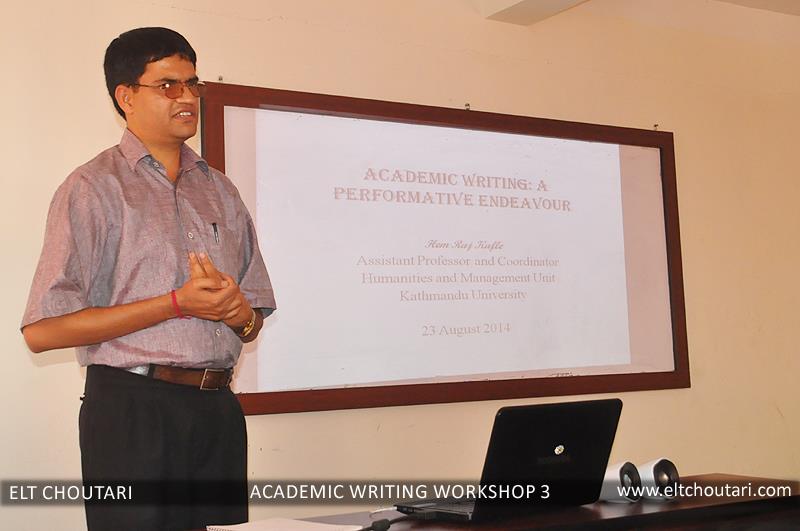
He is tall. Very tall compared to my height. He looks into the world through a pair of slightly shaded glasses. Those glasses probably let him filter all the negativity around him and help him see a vision – a vision of a teacher, a writer and a mentor. He speaks gently and seldom smiles. He stands in the middle of the class and with his words; paints an exciting picture of characters, themes and conflicts; and walks us through the colorful fields full of metaphors, similes and hyperboles.

 He is one of those rare teachers who writes a lot. His blog is a testimony of his prolific writing habit. Even his facebook statuses, usually very short poems, reflect his creativity. Then, it makes me wonder. May be creativity is a verb, not a noun. One has to constantly work at it. It’s just my perception. His creativity could be as natural as breathing.

I had met him back in 2012. He taught me Fiction in my M.Ed. ELT first semester and since then I have had a renewed interest in reading, interpreting and analyzing literature. I started becoming passionate but critical of the texts I came across. In addition to that, he has inspired me to write down my own fictional works.

Naturally, I was pretty excited about the workshop. I had always wanted to be in his classes one more time and the workshop was it. Even though the focus of the workshop was “Academic Writing”, I knew he would have his own twist on it, with a few pinch of strange concepts sprinkled around here and there.

So he started the workshop by asserting that writing is not an isolated activity, but it is an activity integrated with reading, listening and speaking. “The key word is perform. Writing is a performance, it is an action of hands as well as an action of minds,” he added. And most importantly, he continued, “Performance doesn’t mean a writer’s activity alone… it is about a reader’s action also”. This made so much sense that it immediately struck a chord with me. A writer has to let readers perform too. Otherwise, what’s the point in writing at the first place? An effective writer thus leaves enough clues here and there in the text for the readers to come up with their own knowledge.

Hem Kafle Workshop

Writing is a performance because the writer has to make sure that his/her ‘authorial presence’ and credibility are visible in every word and every sentence of the text. Moreover, a writer has to make sure there are implicit and explicit moments of communication with the reader. He/she has to constantly facilitate the reader towards understanding and creating new perceptions. Similarly, a writer has to represent his/her community and contribute towards adding new knowledge and scholarship. Therefore, writing is not merely scribbling texts on a sheet of paper, it is a performance that involves both the writer and the reader.

 Next, he talked about some of the common attributes every writer exhibit in some ways. For instance, the ‘writer’s block’ which he also labeled as the ‘blinking cursor syndrome’ for those who keep staring at the computer screen searching for words to start with. Similarly, every writer has the irresistible urge to tell the background or the whole story. Next, most of the writers can’t decide on the choice of diction – whether to use big or small stock of words, or on the choice of sentence – short sentences or longer sentences.

And to come to the main focus of the workshop, he talked about the process of creating an argument in academic writing and substantiating one’s stance. He gave an instance of Stephen Toulmin’s elements of a proper argument: claim, ground, warrant, backing, rebuttal, qualifier and final claim. A good paragraph is a combination of all or some of the above elements. The concept of ‘rebuttal’ is quite interesting. Apparently, acknowledging opposing views and giving them a small space in one’s argument adds more strength to one’s argument.

At the end, he gave us eleven tips on how to improve one’s writing. I am reflecting on these points from my perspective.

  1. Write aloud.
    It helps shape the quality of writing.
  2. Speak – record – transcribe – Edit
    This is very useful when one is facing the imminent ‘writer’s block’.
  3. Toulmin uncle really works!
  4. Three is enough.
    Three examples, three explanations, three stories.
  5. Keep the big below you.
    This is quite interesting. Start a paragraph with your own sentence and end it with your own. Keep the citations and ‘big’ personalities underneath your first statement. Don’t ever start your paragraph with a citation because this just weakens your stance.
  6. Kill the subordinates.
    If your main info goes to the subordinate clause, rewrite the sentence. Bring your info to the front.
  7. Passive is lousy.
    I also hate sentences in passive voice. I always try to write everything in active voice.
  8. Let the verb stand high.
    Let the verb ‘speak’, rather than ‘be’.
  9. Do not repeat a word if there’s a replacement.
  10. Hear me between the lines
    Make your presence felt. Don’t let the reader forget about the writer.
  11. Dump me if I let you go!
    Challenge: I will not bore my reader. I will not break my reader’s heart, effort, money, etc.

After attending this workshop, I now feel the urge to go back to all my writings and scrutinize them strand by strand – to find my ‘authorial presence’ in them. I had never thought about this aspect of writing – that the author has to be present in the text. Similarly, I am going to try speak-record-transcribe method whenever I feel stuck in the rot. I will also make sure none of my paragraphs start with a citation but with my own sentence. In addition, I will use these techniques in presentations and in writing scripts for speaking as well.

Writing has always been an elusive grape for me. I feel like I am always getting ‘there’ but never near enough. I always go back to my texts, interact with them and revise them. That singer from Rolling Stones is probably right. I can’t get no satisfaction out of my writing. But just like Hem sir once said during his class, “A text is always in the making”. May be it’s not about getting ‘there’ and being satisfied after all. It is a process… a continuum… a journey. And our job as a writer is just to enjoy the ride.

The author, one of editors with Choutari, is a teacher, writer, & blogger.

Teaching Reading Texts through Critical Thinking Perspective

images
Lal Bahadur Rana


In this blog post, I discuss how the core principles of critical thinking such as open-mindedness, ability to see any phenomenon through multiple perspectives, etc. can be exploited in EFL classes with a view to increasing learner-centeredness in our EFL classes and enhance learners’ critico-creative thinking.


Context for teaching and learning English
Despite the strong desire of getting mastery over English, many Nepali learners of English do not have sufficient level of English mainly because of the amount of exposure. Let me give an example of the time teacher and students spend using English throughout a year. Most of the government-aided schools in Nepal have the classes of forty minutes and six classes a week. Thus, there are spending (40 x 6) = 240 minutes in a week (240 x 4) = 960 minutes a month and (960 x 10) = 9600 minutes a year. If we change this amount of time into hours, they study 160 hours. To count in days, they study just 6.67 days a year. Hardly a week! If we deduct the time such as the use of the Nepali language, the time spent on coming and going to class, bandh days, etc. I am afraid, students might be studying in some minus days. Continue reading Teaching Reading Texts through Critical Thinking Perspective

Welcome to September Issue of ELT Choutari

Mentoring Special

Editorial: 

The Choutari Team is delighted to greet you with the September issue of ELT Choutari! This issue is focused on mentoring, which  has remained one of the core values of Choutari since its inception.  We began the Choutari Mentoring Project (CMP) as a new initiative  to enhance a collaborative learning environment among our readers seven months ago. We are excited to receive love and feedback from the students, teachers, and professionals in Nepal. The continual academic support from both the  international and local community of ELT/Applied Linguistic scholars has further encouraged us to develop other news projects in future. We are glad that many of our colleagues are enjoying the benefits of the mentoring project. We would like to thank you all who signed up and participated in this project. In the meantime, we have also received much feedback from those engaged currently in the mentoring relations. We are encouraged by your feedback and do look forward to making this project even more accessible and productive in the days to come.

The September issue of ELT Choutari was originally planned to be a forum to celebrate the mentoring relations and to formally recognize our mentors and mentees contributing to the project. However, based on the feedback we received, and with due respect to the contextual ramifications, we have decided to maintain confidentiality of the participating mentors and mentees. This has been an important learning experience from the critical mass of participants, and we are determined to move ahead with a giving spirit to our field.

This issue of ELT Choutari, however, has come out to be a special one for a special reason. We have posts from Choutari’s key personalities including founding members and past editors. We have an interview with two successful Nepali ELT mentors Ganga Ram Gautam, Reader at  Tribhuvan University, and Laxman Gnawali, PhD, Associate Professor at Kathmandu University, focused on mentoring. Their mentoring stories not only unveil mentoring culture in Nepal, but also present existing perception and attitude toward this in our context.

In the second reflective blog entitled “This is How Mentoring Worked for Me,” Bal Krishna Sharma shares his personal learning experiences from the mentoring activities — both as a mentee and as a mentor. Bal has included the names of his mentor (Elaina) and mentee (Tankia) in his story to give a real story that gives insight into how those relations are developed and sustained. Moreover, this sets a great example of how one individual can benefit from both roles.

Sajan Kumar’s take on mentoring is highly philosophical in third blog entry-“You are, therefore I am: Reciprocity, Metamorphosis, Mentorship and Beyond.” Here Sajan shares a model of mentoring that describes the mentoring process as a cyclical developmental and growth involving contemplation, meditation, mediation, and action — all converging into a transformative process. Sajan describes his mentoring journey stemming out of his intimate collaboration with his guru and the quality time he had with him during his stay at Kirtipur but then goes on to add a theoretical dimension arguing that the whole biosphere may act as the mentor for an explorer of self, such as Sajan himself. His conclusion is powerful: “One repays a teacher badly if one remains only a pupil”

Prem Phyak in the fourth blog post “Not a fix-it shop: Making mentoring productive”  is full of practical insights. Prem has offered some strategies that can be helpful to make mentoring more productive and goal-oriented. Drawing on his own experience working as a writing consultant/tutor for the Writing Center at the University of Hawaii at Manoa for two years, Prem’s post focuses on how to make mentoring more interactive, grounded/bottom-up, and collaborative rather than top-down and authoritative.

The fifth blog entry ‘Bal Ram Adhikari’s Sharing, Caring and Daring in Mentoring’ is a remarkable story of transformation whereby the writer finds himself as a deliverer of something that he had been longed for in the beginning of his teaching career. Adhikari’s experience paints a not-so-good-picture of mentoring in the context of Nepal, but is an eye opener. Having witnessed and been trampled by the “lopsided” practice of power, dominance, and authority, Adhikari’s writing is a call for an action toward a truer mentoring regime in Nepal’s ELT sector.

Finally, we have a photo blog that covers the news from Choutari’s monthly writing workshop facilitated by Hem Raj Kafle, one of founding editors of Choutari.

Here is the list of articles we have included for September Issue, especially focused on mentoring in ELT:

  1. ELT Chat with Nepali Mentors on Mentoring, by Praveen K Yadav  
  2. This is How Mentoring Worked for Me, by Bal Krishna Sharma
  3. You are, therefore I am, by Sajan Kumar
  4. Not a fix-it shop: Making mentoring productive, by Prem Phyak
  5.  Sharing, Caring and Daring in Mentoring, by Bal Ram Adhikari
  6. Choutari Writing Workshop #3: Photoblog, by Choutari Team

Together, these stories, coming straight out of the experiences of successful people in the field, serve as models to be built on. As can be seen, these stories reveal that mentoring is not about following prescriptive norms and rules — it is largely shaped by what goal, passion, philosophy and background that mentors and mentees share with each other. I believe that these stories are my stories, your stories, and everyone’s stories.

Uttam
Uttam Gaulee Editor, September 2014

P.S.: I would like to urge all our valued readers and contributors to please share these stories among your social network and leave comments.

Enjoy the readings!

ELT Chat with Nepali Mentors on Mentoring

Praveen Kumar Yadav, team coordinator for ELT Choutari, had a chit-chat with successful Nepali ELT mentors, Ganga Ram Gautam, Reader in English Education at Tribhuvan University and Dr Laxman Gnawali, Associate Professor at Kathmandu University School of Education, who are not only involved in English Language Teaching, but they has also been mentoring ELT practitioners over one and a half decade. This chat with the ELT mentors and experts delves into the tradition, practice cultural variations, and existing perception and attitude toward mentoring with reference to their own mentoring experience. Please enjoy this insightful conversation with these experts.

Choutari: Could you please briefly talk about mentorship culture in Nepalese context? How do students and teachers in Nepal perceive mentoring?

Gautam:

Gautam, Ganga - Nepal (2) (1)
Ganga Ram Gautam, Reader in ELT Tribhuvan University, Nepal


Mentorship is not a new concept in Nepal. Mentorship was an excellent way of building capacity of a person in the Gurukul education system and it continued for a long time in the tradition. Similarly, helping the young ones by the senior was in-built in our cultural system and the metaphor that we often used for mentorship is पन्थेदाउने which means training the novice person by engaging them in the work under the supervision of the seniors.

Currently, the western education system gave it a new name and it is being discussed in the education discourse. Informally, mentoring is there but at the formal level, it is not very widely used.
Gnawali: 

Laxman Gnawali, PhD                                            Associate Professor (ELT)                          Kathmandu University  School of Education
Laxman Gnawali, PhD, Associate Professor (ELT) Kathmandu University School of Education

Nepalese society had a tradition of mentoring model of education and training until the modern schooling system started for the public in the 1950s. Whether it was about the skills of family occupation and family crafts or the art of war, the experienced ones used to pass down the skills to the young generation by way of mentoring. Take for example a daughter learning to weave paddy straw mat or a tailor’s a children learning to stitch clothes or a priest’s son learning to perform rituals or a young prince learning the tactics of rule. In all cases, the knowledge transfer took place in the mentoring model. Later, the modern schooling system introduced mass education and the mentoring was no longer practicable for most trades. The teaching and learning now embraced cascade model.

From my interactions with the teachers and students, I have gathered that mentoring is not a common practice in the formal education. Though the traditional skills transfer still continues in the mentoring model, stakeholders of the mainstream education are happy to see the cascade model of knowledge transfer function. Ironically, teacher education in which mentoring model would make a difference follows a straight cascade model except in a very few cases.

Choutari: Kindly share with Choutari readers any of your mentoring experience (as a mentee) that you think has added values to your life.

Continue reading ELT Chat with Nepali Mentors on Mentoring

This is how mentoring worked for me

135615_1766463684896_7952262_o (1)
Bal Krishna Sharma,   PhD Scholar   University of Hawaii, Manoa, USA

I went to pursue my graduate studies at the University of Hawaii in 2008. Since I was in a new academic environment, any academic help extended to me would be tremendously helpful. I first had little idea on how the US academic system would work, for example, choosing academic advisers, completing assignments, presenting at conferences, finding and using scholarly resources and connecting to the local ELT professional venues. Thanks to the East-West Center, my scholarship sponsor organization, that connected me to an experienced and very helpful mentor, Elaina. Also thanks to the Second Language Studies Students’ Association that provided me an opportunity to work as a mentor for a BA student. In the following sections, I will briefly describe my experience and learning opportunities from these mentoring programs.

Being a Mentee

The East-West Center Alumni Association asked me to fill out a mentoring form providing details of my academic and professional background, academic interest and my expectations from my mentor. However, I had little idea regarding how this would work and help with my graduate studies at the university. I thought at least I would have an opportunity to connect to an ‘American’ professor. The alumni association also asked the potential mentors to fill out similar forms. By matching common interests between the two parties, I was assigned to a mentor at a local community college. I was excited. I wrote my mentor an introductory email and told her that I was her mentee and wanted to know who she was. Elaina took me to an Indian restaurant for dinner for our first meeting. We chatted about our personal and academic interests, family background and future goals. Continue reading This is how mentoring worked for me

You are, therefore I am

Reciprocity, metamorphosis, mentorship and beyond         

Sajan Kumar

‘I think, therefore I am’, declared Descartes. And I thought the same; I taught the same. You thought, therefore you were. They thought, therefore they were. Nevertheless I have been very inconsistent and unpredictable a man throughout. As time grew, I began to feel entrapped and suffocated; I could not continue to dwell in the same box and I flew away. Afterwards, I disassociated myself from Descartes and many more like him. I had been solid all along; I was liquid now. Snow must melt someday.

joint pic
Sajan Kumar                   Dr Govinda Raj Bhattarai

The story goes like this in brief. With Descartes and his ‘cogito, ergo sum’, it was thinking that ensured my existence in the world I dwelled and played my part in. I existed only because I thought. Anybody existed because they thought. Thinking was the basis for any relationship that I was in, that I wanted to be in. Everything else felt petty; everybody else felt mediocre. I had been a body all along and I was a mind now. Of the three metamorphoses that Nietzsche in his magnum opus ‘Thus Spake Zarathustra, designate of the spirit, hopefully it was one: the camel had turned into a lion. Naturally, the lion felt euphoric about the accomplishment after struggles. However, the lion still lived in an enclosure for his world was private and compartmentalized. Like a chariot horse; he could neither see left nor right but merely straight. Descartes solipsism had led him into such a cage where he saw, heard, felt, touched and smelt with mind alone. Not only that he contemplated with mind but he meditated and mediated with mind/s alone. Perhaps, he had unknowingly obliterated that he possessed a beautiful body too and the body housed a self too. His disillusionment came to an end only when he was stuck on the middle floor and out of blue regained memory of where he came from and also visualized where he was destined for.

Continue reading You are, therefore I am

Not a fix-it shop: Making mentoring productive

Prem Phyak, PhD Scholar  in Second Lang. Studies, University of Hawaii, USA

In this blog post I discuss some strategies that can be helpful to make mentoring more productive and goal-oriented. Drawing on my own experience working as a writing consultant/tutor for the Writing Center at the University of Hawaii at Manoa for two years, this post focuses on how to make mentoring more interactive, grounded/bottom-up, and collaborative rather than top-down and authoritative.

Starting the conversation

One undergraduate student came to the Writing Center and asked whether I could help him. “Yes, I am available now”, I said. After we introduced to each other, I asked what his problem was. He said, “I want to write a research paper for my political science class. But I am struggling to identify a topic. I am worried because the assignment is due next week.” His face was telling me that he was procrastinating and finding no way to move forward.” 

First, I was perplexed how I could help him as he was not sure what he was going to write about. Second, I was not sure what the student was expected to write in his  research paper. I began our mentoring session by telling him that every student faces the same problem. I gave my own example; I quite often do not know what I am going to write in the early stage of my writing projects. Continue reading Not a fix-it shop: Making mentoring productive

Sharing, Caring and Daring in Mentoring

IMG_6861
Bal Ram Adhikari Editor, ELT Choutari

I am a teacher educator and a literary translator by profession. My teaching profession took its roots two decades ago when I was first appointed as a primary teacher in the government-aided school in a remote part of Gorkha. I joined this profession before I was ‘professional’. I was qualified to teach simply becauseI had an academic certificate of Intermediate Proficiency Level in English Education and I could teach or say ‘tell’ my students what was written in the English textbook. I have not strayed from this profession ever since my first appointment.  However, my changing of institutions has been rather unpredictable and whimsical.

During this professional life I ever wished  to be intimately closer to ‘someone’ more experienced, more supportive, more understanding under whose guidance I could learn the science of teaching, feel its art in the actual classroom, and who I could turn to whenever I needed counseling on my profession. However, that ‘someone’ never turned up in my teaching career save the university teachers who observed and supervised my lessons during peer teaching, school teaching and campus teaching during the practicum. That was Okay, I call it ‘just Okay’, since the purpose was to fulfill the requirement of examinations; the process was too mechanical; the feedback for further improvement was too ritualistic. I could have grown differently in the field had I got ‘that someone’[1]. I sense that many of the pre-service teachers who I have been teaching are also longing for ‘that someone’.

‘That someone’ who I have missed in my professional life is dubbed a mentor.The me-like person who wishes to learn under ‘that more experienced one’ in the field is dubbed a mentee. The process whereby the mentor supports the mentee to grow in the field is mentoring.  I come up with certain reasons when I ponder over why I longed for mentoring and why I mentor my students these days. In my observation, this is a widespread longing in Nepal.

Why mentoring? Continue reading Sharing, Caring and Daring in Mentoring

Diversity and Broader Goals of ELT

Shyam Sharma

Sitting down to write this post on diversity and ELT, I remember a story that scholar David Foster Wallace tells in a famous college graduation speech. Two younger fish ask an older one: “What the hell is water?” The point of the story is that “…the most obvious, important realities are often the ones that are hardest to see and talk about.”

The point I want to make in this post is that while we are a nation of very diverse peoples, cultures, languages, and so on, we have to pinch ourselves to remember that we are diverse. I argue that as educators, it is worth pinching ourselves and our students—intellectually, that is—into realizing the value of diversity as a broader goal of education, especially in a country like ours and an interconnected world like today’s.

[youtube=https://www.youtube.com/watch?v=DKYJVV7HuZw]
[This YouTube video is an animated version of parts of Wallace’s speech]

We’ve been told that Nepal has been a garden of “four castes and thirty-six shades” of people; indeed, within an area of 850 by 200 kilometers, we speak more than a hundred languages and are extremely diverse in a variety of ways. However, the garden metaphor was meant to drive home the value of unity more than diversity. The emphasis on nationhood and unity is usually a goodie goodie way to deny that there are deep divisions, structural injustices, and discrimination woven into the sociopolitical fabric of our society. So, it is absolutely time that we situate (even) the teaching of English within the context of seeking to promote respect for diverse peoples, cultures, languages, and epistemologies (even) in a small but complex country like ours.

Continue reading Diversity and Broader Goals of ELT

Teacher Training: One of the Best Ways of Self-development

-Parista Rai

Since the day I joined M.Ed. ELT program, it was my dream to be an ELT trainer and fortunately for me, it came true recently. As a part of Teacher’s Development course, I conducted training sessions in Janakpur and Tanahun in July and although it was my first experience of delivering training, I gained tremendous knowledge and experience. I experienced that conducting a teacher training session is a very challenging job where a trainer has to manage everything for the sake of in-service teachers’ satisfaction. In this article, I am very glad to share my experience.

I had heard about ELT teachers’ training before getting enrolled in Kathmandu University but when I got an opportunity to be a part of the ELT program here, I learnt many things related to English language teaching, learning and training. I neither had experience of a trainer nor a trainee but once when I got a chance to attend an in-service teacher training delivered by our seniors, I got many ideas about the teacher training and started dreaming to be a trainer. And at the same time, I became more interested in teaching and learning English as a foreign language.

Continue reading Teacher Training: One of the Best Ways of Self-development

Ditch it: SLC Exams

central ideaShyam Sharma

I now teach at a prestigious university within the largest and one of the best American public university systems, the State University of New York.

But twenty-four years ago, when I first appeared the SLC, I failed.

Now, I am not about to tell you a wonderful story. Sorry, there are more stories of suicide than of success in this regard. I am instead telling my story, for the first time beyond my family, in order to make a very broad point about the SLC exam and our society. Continue reading Ditch it: SLC Exams

How my mentor transformed me

Priyanka Pandey

I feel very fortunate for getting a mentor when I started my teaching career. My mentor was an experienced and skillful teacher who guided me, changed my perceptions regarding teaching profession, and later made me determined to be in the field of ELT.

The school I worked for (Tiny Seeds Pre-school, Kathmandu) had a system of assigning two teachers in one class; a grade teacher and an assistant teacher. I was selected to be her assistant but initially it was very stressful because I didn’t have any idea about “play-way” method. Being a student of Education, I knew how to make lesson plans in theory, but I didn’t have clear idea about how to make practical lesson plans and how to teach effectively in English medium. Continue reading How my mentor transformed me

The Write Way

Mabindra Regmi

When I graduated from my high school, I thought I was a great writer. I had written for countless assignments and examinations. I had written poems and stories. I had scored relatively high marks in English during my high school final examination. How could I not be a writer? It was a bitter shock when reality crashed in and I had to redefine my so called ‘expertise’ in writing when I faced the challenge of writing a proposal for an educational endeavor. I spent many a night poring over the proposal and scribbling on a piece of paper in that pre-ubiquitous-computer era to keep my inflated writing ego alive.

When I look back in retrospect after what seems like eons, and teaching writing to students for over a decade, a few questions arise. Why did I feel that I was ‘good’ at writing when I apparently wasn’t? What were the factors that I had missed altogether to write well? What were the strategies that I had to adopt in order to enhance my writing skills? And what it takes to create your niche in the world of writing- specifically academic writing? Continue reading The Write Way

Reflections on TSC written test

Praveen Kumar Yadav

After a gap of nearly 17 years, recently Teacher Service Commission (TSC), the government body to appoint teachers for community schools, has recruited teachers for Secondary, Lower Secondary and Primary levels across the country. The process consisted of both written and oral examinations. For written examinations, a total of a total of 413,000 examinees across the country had appeared. Based on results of the written examinations, those successful candidates were called for the interview.

NeltaChoutari would like to congratulate all those who succeeded in TSC exams and have recently become teachers in government owned community schools.  

Out of those successful teachers, the three have shared their experience and reflections through this blog entry. They have been  appointed by the government to teach English in secondary levels. Specifically, they have presented their reflections under three different sections included in the written test. Continue reading Reflections on TSC written test

Speakers’ Club for Professional Development

Umes Shrestha

As we wrapped up the June 20 session of our Speakers’ Club (KU), I remembered how a small dream that I always had turned into a magnificent reality. I had a dream of getting involved in a professional club like the Toastmasters but with English language teachers as its members. And in this article, I want to share the reasons why I wanted to set up the club and talk about how the club helped me in my journey of personal and professional development.

After joining KU’s M.Ed ELT program, I had this idea – the idea about setting up a speaking forum – in my head and luckily my professor Dr. Laxman Gnawali had also thought about it for some time. After spending some time with some seniors and my classmates brainstorming about how to set up such forum and discussing on its name and modality, on August 2013, we officially started with the first session of the Speaker’s Club. It had the participation of students of M.Ed. ELT and M.Phil. English Language Education as well as a number of faculty members. Continue reading Speakers’ Club for Professional Development