Needless to say, the importance of English is surprisingly increasing day by day. People all over the world are investing a lot of money and efforts to English Language. However, college students in Nepal, who have already invested money, time and efforts, for learning English, are yet to succeed. Migrant Nepalis working abroad, who hold academic degrees, cannot speak even simple sentences in English. As a result, they have become the subject of mockery. In this blog post, I will make an attempt to discuss on spoken English as challenge for college students.
Let me share with you an anecdote. One day one of the students came to me and asked, “I can write grammatically correct sentences in English. But why can’t I speak?”
The student is the representative of many others who frequently asks me the similar questions. I did not have any ready-made answers for the curious students’ question that time, however, I discussed with them citing some reasons for lack of proficiency in spoken English.
Some time later, I pondered over the issue. I came up with a very simple and amazing answer. Having grammar in spoken English is useless. Non-native speakers of English facing the problem for speaking English is just due to grammar. This is the fact shown by researches as well. As educated persons or college level students, they always want to use grammar properly, they never can speak English.
Importantly, we can make brief statement, questions and answers in spoken English. For instance, to make the question, auxiliary verbs and WH words are used at the beginning of the interrogative/question sentences as per grammar. Such a complexity to form question or interrogative sentences makes students unable to ask any questions to the teacher or anyone.
Here, one question may arise in your mind, what type of shortcut English is there without grammar? English without grammar can be said to be shortcut or real English. No doubt, there is no language without grammar in the world. Grammar is a science of language. Even if grammar is missing, it is hidden in spoken English.
We mostly use shortcut sentences and we simply prefer to call it “Spoken English”. According to grammarian, I. Jaykaran, who published the book “Master your English Grammar”, we make several shortcut sentences during conversation. It is not a grammatical mistake, but an accepted shortcut.(page 414)
Let’s consider how we speak our Nepali language. As you know, a baby and our grandfather or grandmother do speak Nepali so well without Nepali grammar even they have not learnt in the school. We, educated persons or students, never use Nepali grammar while talking with people. Can’t this be similar case in English. It is vivid that speaking a language does not necessarily use proper grammar, right?
Practical or Real English is informal language. It is also called spoken English. In our daily conversation, we simply use this language in family, with friends, relatives and other people. In Real English, we do not care grammatical rules which frustrate the beginners to speak English.
On the other hand, grammatical (proper) English is formal Language. It is standard and specific language used in academic organization, official purposes and formal programs. We mostly use proper grammar while talking to seniors or strangers too.
STRUCTURE OF SPOKEN ENGLISH
There are two parts in spoken English;missing words and speaking words.
In case of missing words, it is not good to speak frequently the same words or matter in talking, which is already known or spoken out. That is to say, we don’t need to speak again which is clear and can be understood easily.
See the examples below;
Are you watching the TV? (Grammar)
1. You watching the TV? (Spoken)
2. Wathing the TV? (Spoken)
We have to stop the car here. (Grammar)
3. Have to stop here. (Spoken)
4. Stop here. (Spoken)
In example 1 and 2 above, are and you are missing, in example 3 and 4 we and the car, and we have to and the car are missing . It is, of course, considered best in spoken English.
According to grammar, In above example (4), ‘stop here’ is the imperative sentence. But in spoken, it makes a same meaning like other two utterances.
Speaking Words – We simply talk about a person or a thing in normal conversation. To make it short and sweet, we need to speak as Spoken English which is the best way of speaking in every language.
Above example (2), (3) and (4) are as Practical English without subject and object as the grammatical sentences.
The words are missing in Spoken English in such a way. So if we do not know the situation or circumstances, sometimes it becomes unclear or gets different meaning.
To conclude my opinion, I would like to urge the college students to once try to follow the above mentioned way if they really want to speak English fluently. I hope this will help them get success very soon. I am teaching spoken English in such a way mentioned above. I have found the fruitful result. Most of the students are wonderfully satisfied with my teaching.
—————-
The author teaches English language in Kathmandu valley.
Chandra Acharya ELT practitioner, Life Member of NELTA, and freelance writer in English
Frankly speaking, this blog entry does not entertain you, the readers, because it does not unveil any particular issue on ELT rather it talks about an effort I did to advance the career in ELT creating a recurring dream for the learners ever no matter where they go and be what in their life. Hope you do not interpret this as a self exaggeration.
I was so I did, I am and I do and if I will be I will be doing
This is the working definition of existentialism and I am not untouched by this definition. As the title, ‘Crossing the boundary: what I did during my stay still knocks them to ring me’ owns a sense of existentialism which is directly linked to the effort I made during my stay in an English School from where I started my teaching career for the first time. Mount Everest English School Dangihat, Morang, where I started babbling in English (for the language teaching) is the means and ends to expand the horizon of my passion in English language teaching. Thus, the credit of all the success I achieve on ELT till this time goes to the administration there.
At first, it was quite challenging for me to be adjusted in the environment. I was with a tongue twister that how could I be a good member of that nice community. This questioned me several times on my behavior and challenged me to work as a teacher of English. No sooner had I presented in a class of 30 more students for the first time, the nightmare started since then. In the very beginning of the presentation I found some quake shocks in my body but it went at please some minutes later. I didn’t know whether the presentation was beautiful or not but what I did after the supervisor left the class was quite nice and that worked in my selection I think. I had sung a song that was a key of my selection I think because I had kissed the heart of the students through that song. So, my salute also goes to the song; mohani laglahai gauleko bolile…, that I had selected this song as a dancing number at the school anniversary I talk later. Making some other talks with the administration I returned to my room on that day. No sooner had I reached the room I found a call from the principal that I was selected as a lower secondary English teacher there.
The next day I got the appointment. As I got the appointment I found that the real life began with some emotion. On the one hand I felt happy that the cost of the study could be maintained decreasing some financial burden to my family, but I felt like a horse in a shed on that day onwards on the other hand. As I was like a colt on the grassy land before, I found myself be a dutiful dude day to day. Sometimes, I felt the freedom of life was banished but actually the real life had begun. Since then, I understood the value of time, the life of different circumstances and the policy of talks. The very important thing I learnt was the professional life cycle one owns.
Teaching and preaching to the kids at the threshold of adolescence, I crossed a five-month life cycle as a lower secondary English teacher there as I had joined on the month of Kartik. Then after, the post was switched to secondary English teacher. Having being a five-month experienced member of that nice school family, I found myself an energetic member that I had to be in any of the administrative decision, be it a classroom management or creating an English environment they are making every efforts for a long time. Analyzing my capability in English either it is a pronunciation or creative writing skills or any other skills a teacher of English should have, the administration shared me a responsibility of a co-coordinator to manage English environment in the school zone. This made me a unique kind of teacher among the colleague there. As they did this, I thought it was an opportunity to collect the missiles of English language and to blast over that community they were in need. So I promised myself to left no stone unturned in my responsibility ahead.
To this, the very first thing I did was; making the colleagues agree to make ‘teacher talk’ in English as they could and the ‘baby talk’ for the students. The reason why I did this is teacher talk is a key to form a habit to do everything in English on the part of the students because learners are the imitators of their Gurus. Simply, I requested them to use English as a Medium of Instruction (EMOI) as I was impressed by the term; if one needs to be a good person in English one should do things in English. I also tried my best to spent some of their class-time to engage in private speech; talk apparently to and for themselves rather than for any external conversational partners which could regulate internal thought, without any external articulation as proposed by Vygotsky. To the teachers from nursery to secondary, either they were teaching English or Nepali, I shared some ideas to speak in English on several bases. As I was also the beginner in English, I tried my best collecting ideas from external sources to create English speaking environment in the school zone. In addition to this, I assigned a student of higher classes who could spoke English at ease to each house. Managing these things properly, Nepali speaking environment magically switched into an English speaking zone. Here, the very exciting thing I found was, even the students of class nursery smiled saying good morning sir/ma’am, may I go out sir…, bye! bye! sir/ma’am etc. which made me feel proud in my mission.
The second very important thing I did for the success of Mount Everest English School during my stay was; sharing ideas in certifying the authentic teaching learning materials in English. This does not mean that applying a book from the foreign writers, but the book to facilitate English speaking zone they need and to empower students in English. What I did to this matter was making decision against the administration’s agreement. Crossing the boundary they had already established, I stopped them not to apply the books in Nepali medium in English subject. I didn’t know whether the decision I made was favorable to the will of the administration, but it was a great effort for the success of the school and its family I believed. Why because, if students are with the choice of a difficult thing and an easy thing at the same time, no matter they choose the essayist way. I mean if we had launched the books of English subjects translated in Nepali, the students could only read the translated version of English terms. They didn’t go for exploring and practicing the things in English and this certainly could create problems in developing reading comprehension on them which could stop in facilitating in fluency in English too. Considering this I stopped them and they agreed to me finally. But in the very beginning of this decision they were against me as I was to them, because they might have some benefits in applying the books of different publication every year which I didn’t know at the time. With some ups and downs I enjoyed teaching the kids there.
Similarly, my effort for the success of 10th anniversary of the school, the first time after its establishment, was another corner stone for the good will of the school. I know it was the first event I have ever coordinated in my life and that was the first and completely a new event organized among 5 more schools in the community there as the local newspapers reported the other day. In the programme what I did the best was making students able, to present 6 hours long programme sharing varieties of exciting ideas to build of positive attitudes, and to making speeches in English from primary to secondary. The programme proved to be a success of the mission; creating English speaking zone in the school as each students assigned for the specific work talked in English during the day which could easily be seen on parents’ appearance.
As their wish, I left no stone unturned to make the anniversary a mega event under the chairmanship of Mr. Jagat Bahadur Basnet, a foresighted principal of the school. Mr. Basnet was not only a principle of the school; he guided me as a path-exhibitionist whom I never forget till the ELT air exists in my mind. I am speechless at the time I talk about the attachment between him and me. How he guided, encouraged and added a new kind of emotion to boost of my passion in ELT is not enough to explain in words. Because of these very things I worked there as a catalyst for the development of school no matter how hard I did in different ups and downs during my three year’s stay there.
The hardest of all I faced was at the time of leave. It was quite a difficult thing to be separated from their parent like relationship. At the leave I thought that something from my body was being separated. I don’t know how they felt in my leave, whether they were sad or happy but Mr. Basnat’s speechless voice while accepting resignation letter broke my heart. Though leaving them was not my interest, it was my compulsion to earn master’s degree at Tribhuvan University (TU) which, I say, was my childhood dream.
As I had a dream of earning master’s degree in ELT at TU, I did it last year and made them a call to share my happiness; they responded me saying ‘Surya sir the door is open for you all the time’. I wondered why they called me as Surya sir, I questioned myself first but later I found that my very last speechless voice at the time of leave from the school was; I am Chandra Sir till this time, tomorrow I will be back again and rejoin the relationship as Surya Sir why because Surya is far more powerful than Moon (Chandra). And one more thing that refreshed the image about the school was, the school had just been running in a new building with facilitated teaching learning environment. Having fun of this kind we ended the conversation. Since then the call log in my mobile is not untouched from Mount Everest English School’s reminding call.
In summing up, I, not only worked as a teacher there but as a change agent for managing quality education and to the all-round development of the school. Teaching students the good moral to making them a positive minded personality to have success in their life ahead. I tried my best as a teacher one should do this or that for all the success of his/her students and for the school improvement in overall. But one thing I could never learnt during my stay there was money-minded nature which I hope I never learn until my last breath. Because of all these very things, what I did crossing the rules and regulation of the school during my stay still knocks them to call me to reunite the circle there. And finally the school building I visited last time on Dashain vacation stunned my heart. The design of the building attracted me to take hundreds more photograph and one of them I have attached here comparing to its structure during my stay.
Students studying in old classroom settingNew building which warmed my heart in my last visitNew classroom management
The last but not the least words I suggest to the novice teachers and to the experienced ones to some extent are;
believe in work to word,
never be frustrated working under pressure as it is the starting of you real life,
feel that every activities done in the school is your own property and should have your responsibility on them,
try applying all the efforts you have without being money minded,
think that teaching environment you are with is the lab to practice the knowledge you earned,
believe that the routine work you are in teaches you the policy of life,
and finally, leave no stone unturned to be a unique teacher in the circle creating a recurring dream in students mind whatever they do and where they stay in their future life.
Rajan Kumar Kandel Teaching Assistant Surkhet Campus (Education)
This post deals with a short synopsis and experiences of participating an online teacher training course named Practical Applications for Listening and Speaking Skills (henceforth PALSS). It is written to share the willing teachers to help participating an online course in spite of the challenges like frequent power cuts and unstable networking.
Introduction
The course was 10 week long, (started from January 7 to March 15, 2013 for me) offered through the University of Oregon, Linguistics Department, American English Institute (UO AEI) as one of the nine courses funded through the E-Teacher Scholarship Program. We spent at least 8 to 10 hours per week engaged in online studies and activities. We had to score 70% or above to pass the course.
It required us to have the Google email and Skype account which was used exclusively to communicate with the instructor. The course included weekly asynchronous readings and online Nicenet discussion, synchronous weekly small group Skype meetings with the course instructor, synchronous weekly small group Skype meeting with a conversation leader, weekly audio journals where we reflected on what we learned that week, and self-study materials to improve our listening and speaking skills using online resources among others. We had to keep a record of self-study along with reflective comments by the end of each week, in the self- study log (click here to view my self-study log). The course also included whole-group webinars at different times during the course. There were 7 webinars altogether and we were asked to attend and view at least 3 of the webinars and write synopsis and reflection. At the end of the course there was final project of preparing a long lesson plan integrating new methods and activities for teaching listening and speaking. We had to put the written assignment into the appropriate weekly folder in the Dropbox shared by the teacher.
We were expected to read the weekly readings and then post at least two times each week in the related Nicenet online discussion. We had to reflect about our activities during the week in an audio journal. I was much tempted to get acquainted with all the activities of the course and was hurried and impatient to know what I was going to achieve after I complete the course and become eligible to receive the certificate. A kind of storm was haunting inside me.
A glimpse of the course topics and the activities performed
The first week included introduction to the course, meet and interact with course participants, instructor, and conversation leader. The Nicenet discussion for the week was self-introduction. Everyone was asked to write the first post between 100 to 200 words and then post a reply to the post of at least one other participant. As the assignment was finished the obtained marks was immediately sent through the Jupiter Grades.
The second week brought the topics -listening and speaking, accuracy and comprehensibility, and learning objectives. The concept of weekly audio journal and synchronous Skype meetings were started from the week. We enjoyed both synchronous Skype meetings very much. I also prepared 5 minutes audio journal describing and reflecting everything done on that week as I was suggested and I posted it in the Drpobox week 2 folder.
Week 3 started with the topics: speaking, evaluation, teacher and peer evaluation with rubrics, and social bookmarking. The first webinar of the course was also scheduled for that week. The webinars were delivered via a program called Blackboard Collaborate. The webinar was on ‘Building Classroom Community’. Because of the unstable connection I could not attend the online webinar that week but I managed to view the recorded version the next day.
The fourth week was focused on listening and accuracy, lesson plans, and scaffolding with graphic organizers. The synchronous Skype conversation that week was on the use of social media for instruction and the teacher led Skype meeting on information gap drawing. Asynchronous Nicenet discussion was about lesson planning. I attended the webinar for the first time. The main agenda of the webinar were overview of PBL and its application to ELT illustrated by a real example of PBL for ELT. I found it very much interactive, interesting, encouraging, and fruitful.
Pronunciation, syllabus and word stress, and lesson plans were the topics for the fifth week. The asynchronous Nicenet discussion that week was based on correction and providing feedback while teaching speaking. Transcription of the first one minute speech of any of the journals earlier was an added assignment for that week that provided an opportunity to observe and evaluate my own speaking. The webinar that week was on ‘Integrating Pronunciation across the Curriculum’. I got familiar with different steps that we can consider while teaching pronunciation.
The sixth week dealt with listening, note taking, and final project. I explored the websites VOA learning English and BBC Learning English for more than two hours and thought how it can be helpful to me and my students. I thought about how I can make use of those websites in my class. I completed the self-study log and posted in the Dropbox. We studied the mechanics of note taking and found it new and impressive. I prepared the audio journal for the week and posted in the week 6 folder of the Dropbox.
Week 7 introduced the topics: speaking with focus on fluency and speed, using music in the classroom, and final project. Asynchronous Nicenet discussion that week was based on the importance of accuracy and fluency in language learning and which one should be focused at what time. I posted on the Nicenet about the topic and replied on the posts of other participants. I completed the first draft of final project plan and sent it to Mr. Salah Mohammad Ali, my feedback partner for necessary feedback. I also got his plan to suggest some feedback for him. I transcribed first one minute audio of my week 6 audio journal and listed the reflection of my speech. I posted it in the week 7 folder of my Dropbox and shared with my instructor. Synchronous Skype conversation was about role model and teacher led meeting was on songs and lyrics. I found that it was very easy to teach to speak/pronounce longer and complicated constructions using backward build-up technique. The webinar that week was on ‘Free Listening: Autonomous Extensive Listening for ELT’. It discussed about the three strands of listening instruction by Nation and Newton (2009): language focused listening; meaning focused listening, and fluency building listening. I learned that fluency building listening should consist of message focused activities; it should have easy task, and high level performance.
The eighth week was based on listening comprehension, using video in the classroom, saving audio and video online files, and copyright. I posted in the asynchronous Nicenet discussions about how to introduce and use video activities with our students. Synchronous Skype conversation group discussion that week was about music. Teacher led meeting was about the discussion on the TV news video and one of the best songs of Whitney Houston. I also attended on the webinar on ‘Independent Pronunciation Practice for Intermediate and Advanced Learners’. I worked on final project plan, read Salah’s plan thoroughly and completed the lesson plan feedback checklist and sent it to Salah and Donna (my instructor) both.
Pronunciation with the focus on suprasegmentals, fluency, using L1 in the L2 classroom, and lesson plans were the issues for discussion during the ninth week. I posted on asynchronous Nicenet discussion about teaching pronunciation: techniques and activities and replied the post of one of the colleagues. Then, I completed final project- preparing lesson plan and posted it in the Dropbox week nine folder. The synchronous teacher led Skype meeting was on suprasegmentals and mainly focused on the sentence stress. Our teacher taught us comprehensively that the content words, negative contractions, question words, possessive and demonstrative pronouns are generally stressed but function words like articles, auxiliary verbs, personal pronouns, prepositions, possessive and demonstrative adjectives are generally not stressed. We were illustrated that stress is based on the emphasis or the focus. I participated in conversation group discussion and we shared recipe of our best food. The seventh and final webinar was about ‘Jazz Chants for EFL Classrooms’ which taught the basic information about Jazz Chants. I knew that Crolyn Graham, the musician, writer, teacher, and teacher trainer, was the originator and creator of Jazz Chants and she has written many books on Jazz Chants. It is musical and it is loved by all learners: children and adults. It helps the learners to learn pronunciation, stress, and rhythms very easily and comfortably. It can be a great assistance in pronouncing the connected speech in natural speed. It helps to develop fluency of the learners. It can make the environment funny and really safe. Jazz Chants can be used with music or without music even in a crowded class.
The tenth week focused on course overview, dictation, post-course listening assessment, post-course survey, and teacher evaluation. It was the shortest week and the course ended on Friday, March 15. There were no readings and self-study log to do. Nicenet discussion, the last transcription task, course evaluations, an audio journal, and two synchronous Skype meetings were there as the assignments. Asynchronous Nicenet discussion was mainly focused on the course evaluation. Synchronous Skype conversation was about the concluding remarks of the course and any queries related to it. Teacher led Skype meeting was about dictation. I transcribed the first one minute audio of the week 9 audio journal. I also prepared the audio journal of the week as usual.
The course contents for every week along with the checklist, activity plan, and other links were sent by Gmail the day before the week started. I was so interested and busy during the course. I even left many of my regular duties. I never regret for that. As a whole it was much engaging.
Conclusion
I got opportunity to interact with many colleagues teaching English as second or foreign language at different location of this universe in different context, virtually. It also helped me to think critically and creatively to overcome the potential problems in teaching in general and in teaching listening and speaking in particular. I have realized that it has also helped me to evaluate my own learning and teaching English. I knew different new techniques much comprehensively than ever. Frequent speaking with the native and non-native speakers of English and the weekly audio journal helped to sharpen my spoken English. Transcription of the audio journal and different webinars not only added to the improvement of my listening and speaking English but also comprehensive teaching of these skills to my students. Readings and the self-study options expanded my horizon of English and broadened the creative faculty of my lesson preparation and presentation. I found the information gap activity, the backward build up activity, the illustrative description of old and revised version of Bloom’s Taxonomy of objectives, the rubrics, graphic organizers, word and sentence stress, and music and chants in EFL classroom really enlightened me. Synchronous teacher led meetings and conversation group discussion, and asynchronous Nicenet discussion among many participants built my confidence. I encourage novice ELT practitioners to try such online courses.
It was Saturday, and I was on complete rest when I received a call from Rajan Kumar Kandel, the then Secretary of NELTA Surkhet Chapter. He informed me about the 20th International Conference of NELTA in Kathmandu. Though I was already aware of the annual mega event of ELT, I responded him that I needed some time for decision about my travel to the capital and participation in the conference. Soon, he added that Regional English Language Office (RELO) could sponsor me. Listening to the opportunity, I jumped with a joy and I was quick to decide and confirm my participation.
Later, I came to learn that there was another ELT practitioner, who the RELO has sponsored too to make the trip to Kathmandu. I along with seven other English teachers from Surkhet (NELTA Chair Bishnu Kumar Khadka, Yadu Gyawali, Dipendra K.C., Dhani Ram Sharma, Resham Bist, Khagendra Bista and Purna Poudel) travelled to Kathmandu on 16th February 2015 to attend the conference scheduled from 17th to 19th February at DAV Sushil Kedia School situated in Jawalakhel, Lalitpur.
The breakfast time had already been over when we reached to the conference venue. We got registered hastily and entered into the hall but unfortunately, we missed the inauguration ceremony. We felt sorry to skip the essential part of the program. Then my eyes came across a person speaking in the program, who drew my attention. Later I learnt that he was none other than the keynote speaker, Mr. David Hayes, a Graduate Program Director and Associate Professor in the Department of Applied Linguistics, Brock University, Canada. He was delivering his key note speech on the conference theme ‘The Quest for Quality ELT: The Contribution of Continuing Professional Development’. I was really impressed the way he presented the contents on the theme. He mainly focused his talk on teachers’ continuous professional development. I liked his ideas to be constant updating us with professional skills. No farmer can reap the crops daily from the only-sharpened-sickle. And the teacher himself has to learn how to cook than only to eat. His innovative ideas about the teaching were practical and based on cases.
As we reached the conference venue late and we had not eaten anything, we were starving and thirsty but there was no chance of lunch before the plenary sessions were over. However, I attempted to draw my attention to the speech but in vain. The physiological need attracted my thought to the food. At the same time, I realized the fact that we can hardly attract learners for learning unless we address their problems first.
Then a lady appeared at the rostrum. She was Elka Todeva, a Professor of SIT Graduate Institute, Brattleboro, United States. She talked about ‘Riding Waves and Scaling Mountains: Ecological Approaches to ELT. She started with a very practical grammar based on activity. I found her way of presenting preposition. The activity she designed was practical. Moreover, the learning activity was based on fun. Fun motivates learners more. Furthermore, she talked about child friendly and brain friendly activities. I enjoyed her speech as I prefer activities in my classroom.
When Dr Vishnu Singh Rai, the retired Professor of Tribhuvan University, began to talk, I plunged into the Nepali context of class. He made a lot of fun which really made me forget all the physical hunger and thirst. He presented in English through our own perspectives. I loved his originality.
Then it was time for lunch and rushed out of the hall. I saw a long queue of participants standing for lunch. After I had my lunch, I moved to concurrent sessions. I chose some of concurrent sessions as per my interests. First, I wanted to attend the session of Marian Wang from Japan, whose title of presentation was ‘Integrating Critical Thinking Skills into Study Abroad Program’, but the session was houseful when I reached there. Then I attended Jackie Van Tilburgh’s session ‘Writing Assessment: Ruminating Rubrics’. There I learnt about the importance of rubrics for the evaluation of any type of creative writing. The session was equally useful for the writer and the evaluator both.
Next I attended the session of Rosa Fagundes from Bangladesh. She talked on ‘Teaching Writing: the Value of Pre-wring Activities’. She provided different five steps of creative writing activity. They are brainstorming, clustering, listing & outlining, free-writing and the journalist’s questions. They are very practical and significant while teaching writing. I realized that we just ask the students to write but these activities should be done prior.
On February 18, I found Professor Abhi Subedi’s plenary session interesting and motivating. He did not use any ICT tool. He somehow criticized about excessive use of those power point presentations. Then I joined the session of two Thai teachers: Catherine Owens and Robert Burgess. Their session titled Blended Learning: Building Critical Thinking Awareness and Autonomy. They more or less advertized about the program launched by their university. They spoke the influence of ICT in teaching and learning.
The concurrent session I chose next was on ‘Developing Academic Writing’ by Dr. Purna Bahadur Kadel from Nepal. He expressed all the steps of developing academic writing. It can be shaped by some specific procedure.
Last day, Professor Sanjeev Upreti talked about postmodern perspectives. He pointed out the importance of teacher’s ignorance about the absolute answer. The teacher will quest for better until s/he gets it. I liked his post modern approach.
When the plenary sessions started, I joined the session by Kamal Raj Lamsal and Khum Bahadur Gurung on ‘Critical Thinking Activities in the Language Classroom’. They described about the perspective of everyone’s thinking. It is quite unique and absolute. The same thing can be correct in different ways. The last session I attended was the session given by a Bangladeshi Lecturer Murshida Nishat. She made a conversation on ‘Blending Critical Thinking to Develop Writing Skills’. She attached all the kinds of emotions, thinking and belief towards society and culture. I found it very relevant and useful.
Before the closing session, there was a panel discussion with ELT experts from Nepal, India and Pakistan. Director General of Department of Education, Dr. Lav Deo Awasthi was invited there but he couldn’t make it. Instead of Dr. Awasthi, Jai Raj Awasthi had represented Nepal while Z.N. Patil and Zakia from Pakistan were the panelists of the discussion moderated by Bal Krishna Sharma on the English education policy in the three countries. Nepal is in a dilemma about when to start English from class one or three or so on. The government is implying English from very beginning to survive the government schools. The same is the case with Pakistan while India has already English education policy, according to the panelist Patil.
The conference indeed provided the participants especially English teachers from different parts of the country with an international exposure of teaching English. Although I have been teaching English for the last nine years, it was my first time to attend the international conference. I realized that I had earlier missed the great fair of English teachers where they can shop of their interest, sharpen their knowledge, refresh their cognition and enhance their skills. The global practices of teaching language as second language or native, professional development, debate of authentic English, way of teaching and innovative skills and its sharing was wonderful for me. It has invigorated me to my teaching profession. It has motivated me and triggered my passion of teaching English.
Finally, I would like to thank RELO, American Embassy, NELTA Surkhet Branch, conference organizers and the speakers who updated me and my professional skills.
The author is an English teacher at a secondary level school in Surkhet.
For the first time, I have ever attended an international conference recently. I was not just a participant but I was one of the rapporteurs in the 20th International Conference organized by Nepal English Language Teachers’ Association (NELTA) in Kathmandu from 17th to 19th February 2015. The conference covered wide range of issues about various aspects of English Language Teaching (ELT) among ELT professionals, practitioners, researchers, experts and scholars. It proved to be a change agent to promote better ELT scenario in the country. In this blog entry, I make an attempt to share with you about the conference from personal and rapporteur’s view.
It was my first experience and perhaps in the ELT history of Nepal that over 800 participants including teachers, professors, researchers, trainers, and other freelance professionals from 16 different countries including UK, USA, Bangladesh, India, China, Japan, Malaysia, South Korea, UAE, Pakistan, Sri Lanka, Indonesia, Thailand, and Nepal presented, participated and made discussions on different issues of ELT.
Prof. David Hayes, Graduate Program Director and Associate Professor in the Department of Applied Linguistics, Brock University, Canada and Prof. Elka Todeva, a language educator with a doctorate in English in Applied Linguistics, who now works as a professor at the SIT Graduate Institute in the USA, were the keynote speakers of the conference. Both of them have highlighted on the conference theme. The theme of the conference this year was “The Quest for Quality ELT: Riding the Waves and Creating the Landscapes”.
In addition to the keynote speeches, there were 10 plenary sessions, 2 panel discussions, 161 concurrent and 18 Interactive Language Fair sessions.
Day One (Feb. 17, 2015)
I attended a few other panel discussions and concurrent sessions other than the plenary sessions on the first day. The two concurrent sessions that I attended, as one of the rapporteurs, were from India and Bangladesh. Uma Maheshwari Chimirala, one of the ELT professionals from India presented a paper on impact of anticipation and peer assessment on oral task performance who discussed ‘anticipation’ as a teaching strategy to design ‘anticipatory’ tasks to maximize learner investment, noticing and learning opportunities in the ESL classroom.
In the second session, Md. Eftekhar Uddin, an associate professor in the department of English Language and Literature in International Islamic University Chittagong, Bangladesh, made a discussion on ‘Developing Postgraduate ELT Students’ Research Skills through Blended learning Approach’. He presented a detail course module for developing research competence of MA ELT students in a private university in Bangladesh. The module was based on blended learning approach using tech tools like Schoology, Padlet and PowerPoint.
Day Two (Feb. 18, 2015)
The second day of the conference on February 18, 2015 began with the plenary talks by key note speakers Prof. David Hayes, and Prof. Elka Todeva and Prof. Dr. Abhi Subedi.
Key speaker Hayes facilitated a plenary talk on Teaching Learning and Context: What We can learn about Innovation and Quality in ELT from Studying the Lives and Careers of English Language Teachers. In another plenary talk was on Tapping into the Good Learners in All of Us. Likewise, Dr. Subedi facilitated a plenary talk on ‘Is Writing Colourless Green Ideas Sleeping Furiously Together?
Following the plenary talks on the second day, I attended three concurrent sessions. The first concurrent session was of Catherine Owens and Robert Burges from Thailand, who jointly presented a paper on “Blended Learning: Building Critical Awareness and Autonomy”. Secondly, Humaira Cheguft Chowdhary from Bangladesh made a discussion on “Using Pictures to Enhance Appropriate Uses of English Descriptive Words”. In the third con-current session, Ganesh Kumar Khanal from Nepal presented a paper on ‘Addressing Multiple Intelligence in EFL Classroom’.
The second day concluded with two plenary sessions by Z. N. Patil on ‘Enriching Linguistics and Communicative Competence through Literature’ and Ganga Gautam and Zakia Sarwar on ‘Learners Autonomy in Large Class through Innovative Project Based Learning’.
3rd Day (February 19, 2015)
The third day of the conference began with three plenary talks and followed by concurrent sessions. Sanjeev Upreti from Mimic Man to Global Citizen: Interpreting EFL from post-colonial and post-modern Perspective”. The next plenary talk was by Laxman Gnawali on ‘Not Just Action: Blend Activities with Conten’. The last plenary talk facilitated by Balkrishna Sharma was on ‘Whose Waves and For What Qualities: Nonwestern Philosophies for Professional Development in ELT’.
I participated in four concurrent sessions facilitated by the presenters from Bangladesh, India and Nepal. Asmaul Husna from Bangladesh presented the paper on ‘Movies for the English Class’ while Akhilesh Kumar Sharma from India on ‘L2 Teaching learning Process: Students Preference’. Likewise, Thirth Karki from Nepal presented on ‘Short Stories in EFL Classes’. Last but not the least, Praveen Kumar Yadav facilitated a session on ‘New Media Technology for English Language Teaching and Learning: What and How.
To conclude, the three-day conference was a huge success. NELTA president Hemant Raj Dahal’s closing remarks wrapped up the conference. I must say everyone who are directly or indirectly related to ELT field, they must join this forum. As one of the rapporteurs, I felt myself confident and proud to be a member of this largest ELT forum of Nepal.
Attending conferences, seminars and training is not just effective ways to develop one’s professional skills, but presenting papers in such events also plays vital role to develop professionally. Presenting paper in those professional venues boosts up confidence of the presenters when they utilize the opportunity to share their ideas, skills, knowledge and experiences. Last month, when I presented my first conference paper and also participated in Interactive Language fair session, I learnt a lot. In this piece of writing, I will reflect on and share my experiences of presenting my paper in the recent held conference of NELTA in Kathmandu.
The interactive language fair (ILF) coordinated by Dr. Laxman Gnawali, my mentor, was an add-on to the conference. As I participated in the fair, I had an opportunity to realize my strengths as well as weaknesses. It is true that most of the people in every field feel scared when they are doing something for first time and so did I. Although I was excited to present the paper for the first time in the conference, I also feared at the same time and was worried about my presentation since my proposal was accepted for the presentation. My worries grew further as the date of presentation drew closer. I always thought and worked on how I could make the best presentation. The more I worried, more I started losing my confidence. Even I wondered whether I could have sufficient participants in my session.
Many scholars from different countries of the world and different parts of our country were participating in the conference where I was going to present my paper. Such a thing always recurred to my mind and thought. As it was my first presentation in any conference, I prepared my stuff to be exhibited in the ILF session in advance and visited my professor. I received some suggestions from him to make my presentation better and I did accordingly. Even excitement, curiosity and fear of making mistakes within me continued affecting me. But later, I became more relaxed after I got positive and encouraging feedback from my professor when I showed my presentation slides. Then I felt relax a bit and decided not to worry about my presentation any more. I was determined to present my paper at any cost, no matter what could be the results.
But again, when I looked at the conference schedule, I found both of my presentations of concurrent session’ and ‘ILF’ were on the same day. Even I talked to my professor but he told me that it would be difficult to change the schedule. Further, he encouraged and told me not to worry as well.
Finally, the conference started from February 17 and my presentation was the next day. On the first day, I was more curious to learn from the key note speakers and other presenters when they facilitated their sessions. I tried my best to concentrate on the ways they were making presentations.
On the second day, I rushed to the ILF session and exhibited the presentation stuffs in the fair. In the beginning of the session, everyone was invited to introduce themselves and the topic of their presentation and exhibition. It was my turn. As I had slightly changed my topic for ILF, I was little confused and shared the title of previous topic which interrupted me during my speech. I felt little nervous but quickly corrected myself. Upon my presentation, here I question myself, “Is it sin to make mistakes or get confused?”, or do we need to feel humiliated when we don’t have fluency in English? No, not at all, I answer. Making mistake is a process of learning but we should never give up. Such thoughts encouraged me to avoid all the fear of making mistakes and feeling of humiliation. Finally, I increased my level of confidence and perception of looking into making mistake also changed. Finally, my hesitant soul transformed into a confident soul. Then, I realized that it is necessary to change the perception to develop one’s profession.
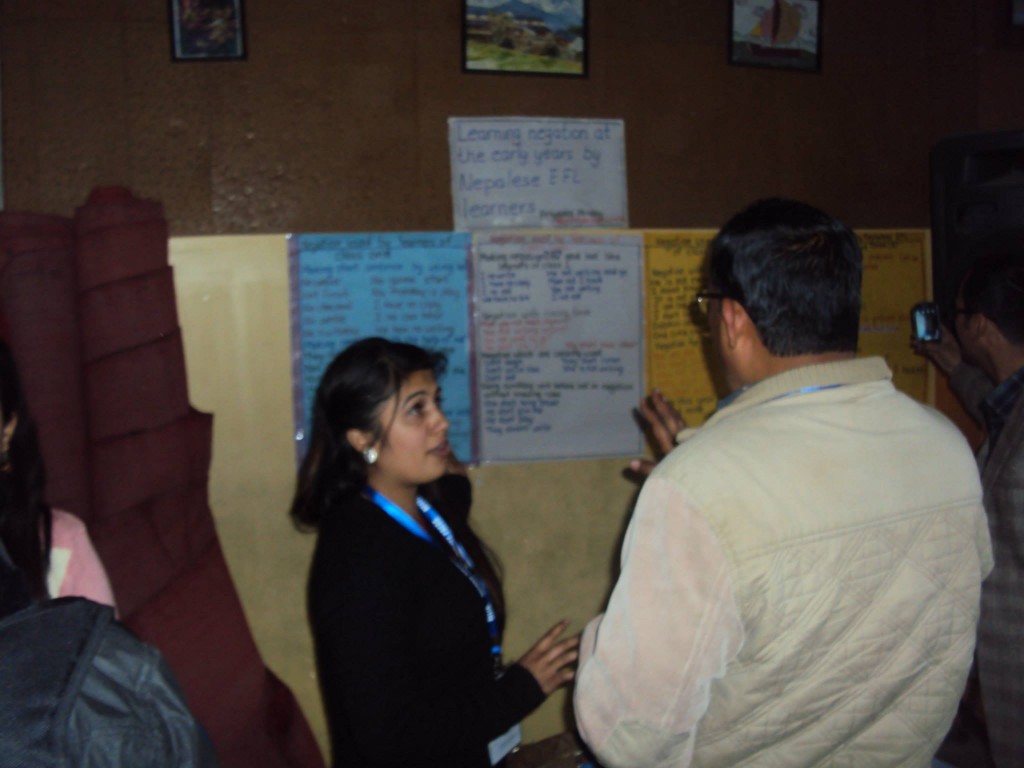
The first session in the ILF was at 1 pm and the second was at 1:35 pm at different halls. During the ILF session, I talked to the participants on ‘learning negation at early years by EFL learners in Nepalese context’. I mainly focused on developmental process of learning negation by Nepalese EFL learners at their early age. I found most of the participants were interested to observe developmental process of learning negation as it reminded their childhood. In the session, I enjoyed myself to interact with participants and also felt more confident as I talked to them. Likewise, I found most of the participants interested to listen to me and they were attentive in the session. Moreover, some participants gave positive feedback and appreciated my session.
Despite of nervousness, both of the sessions I have facilitated went well.This made me feel better and also encouraged me to present my paper in the days to come. I was very happy and got confidence and determined to show my strengths with the help of presentation in the days to come. From that moment I decided to overcome my fear which always blocks me to go further in my life.
To conclude, presenting paper in the conference of NELTA helped me boost up my confidence and I believe that it has a great impact on my professional development. It helped me realize my strength and encouraged me to present the paper in the upcoming conference as well. I wish to become a good presenter, which is an essential part of teaching.
Attending the twentieth international conference of English Language Teaching (ELT) last month was my first ever experience. I cannot help myself expressing immense pleasure to be a part as a participant in the mega event.
Like in the past years, it was the 20th time that NELTA organized the annual international conference that in Kathmandu. This year, the conference was held at DAV Sushil Kedia Vishwa Bharati Higher Secondary School, Lalitpur, Nepal on Feb 17, 18 and 19.And, the theme of the conference this year was “The Quest for Quality ELT: Riding the Waves and Creating the Landscape”.
In addition to the key note speeches, I attended in 10 plenary sessions, which included ‘whose woods are these….? By Vishnu S. Rai-postmodern ELT; Neuro ELT by Marc Helgessen; Teaching, Learning and Context by David Hayes; Tapping into the good learners in all of us by Elka Todevais writing colorless green ideas sleeping furiously together? by Abhi Subedi; Enriching linguistic and communicative competence through literature by Z.N. Patil; Learners autonomy in large class through innovative project-based learning by Ganga Gautam and Zakia Sarwara; From mimic men to global citizens, interpreting EFL from post-colonial and post-modern perspectives by Sanjeev Uprety; No just Action: Blend Activities with content by Laxman Gnawali and Whose Waves and for What quality; Non-Western philosophies for professional development in ELT by Balkrishna Sharma. All the ten sessions I attended were interesting and insightful. However, I found the three sessions quite interesting. Firstly, Marc Helgesen widely talked of learners need, interest and their neurological science in learning language. Secondly, Ganga Gautam and Zakia Sarwara talked about learners’ autonomy in learning, which I found most interesting and greatly useful. They presented free writing or project-Based learning strategies methods and their findings. The third, Laxman Gnawali talked about the flipside of communicative teaching method in language teaching and he also provided the solutions. He argued that communicative method followed by English teachers in Nepal hardly focuses on content.
Likewise, the two panel discussions I attended during the conference were impactful on participants. The first discussion moderated by Dr. Laxman Gnawali was about the role of literature in proficiency development of English language and panelists were Professors Abhi Subedi, Vishnu singh Rai and Tej Ratna Kanskar. The second discussion with panelists Jai Raj Awasthi from Nepal, Zakia Sarwara from Pakistan and Z N Patil from India were on ‘policy issues on ELT’, and it was moderated by Bal Krishna Sharma. They largely discussed on ELT issues and policies on ELT in the contexts of three neighboring countries.
Out of total 161 concurrent sessions in the three-day conference, I attended Flipping the classroom by Christina Torres (USA); Learners autonomy in ESL teaching by Faisal Naseer(Pakistan); Errors correction techniques in ELT by Jagdish Poudel (Nepal), Continuous Assessment to increase motivation by Soniya Urfat Urmee (Bangladesh); Active, independent and lifelong English language learning(part-i) by Umer Farooq (Pakistan); Story writing through a creative fun game by Umes Shrestha(Nepal); look ma: I did it-Reclaiming the joy of learning by Elka Todeva (USA); Working with teachers in the Quest for Quality ELT, Understanding and controlling our experience by David Hayes(UK); Collaborative Approaches to writing effectively in a large class by Chiranjivi Sharma(Nepal) and lastly New media technology for ELT: what and how, by Praveen Kumar Yadav (Nepal). I found each session with own importance and value. Mostly importantly, I came to know that language (English) teaching and learning has wider perspectives of issues and challenges. I learnt about different innovations and investigations in the field of ELT from different countries. Most of the presentations focused on how to teach effectively.
Another interesting session was interactive language fair session, which was coordinated by Dr. Laxman Gnawali. For the fair, 18 presenters stood with their stalls and explained the visitors about their presentation stuffs. I found it most effective session among all sessions, wherein I had an opportunity to meet talk and share our experience face-to-face with the presenters and participants.
As an ELT practitioner, while attending on this mega event I learnt about wide range of ELT issues focusing on diversified areas covering alternative assessment, leaning outcomes and teaching effectiveness, ICT in ELT, creative writing, critical thinking, academic writing, critical thinking, teacher professional development, literacy in EFL, literature in pedagogy, mother tongue education and EFL, multilingualism, trends and research in EFL, new media in ELT, and fun games in ELT. The conference was a get-together of English language teachers, I was able to meet many of them including Dr. Laxman Gnyawali, Ganga Gautam, Rishi Rijal , Balram Adhikari , Umes-Shrestha and Praveen Kumar Yadav. For me, it was also a networking event, I met many of the participants from Nepal and other 16 different countries for the first time and exchanged our experiences and email addresses with a hope to become friends to do the same in future.
Acknowledgment:
I am indebted to the support of our teacher Miriam Corneli from the US, English Language Fellow for Nepal, who I believe is a great ELT scholar. I was one among ten M. Ed. students from MRC Tahachal Campus, who Corneli sponsored for the participation. Through essay writing contest, the ten of us were selected for the reward and the opportunity to attend the conference.
Prem Bahadur Bishwakarma, an English teacher from Surkhet district, had longed for the past few years to attend a mega event of English teachers and participate in the discourse of English language teaching methods and practices. He teaches English at SOS Hermann Gmeiner School, Surkhet.
Eventually, his wish came true this year and now he is in the capital to learn about different English language teaching (ELT) methodologies practiced across the globe. He was happily sharing his experience of teaching English during interactions with other ELT practitioners.
Although Bishwakarma has been teaching English to secondary level students for a decade, after attending the program he realized that he had actually yet to know a lot of things about teaching English.
“I found out that way of teaching this language has changed a great deal. People like us hardly have such knowledge. It has really turned out to be a great opportunity,” said Bishwakarma.
Another English teacher, Durga Kumari Devkota, who teaches at Kanya Secondary School in Birgunj is also in the capital to attend such a program for the first time in her life.
She was encouraged by her colleagues to participate in the program. Interestingly, when she set off for the journey, she also managed to persuade few more teachers to join her to attend the international conference in Kathmandu.
With a view to enhance their knowledge and skills in teaching English, over 800 participants from across the country have thronged to Kathmandu to attend the 20th international conference of English language teaching organized by Nepal English Language Teachers´ Association (NELTA) from Tuesday.
The three-day-long conference that will conclude on Thursday is organized under the theme ´´The Quest for Quality ELT: Riding the Waves and Creating the Landscapes.”
Inaugurating the conference, Minister for Foreign Affairs, Mahendra Bahadur Pandey said that English language is not just a lingua franca as it is seen around the world today as a passport to global competition.
“English is the key to vast treasure of knowledge and skills and it is also the means to economic prosperity,” said minister Pandey. “Hence, English teachers must enable themselves to cater to the learners´ needs.”
Minister for Foreign Affairs, Mahendra Bahadur Panday, inaugurates the 20th international conference on English language teaching, organized by Nepal English Language Teachers’ Association in the capital. Over 800 English teachers have gathered to take part in the conference.(Republica)
“Professional enhancement through such conferences and workshops could prepare them for the job,” he said referring to the 3-day event organized by NELTA.
Meanwhile, Lava Deo Awasthi, joint secretary at the Ministry of Education, said that teachers at community schools that are switching to English as the medium of instruction need to develop their proficiency in the language first. “Only then they can effectively deliver the contents to the students in English,” Awasthi said. At the same time, he also expressed worries over threats to local languages resulting from the increasing focus on English language.
“English is important, no doubt. However, this somehow undermines the existence and development of local languages,” joint secretary Awasthi said.
Prof Abhi Subedi, Prof Tirthraj Khaniya, Prof Govinda Raj Bhattarai, and Prof Jai Raj Awasthi were some of the figures who spoke at the program.
The key speakers Professor Elka Todeva from SIT Graduate Institute of Brattleboro in the United States and Professor David Hays, from the UK, who is currently involved in Brock University, Canada, facilitated the plenary sessions focusing on challenges and opportunities of English language teaching all over the world. In addition, experts from Nepal and delegates from 16 different countries, including India, Japan, the UK, Pakistan, Bangladesh, China, Sri Lanka, UAE, the US, Indonesia, South Korea, Malaysia, Taiwan and Thailand are presenting papers, posters, and participating in workshops related to English Language teaching during the conference.
The conference includes 10 plenary sessions, two panel discussions, 161 con-current sessions and 17 interactive language fair sessions. The presentations cover a wide range of ELT issues focusing on alternative assessment, use of information communication technology (ICT) in ELT, creative and academic writing, teacher professional development, literature in pedagogy, mother tongue education, and current trends and other researches in English language teaching.
During the conference, a special book exhibition with relevant books for the participant English language practitioners has also been arranged with the support from Cambridge University Press, Oxford University Press, Routledge, Collins and the local publishers, informed NELTA President Hemant Raj Dahal. “The participants will be offered special discount on the purchase of books,” he added.
NELTA is a non-government professional association of English language teachers across the country. Through the membership of 3000 ELT practitioners and 43 branches, NELTA has expanded across the country to provide English language teachers with an academic and professional platform for sharing their ideas and networking.
Community schools at a crossroads
A significant number of community schools across the country have already started teaching in English medium while many others are preparing for the shift at a time when they are struggling to deliver quality education due to lack of resources.
However, such a shift has not led to impressive results, linguists say. Every one knows that community schools are taking the step just to retain their students.
“I see the move as a desperate attempt to compete with private schools rather face closure in lack of students,” said Ganga Gautam, a teacher trainer, who is also an associate professor of English Education at Tribhuvan University.
No doubt, community schools that have started teaching in English medium are able to attract more students than before, according to Gautam. “This move is just to ensure their survival,” he said.
Unfortunately, the government has not yet formulated any clear cut policy on English Language Teaching (ELT). Last year, a committee of ELT experts from NELTA reviewed the government plans and policies in order to find any clause related to English. One of the committee members, NELTA president Hemant Raj Dahal, said, “We could not find any clause related to ELT in those documents except in the last School Sector Reform Plan.” Dahal said this during a panel discussion on policy issues on ELT on the second day of the conference on Wednesday. The panel discussion, moderated by Bal Krishna Sharma, a PhD scholar at the University of Hawaii, USA, saw participation of English language experts, Prof. Jai Raj Awasthi from Nepal, Z. N. Patel from India and Zakia Sarwar from Pakistan.
Unlike in India, there is no clear English language policy in Nepal and Pakistan, according to the panelists.
“The contents of other subjects when delivered in English at community schools cannot be rich and resourceful in our context because teachers are not efficient enough in English,” moderator Sharma argued. Prof. Awasthi suggested that the government needs to have a concrete policy on English language teaching based on empirical research. “Then the policy should clearly state that children should be taught English at what age and from which grade.”
Recently, the government allowed community schools to switch their medium of instruction to English if they find themselves capable, according to Prof Awasthi, joint secretary at the Ministry of Education. However, the government has established no mechanism to check whether schools shifting their medium of instruction to English are fully prepared, according to the teachers.
Without adequate preparations and proper plan, this move at community schools for English medium instruction has brought them at crossroads.
This news story written by the author was published in Republica (English National Daily) on February 19. Click here to the original publication.
Interview with Hornby School Tutor Dr. Amol Padwad
Amol Padwad, who took over the presidentship of ELTAI in July, 2010, holds a master’s degrees in English and Russian. He has other degrees to hiscredit like M.Phil (English), LL.B and PGDTE (CIEFL). He also did M.Ed. (TESOL) from University of Leeds, UK on the Hornby Trust scholarship. Currently the head of thePostgraduate Department of English at J. M. Patel College, Bhandara (Maharashtra), he was a moderator of ELTeCS- India (the regional electronic network of ELT professionals, promoted by the British Council) for a number of years.
He has completed one and is working on three ELT projects, funded by the British Council and the Hornby Trust. He is associated with numerous professional and social bodies, and has published several articles and translations. Here’s an interview with him done by Ushakiran Wagle.
What was the main focus of the Hornby School in Nepal?
The focus of the Hornby School in Nepal was ‘learning in low-resource classrooms’. This one-week residential school was a follow-up on a similar school last year. The main objective was to enable teachers to deal with the problem of lack of resources in their classrooms. The approach of the school was not ‘experts bringing academic knowledge and readymade solutions’, but the participants sharing their rich and varied experience, their ideas and practices and helping each other finding ways of addressing the problem.
How was your experience of delivering the sessions at the School?
It was an immensely enjoyable and enriching experience. The group had in it a range of countries (Nepal, India, Pakistan, Bangladesh), school contexts (urban/ rural, private/ state, primary to tertiary) and participant profiles (novices/ veterans, male/ female, various qualifications). There was a lot to learn from and share with each other. The sessions were all participatory and collaborative, and participants contributed actively and seriously to each session. The tutors Richard Smith and Jovan Ilic also brought in their rich experience, varied perspectives and ideas from other contexts.
Did the focus for the school and the local context here in Nepal match? If not, how did you respond?
The focus of the school had a great relevance to the local context in Nepal, I believe. As I understand, shortage of resources is a perennial problem in most Nepalese schools. Most schools have what we would term ‘low-resource classrooms’. So the proceedings of the Hornby School, we hope, were very useful to the Nepalese participants, who must have carried home several ideas and insights from the School to be tried out in their classrooms.
What is your opinion on the global trends and local context difference? How can we as ELT professional balance?
Especially in the case of ELT, we (meaning the countries in SAARC region) show a general tendency of blindly following whatever latest trends and techniques that come to us from the West. Global trends, which for us normally mean Western (especially UK-USA) trends, are either completely and uncritically accepted, or completely and equally uncritically rejected. Take, for example, communicative language teaching, to which we have shown one of these two extreme reactions. What we need is not to accept/ reject the whole package, but unpack it and see what has relevance for us and needs to be discarded. I personally believe that the ‘original’ Western model of CLT is not feasible/ relevant in our countries, but also that there are some really great insights and ideas which we may ignore to our peril. As ELT professionals, we might ask of every new development the ‘WIIFM’ question – ‘what’s in it for me?’
What is your final message to the readers?
My final message to the readers (who are all teachers, I guess) is – a teacher can and does make a world of difference to every classroom, whether we like it or not. But it’s in our hands to try to make a planned, thoughtful and positive difference to our learners and classrooms. The first step of making this positive change is to start changing ourselves.
Perhaps no one exactly knows if the early human being was ‘man’ or ‘woman’. But in the Biblical tradition, it is said that God created the two sexes; ‘Adam’ first and ‘Eve’ later by taking of a rib from Adam. God gave Adam the right and power to name and domesticate the animals. This might be the reason why the terms such as ‘mankind’ instead of ‘womankind’; ‘manhood’ instead of ‘womanhood’; ‘boyhood’ instead of ‘girlhood’; ‘brotherhood’ instead of ‘sisterhood’; ‘forefathers’ instead of ‘foremothers’ were coined and have been very common. English has a lot of words which are formed by adding the terms referring to maleness such as headmaster, manpower, man-made, man-to-man, prehistoric man, man-eating tiger, manhole, fireman, postman, chairman, and so on. Similarly, terms referring to men are put first in the pairs as if the women are the second sex such as father and mother, uncle and aunt, man and woman, king and queen, husband and wife, sir and madam, lord and lady, master and mistress.
English ideology “All men are created equal” is itself gender -biased. Why can’t we say “All women are created equal”? We can find ‘male’ as a base or root for ‘female’, ‘man’ for ‘woman’, ‘he’ for ‘she’, and ‘Mr’ for ‘Mrs’. These terms show that women are semi-human beings, or subordinate or marginal creatures. Female terms are also formed from the male terms by adding the suffixes such as –ess, -ette, e.g. poet/poetess, author/ authoress, actor/actress, major/majorette, usher/usherette. These examples show that men are core and women are derivative of men. The famous linguist Janet Holmes views that the use of an additional suffix to signal ‘femaleness’ is seen as conveying the message that women are deviant or abnormal. It has also been suggested that the suffixes like –ess and –ette trivialize and diminish women, and when they refer to occupations such as ‘authoress’ and ‘poetess’, carry connotations of lack of seriousness. Because the word ‘woman’ does not share equal status with man, terms referring to women have undergone pejoration. If we examine pairs of gender-marked terms such as lord/lady, baronet/dame, Sir/Madam, master/mistress, king/queen, wizard/witch, we can see how female terms may start out on an equal footing, but they become devalued over time.
The English language discriminates against women. When we give our speech, we begin our speech with ‘Ladies and gentlemen’. Does it mean that ladies are not gentle but only men? Why are the men just men but the women are ladies too? Women are given a title, either ‘Miss’ for unmarried ones and ‘Mrs’ for married ones, but men, whether they are married or not, are given a title ‘Mr.’ Why should we distinguish women as married and unmarried by giving the corresponding title but not for men? Janet Holmes also views that women may also be described or referred to in terms of food imagery such as ‘sugar’, ‘sweetie’, ‘honey’, which is equally insulting. We greet the male teacher using more formal term ‘Bhattarai Sir’ but informal term is used to address the female teacher ‘Meera Madam’. We only use the term ‘doctor’ for male but ‘lady/woman/female doctor’ for female one which conveys the idea that she is not the ‘real’ thing. The word ‘professional’ used with the men has positive sense but with the women has the negative sense i.e. they are prostitutes. Similarly, the term ‘businessman’ has positive connotation but the term ‘business girl’ is used as a slang term for a prostitute. We can say ‘She’s John’s widow,’ but we cannot say ‘He’s Sally’s widower.’ Linda can be described as Fred’s mistress but Fred cannot be described as Linda’s master. Men play golf and cricket, while women play women’s golf and women’s cricket. Why so?
The famous sociolinguist Suzanne Romaine views that language has helped to gender the way we think about space; men’s space is public, in the workplace, while women’s place is private and in the home. This difference is encoded discursively in expressions such as working mother, cleaning lady, businessman, policeman, housewife, making it easier to accept as ‘natural’ the exclusion of women from public life. We have the English phrase ‘career woman/girl’ but not the ‘career man’ as if men by definition have careers, but women who do so must be marked as deviant. Similarly, a man can also be ‘a family man’, but it would be odd to call a woman ‘a family woman’ as if women by definition are family women.
Many grammatical forms are also found gender-biased. We can see or read the texts where the use of masculine pronouns ‘he’, ‘him’ and ‘his’ is very common, e.g. ‘Everyone should get his hat.’, ‘Somebody has forgotten his umbrella.’, ‘The average student is worried about his grades.’, ‘Each student will do better if he has a voice in the decision.’ etc. These sexist practices have promoted to the ‘he/man approach’ to language as the scholar Wendy Martyna says, that is, the use of male terms to refer both to males in particular and to human beings in general designates men as the ‘unmarked’ and women as the ‘marked’ human category. Experiments have shown that women feel excluded when they read texts with generic ‘he’, ‘him’ and ‘his.’
Feminists have claimed that English is a sexist language which has marginalized women. Sexist language has been drawing the fire of feminists for several decades now, and a number of linguists and sociolinguists have turned their due attention to the issue. To reduce sexist usages and make the language more inclusionary, new gender-neutral terms have been suggested by feminists such as ‘tey’ to replace ‘she’ and ‘he’, or combining them as ‘s/he’; ‘Ms’ to replace ‘Mrs’ and ‘Miss’; ‘chairperson’ or ‘chair’ for ‘chairman’; ‘fire-fighter’ for ‘fireman’; ‘letter carrier’ for ‘postman’; ‘police officer’ for ‘policeman’; ‘prehistoric people’ for ‘prehistoric man’ and so on. Besides these, the scholars Rebecca Freeman and Bonnie McElhinny mention the five guidelines or strategies suggested by the Linguistic Society of America (LSA) for avoiding the use of the generic masculine pronoun: First, drop the masculine pronoun (e.g. The average student is worried about grades.); second, rewrite the sentence in the plural rather than the singular (e.g. Students can select their own topics.); third, substitute the pronouns ‘one’ or ‘one’s’ for ‘he’ or ‘his’ (e.g. One should do one’s best.); fourth, use ‘he’ or ‘she’, ‘his’ or ‘her’(in speech and writing) or s/he (in writing); and fifth, use ‘their’ when the subject is an indefinite pronoun (e.g. Everybody should get their hat.). Feminists now think that as long as women must use a language which is not of their own making, change is impossible. As an output, some women refer to themselves as ‘actors’ rather than ‘actresses’, ‘poets’ rather than ‘poetesses’ and so on. The sociolinguist Suzanne Romaine writes that many women authors, now-a-days, deliberately use ‘she’ as the generic pronoun to shock their readers. She presents the idea of one feminist as ‘if there are men who feel uncomfortable about being excluded, they should think of how women feel within minutes of opening most books.’ If women feel being excluded, they will not be motivated to read the texts that impede their comprehension. Therefore, let’s create anxiety-free texts by using gender-neutral terms and expressions in order to create linguistic harmony in the linguistic world.
The author teaches at Sukuna and Pathari Multiple Campus, Morang and is a treasurer of Nepal English Language Teachers’ Association (NELTA), Morang branch.
If you had known me five years ago, you would have known me as a news reader in the national radio. You would have heard: This is Radio Nepal. I am Umes Shrestha and you’re listening to the news. First the headlines.
That was my daily routine. Translate the news. Edit them. And go live. I still remember the day I went on air for the first time. Inside this small square studio, I was literally shaking behind the microphone. Needless to say, it was a scary and entertaining job. Getting to speak to the whole nation through the prestigious national radio. It was a dream come true. That’s what I thought at that moment.
But as the years went by, my enthusiasm for the job started to wilt. Something started to bother me. May be it was the routine job. May be it was the same political news day in and day out. But definitely I needed a change.
So after sitting on the same chair for almost half a decade, working on the same PIII computer and going into the same old battered news studio of Radio Nepal – I decided to quit the job.
I went to see my news in-charge. And I told him: Sir, I’m leaving the job.
He turned his big baldhead towards me, stared into my eyes and said: But you are good at it. And I shocked him with this answer: Yes sir, and that’s the reason I want to quit this job.
You see, for almost half a decade, I lived in my comfort zone of that studio and embraced mediocrity. I was the best at being an average. I lost my drive because it was easy, it was patterned and it was getting boring. I had hit the rock bottom.
When I told about this to my mom – she got really worried and said: How can someone even think of leaving a sarkari jaagir? I told about this to my close friends. They reacted the way my mom did. I told this to my to-be-wife. With complete disbelief in her eyes, she told me: You’d better have a good plan – because we’re getting married soon.
But I did leave the job. And after a few months of soul searching, I started teaching in a school and a college. It was my calling. It was what I was meant to do.
And then, I got my hand on the book that changed my life. It was “Leaving Microsoft to Change the World” by John Wood. I suppose, you have gone through this book. One thing I’ve learned from the book is – if you remain happy in your comfort zone, you will settle for that happiness and will eventually stop dreaming for something better.
I am in no way trying to compare myself with John Wood. He left Microsoft and his lucrative salary. He started an amazing organization Room to Read from the scratch. I – well, I left a minor job. But he and his book are always an inspiration to me. The book keeps me reminding to step out of my comfort zone and do something challenging.
I am a teacher, and I want to do something amazing, inspiring and even crazy. I want to be the guy who left Radio Nepal to change the world. Big dream, hai? I believe teaching is a very challenging job. At the same time, teaching is a very rewarding and inspiring job. And I also believe that – teaching can change the world for real.
Please read this book.. it might just change your life as well.
When it comes to teaching of English, the pedagogy takes the centre stage. Every teacher asks: how shall I teach English? And they further ask: which is really a good book? I say there is not one single book which is good, there are several of them. Each book is good and useful in its own way. So, if we want to teach English effectively and also in a way we do not burn out, we need to select some really good books.
I share this list with you. They are some of the key books: some of the must-read books. And I have got questions for you. Once you have gone through this list, please see the questions below the list. Then, respond to the questions in the comments section.
1. Learning Teaching – Jim Scrivener
LEARNING TEACHING, that’s what it is all about. We want to learn teaching and we can learn teaching if we have this book: Learning Teaching. This book is meant both for initial trainees and practising teachers. Jim does not just give theoretical ideas, he presents very practical tips. Read to believe me.
2. How Children Learn – John Holt
Here is why this book is worth reading for the educators to understand HOW CHILDREN LEARN, I just second to what Holt says, “When we better understand the ways, conditions, and spirit in which children do their best learning, and are able to make school into a place where they can use and improve the style of thinking and learning natural to them, we may be able to prevent (much of this) failure.” John Holt
3. Breaking Rules – John F. Fanselow
We can’t be innovative teachers if we just follow the rules that are given to us. So, how do we innovate? It’s by BREAKING RULES. And breaking rules should be our way of life. As Fanslow says. “Only by engaging in the generation and exploration of alternatives will we be able to see. And then we will see that we must continue to look.” Love this book to learn how to break rules.
4. The Practice of English Language Teaching – Jeremy Harmer
Want a comprehensive book on the best PRACTICE OF ENGLISH LANGUAGE TEACHING? Here is the book by Harmer. Just go through this book and you will find a review of global English, ideas to help you continue your professional development alone or with others, methodology for teaching all the skill sectors in ELT. Your practice will definitely improve.
5. How to Teach Speaking – Scott Thornbury
Teachers who practise communicate language teaching in the EFL classes sometimes wonder how to develop students’ speaking skills help them overcome their hesitation. Are you one of them? Here is something you shouldn’t miss? Great ideas to learn HOW TO TEACH SPEAKING. Ideas for teaching English inside the class as well as well as ideas for developing confidence in using English outside the classroom.
6. A Course in English Language Teaching – Penny Ur
You may be an EFL teacher or a teacher educator or both. You may be looking for a comprehensive reference book on ELT methodology. Covering all language skills and aspects and extending to the syllabus design and teacher development, Ur presents this COURSE IN ENGLISH LANGUAGE TEACHING that answers any methodology related questions you may have.
7. Laughing Matters: Humor in the Language Classroom – Peter Medgyes
You want to teach English in a fun way? You want to use humour in the English? You want to see your students as active in the end as in the beginning of the class? You want to have LAUGHING MATTERS to use in your English class? Just go for it. As someone said, “It provides over 120 activities which will inject some light-hearted fun into lessons whilst still being grounded in respected educational theory.”
Here are my questions for you:
Do you have these books? Do you use them? Would you recommend them to other teachers? Which one(s)?
Hu Xiao (Joseph is his English name) is one of the trainers of the workshop***. He holds a master degree in Teaching Chinese to Speakers of Other Languages (MTCSOL). He has also been teaching in BICC for two years. He loves traveling and playing guitar. Here is the interview with Joseph on Chinese Language teaching. I hope you find it interesting and useful.
What is the scope of Chinese language teaching and learning across the world? Why do you think foreigners should learn Chinese?
We hope that Chinese language teaching will be worldwide, just like French Alliance.
I think that China is a country with tons of people as well as opportunities, once you learn Chinese you’ll get the chance to communicate with one of the most potential nation.
As a language teacher, what problems and challenges do you face while teaching Chinese to the foreigners? And how do you overcome them?
The biggest problem or challenge i think is the teaching of Chinese characters. This is because foreign people are afraid of Chinese characters.
I think the Chinese teachers should not only teach the character itself, but also teach the background and the formation of characters. By that can let the students get interested in learning Chinese characters.
Does English language help you in teaching Chinese to foreigners? If yes, in what ways?
Definitely, especially in communicating with the beginners. We call English the “mediator”, but when a learner learns more and more, the use of English should be less and less.
Could you please share with us some phonetic difference between English and Chinese language?
For example, ‘j, q, and x’ in Chinese pinyin. In linguistics, we call them “the sound of tongue blade”, but in English we don’t have a sound like that. When the English-speakers start learning these 3 phonetics in Chinese, they find very hard to pronounce them.
Finally, would you like to convey some message to those interested in learning Chinese language?
We’d like to invite those who are interested in learning Chinese language to attend some Chinese language learning activities held by your country’s Confucius Institute. Because that is the place that you may directly feel the Chinese culture and language. Also if you are not that convenient in learning Chinese in class, you may choose the internet learning. Making more Chinese friends is also a good way to learn Chinese, because the Chinese people are always surround other countries’ people.
***
I have recently attended the ‘2015 China Workshop Program for Foreign Chinese Language Teachers’ at the campus of Beijing International Chinese College (BICC) in the Olympic Village in Beijing, Capital of China.
Over 30 teachers from Russia, Mongolia and Nepal participated in the China Workshop Program for Foreign Chinese Language Teachers, sponsored by Hanban. This workshop/training program is specifically designed to encourage foreign teachers to become Chinese language teachers and promote the Chinese language and Chinese culture outside China. The training course included 100 class hours, plus numerous sightseeing and cultural activities. The courses taught during the workshop were based on the needs of the Chinese language teachers; the main focus was on teaching the foreign participants the theory and methodology of teaching Chinese; and the application of modern educational technology in Chinese language teaching and cultural practices.
All the BICC trainers for this workshop are the full-time Chinese language teachers and guest professors from Beijing University, Beijing Language and Culture University, Beijing Normal University and Beijing Foreign Language University.
Travelling is something I’ve always craved for since my childhood. My passion for travelling has led me travel to many places across the country and recently abroad, fortunately. In the autumn (October-November) of 2014, I visited Eugene, Oregon, USA, to participate in a three-week-long E-Teacher Professional Development Workshop sponsored by the U.S Department of State’s Bureau of Educational and Cultural Affairs (Office of English Language Programs) and the University of Oregon, Linguistics Department/American English Institute (UO AEI). I was chosen for the program based on my performance in the online E-teacher Course I had attended virtually. I was one among 24 participants representing 24 different countries. I not only represented Nepal but also Bangladesh, Sri Lanka and Maldives.
24 participants from 24 different countries
Before I traveled to the US, I had different perceptions and curiosities. This was not only the first time I was traveling to a foreign country, it was also the first time I was making a long journey alone. I was both nervous and excited during the trip. Sometimes, I thought about missing a flight, losing my belongings, and so on. But fortunately, I did not face any trouble at all.
The E-Teacher Professional Development Workshop was held in a beautiful campus of University of Oregon (UO), Eugene. The campus looked so colorful and fascinating with almost five hundred species of trees in its premises, that has made this Oregon more unique in its beauty. Above all, I believe peaceful and fresh environment, generous people, special educational system, and remarkable natural beauty together have made a great ambience for the program.
After having a complementary continental breakfast at the Phoenix Inn Suites, located near the UO campus and downtown Eugene, we attended the morning sessions of the workshop at the Phoenix Inn itself. The sessions were held from 9 am to the noon. Following the morning sessions, we always moved to the UO Campus, Carson Dining Hall for our lunch, which consisted of a variety of food items.
The workshop sessions were designed and delivered in such a way that triggered to make us (participants) more interactive and engaging. I found most of the contents related to Nepalese contexts as well. I really got surprised from the commitment, support of my instructors, management and overall American English Institute (AEI) faculty. What a wonderful management for the workshop! Overall, the sessions, instructors and the materials were incredibly awesome.
Class Observation
Meanwhile, I also got the opportunity to observe the classroom. I mainly observed two English classes at the UO. The first class was at high intermediate level at B13B Klamath with Ms. Stef Brewer. I saw the students discussing Museum and the Art (They had gone there the previous week) in different groups. I also joined with one of their groups and learned about their journey to the museum. The group had some non-native speakers of English whose English language was not very proficient, so to improve their English speaking skills, two graduate students who are native speakers of English, joined the conversation. The graduate students were visiting tutors to them. During the conversation with the tutors, I found they would visit the class twice a week and they also wanted to become teachers. At last, the students were assigned to come up with the problem solving questions and they had to solve in the group. This is the approach they followed to assess the students, I learnt. I really liked this idea to help the learners improve their language skills.
Another classroom I observed was writing at 322 Library with AEIS110 (American English Institute) students. During the observation, I found that the students were non-American (Chinese) and they were taught English grammar. The tutor told me that they were very good at their English speaking skills but they did not know the rules. That’s why they were taught English grammar, the tutor added. This is what I found completely different from our context. Overall, I enjoyed observing both the classes and learned a lot about the new systems which I was not familiar with before.
Observing English Language Class at Academy of International Studies
Likewise, one of the wonderful schools I have ever visited was Academy of International Studies, Woodburn School District. This is an outstanding multilingual school district which motivates and empowers all students to succeed. I was fascinated from different systems and facilities provided by the school. The main mission of the school is to engage, inspire and prepare all students to learn and lead in a global society. The school principal was very kind and supportive. Despite busy schedule, he spent the whole day helping us to observe the classes. I found the Spanish class, German class, and English language classes all interesting. The teachers were highly active and experienced. Above all, what amazed me the most was the goal of the school, which was to produce multilingual students. Multilingualism is viewed as an important and powerful goal of education in more places around the world and we should learn this lesson in Nepal.
Sightseeing
Apart from the workshop and class observation, the sightseeing was wonderful. I visited to different famous places during my stay in Eugene. The first trip was at Oregon coast and Oregon Coast Aquarium. For me, it was also an opportunity to see new and different creatures such as Sea Otters and harbor seal, which I was not familiar with before. The main interesting thing I witnessed there was the time to feed the creatures and see them behaving like human beings.
What I enjoyed doing the most in Eugene was ‘shopping’. Mainly, Bestbuy, Wallmart, Market of Choice and Macy’s, Target were among the different shopping places I visited. I found ‘Best buy’ as the best place to buy electronic items. How could I forget the moment when I was about to lose my way when I went for shopping in ‘Wallmart’? But later with the help of the systematic maps in each and every bus station and the very kind bus drivers, I was able to find out the suitable way.
Newport, Bayfront was another great place for shopping and sightseeing that I could explore during my trip. Although I did not buy lots of things there, I enjoyed watching them and find new things there. I also visited to the Newport lighthouse, beach walk and a great city, New York. Wherever I went, everything was amazing and I enjoyed my visit a lot.
Learning American Culture
Celebrating Halloween
My trip schedule to the US included exploring American culture as well. As a part of American culture, Halloween, a cultural event, is the most amazing experience I had during the trip. I was very excited to celebrate this event, so I and my colleagues went to a local farm to purchase pumpkins. Then, after a very few days, it was the time for Pumpkin Carving for Halloween. It was nice to see all in different looks wearing different cultural Halloween things. We enjoyed a lot taking pictures and having party at Phoenix Inn, Hospitality room.
Then I could participate in a cultural exchange program’ at ‘Knight Library Browsing Room’. The University of Oregon (UO) faculty and staff and invited officials and community members had attended the program, wherein I shared information about Nepal, my country, and Nepalese culture. Everyone seemed enjoying the program and we also distributed some cultural items to the participants. It was really nice to see almost all the participants in their own national customs. Overall, I had a wonderful experience I have ever had.
Final project
Finally, I was supposed to do was to design a project to deliver two-hour workshop in my home country, Nepal. Then, I started working on my project (Team Building) which is suitable in our context. We were 24 participants from 24 different countries to collaborate, discuss and work in the groups which made us easier to work on the project.
Working on the project
Then there was the time to deliver a 30-minutes presentation about my project which was the part of my two-hour workshop. New place, new people and the new things to do, I was a bit nervous. My nervousness grew further after I came to learn that the presentations were broadcast live worldwide and open to the public. Despite of my anxiety, my presentation finally went on well and it was fun and engaging to the participants. It was nice to get positive feedback from the participants including instructors. It was a great learning that there was nothing to be nervous but this way I built up confidence.
To conclude, I spent three busy weeks in beautiful Eugene of Oregon. I feel myself recharged with lots of experiences and excitements back to Nepal. Each place I went was rewarding and stimulating. I wish we had similar roads, physical infrastructure and all the facilities I saw during my trip to the US. I believe the trip was the most exciting and fruitful moment I have ever had in my life. It was simply awesome learning.
—
The author is doing her Masters in ELT from Kathmandu University.
Those who teach English are taken as busy teachers in Nepalese context. Having abundant opportunities for English teachers is probably the key reason for their busier schedules. And many of them claim that they cannot just make their earning sufficient, teaching at just one institution.
“For busy teachers like me, the americanenglish.state.gov is the hub for resources,” said Praveen Kumar Yadav, an English teacher who participated in a training facilitated by me in December. Yadav, who is working for King’s College and Republica English national daily simultaneously, said, “I found the website not only useful for English language teaching but equally for English language learning.”
Even though he has been surfing internet and exploring online resources for English language learning and teaching for the last five years, he had never come across the americanenglish.state.gov before the workshop, Yadav said.
Like him, fourteen English teachers from primary to tertiary levels attended a three-day teacher training workshop organized in King’s College, Kathmandu recently. The main objective of the training ‘Maximizing American Space Resources for English Language Enhancement’ held with assistance of the US Embassy Nepal, was to make the participant teachers familiar with online resources managed by the US State Department, especially americanenglish.state.gov, which are freely accessible all over the world.
Divya Nakarmi, another participant English teacher at DAV School, used to spend most of her time in developing materials for her classroom to teach primary level students. She felt herself over the moon after she came to learn about the americanenglish.state.gov
“This website is incredibly awesome with number of materials I can use in my classroom. I find americanenglish.state.gov an amazing site to solve all my problems,” Divya said. “I don’t have to worry about the materials required for my classroom as I can download them easily from the site itself.”
Immediately after learning about americanenglish.state.gov, one of the participants, Prajwal Singh Thapa, who is pursuing his masters in ELT from Kathmandu University, said that he would constantly browse it.
“To avoid the monotonous class environment, the online resource could be very helpful for me to find various techniques to make the class interactive,” Thapa said.
The website ‘americanenglish.state.gov‘ is a very useful online resources many teachers like me find user-friendly. Once you visit this site, there are two main gateways: Teach and Learn.
The Teach site offers the materials to teach English that include activities, lesson plans, games, songs, stories, reading and writing activities. It also contains the professional development materials including the webinars and teacher training materials. You will also find announcement of the webinar series and other e-teacher training opportunities on this site. Similarly, there are activity books, interesting games ready-to-use materials for busy teachers.
Once you explore the site, you will be addicted to it ! If you would like to make your English class effective, interesting and you would like to have fun while teaching English, this is where you find the wonders !!!
—
The author is Reader in English Education at Tribhuvan University. He is also an executive member (Immediate Past President) of NELTA.
Every January first, people all over the world celebrate New Year in many different ways. Making resolutions is one among many things that most people do. A resolution is a promise to change or do something different in the coming year.
People from all walks of life make New Year’s resolutions as it is a common tradition today. In a recent training, we spoke to participant English teachers about their resolutions, hopes and wishes for 2015.
Priyanka Pandey, one of English teachers, talks about her New Year’s resolutions. She hopes to complete her masters’ thesis and build on her vocabulary.
Another participant, Padam Bahadur Nepali, who teaches English to secondary level students, resolves to explore, learn and practice effective techniques to teach grammar.
Parista Rai, like Priyanka, wishes to complete her master’s thesis and translate the knowledge from the recent training into practice.
As a primary level English teacher at DAV School, Divya Nakarmi, who originally hails from Birgunj, makes New Year’s resolution to make 2015 a memorable year by collecting and developing a lot of materials for different activities of English language learning and teaching.
Making her classroom more interactive and engaging is New Year’s resolution for Sashi Kyasthya.
Similarly, Sodhika Dhungana’s New Year resolution is to make the best use of americanenglish.state.gov to learn different techniques to enhance her language skills.
Prajwal Singh Thapa also makes similar New Year’s resolution like others. He wants to exploit the website ‘americanenglish.state.gov‘and get benefit largely.
Attending different teacher training to develop professionalism is one among other New Year’s resolutions Prasanna Karki makes.
Like Prasanna, Ganesh Kumar Khanal has similar New Year’s resolutions.
Leela Moktan, a student from Janakpur, who is doing her masters from Tribhuvan University, wishes to complete her studies and find a teaching job in 2015 as her New Year’s resolution.
Like all the teachers I spoke to, Yuwaraj Belbase, one of our valued readers, writes on the Facebook of ELT Choutari, his New Year resolution is to implement some innovative and strategic techniques inside and outside the class.
Meanwhile, Umes Shrestha, one of Choutari editors, shared his New Year’s resolutions. He said:
My new year resolution as a teacher is:
To become better at dealing with teenage students To practice more to become a better presenter and a public speaker To explore the concept of entrepreneurship in teaching profession And, to make a lot of mistakes.
Last but not the least, on behalf of Choutari, my resolution here is to wish all of our valued readers, contributors and well wishers a happy, healthy and productive New Year 2015. May all of our resolutions bear fruit in the year ahead.
As a teacher of English, I have often noticed my students having problem in learning functions of language. Theoretically, they learn even much better than we expect but practically they are found struggling with basic functions of language. Almost three or four months ago, when I joined a new school to teach, I was shocked the first time when I heard students having difficulties in choosing and using appropriate language functions. Here basically students were found to have lack of knowledge of language functions. When I came to realize this, I started to talk to my colleagues and principal of school. They also agreed with it and asked me how to make the students learn language functions creating such environment so that students would be able to use them fluently and accurately in practical life. Since then I started to think of and look for the proper ways and techniques of teaching language functions in order to make them capable to use in appropriate time.
Therefore, I as a teacher read different articles and books regarding how to teach language functions to make it easier for my students to use language functions and came up with some ideas. So here in this article, I would like to talk about what language functions are, how language are presented, ways of practicing them, what are the stages of teaching language functions and some activities to teach language functions. Continue reading How to teach Language Functions→
Writing simply refers to the graphic representation of language. It is taken as an act of transmitting thoughts, feelings and ideas from mind to paper. As a student of ELT, I cannot write a paragraph, compose a poem or even narrate a short story. I have been practicing to write for more than fifteen years but I cannot write what I want, and how I want. The problem I was facing with regard to creative writing encouraged me to look out for the issues and challenges in teaching creative writing. Had my teacher taught me about creative writing while I was in school, I would have been able to write creative writing such as poetry, drama, story and so on. Creative writing is personal writing where the purpose is to express thoughts, feeling and emotions. Creative writing is expressed in an imaginative, unique, and sometimes poetic way. According to Harmer, “The term creative writing suggests imaginative tasks, such as writing poetry, stories and plays.” So it represents teaching writing of all genre of literature such as drama, fiction, poetry, personal narration, story and so on. According to Gaffield-Vile (1998), “Creative writing is a journey of self-discovery, and self-discovery prompts effective learning” (p. 31).
Morley (2007) states, “Some people believe there is something new or untested about the discipline of creative writing” (p. 7). Teaching creative writing is a very challenging job to the teachers even though they have lots of knowledge about subject matter. It is because of developed form or genre of language which expresses ideas, information and thoughts by graphic representation. I believe that the aim of teaching creative writing is to make the students able to express themselves in different literary forms. If a teacher gives imaginative writing tasks to the students, they will be engaged and self motivated to write frequently, so it is effective way to improve their skill and ability of language. There are so many issues and challenges of teaching creative writing like critical analysis, formation and structure, wider area, individual variation, untrained English teachers, insufficient time for instruction, lack of resources and materials which are discussed below in details.
Issues and Challenges of teaching creative writing
Harmer (2008) states, “The kind of writing we ask students to do (and the way they we ask them to do it) will depend, as most other things do, on their age, level, learning styles, and interests” ( p. 112).
Different Genre/forms of literature
There are various branches or forms of literature which is called genre. Harmer (2008) states, “A genre is a type of writing which members of a discourse community would instantly recognize for what it was. Thus we recognize a small ad in a newspaper the moment we see it because, being members of a particular group, or community, we have seen many such texts before and are familiar with the way they are constructed” (p. 113). These genres have their own rules, regulations, norms, values, principles, theories, structural patterns, features, types, formations and so on. The teachers have to build creative writing. For this they have to engage the students with creative writing activities which are easy and interesting to take part in, so it helps students to achieve the success in their writing. When students have gained sufficient knowledge of creative writing they can develop writing habit. Therefore the teacher should have the knowledge to teach different genres to make his/her students able to write creative writing.
Individual difference
Different individual may produce equally good results through widely different process. This means that there is probably no one ‘right’ system of writing that we should recommend; rather, we should suggest available various possible strategies, encouraging individuals to experiment and search for one that is personally effective (Ur, 1996).
Lack of Motivation
Motivation is commonly thought of as an inner drive, impulse, emotion or desire that moves one to a particular action. It is the main determinants of teaching creative writing. “It is easier and more useful to think in terms of the ‘motivated’ learner: one who is willing or even eager to invest effort in learning activities and progress” (Ur, 1996 p. 274). The more you motivate the students the more students are motivated and get ready for creative writing so it helps the teachers to teach creative writing effectively. Motivation promotes students’ active participation, so it helps the students to give uniqueness in learning, background for creative writing, and process of creative writing. Motivation helps teachers to provide ability to the students and make learners write creative writing. So we can say that motivation aids the students to achieve success in their creative writing attempts.
Untrained English teachers
The untrained teacher cannot teach the process of different genre of literature as equal as trained teacher. S/he lacks proper knowledge and will not be able to provide good ideas to write creatively and use different strategies and techniques to involve the students in creative writing. For example there are various ways of teaching poem like, acrostic poem (a poem where certain letters in each letters spells out a word or phrase), opposites poem (a poem where two opposite things can exist side by side in a person or situation), group poem (a poem written in a group where at least a line will be contributed by one person of a group) and so on.
Insufficient time for instruction
Teachers and students have limited time for their teaching and learning process in given time framework of institutions. Both students and teachers are inhibited by time, so creative writing is compelled to be taught only for the completion of the lessons. As a result, all the composition lessons are given to the students as homework and another aspect to the students’ difficulties is the perception that taking much time to write a composition is a sign of failure on their part. Unfortunately, students and teachers apparently fail to utilize the opportunity to process writing to fulfill their tasks satisfactorily. “The lack of the use of time to develop students’ creative writing skills led problems in teaching creative writing”(Adeyemi, 2012).
Focus on Surface Errors
Teachers are habituated to assess the students’ writing on surface errors by their profession. They give feedback to the students regarding spelling, punctuation instead of students’ creativity which doesn’t help to improve students’ creative writing ability. As the main focus is on structure as opposed to content or meaning, the students’ compositions will be meaningless and valueless. So intentionally or not, unsatisfactory message goes to the students, which indicates their lack of grammar, structure, punctuation rather than main issues or students’ intention of creative writing. Their intention, their creativity, their ideas and their effort goes unnoticed as teachers mostly focus on the surface errors and fail to acknowledge the hard work the students have attempted. It makes students hesitate and frustrated in themselves in their writing because of spelling, surface error, and punctuation marker. Certainly, there is more to composition writing than the mere issues of spelling and punctuation. Thus it indicates that it is not easy to teach creative writing to the students.
Writing Process
Writing process is also an issue in teaching creative writing. Some of the learner differences are because of their age, practice, motivation, cultural background, particular group etc. These create challenge to teach writing process to the students. Harmer (2008) states that, when students are writing for writing, we will want to involve them in the process of writing. In the real world; this typically involves planning what we are going to write, drafting it, reviewing and editing what we have written and then producing a final version. We will need to encourage students to plan, draft and edit for teaching creative writing so it is very challenging task for the teachers.
Prevention of issues and challenges of teaching creative writing
In order to prevent these issues and challenges, I have discussed some prevention and solutions in detail.
Assessing creative writing
Assessing creative writing helps students know their position and about their creativity through writing. So the teacher should evaluate creative writing by using the same criteria as for different genre. Morley (2007) states that, essays and examination materials tend to be assessed using the same criteria as for an expository essay. Creative writing is judged mostly by literary criteria, and these criteria may fit the critical mind but are not always sympathetic to emotional and personal matters (Hunt, 2001). They should give more emphasis on the importance of original creative writing and evaluate to give appropriate grade by feeling, imagining and involving as like as a real writer of creative writing.
Effective Instruments
Students must have access to high quality instruction designed to help them meet high expectations regarding creative writing. So the teachers should employ different strategies such as motivating; providing opportunities to write creative writing, providing concepts and teaching them to write creatively and employ those concepts; providing imaginative thinking and writing that connects their writing across different genre of literature and providing individual guidance, assistance, and support to fill gaps in background knowledge of creative writing.
Clinical Teaching
Clinical teaching takes place in the context of patient care. It is an intensely personal relationship between students and teacher so it is carefully sequenced. First teachers teach skills, subjects, concepts and process of creative writing; then they re-teach different strategies or approaches to the students to involve them in creative writing such as poetry, story, and drama to those who fail to meet expected performance level of creative writing after initial instruction; finally, they evaluate and provide feedback of creative writing to the students. Teachers conduct creative writing assessment to monitor the students’ progress and instruct them to modify their writing if necessary. Teacher should deal with anxiety, challenges to authority, and lead stimulating discussions and labs. To teach effectively, the teacher should respond appropriately to shy, withdrawn, or disruptive students and use technology more and more for clinical teaching effectively.
Collaborative Writing
Collaborative writing makes the students active in writing that helps teacher to teach creative writing to his/her students in effective way. Harmer (2008) states that, students gain a lot from constructing texts together. For example, if teacher sets up a story circle and provide the hints or starting line and asks the students, the students easily form or construct whole story by discussion and prediction. Strip story activity also helps to teach story to the students in a collaborative way and helps students to engage in creative writing with their full interest.
Creative writing exercise
Teachers should offer some well-tried classroom activities that may motivate students to want to write in English. It proves, ‘practice makes a man perfect’. Likewise doing some creative writing exercises during the class and in leisure can help the students’ to write creatively. If the teacher asks the students’ to write lots of creative writing exercises, it can give support their creative writing and generate in them creative ideas. So the very best method to teach creative writing is by providing creative exercises to the students.
There are different types of teaching writing; guided writing, parallel writing and free writing that will help students to produce appropriate texts even with fairly limited English. However, as their language level improves, we need to make sure that their creative writing begins to express their own creativity through different genre of literature.
Conclusion
Teaching creative writing is very challenging task to the language teachers because of lack of time, motivation, lack of training and building the writing habit as well as creative writing involves various genre of literature such as drama, fiction, poetry, personal narration, story and so on. So it is very difficult to teach creative writing to the students. The main problems in teaching creative writing are different genre/forms of literature, individual difference, lack of motivation, untrained English teacher, insufficient time for instruction, focus on surface errors, writing process and to prevent these issues and challenges of teaching creative writing we can employ assessing creative writing, effective instruments, clinical teaching, creative writing exercise, instant writing, collaborative writing, writing in other genre, using music and pictures and so on.
The author is perusing his Master’s degree in ELT at Kathmandu University School of Education (KUSOED). Currently, he is teaching in a private school in Kathmandu as a secondary level English teacher.
REFERENCE
Harmer, J. (2008). How to teach English. Longman, England: Pearson Education Limited
Hunt, C. (2001). Assessing Personal writing, Autobiography
Mills, P. (2006). The Routledge Creative Creative writing Coursebook . Routledge .
Morley, D. (2007). Introduction to Creative Writing . Cambridge: Cambridge University Press.
Spiro, J. (2004). Creative Poetry Writing . Great Clarendon Street, Oxford: Oxford University Press.
Ur, P. (1996). A Course in Language Teaching. Cambridge: Cambridge University Press.
My learning accelerated as I learnt to read and more I read, more I understood, more I understood more I found my horizons expanding. As my horizon expanded, I realized that I could impart my knowledge and experience to others. My learning was aided by reading and I believe as I teach, my teaching will be aided by my reading. A teacher is first a reader than only a teacher. Here are the views of the two teachers and a learner on a teacher as a reader:
Saroj Mandal:
Teachers help students to get knowledge for the fulfillment of their needs, desires, wishes etc. in their life. So, one can say they totally depend on their teachers. Students always learn from elders not because elders are always right but because they have more experiences of being wrong. Elders express their ideas, thoughts, opinions etc. through various literary forms. Among them one of the effective forms is print like newspapers, magazines, books, articles, poems, stories, essays, novels etc. More teachers will be in touch with these sources, they will have more practical and up to date knowledge which they can use in their profession. If teachers are good readers then not only can they recommend some reading materials to their students but they can also be mediator between students and the writers. Without teachers recommendation students may select inappropriate reading items which can demotivate them or lead them to a wrong paths. That’s why teacher needs to be a good reader as well.
Pabitra Gurung:
It was the color that attracted me the amazing sounds the heterogeneous meanings that I was amused by
I was mistaken by the comics blindfolded by the text irritated by the comprehension I hated and rejected because of exams
happy, encouraged, excited for the first class struck by some new words I gasped hurriedly looked into the dictionary WHAT!!! I already knew it
continued the text, so many words, already read but never had thought
now on more than 100th books, teacher has a very less new word look “you are confused, read the sentence UNDERSTAND, don’t be amused”
Teachers know everything, yes they should and must, no, teachers are human not gods, I doubt, if you are teaching then you should know, or teach the level you can help them grow
I am a teacher and I am proud I read because I have to make my knowledge sprout
Read then you understand your child, Read then you love into the wild, Read then there won’t be new words, Read then you speak your guts, Read then you will understand the world Read then you will understand you
It’s better if you are reader then teacher but when you are reader, you won’t be a teacher, you are facilitator or creator, BUT if you are teacher and reader, you are satisfied and happiness transmit you are knowledgeable and the learned one whom all understand as the case already done
Jiwan Subedi:
He took out a notebook from his back pocket and dictated his lecture of the day. It did not take long for the class to decipher that the data he provided was ten years old. The notebook was in tatters. This was a lecture in the first week of my University. We stopped attending the Professor’s lectures. A decade back, he had switched into being a one-way organism that had stopped taking in and only gave out information and ideas. They said, he had become a Professor with promising credentials, and was then an embodiment of excellence. The person had changed when he stopped reading; the once-stellar brain received nothing to process and fell into disuse.
Throughout my school life in a government school of Nepal, I never felt the need of reading English language in classroom. Those days are still fresh in my mind when my English teachers used to paraphrase and translate reading texts into Nepali and students had to remember words meaning, answers to the questions asked and other tasks. It was teachers who would read the text and make us understand the content, especially by translating them in Nepali and Maithili. Generally, we did not have anything to do with reading the text. It would be teachers’ job to read the text, answer the questions and finally write those answers so that we could copy those in our notebooks and remember them for test. English used to be the toughest subject for almost all students because we had to remember so many things like vocabulary, question answers, structures, rules, examples etc. In spite of such hard effort, we could hardly pass in English test. The students would be considered very bright and talented if they could get pass marks.
Furthermore, while teaching reading text, teachers used to ask us to read aloud in the class and we would do it. However, we would rarely understand the text given to us. I am not sure whether we were not up to the level or the difficulty level of the texts provided to us were beyond our comprehension. But in both cases, we had problem in making sense out of those texts, hence we did not like reading. Sometimes, when we were asked to underline the difficult words, we would have many underlined words in the text and teacher used to write meaning of those words, make us learn them by heart and then he would deliver very long and fine lecture on the content of the text. I passed my school days without even knowing the necessity of reading English texts. I had neither any reason nor any interest to read those difficult and boring texts.
Most of the students, especially those studying in government school of Nepal, have faced similar situation in school level. Now equipped as a language teacher, when I reflect back on how I had been taught reading passage, I can easily notice so many problems in teaching reading in our context. Therefore, in this article, I am going to analyze issues and challenges in teaching reading in EFL classroom of Nepal especially focusing on the issue of selecting right kind of reading text and designing appropriate tasks for it. Continue reading Issues and Challenges in Teaching Reading in EFL Classrooms→