Category Archives: Reflections

Attending an Online Course: My Experience

 Rajan Kumar Kandel Teaching Assistant Surkhet Campus (Education)
Rajan Kumar Kandel
Teaching Assistant
Surkhet Campus (Education)

This post deals with a short synopsis and experiences of participating an online teacher training course named Practical Applications for Listening and Speaking Skills (henceforth PALSS). It is written to share the willing teachers to help participating an online course in spite of the challenges like frequent power cuts and unstable networking.

Introduction

The course was 10 week long, (started from January 7 to March 15, 2013 for me) offered through the University of Oregon, Linguistics Department, American English Institute (UO AEI) as one of the nine courses funded through the E-Teacher Scholarship Program. We spent at least 8 to 10 hours per week engaged in online studies and activities. We had to score 70% or above to pass the course.

It required us to have the Google email and Skype account which was used exclusively to communicate with the instructor. The course included weekly asynchronous readings and online Nicenet discussion, synchronous weekly small group Skype meetings with the course instructor, synchronous weekly small group Skype meeting with a conversation leader, weekly audio journals where we reflected on what we learned that week, and self-study materials to improve our listening and speaking skills using online resources among others.  We had to keep a record of self-study along with reflective comments by the end of each week, in the self- study log (click here to view my self-study log). The course also included whole-group webinars at different times during the course. There were 7 webinars altogether and we were asked to attend and view at least 3 of the webinars and write synopsis and reflection. At the end of the course there was final project of preparing a long lesson plan integrating new methods and activities for teaching listening and speaking. We had to put the written assignment into the appropriate weekly folder in the Dropbox shared by the teacher.

We were expected to read the weekly readings and then post at least two times each week in the related Nicenet online discussion. We had to reflect about our activities during the week in an audio journal. I was much tempted to get acquainted with all the activities of the course and was hurried and impatient to know what I was going to achieve after I complete the course and become eligible to receive the certificate. A kind of storm was haunting inside me.

A glimpse of the course topics and the activities performed

The first week included introduction to the course, meet and interact with course participants, instructor, and conversation leader. The Nicenet discussion for the week was self-introduction. Everyone was asked to write the first post between 100 to 200 words and then post a reply to the post of at least one other participant. As the assignment was finished the obtained marks was immediately sent through the Jupiter Grades.

The second week brought the topics -listening and speaking, accuracy and comprehensibility, and learning objectives. The concept of weekly audio journal and synchronous Skype meetings were started from the week. We enjoyed both synchronous Skype meetings very much. I also prepared 5 minutes audio journal describing and reflecting everything done on that week as I was suggested and I posted it in the Drpobox week 2 folder.

Week 3 started with the topics: speaking, evaluation, teacher and peer evaluation with rubrics, and social bookmarking. The first webinar of the course was also scheduled for that week. The webinars were delivered via a program called Blackboard Collaborate. The webinar was on ‘Building Classroom Community’.  Because of the unstable connection I could not attend the online webinar that week but I managed to view the recorded version the next day.

The fourth week was focused on listening and accuracy, lesson plans, and scaffolding with graphic organizers. The synchronous Skype conversation that week was on the use of social media for instruction and the teacher led Skype meeting on information gap drawing. Asynchronous Nicenet discussion was about lesson planning. I attended the webinar for the first time. The main agenda of the webinar were overview of PBL and its application to ELT illustrated by a real example of PBL for ELT. I found it very much interactive, interesting, encouraging, and fruitful.

Pronunciation, syllabus and word stress, and lesson plans were the topics for the fifth week. The asynchronous Nicenet discussion that week was based on correction and providing feedback while teaching speaking. Transcription of the first one minute speech of any of the journals earlier was an added assignment for that week that provided an opportunity to observe and evaluate my own speaking. The webinar that week was on ‘Integrating Pronunciation across the Curriculum’. I got familiar with different steps that we can consider while teaching pronunciation.

The sixth week dealt with listening, note taking, and final project. I explored the websites VOA learning English and BBC Learning English for more than two hours and thought how it can be helpful to me and my students. I thought about how I can make use of those websites in my class.  I completed the self-study log and posted in the Dropbox. We studied the mechanics of note taking and found it new and impressive. I prepared the audio journal for the week and posted in the week 6 folder of the Dropbox.

Week 7 introduced the topics: speaking with focus on fluency and speed, using music in the classroom, and final project. Asynchronous Nicenet discussion that week was based on the importance of accuracy and fluency in language learning and which one should be focused at what time. I posted on the Nicenet about the topic and replied on the posts of other participants. I completed the first draft of final project plan and sent it to Mr. Salah Mohammad Ali, my feedback partner for necessary feedback. I also got his plan to suggest some feedback for him. I transcribed first one minute audio of my week 6 audio journal and listed the reflection of my speech. I posted it in the week 7 folder of my Dropbox and shared with my instructor. Synchronous Skype conversation was about role model and teacher led meeting was on songs and lyrics. I found that it was very easy to teach to speak/pronounce longer and complicated constructions using backward build-up technique. The webinar that week was on ‘Free Listening: Autonomous Extensive Listening for ELT’. It discussed about the three strands of listening instruction by Nation and Newton (2009): language focused listening; meaning focused listening, and fluency building listening. I learned that fluency building listening should consist of message focused activities; it should have easy task, and high level performance.

The eighth week was based on listening comprehension, using video in the classroom, saving audio and video online files, and copyright. I posted in the asynchronous Nicenet discussions about how to introduce and use video activities with our students. Synchronous Skype conversation group discussion that week was about music. Teacher led meeting was about the discussion on the TV news video and one of the best songs of Whitney Houston. I also attended on the webinar on ‘Independent Pronunciation Practice for Intermediate and Advanced Learners’.  I worked on final project plan, read Salah’s plan thoroughly and completed the lesson plan feedback checklist and sent it to Salah and Donna (my instructor) both.

Pronunciation with the focus on suprasegmentals, fluency, using L1 in the L2 classroom, and lesson plans were the issues for discussion during the ninth week. I posted on asynchronous Nicenet discussion about teaching pronunciation: techniques and activities and replied the post of one of the colleagues. Then, I completed final project- preparing lesson plan and posted it in the Dropbox week nine folder. The synchronous teacher led Skype meeting was on suprasegmentals and mainly focused on the sentence stress. Our teacher taught us comprehensively that  the content words, negative contractions, question words, possessive and demonstrative pronouns are generally stressed but function words like articles, auxiliary verbs, personal pronouns, prepositions, possessive and demonstrative adjectives are generally not stressed. We were illustrated that stress is based on the emphasis or the focus. I participated in conversation group discussion and we shared recipe of our best food. The seventh and final webinar was about ‘Jazz Chants for EFL Classrooms’ which taught the basic information about Jazz Chants. I knew that Crolyn Graham, the musician, writer, teacher, and teacher trainer, was the originator and creator of Jazz Chants and she has written many books on Jazz Chants. It is musical and it is loved by all learners: children and adults. It helps the learners to learn pronunciation, stress, and rhythms very easily and comfortably. It can be a great assistance in pronouncing the connected speech in natural speed. It helps to develop fluency of the learners. It can make the environment funny and really safe. Jazz Chants can be used with music or without music even in a crowded class.

The tenth week focused on course overview, dictation, post-course listening assessment, post-course survey, and teacher evaluation. It was the shortest week and the course ended on Friday, March 15. There were no readings and self-study log to do. Nicenet discussion, the last transcription task, course evaluations, an audio journal, and two synchronous Skype meetings were there as the assignments. Asynchronous Nicenet discussion was mainly focused on the course evaluation.  Synchronous Skype conversation was about the concluding remarks of the course and any queries related to it. Teacher led Skype meeting was about dictation. I transcribed the first one minute audio of the week 9 audio journal. I also prepared the audio journal of the week as usual.

The course contents for every week along with the checklist, activity plan, and other links were sent by Gmail the day before the week started. I was so interested and busy during the course. I even left many of my regular duties. I never regret for that. As a whole it was much engaging.

Conclusion

I got opportunity to interact with many colleagues teaching English as second or foreign language at different location of this universe in different context, virtually. It also helped me to think critically and creatively to overcome the potential problems in teaching in general and in teaching listening and speaking in particular. I have realized that it has also helped me to evaluate my own learning and teaching English.  I knew different new techniques much comprehensively than ever. Frequent speaking with the native and non-native speakers of English and the weekly audio journal helped to sharpen my spoken English. Transcription of the audio journal and different webinars not only added to the improvement of my listening and speaking English but also comprehensive teaching of these skills to my students. Readings and the self-study options expanded my horizon of English and broadened the creative faculty of my lesson preparation and presentation. I found the information gap activity, the backward build up activity, the illustrative description of old and revised version of Bloom’s Taxonomy of objectives, the rubrics, graphic organizers, word and sentence stress, and music and chants in EFL classroom really enlightened me. Synchronous teacher led meetings and conversation group discussion, and asynchronous Nicenet discussion among many participants built my confidence. I encourage novice ELT practitioners to try such online courses.

Reference

Course website PALSS course https://sites.google.com/site/uopalss2013winter/
Conference through eyes of a rapporteur

Jyoti Tiwari

For the first time, I have ever attended an international conference recently. I was not just a participant but I was one of the rapporteurs in the 20th International Conference organized by Nepal English Language Teachers’ Association (NELTA) in Kathmandu from 17th to 19th February 2015. The conference covered wide range of issues about various aspects of English Language Teaching (ELT) among ELT professionals, practitioners, researchers, experts and scholars. It proved to be a change agent to promote better ELT scenario in the country. In this blog entry, I make an attempt to share with you about the conference from personal and rapporteur’s view.

It was my first experience and perhaps in the ELT history of Nepal that over 800 participants including teachers, professors, researchers, trainers, and other freelance professionals from 16 different countries including UK, USA, Bangladesh, India, China, Japan, Malaysia, South Korea, UAE, Pakistan, Sri Lanka, Indonesia, Thailand, and Nepal presented, participated and made discussions on different issues of ELT.

Prof. David Hayes, Graduate Program Director and Associate Professor in the Department of Applied Linguistics, Brock University, Canada and Prof. Elka Todeva, a language educator with a doctorate in English in Applied Linguistics, who now works as a professor at the SIT Graduate Institute in the USA, were the keynote speakers of the conference. Both of them have highlighted on the conference theme. The theme of the conference this year was “The Quest for Quality ELT: Riding the Waves and Creating the Landscapes”.

In addition to the keynote speeches, there were 10 plenary sessions, 2 panel discussions, 161 concurrent and 18 Interactive Language Fair sessions.

Day One (Feb. 17, 2015)

I attended a few other panel discussions and concurrent sessions other than the plenary sessions on the first day. The two concurrent sessions that I attended, as one of the rapporteurs, were from India and Bangladesh. Uma Maheshwari Chimirala, one of the ELT professionals from India presented a paper on impact of anticipation and peer assessment on oral task performance who discussed ‘anticipation’ as a teaching strategy to design ‘anticipatory’ tasks to maximize learner investment, noticing and learning opportunities in the ESL classroom.

In the second session, Md. Eftekhar Uddin, an associate professor in the department of English Language and Literature in International Islamic University Chittagong, Bangladesh, made a discussion on ‘Developing Postgraduate ELT Students’ Research Skills through Blended learning Approach’. He presented a detail course module for developing research competence of MA ELT students in a private university in Bangladesh. The module was based on blended learning approach using tech tools like Schoology, Padlet and PowerPoint.

Day Two (Feb. 18, 2015)

The second day of the conference on February 18, 2015 began with the plenary talks by key note speakers Prof. David Hayes, and Prof. Elka Todeva and Prof. Dr. Abhi Subedi.

Key speaker Hayes facilitated a plenary talk on Teaching Learning and Context: What We can learn about Innovation and Quality in ELT from Studying the Lives and Careers of English Language Teachers. In another plenary talk was on Tapping into the Good Learners in All of Us. Likewise,  Dr. Subedi facilitated a plenary talk on ‘Is Writing Colourless Green Ideas Sleeping Furiously Together?

Following the plenary talks on the second day, I attended three concurrent sessions. The first concurrent session was of Catherine Owens and Robert Burges from Thailand, who jointly presented a paper on “Blended Learning: Building Critical Awareness and Autonomy”. Secondly, Humaira Cheguft Chowdhary from Bangladesh made a discussion on “Using Pictures to Enhance Appropriate Uses of English Descriptive Words”. In the third con-current session,  Ganesh Kumar Khanal from Nepal presented a paper on ‘Addressing Multiple Intelligence in EFL Classroom’.

The second day concluded with two plenary sessions by Z. N. Patil on ‘Enriching Linguistics and Communicative Competence through Literature’ and Ganga Gautam and Zakia Sarwar on ‘Learners Autonomy in Large Class through Innovative Project Based Learning’.

 3rd Day (February 19, 2015)

The third day of the conference began with three plenary talks and followed by concurrent sessions. Sanjeev Upreti from Mimic Man to Global Citizen: Interpreting EFL from post-colonial and post-modern Perspective”. The next plenary talk was by Laxman Gnawali on ‘Not Just Action: Blend Activities with Conten’. The last plenary talk facilitated by Balkrishna Sharma was on ‘Whose Waves and For What Qualities: Nonwestern Philosophies for Professional Development in ELT’.

I participated in four concurrent sessions facilitated by the presenters from Bangladesh, India and Nepal. Asmaul Husna from Bangladesh presented the paper on ‘Movies for the English Class’ while Akhilesh Kumar Sharma from India on ‘L2 Teaching learning Process: Students Preference’. Likewise, Thirth Karki from Nepal presented on ‘Short Stories in EFL Classes’. Last but not the least, Praveen Kumar Yadav facilitated a session on ‘New Media Technology for English Language Teaching and Learning: What and How.

To conclude, the three-day conference was a huge success. NELTA president Hemant Raj Dahal’s closing remarks wrapped up the conference. I must say everyone who are directly or indirectly related to ELT field, they must join this forum. As one of the rapporteurs, I felt myself confident and proud to be a member of this largest ELT forum of Nepal. 

Presenting for first time in the conference

Priyanka Pandey

Attending conferences, seminars and training is not just effective ways to develop one’s professional skills, but presenting papers in such events also plays vital role to develop professionally. Presenting paper in those professional venues boosts up confidence of the presenters when they utilize the opportunity to share their ideas, skills, knowledge and experiences. Last month, when I presented my first conference paper and also participated in Interactive Language fair session, I learnt a lot. In this piece of writing, I will reflect on and share my experiences of presenting my paper in the recent held conference of NELTA in Kathmandu.pandey1

The interactive language fair (ILF) coordinated by Dr. Laxman Gnawali, my mentor, was an add-on to the conference. As I participated in the fair, I had an opportunity to realize my strengths as well as weaknesses. It is true that most of the people in every field feel scared when they are doing something for first time and so did I. Although I was excited to present the paper for the first time in the conference, I also feared at the same time and was worried about my presentation since my proposal was accepted for the presentation. My worries grew further as the date of presentation drew closer. I always thought and worked on how I could make the best presentation. The more I worried, more I started losing my confidence. Even I wondered whether I could have sufficient participants in my session.

Many scholars from different countries of the world and different parts of our country were participating in the conference where I was going to present my paper. Such a thing always recurred to my mind and thought. As it was my first presentation in any conference, I prepared my stuff to be exhibited in the ILF session in advance and visited my professor. I received some suggestions from him to make my presentation better and I did accordingly. Even excitement, curiosity and fear of making mistakes within me continued affecting me. But later, I became more relaxed after I got positive and encouraging feedback from my professor when I showed my presentation slides. Then I felt relax a bit and decided not to worry about my presentation any more. I was determined to present my paper at any cost, no matter what could be the results.

But again, when I looked at the conference schedule, I found both of my presentations of concurrent session’ and ‘ILF’ were on the same day.  Even I talked to my professor but he told me that it would be difficult to change the schedule.  Further, he encouraged and told me not to worry as well.

Finally, the conference started from February 17 and my presentation was the next day. On the first day, I was more curious to learn from the key note speakers and other presenters when they facilitated their sessions. I tried my best to concentrate on the ways they were making presentations.

On the second day, I rushed to the ILF session and exhibited the presentation stuffs in the fair.  In the beginning of the session, everyone was invited to introduce themselves and the topic of their presentation and exhibition. It was my turn. As I had slightly changed my topic for ILF, I was little confused and shared the title of previous topic which interrupted me during my speech. I felt little nervous but quickly corrected myself. Upon my presentation, here I question myself, “Is it sin to make mistakes or get confused?”, or do we need to feel humiliated when we don’t have fluency in English? No, not at all, I answer. Making mistake is a process of learning but we should never give up.  Such thoughts encouraged me to avoid all the fear of making mistakes and feeling of humiliation. Finally, I increased my level of confidence and perception of looking into making mistake also changed. Finally, my hesitant soul transformed into a confident soul. Then, I realized that it is necessary to change the perception to develop one’s profession.

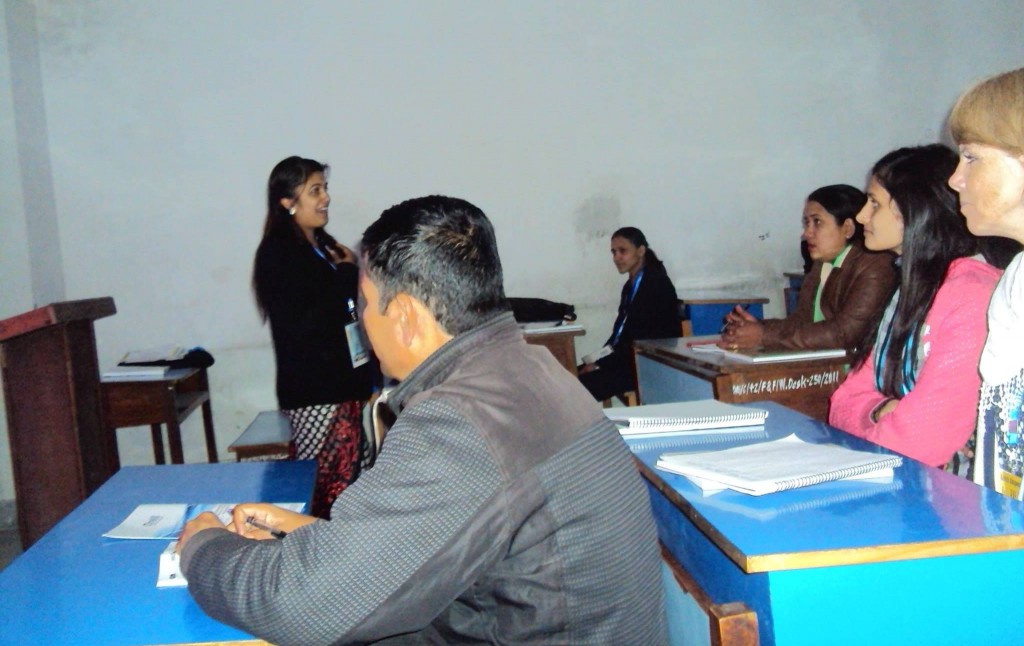
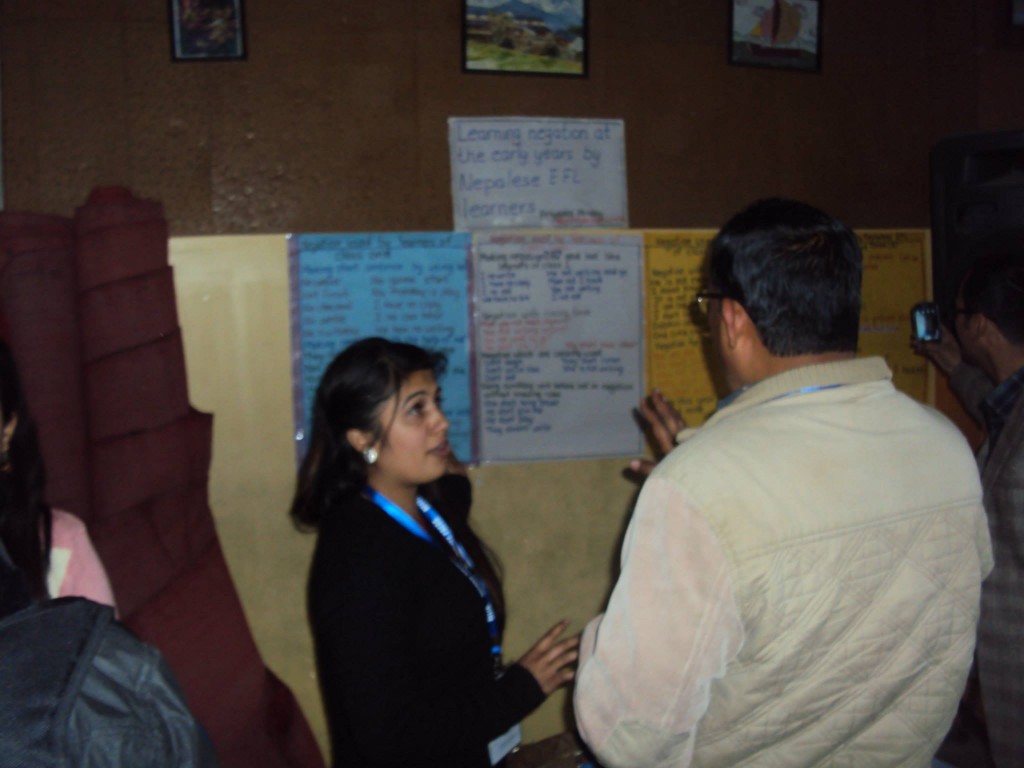
The first session in the ILF was at 1 pm and the second was at 1:35 pm at different halls. During the ILF session, I talked to the participants on ‘learning negation at early years by EFL learners in Nepalese context’. I mainly focused on developmental process of learning negation by Nepalese EFL learners at their early age. I found most of the participants were interested to observe developmental process of learning negation as it reminded their childhood. In the session, I enjoyed myself to interact with participants and also felt more confident as I talked to them. Likewise, I found most of the participants interested to listen to me and they were attentive in the session. Moreover, some participants gave positive feedback and appreciated my session.pandey2

Despite of nervousness, both of the sessions I have facilitated went well.This made me feel better and also encouraged me to present my paper in the days to come. I was very happy and got confidence and determined to show my strengths with the help of presentation in the days to come. From that moment I decided to overcome my fear which always blocks me to go further in my life.

To conclude, presenting paper in the conference of NELTA helped me boost up my confidence and I believe that it has a great impact on my professional development. It helped me realize my strength and encouraged me to present the paper in the upcoming conference as well. I wish to become a good presenter, which is an essential part of teaching.

My first ever experience attending the conference

Deepak Dulal, Master Second year

Mahendra Ratna Campus , Tahachal , Kathmandu

Attending the twentieth international conference of English Language Teaching (ELT) last month was my first ever experience. I cannot help myself expressing immense pleasure to be a part as a participant in the mega event.

Like in the past years, it was the 20th time that NELTA organized the annual international conference that in Kathmandu. This year, the conference was held at DAV Sushil Kedia Vishwa Bharati Higher Secondary School, Lalitpur, Nepal on Feb 17, 18 and 19.And, the theme of the conference this year was “The Quest for Quality ELT: Riding the Waves and Creating the Landscape”.

In addition to the key note speeches, I attended in 10 plenary sessions, which included ‘whose woods are these….? By Vishnu S. Rai-postmodern ELT;  Neuro ELT by Marc Helgessen; Teaching, Learning and Context by David Hayes; Tapping into the good learners in all of us by Elka Todevais writing colorless green ideas sleeping furiously together? by Abhi Subedi; Enriching linguistic and communicative competence through literature by Z.N. Patil; Learners autonomy in large class through innovative project-based learning by Ganga Gautam and Zakia Sarwara; From mimic men to global citizens, interpreting EFL from post-colonial and post-modern perspectives by Sanjeev Uprety; No just Action: Blend Activities with content by Laxman Gnawali and Whose Waves and for What quality; Non-Western philosophies for professional development in ELT by Balkrishna Sharma. All the ten sessions I attended were interesting and insightful. However, I found the three sessions quite interesting. Firstly, Marc Helgesen widely talked of learners need, interest and their neurological science in learning language. Secondly, Ganga Gautam and Zakia Sarwara talked about learners’ autonomy in learning, which I found most interesting and greatly useful. They presented free writing or project-Based learning strategies methods and their findings. The third, Laxman Gnawali talked about the flipside of communicative teaching method in language teaching and he also provided the solutions. He argued that communicative method followed by English teachers in Nepal hardly focuses on content.

Likewise, the two panel discussions I attended during the conference were impactful on participants. The first discussion moderated by Dr. Laxman Gnawali was about the role of literature in proficiency development of English language and panelists were Professors Abhi Subedi, Vishnu singh Rai and Tej Ratna Kanskar. The second discussion with panelists Jai Raj Awasthi from Nepal, Zakia Sarwara from Pakistan and Z N Patil from India were on ‘policy issues on ELT’, and it was moderated by Bal Krishna Sharma. They largely discussed on ELT issues and policies on ELT in the contexts of three neighboring countries.

Out of total 161 concurrent sessions in the three-day conference, I attended Flipping the classroom by Christina Torres (USA); Learners autonomy in ESL teaching by Faisal Naseer(Pakistan); Errors correction techniques in ELT by Jagdish Poudel (Nepal),  Continuous Assessment to increase motivation by Soniya Urfat Urmee (Bangladesh); Active, independent and lifelong English language learning(part-i) by Umer Farooq (Pakistan); Story writing through a creative fun game by Umes Shrestha(Nepal); look ma: I did it-Reclaiming the joy of learning by Elka Todeva (USA); Working with teachers in the Quest for Quality ELT, Understanding and controlling our experience by David Hayes(UK); Collaborative Approaches to writing effectively in a large class by Chiranjivi Sharma(Nepal) and lastly New media technology for ELT: what and how, by Praveen Kumar Yadav (Nepal). I found each session with own importance and value. Mostly importantly, I came to know that language (English) teaching and learning has wider perspectives of issues and challenges. I learnt about different innovations and investigations in the field of ELT from different countries. Most of the presentations focused on how to teach effectively.

Another interesting session was interactive language fair session, which was coordinated by Dr. Laxman Gnawali. For the fair, 18 presenters stood with their stalls and explained the visitors about their presentation stuffs. I found it most effective session among all sessions, wherein I had an opportunity to meet talk and share our experience face-to-face with the presenters and participants.

As an ELT practitioner, while attending on this mega event I learnt about wide range of ELT issues focusing on diversified areas covering alternative assessment, leaning outcomes and teaching effectiveness, ICT in ELT, creative writing, critical thinking, academic writing, critical thinking, teacher professional development, literacy in EFL, literature in pedagogy, mother tongue education and EFL, multilingualism, trends and research in EFL, new media in ELT, and fun games in ELT. The conference was a get-together of English language teachers, I was able to meet many of them including Dr. Laxman Gnyawali, Ganga  Gautam, Rishi Rijal , Balram Adhikari , Umes-Shrestha and Praveen Kumar Yadav. For me, it was also a networking event, I met many of the participants from Nepal and other 16 different countries for the first time and exchanged our experiences and email addresses with a hope to become friends to do the same in future.

Acknowledgment:

I am indebted to the support of our teacher Miriam Corneli from the US, English Language Fellow for Nepal, who I believe is a great ELT scholar.  I was one among ten M. Ed. students from MRC Tahachal Campus, who Corneli sponsored for the participation. Through essay writing contest, the ten of us were selected for the reward and the opportunity to attend the conference.

Hiding the Gold Coins: A Reflection on Choutari Writing Workshop by Hem Raj Kafle

umes
UMES SHRESTHA

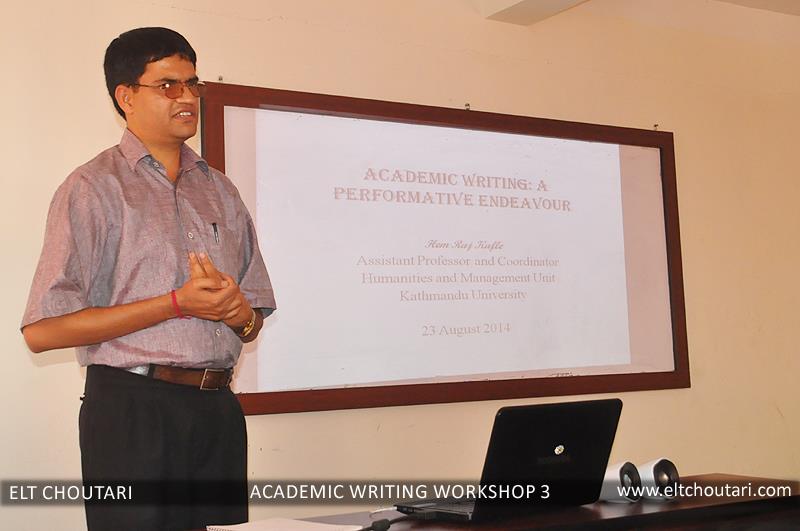
He is tall. Very tall compared to my height. He looks into the world through a pair of slightly shaded glasses. Those glasses probably let him filter all the negativity around him and help him see a vision – a vision of a teacher, a writer and a mentor. He speaks gently and seldom smiles. He stands in the middle of the class and with his words; paints an exciting picture of characters, themes and conflicts; and walks us through the colorful fields full of metaphors, similes and hyperboles.

 He is one of those rare teachers who writes a lot. His blog is a testimony of his prolific writing habit. Even his facebook statuses, usually very short poems, reflect his creativity. Then, it makes me wonder. May be creativity is a verb, not a noun. One has to constantly work at it. It’s just my perception. His creativity could be as natural as breathing.

I had met him back in 2012. He taught me Fiction in my M.Ed. ELT first semester and since then I have had a renewed interest in reading, interpreting and analyzing literature. I started becoming passionate but critical of the texts I came across. In addition to that, he has inspired me to write down my own fictional works.

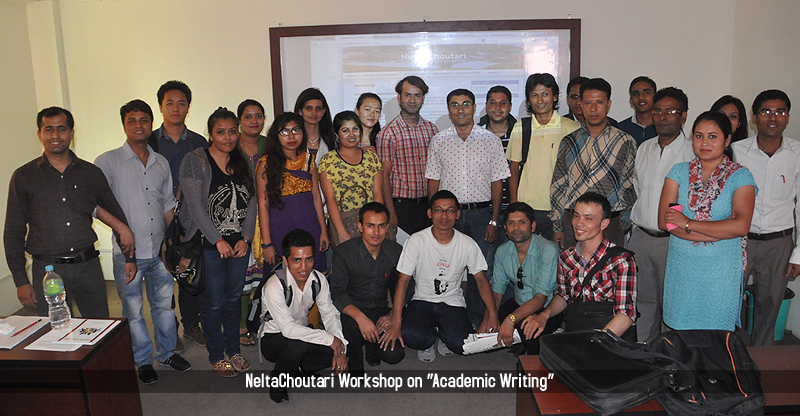
Naturally, I was pretty excited about the workshop. I had always wanted to be in his classes one more time and the workshop was it. Even though the focus of the workshop was “Academic Writing”, I knew he would have his own twist on it, with a few pinch of strange concepts sprinkled around here and there.

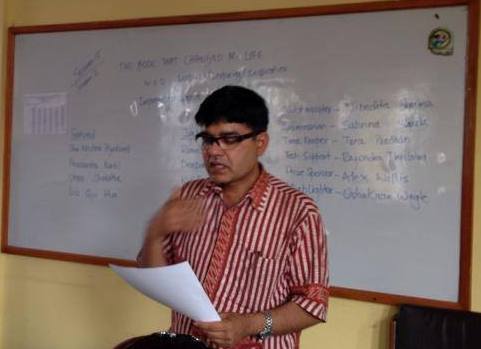
So he started the workshop by asserting that writing is not an isolated activity, but it is an activity integrated with reading, listening and speaking. “The key word is perform. Writing is a performance, it is an action of hands as well as an action of minds,” he added. And most importantly, he continued, “Performance doesn’t mean a writer’s activity alone… it is about a reader’s action also”. This made so much sense that it immediately struck a chord with me. A writer has to let readers perform too. Otherwise, what’s the point in writing at the first place? An effective writer thus leaves enough clues here and there in the text for the readers to come up with their own knowledge.

Hem Kafle Workshop

Writing is a performance because the writer has to make sure that his/her ‘authorial presence’ and credibility are visible in every word and every sentence of the text. Moreover, a writer has to make sure there are implicit and explicit moments of communication with the reader. He/she has to constantly facilitate the reader towards understanding and creating new perceptions. Similarly, a writer has to represent his/her community and contribute towards adding new knowledge and scholarship. Therefore, writing is not merely scribbling texts on a sheet of paper, it is a performance that involves both the writer and the reader.

 Next, he talked about some of the common attributes every writer exhibit in some ways. For instance, the ‘writer’s block’ which he also labeled as the ‘blinking cursor syndrome’ for those who keep staring at the computer screen searching for words to start with. Similarly, every writer has the irresistible urge to tell the background or the whole story. Next, most of the writers can’t decide on the choice of diction – whether to use big or small stock of words, or on the choice of sentence – short sentences or longer sentences.

And to come to the main focus of the workshop, he talked about the process of creating an argument in academic writing and substantiating one’s stance. He gave an instance of Stephen Toulmin’s elements of a proper argument: claim, ground, warrant, backing, rebuttal, qualifier and final claim. A good paragraph is a combination of all or some of the above elements. The concept of ‘rebuttal’ is quite interesting. Apparently, acknowledging opposing views and giving them a small space in one’s argument adds more strength to one’s argument.

At the end, he gave us eleven tips on how to improve one’s writing. I am reflecting on these points from my perspective.

  1. Write aloud.
    It helps shape the quality of writing.
  2. Speak – record – transcribe – Edit
    This is very useful when one is facing the imminent ‘writer’s block’.
  3. Toulmin uncle really works!
  4. Three is enough.
    Three examples, three explanations, three stories.
  5. Keep the big below you.
    This is quite interesting. Start a paragraph with your own sentence and end it with your own. Keep the citations and ‘big’ personalities underneath your first statement. Don’t ever start your paragraph with a citation because this just weakens your stance.
  6. Kill the subordinates.
    If your main info goes to the subordinate clause, rewrite the sentence. Bring your info to the front.
  7. Passive is lousy.
    I also hate sentences in passive voice. I always try to write everything in active voice.
  8. Let the verb stand high.
    Let the verb ‘speak’, rather than ‘be’.
  9. Do not repeat a word if there’s a replacement.
  10. Hear me between the lines
    Make your presence felt. Don’t let the reader forget about the writer.
  11. Dump me if I let you go!
    Challenge: I will not bore my reader. I will not break my reader’s heart, effort, money, etc.

After attending this workshop, I now feel the urge to go back to all my writings and scrutinize them strand by strand – to find my ‘authorial presence’ in them. I had never thought about this aspect of writing – that the author has to be present in the text. Similarly, I am going to try speak-record-transcribe method whenever I feel stuck in the rot. I will also make sure none of my paragraphs start with a citation but with my own sentence. In addition, I will use these techniques in presentations and in writing scripts for speaking as well.

Writing has always been an elusive grape for me. I feel like I am always getting ‘there’ but never near enough. I always go back to my texts, interact with them and revise them. That singer from Rolling Stones is probably right. I can’t get no satisfaction out of my writing. But just like Hem sir once said during his class, “A text is always in the making”. May be it’s not about getting ‘there’ and being satisfied after all. It is a process… a continuum… a journey. And our job as a writer is just to enjoy the ride.

The author, one of editors with Choutari, is a teacher, writer, & blogger.

Teaching Reading Texts through Critical Thinking Perspective

images
Lal Bahadur Rana


In this blog post, I discuss how the core principles of critical thinking such as open-mindedness, ability to see any phenomenon through multiple perspectives, etc. can be exploited in EFL classes with a view to increasing learner-centeredness in our EFL classes and enhance learners’ critico-creative thinking.


Context for teaching and learning English
Despite the strong desire of getting mastery over English, many Nepali learners of English do not have sufficient level of English mainly because of the amount of exposure. Let me give an example of the time teacher and students spend using English throughout a year. Most of the government-aided schools in Nepal have the classes of forty minutes and six classes a week. Thus, there are spending (40 x 6) = 240 minutes in a week (240 x 4) = 960 minutes a month and (960 x 10) = 9600 minutes a year. If we change this amount of time into hours, they study 160 hours. To count in days, they study just 6.67 days a year. Hardly a week! If we deduct the time such as the use of the Nepali language, the time spent on coming and going to class, bandh days, etc. I am afraid, students might be studying in some minus days. Continue reading Teaching Reading Texts through Critical Thinking Perspective

Teacher Training: One of the Best Ways of Self-development

-Parista Rai

Since the day I joined M.Ed. ELT program, it was my dream to be an ELT trainer and fortunately for me, it came true recently. As a part of Teacher’s Development course, I conducted training sessions in Janakpur and Tanahun in July and although it was my first experience of delivering training, I gained tremendous knowledge and experience. I experienced that conducting a teacher training session is a very challenging job where a trainer has to manage everything for the sake of in-service teachers’ satisfaction. In this article, I am very glad to share my experience.

I had heard about ELT teachers’ training before getting enrolled in Kathmandu University but when I got an opportunity to be a part of the ELT program here, I learnt many things related to English language teaching, learning and training. I neither had experience of a trainer nor a trainee but once when I got a chance to attend an in-service teacher training delivered by our seniors, I got many ideas about the teacher training and started dreaming to be a trainer. And at the same time, I became more interested in teaching and learning English as a foreign language.

Continue reading Teacher Training: One of the Best Ways of Self-development

Ditch it: SLC Exams

central ideaShyam Sharma

I now teach at a prestigious university within the largest and one of the best American public university systems, the State University of New York.

But twenty-four years ago, when I first appeared the SLC, I failed.

Now, I am not about to tell you a wonderful story. Sorry, there are more stories of suicide than of success in this regard. I am instead telling my story, for the first time beyond my family, in order to make a very broad point about the SLC exam and our society. Continue reading Ditch it: SLC Exams

How my mentor transformed me

Priyanka Pandey

I feel very fortunate for getting a mentor when I started my teaching career. My mentor was an experienced and skillful teacher who guided me, changed my perceptions regarding teaching profession, and later made me determined to be in the field of ELT.

The school I worked for (Tiny Seeds Pre-school, Kathmandu) had a system of assigning two teachers in one class; a grade teacher and an assistant teacher. I was selected to be her assistant but initially it was very stressful because I didn’t have any idea about “play-way” method. Being a student of Education, I knew how to make lesson plans in theory, but I didn’t have clear idea about how to make practical lesson plans and how to teach effectively in English medium. Continue reading How my mentor transformed me

The Write Way

Mabindra Regmi

When I graduated from my high school, I thought I was a great writer. I had written for countless assignments and examinations. I had written poems and stories. I had scored relatively high marks in English during my high school final examination. How could I not be a writer? It was a bitter shock when reality crashed in and I had to redefine my so called ‘expertise’ in writing when I faced the challenge of writing a proposal for an educational endeavor. I spent many a night poring over the proposal and scribbling on a piece of paper in that pre-ubiquitous-computer era to keep my inflated writing ego alive.

When I look back in retrospect after what seems like eons, and teaching writing to students for over a decade, a few questions arise. Why did I feel that I was ‘good’ at writing when I apparently wasn’t? What were the factors that I had missed altogether to write well? What were the strategies that I had to adopt in order to enhance my writing skills? And what it takes to create your niche in the world of writing- specifically academic writing? Continue reading The Write Way

Speakers’ Club for Professional Development

Umes Shrestha

As we wrapped up the June 20 session of our Speakers’ Club (KU), I remembered how a small dream that I always had turned into a magnificent reality. I had a dream of getting involved in a professional club like the Toastmasters but with English language teachers as its members. And in this article, I want to share the reasons why I wanted to set up the club and talk about how the club helped me in my journey of personal and professional development.

After joining KU’s M.Ed ELT program, I had this idea – the idea about setting up a speaking forum – in my head and luckily my professor Dr. Laxman Gnawali had also thought about it for some time. After spending some time with some seniors and my classmates brainstorming about how to set up such forum and discussing on its name and modality, on August 2013, we officially started with the first session of the Speaker’s Club. It had the participation of students of M.Ed. ELT and M.Phil. English Language Education as well as a number of faculty members. Continue reading Speakers’ Club for Professional Development

Reflection on ‘Behind Academic Publishing-Why, How & What’

Krishna Prasad Khatiwada

‘Get your name registered!’… I excitedly followed the post on the timeline of NeltaChoutari, after I came to learn that Mr. Bal Krishna Sharma was the facilitator of the workshop titled Behind Academic Publishing: Why, How and What. I find the workshop as a crucial step forward for an aspiring writer like me to know more about how to write academic journal articles and get them published. Upon signing up for the registration, I made a call to Umes, one of NeltaChoutari editors, prior to the scheduled workshop to confirm my participation. Finally, I participated in the three-hour workshop which I believe paved a way toward academic writing and publishing with the knowledge and styles that the facilitator shared with us during the session. Continue reading Reflection on ‘Behind Academic Publishing-Why, How & What’

Choutari Workshop: Photo Blog

Texts by Praveen, Photos by Umes

NeltaChoutari organized a workshop titled Behind Academic Publishing: Why, How and What at King’s College, Babar Mahal in Kathmandu on June 28, 2014.

choutari-workshop-01

Bal Krishna Sharma, a founder of NeltaChoutari and a Ph. D. scholar at the University of Hawaii at Manoa, USA, facilitated the one-day workshop, attended by over 30 emerging authors, especially English teachers and students from Kathmandu University and Tribhuvan University. Continue reading Choutari Workshop: Photo Blog

Testing the Testing System of Nepal: An Interactive Article

Choutari Editors

Testing is inevitable although not desirable. It is necessary in order to keep the track of overall progress of language teaching programme. Debates have been going on for and against the testing. However, the important point to note here is that it is the faulty process of testing that is being criticized not the concept of testing itself. In fact, such criticism is necessary as it can help improve the system. The sphere of language testing in Nepal is also not free from criticism. Therefore, we decided to test the testing system of Nepal in this interactive article. We have attempted to explore the existing problems in the field of language testing and possible solutions to them after an interaction with experts and readers. We believe such interactive can play a significant role to reform the system. A thematic question was asked to language experts as well as Choutari readers. The question was ‘What is a major problem in language testing system of Nepal and what can be the solution to it?’ Among the responses collected, we have presented the opinions of eight respondents here:

Shyam Sharma:
There are many problems with current language testing regime (as well as some good things). One issue that’s come up in our conversations is how testing practices typically ignore multilingual competencies. At first, this may seem like an impossible ideal, but if you look deeper, the question becomes why not. Ours is a multilingual society and students’ language proficiencies are not isolated; their English is a part of a complex sociolinguistic tapestry; their other languages don’t “hamper” English; languages aren’t just mediums but rich epistemological resources; and, humans have always spoken multiple languages without seeking a monolingual standard. So, when we face the task of teaching and testing students’ English abilities in isolation, we shouldn’t act like helpless slaves of the system; when discussing the roots and stems and branches and bitter fruits of the current regimes, there’s no need to surrender to the “reality.” The reality includes politics, power, and possibilities beyond their grips, and thus, we must broaden the base of our discussions so we can see testing as a broader phenomenon than, well, testing. Scholarly conversations under the tree here can and should help the community rethink the fundamentals.

Shyam Sharma is an Assistant Professor in the Program in Writing and Rhetoric at Stony Brook University (State University of New York)

Prem Phyak:
I call it an ‘issue’ rather than a ‘problem’; why do we still ‘test’ monolingual ability (although our students have bi-/multilingual ability)? Another issue embedded within this issue is: How can we test students’ multilingual ability? First, we must be clear that ‘testing’ is not a ‘fixing-shop’ where you can fix a ‘problem’ rather it is a complex discipline which needs a critical scrutiny from multiple perspectives for a valid evaluation of students’ ability. Our assumption that ‘language testing’ should only test ‘monolingual ability’, meaning that multilingual testing is impossible, is the major challenge for reforms in language testing. This dominant assumption decontextualizes language testing from students’ cultural, linguistic and educational contexts. So, the major issue is: our tests are not context-sensitive. For example, I still remember that we were often asked to write an essay in SLC (School Leaving Certificate) exam about different highways in Nepal but I had never seen any highways (when I was in school). We were asked to memorize their lengths, construction dates and so on. I could not even conceptualize what a ‘highway’ was. However, I could write more and better when I had to write about ‘my village’ or ‘my school’.

The issue of contextualization is closely associated with testing multilingual abilities; locally-contextualized test items require students to work with their abilities in more than one language. For example, when I had to write an essay about my village I used to think in Limbu, Nepali and English. I (and my friends) could not think about the topic in only one language – no separation of languages! But the tests did not allow me to use my Limbu and Nepali abilities while writing essays in English. This is the major issue, right? If language tests are meant to test ‘language ability’, why don’t we test students’ functional abilities in multiple languages? This applies to Nepali language tests as well. For example, when students speak Nepali they simultaneously use English as well (and/or other local languages if their first language is other than Nepali); one cannot create the fixed boundary of a language. Suppose a bilingual student writes “आजको class मा कस्तो frustrate भएको…” (I had frustration in today’s class) for her Nepali essay (it can be more complex than this in the case of Maithili and Newari children, for example), how do we evaluate her Nepali language ability? The first reaction could be ‘असुद्द” (incorrect –literally impure). However, she is expressing her views fluently by using both Nepali and English in her repertoire. She cannot separate one language from another. This means that monolingual tests do not test students’ bilingual or multilingual abilities. Unfortunately, the students who show their bi-/multilingual abilities in language tests are considered ‘deficient’ and ‘poor’. However, the above example represents the use of language in the real-life (authentic) context.

There are ways to test multilingual abilities. For example, an inquiry-based formative assessment, which engages students in doing research and working with teachers to receive qualitative feedback on their work, can be one way to help them fully utilize their multilingual abilities. Such assessments encourage students to translanguage (use multiple languages to perform different tasks) to achieve the goals as specified by the test criteria. However, any kind of so-called ‘standardized test’, which are guided by the monolingual assumption, cannot test bi-/multilingual abilities. We should say a big ‘NO’ to the standardized tests if we truly believe in developing equitable language testing.

Prem Phyak is an MA (TESOL), Institute of Education, University of London, UK, M.Ed., Tribhuvan University, Nepal

Tirth Raj Khaniya:
Lack of professionalism is the main problem of English Language Testing in the context of Nepal. Professionalism is known as ability of applying fairness, ethics and standards in exam related issues. While dealing with exam related matters we need to be fair. We assume that we are professional but in reality we are not professional thus the test is not testing what it is supposed to test.
In language testing for teachers’ to be professional they require both necessary skills and abilities and application of those skills and abilities in a proper manner. To maintain professionalism it is necessary to have wide discussion among teachers and therefore all those who are involved in exams will have clear understanding.

Tirth Raj Khaniya has a Ph. D. in Language Testing from University of Edinburgh, UK. Currently, a Professor of English Education, he teaches language testing in the Department of English Education, TU.

Ganga Ram Gautam:
The main problem of language testing in Nepal is that the test itself is faulty. It does not test the language skills but test the memory of the text materials given in the textbook. There are also other several problems that include the issues with the test writers, test item construction, test administration and validation of the tests.

One solution of this problem could be to develop standardized tests and administer them in the various key stages such as primary level, lower secondary level and secondary level. In order to do this, we need to train a team of experts to develop the test and the test should be standardized by going through the reliability and validity testing. Once the tests are developed, they should be administered in a proper way so that the real language proficiency of the students can be obtained.

Ganga Ram Gautam is an Associate Professor at Mahendra Ratna Campus, Tribhuvan University and former president of NELTA.

Laxman Gnawali:
There is no need to reiterate that the aim of the learning a foreign language is to be able to communicate in it. In order to find out whether English language learners in the Nepalese schools have developed communicative skills in this foreign language, there is a provision for the testing of listening and speaking at the SLC level. I feel that this test is not serving the purpose. The lowest marks students get in speaking is 10 out of 15, which is 66%. However, when we communicate with the SLC graduates (let alone who fail the examination), most of them perform very poorly. There are two reasons for this inflated marking: the speaking test includes predictable questions for which the responses can be rehearsed: personal introduction, picture description and one function-based question (which is repeated so often that students can prepare a limited set of responses and be ready of the test). Secondly, there is a kind of extreme leniency in the examiners; they just award marks irrespective of the quality if the responses.

Two interventions could improve the situation. Firstly, the examiners should be trained to ask very simple everyday realistic questions which students cannot respond without knowing the language. Secondly, each test should be video recorded so that inflated marks can be easily scrutinised. Administrative issues should not come in the way of quality testing which has far-reaching consequences.

Laxman Gnawali is an Associate Professor at Kathmandu University and Former Senior Vice President of NELTA

Laxmi Prasad Ojha:
I think we are giving too much priority to examinations and tests in our education system. We do not understand the purpose of testing and evaluation. We don’t test the comprehension and understanding of students. This is the main cause of the failure of our education system in many cases, including the language teaching programmes.

Uttam Gaulee:
I think “formative” should be the key word here. Laxmi ji, pointed out an important bottleneck we have experienced due to lack of purpose of testing and evaluation. If we think of a typical Nepali school, we do give more importance on summative tests than the formative ones. What we seriously lack (and that’s why we have a tremendous opportunity to work on) is systematic feedback for student.

Uttam Gaulee is Graduate Research Fellow, University of Florida College of Education, Gainesville, Florida

Bal Krishna Sharma:
Yeah, one way would be to introduce and practice more formative type of assessment. This will evaluate and test students’ ongoing progress and learning outcomes.

Ph.D. student, University of Hawaii at Manoa

Although the issue was one, the thematic question unbelievably raised so many genuine issues. The respondents highlighted the issue of testing multilingual competencies apart from only testing monolingual ability and also suggested some ideas on how to test students’ multilingual abilities. In the same way, the interaction raised the issue of lack of professionalism in language testing. Similarly, the respondents also urged that our memory-driven testing system itself is faulty. Furthermore, there is problem in test construction and administration and suggestion is put forward to develop and practise standarized tests to minimize the problems. In relation to the problem in testing listening and speaking in SLC exam, it emphasized that the test items are predictable and examiners are lenient and award marks irrespective of quality. The solution proposed is to train the examiners properly and introduce the system of video recording students’ performance. On the other hand, overemphasizing exams and not testing what it should test is characterized as a problem. The solution discussed over such problem is to give more importance to formative test rather than summative test, which helps keep the track of students’ achievement.

Now the floor is open for you. Share what you think is the problem of testing system in our context and what can be the solution. We believe such interaction contributes in the development of innovative ideas in ELT.

Giving a Benefit of Doubt During Assessment

Umes Shrestha

I am a teacher who likes being very liberal while checking answer papers and in this article I am going to talk about why I detest our testing system; why I give a benefit of doubt to the students; and why doing so, I believe, helps foster their confidence and reinforce their learning. I’d like to start by talking about how difficult it is for me to fare with tests and exams, and suggest that we stop doing to our students what many of us as teachers can’t bear ourselves.

Besides teaching, I am also pursuing a Master’s degree in Education. It is a semester system, which means there’s a final examination every six months. And I find it really stressful; in fact I have always found examinations very stressful throughout my life. I may not know my strengths but I know one of my weaknesses for sure – I cannot read books or notes to memorize answers. I do understand the overall concepts but I can’t memorize them in order to spill them all over the answer sheet. I can’t do it even if my life depended on rote memorization. Far worse, my attention span is shorter than an ant’s tail. I cannot remain calm for more than 10 minutes. I am always drowning in a sea of distractions. Family. Friends. Facebook. Music. Home. Job. Deadlines. I can’t quite keep up the concentration. I get itchy and I have to take a short break every 10 minutes or so. My mind operates that way.

While taking exam, I can’t think fast enough to frame and organize my answers. I need time to generate ideas, plan a structure and write essays. I make a lot of spelling errors because I heavily rely on spell checkers. My handwriting and presentation look impeccable in the first two pages but they soon start deteriorating as the clock in the exam hall ticks away in a flurry.

That’s my story. I don’t like being tested in such constrained time and in such ominous hall. I feel it is completely unfair to be judged on what I write in three hours. And to add to my frustration, I am always haunted by the usual mentality of language teachers who are very strict while checking answer papers. And I’m pretty sure there are many out there, both teachers and students, who can perfectly relate to me. Therefore I believe this extreme emphasis that our educational system puts on summative testing as the only mode of assessment could be very damaging to our students and, as a consequence, to our society at large.

So let me ask you to do this: imagine yourself being a teenager, surrounded by technology and media, having access to unlimited knowledge and resources, having friends who are hyperactive on the internet and social networking sites, having too many options at hand. Imagine yourself sitting in the class for hours and hours, sitting on the same desk and ‘listening’ to the teachers who use the same deadbeat methods day in and day out. Imagine yourself not knowing (or doubting) the relevance of the traditional education, getting certificates, getting degrees, joining the workforce and doing the same old jobs.
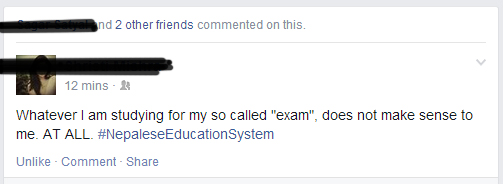
exam-makes-no-sense

(Pic: a screenshot of one of my student’s facebook status. This student is perfectly clueless.)

And we ask them to sit for exams. We ask them to write an essay on festivals of Nepal. Or we tell them to compose a speech on Nepal’s historical figures. We tell them to write a complaint letter with date, salutations, body and closings in a precise format. We tell them to write coherently and cohesively. And we want them to write without any spelling errors.

Worst of all, we don’t try to find alternatives to the discouraging test-driven system. Instead, we make the overall process and environment of learning frightening for students by using the fear of exam to work like slaves throughout the year, by focusing on what they lack all the time, and by being strict when assessing their work.  And at the end, even when we could have done otherwise, could have at least made a better combination, we just tell them to sit for three hour exams and expect them to compose perfect essays with their perfect handwritings. We stress on neatness and cleanliness; we write comments, underline wrong answers, we circle misspellings and with red ink we cross out answers that don’t match our expectation. That’s what we usually do, don’t we? There could be different ways to assess our students but at the end of the day, we (have to) judge students based on written examinations.

It would seem as if in the present context, there is absolutely no way out of this final written examination module but dear teachers, here are some of the things I do, and as a teacher, this is what I propose you to try out these and similar things as well.

I give my students a benefit of doubt while checking their answer papers. I understand, they don’t take exams because they like it. I have never come across any student who loves taking exams. On top of it, they have to take exams of seven or more subjects every term. I can perfectly relate to the maddening pressure to perform. They have no option, and neither do we. So while I check their answer papers, I gently remind them of their spelling mistakes but don’t deduct any marks for it. I overlook minor errors and slips like she don’t have friends. If they write any brilliant essays with a logical framework, I get super joyous about it. And I give it 10 out of 10. Why not! (This one student glared me back with disbelief and said: Sir, you gave me 10 out of 10? And I said: Yes, you deserved it.) If their essays look messy and are riddled with terrible structures, I don’t butcher their effort thoughtlessly. They would have done it better if they didn’t have any time constraints or if they had time to draft and re-draft the essays. I try to be sensible about their handwriting too, because writing for three hours straight is a real pain in the ass and the wrist. I go through the same pain every time I take an exam. One reason, many of us are used to typing on computer rather than writing with a pen. And I am never picky about grammatical errors. I have seen my professors at the university make grammar errors. I have seen me making horrible grammatical errors. We all do.

I try to keep track of the students, their progress, their assignments, classroom participation, portfolios – but I don’t judge them based on one written examination. I am definitely not seeking an easy way out. I communicate with the students who are lagging behind and make them feel safe. I do demand high, push their limits but I want to be realistic, and set realistic goals and realistic expectation. At the end of the day, I feel like I have done my part and go to bed without any resentment or bitterness.

Our testing system is full of holes, and it desperately needs a facelift. However, we can’t change the entire system right away, let’s be realistic. But what we can do is empathize with the students. Therefore, dear teachers, give your students a benefit of doubt, because sometimes we too need it.

I’m going to wrap up my ‘rant’ with one more facebook status that I came across –  just to add to my argument.

umes

Umes Shrestha

M.Ed. ELT

Teaches Business Communication and Literature to undergraduate students

Games for Retaining Vocabulary

Pema Kala Bhusal


I would like to begin this article by stating what Wilkins said to show the importance of vocabulary – “Without grammar, very little can be conveyed and without vocabulary, nothing can be conveyed” (Wilkins, 1972). Vocabulary acquisition is crucial for second language learning. However, many second language learners feel that learning new vocabulary is a tedious and laborious process. On this paper, I first discuss about the problems faced by my students while dealing with vocabulary. And then I will offer some guidelines and suggestions on ways to retain new vocabulary.

I remember my tutors at KU teaching ‘Teaching Vocabulary’ by using different games and by using flashcards, ball, realia etc. The games helped me learn collocations, synonyms, and different words very easily. I was not completely aware of those words, but now they are still in my mind. I came to realize that games are very effective tools for retaining new words.

During my school days, I never saw my teachers using games in the classroom. We learnt the meaning of difficult words through rote learning. When I started teaching, naturally, I didn’t have any knowledge that vocabulary could be taught through games. When I saw my teachers using different games at my university level, I seemed to be unfamiliar with them and I felt having very less knowledge about vocabulary. I imagined what if I had a chance to enjoy these kinds of games in school! My vocabulary knowledge would have been stronger than now.

When I taught lower secondary level students in the public school, I found that the students had many problems regarding vocabulary. For instance, when I asked them to describe a picture, they were unable to do so. They could not make logical connections among words. To make it worse, they couldn’t find the right words to describe the picture.

After gaining knowledge about using games in the classroom, I used different games such as ‘Kim’s game’, ‘Relia’, ‘What’s missing?’, ‘Erase’ and ‘TPR verb game’ to teach vocabulary. When I employed the different games through different physical activities, the students had lots of fun and they were learning the words quickly and effectively. Since that day, they kept telling me to use such kinds of games in my classroom as they had never done such activities before.

I realized that it is important to understand this issue from their perspective because they have been practicing and learning English in their native language from the very beginning. They always carry an unknown fear of using English, especially while speaking. This might be the result of the teaching trend as well, which is – the teacher comes in the classroom, asks the student to look at the book and he/she translates the passage into Nepali. The students are still taught English using a conventional approach like a grammar translation method. (I don’t mean that grammar translation method is not a good method to use in the classroom. We can use it depending upon the context and situations. Sometimes the students can understand more easily when teachers use this method.)

Similarly, if we teach vocabulary through drills, it might become boring for the students, especially those who have limited expertise in language study. Forgetting the word is also another problem. Most of the students complain that they forget words soon after learning them and they don’t exist for a long time. I recently observed an English language classroom of grade 8 at a public school. During my observation, I found the English teacher using Nepali language all the time. I felt very sad about the situation and thought how the students would never develop their English language that way.

Now let me share a few strategies I have used in my classroom for the enhancement of my student’s vocabulary. The first strategy was I asked them to read the passage before coming to the class, assuming that the more they read the more they can see new words to learn. Then, I asked them some words related to the passage. When I did so, some of the students responded from the context and some got confused. Therefore, I made them familiar by showing some pictures, realia and engaged them into conversation. This strategy helped them learn the words easily because I think interaction is the key to succeed in language learning.

Likewise, I asked the students to come in front of the class and touch some objects without looking at them, recognize the objects and describe them to the class. They were very curious and enjoyed the sensual learning activity. Another game I used frequently in my class was the game called ‘Erase’. I used this game to teach the name of the animals, classroom objects, etc. For this, I asked my students to tell me the name of the animals they knew. After that, I made a circle on the board and wrote them down around the circle. In this way, I elicited the names of the animals. After that, I randomly wrote them down on the board. First of all, I asked them to repeat the words in chorus so that they could remember the words for the game. Then, I arranged the students into two groups and lined them up into two teams. After that, I provided the first student in each team an eraser and they raced to the board to erase the word I have yelled out. The game was played in the same way to the end. The first student who correctly erased the word won a point for the team. Finally, I scored the group that won. This is one of the examples of a game I have used in my classroom.

In this way, I used several games to teach vocabulary. From their active participation and involvement, I came to know that integrating games, both physical and mental, helps the students to keep their mind alert. Not only this, they were able to reduce their boredom and retain the words easily.

To sum up, games play a very important role to motivate the students in learning activities. From these experiences, I have realized that acquiring and retaining vocabulary in a foreign language is a challenging job, but learning vocabulary through games is one of the effective ways that can be applied in any classroom. They can be used not only for mere fun, but more importantly, for the useful practice and learning purpose. There is a good Chinese proverb “tell me, I will forget; teach me, I will remember; involve me and I will learn”. This saying also proves that if we ask the students directly to write or tell the unfamiliar words, they would probably be unable to do so and feel discouraged, but they can write or tell if they are involved in different fun activities.


prema

Pema Kala Bhusal
M.Ed. ELT, 2012
Kathmandu University School of Education

YouTube: My Best Friend Forever

Chandra Pd. Acharya

Before I started pursuing my master’s degree in English education at Tribhuvan University, Kathmandu, I didn’t have any inkling that YouTube, a video sharing website, was there. On my birthday, one of my girlfriends gifted me a laptop and she suggested me to spend some of my study hours on YouTube surfing educational videos. For the first time, I learnt about the video sharing website. No sooner had I came to know about this than I befriended with it since it turned to be like a friend in need is a friend indeed. In this blog entry, I have shared my experience of using YouTube for enhancing my English language competency.

In the initial days, I did not exactly know how to use YouTube. I did some researches on web and however, some odd months later, I got the idea as a result of learning by doing, and kept on using it to the fullest. The English pronunciation that I have commanded over today is the outcome of watching English videos uploaded on YouTube. My current English is gratifying me, even some of my friends find it awesome. But, I love to opt for ‘good’ rating for the good has a chance to learn it for the better as learning begins from cradle and lasts to grave. So my English learning through YouTube surfing could by no means be an exception provided that I had in one way or the other fallen in love with it. Once in love, forever in love, I think I internalized this adage. To be honest, surfing YouTube videos time and again became my forte and I am damn sure it will continue till my last breath. Maybe this is because of my forever longing. Now I feel I should immensely grateful to three former PayPal employees Steve ChenChad HurleyJawed Karim who fathered YouTube in February 2005.

The point I want to make is YouTube for me was the best way to learn English however there are a lot of means available these days. So choose whichever you think the best. Truly speaking, my passion for YouTube surfing was and is to expand the storage of vocabulary and to polish the fluency in speaking English. Hence my penchant for YouTube surfing gives birth to this article.

As I believe fluency in English is the key important factor for people around the world for communication in English. It is one of the important language components to be developed. Fluency is a speech language pathology which means the smoothness or flow with which sounds, syllables, words and phrases are joined together when speaking quickly. Hence, fluency in English can be termed as ease and smoothness of speaking.  Stressing much on this feature of language, Brumfit (1984, p. 56) opines fluency as natural language use.

Generally, we need to make our fluency a comfortable one so that the communication moves ahead between the parties (encoder and decoder). It gets matured through simple day-to-day tea talk to public speaking. Likewise we have to know the organization, pronunciation, word use, body language etc. Here, I am pinpointing some of the important guidelines required to become those who want to develop their fluency in English through YouTube.

1. Technical Qualities

Here ‘technical qualities’ refers to overall qualities of videos available in YouTube. This includes clarity, video resolution, sound effect, etc. As suggested by Mullen & Wedwick (2008) and Trier (2007), quick access to vast quantity of video database provides a great deal of opportunities in enhancing learning. The video clips downloaded from YouTube or other similar websites are very educational and practical to use. For instance, in the technical dimension, many users claim that online videos clips are high in quality. According to Hubbard (2009), attributes like fine audio and visual are very important in aiding learning and sustaining the interest of learners. Thus, the quality of freely available YouTube videos is good, and learners can be benefitted from them without difficulties.

2. Content Focused

The contents of selected video clips do not only meet individual learners’ need, but also help them learn how to present the information attractively and effectively. Muniandy & Veloo (2011, p. 177) conclude that “the claim of many users and researchers on content of video clips uploaded online are indeed presented in a dynamic way that can enhance mastering of English language among students.” This is highly concerned with the language used is appropriate or not, the language used is conversational in nature or not, the videos scaffold constructive learning or not etc.

3. Engaging

The next important this that a learners should consider while surfing YouTube is whether the videos can engage learners or not. Mostly the content of online video clips are indeed engaging and could help learners to be more focused. At the same time one should consider the following things in his/her mind i.e. whether the contents of videos are attractive or not, either they are well organized or not, whether the duration of the videos are appropriate or not, is the content easily understandable or quite difficult.

4. Optimistic Attitude

‘Optimistic attitude’ refers to the positive expectancy that one gets after surfing the videos in YouTube channels. Frankly speaking the learners themselves should be very optimistic about the outcome of surfing the video clips. To this one should be sure that they learn something and the reforms will take place. Thus optimistic attitude and keenness is also a strong indication so that the learning goes at pleasant manner and becomes strong one near natural future. To this, the criteria to be considered are; whether the video more interesting or not, whether the videos can capture and retain ones’ attention or not, can the videos generate new ideas or not.

As similar to the saying, ‘the better learners today are the better teachers tomorrow; a learner should keep the above mentioned things in one’s mind in order to strengthen fluency in speaking English. There is a belief based on research findings that the more one use video clips either from YouTube or any other online sites the better the fluency s/he develops. And the ability they earn woks as a mechanism in their future teaching. This can be their public image among the learners they deal with.

Likewise, I think it would be better if I mention some of the links of YouTube videos I went through and visit these days too in timed conditions for developing fluency in English. One of the effective video clips I went through in the beginning days was ‘Learn How to Speak English Fluently and Confidently’ [youtube=http://www.youtube.com/watch?v=va8ESm0tQCI]. This was a tutorial like video clips that added some skills of speaking fluently on my side. The clip suggests that the more one listens the better he speaks.

Similarly, a video clips entitled ‘Fluency in English’[youtube=http://www.youtube.com/watch?v=E_uTu3dGI84] talks about the suprasegmental features such as stress, length, rhythm, tone etc. in a practical basis. The video further suggests that practice and practice until one gets what he wanted to get is the key thing in developing fluency in English.

The other effective video clips that taught me a new kind of lesson was ; ‘How Do You Speak English? Speaking Exercises To Improve Your Fluency in English’ [youtube=http://www.youtube.com/watch?v=sKuu3Wwr_3g] What I learnt through this video is that I have developed fluency one need to speak as s/she sings a song in his/her native tongue. Regarding this ideas, here I would like to connect suggestion from one of my Gurus that if one needs to be a good speaker in English,  s/he needs to speak it as similar to his/her native language.

However,  one of major problems in teaching students I have noticed is how to make the teachers’ talk comprehensible to the learners. Traditionally, the input, the subject matter in general, had been directly translated into the students’ mother-tongue. Teacher used to be like a bilingual dictionary having meaning of one word into two languages. The job of students was not to exercise mentally to extract the teachers talk but to memorize and repeat spelling and meaning time and again to form habits. But, at present this approach has become obsolete. Now, the main objective of teaching speaking skills is to make students able to make teacher talk as comprehensible as possible so that the learners can themselves be familiar with the content delivered in different contexts. So, a teacher needs to use numerous ways to make input comprehensible so that the pattern of rote learning gets avoided.

Another  significant problem with developing fluency in speaking English is that what has been learnt today is often forgotten tomorrow. Hence, to speak smoothly, smart usage of vocabulary is also important which can also be possible through English videos. For this, one should surf the videos in an appropriate time interval. Besides,  to boost up fluency in speaking, it is advisable not only to revise the video clips periodically, but also start each day with a new clip and practise, and imitate it throughout the day. In addition, it is necessary to develop the habit of making casual talks with the friends.

Frankly speaking, for me, to develop my fluency in speaking I didn’t felt hesitation to make talks in English with a tourist from core English speaking countries to varsity teachers from home and abroad either through online video calls or the face-to-face context-specific conversation.

To draw a conclusion from my experience shared here, I feel myself proud of developing an adage that the enormous number of video clips available online or offline can be a gateway to success in developing fluency in speaking English. However, one needs to be careful to select appropriate clips based on his knowledge and understandings in English so that the pace of his/her making fluency in speaking English gets matured in a natural way.  This will help the users capable for earning bread and butter in their career. 

Now I would like to retrospect to reiterate if she was the best friend, who gifted the laptop with internet access, or the laptop with internet access. But I feel the latter is the best of the best for me because YouTube has been a great companion to develop my fluency skills. 

References:

Brumfit, C. (1984). Communicative methodology in language teaching: The roles of fluency and accuracy. Cambridge:                                                                CambridgeUniversity.

Hubbard, P. (2009). A general introduction to computer-assisted language learning. In Japan. Retrieved on 11th Feb, 2011 from                                              http://www.robon.org/gary/captioning

Mullen, R. & Wedwick. (2008). Avoiding the Digital Abbys: Getting Started in the Classroom with YouTube, Digital Stories and                                                                        Blogs, Vol.82 (2), 66-69.

Muniandy, B. & Veloo, S. (2011). Managing and Utilizing Online Video Clips for Teaching English Language: Views of TESOL Pre                                                                        Service Teachers. 2nd International Conference on Education and Management Technology.                                                                               IPEDR vol.13 (2011) © (2011) IACSIT Press, Singapore.

Trier, J. (2007).“Cool” engagements with YouTube: Part 1. Journal of Adolescent and Adult Literacy 50:408–12.

aacharya


Chandra Prasad Acharya

Masters in English Education, TU

My Journey of Journal Writing

Santona Neupane

A few months back I found myself counting the notebooks and diaries I had received in 2013 alone. They were given to me by my near and dear ones, assuming I would put them into good use, owing to the fact that I love writing. Including the two that I had bought for myself, the total was nine. Embarrassing thing though, was that, all the notebooks-except one- were empty. It was high time I did something about those notebooks. To put them to good use, I started to reflect on my days and jot them down on those notebooks. Not only did I put those notebooks into good use, I even established a writing habit: the one that helped not only me but would eventually help my students as well. In this article, I am going to talk about how journal writing helped me and my students become more expressive and creative in our writing. Further on, I will discuss why I think teachers need to implement this technique to improve students’ writing skill.

I teach in a secondary school and the students I was teaching were not good at writing creatively. We know teaching is a dynamic process and we learn as we teach. When things do not go as you plan, you have to look for alternatives. And thus I looked around for different approaches that might help my students. As I guided and taught them a thing or two about writing, I found that they did write but they were not enthusiastic about it. And, improving their overall language skills was another matter. That’s when I thought about journal writing, as it was helping me as well in my writing.

I hence proposed the students a journal writing project. The requirement was simple – write down about your day, every day. The students were under no restrictions except to write daily. They were free to write whatever they liked, however they liked and write how much long they wanted to. My condition was I would check their work initially to provide feedback and when it would be evident that they are able to do it on their own, I would read their work only if they wanted me to.

The initial entries included what they did at certain time that day.  Now as a reader that’s hardly something that excites. I suggested them to drop the conventional diary writing style they had acquired and to focus on only one important moment or event of the day. To break established habit is quite difficult and it was really hard for them to change their habit yet with persistence and practice they were able to achieve this.

The next step was to help them describe their day in terms of their senses. We had a class specially focused on five senses. At first, the students were given a magazine cutout of a beautiful scenery. They had to imagine themselves in that particular place and describe it in term as of sight, smell, sound, taste and feeling. This proved to be a useful exercise which helped the students to be expressive about their feelings.

Following the example of my own teacher, I asked them to be personal in their journal writing. I told them to be reflective and that their writing needed to mirror their individual self. Even though I had told them I wouldn’t read their entry if they didn’t want to give it to me, they insisted I read it and provide feedback. Following a month or so the writings they produced went through some transformation but there were still some exceptions. Once, on reading the entry of a class, I saw that everyone had written about the same event that had happened the previous day. Though the event was same, the perspective differed with different entries. With the permission of the class, the students presented the entries and we held a discussion on how each of them had different perspectives. This proved to be an interesting topic for discussion and by the end of the lesson students were aware of the difference and had a new understanding.

I would be lying if I said that journal writing transformed each and every student’s writing skill. Some of the students continued to produce uninspired entries. No doubt, they had followed my instructions yet their entries lacked life as they had detached themselves from their entry. But I asked them to continue writing to establish the habit. Once I found an approach of a student quite innovative and interesting; and with her permission, I shared it with others as well. She had described a typical winter morning in such a way it seemed as if everything was gloomy and dreary. Then her writing moved on to describe a transformation: as the fog cleared she described how she could see things clearly which only moments before, seemed blocked. This opened a new dynamics for others. They started to experiment different forms as there weren’t any particular restriction on how to write. Some of the entries that were produced were in the form of verse, drawings, haikus etc.

This writing project was a stepping stone for me as a teacher and for my students as writers. We did not have a separate time allocated for this writing class. As the work progressed I guided, taught and provided feedback to them within the regular classes and sometimes during break time. Time and again I shared my entries with them and that helped them.

Journal writing can be a special tool for your students to improve their writing skills; one that doesn’t take much resource and time. There is a high chance of this turning into a habit for life. It encourages them to reflect on certain element of their day and examine it. It awakens the writer in them and as is the nature of humans they look for ways to be more creative with it. This even helped my students produce poems and stories. It became a medium to share their views, ideas, opinion and feelings. The continuous writing helped them to be descriptive and expressive in their other writings as well.

Not only this opened a new way of understanding for my students, it also helped me to develop myself as a teacher. The problem had been bugging me for a long time and it encouraged me to look for ways. I had to do something. My personal experience, few suggestions from my teacher and inspiration from a Hollywood flick helped me conceptualize this project and few adjustments along the way helped this journey to be smoother.

santona

Santona Neupane
M.Ed. ELT, Second Semester
Kathmandu University


Exploring Challenges in In-Service Teacher Training in Nepal

Rajan Poudel

Globalization of English language demands competent users of English language in the world today. And to producing competent or skilled language users, there is the need of qualified educators and technical manpower. The Ministry of Education (MoE) has been implementing in-service teacher training for a long time to improve the quality of English language teachers. But there are numerous issues related to in-service teacher training, regarding its effectiveness and transformation. Therefore, this article seeks to scrutinize issues and challenges of in-service teacher training in Nepal.

In-service teacher training in Nepal is usually seen ineffective because English language teachers are not adequately trained to teach at school (Shrestha, 2008). There are questions to be addressed in relation to the quality, transformation of knowledge, effectiveness, methodology and approaches of in-service teacher training. School administrators, the major stakeholder, often complain that training is provided only when there is a revision or changes in core curriculum. But there is a lack of training and continuous support to equip teachers to face challenges while teaching.

In theory, in-service teacher training is training taken by a teacher after he/she has begun to teach. The training aims at enhancing the skills, knowledge and performance of the working teachers. In-service teacher training is important for a teacher because the working conditions and the demands from the society are always changing for professionals like teachers (Gnawali, 2001). Thus, in-service training is necessary to meet the demand of time and demands of the society.

Some of the key objectives of teacher training, as Bhan (2006) mentions, are – to upgrade the qualification of a teacher, to upgrade the professional competence of serving teachers, to prepare teachers for new roles, to provide knowledge and skills relating to emerging curricular change, to make teachers aware of critical areas and issues, and to overcome gaps and deficiencies of pre-service education. These objectives of in-service teacher trainings are equally relevant to the context of Nepali education system. In this light, Bista (2011) mentions that untrained teacher may not be as innovative as their trained counterparts. Therefore, training is important for teachers to upgrade, enhance professional competence and raise awareness in the critical issues and areas.

Role of National Center for Educational Development (NCED)

In-service teacher training programs are primarily run by the National Center for Educational Development (NCED) and Secondary Educational Development Center (SEDC) in Nepal. Established in 1992, NCED is the government run institution that conducts teacher training. The center has nine well facilitated primary teacher training centers spread throughout the country. NCED has also a policy to allow the private agencies to run teacher training programs. NCED has been offering the long-term 10 month in-service training to the working teachers but a lot of permanent teachers are still untrained.

Issues and challenges

Not only is it important to prepare updated teachers, it is crucially important to produce quality learning outcomes through in-service training. For this, one of the ways is that teachers be willing to work collaboratively with other teachers. Neuman (2010) states that many teachers who are interested in exploring processes of teaching and learning in their own context are either unable, for practical reasons, or unwilling, for personal reasons, to do collaborative work (p.18). However, in our context, teachers are hardly willing to collaborate with each other.

On the basis of my own interaction with major stakeholders, besides collaboration, these are some major issues and challenges of in-service teacher training.

Copycat mentality

Copycat mentality is one of the major issues that strives on imitation of what happens in the western countries. Our curricula, pedagogical approaches, assessment methods continue to be derived from the West. For instance, Vygotsky, Piaget, Bruner and Maslow continue to be perceived as gift for the scholars in Nepal.

Similarly, practicum or teaching practice models are imported from another context. These concepts need to be contextualized rather than adapted. Teacher training institutions and schools have not valued indigenous epistemologies or the culture and value systems of Nepali children. This has led in significant ways to schools being perceived as an alien and unfriendly place, with seemingly irrelevant content and practices that marginalize students and lead to underachievement. Therefore, the need for a culture sensitive pedagogy in teacher training program is crucial.

Shortage of trained trainers and trained teachers

The government of Nepal claims that 92.9% teachers in primary, 79.4% in lower secondary and 90.3% in secondary are trained teachers (Flash Report 2012/13). But in reality, there is a dearth of well-experienced, appropriately-trained teachers. Teachers have become training-proof, mostly in primary level because they don’t feel differences in many types of training conducted for them. The effectiveness of teacher training has not reached inside the classroom. The achievement of students in different examinations is the evidence of this low training delivery. Similarly, there are also challenges of finding quality teacher trainers who can facilitate teachers to transfer their new knowledge in the classroom.

Teaching conditions

One cannot talk about teacher training or education without adequately looking at their teaching conditions. An inescapable fact in Nepali context is that teachers are underpaid but overworked. Unreasonable demands and pressures are laid at their shoulders, more so when they get transferred to rural communities where the living standard is generally lower than in urban centers. Policy makers need to ensure that teachers are treated equally so that they could contribute the best in term of effort and outcome in the classroom and communities. Therefore, their teaching conditions need careful re-evaluation.

Ongoing professional development

It is not unusual in Nepal for teachers to continue working without further upgrading of their knowledge or skills for the rest of their teaching careers. For example, it is common for lower-secondary or secondary teachers in either rural or urban schools to fail to undergo any refresher courses for a very long time. They require attending short in-service training courses only when there are changes made to curricula. This has serious implications for the quality of their teaching. It is imperative that Ministry of Education devises strategies whereby their teachers would be continually upgraded on curriculum, pedagogical and assessment area in their respective fields.

Shifting from knowledge to practice

Teacher trainings require a shift of focus from what teachers know and believe to what teachers do in the classroom. In this regard Freeman (2001) states that as there are many problems with this knowledge-transmission view, it depends on the transfer of knowledge and skills from the teacher education to the classroom in order to improve teaching (p.73). This does not mean that knowledge and beliefs do not matter but, rather, the knowledge counts for practicing entailed by the work. A practical knowledge generates tasks and involves teachers in practice. But, practice-focused curriculum for learning teaching needs to include significant attention not just to the knowledge demands of teaching but to the actual tasks and activities involved in the work.

The concern on focusing to the practical tasks is that if the teachers become aware of the practical tasks, they can develop different tasks and apply in the classroom. Getting knowledge means being aware and applying in the daily behavior. For instance in a classroom, the novice teacher needs to know how to conduct a short warm-up language activity at the beginning of the day, it is easy to shift into a discussion of the uses of warm-ups, an analysis of possible language activities, or a reflection on how well a particular activity worked. Thus, teacher training needs to offer deliberate opportunities for teachers to practice the interactive work of instruction. Shifting of training must be observed in classroom context rather than documentation

Besides the above mentioned challenges, teacher trainings are mostly based on aid dependency where concerned authorities conduct training to get aid form the foreign agencies. Thus, teacher trainings are just in name, not in work. Without blaming anyone, training should be conducted for knowledge transferring into classroom, improving teacher skills, attitudes – but not for imposing latest development theories.

Another area of concern is the lack of induction program to new-inexperienced teachers after joining schools. Even national curriculum doesn’t talk about new teacher induction, this situation needs rectifying. A teacher goes to school and the head-teacher or principal asks him/her to start immediately, and even sometimes the teacher is assigned to teach Social Studies or Population. What needs to be remembered is that ultimately, it is the students who will suffer the consequences of inadequate support for teachers starting out on their teaching careers.

Conclusion

To conclude, EFL in-service teacher training in Nepal is crawling with lots of hindrances for trifling achievements. Efforts are being made but they are insufficient. The concerned authorities are required to work hard to address the dire needs. One sole organization NCED alone cannot cope up with all the challenges and thus other organizations of similar interests must collaborate. For this government must diversify and ease their monopolistic policy.

References

Awasthi, J.R. (2009). Teacher education with special references to English language teaching in Nepal. In S. Mansoor, A. Sikandar, N. Hussain and N.M. Ahsan (Eds.). Emerging issues in TEFL: Challenges for Asia. New Delhi: Cambridge University Press.

Barker, I. (2010). Cambridge international diploma for teachers and trainers. New Delhi: Cambridge University Press.

Bhan, S.P. (2006). Teacher training. New Delhi: Lotus Press.

Bista, K. (2011). Teaching English as a foreign/ second language in Nepal: Past and present. English for specific world, Vol. 11, No. 32. Arkansas State University, USA.

Farmer, F. (2006). Teacher training and development in ELT: A professional approach.  Indonesian journal of English language teaching, vol. 2. No.2. (pp. 149-158).

Freeman, D. (2001). Second language teacher education. In R. Carter and D. Nunan (Eds.). The Cambridge guide to teaching English to speakers of other languages (pp. 72-79). UK: Cambridge University Press.

Formative Study Report 36 (2009). Exploring the opportunities for professional development of primary school teachers in Nepal. Kathmandu: Tribhuvan University Research Centre for Educational Innovation and Development (CERID).

Gnawali, L.(2001). Investing classroom practices: A proposal for teacher development for the secondary school teachers of English language in Nepal. An unpublished dissertation of Masters: The college of St Mark and St John, London.

Government of Nepal, Ministry of Education. (2066). Teacher Professional Development (TPD) Handbook. Sanothimi: National Center of Educational Development.

Government of Nepal, Ministry of Education .(2012). Flash Report 2012/13. Sanothimi: Department of Education.

Mohan, R. (2011). Teacher education. New Delhi: PHI Learning Private Limited.

Neuman, D. (2010). Research methods in language learning. New Delhi: Cambridge University Press.

Shrestha, K.N. (2008). Teacher development and management at secondary education in Nepal. Journal of education and research. Vol. 1. No. 1. (pp. 41-50).

rajan

Rajan Paudel
M. Phil. ELE
Kathmandu University
School of Education

Reflections on Presenting in Interactive Language Fair (ILF)

Reflections on Presenting in Interactive Language Fair (ILF)

Jeevan, Dipesh and Praveen

The Interactive Language Fair (ILF) during the 19th International Conference of NELTA in February 2014 was the first of its kind coordinated by Laxman Gnawali, Associate Professor (ELT)
School of Education Kathmandu University. The coordinator of the ILF has introduced this special event to the conference, replicating the ideas of similar event of the IATEFL. The idea was that each presenter was provided with one table, which was visited by groups of delegates interested to know more about the theme of their presentation. The separate tables were arranged just like stalls in a fair. Sixteen presenters, including us (Jeevan, Dipesh and Praveen), had interactions with the audience, by providing them information, answering questions, and inviting responses. The participants walked from one table to another, learning the presenters’ efforts to different ELT issues through discussion. In this post, we have shared our reflections on presenting in the ILF.

 Now, let the world see our students’ creativity’: Jeevan Karki

Unlike other sessions, the ILF was a truly participants-focused event, where presenters explained their researches and other successful ELT ventures to the visitors, based on their queries. On the contrary to other sessions, the ILF presenters had to share the aspects of the presentation that the participants opted for learning. In addition, they could discover a wide range of issues dealt by different presenters at a single slot. Similarly, they enjoyed freedom to visit the presenter’s stall as per their choices.

The title of my presentation was ‘now, let the world see our students’ creativity’. I focused on publication of creative writings of our students, which I believe is the greatest award for encouraging them. I chose the area of my presentation after I generally found very few of them focused on publishing the creative writings of students. As a whole, I shared my opinions with the audience on the significance of publication when they want the students continue with creative writings.

In order to encourage language learners and develop their competencies in creative writings, we, a group of young scholars involved in creative writing have started a webzine called www.merocreation.com. I introduced the webzine and shared my ideas of encouraging students in creative writings and the procedures of how we publish the students’ writing on the online venue. As similar to my last article in Choutari,  I discussed on techniques to accommodate creative writings in language class. Many participants visited my stall and we had a very exciting interaction. Besides the interaction, I showed them a video clip on creative writings. I took it for a splendid opportunity to share with them my ideas and initiatives on MyCreation. One among those visitors was a young participant from Bhaktapur, who I find was looking for some ways of giving platform for his students’ creative writings. He was so excited to learn our venture that he continued the talk during our lunch time, even after the conclusion of the event.

Let’s get the ball rolling 24/7 with Critical Thinking: Dipesh Sah

As the ILF was completely new for ours, I had submitted my proposal soon after the call for presentation was solicited by the coordinator Gnawali Sir. As luck would have it, I got an opportunity to present the research paper, where I made an attempt to show the value of critical thinking strategies for better learning in the ELT classroom.

Critical thinking underlies the three layers, which are mental, critical dialogue, and control based on reliability. It is a process by which the thinker improves the quality of their thinking. It is also an energizing force in education and a powerful resource in one’s personal and civic life. In my research, I have analyzed the data in order to find out the quantitative level of critical thinking in the students. My research was based on primary data collected from one public campus and two constituent campuses of Tribhuvan University viz; Sanothimi Campus, Sanothimi, Mahendra Ratna Campus, Tahachal and Nilkantha Campus, Dhading. Finally, I have suggested some the specific techniques used for testing the learners’ thinking capacity and also the ways to develop their individual critical thinking skill.

No doubt, I have experienced a good interaction with the audience in the ILF. Unlike plenary and concurrent sessions, it was not only interactive but it was participatory too since there was an exchange of conversation between me and them.  

Professional Development in Nepalese ELT through Blogging: Praveen Kumar Yadav

I was thrilled to participate in the special event during the conference of NELTA in February. Taking the case of NeltaChoutari from my M. Ed. research, I have shared with the audience how it has helped ELT practioners in Nepal build on their scholarship and enhance them professionally and also the ways they have translated their learning from the blog into practice.

Starting with a glimpse of background and rationale of the research study, followed by the methodology I have adopted, I have highlighted on the blog ‘NeltaChoutari’ has helped to develop ELT practioners in Nepal professionally and also the ways they have translated their learning from the blog into practice. For instance, the informants have used the materials from the blog to facilitate trainings, carry out activity in the classroom, reference into their theses and organize discussions on ELT issues. Based on the findings, I have concluded with some substantial suggestions to increase its readership and circulation and also pedagogical implications.

Wrapping up

Before we attended the ILF in the conference, the event coordinator Gnawali Sir had solicited us one PowerPoint slide, which included our name, institutional affiliation and the title of our presentation. He had suggested us to include a relevant image on the slide as per our wish and also insert some text on our presentation to help us in our talk. While the slide was projected, we had our two-minute thumbnail presentation in the beginning.

As we were asked to bring slide show, video, poster, any other materials that we wanted to display/present and interact with the audience, a table was provided to us for the materials including the summaries of our presentation for distribution. However, had the presenters experienced about the language fair, they could have brought many materials as expected and display them for the purpose.

Indeed, our presentation in the ILF was rejoicing experience for us. As we learnt that this special is going to take place again in the next year, we anticipate our participation as well. But, we are confident that this will be one of the most popular events during the conference 2015.