Category Archives: Reflections

A Presenter’s Reflection on Nelta Conference

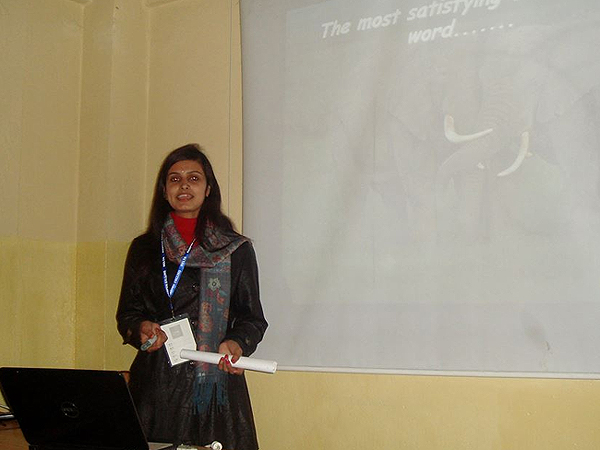
Prema Bhusal

 prama-bhusal

I was very excited from the very beginning when I heard that 19th International conference was going to be held. We had a discussion in our classroom as well with our Associate Professor, Laxman sir. Then, out of curiosity, I decided to write a presentation proposal for the conference. Then, without making any delay, I sent my proposal to the representatives and received prompt response of acceptation. From that day, I had different kinds of curiosities in my mind about what and how it would go in the conference.

On the first day of the conference, I saw an overwhelming number of participants from home and abroad. Then, I entered in the plenary hall and attended the sessions of key speakers Prof. Stephen Stoynoff, Prof. Keith Morrow and Prof. Z, N. Patil.  Along with them, I saw other apex personalities from different parts of the country.

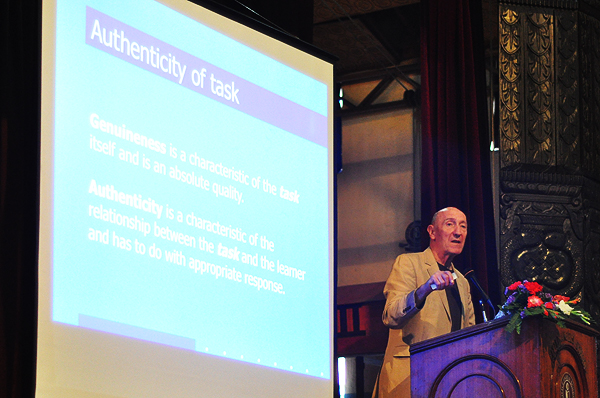
I was really mesmerized by the thoughts about assessment and different issues shared by the key speakers. All the key speakers were exploring assessment in different ways. Some were talking about authenticity, genuineness and some from socio-cultural perspectives and some talking assessment as love and arrange marriage. Although, all the key speakers have equally contributed assessment taken from different perspectives, I felt very blissful when I heard this line from Prof. Z.N Patil, from India that “Formative assessment is like a love marriage and summative assessment is like an arranged marriage”. It made a great impact to me as this was really relevant to what I was doing. I’m doing an online course on ‘assessment’ sponsored by OregonUniversity, U.S and U.S Embassy. When I shared Prof. Patil’s analogy of formative assessment as a love marriage and summative assessment as an arranged marriage, my professor, Sandra Clark mentioned that the analogy made her and her staffs laugh as she had never heard that before. Now, it is a matter of discussion in our online discussion board.

Now, let me share my feelings about concurrent sessions. When I started to join in concurrent sessions, I found different kinds of people from different parts of the world and I had different kinds of feelings in this session. It is because, some mentioned very good ideas about their teaching experiences and some were not very confident in their subject matter in spite of being a professor. Sometimes, I felt sad when some presenters were wondering and moving here and there, because none of the participants were in their session. Then, I compared myself with them – what will I do if I face the same situation? I had a kind of terrible feeling and without any delay, the turn of my presentation came on the final day, immediately after the lunch. Before presenting the topic “Developing Speaking Skills of Students”, my feelings was the same and wondering what will I do if there is no participant in my classroom? But apart from that, I had a kind of feelings to soothe myself that I will at least get a certificate if nobody is with me, but the God was with me and my wishes came true. I saw a number of participants in my session from the different parts of the world. When I saw their active participation and curiosity in the subject matter I have presented, a great relief came into my mind which gave me encouragement and I felt more confident. So, my presentation went on well than I had expected.

All in all, the 19th international conference of Nelta made a great impact on me. I just don’t know how to express it in these few words. I have realized that I have built up my confidence on the subject matter and I’ve also made both personal and professional progress. This conference has helped me know better about global practices, the role of presenter, participants and the relationship between the two. It has helped me present more effectively and confidently in the days to come. All the reflection of the conference and attempts, I have done to gain knowledge undoubtedly has enriched my knowledge and skills. I got a chance to share my feelings to the open-minded people from different parts of the world.

—-

prema

Prema Bhusal
M.Ed. ELT, Fourth semester
KathmanduUniversity

What does ‘authentic’ assessment mean?

Mabindra Regmi

morrow

“What does ‘authentic’ assessment mean? How do we do it?” A Critique on 19th NELTA Conference Plenary by Professor Keith Morrow, UK

Authenticity in Context

Man: Mary, am I a man?
Woman: Yes, John. You are a man, and I am a woman.

Dr. Keith Morrow started the plenary session at Hetauda on 3rd March, 2014 with this excerpt from an English textbook used in England over four decades ago. It is interesting to note that the textbook writers and language policy makers bordered absurdity in the name of imparting the right content to the students. Dr. Morrow shared the same line of thought and discussed with the audience regarding how the text in English textbooks have steadily gravitated towards authenticity. And how all this has resulted in a testing system that is more authentic in nature.

But what is authenticity? Dr. Morrow was of the notion that a text that mirrored the context of a society as exactly as possible could be considered more authentic. This resulted in an inextricable correlation between the text and the context of the learner while defining authenticity. Probably that was the reason why the speaker delivered the whole session on authenticity along the thread of context of the learner. He exemplified his belief by giving an example of how an authentic piece of language text like his personal tax return paper, might prove to be far from authentic in a different context, say Nepal. This spatial, and most likely temporal, property of language discourse necessitated context of the learner to be addressed while designing both textbooks and assessments for language learners.

Dr. Morrow thus added the aspect of context while designing a test in addition to the two important traditional criteria: validity and reliability. He was of the opinion that there was a very direct and strong link between validity of a test and the context. However, the relationship between reliability of a test and the context could be rocky at the best. By making the test authentic in accordance to the context of the learner, the validity is confirmed as the test measures exactly what it intends to measure. But if you consider the reliability of the test, the same learner taking the same test at two different times might not result in the same performance level. Now this creates a dilemma – should we contextualise the testing material so it is more valid to the learner, or should we refrain from doing so, and confirm to the reliability criterion that is so essential in testing?

Although the session did not offer a viable solution for the ensuing dilemma, it did focus on the necessity of the testing material to be more authentic in nature. Authenticity in testing not only brings the learner closer to the language, but also creates a more meaningful learning. However, since it is the learner who is indulged in the language pedagogy, it is imperative to integrate the context of the learner to make the testing more authentic.

Mabindra Regmi
M.Phil. English Language Education
Kathmandu University
Email: mabindra@gmail.com

Learning from Self and Others

Gopal Prasad Bashyal

I attended the 6th International Conference of Bangladesh English Language Teachers’ Association (BELTA), held in Dhaka, Bangladesh in January 2013. On this post, I am going to highlight the experience of attending the conference as one of the NELTA members.

Dhaka became unexpectedly warmer after a week’s unusual cold. The airhostess in Biman Bangladesh welcomed the passengers immediately after they stepped into its cozy comfortable cabin and made everyone laugh. She said, “Welcome to the cold winter in Bangladesh.” Thanks to the BELTA people who had already informed us individually and through their website www.belta-bd.org. The plane flew high. It flew higher and much higher. It could scale the sky over the cloud; it made its way breaking the cloud; and I was sensing the thrill of its ascent. It made me think about the height of my destination. The plane landed on ShajahInternationalAirport. For me it was a beginning since I had not scaled any professional height so far. For me it was a move in the runway. For me this was the first attempt to offer myself as a competent learner in the crowd of such a mega ELT event outside Nepal.

It was January 16. The sun was slowly hiding into the horizon. George Pickering, the trainer for Peer Support Review (PSR), chased us to the Conference Hall on the sixth floor of Royal Park Hotel, Banani, where we were introduced with the BELTA Chapter representatives. The PSR training was enthusiastically entertained as the milestone for the strong foundation and active functioning of Teacher Associations (TAs) like NELTA, BELTA and SLELTA. The PSR was mainly about BELTA and NELTA. We began a diagnosis of TAs’ leadership, management, their functioning and performance, documentation and future directions. The PSR members were divided into three groups and assigned tasks: Group A mission and strategy, leadership and communication, Group B the International Conference, newsletter and website, and Group C Marketing and membership, training and development, finance, and innovation and networking.

The reviewers were oriented about questioning skill, investigating information, conducting focus group discussion (FGD), and reporting. The reviewers interviewed and organized FGD with the participants, members, executive members and office bearers. They also studied the publications and records. The reviewers obtained the necessary information during the Conference. The participants and executives were happy to talk to the reviewers since it was a kind of learning process through mutual interaction.

BELTA has earned prestigious position as a volunteer institution working for enhancing ELT in Bangladesh. The presentations and representations in different forums at home and abroad by its leaders, regular events like trainings, workshops. Emerging Chapters, partners in Bangladesh and outside, professionally competent leadership and growing interest of teachers in BELTA and its activities are some evidences that BELTA lives forever. Though there are only 10 Chapters and only about 200 life members, the participation of more than 500 in its 6th International Conference was a great success and a sign of bright future.

The Conference was well managed regarding time, communication and range of presentations. The Conference featured 104 presentations – 6 plenary presentations by invited speakers, 27 workshops, 67 papers, one debate, two panel discussions, pecha kucha, cultural show, and book fair. The theme of the Conference was “Multiple Realities of English: ELT and Beyond.” During the conference, invited speaker George Pickering focused on the urgent necessity of teachers to change themselves due to the changing role of teachers, new teaching methodologies, educational reforms, new learning techniques and globalization. He observed growing Englishes in different regions.

Discussing on the ELT in South Asia, Adrian Tenant observed the lack of integration – while implementing one part of educational process the others are neglected. His workshop focused on teachers’ beliefs and reflective teaching. Likewise, Prof. Fauzia Shamim from Taibah UniversitySaudi Arabia, specified the knowledge, skills and dispositions necessary for effective teaching as benchmarks of the standards for teacher education. She shared about ‘teacher evaluation for development’ in her plenary and in her workshop focused on large class as an opportunity.

Dr Eric Dwyer from the US argued for incorporating local contributions in the curricula and also focused on developing classroom libraries of student generated compositions – using minimal resources. Another invited speaker Prof. Rubina Khan’s speech focused on teacher leadership. In addition to these plenary speeches, other presentations range from topics on young learners to adult education, from tertiary and secondary education to curriculum and materials design, from community-based learning to the use of technology, from examinations and its impact on society to the concept of developing innovative practices. They were research based and thought provoking.

The Conference was a gallery of highly professional scholars from Bangladesh, SAARC region, the US, the UK and Saudi Arabia. It was a galaxy of novice young and worldwide popular experienced teachers working at various contexts. The rooms were well-equipped and the volunteers were ready for maintaining necessary arrangements.

As an ELT practitioner, it’s a great opportunity to enjoy abroad journey for professional development. Women leadership, time management, range of presentations, professional as well as managerial leadership, coordination among partners and sponsors, growing competent human resource at local level are some major lessons on the part of association.

The Conference also gave a message for empowering the learners using locally available sources and engaging students for varieties of learning processes. Despite problems to implement communicative language teaching, teachers can identify and select the appropriate techniques applicable in their own context. The Conference gave the message that teachers need not run after the experts or ‘heavy weights’; they are innovators of appropriate techniques for their classroom. For this, teachers need to gain and update knowledge and skills of current techniques and technologies through continuous professional development and enjoy teaching.

Gopal-BashyalGopal Prasad Bashyal
Chair, NELTA Palpa Branch,
Presenter and Reviewer,
Sixth BELTA International Conference, Dhaka, 2013
Email:gopalbashyal@gmail.com

What are you taking into the classroom?

Santona Neupane

During the conference, we asked a few of the first time conference attendees about their experience and what will they be taking to the classroom from the conference. Here are their views.

Sudip Neupane, M.Ed (ELT) KUSoEd

My reason for attending the conference: I attended it to learn new things about language and learn the recent techniques, methods and strategies in ELT.

The session I liked: I liked the Key Speech delivered by Prof. Stoynoff and Keith Morrow as they both shed some light on alternative assessment as a way to promote connection with teaching/learning and assessment. It was quite relevant.

My reflection:  As it was the first NELTA conference I attend, I learnt many things about English language teachings.

What I will be taking from conference to classroom: the notion on how learners need to be aware and motivated to learn.

Raju Shrestha, M.Ed (ELT) KUSoEd

My reason for attending the conference: I attended the conference so that it would help me gain confidence, gain exposure in English and to get involved in interaction.

The session I liked: The concurrent sessions on various issues were more effective for me.

My reflection:  As it was the first NELTA conference I had attended, It was a great opportunity for me to get exposure in English as there were native speakers. It helped me realize that everyone has capability within them but it has to be recognized and activated through exposure, participation, motivation and interaction.

What I will be taking from conference to classroom: There are many things that I have learnt in this conference which can be applicable in my classroom. After attending the conference I have started to focus on making my classroom more interactive.

Saroj Kumar Mandal, M.Ed (ELT) KUSoEd

My reason for attending the conference: To acquire ideas on assessment and other teaching learning activities.

The session I liked: Plenary by Prof. Z.N. Patil and the Pecha Kucha Show.

My reflection: I acquired new ideas on various teaching learning activities as well as assessment. I came to realise the existence of various types of assessment systems and their effectiveness. I even sharpened my communicative skills by interacting with the participants and presenters both from home and abroad. It was useful in the sense that the methods, techniques and ideas from key speech and presentations can be easily implemented in our classroom.

What I will be taking from conference to classroom: I will not limit my student assessments on written performance only, as had been done traditionally. Rather, I would assess student performance based on other skills they demonstrate as well, e.g. listening, speaking, and reading.

—-

santona

Santona Neupane
M.Ed. ELT, Second Semester
Kathmandu University

Language Testing and Assessment Workshop: A reflection

Ganesh Datt Bhatta

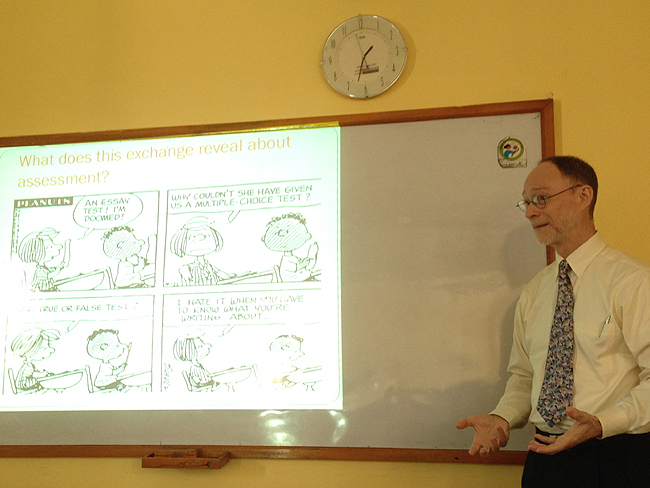
On February 23, 2014, I attended a one-day workshop on ‘Language Testing and Assessment’ conducted by NELTA in association with the American Embassy at Kathmandu University, School of Education. The workshop was facilitated by Dr. Stephen J. Stoynoff from Minnesota State University Mankato USA, one of the key note speakers for the 19th International Conference for NELTA.

stoynoff-1

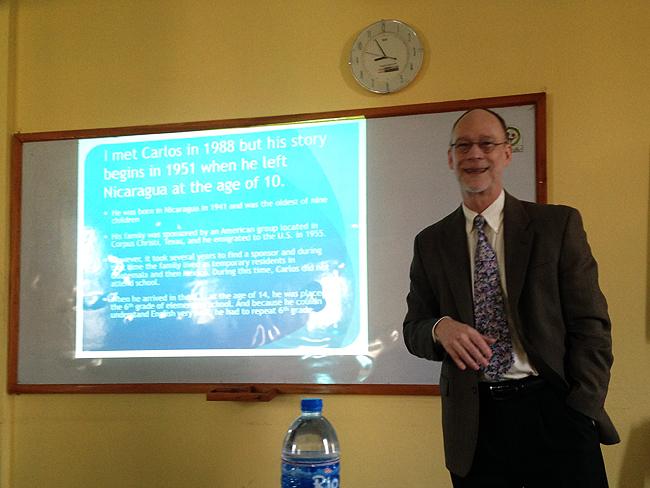
It was a very lively session by Dr. Stoynoff as he presented on how learners who learn English as the second or third language struggle in learning the language in the classroom.  He shared an example of his own friend, Mr. Carlos who had immigrated to America from Nicaragua in 1950s. He belonged to a Spanish speaking community and was already 14 when he joined a school in Texas, US. It was difficult for him to learn and adjust in the classroom with his peers who were much younger by age and he did not know English either. As a result, he could not succeed in his sixth grade and he had to repeat the same grade. As English was not his first language, it was obviously difficult for him to understand what the teachers taught in English medium that followed “sink-or-swim” model.

Dr. Stoynoff asked all the trainees to find out the factors that influenced language development and reasons for Carlos’s failure in grade six. The discussion ended with findings of the factors like home environment, societal environment and individual factors of language learners influence the language development.  A learner learns language if the educational level of the family is higher. The families which give priority to learn different languages helps a child to values towards education is also important for the development in a learner. It was amazing to find that Carlos earned a PhD later, though he had tough time in school in the early years of migration. The turning point in his life was at his school where a teacher appreciated his work in Spanish. Those inspiring words from the teacher guided him to choose Spanish for his further education and he earned a PhD in the same area. Now he is regarded one of the important experts in the field of Second Language Learning and Teaching.

It can be inferred from the story of Carlos that a teacher can inspire students to pursue their career in proper field of education and the motivating environment of the family also contributes in effective learning of languages. The interaction of the factors like home environment, societal environment and individual factors of age, proficiency of the first language, attitudes towards the second language and access to the Second Language and culture affects the rate of second language development of the learners. The first session ended with one open topic to debate on the pros and cons of teaching other languages than first language at early age of learning.

The second session of the workshop focused on the current trends in the field of Language Testing and Assessment. Assessment is a process based activity to ensure that a learner is developing his/her learning that continues throughout the daily classroom activities. The trainees were divided in groups to make a student profile having some questions to check the background of students in academics performance and to design the learning environment on the bases of it to expect possible development in the pursuit of the course.

Dr. Stoynoff shared the current practices of Language Testing and Assessment in the USA and some other countries. The trainees were asked to make comparisons between the classroom tests and the standard tests (high stakes tests). The discussion gave us idea about the types of testing in classrooms and beyond classrooms in terms of their procedure of conduction.

stoynoff-3

Nepal has been following the decade-long practiced assessments and tests in all levels of education from nursery to university level for different purposes whereas the other countries have updated their testing mechanism to enhance the ability and strength of the learners. But there is no such standard test for Nepal to check the ability of Nepalese students. We came to realize that there is enough space for ELT practitioners and language experts for research in Nepal to design a standard test to check the ability of our students in Nepal vis-à-vis the students of other countries.

The one-day workshop was an eye opening program for the participants where we got to know the recent trends of language testing and assessment. I, on the behalf of all trainees would like to thank NELTA President Mr. Hemanta Raj Dahal and Ms. Sara Denne-Bolton, Regional English Language Officer (RELO) from Embassy of the USA for providing such an opportunity to discover our strengths as teachers of English language and find our students’ potentialities in learning second language comfortably.

Photos: Umes Shrestha

ganeshdatt

Ganesh Datt Bhatt
Life Member-NELTA Kanchanpur
HimalayanWhiteHouseInternationalCollege, Kathmandu
Email: yrsgdbhatt@gmail.com


Before the Sun Rises: A Reflection on a Recent Choutari Meeting

Shyam Sharma and Uttam Gaulee

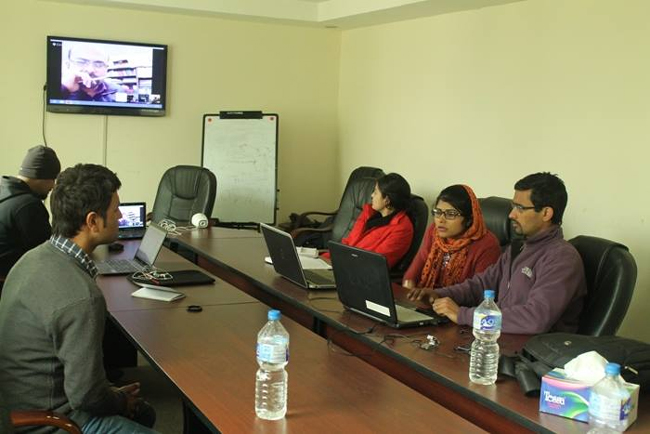
Outside, the pile of snow was thicker than vehicles parked on the street. From frozen New York joined Shyam Sharma.

Uttam Gaulee was in warm Florida (as far away from Shyam’s place as Colombo is from Kathmandu), at 10.30pm, still in my University of Florida office.

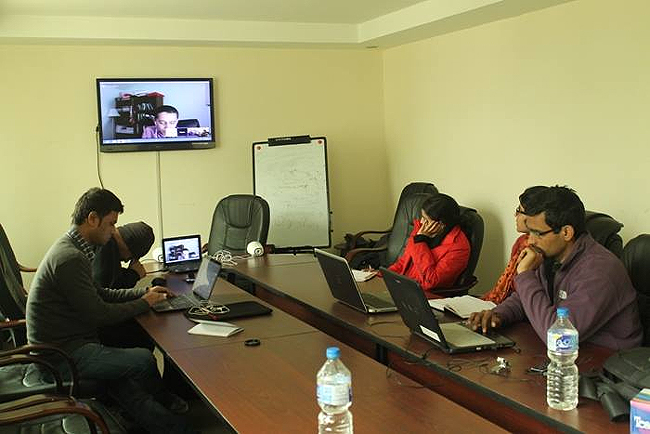
In Kathmandu’s King’s College in Babarmahal had gathered some of Nepal’s brightest ELT scholars– which we are not exaggerating. It was early morning there, seemingly cold, and some colleagues were slightly late from trying to juggle personal and professional responsibilities (as well as beat Kathmandu’s traffic).

Present in the virtual shade of the Choutari tree were Praveen Yadav, Umes Shrestha, UshakiranWagle, Santona Neupane, Suman Laudari, and Jeevan Karki from Nepal; Uttam and Shyam joined from the US.

choutari-meeting-1

Technological Demo

This was a meeting among Choutari editors, originally supposed to be a “training” where Shyam was going to walk us through the kinks of technology before discussing how to translate technological affordances into professional purposes. The plan was to ensure that editors are proficient in the use of WordPress blog platform and functionalities: how to add new posts, save drafts, schedule for certain dates, order by time stamps, create table of content, hyperlink using part of preview link, integrate images and other media, learn how to tag and categorize posts, and so on. Shyam did start by emphasizing that the technology is largely a tool that we need to learn how to use with command (meaning everyone must learn how to post/schedule, edit, link, organize, and manage posts and pages on the blog) but the focus must be on how to achieve the professional objectives that the tools are used for achieving. We used the metaphor of hasiya, kodalo, and bancharo and how we keep them sharp and ready but don’t look at them as the focus of our harvest seasons.

However, within a few minutes of trying to walk the rest of the group through the dashboard of the WordPress blog, using Google Hangout’s Screen Share functionality, he realized that the participants already knew the basic applications and functions–or at least they could teach each other basic features and more quickly and easily. In fact, more people than we knew prior to the meeting turned out to have their own blogs and have mastered fairly advanced functions. Going into details of advanced functions like managing widgets, plugins, theme and customization, exporting content, and managing pages could make the meeting more boring than productive; and more advanced functions should also come from gradual development of expertise. Some roles such as approving comments can be assigned to certain editors because they need some attention and understanding (such as spotting and excluding spams; Uttam and Praveen seem to be doing this now, and that looks like a good plan).

So, the conversation naturally and quickly moved on to the agenda of maintaining quality, promoting collaboration and efficiency, and modeling for as well as engaging the community.

Maintaining Quality: Making Review Process Effective and Efficient

We started this segment by summarizing the notes that were shared with the group prior to the meeting. It is worth highlighting that editors fully familiarize themselves with the rules provided to writers; these rules are outlined and even demonstrated under the section “Join the Conversation.” We also later discussed the overarching objectives of the forum spelled out at the top of the Team Charter. The specific best practices and general mission statements are worth viewing as giving us a sense of direction with regard to quality of the publication and engagement of the community. Below is a rundown of what we discussed in terms of making the objective of maintaining quality/standard efficient from a collaborative perspective. Please don’t read these as instructions; they were discussed as suggestions for effectiveness and efficiency. Everyone agreed that a more efficient process for collaboration is needed.

  1. Submission: All submissions must be made to the official email, neltachoutari@gmail.com in order to avoid various types of possible confusions and inefficiencies. First, promote the “Join the Conversation” section; when any authors submit their drafts to individual editors, they should request the writer to resubmit it to the official email address (create a template email if necessary); or just forward the email to the official email, copying the author. Even this much will make a huge difference in terms of streamlining the review process.
  1. Reception & Assignment: The lead editor of the next month should respond to all submissions made between, say, 16th of the previous month to the 15th of the current month. Lead editors can choose to respond from the official email if they prefer; otherwise, lead editors can respond to writers of each submission during the time window and copy one reviewer (and if necessary one mentor), asking everyone to complete the review process and submit the article by, say, the 24th of the month before publication. If a lead editor can distribute the burden of review among different editors/reviewers, starting with his/her subeditor(s), this will allow the lead editor to be more creative, to try to cover more base, to run the conversation, and to better maintain the overall quality. To avoid confusion, editor/reviewers not assigned to work on any draft should leave it to the assigned editors/reviewers. We also discussed the driving principle that “collaboration” and “taking turns” are two very different things, and what we need is the first!
  1. Collaborative Review: Using Google Doc as a general rule can make a positive difference, though it may be necessary to give individual writers the choice of opting out and using email with his/her reviewer (and mentor if any). Lead editor can create a new Google Doc each within the official account, giving edit access to the writer (as well as editor/reviewer and any mentor). Again, while some writers may not be able to use Google Doc (due to technological limitations of skill, tools, internet, anxiety, etc), even those who are able to do so will significantly eliminate the need for email- or phone- based updates among the writer, reviewer, and coordinating editor. Just the lead editor being able to see where the review process for some of the submissions can save a lot of time and hassle. Finally, some writers may not want the review process to be open to all editors, but the solution to this is to make the review process more professional (and respectful of authors) rather than relapsing into privacy–because the idea of privacy among editors doesn’t make sense anyway. A standardized folder and file naming convention should be developed through a Facebook Group conversation.
  1. Assessment of Quality: Lead editors should sort submissions into three or four groups, such as: 1) ready for publication with minor edits, 2) worth reviewing and publishing next month, 3) worth assigning a mentor as well as reviewer, and 4) impossible to improve. While the general principle of a community like this should be “reform not reject,” there may be some cases of #4, such as plagiarized or already published content, not at all related to ELT, etc. Drafts in category #1 can be managed by lead editors themselves (no need to assign a reviewer); drafts in category #2 would be the majority; drafts in category #3 should be directed to the coordinator of of the Choutari Mentoring Project, Uttam Gaulee, or at least copied/coordinated. The idea here is that even though a blog should not be about rejecting or accepting articles like conventional journals, shifting the focus from personal to collaborative/communitarian is in everyone’s benefit. We also briefly touched upon the following issues as a yardstick for assessing how to approach different types of drafts/submissions:
  1. Relevance and Significance: The draft is not relevant to ELT, doesn’t situate or even relate the main idea to ELT or to education at large in a significant way. Or, the draft doesn’t have a significant, interesting, or engaging point from the perspective of our readers–because the subject is outdated, the topic too broad/vague, the argument diluted, etc.
  2. Organization and Connection: The draft doesn’t start with an engaging and clear introduction that provides a sense of direction, a sense of scope, and a sense of organization to the readers–and there doesn’t seem to be an easy fix, such as moving the key idea to the beginning and adding transition sentences for better flow between sections that are in themselves focused on the main idea.
  3. Focus and Strength of Main Idea: The draft has long a long background and/or includes barely relevant paragraphs/sections that can’t just be deleted (because the rest of the draft would be insufficient or affected by the removal of parts), or the overall writing doesn’t develop a main idea with a focus and a perspective.
  4. Originality and Use of Sources: The author uses external sources without proper/effective citations, seems to use external sources without citation but it is hard to determine by simply Googling chunks of text, or cites correctly but the citations are not integrated and used effectively alongside his/her own ideas–for instance, there are large chunks of citations that are not yet framed within the writer’s own ideas.
  5. Language and Style: The writing is highly formal, academic, or abstract and therefore in need of “translation” to make it more accessible to the blog’s readers–or it is extreme on any other end, such as too informal, too gimmicky, etc.

Fast Tracking Review: Taking drastic but intellectually sensitive approach as editors: especially when there is little time and not enough material, blog coordinator and/or editors/reviewers may have to take a drastic approach. But the authors must always be given the opportunity to review and approve any and all changes/edits made to their work. Here are some time-tested strategies that may be handy.

  1. Do/Show: cut/paste the main idea if it comes late in the draft to the beginning, add a sentence or two in the beginning (esp. within the first two paragraphs) in order to provide context and/or overview of the post, foreground or add topic sentences within the body paragraphs;
  2. Tell Directly: highlight and directly tell the author to delete any sections that are irrelevant or go too far in one direction, ask the author to condense an elaborate section into a certain proportion such as two-third or one-fourth, etc, and
  3. Ask Bold Questions: ask the author if any section can be deleted, condensed, or elaborated as necessary.

choutari-meeting-2

Team Spirit: Team spirit is very important. Both facilitators highly emphasized that Choutari is a forum with tremendous value and impact in the world of ELT and that it also has huge potentials for the editors’ professional growth; but both the impact on the profession and the person heavily depends on maintaining a team spirit, keeping one another inspired and energized, cultivating a positive attitude, going for the positive, inspiring the community, giving the best back. And, for a community that depends on virtual communication, all the above heavily depend on regular communication among the team as well as strong, positive messaging from the team to the community.

Reflective Editorship: We also touched upon the idea of “reflective editorship,” which means that if lead editors start, carry out, and end their coordination by engaging the rest of the team in an ongoing conversation, assessment, and reflection, there will be continued learning and inspiration for all involved. No one comes to Choutari already knowing what exactly to do; if we do, we would still be quickly outdated! The community continues to develop new ideas, columns, strategies, etc; and this starts by building one set of guidelines and trying to achieve the shared objectives, then gradually updating and improving the strategies through ongoing conversation and reflection. The Team Charter is a starting point, not a stone tablet with rules.

As we were engrossed in the conversation, paratha arrived. Amid the rustle of unwrapping packages and as our colleagues back home served themselves the mouth-watering breakfast, and with our mouths watering from two ends of a country on the other side of the world, we wrapped up the conversation. Very deep intellectual discussions branching out from technological topics, laughter and giggles, multi-tasking, using alternative channels when the lights went out, bantering about the men in Kathmandu forgetting to turn the camera to the chelis . . . made the meeting both inspiring and memorable.

The Choutari brings people together, people who are on their way to their own professional destinations (or rather journeys), people who care enough to stop by, to share their ideas– in spite of the crazy busy lives they live, in spite of the seven seas separating them. The virtual Choutari has a lot in common with the physical. This too is on the way to somewhere, as the physical choutaris usually are. This too gets its meaning when people stop and talk, rest and energize themselves. The burdens we carry may have become abstract–for as teachers, scholars, we transport ideas on our backs–the journey we make may be to places around the world, and the travelers we meet may be citizens of the whole world. But we still share the same concern to keep our community informed, our bonds strengthened.

It was 2.30am by the time we finally left the Google Hangout. The snow was still piling up in New York, Uttam had to go home by the last university escort at 3 am, and colleagues in Kathmandu had half the day left and work to be done.

Photos (above): Jeevan Karki

shyam

Dr. Shyam Sharma is an assistant professor of Writing and Rhetoric at State University of New York, Stony Brook University. His professional interests include composition (writing and rhetoric) pedagogy and theory, writing in the academic disciplines and professions, multilingual and multimodal writing and scholarship, rhetorical traditions, and research and program development for professional development of university students.


Uttam Gaulee is a doctoral student in Higher Education Administration and Policy program at the Department of Human Development and Organizational Studies in Education at the University of Florida. After working as an English language teacher at Tribhuvan University colleges in Nepal, he joined the University of Pittsburgh as a Fulbright scholar, before joining UF. He is Associate Director of Community College Futures Assembly at the Institute of Higher Education and also serves as Graduate Affairs Chair of Graduate Students Council at UF. Uttam is leading the new Choutari Mentorship Program.

In the Mission of Grooming Young Creative Minds

*Jeevan Karki, www.merocreation.com

jk.pravat85@yahoo.com

Hello Sir!!!!! 

am (I’m) missing u a lot especially when the english periods go no quite monotonous. anwy (anyway) am f9 (fine) n doing gud. hope u r also f9 n u know wt(what) sir i started writing poem frm grade 10 n till date i hav completed 50 poems. shocking na!!!! n sir i would really lik to thank u as u inspired me to write the poems. eventhough that time we didn’t use to write bt (but) with the passage of tim i also got the knowledge abt why u were so eager regarding student’s creativity. all the credit goes to u. thank u so much sir!

really missing u sir!

Sakshi

I received this mail on July 20, 2012. The sender by now is obvious. She is one of the students I taught in grade eight, two years before the date mentioned above. I used to teach her both English language and literature. In the parents-teachers meeting, the parents often used to complain (and still do) about their children not being creative and just cramming overnight for exams. Most of the time, we teachers keep the issue of creativity aside by telling them it is the matter of innate quality, hard work of students and support of guardians. Blah, blah, blah. However, the kind of activities we do in the classroom and the sort of home assignment we assign also have something to do with students’ creativity. Soon after the parents-teachers meeting, a three-week winter vacation was going to kick off. As a vacation work, this time I thought of assigning a bit different work rather than telling them ‘do exercises from page number this to that’. I gave them some reading work and creative writing. As for the second one, they were supposed to come up with some kind of free writing such as poems, stories, songs, travelogues, essays, diary writing (memorable days), etc. First, they looked puzzled, for they were not used to this kind of assignment. So I gave them guidelines to write and also declared that best writings would be sent for newspapers in order to encourage them. The vacation was over. However, I was not very hopeful that everybody would bring their assignment. To my surprise, everybody brought some writing. Some even brought two writings. I went through them in my free time and found most of them original and creative. Now I was in trouble. As I promised, the writings had to be sent to the newspapers but there were too many. Then I decided to publish a class magazine and shared the idea. Then, I divided the responsibility, making sure that everybody is involved. They worked with their group members in their free time in school and at home without disturbing their regular studies. After a month, each class had their own mesmerizing wall magazine. The parents were pleased to see the outcome in the final parents- teachers meeting and the school administration also took the effort positively and published that news in the school news bulletin too. It could also be one of the reasons that I got a promotion the next session. However, I did not wish to continue working there because I got a better opportunity in another institution.

In the next institution too, I pondered some better ideas of developing creativity of these young minds through free writing. In place of a wall magazine I was thinking of other reliable and long- lasting alternative, which could also include young students from other schools. However, the session was towards the edge without materializing any concrete idea. There was one creative colleague, who belonged to computer faculty, Mr. Krishna Subedi. He is also a web designer and developer. I talked to him and finally we decided to do something on the Web. Then we launched a website or webzine on May 2012. We named it merocreation.com.

We started this small venture for giving young creative minds an open creative platform with the motto “encouraging and energizing the young creative”. Initially, only two of us used to work. Mr Subedi looked after technical aspects while I devoted myself to the content area. We started with the creative writings of the students of our schools. Later, the visitors multiplied and we started receiving the writing from other institutions too. We kept modifying and beautifying the site but because of the overflow of the visitors only we two could not handle it. So we developed a team of thirteen members, including an advisor. It was after two months of the inception of the webzine, I received the above mail from Sakshi.

The mission of creative writing has kept me in touch with so many old students, including Sakshi. There is a boy named Samyam Shrestha, who published few stories in the webzine (he had published not a single story anywhere). His stories are mostly read and liked by the visitors. He mailed me around six months back and said that he wanted to publish a story collection. He is an eleventh grader now. There is another girl named Reeti KC from the same level. She is very good in poetry and has published many poems in the webzine and also in the national newspapers. She mailed me recently stating she has made up her mind for publishing a poem collection and asked me to edit it. It shows that something is going on. Something is happening. The webzine has been grooming these young minds and providing them with an interactive platform. This is also a part of language teaching; language teaching through creative writing.

How to accommodate creative writing in the language class?

It is a frequently asked question by language teachers. They say that they have to complete the syllabus, focus on exams and all students expect good grades. Therefore, there is no time for creative writing. Please do accept that I also have the same problem like yours. We are the birds of the same feathers. Despite all these things, it is possible to accommodate creative writing in the language class.

The first and basic thing is to be self-conscious about our students’ creative writing. When we assign them any writing, we have to make sure there is an adequate space for creativity. Whatever students do and write, we can give it a creative flavor. I call this process an inductive approach to creative writing. Here the teacher gives students the usual class assignment or home assignment, but it is given consciously having space for imagination, logic and noble ideas. Then when students submit the assignment, the teacher has to check the writing through the lenses of creativity. As per the feedback, the teacher can point out the area where the juice of creativity and elements of imagination, logic and noble ideas can be incorporated. Also, they should be asked to re-write so that their writing is publishable somewhere. Let’s take an example, how we can change letter writing into a creative activity.

Suppose, I am teaching students of the lower secondary level to write a letter to their brother or sister who is addicted to social networking sites. The letter can include some constructive suggestions to minimize the habit of always hanging on the sites and also the ideas of using social networking sites for educational purposes. If the letter includes these things, it will be an informative article for many people and hence it is publishable as a creative writing. However, the ideas need to be practical and the language needs refining. Here comes the role of a teacher. There should be discussion and brainstorming before assigning such an activity. After they write, the teacher can ask students to read each other’s writings and offer feedback. Similarly, he or she can also form a group of more-able students as the editors of the class. In the first phase, they can help the teacher to sort out the writing then the teacher can go through them. This will develop a habit of learning in collaboration, a sense of responsibility and togetherness in the language class, which after all will minimize the teacher’s burden.

Similarly, if I am teaching letter writing to students of secondary level, it is not necessary I always teach them to write letter to their fathers for asking pocket money and so on. I can also teach them writing letter to Prime Minister regarding how to stop corruption in the country.  It will be a highly creative writing and publishable in the newspapers, webzines and other magazines. The same technique can be applied to other types of writing like paragraph writing, essay writing and so on. To the same token, in a bit long break, we can give students the writing tasks which are creative by nature like poems, stories, essays, travelogues, songs, book/film reviews and so on. In my case, in the vacation like term break, Dashain-Tihar vacation, winter vacation, I assign them to read novels or story books and write their own reviews (applicable especially for the secondary level). In this way our students do creative writing without being much conscious that they are doing it. That is why I call it the inductive approach to creative writing. Without telling anything like, “Okay class, today we are going to do CREATIVE WRITING…!” we can engage our students in creative writing activities. However, the continuity of this process depends on teachers’ readiness and reward. As per the first one, as you are reading this article, it is sufficient that you are ready for students’ creative writing and now it is the second one to think of. It is very important that students be rewarded for their creative work, and the most valuable reward for them is publishing their work in magazines or webzines.

Why webzine?

I said that the publication of students’ creative writing is the best award and it is true. There is a girl in my class, who is very good in her study. Seeing her friend publishing articles in the newspapers and magazines, she also sent some but they never got published. She got frustrated and never tried again. Then she stopped writing completely. I came to learn about that and asked her to show her writings. I checked them, gave some feedback and asked her to rewrite. She did and it was published in the webzine. The publication of her article sparked a wave of euphoria in her and she resumed her writing. Now she often writes and publishes. There might be many hidden potential young minds not getting a suitable platform. Of course, there are newspapers and children magazines, which publish the creative writings of students but they are few and have to look all over the nation and hence cannot give space to all children. So we need to look for an alternative. In order to promote language and creative writing, we can publish school magazines giving space for all the students in school. Similarly, we can also publish the class wall magazine, which can give space to more students of a class. I tried these and found them only being confined to school and failing to be long lasting. Then I started this webzine, which has multiple advantages. Students can get their writings published instantly. It has global access and the writing can be viewed anytime from anywhere. Students can also share it with their relatives who are in another corner of the world. Similarly, another important thing is it is highly interactive. They can get instant feedback from their readers. In this forum, they can find so many like-minded young people writing, publishing, reading and commenting each others’ work. This will give students a creative and productive environment. All these things will encourage them to keep writing. However, they do not find all these facilities in the print media. In the same way, students (especially from the town area) today spend their time surfing the Internet rather than going through the printed materials. So this is also an attempt of developing a culture of doing academic activities in the World Wide Web. It is undoubtedly a great platform for developing language and creative writing among young learners.

However, it does not imply that all English language teachers need to have their own webzine. If you can have, that’s superb. If it is not possible, you can try the alternatives discussed above. In the same way, you can consider this webzine as your own and send the writings of your students to publish there or encourage them to send themselves. As being one of the content editors of the webzine, I suggest teachers that they read the writing of their students and give feedback before sending for publication. Spending some time in this webzine will help students develop their language and creativity. Besides creative writing, they also can find some useful academic and non-academic resources in this webzine. This is purely an academic and creative mission; a mission to develop language through creative writing. We are trying to teach language to our students but now let’s also try to teach the creative use of language. Let’s teach them to play with words and learn art of words. Children have a lot of energy and ‘crazy ideas’. They are highly imaginative. Let’s provide them with some scaffolding. Let’s convert their energy and ideas into creativity. Merocreation.com can be a forum to groom young and creative minds to be a creative citizen of the globe. So let’s join our hand together in this mission.

Finally, I’d like to express my gratitude to Mr. Subedi, Kigan Khadka, a web designer and developer, and all team members: Akrin Adhikari, Jeevanpanee, KP Ghimire, Kumar Narayan Shrestha, Megh Raj Shrestha, Ranjana Khaniya, Richa Bhattarai, Sanjaya Karki and Upendra Subedi for their support and inspiration.

* Jeevan Karki teaches at Graded Medium English School (GEMS), Lalitpur. His areas of interest include creative writing, translation and documentary making.