Category Archives: ELT Resource

Writers Teach, Teachers Write

Kirk Branch

U.S.A.

Over 15 days, I traveled throughout the southern part of Nepal (“I went down,” I tell my friends in the United States, who expect to hear stories of the Himalayas), working with teachers and students – writers – who were looking for ways to incorporate creative writing into their English language classrooms. At the invitation of the U.S. Embassy, and hosted throughout by NELTA representatives in Kathmandu, Birgunj, and Kawasoti, my short trip will stay with me well after my return.

Before every workshop I ran, before the talk I gave in Birgunj, I asked participants a simple question: “How many of you are writers?” Sometimes, nobody raised a hand; occasionally, some raised a tentative hand, nervous about claiming the title of writer but unwilling to say that they weren’t. That question introduced the simple idea at the heart of all the workshops and conversations I had in Nepal: If you are not a writer, you are not qualified to teach writing. How can you teach guitar, if you can’t play guitar? How can you teach volleyball, if you don’t play volleyball? Of course you cannot, or at least you cannot do it very well.

And so, in all the places I traveled, we wrote. We wrote stories, and memoirs, and poems, haikus and slam poetry and fables. I heard stories about family members who sacrificed for their children, poems full of frustration at the current politics of Nepal, diatribes against the bandh. The writings were by turns funny, beautiful, sweet, angry. And we shared the writing, reading aloud, sometimes laughing, sometimes tearing up, sometimes feeling the anger and frustration, always supportive and always curious about what each participant had to say and wanted to explore.

In the process, I hope that the participants began to understand how to think like a writer. Writers know a few things about writing that non-writers don’t usually understand. Perhaps most importantly, writers understand that the rules provided in textbooks and in official curricula are usually too simple and often are just wrong. Some writers use an outline when they write, but most don’t. Some writers create texts with only five paragraphs, but most don’t. Some writers have a topic sentence at the front of every paragraph, but most don’t. Teachers who write as well as teach writing are better able to help other writers find things to write about and support them as they create a text, not by giving them strict rules, but by offering knowledgeable support.

All writers know that writing is hard, that becoming a more proficient writer requires regular practice, that even people who write for a living struggle with openings and agonize through several drafts to reach a level of satisfaction with their work. All writers know that at some point, they have to share their work with an audience, that their main job is to connect with that audience, and that all the questions they have about style and structure matter not because they are “rules for writing” but because style and structure are the ways the ideas of a writer become accessible for that audience.  All writers know that the work of learning to write never stops, that a piece of writing can always improve, that writers need support and encouragement as much as they need criticism and commentary.

By the end of the workshops I ran, by the end of my trip, more people raised their hands when I asked “Who here is a writer?” I hope that even more would raise their hands now. Being a writer, identifying as a writer, requires only that a person write, commit on a regular basis to the work of sitting with a piece of paper or in front of a computer screen and filling it with words, with language. I hope that these newly identified writers in Nepal experience the joy of discovery, of writing something they didn’t know they thought, of surprising themselves with a beautiful image or important idea or funny description. And I hope they share their writing with other writers and inspire them as well with their ideas.

Mostly, I hope these new writers – these writers who teach writing – use their experiences as writers to help their students engage with the task of writing and reading. I hope all the writers who are also teachers of the English language in Nepal will harness the creative power of their students to inspire each other and embrace the joy of creation, to write texts they care deeply about and want to share with other students.

Like teachers all over the world, teachers in Nepal must follow official curricula, must prepare students for tests required by the government. Like teachers everywhere, teachers in Nepal sometimes become frustrated by these requirements because they do not allow enough freedom for teachers. I hope that by joining with other teachers, by learning the power of creative writing, of helping students learn language – any language – by helping them become excited about what they have to say, teachers in Nepal can start to have more voice in shaping a curriculum they are excited to teach!

I end this piece with a poem I wrote during a workshop at the NELTA headquarters in Kathmandu, with a group of teachers and students who walked as much as 12 kilometers over the course of a 2-day bandh, to participate. I dedicate this poem to them, and to all the other participants I met in Birgunj and Kawasoti, who inspired and excited me to do my best teaching, who took my challenge to become writers, who I hope I will see again. It’s dedicated to all the people at NELTA who made my trip so wonderful and engaging. I hope I have a chance to meet some of you again. I promise I will never forget you!

Whose language is this, English?

Can I call it mine,

this language of my childhood stories,

my mother’s soothing,

my father’s rebukes,

my brothers’ tauntings,

my teacher’s lessons,

my lover’s caresses?

Yes, it is my language!

Does that mean I own it?

Do you own the water you hold in your hands?

Do you own the air you breathe into your lungs?

Do you own the spirit that animates your soul?

What Writers Need to Know about Starting and Then Getting Better at Writing

Jayakaran Mukundan

Malaysia

Most people think they cannot write and when they start having these thoughts they will never begin writing. It is not easy to write a poem or a story if you haven’t done much of it but if you start and if it isn’t good at least you have tried. Once you start, get someone who writes frequently to look at your work. Get advice and then re-work your stories and poems. Once you finish start on new work so that you get “addicted” to it. Here below is some advice on how to get started and how to keep the momentum:

  1. If you have written a story or poem and after a while you don’t like it, don’t throw it away. Get some advice from people who write often and ask for help on improvements. Rework the poem or story and then show the expert to see if he/she likes it after the changes
  2. Sometimes no matter how much you try your writing stalls and this is referred to as “blocking”. You may then be, without your conscious knowledge, a “blocker”. People who are blockers are usually writers who are too afraid of making mistakes. If you are this sort of person, learn to relax and have a positive attitude towards your writing. Just keep writing and tell yourself you will change course or look at errors after you have written a page or two. If you worry about bad ideas or errors you may never get to start!
  3. Read more stories and poems and get ideas from professional writers. The more we read the more we are aware of how other people write their stories. We cannot copy these stories but we can learn some strategies so that our stories get better.
  4. If interested in writing poems but you have no idea as to how to start, get a reference which deals with scaffolding strategies that help learners become beginner poets. All you have to do is to learn some of the patterns (for form poems) and then you are on your way!
  5. In order to boost your confidence try publishing your work. The Regional Creative Writing Group does publish the work of amateur writers. Even if you don’t join the group, you can send in work (there may be a representative of the group in your country!)
  6. When you go to places like your ancestral village listen to what elders would say. Keep a record in your notebook. These may become ideas for new writing. When you are free try recalling some things at school like a teacher who is funny or a teacher who constantly forgets. Try writing poems about these people. In fact try writing about people in your family.
  7. Photographs are a good way to start writing. When at home sit with an older person; your father or mother and grandparents. Go through the family album with them and try getting as many stories about people and places from them.  Family albums are a great way to start writing stories and poems.
  8. Last but not least never say you can’t write. Most people who say this end up being good writers after some practice!

Some observations on Nepali teachers writers during the recently concluded Creative Writing Workshops

Generally different people have different personalities and individual preferences, hence write differently. Generally Nepali teachers are very enthusiastic. When at first they were taught scaffolding techniques they began to realize that they could write. This took place when they were taught some scaffolding templates for developing form poems. These exercises soon raised their eagerness to experiment, manipulate and essentially “play” with the language. When they started playing with language the creativity of these teachers soon began to show!

The writing trip was another instance where they learnt to write creatively “after making close observation”. It was good opportunity for them to realize that writing was not just confined to classrooms. The entire space that surrounds them can be inspiration for their writing. Many of the participants confirmed that they would also be working on creative writing projects with their own students after the workshops. That was indeed nice to hear!

Birgunj Truly Represents Nepal

-Vishnu S Rai

Place: Kailash Hotel, Birgunj

Date and time: March 8, 7 PM.

We are standing at the threshold of the hotel to greet the members of the Asian English Teachers’ Creative Writing Group (AETCWG). There is excitement in the air. People are expectant: cameras ready.

A Hias approaches us slowly and stops. The doors open and produces Jay from Malaysia, Iqbal from Pakistan, Kanokon from Thailand, Li Wei from China and Moti, Sarita, Tapasi and Maya from Kathmandu in a row. Then, slowly from the open door emerges the saintly figure of Alan Maley from the UK. Cameras start clicking, there are handshakes and the sounds of pleasures, “Nice to see you again’, ‘Welcome to Nepal’ are heard. The group is joined by Kirk from the USA and the group slowly enters the hotel.

They are the members of the AETCWG who have come to Birgunj from different parts of the globe to meet at their annual meeting and produce creative works that can be used in ELT classrooms on one hand, and to help develop creativity in those English teachers of the region who aspire to be creative. They are here to break the myth that only the god-gifted people can be creative.

Man is not anything by birth

He is what he makes himself

By passion,

Diligence, and

hard work.

9th March: Workshop Day 1

The first day of the workshop starts with introduction of the new members from Birgunj. They are Sajan Kumar, Suresh Shrestha, Ram Abadhesh Ray, Praveen Yadav, Kamalesh Raut and Jyoti Tiwari. The best thing of AETCWG workshop is that there are no formalities of opening, etc. It starts its works like a big family. There is no President or General Secretary and there is no membership fee. Anyone can be the member of the group provided that they, from the bottom of their heart, want to write.

Alan does some warm activities and then the members start looking at each other’s writings for the sake of discussion, constructive comments and feedback. They work for the whole day until it’s time to stop. One example is given below which is based on the painting ‘Nighthawk’.

Empty city

With light and all

Preoccupied people

With lost soul.

Lots of food

But no apetite

Lost in thought

Tongue tied.

Eerie feeling

Gloomy atmosphere

Empty heart

Nothing to share.

Neither they want

to show nor to be seen

In this very world

We pay for our sin.

10th March: Workshop Day 2

The group is ready to go for a writing trip. Each member has been asked to observe things on the way and make notes which can later be developed into poems and haibuns.  The group reaches Trikhandi –the crystal clear water of the river is hurrying down like someone who hurries to meet their love. People are bathing in the river and the goddess watches them benevolently from her little temple perched on a rock just over the river.

The group later visits the martyr park and pays their homage to those brave sons of Nepal who sacrificed their lives for us so that we could breathe in the free and fresh air of democracy. The group returns to Kailash at 6. An example from the writing trip is given below in the form of a haiku.

A chimney and a

Hospital stands side by side

Demand and supply

11th March: Workshop Day 3

The group members present their creative ideas and activities that can be used in the actual classroom situation. For example, the members were asked to pick up a stone which they liked and observe it carefully: its colour, shape, size, touch everything, and then write about it in the first person as if the stone was telling its story. The same could be done with the students. I picked up a small stone which was smooth by touch and had the shape of a heart. Here is what I wrote about it. Other members also wrote about their stone and each writing was different

I’m a stone.

I’m the heart stone.

You might think how could there be a heart stone.

But I am.

I’m the heart stone.

No, seriously.

Look at me!

You see my shape? It’s like a heart.

Touch me!

Do you feel my softness?

No, no. Please don’t rub me with your rough fingers.

Put me onto your cheek and then you’ll feel how soft a heart is.

I’m not a heart made of stone.

I’m the heart stone.

Would you pick me up?

I suggest you should.

You can take me to your love, to your sweetheart.

They will be so happy.

A heart stone as a souvenir from a river of Nepal.

And what’s better than making your love smile which brightens your own heart.

Would you now pick me up?

Gently please!

For I’m the heart stone.

The workshop ends with the discussion of publishing the workshop products and the next meeting of the group in some other country.

12 March: Conference Day 1

The conference starts one hour late which is unusual to the foreign guests. Some muttering and grumbling are heard but later they realize that it is not a big deal in Nepal to be late.

How time flies for non-Nepalis

When they are having fun

It travels slowly for Nepalis

Like a penguin walks in the sun

The conference was inaugurated by Prof. Dr. Gobinda Raj Bhattarai which was followed by the presentation of the keynote speaker Prof. Alan Maley. Next: Dr. Kirk form the US gave his plenary talk which was followed by the concurrent sessions.

It was a pleasant surprise to find participants in such a great number from the adjacent districts viz. Dhanusha, Mahottari, Bara, Makwanpur and as far as from Kailali.

13th March: Conference Day 2

The second day of the conference started with the plenary from Prof. Dr. Bhattarai, followed by Dr. Vishnu S Rai and Prof. Dr. Jayakaran Munkundan. After the lunch break concurrent sessions started.

One of the special features of the conference was that at the end there was poetry recitation programme for one and a half hours in which poets recited the poems in five different languages viz. English, Nepali, Bhojpuri, Maithili, and Punjabi. Here is a poem recited in the ceremony.

My Child’s Eyes

I walked through the windows

Of my child’s eyes

Into a world of wonder

Where the grass is always green,

No sky is ever anything but blue,

The sun shines eternally from one corner,

Houses puff dainty smoke for ever –

And people never cry.

A land of bright-eyed foxes,

Breathtaking birds,

(Occasionally flying upside-down),

Daddies and mummies,

And people who never die.

And then I walked out again,

Crying for the innocence she’ll lose.

I walked through the window of my child’s heart –

Trying not to break it.

Birgunj hospitality

The members of the group were overwhelmed by the generous hospitability of the host. They were taken to different local members’ home for dinner to taste typical hill and Terai dishes of Nepal. They ate Gundruk and Dhindo, Dahibada and Kadhi,  Mohi and Lassi and what not. Nepal is a multilingual, multicultural country and the work/conference reflected it in its papers, its poems, its food and its cultural performances. This was a great experience. Birgunj truly represents Nepal –a town where Hills and Terai and their different cultures and languages meet together and turn into a mosaic.

My Reflection on Birgunj Conference

Kanokon  Opasmongkonchai

Thailand

One of my great experiences which I’d like to share with you was to attend the conference that took place in Birgunj, Nepal on 12 -13 March 2013. It was Asian English Teachers’ Creative Writing Conference (2013), in which apart from gaining knowledge from expert creative writers, Prof.Alan Maley, Prof. Jayakaran Mukundan, Dr Kirk Branch, Prof. Dr. Govinda Raj Bhattarai, Dr. Vishnu Singh Rai and other scholars, I also obtained friendship with warm hospitality, as well as Nepalese cultural learning.

In fact, I had been there in Birgunj in a team four days before the conference. We had a three-day pre-conference session of only core group members. In the session I got acquainted with some new faces. We shared our poems and stories and had peer-editing that offered an ample opportunity to understand and learn how uniquely we take up creativity. The second day was much more memorable. We had a trip to Trikhandi on a bus. It was about three hours to the south of Birgunj. There I saw mountains stand very close all around and a clean stream rush down. I felt it special for getting intimacy with nature. We were there to empower our creative writing being close to nature. We all carried some stones of our choice and I brought back a heart-shaped one. On the third day we had a great time sharing our poems and stories that we had composed on the stones we had carried. It was of the greatest significance, since we had penned what we had observed on our field trip. It gave us another but the most crucial lesson how to find our surroundings in our literary work.

It was on March 12, the first day of the conference after the key speech by Prof. Alan Maley and a plenary session by Dr. Kirk Branch, I had a paper to present in one of the buildings of a nearby college. I was delighted to have about 35 participants to join the creative writing activity with me “Using a Picture to Stimulate Creative Writing.” I was very much impressed by participants who paid a great attention to the activity. While making a presentation, I wondered if the picture would be too difficult for them to write on or not. But, with their abilities and talents, it was obvious that they could write poems and short stories rapidly and colorfully, indeed.

Here are some of the poems on the pictures that they composed during the session and that I would love to share with you hoping that you may also try writing:

My Heart Says  

Oh, Dear
You look as fresh as dew
I don’t have many words to say
But only few
You are the old one for others
But in my sight, you are always new
I am the sky, you are my moon
When I see you, I forget the morning or noon
I have devoted my heart to someone and that is you
No matter you love me or not
But dear, really I love you

(Krishna Chaudhary)

Mona Lisa’s Change  

Oh, Mona Lisa
Pure and pretty woman
You’re born in a palace
And you end in the Mc Donald’s
Why you change your life?
I know well, my Mona
You don’t like the servants
You just wish a coca- cola!

(By Spanish participant)

……………………………….

What eyes she has,

What eyes!

It’s hardly a surprise

That millions have looked into them –

She looks so calm and wise.

But if, by some strange chance

We passed with a quick glance

Today,

Would we even spare the time

To ask her for a dance?

Or simply walk away?

(Alan)

………

And my friendly souvenir to you:

Let’s Smile!

Nothing to pay
When you smile.
So, let’s smile.

Something you gain
Is friendship
Hope
Joy
Peace
So, let’s smile.

Anything makes you pain,
Forget it awhile.
So, let’s smile.
Smile! Smile! Smile!
(Kanokon Opasmongkonchai)

Pictures used in the workshop:

Picture1

To my mind, participants were quite active and confident of doing the activity with me. They had proudly presented their writings. It was very nice that they had different views-points to write, so it made the workshop more interesting, making me feel that they could secure their own space for potential writers to grow out of them! Best Wishes!!

After the paper presentations on the first day, we got back to the Town Hall to observe the cultural program held by cute school boys and girls. Several times they got me to feel like singing and dancing next to them. They sang songs and danced so well that I couldn’t at all feel how swiftly time had flown away. I also learnt about the diverse cultures in the country through their dresses.

On the second day just before the closing ceremony we had another literary taste. It was a poetry recitation. Several participants including Prof. Maley, Dr. Branch, Prof. Bhattarai, Dr. Rai recited their poems in different languages – English, Nepali, Bhojpuri, Maithili, etc. Although I could not understand the poems in the languages other than in English, yet I could perceive their elegance through the ways they were recited. It was really a good example of multi-lingual harmony in Nepal.

In my view, creative writing is the best challenge to accept if you are learning to write. It requires a great deal of patience as well as love to do that. Maybe love should come first. Self-discipline to practice writing with figurative languages together with observing things around us deeply and correctly with imagination is a very important qualification of being a good creative writer. It is certain that it gives us pain when the idea doesn’t come out and in particular when we write in English, which is not our mother tongue. But, when the good result ripens, I dare say it’s worth it, indeed!

Before taking leave, what I am feeling now is:

Loneliness is…

Loneliness

Is

Fungus:

It’s fast to grow

It’s hard to heal

Its root

Is too deep

To eradicate

And

Ready

To come back

Terrible!

(Kanokon  Opasmongkonchai)

Stay in touch to ward off the feeling of loneliness.

Cheerio!

Blog on Creative Writing Workshop and Conference in Birgunj, Nepal

Li Wei

China

March 9-13th, 2013

This is my fifth time attending Creative Writing Workshop since 2006. I have been to Vietnam, Indonesia, and Nepal with other core group members during the past few years. Birgunj has been my second trip in Nepal. I have had wonderful memories about the beauty of local natural scenery and the hospitality of local people. The experience in Birgunj has deepened the unforgettable impression of Nepalese culture and people.

Every time when I prepared to attend the creative writing workshop, I went through a very energetic and productive period of writing. The time constraints pushed me to engage in the writing, thinking, creating and rewriting cycles. My mind has been occupied by the inspiration of creative impulse and the floating images occurring from my life experience and my imagination. I was often tortured by the writer’s block at the very beginning. Facing the blank paper, my mind was full of unknown thoughts. It seemed so difficult to get started sometimes that I switched to absent-minded state. Usually, the nervous mind got relaxed during the time. Then the inspiration returned little by little and the writing process started from the moment I typed in words on the computer screen. Once I started writing, my hands would be led by the inner talk or ideas appearing in mind. As an effective way for me to keep writing creatively, free writing helped a lot.

Writing leads to rewriting. It becomes much easier to rewrite or revise once there are plenty of words on paper waiting to be reshaped and processed. Our brain works better under a little bit pressure but not so well under an enormous burden of the external or internal pressure. Facing a blank page brings much more pressure for a novice writer, which stops him or her to pick up courage and start writing. While facing a fully occupied written page, the brain is more relaxed and ready to cut dissatisfied parts and add more details from visualization. After some practice, gradually I come to understand the tips of overcoming writer’s block, which are free writing without self-judgment or self-criticism and fast writing without thinking too hard or worrying too much. Free writing and fast writing are the two best ways for me to start writing and keep on writing whenever I face the blank page. In addition, extensive reading and journal writing can also bring inspiration now and then.

Things are getting much easier when the first draft is ready to be read. Revision is cooking a ready-made dish with some sources and refreshing views. Inspiration only comes naturally after racking one’s brain. It is a bit like giving birth to a baby. Thinking is the pregnant process and inspiration is like the hard push. The new-born baby looks ugly as if the first draft seems rough and imperfect at the first glance. Revision and rewriting are the upbringing process, which take a lot of energy of the writer but the writing piece is taking shape after some hard work. In the creative writing workshop, every participant shows others his or her prepared writing as if showing the photos of the cute baby. Then the readers are supposed to give comments or suggestions to the writer.

The communication between the readers and the writers is crucial during the revision process. The writer can receive different opinions from different readers and find out the weaknesses or shortcomings in his or her writing as well as the positive feedback about the writing. The whole communication process is carried out in a friendly and helpful atmosphere. No one should be laughed at or belittled during the mutual comment process. It is often an interesting process to discover how your readers understand your story or poems in a slightly different way according to their own life experiences and cultural backgrounds. If the writing touches the heart of the reader, it can be shared in experience universally no matter which culture it might represent. There are a lot of commonality among human life experiences and emotions. Cultural differences bring diversified settings and environment into the story and show various mentality of the main character, but the basic emotions are in common.

In our creative writing workshop we worked as a team. We read one another’s story and poems, and then we gave our comment to the writer. I could often learn a lot from my readers and realize how to revise my work. For example, as core group members, we were required to write about a picture called Nighthawks. It was interesting to discover that everyone saw the same picture in different ways. Although the main theme was the same about solitude or loneliness, the writers in different ages and from different cultural backgrounds did illustrate the picture in their own way. It was inspiring to read various poems written about the famous painting Nighthawks. The universal emotion of human being was very influential and powerful. Writing from observing a picture was also an effective way to learn to observe carefully and write something out of box. The picture was the stimulator and the restraint. We need to observe the characters in the picture and we also need to think imaginatively out of the picture. As creative writers, we should not be locked into the picture itself like the main characters in it, but we should jump out of the frame and write something unseen.

Talking about my presentation during the concurrent session, it had attracted a roomful of audience and most of them were students in the university. They were eager to listen to my talk and I could feel their enthusiasm from their eyes. I divided my talk into two parts. The first part was about what creative writing meant to me. I thought creative writing had made me love writing much more than before. It was a process of learning to write and also a process of self-discovery. Whenever I tried to create a character, my life experience and people who were familiar to me were jumping into my mind. I thought creative writing could not come from an empty space. The seeds of a story must lie somewhere in our daily life. Through reflection and observation, stories would take shape in some way or another. The second part was about activities which could be used in English writing classes of different levels. Even some very simple activity could lead learners to create unexpectedly beautiful poems through right guidance. For example,

‘When I think of …

I can see…

I can smell…

I can taste…’

One girl in my presentation room wrote about sunset in the form of the above simple pattern. It was so beautifully written that I could not help offering my praise to her in front of the audience. Her poem really inspired me to use the simple-form poem activity with more advanced students because their imagination and language expression were more interesting in a way. Although the form could be simple, the ideas and the feelings were thought-provoking without limitation. Once learners knew how to play with words within the restraints of the form, their thoughts and imagination could be as flexible as the flowing water which could be filled into any shape. I felt the most rewarding experience of doing creative writing was that the potential inner creativity of oneself could be stimulated in the process of word play. The sense of achievement was fulfilling for most English learners. To find your own voice and express your inner thoughts in a foreign language were very challenging as well as exciting. The happiness of composing a short poem or a short story was so strong that the painful producing process seemed bearable.

In a word, the Birgunj Creative Writing Workshop and Conference were very successful and unforgettable with the help of many organizers and participants. I believed that there would be more creative writers appearing in Birgunj who would love to share their stories and their poems with the rest of the world in both Nepalese language and the world language English. Let’s write and enjoy!

Take-away of this year’s NELTA Conference Key Speeches

Ganga Gautam

NELTA Member

This year’s NELTA conference began with the two powerful key speeches;

1)      Dr. Richard Smith – Transformations in ELT – Contexts, Agents and Opportunities

2)      Prof. Dr. Jodi Crandal–Preparing Global Citizens: The Role of Content-BasedLanguage Instruction (for English language instruction at all levels)

Dr. Smith in his presentation talked about how ELT has undergone massive transformation and he highlighted the key milestones of the shitfs in the ELT paradigms. One of the important messages that Dr. Smith brought in his presentation was the shift in the teaching methodology. He made endeavors  to communicate that talking about the single generalized method of teaching would be irrelevant at present context because it is the teachers who invent and create the methods by themselves based on the local contexts and the need of the learners at the local level. Rather than just following the approaches and methods from the BANA countries, it would be wise for the teachers to look at those methods and see how they can judiciously use them with the modifications and changes to suit their learners and the local context. Collaboration among the teachers from different settings would thus, produces appropriate methodology for the teachers. The methodological inventions are, therefore, bottom-up and they are led by the teachers rather than top-down as it was in the past. He concluded the session with a thoughtful question

“How can you bring about appropriate transformations in your ELT practice, in your own context, as an agent – at least partially — of your own destiny, and what opportunities do you see for supporting your students’ as well as your own development?”

The second key speech, which was given by Dr. Crandal, highlighted the role of content integration in the EFL/ESL materials. She shared that the global citizens of the current world need the 21st century skills and the EFL/ESL classes should include the materials from the wide array of disciplines so that the language teaching becomes not only lively and meaningful for the learners but also expose the students to the materials they will encounter in their real world after graduation. She also presented how language and content can be integrated together and shared some examples of the collaborative efforts made by language and content teachers to implement content integrated language teaching and learning in class.

So the take-away of the conference from these sessions is that it is the teacher who is responsible to make the methodological decisions in the local context to suit the learners’ need, interest, culture, their native language and so on. Collaboration with other teachers at the local, regional, national and international level will promote mutual learning building upon the successes in different countries and enhance professional harmony among the practitioners. Similarly, the integration of language with the content area subjects will promote thinking skills among the learners and the learning will be authentic for our students.

A rapporteur’s reflection on the 18th Int’l Conference of NELTA

Mandira Adhikari

Attending conference is one among various ways of teacher’s professional development.  Maggoli (2003) says that many teaching professionals attend conferences, seminars or courses as a part of their professional development. She further puts an emphasis on the conference plan that a participant should have so that they will have the aim of attending the conference and they will utilize their learning after returning back to the classroom. For the same cause, I attended the 18th international conference of NELTA to gain various ideas that will be useful for my classroom teaching, personal learning and professional development.

On the first day of the conference, I attended the speech of Key Speaker Dr. Richard Smith from UK on the conference theme ‘Transformations in ELT: contexts, agents and opportunities.  I would like to share with the community some of the key extracts from the key speaker. English now is no longer owned by the native speakers, the number of English speakers is increasing rather than decreasing day by day and there is the need of more English teachers. The main message of his presentation was to focus on the bottom –up approach in ELT and teachers can be the best researchers as they are well aware of their contexts and the problems they are facing. Similarly, finding out the solution by the teachers themselves would be more effective as they are the ones who are contextualized in their classroom. He concluded his session remarking that transformation is going on and new challenges in the ELT are emerging that demands bottom-up approach and teachers are the major ELT agents in their own context.  Thus, his presentation motivated me to be the researcher of my own classroom and helped me build up a confidence that I am the one who can better understand my context and my classroom rather than any other person.

Another session which I attended was facilitated by Sayeedur Rahman from Bangladesh on ‘Politics of English Initiatives Implementation in Bangladesh: An Investigation of ELT Reforms which clearly mentioned that the programs implemented in Bangladesh in order to improve English language are not as satisfactory as they need to be. He also presented various facts and examples that pose challenges to the program implementation without desired output.

Similarly I found the joint workshop by Ashley Hager, Madhukar K.C. and Sumati Shakya entitled ‘Enhancing critical thinking and creativity in EFL Classroom more effective. This workshop helped me to gain the idea that critical thinking is something that makes an individual think critically rather than just a plain reading. It is something like ‘thinking outside the box’. At the end of the workshop, I thought critically and was able to make my own quote “innovative mind for revolutionary world”.

On the second day of the conference, the three plenary sessions helped me to gain ideas especially on the problems of large classes and the use of ICT its impact, affordances and constrains in ELT. The plenary session by Prof. Dr. Jodi Crandall, on The Expanding World of the ELT Professional: Opportunities and Challenges’ mainly focused on a number of factors have come together to make the world of English Language teaching one of the increasing opportunities such as the globalization of English, the introduction of English in earlier grades, the increasing use of English as a medium of instruction at some level of education especially higher education, the incensement reliance upon digital technology and so on. Her presentation highlighted the different issues of teacher development such as mentoring especially the role of the mentor to develop one’s professionalism. The way she presented the challenges and opportunity for the teachers looked as if she represented the stories about all of us who are facing several challenges but are trying to create opportunities within those challenges.

Another plenary by Dr. Richard Smith on Teaching Large Classes basically focused on successes and challenges of large classes where he encouraged the participants to share their own teaching successes and challenges in large class. From the discussion sharing, major challenges of teaching large classes included unable to check the homework, no participation of all students, difficult to get students’ attention, difficult to control noise in the classroom, problem in dealing with mixed ability students, difficult to achieve rapport among students- students and students-teachers, difficult to hear individual responses from the students, difficult to promote active learning, difficult to manage the classroom and difficult to remember all the students’ names.

To address the above problems Dr. Smith concluded with the suggestions that they should apply group works to make all the participants active, develop ground rules to minimize noise level, ask them to write notes and see at home to understand the mixed abilities of students, chat with students every time when the teacher gets time and play the role of the moderator to build rapport, ask students to find themselves or ask them to do project work in group to make active learning fruitful and ask students hang a name tag in their uniform when they come in the class to remember all the students’ name in the large classes.

Kalyan Chattopadhyaya from India in his presentation ‘Transformations in ELT: ICT in Learning Spaces, and Teaching Practices showed how the use of technologies is changing the ways of teaching and learning of English language teaching. His presentation was database and was focused on the following points; Teachers’ use of ICT tools, Impact of the use of those ICT tools, Affordances and constrains of emerging language learning spaces and challenges of those tools in ELT. He found the teachers were using ICT in language teaching to fulfill the objectives such as finding out the useful information or idea, expressing oneself through the web, communicating across cultures and fostering independent learning. He presented that ICT integration in ELT has larger impact such as learning beyond the classroom, providing new learning spaces, BYOD/BYOT: learning with your devices, supporting and sharing the ideas and self- exploratory practices. Despite of some limitations, ICT tools provide us the opportunities in ELT and we should never think that at first we need to master in technology first and use it later however, we can simply learn the essential tools and start using it.

On the same day I with three of my co-presenters (Dhanapati Subedi, Nibedita Sharma and Bhumika Adhikari) presented our paper based on the need of the teachers of Kathmandu valley. Upon our presentation, I found the participants more interested to learn the current need of the teachers and conduct researches on the area. The opportunity to present a paper in a mega event of ELT made me more confident adding a brick in my professional development.

The 18th international conference of NELTA was more helpful for me to learn a lot for my personal as well as professional development gaining substantial ideas that I can implement in   my classroom of real situation and building my self- confidence for further presentations.

From the Conference to the Classroom

We had asked the participants of the 18th international conference of NELTA – Could you please share with Choutari one thing that you are taking away from the conference into your classroom? 

In the response, we have received the following views, which have been presented below:

I bring the passion of ELT young fellows from this conference to my classroom as they are so curious to learn something and I am fortunate that I have the moment to share my learning. During my stay, I am feeling that NELTA people are so much sensitive about systems and about English teachers but they should collaborate with the new sense of young ELT fellows and go ahead who are far from the valley and struggling with their contexts and contents together.

– Ms. Kate Miller, UK, NELTA  Member

I learnt the ways to tackle with the large class in the plenary hosted by Dr. Richard Smith in the conference. Upon retuning to my school, I am sure I can effectively manage my classroom and make my teaching better than before.

– Madan Kafle, NELTA Sindhuli

I found that ELT [practitioners] sharing latest information is applicable in real classroom. It was great opportunity to know about ELT situation of other countries and share the existing situation of Nepal. The resources shared would be so essential to develop language competency. Besides, I have learnt different ELT methodologies the presenters presented and their application into classroom.

                         – Hom Raj Khadka, NELTA  Banke

I enjoyed the class of Ms. Christine Stone in the 18th International conference of NELTA as I found it so useful especially for teaching primary level students. Despite of her ageing, she was proactive facilitating the session with support of her co-presenters. Her sessions were indeed impressive to me.

– Dor Bikram Thapa, NELTA Sindhuli

I liked the way Ms. Kate Miller engaged the participants in interaction in her presentation. She talked about early childhood education. I liked her simplicity dealing with the learners, which I am going to apply with my students and her techniques in the classroom.

– Dipendra Lal Karn, NELTA Janakpur

The session entitled Teaching Writing in Large Classes: Models, Rubrics, and Peer Review facilitated by William Wolf from Bangladesh during the conference upgraded me to teach writing skills in the classroom in a different way.

–Krishna Lal Sharma, NELTA Nawalaparasi

When I entered into the auditorium, I found the executive members and volunteers busy managing the event with their efforts they could. I was totally upset because nobody talked to me but soon my attentions drew to Dr. Richard Smith’s talk during the plenary session. Dr. Smith’s views about controlling the large ELT classroom were no doubt appreciative but I was puzzled whether the techniques he suggested will be applicable in the context of Nepal or if yes, to what extent. I wanted to raise this question but I could not ask.

–Keshab Dutta Bhatt, NELTA, Kailali

I found a new trend of presentation in Pecha Kucha Fun which had been performed by a team of Students from Kathmandu University led by Associate Prof. Laxman Gnawali. Although it was interesting in the audiences’ views, I could not learn any contents but it was helpful for entertaining the students of ELT with ELT humors. I learnt that several pictures can be used to motivate the learners on the contents.

– Dinesh Kumar Yadav, NELTA Janakpur

I learnt a good lesson from the special session facilitated by Mr. Fife MacDuff and Mr. Bishwa R. Gautam about applying the techniques and ways for ELT Graduate Studies and Assistantships from American Universities.

 – AP Bhattarai, NELTA Life Member, Kathmandu

I am impressed by the lecture given by Mr. Richard Smith, which was about the new trends and the mobilization of ELT in the current global situation. But I was sad because I did not find any advisors who used to be our celebrity and the stars in NELTA.

 – Gopal Prasad Basyal, NELTA Palpa

 I wished I could attend some presentation focusing on the role of the ICT in the ELT classroom. My wish was fulfilled when I participated the session of Dr. Kalyan from India. He shared with us different ways and ideas how ICT tools can be integrated for effective ELT classroom.

 – Ms. Shyama Tamang, NELTA Nuwakot

 I attended the concurrent session of Ms. Monalisa Khan from Bangladesh. She shared us about the challenges while teaching EFL writing at the tertiary level. The content was interesting to me and more interesting were the ways she presented her paper. I learned some measures that will help me overcome those challenges in my classroom.

 – Dipesh Kumar Sah, Siraha

If  you have participated in the conference and you wish to include your views to the list  or share your response to the above-mentioned question with the larger ELT community home and abroad, please add your response as a comment.

Wish for a Bigger, Better Choutari

Hem Raj Kafle

I remember seeing Shyam only once in one of my NELTA conference sessions in 2004. I get to see Sajan once a year. I know Prem well but we used to meet on rare occasions before he flew to pursue the doctorate. I have known Mr. Kamal Paudel for the last 15 years, but our regular communication is limited to Facebook chats and telephone conversations. Bal and I have never seen each other.

Nelta Choutari brought all of us to personal and professional intimacy.

I became a part of Choutari because of my audacity to ask for more work.  I first expressed the intention to join the team in the 2010 Nelta International Conference, at Little Angels’ College, Lalitpur. A webinar conducted by Mr. Paudel, Prem, and Sajan, featuring Shyam and Bal from USA during their late nights was something for epiphany. The advocacy for professional networks, and of the use of Web 2.0 among the English community, and the mention of Choutari and what its team had by then done gave me a sense of elevation. This happened to be a time while I was almost surreptitiously maintaining a couple of personal blogs, and while only a handful of academics in Nepal were beginning to take note of the worth of owning a platform of this sort.

The Team readily accepted me as an administrator/editor as early as April 2010. But I had only little zeal for stereotypes, and proposed to the Team that we could reach out to people beyond the English community to talk about English and its disciplinary worth. In my first editorial for Choutari (May 2010), I made an invitation to work ‘beyond the ritual’, to “come challenge our smug culture of sharing very little or nothing.”

Choutari gradually became an inclusive space with areas as diverse where English played a part as literary criticism, scientific research, travel writing, and teaching. There was little qualm about this multiplicity and the publication of the seemingly extra-ELT texts. But we had agreed upon the value of exploring the human as much as the professional, teacher and learner. Working mainly on the oral history project was the memorable experience in this direction. The interviews sought to bring out the personal stories of English teachers, which at times might have failed to appeal to a wider audience. With what I could collect it was not easy to satisfy certain type of people, the type that expected to hear certain type of English and certain type of opinion. But it was meaningful to have on board people like Gammbhir Man Maskey (Kathmandu) Rajendra Bimal (Janakpur), Prem Subedi (Morang) and Ekku Pun (Dhulikhel).

Choutari literally gave me a company of endurably cheeky and competent friends, who did not observe ritualistic courtesies in matters of quality and keep quiet in the urgency to speak. This quality I had developed already in the company of the ‘youngsters’ in the Society of Nepali Writers in English and Literary Association of Nepal. At times, the Choutari Team together thought we hurt ‘senior’ contributors by trying to put things straight. Often we anticipated that some people would stop writing for us. But, we assured one another the authenticity of our collective audacity, the advocacy of openness and quality. And every contributor turned out to be readier to help us. A simple, unpaid blog attained merits of a professional resource site.

We had always been maddened by a number of other priorities. But Choutari did not fail to come later than the second day of a new month. This was the result of our friendly non-compromise for delay. We helped and claimed the right to be helped. And we clung to the principle of remaining intact till a good team of volunteers was ready to take the charge. Truly, I was the last person to join the team and nearly became the first to leave, in lack of time. But the team held me around. I am glad I did not drop midway.

A lot of people know us by our names and writings. I often happen to surprise a young ELT scholar in our first acquaintance. I feel that people have formed an impression about us different from our faces tell them. Perhaps, we don’t look the way we write and quarrel.

I am glad I joined the team of great scholars — cheeky, audacious, resourceful …. I hope the new team will check being too submissive, too compromising and too polite in matters of professional integrity. I wish you all the best for bigger, better Choutari and promise to remain a part as a reader and contributor.

Happy New Year.

How to use Newspapers in ELT


Praveen Kumar Yadav
praveenkumaryadava@gmail.com


Background

Teaching English through the use of authentic materials can prove effective, creative, innovative and interesting for both English language teachers and learners. What we mean by authentic materials in teaching is the materials that have not been designed for teaching purpose. For example, a letter written by your friend, a press release, a notice and other materials that are not meant to have developed for teaching can be authentic materials for English language classroom.  Teaching English through the use of newspapers in ESL/EFL class is one of the popular sources of authentic materials.

A newspaper refers to a printed publication daily or weekly containing news, advertisement and articles on various subjects. The NEWSPAPER has an acronym in which ‘N’ stands for North, ‘E’ for East, ‘W’ for West and ‘S’ for South respectively. That is to say, the newspapers report the incidents from all four directions of the place or the world.

Newspapers, obviously, are authentic teaching materials for English language classroom. They can be used for a variety of purposes in English language teaching. For example, they can be used to motivate students, to present new structures and practise them, for communicative activities, for teaching free compositions writing and vocabulary and so on. The newspapers include different sections and columns like editorials, news, book review, advertisements, condolences, letter to the editors that can be cut out for preparing different teaching materials for ESL/EFL classroom.

Unlike most language textbooks, this information builds from day to day—what is learned in reading a story today can be applied to an updated version of the same story tomorrow.

In other words, the newspapers are more current and updated in comparison to the course books.

Suggested Activities

  1. 1.      News in Brief

    In some newspapers e.g. Newsdigest as in The Kathmandu Post, there is a ‘news in brief’ section consisting of many short news items (one paragraph each).

–         Give each pair of learners one of these news items for reading

–         Ask them to write a headline for it on a separate slip of paper.

–         Collect all the stories and the headlines.

–         Paste them on the board or put them on a table and ask learners to match the stories and the headlines.

  1. 2.      Caption Writing

–         First of all, let the learners read the captions under the photos and learn the structures and patterns used.

–         Assign them to write the caption of some photos

–         Collect the captions written by the learners and paste them on the board to decide the one which is the best of all.

  1. 3.      Letter to the Editor

There is a letter to the editor section in each and every English Newspaper. For example, Voice of the People in The Kathmandu Post, letters to the editor in The Himalayan Times.

–         Direct learners to the letters to the editors section of the newspaper.

–         Ask them to read some of the letters and discuss in pairs which ones they find most interesting/ controversial/ easy to understand. Feedback on this as a class. There is often more than one letter in the letter to the editor section that can spark discussion or a controversy.

–         Now ask learners to write their own letter to the editor. They can respond to one of the letters on the page, or they can write about a recent news item. They must write between 25 and 75 words. When they have finished, ask them to compare letters with a partner and try to peer correct any big mistakes. Circulate and monitor. Then post the letters to the editor around the class. If someone responded to an earlier letter then they should copy and cut out the original letter to which they are responding.

–         If possible, email the letters written by the learners to the respective newspapers. If published, they will be encouraged and it would also act as a reward to them.

–         Ask the learners to read the news or article and let them write a letter to the editor responding the news and article.

  1. 4.      What’s this?

–          Cut out some photos from various newspapers (not necessarily English newspapers) of recent news items which are familiar/ relevant/ of interest to your learners.

–         Put the learners in pairs. Demonstrate the activity by holding up a picture.

–         Let them speak and describe what is in the picture (there is… there are… a man is talking… two women are walking….)

–         Speculate about what the news story could be (it could be… it must be… he might be…)

–         Ask learners to do the same with their picture in pairs. As a follow up they could write the caption for the photo on a separate piece of paper. Collect the captions and photos. Redistribute them to the learners, who now have to find the photo to match the caption.

  1. 5.      Newspapers as a prompt

We can always use newspapers as a prompt to start a discussion on a given topic. Just as we would show a picture of something to prompt discussion, do the same with a newspaper article. If our aim is discussion and speaking skills, then why not use a newspaper written in the learners’ L1 to prompt discussion? Learners will be able to skim an article much quicker in their own language, especially at lower levels. If the issue is local, all the more reason to do so.

A variation of this would be to ask the learner to read something from the newspaper in their own language and explain it to you in English (of course this works best in small classes or one to one classes).

  1. 6.      Newspaper as a prop

We can use a newspaper in class without learners having to read it at all. For some role play speaking activities give out props. For fidgety learners, having something to hold while they are speaking can help!

For example, role-play a conversation between two people over a coffee in the morning. To help them get started, give them the following options to start a conversation:

A (reading a newspaper) – Can you BELIEVE this?
B – What is it?
A – This is an outrage. Listen to this…
A – Are you listening to me?
B (reading a newspaper) – Hmmmm?
A – I was saying…

  1. 7.      Role-play the news

    Choose an interesting article or story from the newspaper and make enough copies for every pair of learners. There are often “human interest” stories in the newspaper which adapt themselves well to role play (“Man finds long lost brother”; “Lottery winner buys a house for pet dog” etc.). Ask learners to first read the newspaper and then improvise a short role play. Role plays from newspapers are often conducted one of two ways: 1) one learner plays the journalist and the other plays the protagonist of the story; the journalists does an interview, or 2) learners each take the role of a person in the story and act out the story, or something that happens before or after the story.

8. What’s in the news today?

– Distribute the newspapers, one for each group of two or three learners.

– Tell them they have a time limit with which to skim through the newspaper.

– When the time limit is up, ask two groups to get together and report to each other   everything they remember that is in the news.

They must do this in English, and cannot refer to the newspapers (this is important, because otherwise we may get one or two learners who bury their heads in the paper and don’t participate!). Do feedback as a whole group. This is a combined reading and speaking activity, although the time limit forces learners to use the reading skill of skimming.

9. Newspaper show and tell

Give each learner a newspaper and tell them that for homework, we would like them to take the newspaper home, choose an article and prepare a report on it to classmates. The report must be no longer than five minutes, and should include peer teaching on new vocabulary that the learner encounters in their article. This encourages reading outside the classroom, as well as dictionary use. Set up a schedule and have the last five minutes of every class devoted to news reports by a learner or learners and make this project part of our class routine.

10. Newspaper Quiz

Give each group of four or five learners a newspaper and a piece of paper. Tell them that they have ten minutes to make a quiz based on that section of the newspaper. Suggest different kinds of questions, e.g. How long has X been… Where is …? How many people…? What happened in …? Who is…? Who won…? How much did…pay/cost…?

In groups, learners write six questions. Circulate and monitor, checking the grammar and spelling in the questions (and making sure that questions are not too difficult!)

When the groups are finished, they pass the paper and the questions to another group. Set a time limit for new groups to do the quiz. Repeat the process if you have time. Do feedback and check the answers to the quizzes. This is good to practise the reading skill of scanning for information.

These are not only the exercises that can be used for English language teaching using the newspapers. A number of creative activities for different language skills can be prepared based on the different items of the newspapers.

Conclusion 

Newspaper is a useful tool in the ELT classroom for improving reading skills and enhancing students’ knowledge of current affairs. However, it depends on the teacher or facilitators how they work out with the newspaper materials. Therefore, they should be able to select the items that suit the need of the language learners. They should keep in mind that learners should be left free to select an article that interests them, work on it and report back to other learners. They should get learners to read outside the class as much as possible.

If we teachers can get our learners to regularly dip into English newspapers, their reading skills, writing skills and vocabulary will improve.  We can talk about reading and comprehension of English texts with our learners as well, and share strategies that they use while reading. If used in a more inspiring way, newspapers can help both the teachers and learners achieving their goals.


Teacher Training in Nepal: Reflection and Realities

– Janak Raj Pant

In Nepal, we have a lot of trainings in which we discuss the modern teaching techniques and learner centered teaching. Although, in its School Sector Reform Plan (SSRP), the Ministry of Education (MOE) has focused on the teacher professional development, still teaching learning activities have largely remained the same i.e. traditional teacher-dominated classroom activities. Although we reiterate, in theory, that we should move from the eastern highly strict teaching methods with due importance on the teachers’ role to the students’ and from rote learning to discovery and innovative, explanation and oratory to activity, the current situation shows that we could neither maintain our originality nor incorporate the innovative practices and standing in the transition with a high risk on making the situation even worse. This situation has made us critically reflect and explore the root causes behind this: if there is something we can do with our teacher training to make it more effective?

Against this brief backdrop, in this article I present my reflective note which focuses on my teacher training experience for different institutions and organizations in Nepal including NELTA. My reflection is based on face-to-face interactions with teachers, trainers, education officers working for different I/NGOs in different teacher training programmes in Tanahu, Dhanusha, Kapilbastu, Baglung, Surkeht and so on. In addition, I also draw on the field observation of a number of schools in Kathmandu, Lalitpur, Bhaktapur, Lamjung, Makwanpur, Kaski, Kailali, Sindhuli, and Kaverplanchwok. Mostly my reflection represents the situation of teacher trainings in community (public) schools in the country.
Basically, I have tried to focus on the existing gaps and limitations in teacher training with an intention to initiate ‘thought for actions’ for improvements. Some major needs and ideas for addressing challenges are also mentioned briefly.

Uniformity?
Presently there is little uniformity among the teacher training courses and programs. So far our state agencies have not been able to monitor the teacher training courses and programs implemented by different organizations in terms of their relevance, need and quality. It is bizarre to mention that your expertise and the standard evaluated to be a teacher trainer. In many cases, I have seen that the Teachers’ Professional Development (TPD) courses are developed overnight including the content that comes on the top of one’s head rather than from teachers’ needs analysis. This has made teacher training programs unfocused and ritual.

We have not been able to make our teacher training courses/programs consistent and uniform within and across institution. So-called trainers have been using different modules and content according to their convenience and capacities without considering their impacts and relevance in teaching and learning. My observation is that there must be at least some kind of perceived sense of standard for which everybody should try hard to achieve and therefore, not facilitating training with the content that comes in his/her mind but with some preparation, planning and reflections of their working context.

Resourcefulness?
In the training programmes, we rely mostly on awfully limited materials. Frequently, we notice the trainers using the same training sessions in all the places and times not because the context and need is the same but because the trainer is good at that particular bit that he/she got from another trainer. And the trainer asks our teachers to generalize them in rest of the context. It is good to ask them to generalize but it is not fair to ask them to generalize something we fear to do and fear to bring into a broader discussion. So, another major gap in the field of teacher training is the fear to accept we are not enough and we do not have enough materials. I think first we as trainers need to be ready to accept our weakness and work hard to enhance our skills and explore resources. To this end, we can work with the teachers collaboratively and share resources with them so that they feel that what they are trying to do is new and worthwhile for improving their situation. By doing this, they feel proud of what they have created and will be able to convey the message to other teaches as well. But so far, it has not been possible not because it cannot be accomplished but because we did not try to do it. I have felt that there is we need to develop a a resource center where teachers have access to updated materials that they can read and use in the classroom. They can produce something like that in their own effort as well.

Coordination and collaboration?
There is lack of coordination among the teacher education organizations. All the organizations have their own resources. They are doing the same job in their own. What if they do it together and share it for the larger number of teachers. Instead of doing the same thing ten times, we can do the same thing accumulating all the efforts in the same place so as to make it very effective and uniform. This will foster the culture of collaboration among the organizations working with the same objectives.

Follow-up and support?
For the effective use of knowledge and skills gained during the training, trainees need frequent follow up and support based on the action plan prepared at the end of the training. It also exerts some positive pressure for training transformation. But unfortunately in many cases I have noticed that the action plans for the implementation of the training are rarely prepared. Majority of training programs lack comprehensive follow-up plans as well. And where the follow-up is conducted the support mechanism and time remains vague. The Government Resource Persons who are responsible for the regular supervision and support to the teachers have the responsibility of covering more than 32 schools in average, which is impossible for an expert to make observation and provide substantial input to teachers on their teaching skills.

Continuation and conformity?
Teacher professional development is not something that takes place in the form of an event e.g. marriage. It is something that occurs as an ongoing process. The teacher training programs we conduct need to be based on previous training, should start from what teachers practiced in different contexts, how they are using them, what were easy and what were challenging to implement in practice. Having reflected on the previous training and making it stronger in action, we can step ahead with further training. Most of the trainings we have currently are not based of previous experience and we always make a fresh start. Our trainings always begin with and dismissed in the middle, before they get matured. We remain always immature in our action and the impacts we intend to make are not seen. That is what most of our teachers are experiencing.

Responsibility?
One of the most important features of teacher training is to what extent its effectiveness becomes visible in the classroom. The trends in our teacher training are not focused enough in this regard. The teacher themselves are supposed to be the only responsible agent for the transformation of the training. What about the trainers and training providing organizations’ role? How many of the trainers contact their teachers in this regard?

So my feeling is that teacher training has been taken very lightly and the job of training has become just a recreational project, something done for pleasure rather than for making professional impact. It is important for all the teacher educators and teacher educators’ organizations to have teacher training policy guidelines first.

I sometimes feel, maybe it is worth having a conference on teacher educators’ organizations in Nepal to develop a common teacher education policy guidelines to make them responsible for their actions and impacts.

Being a Teacher

– Hem Raj Kafle

Some school children might wonder, “How do teachers know so many things? Why are they smarter than many other people? Why do people generally not speak ill about them?” They get the answer in growing up. They know that teachers have spent certain years learning, and imparting that learning. They have learned from more qualified persons and qualitative sources. They command respect for being responsible, and thus people do not generally speak ill about them.

The opportunity to teach is a reward. The realization of being rewarded starts with the belief of being in good company of students and colleagues, who signify the piety of creating, transmitting, expanding and sustaining the mission of culturing the society as a whole. The teacher is a torchbearer, who always helps fellow beings to explore their lives’ directions and to widen their intellectual horizons.

There are productive challenges in being a teacher. First, you can’t afford to be lazy. A simple rule in teaching is you have to know more than what you can tell in the classroom. For this you must continuously know. A competent teacher makes every teaching a new teaching, and every day a different day. And a teacher must be more dynamic and knowledgeable than students. Students adore teachers who are intelligent and active, in the same extent as teachers would love to teach intelligent and active students. Such expectation of reciprocation and mutual respect forms the first necessary classroom infrastructure. Second, you can’t be dishonest. Dishonesty does not go with real teaching. Dishonest persons, in fact, are unfit in every profession that involves welfare and service to people in large number and multiple generations. Even if honesty may not pay at once in teaching, it certainly gives the satisfaction of being a part of a virtuous growth of knowledge and wisdom, which expand as they transfer, and transfer as they expand.

In teaching there is always a chance to know people and be known. Knowing people helps you increase the number of friends. Adding the number of acquaintances is a good source of knowledge, and partly, of emotional security. And this does not happen just once, but over the years. The piety of the profession itself suffices to keep you honest and invulnerable to corruption. Teachers are expected to act as role models both in knowledge and conduct. They are ethically conditioned to continuously update and polish themselves. This keeps them good, and goodness is not without returns, let alone the joy of seeing successes and growths.

Teaching may not ensure material prosperity. Sometimes, you may think of switching the profession for rapid social or financial uplift. But everyday necessities and the desire for quick fame do not suffice to make you disapprove of the grandeur of teaching. The fact that teachers are needed until humans stop learning makes your presence indispensable and your profession respectable.

Growing Together with NELTA

Shyam Sharma, State University of New York

It was during the summer of either 1995 or 1996 when I attended my first ELT training. Professor Awasthi and Ganga Ram Gautam were in the city of Butwal to offer a one week training. In the almost two decades that followed, I have not only attended but also presented teaching workshops, training sessions, and papers. But when I think about my own growth as a teacher, I start in Butwal, with Awasthi and Gautam as the trainers. These two ELT scholars had a different way of sharing ideas: they inspired the participants to think about language teaching as a profession, as a life-long journey. They didn’t just tell us how to teach the conversion of active to passive voice; they framed their presentation of teaching skills within larger ideas of professional development. Gradually, I found out that these two scholars were among the first few people in Nepal to start a new organization called NELTA, an organization that they repeatedly told us back in those days was NOT politically oriented or influenced, an organization that was dedicated to professionalizing ELT in Nepal. What they said that week made an impact that continues to make me think about ELT, about teaching English in relation to the larger domain of secondary and tertiary education in Nepal, about professional development of the people and the organization that brings them together, generation after generation.

As I returned home from teaching  the first week of class to business studies majors at the State University of New York this week, I thought about my journey of teaching from Butwal to Stony Brook. We all have our own individual paths that are different from everyone else’s, but we also have something that we share. I share with most readers of this entry (fellow English teachers in Nepal) a professional platform, a platform from which we have all gained something and to which we have given something. I learned from the community of NELTA scholars—conference presenters, to be more precise—how to use the blackboard, how to teach vocabulary, how to integrate literature into language teaching. I don’t know how significant my giving to NELTA community has been, but I think about it, I try my best. I was not one of the most active members between my becoming a member while I was teaching in Butwal and when I left for further studies in 2006, but I actively participated in NELTA trainings and conferences. I guess I learned to value professional development through give and take with a professional organization a little late in my career. But while I might have picked up the excitement about professional development a little slowly, when I think about how my participation in trainings and other professional development activities of the first few years paved the path for the next stage (for instance when my ELT trainings made my teaching at TU more effective), I realize how important an engagement with a professional community can be.

As I reflect on my own experiences, I want to urge my colleagues—not just those who are new in the profession of ELT but also those who are my generation and older—to share, to inspire others, to engage in professional conversations and activities, and to help NELTA build scholarship from the ground up. We have a journal, and we have this blog where a substantive amount of scholarship is published; but we need much more. We need to create more, and newer types of venues for developing and exchanging professional ideas that come out of or are applicable to the particular context of Nepal. For instance, a twitter-based conversation could help us share quick teaching tips with brief text; or a more teaching-focused conversation via Facebook would help us bring more of us into the conversation. Maybe we need more journals, newsletters, and mailing lists. But for any and all of these ideas, we need dedicated NELTA members. And the larger point that I am trying to make here is that there is space and opportunity—and also need—for many, many more NELTA members to start new initiatives, to join existing forums of professional conversation, and to share news ideas and challenge our conventions.

In order to realize our potentials, we may need to change or update our approaches and even our attitudes toward professional development of ourselves and our organization. When I first went for ELT training, I felt a stark difference between the “training” that one of my cousins, who was a public school teacher, went to and the training that I went to as a private school teacher. For my cousin, the training was a source of income and a matter of some pride/ego when he returned to the village. My incentives were very different: I was excited by the skills that I learned and used in my classroom and by the difference that using those new skills made in my teaching and my students’ learning. Over the course of the next ten years, NELTA’s ELT trainings helped me become an effective teacher as I moved up the ladder of my career. Even when I left teaching in high school and started teaching at the university—a place where teaching methods had almost no place in the discussions, programs, or incentives for teachers—I continued to implement new pedagogical skills and ideas that I brought back from NELTA trainings, conferences, and publications. In fact, even after I switched my discipline to writing studies and moved to a radically different academic setting in the United States, I refused to stop asking how the pedagogical ideas and skills that I had learned in the field of ELT might apply to the new discipline. Specific idea and skill from ELT may not have been directly relevant in the new discipline, but the underlying passion for professional development that I had acquired kept me excited, eager, and passionate about learning new teaching skills. I once again bring in my personal experience because I want to urge my colleagues in Nepal—whether you are just beginning to teach or have taught as long as me (or more)—to invest as much time and attention as possible to professional engagement with this great organization.

I will admit that NELTA as an organization has not always tapped into the potentials of its members very well. We see young people come in with excitement, and cool down after a while. When this happens, I am reminded of a teaching tip that professor gave me some years ago, telling me to “not” tell a student that what he/she is saying is obvious, that it has been said already by someone else. That’s not the point about learning; a learner needs to be excited first and foremost, rather than their knowledge having to be just right, relevant, substantive, etc. Let us inspire our new members to share whatever they can share, telling that they don’t have to say the most important thing in the world in our forums. Let us write to explicitly encourage and inspire them. Let us give them opportunities and challenge them. We tend to focus on “quality” at the cost of equal opportunity and respect for everyone. Often I feel like older members of NELTA don’t use the basic social skill of communicating, acknowledging, joining the conversation with especially younger members. Indeed, people with greater social status seem to be reluctant to take issues of teaching, learning, and scholarship seriously/passionately. It’s possible that in our culture at large, when people become more experienced and established, we expect them to maintain their status—which may make sense from a certain perspective but it is a terrible thing from the perspective of professional development, both for them and for the professional community at large. That is perhaps why we see many senior scholars, in any field, who do not share their ideas in writing—neither in traditional nor newer modes of professional communication—and so they lose the wonderful opportunities of continuing to develop professionally and intellectually. Other people regard them superior just on the basis of their age and status. That’s a terrible, terrible culture that needs to change.

Let me state more explicitly my objective for sharing this reflect on my journey with NELTA. First, I feel at this point that I am at a major turning point in my career. In August, I joined the State University of New York, the largest and one of the most prestigious public university systems in the United States, as an assistant professor. Though I specialize in writing studies (I moved away from ELT per se almost a decade ago), I continue to profoundly value my participation in NELTA’s various professional development activities (journal, blog, social media and mailing list, conference, personal and personal communication with members of the community) because I believe that I can give something back to a society and professional community to which I owe a lot. As I indicated above, I may be in a different kind of situation today, but I too started like any primary or secondary school teacher in Butwal or Birgunj or Taplejung is starting today—with a dream, with passion as an English teacher. I believe that if those of us who have a few ideas to share do not hesitate and share those ideas, we will inspire more new and young and resourceful colleagues to come forward. We may want to give back (as well as take from) NELTA in different ways—off and on line, in person and in groups, in formal and informal settings—but we can and should all give and take.

If NELTA grows, we will grow. Even when we go different routes off the regular path, we can help others who follow our footpaths grow and realize tremendous potentials for them, for Nepal, and for the world. And in helping them, we always get a lot back. We get new ideas, inspiration, satisfaction like nothing else. That’s a strong and sincere feeling about my growth with NELTA—from Butwal to Kathmandu to Kentucky to New York—which I wanted to share as I start a new journey in my professional career.

Writing workshop: A Report

Praveen Kumar Yadav

Nepal English Language Teachers’ Association (NELTA) started publishing its journal annually after three years of its inception in 1993 AD. So far NELTA has published twelve volumes of its journal till 2011. All the journals are not peer reviewed, however. The Journal of NELTA became a peer reviewed journal in 2010 only. It has been an integral part of NELTA’s mission for ‘enhancing the quality of English language teaching and learning through professional networking, supporting and collaboration’. It is also a means towards achieving NELTA’s goal of providing a ‘forum for exchanges of ideas and experiences at national, regional and international levels’.

Following the NELTA’s announcement for the call for articles for the upcoming volume of the Journal of NELTA 2012, Mr. Bal Krishna Sharma, one of the editors of the journals and a former EWC fellow, who is currently doing his PhD in Applied Linguistics at the University of Hawaii, USA, facilitated the workshop cum presentation organized by NELTA Central Committee at its office in Kamaladi, Kathmandu on 4th Aug, 2012. Altogether fifty members of NELTA, who are interested to get their articles published in a peer reviewed journal, had enthusiastically participated in the workshop.

Mr. Sharma discussed the following issues during the presentation.

  • Things we should consider before submitting a manuscript to a journal.
  • How to Avoid Plagiarism
  • Why are manuscripts rejected?
  • Where do you find more recent academic resources?
  • What do the reviewers focus on while reviewing your manuscript?
  • How to respond to editor and reviewer comments? And many more such questions

In order to contextualize his presentation, he drew samples from the NELTA journal manuscripts and showed the audience examples of papers that were not accepted or publication. Contrary to my expectation, there were examples of research reports that cited from different sources but did not acknowledge the source. In addition, there were manuscripts that did not read like a research paper, but like a textbook chapter or a class note.

Mr. Sharma focused on two different themes in order to address these agenda: (1) formatting a research paper, (2) avoiding plagiarism

Formatting a research paper

A research paper/article usually follows an IMRD (Introduction, Methods, Results, Discussion) format although there are variations and different labels/names for that.

1.      Title:

The title of the article should be concise. An author should use the key terms that s/he are going to use in the paper/article. The title should be written in such a way that helps readers to predict the purpose and content of the article. A good title helps the readers predict the content of the article.

2.      Abstract:

The abstract of the research paper/article should include three moves: Purpose/objective; methods; and major findings.

 3.   Keywords 

keywords refer to technical and conceptual terms used in our paper. The keywords help readers find our article in google.com. These are the words typed to find our paper/article.

4.      Introduction (funnel shape— moving from general to specific)

  • Introduction
  • Background
  • Literature review
  • Theoretical/conceptual framework
  • Niche/hole and significance of the study
  • Research questions

5. Methods

  • To describe the theoretical approach, the material analysed and the procedure applied (Swales and Feak, 2004).
  1. is explicit about what the author(s) did;
  2. gives reasons for actions, explains procedures, specifies categories etc., may give examples;
  3. procedures normally written in the past tense;
  4. packed with terminology
  5. sometimes subdivided into sections:
  6.     Context/site of research
    1. Participants
      1. Tools and data collection
      2. Analytical procedure

6. Results/Findings

–     To describe the findings with “variable amounts of commentary” (Swales and Feak, 2004: 157).

–     Answer our research questions

–     Arrange sub-headings according to the order of our RQs

–     Do not set out to answer that you did not propose

–     Double-check if you answered all RQs.

–     Note: It  may merge into discussion

  • It goes beyond factual recount of the findings;
  • It may involve a discussion section as well as the following:

–     Justifying the methodology;

–     Interpreting the results;

–     Citing agreement with previous studies;

–     Commenting on the data;

–     Admitting difficulties in interpretation;

–     Pointing out discrepancies (Swales and Feak, 2004: 171).

7.      Discussion (Conclusion)


  1. to offer “an increasinglygeneralized account of what has been learned in the study” (Swales and Feak, 2004: 157).

i.      must go back to the research question(s) asked in the introduction;

ii.      focuses on points rather than facts;

iii.      is interpretive rather than descriptive.

8.      Conclusion (Concluding or Final remarks/Direction for future research..)

Move 1: consolidate your research space (obligatory)

Move 2: indicate the limitations of your study (optional)

Move 3: identify useful areas of further research (optional)

9.      Reference

  • Use the suggested style, e.g. APA
  • Use alphabetical order
  • Cross-check all in-text citations are in the reference section and vice versa
  • Use the latest available resources

How to Avoid Plagiarism

Plagiarism is a form of academic dishonesty. Acts of academic dishonesty include Plagiarism (representing the words or ideas of someone else as one’s own), Cheating (getting credit by deceptive means), Fabrication (making up information), Falsification (altering information/records), Multiple Submissions (using the same work to receive multiple instances of credit) and Complicity (in any of the forms of academic dishonesty above)

People often plagiarize when they do not know about plagiarism and they do not feel their language skills are good enough. Those who are do not have enough time, people often plagiarize. Dishonesty and laziness and cultural differences are also responsible factor for plagiarism.

As consequences of plagiarism, we may defame our names.  We do not get published and we may be expelled from a college. Our thesis may not be accepted and we may not be promoted in our job. Therefore, we need to avoid plagiarism.

To avoid plagiarism what we need to do is to be honest of ourselves. The strategies that can help us to avoid plagiarism are as follows.

• Summarize (and cite the source) = general meaning + our words           + citation

• Paraphrase (and cite the source) = exact words         + our words           +            citation

• Quote (and cite the source + page N) = exact words+ quotation marks+ citation +page no (APA)


Paraphrasing is used when we want to report all of the meaning of a sentence or passage, quotation should not be used while summarizing is probably the most common method used when we only want to report the main points of a passage or paper. Both paraphrasing and summarizing are similar in the way that they both involve putting information into our own words.

Quoting can be useful for showing exactly what someone has said about our topic, or when an author’s exact words are very important or interesting. While quoting, we must not quote too much but 10% of total paper –or less-in many fields. We can use quotes as the original words sound better than my words.”


Conclusions

Mr. Sharma concluded the workshop cum presentation with Do’s and Don’t’s in publication.

Do’s in Publishing

Don’t’s in Publishing
  • Plan ahead
  • Read and follow submission guidelines thoroughly
  • Review the most recent research on the topic; Review journal articles
  • Find some gap/hole in research
  • Write to the editors if you need resources or suggestions on your research
  • Show the paper to your colleague before you submit; Extra pair of eyes are useful
  • Write to the authors if you did not hear from them
  • If your manuscript goes through the review process, read the reviewer and editor comments carefully; they have spent a lot of time for your paper. Editors ‘never’ say they accept your paper without any changes.
  • Write to them for clarification or any possible conflicting suggestions from reviewers
  • Submit the revision; mention in the email what major changes you have made to the revised version
  • Wait patiently for the final decision; Make further revisions whenever necessary
  • Do not draft your paper overnight!
  • Do not plagiarize. We have softwares and techniques to trace that.
  • Do not write a fake research report. Editors can ask real data and can scrutinize further on methodology. Fake research reads fake.
  • Do not submit a paper that you wrote 10  years ago. Update it.
  • Do not include sources in references that you did not mention in the text, and vice versa
  • Do not submit a thesis chapter!
  • Do not submit a paper that is more like a text-book chapter; Journals publish ARTICLES.  (data-based; empirical)
  • Do not submit one paper simultaneously in two journals
  • Do not challenge editors!

To Interest Students in English Class: A Common Challenge

Khagendra Raj Dhakal, MEd (TESOL)

Asst. Dean / ELT Specialist

Faculty of Applied Arts

King Mongkut’s University of Technology North Bangkok

Let’s recall when we sat for an uninteresting lesson for hours. I bet you remember a few moments that you spent just yawning in the class. Even a knowledgeable teacher can fall apart to having the students attentive during the class if the lesson doesn’t click them. A teacher’s hard preparation can be less effective when it fails to incorporate what enthuse students in the lesson. This is really true in terms of English teaching in many cases if not all.

So what creates the joy of learning in English class is a common challenge to all English teachers. Does this require a language teacher to have some extra talents? I think it’s more about a vision of a teacher that can take away the classroom stress by designing interesting activities. It takes a lot of planning and work but can pay off well in the end. A meaningful learner friendly activity can create an environment where students face some challenge, make decisions on their work, explore the solutions, don’t get penalized for making mistakes, and enjoy doing the task. Often time teachers have given up teaching profession just getting frustrated from a non cooperative class despite strong efforts from them. Pity those teachers who gave up instead of analyzing what it took to pique the students’ interests.

The key point here is a teacher should know the students and should prepare the lesson that fits them. By considering the students’ language level, age, background, and aptitude, a language teacher can contextualize the lesson in a way that becomes more important to their lives. In the worst case, students do not even understand the 10 % of classroom language due to the limited knowledge of the target language. Expecting such students’ active participation in the lecture that is not connected to real life can be unrealistic. Simple techniques like making eye contacts, calling the students by their names, praising their small effort, grouping them differently can sustain the students’ interest to the lesson. Unless you create the environment that challenges students to be part of your lesson, there is very little or no learning even though factors like culture and loyalty to teachers can make them ideally present in your class.

Let me share an activity that interested students which I used for undergraduate class recently in Thailand. The lesson for the day was about ‘A City Square’ and students were supposed to learn the use of ‘Prepositions of Place’. I started the lesson by asking my students what they can see in the nearest city center (Siam Square) in Bangkok. They kept telling different things including movie theater, post office, mail box, book store, coffee shop, park, gym, ice-cream shop, ATM, drug store, newspaper shop, hotel, clinic, library etc. I elicited their answers making a list on a side of the white board. Then I asked the students to draw a rough map on the board spotting the elicited places. I urged everyone to participate to complete the overall map of the Siam Square which they love to visit frequently. Some students took the lead by sketching the different roads in the Siam Square and rest continued to complete the map by spotting all the places on the map. Students seemed excited while contributing to the map sketching activity. They completed the map in the best possible ways they could as I saw them advising their friends to spot certain places properly to make the map look better.

The activity didn’t end there. I further extended it into a game. Students were divided into 3 groups each having 7 members and played the Hide and Seek out of that map. In this game, each group sends a representative (in rotation) to the front of the class to hide himself/herself in one of the places on the map and informs the place to the teacher so that teacher can play the role of the judge. While a hiding student represents one group, the rest two groups go on guessing for 5 times taking the turns. To ease the game, I introduced some sample structures on the board. For example: Are you beside…? Are you near…? Are you next to …? Are you on …? Are you  between…? Are you across from…? Are you on the corner of…? Are you behind…? They keep guessing using the questions based on the sampled structures. The hider usually said ‘No I am not’ or ‘Yes I am’ in the response. When students were not sure about which preposition fits better to describe a certain place, they sought my help. The successful group who could locate the hider was awarded with a point. This process went on for 7 rounds. I facilitated the game and scored on the board. The higher scorer group was announced as the winner of the game.

This activity illustrates that presentation and practice stages of the lesson should be interesting. The most important thing during this lesson was students enjoyed the game and learned to describe the places using appropriate prepositions at the same time. The presentation stage should be as short as possible just to introduce the vocabulary and target language while the production stage can relatively be longer. If the students like the activity they work hard to please the teacher spontaneously and practice stage of the lesson becomes more live. I observed both groups cheering their groups during the game. Considering the available time and the students’ interest to the activity, you can vary the length of the practice stage of your lesson.

Production stage is another critical phase to keep students interested in the target language lesson. I have heard a lot of colleagues complaining about the students not being responsive in the last part of the language lesson. Again there may not be any magical wand to keep them interested but offering an opportunity to experiment the language they learned in the practice stage can help it going. You can assign a different game or fun activity during the production stage. Students appreciate the variety in activities just as the fashion lovers do in the dress selection. For the production stage of the lesson discussed above, I assigned a ‘pair talk’. Students worked in pairs and asked each other about the location of the different places on their university campus. By taking turns they conversed like: Student A asked where is the coffee shop in our university? And Student B replied it’s between the 7/Eleven store and the university clinic.  Every one was engaged in the conversation using the earlier learned language skills in a fun way. I just went around and observed their talk. The class was really noisy which I love to see.

At the end of the lesson, I asked the location of a few popular places in Bangkok to the individual students to trail their understanding of the lesson. More than 98% students answered correctly that showed to me that this was an effective lesson. A few students committed some errors in the sentence construction level but still they placed the preposition (included in the lesson) appropriately. Such learning experience was taken very differently by the students than dictating pages long rules of using preposition of place with some paper pencil exercise to practice. As researches support, there could be higher chances that students could apply this sort of learning experiences in new situation and the activities that have touched them deep inside can stay longer in the mind.

The underlying point here is activities conducted in the classroom should be meaningful. The activity that students don’t consider important for them will definitely end up being a burden, thus creates the frustration in learning. This is applicable to language class in a sense language learning is a purposeful act. A Chinese girl who wants to set up a teashop at China Town in NYC may want to learn how to communicate to the customers. If you put her in a situation where she has to talk to the customer in the class, she will definitely put her effort to the best of her capacity. On the other hand, if you gave her a role of a traffic police to deal with a motorcycle rider on the street, she may not put the effort as she did for the former role. Though both situations are student centric the latter one can’t interest her as the former does.

Another thing a teacher can do to interest language students is designing activities that require critical thinking. As a teacher you can pose a controversial issue that is somehow directly related to your students. It helps the students dig out the issues going beyond the cold hard facts. Such activities can give a ground to practice and develop the language and critical thinking skills. Not long ago, I experimented this concept in Grade 9 English class in an international school in Bangkok. Age wise they were critical, generation wise ultra modern, and background wise diverse. So, it was always a challenge to me especially to keep them going throughout the session. The language items I was supposed to deal with, a lot of times used to be already familiar concept, thus my conventional attempts could no way interested them. At times I was frustrated too. However, I didn’t give up but kept contemplating. Consequently, I came up with a new idea of organizing a debate in the class to enhance the same language skills. I divided the class into two groups and allowed them to debate on ‘homework in language learning’ in a parliamentary style.  Apparently, the class went live with strong logics from both sides on the given topic. Even the class ended, students were busy discussing on the feedback of the debate they had. Young students gave me a lot of compliments also for assigning such tasks and requested to continue such in the following classes.

This activity was far more effective than my power point presentations which I used to spend hours to prepare. At the same time this new idea made my work easier, it was just mere an idea that worked effectively. The students today can’t be satisfied by anybody who just stands in front of them in the name of a teacher; understanding them is essential. It gave me a lesson that students of the 21st century are far more different to the students of the past. Even a gap of ten years is producing two distinct generations of learners. A language teacher with the mindset of the 20th century or earlier can blame the new generations for being ‘hard headed’ but may not review his/her teaching approach; carrying a grandfather’s time prescriptive grammar book, s/he enters the class and bores the students to death and boasts with his sophisticated knowledge in the subject matter. Just the knowledge of the subject matter alone may not make one a language teacher in this changed context. A language teacher now requires sound vision of teaching, capacity to understand the learners, knowledge of the new technologies and skills to adapt them all in the lesson.

In my journey of teaching English, I was fortunate to meet students from different backgrounds from Non-native to Native English speakers, the list of countries that my students have come from span four different continents. I dealt with such diverse body of students in different level and contexts from international school to the university settings. There was a time an American parent approached me in the school and raised a question that how come his daughter failed an English test I gave. I had no words to reply him but her answer paper to show. There was another time my students evaluated me as the best teacher of the year as I could understand them better. While dealing with varieties of English courses with such diverse body of students, I have realized that each student I met was a different personality with different talents. However there was one common thing I observed in all of them was everyone loves fun. So this magic of fun can be integrated in language class to interest the learners successfully.

Just to interest students into the lesson is not everything about the greater transformation in teaching that has taken place recently, but it’s one of the major components for sure. Changing oneself to adapt to such transformation in language teaching context is a harder thing to do. In the classroom there are really two sets of learners. The students who learn how to use English better from their teachers, and the teacher who accepts that learning how to be a good teacher sometimes involves how the students react to you. Now I am teaching in a university where the interaction to students gives me new insights to change myself to be more understanding teacher in every new lesson. This way, it took me over a decade to realize that I have a lot more things to learn to be a successful teacher. Nowadays, I try to consider the silent voices within my students as my guidelines to figure out what activity fits them better. I must credit my delightful students for my present outlook on teaching English as they really taught me to think this way. So, here I would like to urge all fellow English teachers to review on how they define their role once and see if they are also taking so long to transform like myself to understand their students.


Bal Krishna Sharma and Prem Phyak

On May 15, 2012, we facilitated a one-day workshop on ‘critical literacy in teaching English’ for secondary level teachers in Lalitpur. We had an enthusiastic group of 16 participants for the workshop organized by NELTA Lalitpur. There were two major goals of the workshop:

—  To understand the ways of linking authentic materials to local contexts in order to develop the students’ critical literacy skills.

—  To prepare and demonstrate a lesson plan that includes the use of locally available materials, addressing a critical social issue in Nepalese society, and demonstrates the teaching of language structure(s) (e.g. grammar, vocabulary, communication skills, etc.) based on the mandated secondary school level curriculum/textbook.

We went through the following stages in order to deliver the workshop.

  1. Materials preparation and evaluation: We (Bal Krishna Sharma and Prem Phyak) first independently worked on preparing materials. Bal Krishna prepared three English language lessons for teaching critical literacy: Domestic Child Labor, Women and Girls in Education and Dowry Practice. Pictures and essays were drawn from newspapers, magazines and other online sources. Prem drew on experiences from his previous workshop on critical literacy at NELTA Conference and a published article on NELTA’s Proceedings (co-authored with Rachel Bowden). Prem himself took a number of pictures of street children in Nepal, environment pollution in Kathmandu and prepared materials and lessons following OSDE methodology in order to train teachers at the workshop. Drawing ideas and materials from these two sources, we decided to train English teachers who were teaching English at secondary and post-secondary levels.
  2. Input: Before we engage the participants in actual activities and tasks, we thought that some theoretical and conceptual information on ‘critical’ pedagogy and literacy was essential. Our experience with similar workshops shows that the participants do want to ‘learn about’ recent developments and innovative ideas on English language teaching. Some of the questions that we asked the teachers to contemplate on as we worked on during the workshop were:
    • What are some critical issues in teaching English as an international language?
    • Are we isolating the students from or making them familiar with critical social issues while teaching English?
    •  Do the activities/texts/ methods we introduce in classrooms really encourage students to engage in dialogs?
    • Do we try to explore diverse ideas or single (so-called right) idea from the students?
    • Are we imposing teachers’ power or liberating students to come up with their own ideas?

    We talked about Paulo Freire’s ideas on critical pedagogy and his criticisms of banking model of education (Freire, 1970).  We made a distinction between traditional transmission model of education and relatively modern view of student-centered teaching. With the help of powerpoint slides, we explained different technical terms used in the field: critical pedagogy, feminist pedagogy, radical pedagogy, transformative pedagogy, and pedagogy of hope/possibility/empowerment (Wallace, 2003).

    3. Issue Elicitation: It was necessary for the participants to remember that English teachers should not only be teaching grammar or vocabulary or language skills, but also be putting language in a broader Nepalese societal context and teaching critical social issues.  We asked a question ‘What are some critical social issues in your locality?’ The participating teachers volunteered to mention social issues that are very much concerned about and are interested in addressing their English lessons.  As they said, we noted them down on the board:

    Gender inequality in education; Domestic violence; Dowry in marriage; Discrimination of gender at and after birth; Caste/ethnicity/class discrimination; Brain drain; Human trafficking; Cultural pollution/ degradation/ imperialism; kidnapping ; Poverty; Child labor; drug addiction; superstition; sexual harassment; global warming; bullying; cyber bullying; corruption; unemployment; price hike; energy crisis

    Then, as part of a mini-task, we asked the participants to read a text on child labor from a national daily The Kathmandu Post: No festive season cheer for domestic child workers  and gave the following instructions:

    -Read the text and prepare one critical reading question that you can ask your students.

    -Share with your group members and discuss how you can make your questions more engaging and critical.

    -Choose one question to share with the whole group.

    We visited individual groups and overheard what they were talking about. They were discussing how they could make the questions more ‘critical’. Following are the questions that each group shared.

    —  How could you react if a similar situation happens to you at the age of 16?

—  Why is Sanju Shrestha unable to go home to celebrate Dashain?

—  Why do you think Sanju does not feel good?

—  Is the mistress doing good for Sanju? Why (not)?

In addition to these questions, group discussions showed that the following language items can be taught:

—  vocabulary: fragrance, activities, leisure, privilege, monitor, flashcards, phonetics, meaning, synonyms, use in a sentence

—  narration/reported speech: underline,

—  voice: helping verbs and active and passive: underline;

—  Expressing likes and dislikes: elicitation; underline; compare and make them work in pair or group

We followed a similar process using the following picture asked a similar question: “How will you use this picture in your class? What language item can you teach?”

Image

4. Reading a Sample Lesson Plan on Critical Literacy:

Then we asked the participants to read a lesson plan on Gender differences in schooling and occupation. Since we wanted the participants to have a thorough reading of the lesson plan, we prepared a set of guidelines to help them focus on each component:

—  What are the teaching items for this lesson? (page 1 top)

—  What are the SLOs and instructional materials?

—  What are the main components of the lesson plan?

—  What activities, materials, and SLOs are mentioned in the lesson?

—  What do pre-reading activities include (page 2-4)? Fill out some slots in page 2, 3 and 4.

—  What activities are used for the reading text?

—  What grammar items are focused in this lesson?

—  What makes this lesson more interactive? How does this address critical literacy issue?

This sample lesson plan reading activity started with an individual reading followed by pair and group discussions. We visited individual groups to see if they have any questions.

5. Preparation of a Lesson Plan:

Obviously we wanted to let the participants choose a critical social issue on their own and prepare a lesson plan based on that. However, neither we nor the participants had materials necessary for any open-ended issues. We grouped the participants into four and provided them with the pictures (one example is given below.  We took this picture from The Kathmandu Post) and reading texts. Here are four themes and some pictures we provided: street children, elderly population, pollution, witchcraft practice. Image

The participants were expected to start with Student Learning Outcomes and work on detailed components of a lesson plan for a 45-minute class, keeping the language and social background of their students. Each group engaged in discussions and each decided to teach different language skills/aspects while simultaneously teaching a critical social issue. Here are some pictures from the event: ImageImageImageImage

6. Why This?

Classroom teaching in Nepal strictly follows prescribed textbooks because students are tested from the textbooks at the end of the academic year. While the English medium private schools make use of textbooks published by international publishing houses like Oxford, Cambridge and Longman, government-aided public schools use textbooks approved and published by the Ministry of Education. These textbooks make very little attempt to encourage local teachers to design their own materials that supplement the textbook topics. There is enough room to contextualize the materials and activities in the textbooks that make connection with the learner’s everybody life in their community. This workshop illustrates that it is possible to teach, for example, vocabulary and grammar and other language skills by linking them to broader societal contexts that the learners are part of. When the teachers include a critical literacy component in their teaching, students do not only engage with language practice; they in fact can constantly take part in making discourses that question or negotiate the power and hegemony persistent in their societies.

Here is a response from one of the participants.

I learned how to make students active and enthusiastic to read a text themselves. I knew how to engage students in asking and responding critical questions. …. I learned how to organize group works to promote classroom interaction. We can teach grammar from the text (which is related to a critical social issue). We can collect the individual report and share their knowledge among their friends through critical discussion. It helps them to experience a friendly environment in the classroom. I learned how to make an effective lesson plan within a fixed time. The workshop provided me an opportunity with designing a lesson plan in collaboration with friends. I also learned how to make lesson plans objective oriented and demonstrate them before they are really used in the classroom.   Now I feel comfortable to teach in classroom with a lot of contextualization. My students too feel so happy to read actively and creatively. It makes my students curious to know more about their society and interested to share their views in the classroom.

References

Freire, P. (1970). Pedagogy of the oppressed (MB Ramos, Trans.). New York: Continuum2007.

Wallace, C. (2003). Critical Pedagogy for language teaching. In Critical Reading in Language Education (pp. 49-78). Palgrave Macmillan, London.

An English Teacher’s Dilemma

Umes Shrestha
Shining Stars Boarding School, Sanepa, Lalitpur.

This is one of the common expressions students in my school use. I’ve been teaching English in a secondary school in Lalitpur for almost two years, and here are few of the problems I have come across.

The first one – the students, both juniors and seniors, have the habit of speaking in “progressive” almost all the time. For instance:
Sir, he is beating me and taking my book.
He is pushing for me.

She is pushing for him, and beating for him. And he is crying.
(Their endemic use of ‘for’, too)

I am not so sure how the students picked up this sort of English speaking habit in the school. But I think they might have picked it from the teachers in the first place. A common logic says – students learn from the teachers. May be from the English teachers, or may be from other subject teachers.

The school system says, we need to create English environment. Everyone must speak in English, both the teachers and the students (except for in the Nepali classes). This system is followed in most of the private boarding schools all over Nepal. I don’t know how far the system has been effective. But, I can’t change the system. If it was up to me, I would give the students a choice between learning other subjects in English or their mother tongue Nepali. I’m not sure if that would work either. Until that happens, the teachers need to stick with the system and try to be better at it somehow.

Coming back to my situation, the second problem – the students speak a weird form of English; a version which is a direct translation of Nepali to English and mixed with incorrect/unusual sentence structures. Some call it “nepanglish”. Some say its okay, and that we should use English in our own Nepali context. It will even help develop a new dialect of English – a native-tied version of English, they say. Some, just like me, frown over it.

I’m facing this crisis in Class 9 and 10, every single day. I’m stuck in this strange dilemma – whether to finish the course in time and prepare them for the SLC exam or to teach them right from the basic grammar and basic English expressions.

May be the whole concept of teaching English in the schools has to be redefined. May be the system (like, English Speaking Zone) needs to be discarded. May be we’re giving pointless importance on English as a foreign language.

Or may be, we should be able to use English without grammatical errors and we need to strive for it.

May be, we don’t have to speak or write correct version of English at all and we will still do well in future. Lots of may be-s, lots of opinions.

Meanwhile, here’s a list of some “nepanglish” expressions I’ve heard students (and teachers alike) use in the school.

Homework became.
Give fast. (Fast giving.)
I am not beating him and. (Yes, they end the sentence with an ‘and’)
Book give.
Headache making.
Homework show.
Fall downing. Take outing. Get upping.
I am catching book.
Shouting much yeah?
Have must go home.
Have you pen?
Angry coming for me.
Nonsense fellow, Hero becoming?
Late became.

Well, how is it at your school?

——————————————

Umes Shrestha also runs a personal blog:
Personal blog:  www.latebecame.wordpress.com.

Advanced Reading Courses: New Aspirations and Challenges

                                                                                     Bal Ram Adhikari

                                                                                    Mahendra Ratna Campus, Tahachal

The contribution of reading to the development of overall language proficiency cannot be overrated, especially in the EFL contexts like ours where students’ contact with English is almost what they read in and outside the classroom. Our students often end up with reading, and with some vocabulary and grammar practice activities that follow. Sometimes, the position the reading skill has enjoyed in the course, classroom practice and examination is at the expense of other vital skills of English, namely listening and speaking. Despite this, written texts are the most accessible, reliable and structured source of English input for the majority of our students, who, in their attempt to appropriate the foreign tongue, are struggling in the under-resourced academic environment. The challenge that looms large in front of university teachers teaching the reading courses is how to assist their students in exploiting the reading materials at the fullest for multiple purposes. The purposes range from reading for gist, specific information, and language awareness to extensive reading for one’ pleasure as well as professional development.

Having students read a variety of texts in the classroom and encouraging them to do the same outside are motivated by the twin-goals of knowledge acquisition and language acquisition. That is, the ideal combination of knowledge component and language component leads to the organic development of language in students. It is possible when the latter is subservient to the former. The focus on the knowledge component engages students in the comprehension, analysis, synthesis, application, evaluation and most importantly creation of knowledge by employing the linguistic and non-linguistic resources at their disposal.   The courses Reading Writing and Critical Thinking, Expanding Horizons in English, Readings in English, prescribed by Tribhuvan University for its B Ed and M Ed English students reflect the emphasis on the combination of knowledge and language components, and the integration of language skills backed up by the critical thinking component. For this, the reading textbooks under these courses consist of authentic texts from the diverse fields of knowledge such as humanities, pure and medical sciences, social sciences, environment science, psychology, religion and mythology, spiritualism, language and society, gender studies, cultural studies,  mass communication and technology, to name but a few. Obviously, it is our first experience of being exposed to such a vast array of authentic texts from different fields.  As a result, the teachers and students both are overwhelmed by the demand made by the courses. The challenges they have been facing since the implementation of the courses in 2010 are many. The teachers express mixed feelings about the nature of the courses and possibility of their effective implementation.

Against this backdrop, I’d like to shed light on some of the challenges that teachers and students of these courses are facing. Also, I’d like to make some workable suggestions to overcome them.   To serve this purpose, I have drawn on my own experience of working in these course books as a contributor and trainer.  Some of the insights into the challenges faced by the teachers and students are also based on my personal communication with the teachers during the different training programs. I begin with the common aspirations expressed in these reading materials, then move to underlying theoretical assumptions before I discuss the common challenges and ways of overcoming them.

Common aspirations expressed in the course books

The prescribed books, namely, New Directions: Reading, Writing and Critical Thinking (ed. Gardner, 2005), Expanding Horizons (eds. Awasthi, Bhattarai and Khaniya, 2010) are prescribed for Bachelor’s first and second year students majoring in English education, and Reading Beyond Borders (eds. Awasthi, Bhattarai and Khaniya, 2011) is for Master’s second year students. These books contain the authentic reading materials from the diverse fields of study. The aspirations expressed by the editors of can be summarized in the following points:

  • Enriching students’ vocabulary through implicit and explicit exposure to authentic written texts.
  • Fostering critical thinking in the reading and writing process.
  • Emphasizing the role of the critical thinking component  in the English for Academic Purpose
  • Training students in reading and writing strategies through intensive reading activities in the classroom so that they can transfer such strategies to out-of-classroom reading and writing.
  • Fostering simultaneous development of English language acquisition and subject matter acquisition.
  • Encouraging students to use English as a means of accessing content information on the diverse fields of contemporary world.
  • Integration of all language skills and language aspects.

The editors are also aware of the fact that academic or advanced reading is incomplete without academic writing. That is, the tasks for students are developed in such a way that reading and writing feed off each other and the critical thinking component backs up these two processes.

Theoretical assumptions of the courses

The following theoretical assumptions seem to underpin the reading courses:

  • Reading is an interactive process.
  • Reading is a purposive process.
  • Reading is a critical process.
  • Reading proficiency calls for extensive reading habit.

Of them reading as interactive and critical processes deserve a special mention, for they challenge the traditional notion of reading as a passive skill and the reader as the mere recipient of information. Contrary to the passivity of the reader and mere receptivity of information, these two assumptions redefine reading as a highly productive, interactive and dynamic process. To be more specific, reading as a critical process has been the prime focus of the courses, at least in theory.

Reading as a critical process

Any reading which is critical is also purposive and interactive. Reading as a critical process can be interpreted from the two dominant perspectives. The first perspective deals with the cognitive aspect of reading that requires readers to engage in the higher order thinking as postulated in the Bloom’s Taxonomy (Bloom 1956, and Grondlund, 1970, as cited in Law and Gautam, 2012,  p. III).  The second perspective takes reading as “a social process” (Kress, 1985, as cited in Hedge, 2000, p.197). According to Hedge “from this perspective, texts are constructed in certain ways by writers in order to shape the perceptions of readers towards acceptance of the underlying ideology of the text” (ibid.). A text is a dynamic space where the ideology (i.e. socio-cultural, political and professional beliefs and values) of the reader comes in direct contact with that of the writer often in the form of either resistance or  submission. Critical reading in both cases calls for the active interaction between conscious readers and the writer. Such interaction can take place in two different but interrelated modes.

a)      Interaction with the text

In this mode of interaction, the reader interacts directly with the text. It can also be termed as the outer-projected interaction in which the reader interacts with the textual features: its theme, characters, linguistic features, cultural elements and writer’s style. This mode of interaction is active mainly, but not necessarily exclusive to, the while reading phase, which focuses on the extraction of the required information and comprehension of the gist. The strategies employed by the reader can be receptive reading, skimming, scanning and intensive reading.

b)     Interaction with the Self

Comprehension is necessary but not sufficient. Readers have to transcend the mere extraction and comprehension of information. They should relate what they have comprehended from the text to their experiential world, reflecting on what they have learned, what it means to them, and pondering how they can use it. This mode of interaction can also be termed as the inner-projected interaction. Readers who do not relate textual information to their purpose, experiential zone and existing knowledge fail to move upward in the higher order thinking skills such as analysis, synthesis, evaluation and creation. It is also difficult for them to challenge the writers’ viewpoints and maintain critical distance from them. This mode of interaction is active mainly, but not necessarily exclusive to,  pre-reading and post-reading phases. The reading strategies employed can be reflective and refractive.

Organization of the textbooks

The texts from different sources are structured under different thematic headings. The overall organizations of the materials can be divided into macro- and micro-levels. At macro-level, each book is thematically organized under different headings such as Intercultural Communication, Education, Mass Media and Technology, Gender Roles and Work (New Directions, 2005),  Humanities, Social Sciences, Human Rights and Freedom, Education and Language Teaching, Globalization and Postmodernism, East and West, Masterpieces, War and Piece, Travel and Adventure, Health and Medical Science, Sports and Entertainments, Science and Technology, Nature, Ecology and Environment ( Expanding Horizons in English, 2010), and Literature and Art, Democracy and Freedom, Multiculturalism, Globalization and Postmodernism, Philosophy and Ideology, Memoire and Revelation, Science and Technology, Sports and Entertainments, and so on (Reading Beyond Borders, 2011).  Each thematic heading is fleshed out with different relevant texts.  The variation in the macro-level organization seems to be the matter of choice, interest, and focus of the editors. At micro-level, each chapter is structured under the different headings such as Unit Opener, Core Readings, Making Connections, Additional Readings, and Easy Topics (New Directions); Before You Read, Vocabulary, Dealing with the Text, and    Beyond the Text (Expanding Horizons in English); Dealing with the Text, and Beyond the Text (Readings Beyond the Borders).

Classroom pedagogy

The classroom pedagogy suggested in all these course books is an integrated approach. The teachers are supposed to interpret the term integration from two perspectives: integration of content areas with the English language, and integration of major language skills and language aspects. The first implies that learning English with relevant content areas leads to deeper processing and hence ensures better output. The second implies that integration of two or more language skills is a natural phenomenon in real life language use, and vocabulary and grammar are integral components of language skills. Hence, “students might read and take notes, listen and write a summary, or respond orally to things they have read or written (Richards and Rodgers, 2001, p. 208).

Major challenges

The type and the magnitude of challenges faced by teachers and students vary depending on the nature of texts and the amount of schematic knowledge the readers bring in, and resources available to approach these texts.  The common challenges can be discussed under the following headings:

1)      Nature of the texts

The text is what students interact with for the enrichment of language and subject matter knowledge. The output from this interaction cannot be high if the the text itself poses a problem for students.  The interaction between students and texts can be negatively affected if the text has its origin in the culture almost unknown to the students and if its language and subject matter are too taxing for them to process. Povey (1979, as cited in Celce-Murcia and Hilles, 1988, p.123) has used the terms cultural, linguistic and intellectual humps or barriers for these constraints imposed by the reading text itself.

a)      Cultural barriers: Cultural barriers include imagery, tone and allusion (Celce-Murcia and Hilles, 1988, p. 123), along with myths, folk tradition, religion, national history and a way of life embedded in the text. The reading materials which belong to foreign cultures are more difficult to interpret than those belonging to readers’ national or regional cultures. Because of the cultural elements embedded in them, the chapters such as Paradise Lost, Contemporary Writing in Arab Countries, Death Valley, and Iliad from Expanding Horizons are obviously more challenging for our students than OM, The Bhagvat Gita and The Necessity of Religion. The texts with foreign cultural elements require sufficient contextualization before students deal with them.

b)      Linguistic barriers: Linguistic barriers include complexity of syntax, lexicon and style of the text. Language used in the text can be seen as one of the major barriers to the effective interaction between text and students. This barrier seems formidable, especially for those (both students and teachers) who lack extensive reading in English. The chapters such as The New Age of Connectivity, What is a Novel? , Contemporary Writing in Arab Countries, The Birth of Sex Hormones, etc. from Expanding Horizons do not lend themselves to easy interpretation because of their jargon, complex sentences and formal style.  Similar is the case with the chapters like  Post-structuralism, Asymmetries of Commerce and Culture, Religious Tolerance- Peacemaker for Cultural Rights, and Japan included in Reading Beyond Borders. Because of area-specific words, lengthy and complex sentence structures, and highly formal style, many texts in the course books are linguistically too challenging for the readers to process the content. These texts call for a lot of language preparation work before making entry into them.

c)      Intellectual barriers: Intellectual barriers occur when the reader lacks “intellectual maturity and sophistication necessary to appreciate, relate to, and comprehend the subject matter” (Celce-Murcia and Hilles, 1988, p. 123).  The texts such as The Birth of Sex Hormones, The Science of Heredity, The Promise of Global Institutions, The Age of Connectivity and Cubism are not intended for general readers. These texts represent the recent findings in their respective fields. The editors seem to presuppose that students have sufficient knowledge in the fields like genetics and anthropology, Information Technology, and painting and sculpture. The teachers during the training often complained that the issues discussed in these texts are too difficult for them to understand, let alone their students.

2)      Attitudes to reading skill

The prevailing attitude towards reading as a receptive skill has also remained as one of the major barriers to the successful implementation of the courses. As discussed above, the courses embrace the recent trends in teaching reading as an interactive and critical process while the prevailing classroom practice shows that all that a good reader needs is the ability to answer the comprehension questions given in the course book. Similarly, there seems to be a gap between what the teachers and students expect from each other. The teachers expect their students to read the text and answer the questions that follow. Students, on the other hand, expect their teachers to read the text for them and supply summary and answers.  This classroom practice fails to see the value of pre-reading and post-reading activities and is almost confined to the comprehension phase of reading. As a result, the integration of other language skills with reading is missing.   For such teachers and students the reading activity begins from and ends with the given text itself, i.e. for them the text is the end not the means.

3)      Text as an end: Those we consider reading as a mere receptive process tend to take the text as an end to itself. Such a view undervalues the multiple purposes that the prescribed reading materials can serve. A text should be taken as a means to access information and language resources. In other words, a text is a means to   activate the reader’s schematic and language knowledge, to play with various writing styles and strategies, and to create another text that either conforms to or resist the writer’s stance. Its classroom implication is that readers should begin from and end with the non-textual world vial the textual one.

4)      Institutional constrains

Lack of adequately trained teachers, sufficient orientation to them, sufficient preparation time available for them, and the large class size have remained other challenges to the teachers and students.

Insights into the nature of the courses, organization of the reading materials, the suggested classroom pedagogy, and challenges faced by the students and teachers in the actual classroom can help us to think of the areas to be addressed and design effective classroom procedures.

Some basic questions to be addressed

It is important that the teachers address the following issues before engaging students in the actual act of classroom reading:

  • What to do before, during and after students read the text.
  • How to guide students   through the text to read meaningfully, purposively and critically.
  • How to have students read/learn cooperatively in pairs and groups.
  • How to assist students in connecting what they already know to the text and what they have learned from the text to the real world.
  • How to integrate the reading skill with other skills.

Classroom procedures

The prescribed course books Expanding Horizons in English and New Directions have followed the established practice of the three-phase procedure: Pre-, While-, and Post-reading. These phases can also be termed as anticipation phase, building knowledge phase and consolidation phase respectively (Crawford et al., 2005). Crawford et al.  have used the organic metaphors to highlight the value of these phases of critical thinking and productive learning. In the anticipation phase a wheat seed is planted in rich soil, the seed sprouts and a plant grows in the building knowledge phase, and finally in  the consolidation phase the head of wheat is mature, and contains seeds of many other plants (2005, p. 4-5.)

New Directions and Expanding Horizons both are rich in the variety of reading tasks under each phase. However, Reading Beyond the Borders has skipped the Pre-reading phase, leading the students to an abrupt confrontation with the text. If not handled by an experienced and trained teacher, the students are likely to experience a sense of bewilderment for want of background information required to enter the text.

a)      Pre-reading phase

This is the preparation or schemata activation phase. While engaging students in the pre-reading or anticipation tasks given in the books and teacher’s manuals or designed by the teacher himself, the he should

  • respect and capitalize on the student’s experiences, knowledge and language resources.
  • assess informally what they already know, including misconceptions (Crawford et al, 2005, p. 2).
  • provide a context for understanding new ideas.
  •  ask them to write down what they Know about the topic and what they Want to learn or expect from it.

b)     While Reading Phase

The students in this phase deal with the text. The teacher should set tasks that require them to inquire, find out and make sense of the reading materials. The while reading tasks should encourage students

  • to indentify the main points and their supporting details.
  • to find new pieces of information from the text.
  • to compare their expectations with what is being learned, and to revise them or raise new ones (Crawford, et al. 2005, p.3).
  • to react to the opinions expressed, ask themselves questions, and to predict the next part of the text from various clues (Hedge, 2000, p.210).

c)      Post-reading Phase

This phase takes the students beyond the text. However, the tasks in this phase should be tied up with pre-, and while-reading phases, and should lead to writing and speaking tasks.  That is, this phase has both backward-looking and forward-looking purposes.  The instructor in this phase should set the tasks that require the students:

  • to reflect on what they have learned by summarizing the main ideas in their own words.
  • to interpret the main ideas.
  • to share opinions in groups
  • to agree or disagree with the writer’s stance.
  • to role-play major situations or characters given in the text.
  • to create a parallel text.

Although the classroom reading procedures are divided into the three different phases for the theoretical convenience, these phases and activities under them lie in the continuum. In the actual classroom practice, it is almost impossible to say when one ends and another begins. Such compartmentalization is not desirable either.

Conclusion

Compared with the previous ones, the courses Reading, Writing and Critical Thinking, Expanding Horizons, and Readings in English prescribed by Tibhuvan University for its Bachelor’ and Master’s programs mark a paradigm shift in English Education . The reading texts under these courses have embraced current trends in ELT that gives priority in flooding ESL/EFL learners with relevant, contextualized and authentic texts.  However, it goes without saying that the effectiveness of these courses depends on how the course books are exploited in line with the aspirations expressed in them. Both teachers and students should bear in mind that there is no easy and direct route to journey into the textual world.  Much depends on how clear we are about our destination, how well prepared we are for it and how skilled and experienced we guides are.

Awasthi, Bhattarai and Khaniya (Eds.) (2010). Expanding horizons in English. Kathmandu: Vdhyarthi Prakashan.

Awasthi, Bhattarai and Khaniya (Eds.) (2011). Reading beyond borders. Kathmandu: Vdhyarthi Prakashan.

Celce-Murcia, M. and Hilles, S. (1988).  Techniques and resources in teaching grammar. Oxford: OUP.

Crawford, A.,  Saul, E.W., Mathews, S. and Mkinster, J. (2005). Teaching and learning   strategies for thinking classroom.  Nepal: Alliance for Social Dialogue

Gardner, P.S. (Ed.) (2005).  New directions: Reading writing and critical thinking. Cambridge: CUP.

Hedge, T. (2000). Teaching and learning in the language classroom. Oxford: OUP.

Law, Barbara, and Gautam, G. R (2012). Teachers’ manual: Expanding Horizons. Kathmandu: NELTA.


[1]  I am grateful to Dr. Barbara Law and Ganga Ram Gautam with whom I had an opportunity to work as a contributor to the teachers’ manual for Expanding Horizons.  The basic outline of this article was developed during the training we (Barbara and I) conducted together in Gulmi.

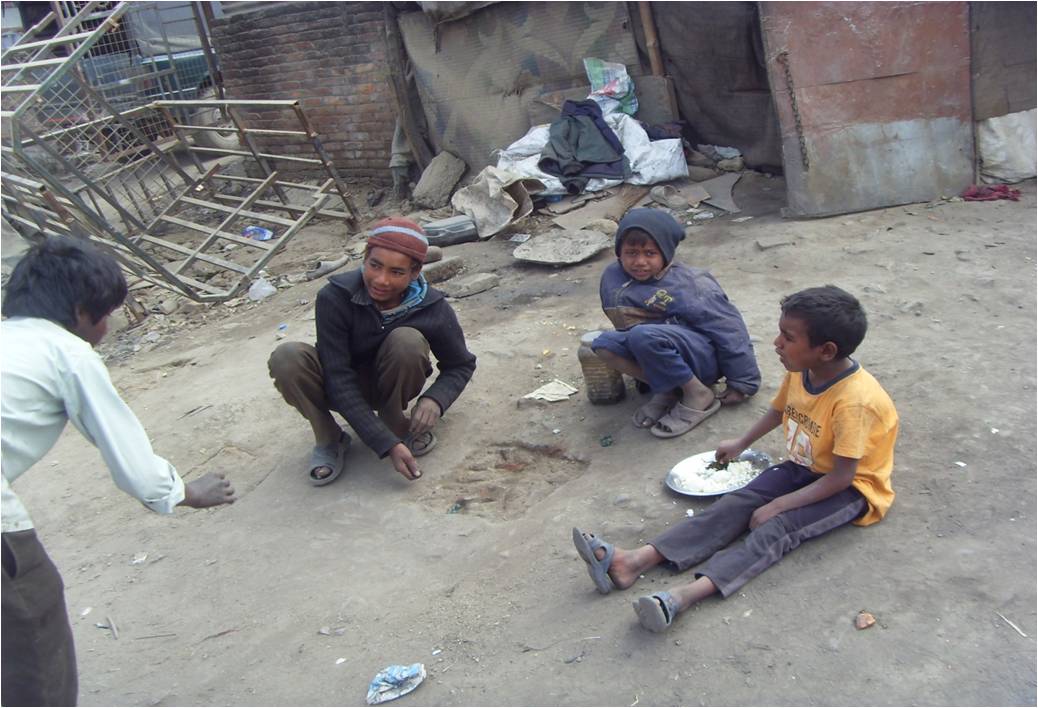
Reflecting on my Trip to the US and Some Insights for ELT

Madhu Neupane

Tribhuvan University

Teaching language also involves teaching of culture. While the profession of ELT in the past mainly emphasized teaching the culture of ‘native’ English speaking cultures (e. g. those of the US or the UK), EFL practitioners have now become increasingly aware of the importance of teaching multiple cultures from around the world and develop learners’ cross-cultural awareness. I also believe that the US culture, for example, is not the culture we should be teaching, but one of the cultures our students need to know about and be aware of as more Nepalese youth opt for higher education in the US and have been more influenced by popular culture developed in the West. The goal of this essay is not to teach American culture or offer pedagogical tactics in teaching students’ non-native culture, but to provide my reflection of experiencing a culture different from the one that I grew up with and shed some lights on how different themes can be important for a critical pedagogy. This is based on my recent visit to a number of US states sponsored by a program called the US Society and Culture.

The central focus of the program ‘US Society and Culture’ under Study United States Institute (SUSI) was America’s reconciliation of cultural and social diversity with national unity. The successes and failures of the United States in achieving this reconciliation was discussed in the program with the help of lectures, panel discussions and accompanied field trips to different places.  North America was founded in the conviction of diversity of its component groups for the establishment of a well ordered society. For the promotion of autonomy for supporting diversity and liberty, decentralization has been applied.  Federalism based on the principle of decentralization seems to be working successfully in America. Richard Pious, Ochs Professor of American Studies, Bernard College and Columbia University highlighted the concept of marble cake federalism in American government. Even with the federal system whole postal service is national and the collection of revenue is highly centralized.  Education has been extremely privatized and not enforced by the states. There is involvement of interest groups in all the areas. Ethnic interests are marginalized as far as possible. People have nationalized culture, very effective internal security system, and conflict management system. American people place high premium on national identity “American creed” and take pride in it.

The management of diversity with national unity has been central to the discussion in academic disciplines, research and literature. In the book Achieving Our Country Richard Rorty emphasizes the Darwinian view of animal in human life. Our sense of community, according to him, is the product of evolutionary course. Communities are always shaped by the ongoing urgency of environment. There is no more reason to live rather than responding to urgency. Rorty’s view is oriented to future and hope for the betterment of community. It leads to the idea of democracy. Everyone is involved in the project of forward looking community. Democracy, in Rorty’s view, is something that is yet to be achieved; it is not something that a country has already achieved. Underlying meaning of his discourse is that unity in diversity is yet to be achieved in complete sense because we need to work for better situation than the one existing now. The play “Other Desert Cities” by John Robin Baitz also shows the tension between independence and control as well transparency and withholding of information.

Principally there is no dominant religion and the state secular. Everyone is free to practice their religion. However, the country in practice seems to be dominated by Christian Protestantism.  According to survey conducted by Pew Forum in Religion and Public life, American people believe that religious faith lead to eternal life. “In God we trust” is printed in notes and coins. Though secularization is the part of democratic process people belonging to Muslim religion are having hard time in America. Khalid Latif, personnel in New York police department emphasized that the country has negative attitude about Muslim today and the situation has been worsen by the narratives produced against Islam though most of them, in his opinion, are based on stereotyping and propaganda. The impact of September 11 has remained the same even today. Even if Latif is a police personnel in New York Police Department, while travelling he has been detained and questioned for 2 to 6 hours. “You are young, you are male and you are Muslim. These three things do not go very well here”, they say. The idea ethnicity and religion is still very powerful. The understanding is that it is essentially being radical posing challenge to the unity in diversity.

America has been very successful in entrepreneurship. In the beginning America was an agrarian society with many people living in the rural areas but now the percentage of individual farming is very low. Because of industrialization, America has been successful in increasing its GDP dramatically by generating wealth through trade and maximizing difference between input and output in production. The factors that have contributed for the economic success in American community, according to George Smith, Professor of Economics in NYU, are: good institutions, vibrant entrepreneurship, sophisticated managerial capacities, enabling political system, and effective financial system.

Joshua Freeman, Professor of History in Queens College mentioned that most Americans lack class consciousness. Whether there are classes is a controversial issue in the United States. Class consciousness is considered to be inherently negative. The idea is that classes do not exist and if they do exist it is a bad thing for society. Many people identify themselves to be middle class which lacks an agreed upon definition. The labor movement is certainly getting weaker and unions are not central to the discussion. The government has passed a lot of rules protecting people to organize.  The legal protection for workers has declined and welfare system has gone down. However, the union has played important roles in the life of workers. Many people associate unfavorable working conditions with weakening unions which are under tight regulation. Government wants to do away with any type of class. However, the class war is going on whether someone is conscious or not. The enemies of union have devised wonderful language and want destroy it at all cost. They want to have right to do anything they like and say that “let the free market decide”. There has been an attack in public sector with the slogan “get government back”. However, the class war is going on whether someone is conscious or not.

Though America is one of the richest countries in world, 15 percent of American people live below poverty line. Though people tend to define poverty in terms of how much they earn, it really depends on income and expense both. Forty-six million people in America live in poverty. Though the country has the highest per-capita income in the world it does not have the lowest poverty rate. Because of the great recession poverty has increased because of the increase in unemployment. Though there is some job training and other job support program by government to reduce poverty have not been very effective because of government cutting public expense refusing to increase taxes. There are many voluntary organizations working in this sector. Since both main parties are capitalist in nature, the program for reducing poverty has not been effective there. Stave Randol, a media analyst highlighted the fact though altogether almost 50 per cent people are affected by poverty; poverty hardly gets any place in media.

Immigration has been a great issue in America from long ago. People have mixed attitude about the effect of migration. Public and private conversation about immigration is different. In public many people talk about it positive impact but in private the situation is mostly opposite. The immigrant museum in Ellis Island in New York shows terrible time people had during great migration. Only the ‘free white’ people were allowed to enter the country and whiteness was considered to be gold standard for citizenship. Unwhiteness was supposed to be the lack of freedom and associated with slavery. It was not only about skin color. In 1816 the immigration law made provision not to allow the people who were prostitutes, idiots, lunatics and Chinese to enter the country because they were not considered to be the right kind of people. The Chinese were the only people to be specified on the basis of the nation. By 1924 Asia Immigration was stopped because they not supposed to be the right kind of people. During the first recession only the white people were included in the welfare program given by the government. Though the immigration act in 1965 threw out the old rule, there is still segregation and the anxiety about unity in American Society because of immigration from all parts of the world.

The main important factor of democracy is that there is a fair and competitive election. There is a significant decline in the voting participant in America. There has been 40% decline in the last 2o years.  There are multiple political identities because people can belong to one coalition this year and the next coalition the next year. The biggest problem is to represent the minority. Though there is the idea that the minority should be prevented from the tyranny of majority, the chances for other parties to come to power are very low. People say that political polarization at this time in America has been the greatest in the history. Republicans want small government playing lesser roles whereas democratic want to increase government participation. Political discourse can manipulate the people in such a way that they even vote against their own interest and the same has happened with the welfare system in this country. There is a dysfunctional aspect in American political system where the money and media matter a lot than the real interest of the people.

Almost all people are using the modern technological devices that information communication technology (ICT). Newspapers are losing their readership since there is increase in the use of internet devices for getting information. The social networking has also been increasing with the use of the internet. The use of technology is narrowing down the differences as well as promoting digital divide. The right to privacy, a highly emphasized right in American constitution, has been threatened due to the use of new technology, for example wire tapping, wiki leaks, etc. There is invasion of privacy from the private sector as well because service providers tend to keep records of conversations for different reasons. There is over concern about the suspicious activities. The high emphasis placed on freedom of speech, in the opinion of American people, has somehow promoted lack of professionalism in media.

Because of automobile and well developed highway system, there has been great increase in suburbs. In 1920s many people used to live in cities while in 1970s the number of people living in suburbs surpassed the people living in cities. Middle class define themselves in terms of space and suburbs provide them with space. Suburbanization began right after the Second World War when the industrialization replaced the labor force in most of the areas. Suburbanization is also associated with race because there were mainly white people living in such suburbs. The earlier suburbs have all become cities now. Highway system and federally subsidized housing system contributed for the boom of the suburbanization.

High divorce rate, single parent family, pregnancy before marriage and women’s giving more priority to work rather than family and marriage have been major issues in family related discourse. The state does not have good welfare system and most children who have completed their graduate education cannot depend on themselves so they come to their parents. They describe this situation as boomerang family anxiety. As per the data of 2005 majority of children born in US are born to immigrants. The race has been a legacy from the very beginning. Socioeconomically the society is still segregated. “Race suicide” (white race), some people think, is taking place because native women have fewer children and immigrants have more children. There was anxiety that the women, if educated would not give birth to many children which would lead to race suicide which still an issue in family related discourse. Through fitter family contest, the idea of larger family was promote in 1970s. Women were expected to have children and live at home. Women at that time came with the idea that if we want to change the world we need to change the perception of people about it and which is possible through the creation of discourse.

Though higher education is free and compulsory, college education is very expensive for many people. I could not believe that the percentage of people completing college education is less than 30 per cent. The percentage of Ph. D holder is not two percent yet. The quality of public schools in comparison to private school is perceived to be very low and the well-off peoples do not send their children to public schools. Performance of school children in average, as mentioned in lectures, is lower in comparison to other developed countries like Canada, the UK, Singapore, Taiwan.

Concluding the reflection, the country’s overall development is really amazing. I was really impressed by cleanliness, well developed highway system, rule abiding system, punctuality, planning and persistence of American people. The things preserved in American museum made me think about our politicians who sold weapons of historical importance in penny. The things that were contrary to my expectation were, lack of security of workers in work place, low quality of education in public schools, and high influence of money and the power of wealthy people to influence decisions that affect life of common people in politics. Besides gaining general knowledge about American society and culture it provided us with the opportunity to learn a lot from the participants who represented 18 different countries. I wish we had similar program to disseminate similar knowledge of our country to other people in the world.

So what then?: I am not saying that this is the best country in the world, but mentioning a number of things that we can learn from for our lives. At the same time we can also question dominant ideologies and practices tied to these issues. A number of themes appeared in my reflection — for example, religion, race, migration, technology, divorce, pregnancy, marriage, environment – and these are important concerns for a critical pedagogy. These are the themes we have been teaching in textbooks produced by the international publishing houses. Learners can compare their cultures against the US or other similar dominant culture. When we teach English following insights from critical pedagogy, we not only teach vocabulary or grammar, but also issues that matter to our lives. For example, I mentioned selling Nepali historical weapons to a US museum. This could be a topic for you critical reading lesson. You can extract a text from the Kathmandu Post “Lost history: Gehendra-made guns sold off to US companyand plan a lesson around this topic. You can also read Bal Krishna Sharma and Prem Phyak’s post regarding how to design lessons around critical social issues.

(Ms. Madhu Neupane is a lecturer at the central department of English education in the University Campus, Kirtipur.)

Importance of Lesson Plan in ELT Class

Kapil Neupane, Model Boarding Higher Secondary School, Bhaktapur

A “lesson plan” can be defined in many ways. As someone who learned the idea of lesson plans after having taught for a while, I have found lesson plans to be the most valuable asset in my teaching. Without a lesson plan, I get nowhere with my teaching. A lawyer spends hours planning a case before appearing in court, a couch spends hours planning the plays and watching the team and a director explains his film story to his actors again and again, just why? Any successful professional knows that the quality of planning and preparation affects the quality of results. So, a lesson plan is to a teacher what a calculator is to an engineer, a stethoscope to a doctor, and a packet of seeds to a farmer. A lesson plan gives teachers an eagle’s eye of view of things to be taught and learned everyday. It also helps them determine when to insert ice breaks, interesting facts, and other components of engaging learning for my students. In fact, if used well, a lesson plan can also help students’ learning by helping them know what comes when and how things are done during a class by the teacher and by them.

Now, let me share my experiences of teaching which really began ten years ago. During those days, I did not really plan and prepare what I wanted to do during a class before entering the classroom; I read the material and thought that I knew the content well enough to teach it. In retrospect, I understand that my students did not pay much attention—and some did their homework for the next class and others just seemed to wait for the bell to ring—because I did not have clear purpose and organization behind my teaching. I got many complaints about my students being noisy from the teachers teaching at another class next to mine, and I complained about my students lack of attention. Some of the students pretended to listen to me perhaps to keep me pleased.

Frankly, I too waited for the bells to ring because the classes were painfully disorganized and students’ didn’t behave well. During class time, I had no fixed time for students’ performance and exchange of their learning, and when the bell rang I would frantically try to tell students what to do for the next class. There was no time for students to ask questions about homework or revisions. I rarely went to class with teaching material other than the course book, and my only objective was to finish teaching that material. Many of my students failed their exams, and I had to explain why. In response, I was upset and I went to the extent of scolding and blaming the students for being lazy. But the problem was that most students who failed in my class did better in other subjects. There had to be a reason. And for sure, the key reason was that I did not teach with a plan and a purpose. I did not use lesson plans, did not assess the outcome, and improve my teaching.

It was when I joined the bachelor of education degree that During I studied a theoretical subject in which I got the opportunity to learn about how to plan and execute a lesson and what the benefits of doing so are. I also later got other opportunities to participate in ELT trainings and workshops.

Today, I realize that the failure of students can be indirectly the failure of their teacher. Students who are taught without a clear sense of purpose and well-designed learning activities fail more often than students others. Now I enter any classrooms only after preparing a compete lesson which allows me to visualize every steps of teaching process in advance. In addition, a lesson plan records and saves my time as I teach similar subject and lesson in the future. Although it requires an investment of time, energy, and thought, lesson planning has been more than worth the time and energy to me.