Category Archives: ELT Resource

The Pragmatics ‘Became’

Umes Shrestha


This happened in the first few months of my teaching career at a private boarding school in Lalitpur. It was one of the terminal exams in the school. I had finished handing out the answer sheets to the students, and was waiting for the bell to ring so that I could hand out the question papers. But, somehow there was no ring and one of the students from class 10 said, “Time became already”.

“What!!!” I exclaimed.

He said it again in a matter-of-fact-ly way, “Time became”.

It was the first time I’ve heard someone say that. At that time, I thought that it was his idiosyncrasy, this expression was his exclusive error. But I soon realized that the expression “time became” along with late became, right became, wrong became, homework became and countless of other became-expressions were quite common among the students and even the teachers in my school.

And once I was aware of this phenomenon, these became-expressions began to hit my ears from all directions. From the primary classrooms to the secondary ones. From the playground to the library. Became, I realized, was omnipresent in the school.

It was an epidemic. That’s what I initially labeled it as. I shouted out at the students. You can’t say ‘time became’. I corrected them. It’s not ‘late became’, it should be ‘I’m getting late’ or ‘It is getting late’. There was no respite, though. I started correcting their numerous other expressions as well. I made them write down the correct expressions. 20 times each. I made them speak aloud those expressions. 10 times each. I warned them. I threatened them. I preached them. But all in vain.

A week later, the students were back to their original English. Inside the classroom, they tried to be aware of my presence and my frown. Outside the classroom, they were back to their original self. Carefree. Spontaneous. Happy. It was like, they just didn’t give a hoot about the correctness of English language.

So, what’s unique with this “became-epidemic”?

The meaning of become/became usually translates to बन्नु [bannu] or हुनु (भयो) [hunu / bhayo] in Nepali. The first usage of ‘become’ as ‘बन्नु’ is very literal, as in:

Hari became a doctor.
हरी डाक्टर बन्यो।
[Hari doctor banyo]

However, the literal meaning बन्नु oftentimes gets morphed into हुनु (and the past form भयो) with the usages like:

Hari became first in the exam.

हरी जाँचमा फस्ट भयो।
[Hari jaanch ma first bhayo]

Or, here’s a context where भयो translates so smoothly into became. The bell has just gone off signaling the end of the class. The teacher is collecting papers from the students. One of the students has not finished writing it yet. And, the teacher asks, “Became?” (भयो ?) [bhayo?] The student says,

“Not became” (भएको छैन।) [bhayeko chhaina].

Hence because of this interference or influence of become’s Nepali meaning, students find it easier to make expressions like late became, wrong became, problem became and homework became. It’s short. It’s understandable. And, the best thing, it works among their context.

There are several other expressions as well, which have become regular among my students. One is ending a sentence with ‘and’, as in:

Student 1: (He wants to copy the answer.) Give your copy.

Student 2: Haven’t finished and.

This usage of ‘and’ to end a sentence is just as rampant as the usage of ‘became’. ‘Stop pushing and’ or ‘I am not coming and’ or ‘Not became and’.

The usual meaning of ‘and’ as a conjunction is (र) [ra] in Nepali, but students use it as a discourse marker to mean (अनी) [ani]. They translate the Nepali structure, for instance:

सकेकै छैन अनी [sakekai chhaina ani] into ‘Not finished and’.

This interesting phenomenon got me into thinking a lot. I turned the pages of Second Language Acquisition and Applied Linguistics books. I discussed about this with my teachers and friends. I googled around if this type of sentence structures were normal in other ESL communities as well. I came to realize that it was a normal phenomenon among the learners of a second or foreign language. It also got me thinking that my initial reaction and judgment was pretty immature and naïve. I was rude. And I was sarcastic to the students.

So this question – why do the students speak English in so Nepali way? – keeps prickling my brain. I have stopped correcting the students. I feel more curious and more confused, but I don’t get angry or frustrated anymore. These days, I just try to make my students aware of these ‘became-expressions’. But I don’t overtly correct them, hoping that one day they will pick up the appropriate expression on their own.

I am thankful to the became-expressions as they have helped me understand a part of second language learning. They have helped me gain insights and amend my teaching philosophy. My mission in my earlier days of teaching English was – not to speak Nepali at all in the classroom. Now, I don’t teach English without throwing in few Nepali expressions whenever I feel it aids the learning of my students.

Author:

Mr. Shrestha is a blogger who blogs at http://latebecame.wordpress.com and podcasts at http://latebecame.podomatic.com


Teachers’ Perception and Practices on Dealing with Homework to Young Learners

Dipendra Kumar Khatri

Homework! Oh, homework!

I hate you! You stink!

I wish I could wash you away in the sink,

If only bomb would explode you to bits


By Jack Prelutsky

In the above stanza, the poet Jack Prelutsky speaks of the feelings and attitudes of young learners towards homework. Many a time homework has become a cause of corporal punishment in many schools of Nepal. It has destroyed students’ fun, laughter, games, confidence, etc.  It embittered parents- children relationship, teacher- student relationship, etc. It has appeared as a villain for young learners and does not seem to disappear until a  foreseeable period of time. Teachers, on the other hand, like to assign homework with a hope that learners better learn the things they have taught.  In this connection, I like to share how teachers perceive and practice homework.

I, as the training co-coordinator NELTA Surkhet, facilitated a session on ‘Dealing with Homework in Primary Level’. The main objectives of the presentation was to find out the participants’ perceptions and practices on homework and share how teachers deal with different issues on homework.

In the sharing session, most of the teachers reported that they would always give homework to their students with a view to engaging them in learning at home so that they could consolidate what they had studied at school. They also shared that most of the teachers assign writing or reading or project work as homework. The teachers from the private schools said that they would give a lot of homework, and spend some twenty to thirty minutes to correct it.

The teachers from public schools shared that they were assigning homework ‘sometimes’; not every day; whereas the teachers from private schools shared that they were assigning homework ‘everyday’ and they would give a lot of homework if there is long vacation.

All the teachers shared their bitter experiences of  hearing that voice of students as the responses for not doing homework. Despite their expectations, often teachers have to listen to their students speak out the following utterances:

Sir, my brother tears my notebook.

Sir , yesterday I was absent’

Sir, I had gone to my mamaghar.

Sir, another teacher check it.

There was a lot of homework yesterday.

Sir, I asked father but father did not learn about it.

I only copy it, I do half only.

Sir, it was difficult.’ No idea.

I have lots of work in home.  ‘I have no time to do.’

‘I did not copy the homework.  You rubbed out the questions so fast.’

Sir, I forgot my copy.

‘Sir, I have new copy today.’

I forgot to keep in my bag.

I lost homework copy, sir

Sir, you no give me happy. So I have don’t write.’

Yesterday, I didn’t come to school.

Sir, my mother did not buy copy today.

‘I lost my English book.’

I have not a pen.

Sir, I am sick.

Sir, you check yesterday, I no do today.

‘Sir, you don’t find me very good.’

Some students just stand up still and remain silent; they do not speak but seem to have been terrified. Their face looks gloomy. They do not respond verbally. Those were the common verbal and non-verbal responses to the teachers who check homework. I believe that such responses certainly make both students and teachers feel bad and degrade their zeal for learning and teaching respectively.

Strategies to deal with homework

The teachers shared that they are using many types of strategies to deal with homework effectively.  Some of them are: asking the students for not doing homework, asking parents to come to school, asking learners to do the tasks while the teacher is checking other students’ homework, etc. Some of the teachers even reported that they would get angry when they do not find suitable reasons for not doing homework.

Harmer (2008) advises teachers to ask the students’ interest and try to set homework which are relevant to them; not only in terms of their interests but also in terms of what they are studying. The teachers tend to assign homework related to what the students are studying. They never consider their interests. Similarly, they are willing to contact guardians to conform the reason for not doing homework by their children.

The teachers do not visit the guardians to encourage their children who keep doing homework regularly. They do not telephone the guardians whose children do not have the problem of homework, but they telephone those guardians whose children have the problem of doing homework. Most of such parents also cannot support their children in doing homework. Therefore, not only students but also parents feel embarrassed for being called in the school just to listen to the same thing: Your child does not do homework.

All the teachers shared that they were giving the exercise or lesson of the book as the homework.  To write, read and memorize. They generally do not make it fun i.e. give varied types of work; not only the questions from the book but also some funny tasks. Students want to be involved not only in the routined tasks, but also some serious things or some slightly crazy tasks. The homework can be given in envelops or sent them in e-mails jut to make them feel like doing homework.

The private school teachers said that they would use homework diary to keep record of homework. But it was not used by public school teachers. The teachers in Surkhet valley did not give extra-activities as the homework. They gave homework from books only. They gave tasks orally or in written form face to face; not in envelops and e-mails. The teachers do not give the individual (solo) work, but only one type of task to the whole class.

The teachers form private schools shared that their first duty entering into the class is to check the homework. So they check the students’ homework very often. They do not use pair or student checking strategy. A teacher checked all the students’ homework. They spend as many as thirty minutes for correcting homework. How long do they actually teach!  They did not have sufficient time to check properly with constructive feedbacks. As a result sometimes guardians complain their strategies, sometimes the students themselves question to their teachers. The teachers from the public schools often face the problem while checking the homework because of the large no of students in a class.

Teachers do not forget assigning homework, because they believe that if students do homework, they have learned well. They are overwhelmed by the right responses of their students and keep correcting assignments, no matter how long they are.

The teachers only respect the right answers in the students’ homework, which is also not so good practice, because from the students’ mistakes or errors they can notice how much they have learned and how much they need to help them learn. They can make their further plans in such a way that they can significantly decrease the number of errors to be committed by their students.

Generally, the teachers do not think how they can make post-homework productive. They rarely manage the class where the students correct their mistakes and learn from one another. The teachers  have not  been successful to provide their learners with opportunities to get students to correct each other’s homework in supportive and cooperative way.

It was also shared that the teachers form public as well as private schools took many trainings that helped them to create home wok friendly environment i. e. if the students are not doing homework, the teachers will help them do at school during the class time. They were not using the punishment as the strategy to deal with homework. They also mention  that  they were in favor of finding out reasons why their students do not do homework and act accordingly.

Conclusion

In conclusion,  homework seems to be an integral part of teaching and learning activity from teachers’ perspective. The teachers who teach to young learners should particularly think of some ideas of making homework a fun activity and should not make learners feel any kind of burden, which can have a lot of repercussions on intellectual, emotional, social, etc. aspects of youngsters.

Author:

Mr. Khatri is a life member of NELTA and a Teaching Assistant at Surkhet Campus (Education) and he has been teaching English at the campus over the last four years.

REFERENCE

Harmer, J. (2008). How to teach English. London: Pearson Longman.

Resource of the Month

Based on the positive feedback and suggestion from our readers to share a useful resource link every month, we have started a regular post titled “Resource of the Month” from August 2013. For the resource of this month, we are sharing with you a good source from the south Asian region: Pakistan. The link below is an open access site where you can find e-copies of dissertations as maintained by Pakistan Research Repository. You can browse the pages based on the year of publication or based on the subject as you like. Using keywords for the search phrase is another option.  We hope those of you who are at the dissertation stage particularly will find this resource helpful. The link is:

http://eprints.hec.gov.pk/view/subjects/b5L.html

Acknowledgements: We’d like to thank Madhav Kafle, one of our Choutari team members for researching the resource and sharing with the readers for this month.

-Eds.

Interaction in English language classrooms to enhance students’ language learning

Chura Bahadur Thapa & Angel M. Y. Lin *

Introduction

EFL contexts like Nepal seldom provide students with opportunities for authentic communication in English. Therefore, deliberate ‘interaction in the classrooms’ is emerging as one of the leading conventions to enhance the students’ linguistic resources as well as equipping them with appropriate skills for communication. The major intent of this entry is to share a teacher’s insider experiences of developing interactions in an ESL classroom in Hong Kong while fully recognizing that the contextual differences between Hong Kong and Nepal will necessitate teachers’ own creative adaptation or re-invention of whatever tips shared from elsewhere. We shall, first of all, present the concept of interaction from sociocultural perspectives and discuss various challenges for the front-line EFL teachers to plan and implement lessons that incorporate interactions in ESL or EFL classrooms. Then, insider experiences of the first author of this entry in overcoming those challenges are shared. Assuming that the textbooks and teaching materials play a vital role to promote and facilitate the interactions in classrooms, a sample activity designed for the Secondary Two (Class 8) ESL students in Hong Kong is also included and discussed.

Interaction in language classrooms

Classroom interaction has been considered one of the most important pedagogical research topics in language classrooms in recent decades, mostly due to the influence of the Russian psychologist Lev Vygotsky. Vygotskian sociocultural theory (Hall & Walsh, 2002) views the act of language learning as a social activity in which children build their knowledge through the help and scaffolding of more knowledgeable peers or teachers. Interactions in language classrooms are important social activities for students through which they not only construct knowledge, but also build confidence and identity as competent language users (Luk & Lin, 2007). In an in-depth ethnographic study of teacher-student interactions in Hong Kong, Luk and Lin (2007) found out that students develop multiple identities through their classroom interactions with their language teachers. Although the study took place in an ESL classroom where native English language teachers are available, Luk and Lin (2007:188) present a telling story about how students negotiate identity and cultural resources, which are “translated into non-institutionally sanctioned language practices and identities”. Perhaps, the social knowledge students bring into the classrooms might be those “non-institutional language practices”, which schools and teachers are supposed to build on in order to enhance their learning.

Interaction in the classroom refers to the conversation between teachers and students, as well as among the students, in which active participation and learning of the students becomes vital. Conversations are part of the sociocultural activities through which students construct knowledge collaboratively. Conversations between and among various parties in the classroom have been referred to as educational talk (Mercer and Dawes, 2008) or “exploratory talk” and “presentational talk” (Barnes, 2008:5). Presentational talk is the one-way lecture conducted by the teachers in the classroom, mostly featured in Nepalese EFL contexts, which contributes little to encouraging and engaging students in a communicative dialogue. Exploratory talk is a purposeful conversation, often deliberately designed by teachers, which provide opportunities to students to engage in “hesitant, broken, and full of deadend” conversations enabling them to “try out new ideas, to hear how they sound, to see what others make of them, to arrange information and ideas into different patterns” (Barnes, 2008:5). Given the limited linguistic resources the EFL students possess in their school years in EFL contexts like Nepal, these hesitant, broken and deadend conversations could be developed into spontaneous conversational skills. When students engage in interactions, they produce “symmetric dialogic context” (Mercer & Dawes, 2008:66) where everyone can participate, get respected and get the decisions made jointly. Students’ participation in interactions, therefore, can help them enrich their linguistic resources and build their confidence to communicate with others in English.

Designing interaction: challenges and ways ahead

When I started teaching English in a Hong Kong school, I noticed that students in Hong Kong like to talk a lot. These talks are often characterized as responses to the multiple stimuli such as various gadgets and social media. To realize the importance of students’ talks in their knowledge building was a paradigm shift in me, as my high school days in Nepal still remind me of the very quiet classrooms where often only the teachers talked. The process of designing lessons with meaningful interactions in my ESL classroom in Hong Kong posed several challenges such as incorporating various forms of interactions, achieving the lesson goals through such interactions, participation of students in meaningful interactions, and making sure that all the students engage in conversations and learn from the teachers as well as from themselves.

Secondly, of course students’ varying language abilities, topics that generated the conversations among them and matched their abilities presented a micro level challenges in managing interactions. Students in my class came from diverse cultural and linguistic backgrounds, and I believed that they brought with them their own unique knowledge base. Their varying English language ability might sound simple to some or unnoticeable to others, but addressing them in the classroom would very much influence how they view themselves and others (Luk & Lin, 2007) and make them feel how their cultural and linguistic knowledge base could be important in furthering their academic journey.

To overcome the underlined challenges, I took a closer look at other teachers’ practices and suggestions by researchers (Jong & Hawley, 1995). I found Jong and Hawley’s (1995) suggestions particularly setting up group roles, teacher monitoring and evaluation, peer evaluation, appropriate group size and configuration quite useful. Assigning group roles and group configurations could be thought during the planning stage. Teacher monitoring should be conducted at the while-teaching stage, and teacher and peer evaluations are elements to be incorporated at the post-teaching stage. I often incorporated three stages of interactions in my lessons.

  1. Interaction of the students with the teacher (Teacher Student Whole-Class Interaction): I often asked students to respond to a certain question related to a emerging topic or a topic that was already taught as part of the whole-class interactions. For the responses, students were randomly selected based on their ability, seating arrangements, gender and cultural groups to make sure that they all get represented in the interaction process.
  2. Pair Interaction (Interaction with their peers sitting together or next to them): This interaction often took place during the pre-teaching stage, for example to activate their schema on a topic. As part of assigning group roles, students were usually asked to interact with their partners on a topic given by the teacher and present it to the whole class.
  3. Group Interaction (Groups of 4-5 students): This form of interaction often took place during the while-teaching stage. After students read a text, for example in a reading lesson, they could pick up a concept for discussion. Their discussion could dwell on expanding the practical meaning of the concept, finding solution to a problem or bring up a creative issue out of the topic. Based on Jong and Hawley’s (1995) suggestions, students’ roles were often divided based on the nature of the topic such as a note taker, a facilitator, a presenter, and so on. Assigning these roles was crucial to prevent the students to digress from discussion their topics or and contribute meaningfully in the whole learning process.

The idea of teacher monitoring took place during the process of pair or group interactions. Teachers could evaluate the extent and forms of interactions students conducted during the process, and at the same time, provide feedback and support to the weaker students. I often walked around the class and monitored the students’ interactions to make sure that they are up to the tasks and are supported when in need.

Timing the interactions was another important aspect handling the students’ conversations purposefully and meaningfully. I often gave the students 5-10 minutes to interact among themselves and prepare a presentation poster or speech. The timing depended on the topic’s extent of difficulty and students’ ability as well.

Students were often asked to present the outcome of their interaction to the whole class in poster or speech forms. In order to ensure every students’ participation, they were trained and assigned with roles to make contributions individually even during group presentations. This was at this stage that the teacher and peer evaluation took place. I often adopted a range of techniques to evaluate students’ performances such as asking students to fill in an evaluation rubric or asking students about their peers’ performances and grade them on the board. Sometimes this process generated heated debates and quarreling, friendly though; among the students because they thought that some of their peers were not evaluating them fairly.

Last, but not the least, I also created teaching materials and worksheets conducive to the diversity of the students particularly in order to scaffold on their linguistic and cultural resources. Textbooks nowadays are found incorporating activities for some forms of interactions, but they often become irrelevant in the classrooms because these textbooks cannot address the range of students’ ability levels, skill levels and their cultural and linguistic backgrounds. Most textbooks in Hong Kong, for example, incorporate elements of Chinese and Christian festivals and ask the students to interact on that. However, students from Nepal, Pakistan, India, or Sri-Lanka in Hong Kong would not be able to use their cultural resources and construct knowledge from the interactions. Although English language textbooks in Hong Kong are considered to be the most advanced resources for ESL students, modifications often needed to suit to my students’ needs. These changes sometimes also needed to address the students’ willingness and skills to spontaneously engage in interactions. For example, some students in my class were very poor in English and found it hard to even properly construct questions to ask their friends, while others were at a native English speaker’ level.

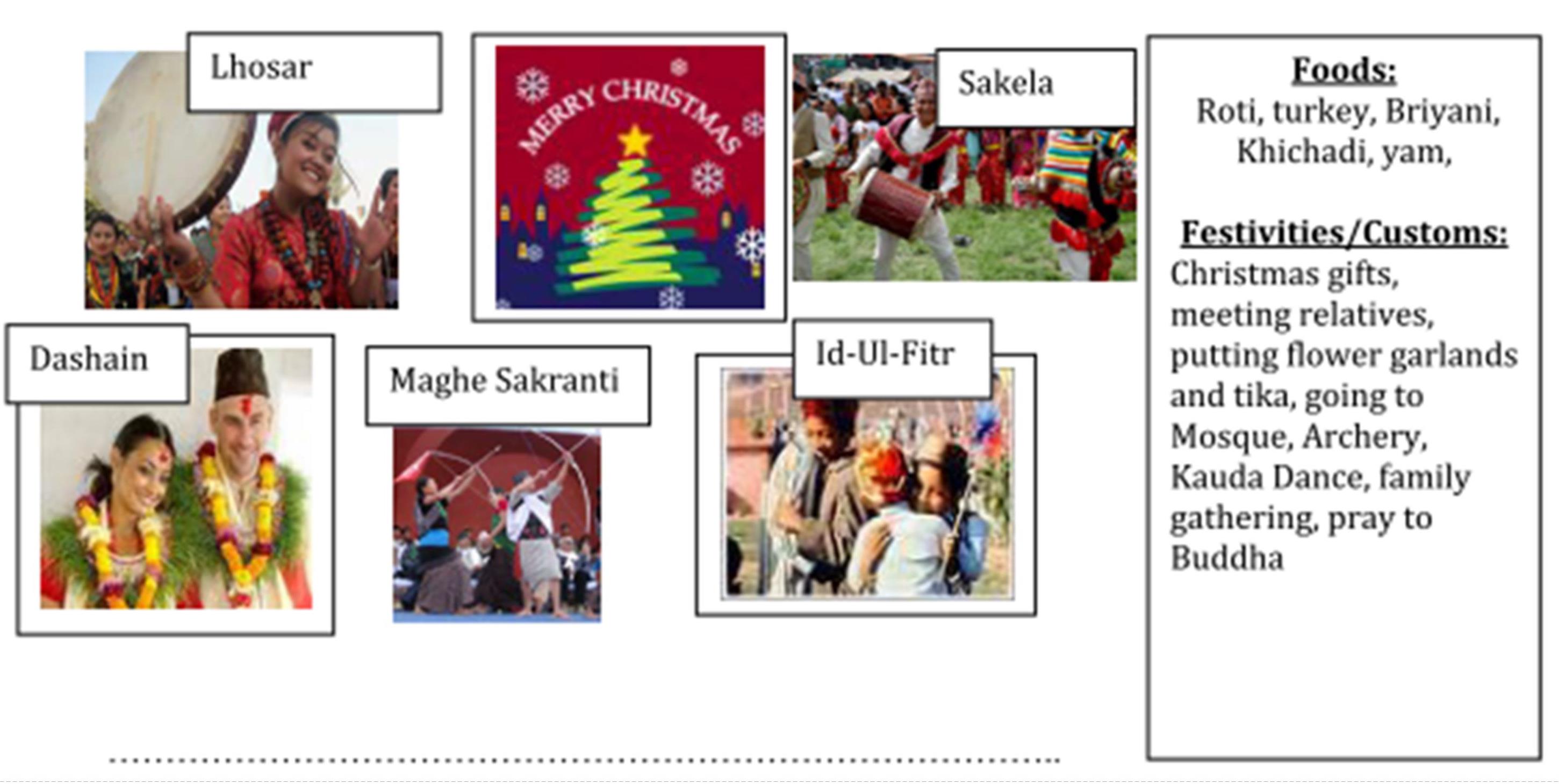
Taking these questions into consideration, we present an activity (Activity 1) that can potentially be used to promote pair interactions in an EFL classroom. This activity is a modified activity from a secondary two (Class 8) English language textbook in Hong Kong, which is believed to suit students with moderate English ability. The moderate language ability in this context is the students’ ability to use connectives and quantifiers in authentic situations. This activity incorporates multicultural elements in the context of Nepal as it contains pictures of various Nepali festivals as well as Western festivals such as Christmas. Students can ask their peers about their likes or dislikes and jot down their answers to present to the class. Phrases given in the boxes are meant to cater for learner diversity. For higher proficiency students, this activity can be presented in a different way to suit their levels.

___________________________________________________________________________

Activity 1:

Worksheet A

1. Study the pictures in the boxes in pairs. Ask questions to your friend about items that he/she prefers or doesn’t prefer more (or less) and why. Write your friend’s responses in the checklist at the bottom.

You may begin like this: Which festivals do you like more/less/most/least? Why?

 Publication1………………………………………………………………………..

Check List

2. Write your friend’s answers below. You may need to present it to the class.

* My friend likes ___________________________ more, because ______________

* My friend likes __________________________less, because _________________

______________________________________________________________________

* He/She likes ___________________________ the most, because _____________

______________________________________________________________________

* My friend likes ___________ the least, because __________________________

Conclusion

This entry presented the concept of interaction from a sociocultural perspective sharing the first author’s teaching experiences in a Hong Kong school. The sharing included the challenges as well as possible strategies a teacher might adopt to devise, implement and evaluate interactions in an EFL classroom. The sharing could present a model for EFL teachers to choose from many other pedagogical options in order to enhance the students’ English language learning. The activity presented in this entry is only one example of hundreds of such possible activities. The original activity might not be suitable to adopt exactly in Nepalese EFL classes, as there are diversities in terms of language, culture, students’ abilities as well as available resources based on geography, developmental level and proximity to urban life. Teachers need to bear in mind that they understand their students the best and they need to know how students can best interact and learn the language in the classroom.

*About the Authors:

1- Mr. Chura Bahadur Thapa is a PhD Student in the Faculty of Education at The University of Hong Kong. He was an English language teacher in a local college in Hong Kong for almost 7 years before joining HKU as a postgraduate student. He is currently researching the language learning and motivation of ethnic minority students in Hong Kong. His other research interests include- education of ethnic minorities, linguistic and cultural identity, intercultural communication and citizenship education. He can be reached at chura@hku.hk

2- Dr. Angel Lin received her Ph.D. from the University of Toronto, Canada. She is an Associate Professor of English Language Education at the University of Hong Kong.  Well-respected for her versatile interdisciplinary scholarship in language and identity studies, bilingual education and youth cultural studies. she has published six research books and over eighty research articles. She can be reached at angellin@hku.hk.

REFERENCES

Barnes, D. (2008). Exploratory talk for learning. Exploring talk in schools. Los Angeles, London, New Delhi: SAGE, 1-15.

Hall, J.K. & Walsh, M. (2002). Teacher-student interaction and language learning. Annual Review of Applied Linguistics, 22, 186-203.

Jong, C.D. & Hawley, J. (1995). Making cooperative learning groups work. Middle School Journal, 26 (4), 45-48.

Luk, J.C.M. & Lin, A.M.Y. (2007). Classroom interactions as cross-cultural encounters. Native speakers in EFL classrooms. Mahwah, New Jersey, London: Lawrence Erlbaum Associates, Publishers.

Mercer, N. & Dawes, L. (2008). The value of exploratory talk. In Mercer, N. & Hodgkinson, S. (Eds.). Exploring talk in schools. Los Angeles, London, New Delhi: SAGE, 55-72.

My journey from a Novice to Better Teacher

Suman Laudari

Through this blog entry, I would like to share with the ELT community my narrative of professional development. I will first briefly review the notion of teacher development and then, I will share some of the things that I have gained over the past few years to improve my classroom practices followed by my personal attributes. Thus this entry will try to showcase my both personal as well as professional development as a teacher. 

Teacher development

Teacher development is a process of bringing changes in teacher’s behavior, attitude and beliefs in terms of teaching, construction of knowledge and classroom practice. These changes can be brought into two ways; teacher training and teacher development (Richards & Farrell, 2005). The former is related to the activities enhancing the teacher’s existing knowledge, skills and capacities in the subject matter they’re teaching  while the latter refers to general growth that serves a long term goal and is related to understanding the teaching and its different aspects, classroom practices, and themselves as teachers.

            Teacher development in ELT is aimed at understanding second language development process, teaching learning style, changing roles of teachers depending upon learners, classrooms, context and the society and how learners perceive what is taught in the classroom (Richards & Farrell, 2005). Such understanding transforms a novice teacher into an experienced one who then performs things differently as they can anticipate the classroom problems, think of solutions and solve them through different classroom techniques (Berliner, 1987).  This understanding can be gained through different practices such as reflection, action research, collaboration and communication with fellow teachers, training, reading and writing. The following section mentions the activities that I have done to translate the theoretical aspects as mentioned above into practice.

My efforts for teacher development 

The activities and strategies that I was involved in for teacher development can be classified into the following five categories:

1.      Training and workshops: Like as any other teachers, one of the things that I have been doing over the past few years, in fact since I started my teaching career, is attending different trainings and workshops organized by different publication houses, different schools, NELTA (Nepal English Language Teachers’ Association), British Council and later English Access Micro Scholarship Project implemented by NELTA in Nepal in collaboration with US State Department. Most of these trainings were free and the rest of them were paid. I am sure  that all the trainings were not equally useful but I have  certainly learnt  something. I hardly missed any training or workshop opportunities I was offered as I was very enthusiastic to attend them since they either reinforced me with things that I had already learnt at different points of time or taught me something completely new which was largely beneficial to my class.

 2.      Conference and Seminars:  Another source of my learning was conference and seminars basically organized by NELTA. I have not missed any international conference organized by NELTA annually in February since 2007. I have attended the conferences and seminars acting different roles as a volunteer, a rapporteur and a presenter. The different roles I have acted during such occasions enabled me become a matured teacher. Plus, these events provided me with opportunities to meet national and international personalities in ELT and exchange our ideas. Such a gathering encouraged me to be more dedicated to my teaching providing me impetus to keep working to improve my English language competence.

 3.      Reading:  Needless to say, reading holds a great significance to build on one’s professional career. To be honest, I did not know what reading is before I started it myself. The first book that I have read beyond my course book was ‘Robinson Crusoe’ by Daniel Defoe, after I became a teacher. The book made me realize that reading is a fun. I kept on reading a lot of novels both in English and Nepali and now it has not only become one of my hobbies but also a craze. Later, I took to reading ELT books and journals. Reflecting my past, now I can say that there was not a single day when I was not involved in reading a book or an article. It has helped me improve my reading speed and enhance my comprehensive skills. Most importantly, reading provided me with the chances to compare my classroom practices with the prescribed ones in different books and articles I read.

 4.      Sharing sessions with colleagues:  Sharing sessions with fellow teachers and colleagues was another activity that helped me become a better teacher today. . I have always shared my ideas with fellow teachers informally at my schools and formally with and the audience during different training sessions organized by NELTA and other institutions. These sessions comprised of sharing of my good practices from handy classroom tips to English songs. Most importantly, attending these training sessions was a good opportunity for me to reflect on my own practices of teaching and carry out self assessment with the ideas whether they work in different situations.

 5.      Online teacher trainings and webinars:  Attending online courses and webinars entitled ‘Teaching English to Teens (TET)’, ‘Critical Thinking in English Language Teaching’, and ‘Teaching English Webinar’ was the latest practices to add in my list. These courses were offered by Regional English Language Office (RELO) in Nepal in collaboration with some reputed universities in the United States. I found these courses and webinars useful for it provided the participants a global platform to discuss and share personal beliefs and philosophies regarding teaching. And these e-courses provided me with opportunities to reflect on my practices and engaged in professional discussion with teachers from global arena. In addition, such courses provided me some assignments like something to read, write and discuss with others as a teacher, which kept me thinking about my course, lesson plans, curriculum and teaching.

Easier said than done. I could go on writing more about these practices and suggest others they should replicate them than I would like to share some of my personal attributes that helped me become a better teacher in the following section.

Personal attributes from a novice to better teacher

One of the attributes that helped me bring this transformation was my passion to become a better teacher. Next, I was ready to embrace new challenges and never said ‘NO’ to any opportunities, no matter how trivial it was. Thirdly, my curiosity to explore the world of teaching was another X-factor in my career. Likewise, I was always positive about my learning despite all the odds. Like any other teacher, I went through hard times.  My earning was meager and the pressure was always escalating, however I was always positive and I lived with HOPE.

Another thing that I kept me alive in this profession was my hard work. I never let my passion drift away. Hard work probably was the result of positive disposition, passion and the enjoyment I that derived from my teaching. Next, I was generous as I did not confine myself in the things that I learnt. I always had my goals set. Most of these goals were not big. I trusted on little goals such as completing the novel by the weekend, writing a haiku a day and writing a blog entry the next week. They gave me something to look forward to. Lastly, I would like to focus on the efforts to self development, which will only be successful when you are ready for. The readiness brings commitment and commitment gives the encouragement and motivation to accomplish a task, and this attribute has brought all the changes in me.

Conclusion

I would like to conclude that any teacher can transform themselves when they wish to do so. It is obvious that teachers have hard time in Nepal but this does not mean that we ignore our professional growth. I have the opinions that positive changes are possible only when we take responsibility for our growth.

REFERENCE

Berliner, D.C. (1987). Ways of thinking about students and classrooms by more and less experienced teachers. In J. Calderhead (Ed.) Exploring teachers’ thinking (pp. 60-83). London: Cassell.

Richards, J.C. & Farrell, T.S.C. (2005). Professional development for language teachers: Strategies for teacher learning. Cambridge: CUP.

About the Author:

Mr. Laudari is a visiting faculty to Kathmandu University and Ace Institute of Management. He is currently in the UK pursuing his master’s degree at Lancaster University under Hornby Scholarship.

An Unforgettable Teaching Technique

Dipendra Kanu

There are so many memorable moments of teaching English language, be it at English language institute or higher secondary school or college. I’d like to share with you what I find to be one of my most effective moments of teaching, which is teaching a story in grade twelve. 

As I was planning to teach students the story ‘The Tell Tale Heart’ by Edgar Allan Poe for grade XII, I was thinking of presenting a quite new idea in a different way from previous times. But I was quite confused and worried about how to teach the story effectively since I was unable to teach the same last time as effectively as I had expected.  I had not spent a great deal of time and I had prepared the lesson in a complete rush. As a result, I could not teach satisfactorily at the first attempt. However, there was a feeling of dissatisfaction in me as the students were not able to comprehend the texts properly as per my expectation.  

In the evening while I was sitting on computer with internet thinking of the next day’s lesson, an idea of searching some teaching materials struck my mind. When I tried it on Google, I found thousands of useful links there but they were of no help for me. Then I did it on YouTube where I came across a very satisfactory video clip uploaded by The Film and TV Channel on Sept. 21, 2009 and its duration was only 10 minutes. No sooner had I downloaded the clip than I watched it for three to four times to satisfy myself and then made a plan to show it to students on my laptop.

Then I took to Googling again till I found another useful file containing the story in pdf version. I printed the story on some pages albeit the course book already contained the story. The only difference was—the pictures in the story which the book does not have. Similarly, I also found some useful links for its audio clips this and also this in mp3 format. First I downloaded them on my computer and then on my mobile phone set.

The next day, I went to the class fully prepared with the audio clips on my mobile phone and video clip on my laptop and the printed papers of the story with attractive pictures. I had given the class a short notice about some video clips on my laptop the day before. The desire to watch the video motivated all the students present in the class that day with much enthusiasm and curiosity.

First I asked them to be attentive in the class and listen to what I was going to play on my mobile set. I played it for 13 minutes and 28 seconds but some of them hardly understood the sound properly since it was the native tongue. Next, it was the time to show the video on the laptop. The students were quiet to watch the short clip. They tried their level best to understand what was going on. After they listened to and watched the clips, I explained the story to them. It was much easier for them to understand it in a quite interesting way. Finally, I presented its summary with the help of printed sheets of papers containing the pictures accompanying to the story. And I asked them to get them photocopied if they wanted.

As luck would have it, it was the last period and I took advantage of this and engaged them for more time than usual. This time my students were able to comprehend the story as expected. It took me around an hour to finish it. This was the most successful, effective and satisfying lesson that I have ever taught in my teaching career. 

Let me conclude this short blog entry with the message—if we really try to explore the resources around us, they can be useful and powerful tool for our classroom activities and teaching something with audio-visual aids will have large effect on the learners. If you are going to teach the story ‘The Tell Tale Heart’ in grade XII in your class, you can use the hyperlinked resources I have mentioned above to make your teaching effective and feel the success.

About the Author:

Mr. Kanu has been teaching English for more than a decade. Currently he is involved in Popular English Language Institute, Thakur Ram Multiple Campus, Birguj Commerce Campus and Kadambari Academy in Birgunj. Besides, he is a journalist associated with Federation of Nepalese Journalists (FNJ) Parsa Chapter and the publisher/editor of The Young Guys, English Weekly Publishing from Birgunj.

An effective teaching through a student’s eyes

*Jyoti Tiwari

Teaching and learning processes involve a lot of ingredients to make imparting knowledge and skills from one person to another effective. Teacher, teaching aids, methodology, planning and strategies are some of those ingredients. In their absence, teaching and learning processes are negatively affected.  Basically, teachers’ knowledge and skills are the main things for a successful teaching learning. No doubt, availability of resources and sufficient teaching aids and materials play a significant role for effective and successful learning. Lack of such resources inevitably creates a lot of problems derailing the learning process.

In Nepal, there are many schools which lack physical infrastructure, trained teachers, and other resources required,  But this does not mean that teaching learning activities do not take place effectively. Many schools have teachers who have taken teaching profession for their passion. They have been carrying out teaching learning activities more effectively and successfully even in the absence of such resources. They have proved the fact that it is the teachers who can be the world in the classroom to their learners.

I am writing to share a story about one of my teachers who taught very effectively in spite of lack of resources. After being in the teaching profession for more than four decades, essentially his entire professional life, he is now retired. But he remains a major source of inspiration for me.

I was unaware of how important the teacher’s knowledge and skills can be while I was  in school. BUT now when I myself am teaching after completing under-graduate studies, I realize and I could not help myself thinking of Ridhhi Kant Singh Thapa, my English teacher from Trijudhha secondary school in Birgunj.  I can still remember his teaching style as quiet different from others.

Mr. Thapa was really passionate about teaching and that was perhaps the most important reason for why he was such a successful teacher. Inspired by his teaching style and classroom procedures, I would like to share with the audience some of his key teaching tips and techniques that had overwhelming impact on the learners through this short blog post.

I can still recall when he entered into the classroom, the environment changed automatically and there was active participation of students. Every student was enthusiastic about reading the text again and again.  At the end of each lesson, we all were busy in making the questions ourselves and writing their answers accordingly on our own. My teacher usually wrote some examples of making questions to help the students who were weak and his individual attention to such students increased confidence and habitué of reading and writing.

While teaching passages and stories, the way the teacher adopted was very impressive and interesting to improve reading and writing skills. Here is a series of activities he used in the classroom and they have been presented in a process flow.

First, the teacher [T] selected some reading text ‘passage’ or ‘story’ or ‘dialogue’ from the textbook. He further informed the students [Ss] which text they were going through.

 Secondly, T made Ss read the text themselves and asked to make questions as many as possible while reading the same text.

After that, T asked Ss to note down the answer of the questions they had made while reading the text. 

In the meantime, T wrote some structure and examples on the board so that Ss would feel easy to do their task. He helped Ss with difficult word meanings in order to comprehend the text clearly and write the correct answer of the questions.

Then, T asked Ss to exchange their notebooks with their partner in a pair. After they had reviewed the answers written by their friends, they had a discussion and checked the answers of their friend’s notebook in pairs correcting their mistakes.

T asked Ss the number of the questions they had made and asked them to find the student who made more questions.

T was more interested in finding out which question Ss found hard to formulate and answer. Through this activity, he came to know where they were facing problems and where they required his support. It helped him come up with proper solutions helping Ss understand the text better.  

Then, T wrote all the questions on the board asking Ss one by one from the same list which they had prepared while reading. Similarly, he approved the answers they had prepared asking them in turns.

At the end, T knew how well Ss have understood and comprehended the text and if they are found missing something or clarity required, he was always forward looking to take possible steps to fulfill the gaps. This is how he was successful in making the lesson interesting and effective.

Benefits of using the above strategy

Following are the benefits I have experienced of using the above strategy;

  • It is a learner centered method.
  • It is easy to carry out without much planning and it requires no teaching aids and materials
  • It can be very useful where schools lack resources or cannot afford teaching materials
  • It increases confidence level of learners and enhances both of reading and writing skills.
  • It is suitable for large classroom especially to make all the students engaged and check their assignments
  • It helps enabling learners to comprehend the text themselves
  • The role of teacher in the activity is facilitators
  • Increased vocabulary power of the learners
  • No use of teaching materials and other resources but teacher can use flash cards, pocket chart and pictures in order to make classroom more live and motivated
  • Even untrained teachers can easily carry out this procedure and can get control over the large class-room.

As inspired by my English language teacher whom I have lots of respect for because of his uniqueness and successful teaching career, I have shared the above mentioned teaching procedure hoping it  could be beneficial and useful to those teachers who are compelled to teach due to lack of teaching materials and resources required. 

About the Author:

Miss Tiwari is an undergraduate in ELT from Tribhuvan University and preparing for her masters’ degree. Currently, she is working as Radio Jockey for Radio Bindas in Birgunj.

Resources for Researchers

THESIS writing in Nepal seems to be a hard nut to crack for many university students and researchers. No doubt, they require a great deal of patience, research skills, writing proficiency as well as analytic expertise for such writing. However, finding a relevant body of literature is equally important. Especially for the beginners, it is always a challenge. We have seen that they visit libraries and resource centers or send out emails to their colleagues and teachers or google the internet.

Are you writing your thesis or guiding/supervising theses or helping you students and colleagues carry out research? You must be looking for some useful resources especially some sample theses related to your topic. To ease your task of researching, Choutari has brought you a resource link (click here or see the url below) from the University of Jyväskylä, Finland, that can be a good resource for language teaching scholarship in general and writing theses in particular.

Since this is an open access source, it can be accessed freely from anywhere and all you need is internet access. The beauty of sharing this link is—you can download the theses as most of them are downloadable. We hope you will find it useful. The link to the source is: https://www.jyu.fi/hum/laitokset/kielet/tutkimus/hankkeet/paattyneet-hankkeet/varieng/en/publications/masters_theses

Acknowledgments: We’re grateful to Bal Krishna Sharma for researching the source link and forwarding to Choutari. -Eds.

Translanguaging to teach English in Nepal

Ofelia García*


Introduction

            English language teaching throughout the world has suffered from a monoglossic bias; that is, the view that English could only be taught in isolation and separated from the languages spoken by students. This was, of course, the pedagogical tradition that emerged from the West, and especially from North American and British scholars in particular, who saw the teaching of the English language as a monolingual imperialist enterprise. But in the 21st century, English teaching has gone global, no longer in the hands of colonial masters, but taught throughout the world by many who share language and culture with students. And yet, our pedagogies have remained as monolingual as ever, robbing students of opportunities to use their home languages to make sense of the complex use of English that is demanded in the world today.

            I argue here that we need to adopt a translanguaging lens, a lens which allows us to think about language, bilingualism and learning from the perspective of emergent bilingual students themselves. I start by considering the concept of translanguaging.  Using the translanguaging lens, I then provide counterarguments to some of the constructions about English language speakers, English language acquisition and learning, bilingualism, and language education that have been responsible for much failure in the teaching of English to students throughout the world.

Translanguaging

The term translanguaging was coined in Welsh (trawsieithu) by Cen Williams. In its original use, it referred to a pedagogical practice where students are asked to alternate languages for receptive or productive use; for example, students might be asked to read in English and write in Welsh and vice-versa. Since then, the term has been extended by many scholars (e.g. Blackledge & Creese 2010, Canagarajah 2011, García 2009; García & Sylvan 2011, Hornberger & Link 2012). I have used the term to refer to the flexible use of linguistic resources by bilinguals in order to make sense of their worlds, and I have applied it mostly to classrooms because of its potential in liberating the voices of language minoritized students.

I use translanguaging here to refer not to the use of two separate languages or even the shift of one language or code to the other (for simple Questions and Answers on translanguaging for educators see my introduction to Celic and Seltzer, 2012). Rather, translanguaging is rooted on the principle that emergent bilingual students select language features from a repertoire and “soft assemble” their language practices in ways that fit their communicative situations. Translanguaging in education can be defined as a process by which students and teachers engage in complex discursive practices that include ALL the language practices of students in order to develop new language practices and sustain old ones, communicate and appropriate knowledge, and give voice to new sociopolitical realities by interrogating linguistic inequality. In today’s globalized world what is needed is the ability to engage in fluid language practices and to soft-assemble features that can “travel” across geographic spaces so as to enable us to participate fully as global citizens.

Counter-narratives about English, its speakers, learning English, bilingualism, and teaching English

            The education of emergent bilinguals suffers from five major misconstructions about English, its speakers, the learning of English, bilingualism, and the teaching of English that can be counter-narrated through a translanguaging lens as follows:

  1. English is not a system of structures.
  2. “Native” English speakers are neither the norm nor objective fact.
  3. Learning English is not linear.
  4. Bilinguals are not simply speakers of a first and a second language.
  5. The teaching of English cannot be enacted in total separation from other language practices.

I will develop these counter-narratives to deconstruct some of the myths with which we have been operating in educating emergent bilinguals.

English is not a system of structures

English forms and meaning are not auto-sufficient, but arise in and through social practice, as linguistic practices get used repeatedly in local contexts for meaning-making. Language is a series of social practices and actions that are embedded in a web of social relations and that orient and manipulate social domains of interactions.  Pennycook (2010: 9) explains:

A focus on language practices moves the focus from language as an autonomous system that preexists its use, and competence as an internal capacity that accounts for language production, towards an understanding of language as a product of the embodied social practices that bring it about (my italics).

English is not a system of language structures; rather, languaging through what is called English is practicing a new way of being in the world.  This understanding of what English is and is not has enormous implications for our conceptualization of English speakers, the next counter-narrative that I propose.

“Native” English speakers are neither the norm nor objective fact

It is important to recognize that monolinguals are not the norm in the world. Although estimates are difficult to make, well over half of the world’s population is bilingual or monolingual. In the second language acquisition literature, the “native” speaker is always held as the ideal. But the notion of who is a “native” speaker has been questioned in the fluidity of today’s global world. Often “native” has become indexical of being white. The ideology of the existence of a monolithic “native” English creates an order of indexicality (Blommaert, 2010) that favors the language practices of white prestigious monolingual speakers. Thus, the other “native” practices are reduced to being “corrupted,” “stigmatized,” “deficient,” “needing remediation.” As many have argued, there is no “native English standard.” Being a “native English speaker” is not simply being monolingual or speaking a certain way. At the same time, learning English does not happen in a vacuum, and is not linear. This is the misconstruction addressed by the counter-narrative in the next section.

Learning English does not proceed from scratch, is not linear

The learning of English has often focused on an end point, the ultimate attainment of a “native English standard.”  When students haven’t achieved this, they are said to have a “fossilized interlanguage”; that is, their language system is said to be permanently deficient. Rarely has the learning of English paid attention to the resources students bring and to the dynamic process through which language practices emerge. But students are much more than just blank slates that are subsequently filled with English structures. They bring to classrooms knowledge, imagination, and sophisticated language practices. In addition, they do not forget what they know in order to take up English. These students are emergent bilinguals with full capacities. Their new language practices do not surface from scratch, but emerge in interrelationship with old language practices.

If the English language is not, as we have seen, simply a system of structures, then it follows that it is not possible just to add up structures in linear fashion in order to learn. Instead, English learning emerges as a flexible continuum, as students take up practices in interrelationship with others. The result is never an end point at which students “have” English. Rather, emergent bilinguals “do” language, languaging in ways that include practices identified as “English” in order to negotiate communicative situations and meet academic expectations. Emergent bilinguals are not simply in a stage of “incomplete acquisition.” The next section questions the misconstructions about bilingualism held by schools that have served to alienate the complex language practices of emergent bilingual students from English learning and provides an alternative narrative.

Bilinguals are not simply speakers of a first and a second language

Bilingualism in schools is often understood as being additive. Additive bilingualism refers to the idea that a “second language” can be added to a “first language,” resulting in a person who is a balanced bilingual. The views about languaging that I have been developing here lead us to reject the idea of “first” and “second” language, as well as balanced bilingualism.

Although most bilinguals may be able to identify which language they learned “first” and which language they learned “second,” the assignment of a “first” and “second” language to bilinguals is as much a theoretical impossibility as is the concept of being a balanced bilingual.  New language practices emerge in interrelationship with old ones, and these language practices are always dynamically enacted.

I have argued that bilingualism can be better seen as dynamic.  In contrasting dynamic bilingualism to an additive perspective, I go beyond simply the perspective of language systems and refer to the multiple and complex way in which the language practices of bilinguals interact and form a complex language repertoire. I have used the image of a banyan tree to suggest that language practices emerge and develop in intertwined ways.

As bilingualism emerges, the identification of language practices belonging to one or another “language” has to be questioned. Bilinguals translanguage, disrupting conventional ideas of what languages are or of the languages that bilinguals have. Bilinguals are clearly not two monolinguals in one. They use their complex language repertoire to fulfill the communicative needs that emerge from the different landscapes and speakers through which they shuttle back and forth. I have used the image of the All Terrain Vehicle to suggest that bilinguals use their complex language practices selectively as they adapt to the ridges and craters of communication in different languagescapes.

Traditionally, bilingual use has been understood as following a diglossic compartmentalization, with one language spoken at home, another one in school. But the translanguaging lens we have adopted makes clear that the language practices of bilinguals are transglossic, and that their full repertoire of practices is used in homes, and often “invisibly” in schools. The structures of language and education programs and their pedagogies have to respond to greater fluidity. This is the misconstruction addressed in the next counter-narrative.

The teaching of English cannot be enacted in total separation from other language practices

Traditionally, the teaching of English has taken place in English only. But as the complex translanguaging practices of bilinguals are made more evident, structures and pedagogies that separate languages artificially have to be abandoned. The language separation approach that is often used has to be abandoned.

All teachers must adopt translanguaging strategies in teaching.  It would be important for English teachers to leverage the children’s entire language repertoire in making meaning and to develop the children’s metacognition and sense of self-regulation as they translanguage.

Oral discussions that include all students’ language practices enable their class participation, deep and reflexive thinking, and rigorous cognitive engagement with texts. The reading of difficult text is facilitated when students can access background material about the content of the text in other languages. Engagement with writing English texts is also facilitated when students can discuss, read and write first drafts that may include other language practices besides those that are in English.  Translanguaging is an important tool.

A translanguaging lens enables us to understand the teaching of English to emergent bilinguals in new ways. Focusing on translanguaging practices enables us to shed notions of system structures that can be linearly taught, of the proper usage of natives, of the value of monolingualism, of bilingualism as simply double monolingualism, of the teaching of English without considering the entire language and semiotic repertoire of students.

References

Blackledge, A. and Creese, A. (2010) .Multilingualism. London: Continuum.

Blommaert, J. (2010). The Sociolinguistics of globalization. Cambridge: Cambridge University Press.

Canagarajah, A.S. (2011). Codemeshing in academic writing: Identifying teachable strategies of translanguaging. The Modern Language Journal 95(iii), 401-417.

Celic, C. and Seltzer, K. (2012). Translanguaging: A CUNY-NYSIEB Guide for Educators. New York: CUNY-NYSIEB. Online document: http://www.nysieb.ws.gc.cuny.edu/publicationsresources/

García, O. (2009). Bilingual education in the 21st Century: A Global perspective. Malden, MA and Oxford: Wiley/Blackwell.

García, O. and Sylvan, C. (2011). Pedagogies and practices in multilingual classrooms: Singularities in Pluralities. Modern Language Journal 95(iii), 385-400.

Hornberger, N. and H. Link. (2012). Translanguaging and transnational literacies in multilingual classrooms: A bilingual lens. International Journal of Bilingual Education and Bilingualism 15(3): 261-278.

Pennycook, A. (2010). Language as a local practice. London and New York: Routledge.

*Ofelia García is Professor in the Ph.D. program of Urban Education and of Hispanic and Luso-Brazilian Literatures and Languages at the Graduate Center of the City University of New York.   She has published many book chapters, articles, and books. She is the Associate General Editor of the International Journal of the Sociology of Language.

What should one do in a language classroom?

Rama Kant Agnihotri*

What students and teachers should do in a language classroom is best left to them. Language teaching is so complex and so contextually rooted that except for very general guidelines, nothing may really help in the actual task. What language professionals can at best do is to make available in as accessible a manner as possible content, form and format (oral, printed, digital etc.) material about the potential of the learner, aspects of nature, structure, acquisition and change of language, features of language variation, nature of learning processes, materials, methods and evaluation procedures. In this short article, I focus only on one issue that may be of some use to language teachers: How languages of learners in a given classroom is not an obstacle in the trajectory of language learning; it is in fact a resource not only in language teaching but also in enhancing cognitive growth and social tolerance.

Most teachers and several language professionals believe that languages of students are an obstacle in the process of learning another language. Many actually believe that they cause major interference and therefore students should not even be allowed to use their languages in the class and the school. The typical paradigm in which they work could be defined as ‘a class, a teacher, a text and a language’. Nothing if you reflect for a moment could be further from the truth. All classes are by default multilingual. Examine your own and examine your own language profile and that of your friends. Secondly, languages student bring with them are and can be used as a resource rather than dismissed as an obstacle. Languages always flourish in each other’s company; they suffocate in prisons of isolation and purity. English today is rich because it keeps its doors open; so were Sanskrit and Hindi till they started closing their doors. Thirdly, it is not at all difficult for all teachers and students to appreciate that all languages are equally rule governed and rich. This is something which is so effortlessly achieved if the strengths of a multilingual class are recognized. For example, all languages will have some technique to indicate the relationship between the subject and the verbal elements. That some languages may look more powerful than others is NOT a linguistic matter but one of history, sociology and politics and these aspects can also be easily demonstrated if the teachers are open to such a discourse. Languages like Latin, Greek, Sanskrit, Persian etc. were once very powerful; the power of English is only a few decades old and there is no reason to believe that it would stay like that. If you leave out china, Russia, Africa, India etc., the English speaking world is actually very small.

In any case, we do need to think why theories of interference hold such power and what’s wrong with them. These theories hold power because they are the most convenient answers to what is going on and they stop any deeper inquiry into the issues involved. It is a cosy corner that looks very attractive to a teacher who breathes some relief in saying: They will never learn; their languages always come in the way. What teachers don’t realize is that errors are necessary stages in the process of learning and what is being dismissed as interference may actually be a part of the UG driven way of acquiring a language or a milestone in the process of learning. Let’s consider some typical examples.

Let’s start with syntax. The fact of the matter is that there is actually no major difference between the basic syntactic structure of say Indian English and British or American English. All children, including those from the so-called native English communities, will make such errors as ‘he go to school’; the structural pressure of English syntax dictates that it should be so. Imagine everybody including ‘I, we, you, you plural, they’ ‘go’, why should poor ‘he, she, it’ ‘goes’!!! But if we stop comparing the behaviour of school or undergraduate learners with fluent speakers of ‘standard’ English, we will realize that all speakers of English, whether they acquire it as L 1 or L 2, learn to say ‘goes’ in due course. Take another oft quoted example of the invariant tag-question. When many speakers of the Asian subcontinent use ‘isn’t it’ with all kinds of statements, it is often pointed out as a major interference from say Hindi ‘hai na’ etc. Nobody takes the trouble of finding out how many ‘native’ varieties of English do the same. Some varieties of Canadian English certainly do it with a different invariant tag. Two points may be noted here. It may be a part of the standard commonly used Indian English and there is nothing wrong with this fairly understandable overgeneralization. In fact, in the speech of the teachers and the community, there may be no exposure to the variable tag question. Secondly, in the case of fluent users of Indian English, there may be many who actually use the variable tag question. What you eventually accept as a standard ‘correct’ usage is a matter that is located in a spatial, temporal, historical and sociological space.

Consider morphology. It is well attested that all children irrespective of whether they learn English as L 1 or L 2, go through a stage of using first ‘go, went, gone’ (as unrelated items) and then ‘go, goed, goed’ (as morphologically demanded items) and finally acquiring the exception ‘go, went, gone’. Imagine that all learners go through this stage and the set of irregular English verbs is rather large including such commonly used verbs as ‘come, cut, dig, do, eat, get, give, make…’ etc. Word formation strategies have nothing to do with interference. Yes, languages frequently borrow from each other, particularly cultural items. There is nothing you can do about it. English simply adds an additional appendix to its dictionary every year; speakers of course always move ahead of the dictionary.

Take phonology. Do all the so-called native speakers of English speak the same way? Will any one of you, unless she belongs to north of England, claim to understand a word of Yorkshire English? Or do you all understand rural Texan English? I don’t. I don’t even understand my grand-daughter studying in Malone in New York State. She finds it equally difficult to understand my Indian accent. Phonology is a marker of group identity and if you are really interested it will not come into your way after a while. But if you are already beyond 15-16 years of age, you will notice that your jaw is set and you may not get the ‘English English’ inter-dental fricatives, or the aspirated alveolar stops or the distinction between /v/ and /w/, which is really nothing to write home about unless you want a job at the BBC etc. Every variety has a right to its distinct identity.

So if languages of learners are not in our way, why do we make such a miserable mess of language teaching? At most places I know of, most learners don’t even manage to master the basic skills of reading comprehension and writing coherently. We do need to examine the language profile of our class. Every child brings a different linguistic and cultural resource to the class and these can indeed be sensitively assimilated into the teaching-learning process. The first requirement is of course that the teacher needs to walk out of the position of being the fountainhead of all knowledge and have faith in the ability of children to use their resources creatively. In actual classroom transactions it implies that the time taken by individual learners and their interactions in peer group would be much more than normally consumed by the teacher.

We today know that multilinguality is a default human situation and is constitutive of being human. Every classroom by default is inherently multilingual. Further, in a variety of ways, recent research has established how this multilinguality can be used not only as a resource but also as a teaching strategy and a goal. It correlates positively with language proficiency, cognitive growth, scholastic achievement, divergent thinking and social tolerance. It is also now well-established that levels of language proficiency enhance significantly with metalinguistic awareness which would tend to grow if we allow children to reflect on their languages.

What kind of strategies would be most useful in such situations? In fact, there is no limit and also no defining ‘models’. Freedom from the bondage of script is the first step. With very small effort on the part of learners and teachers, it becomes evident that all languages can be written in the same script, with some modifications. What we do need to understand is that all children and all their languages need to  be involved and the teachers need to create situations in which children can work in groups collecting data from their languages, classifying it into different categories, examine the relationships among different parts and arrive at conclusions and hypotheses that would account for their data. Consider for example, the making of nouns from adjectives in English. Adjectives like ‘dark, lazy, rough, kind, small, rich, soft etc’ can be turned into nouns by adding ‘-ness’. However, this is not where teachers would start; they would instead start by talking informally about adjectives and nouns for a few minutes. Then leave it to groups of children who share some languages to make list of adjectives and related nouns in different languages available in the class. Hindi may not have any such strategy; but it may have some others. Or take the case of making plurals. With very limited guidance children will themselves work out the problems of saying that the plural in English is made not by adding ‘-s, -es or –ies’; once it is explained to them that they should focus on the sounds with which a plural ends, they work out that significance of ‘-s, -z and –iz’ in making plural, themselves pointing that the plural of say ‘dog and baby’ is made by adding the same sound. Another group will come up with a strategy for making plurals in Hindi which has not one but 3 plurals for each noun e.g. in the case of laRkaa ‘boy’, we have ‘laRke, laRkoN and laRko’, being the nominative, oblique and vocative plurals respectively. Consider the case of making ‘negatives’ in different languages. It is possible that children would themselves (and so would the teacher) discover that negatives in all languages are made by putting the negative element close to the verb of the main clause and if a rule is discovered in this way, it is rather unlikely that children would make mistakes in speaking or writing negative sentences. Take the case of translation. Nothing enhances language proficiency more than peer-group attempts at translation, not the traditional type of ‘literally and accurately translating from language X to language Y’. A small poem for example could be taken from any language. Notice that the power structures in the classroom at once start getting democratised; teacher is at the back of the classroom listening like others to a poem in an unknown language which is then written and explained by children in the script they are already using. The poem is then translated into several languages in small groups. Stories, plays, cultural events, social issues etc. could also be treated in a similar way. The kind of phonological, syntactic, semantic and semiotic issues such an exercise raises is overwhelming. The idea is to go through the process, not to arrive at a final, perfect translation.

*Rama Kant Agnihotri, D.Phil. (York), retired as Professor and Head, Department of Linguistics, University of Delhi. He is interested in and has taught and written extensively about Applied Linguistics, Morphology, Sociolinguistics and Research Methods for several years. He has lectured in Germany, UK, USA, Canada, Yemen, Sri Lanka, and Pakistan, among other countries. He has also been working with several NGOs across India in the area of elementary school education. He co-edits, with A. L. Khanna, the Sage series on Applied Linguistics. He was Chair of the NCERT Focus Group on The Teaching of Indian Languages during NCF 2005.

NNESTs and Professional Legitimacy: Fighting the Good Fight

 Davi S. Reis, Ph. D.*

Identifying and exploring the sources of one’s insecurities and fears is a daunting task for most of us. Yet, when it comes to Non-Native English-Speaking Teachers (NNESTs), taking the time to deliberately reflect on the sources of our professional insecurities is a helpful step in acknowledging, negotiating, and claiming professional legitimacy as English Language Teaching (ELT) professionals. As an example of this type of reflection and with the goal of helping others in their own journey, I share a bit of my own narrative as an NNEST in TESOL, including struggles and successes[i], and offer a few reminders, strategies, and resources for challenging the native speaker (NS) myth (that is, the notion that NSs of English are better language teachers)[ii].

A PERSONAL ANECDOTE

As an ELT professional, I worked hard to become a good language teacher. I pursued a bachelor’s degree in TESOL and a master’s degree in Education (both from an accredited American university), and taught ESL in the U.S. and EFL in Brazil for a few years. Yet, I was unpleasantly surprised when a private English institute in Belo Horizonte, Brazil (my hometown and country) offered my partner a job (virtually on the spot) but denied me the chance to even interview for the EFL teaching position they were seeking to fill. Although my partner is a highly qualified mental health counselor, he had no training or experience as a (language) teacher at that point. He was explicitly told that they only hired individuals who were NSs of English (the case with  my partner). Regardless of their possible motivations for enforcing such a questionable policy (that is, buying into the NS myth themselves or, as they claimed, feeling pressured by students’ supposed demand of and preference for NSs), I found myself doubting my own hard-earned professional expertise and experience. Especially when, though largely unconsciously, I had done my very best up to that point to sound and even act like a ‘native speaker of English’ (for me, this meant emulating and imitating some of the American English accents I had been exposed to while an international student in the U.S.).

A PERVASIVE FALLACY


My point in sharing this personal anecdote is that, as a ‘minoritized’ group (NNESTs actually make up the vast majority of ELT professionals in the world), we often suffer the damaging effects of an oppressive ideology. Unfortunately, the message heralded by the NS myth is clear and widespread: NSs do it better! They speak English better and, so goes the logic, will be better teachers and make for better learning and happier students (or should I say customers?). Despite its harmful effects, this clear message often works its way into NNESTs’ psyche through its pervasiveness in popular culture, teaching materials, and even published research in TESOL and Applied Linguistics. To make matters worse, the attribute of ‘native speakerness’ is conflated with phenotype (i.e., ‘real’ NSs of English are white, have blond hair, blue eyes, and, preferably, either an American or a British accent). NSs are also perceived as being largely monolingual (after all, according to the NS myth logic, if one already speaks English natively, there is little need to learn another, less influential language). My goal in grossly identifying some of the discourses around the NS myth is to expose it as a fallacy with harmful consequences to NNESTs and to the TESOL and ELT fields.

USEFUL REMINDERS

The so-called ‘NNEST movement’ has been growing exponentially since the late nineties thanks to various converging efforts: the creation of the NNEST Caucus/Interest Section in TESOL, TESOL Position Statements against the employment discrimination of NNESTs, and quite a bit of research[iii]. Yet, too easily we still buy into false dichotomies and blindly adopt disempowering discourses. But if our goal is to continue to improve the work conditions for NNESTs around the world, we must tirelessly, diligently, and unwaveringly challenge the status quo by working against the NS myth. In other words, I believe we can improve our own situation and that of our field by challenging unexamined assumptions and thinking and by encouraging and helping others do the same. Because, in my experience, this is much easier said than done, I offer ten points below as useful reminders regarding NNESTs’ quest for professional legitimacy:

1)      NNESTs make up the vast majority of English teachers worldwide, so our needs and strengths as professionals cannot be easily dismissed;

2)      NNESTs can relate to and support learners in unique ways that are often unavailable to NESTs, such as understanding first-hand the language learning difficulties and empathizing with students’ struggles.

3)      We all have (at least) one native language. So NSs of English are also NNSs of many other languages (this is an issue of positionality). Similarly, we can choose to think of ourselves as bi- or multilingual rather than simply NNSs of English;

4)      What counts as ‘native’ English is highly debatable. Language use is embedded in various but specific sociocultural, sociopolitical, and socioeconomic contexts, so holding an unattainable image of a mythical variety of English is likely to do more harm than good;

5)      The term ‘near-native’ may be an improvement over the term ‘non-native’, but still positions NNESTs as second best in relation to a ‘native’ target (an often ill-defined and unattainable expectation);

6)      All of us (NSs, NNSs, and all in between) make ‘mistakes’ when using language. But rather than viewing such occurrences as ‘errors’, we can think of them as natural and even helpful processes in most types of (intercultural) communicative encounters;

7)      Communication is a two-way street. Both interlocutors should make an effort to understand each other and to clearly communicate their ideas;

8)      Students learning English today are much more likely to be using their language skills with other NNSs, rather than with NSs of English;

9)      Accent (we all have one!) is not a predictor of language proficiency. It may reveal one’s pronunciation skills, but very little about their skills as a language user in real-life contexts and situations. In addition, because one’s accent is intricately connected with one’s identity, it should be honored and respected;

10)  Though language proficiency is a worthy goal we should aspire to achieve and maintain (regardless of native speaker status), it should not be conflated with one’s ability to teach language. In other words, being able to speak a language well does not automatically translate into being able to teach it well. Becoming a teacher takes training, time, and dedication.

TAKING ACTION!

In light of the points presented above, I also offer the following suggestions for taking action and becoming an active contributor to the NNEST Movement:

– Get involved! To the extent possible, become involved with or a member of a professional organization. These organizations help members create synergy about important issues to the profession (such as discrimination against NNESTs) and move the field forward by fostering collaboration and providing a sense of direction.

– Speak up! Silence is often perceived as an indicator of acquiescence. In many contexts, both social and professional, you may be the only individual who is aware of the dangers of operating under the NS myth. Speak up when you see a job listing or advertisement seeking only ‘NSs’. When NNESTs collectively make their voices heard, such discriminatory ads are sometimes removed or revised.

– Collaborate! Identify and take advantage of ‘allies’, including NESTs who are aware of the NS myth and work against it. NEST allies can help clear up many of the misconceptions we carry unknowingly about being a native English speaker (e.g., the U.S. is a very large country with many Englishes spoken throughout, rather than the land of a mythical, pure ‘American English’ as it is often portrayed).

REACHING OUT!

Though strong in numbers, NNESTs often feel isolated, powerless, and ‘minoritized’ in light of persistent native speakerism. But by reaching out to others and connecting to various resources, NNESTs can gain the knowledge, skills, and support they need to help collectively combat and overcome the NS myth. Here is a list of several groups, efforts, and resources you may want to check out, join, and contribute to:

NNEST Interest Section: Although you must be a member of TESOL International Association in order to become a member of one of its interest sections, doing so can open up a number of resources, such as the NNEST Newsletter and the NNEST-IS Listserv, where NNESTs from all over the globe can connect, learn, and challenge one another to improve our professional lives. Even if you are not a member of TESOL, you can find resources on the NNEST-IS website, such as a brief history of the NNEST movement and a list of resources and links.


NNEST Interest Section Blog: This forum was created in 2011 as a venue for focused discussions on issues relevant to NNESTs. Along with the NNEST Listserv, it provides a space where NNESTs and allies can connect, share, and ‘synergize’. But this synergy will not happen without the inclusion of various voices and experiences, including yours! So next time you have a question or comment related to NNESTs, consider sharing it with like-minded colleagues via this forum.

NNEST of the Month Blog: Featuring a vast collection of almost 100 interviews and tackling a range of NNEST-related issues, this blog welcomes contributions by practitioners, graduate students, researchers, scholars, and anyone who is interested in issues related to NNESTs and professional legitimacy. As one of the members of this blog’s editorial team, I can attest to the high professional development value of the voices and perspectives represented in the contributions from NNESTs around the world.

NNEST Facebook Group: Currently with over 400 members, the NNEST Facebook group is open to all NNESTs and friends of NNESTs. It provides yet another forum where NNESTs can share their concerns, struggles, successes, and resources. One of the main advantages of this group is the immediacy of posting and receiving responses or feedback. As with all things Facebook, it is always being updated.

Equity Advocates – Working toward Professional Equity in TESOL: With over 120 members, this Facebook group invites members to share “knowledge and strategies” for fighting “professional inequity in the field of TESOL”. So when you witness discriminatory practices or feel victimized yourself, try reaching out to this group. As a professional group, NNESTs can make a much bigger difference by joining forces and acting collectively, rather than in isolation.

TESOL Position Statements: Several position statements put forth by TESOL International Association are relevant to NNESTs, but a pivotal one is the Position Statement Against Discrimination of Nonnative  Speakers of English in the Field of TESOL (March 2006) . Although these position statements are not policies, they influence policy, so it is important that we be aware of such statements and spread the word.

Finally, five volumes focusing on the professional lives of NNESTs are especially helpful (see full references below; with the exception of Braine, 2010, all are edited collections): Braine (1999), Kamhi-Stein (2004), Llurda (2005), Mahboob (2010). In addition to helping coalesce the NNEST Movement, these titles cover a range of relevant issues for NNESTs and provide much food for thought.

In conclusion, there are ways to resist native speakerism and the discrimination we often experience. With every interaction, we can help erode the NS myth and strengthen the NNEST movement. It will not happen overnight, but the better NNESTs are able to articulate why they deserve to be treated as qualified ELT professionals in TESOL, the better chances we have of making a real difference. So next time someone implies that NSs make better language teachers, caringly give them some food for thought. They will be better for it, and so will we.

References:

Braine, G., Ed. (1999). Non-native educators in English language teaching. London, Lawrence Earlbum.

Braine, G. (2010). Nonnative speaker English teachers: Research, pedagogy, and professional growth. New York, Routledge.

Kamhi-Stein, L. D. (Ed.). (2004). Learning and teaching from experience: Perspectives on Nonnative English-speaking professionals. Ann Arbor, MI: University of Michigan Press.

Llurda, E. (Ed.). (2005). Non-native language teachers: Perceptions, challenges, and contributions to the profession. New York: Springer.

Mahboob, A., Ed. (2010). The NNEST Lens: Non Native English Speakers in TESOL. Newcastle upon Tyne, Cambridge Scholars Publishing.

Moussu, L. and E. Llurda (2008). Non-native English-speaking English language teachers: History and research. Language Teaching 41(3), 315–348.


[i] If you’d like to know more about my own experiences and views as an NNEST, you can read about them here.

[ii] To be sure, I have many friends and colleagues who are native speakers of English and believe that they, too, can make fine ESOL teachers with proper education and training.

[iii] For a helpful state-of-the-art article on NNEST issues, see Moussu and Llurda (2008).

*Davi S. Reis is an assistant professor in the School of Education at Duquesne University, in Pittsburgh, PA. He teaches courses on cultural and linguistic diversity to pre- and in-service teachers and to graduate students in the master’s program in ESL. His scholarly interests include NNEST Studies and Teacher Education.

Action Research for EFL Teacher’s Professional Development

Manita Karki

M.Phil. in ELE

Kathmandu University

School of Education

In recent years, action research has become increasingly popular as a form of professional development for teachers. The reason is, action research helps teachers to “look behind” what they did and  provides space for teachers to correct their past mistakes and analyze needs of the students. Such work significantly helps teachers to grow as professional teachers. So doing action research is one way to solve the faced problems while teaching and to develop teachers’ professional carrier too.

For me the category “Action Research” is not new but the meaning has  changed a little bit recently.  Action Research usually refers to “the researcher doing their research in the field” . Before taking the course “Action Research and Teacher Development,” I thought action research meant  going to the  field, observing the situation and finding out the real problem among the students regarding their study (learning) and then trying to solve those problems by applying different teaching-learning techniques, methods, and strategies. But now I have realized that after completing the process, the researchers should continually look for other difficulties among the same or different level of students. What I used to think was not completely wrong but that was  just the narrow sense of my understanding , which I noticed only after completing course on “Action Research and Teacher Development.”

Action research mainly consists of self reflection as its central tenet. McNiff (2002) opines that “Action Research is a term which refers to a practical way of looking at own work to check that it is as one would like it to be or not.” Because action research is done by self, the practitioner, it is often referred to as practitioner based research and because it involves thinking about owns work, it can also be called a form of self reflective practice. “In traditional forms of research/empirical research, researchers do research on other people but now they do research on themselves” (McNiff, 2002).

Here with the help of McNiff’s idea I can say that action research is mainly based on self-enquiry: conducting research by the self about the self. For example “YOU” as a practitioner can think about  your own life and work and this involves you asking yourself why the way you work is different?, why you are the way that you are? In this way you can translate your research into practice. However,  systematic investigation into your own behavior and the reasons for that behavior is quite essential. Achieving a  better understanding of yourself can further help you to grow personally and professionally.

Action research is an open ended  research and does not begin with some sort of fixed hypothesis because researchers generate knowledge while conducting research  and they keep on thinking and (re)designing what to do next. “The research process is the developmental process of following through the idea, seeing how it goes and continually checking whether it is in line with what you wish to happen” (Norton; 2009). What we can say then is that action research is a process of a form of self evaluation.

Therefore, importance of  applying it in teaching and learning field can be immense. If we  continuously involve  in  thinking about the tasks we do, in checking what went right and what went wrong and keep ourselves busy with reflection, we will be able to see  areas of weaknesses and areas of our strengths.  In the words of Smith and Gillespie (2007), in addition to “knowing what” and “knowing how” teachers must also be competent in “knowing why” and “knowing when”. The capacity to reflect and then develop a culture of questioning (ones practice) helps a teacher to be professionally competent and practically good at teaching because it furnishes positive impact on how and what students learn, and motivates to keep learning further.

So from my own experience now I can say that doing action research is very useful for the teachers to develop his/her teaching style because when the teachers involve in doing action research while teaching then they can look behind what, how, when and why they teach and what they are missing. With the help of the knowledge of weaknesses in their teaching and of the level of students, they can develop their own best pedagogies. In this way doing action research helps  teachers to be a professionals and enhance their teaching learning activities. Because of these reasons I can say that “Action Research plays vital role in teacher’s professional development”.

References

McNiff, J. (2002). Action research for professional development: Concise advice for new action researchers.

http://edavula.co.cc/web_documents/ar_jean_mcniff_-_per_studentet_e_ma.pdf

Norton S. L. (2009). Action Research in Teaching and Learning: A practical guide to conducting pedagogical research in universities. London: Routledge.

Smith, C. & Gillespie, M. (2007). Research on professional development and teacher change: Implications for adult basic education.

http://www.ed.gov/teachers/how/tools/initiative/factsheet.pdf.

The English Teacher: Where Is The Shoe Pinching?

                                                                                                                         Dinesh Thapa, Lecturer of English

Kitini College, Godawary 

 (Taukhel) Lalitpur Nepal

Email: dtdthapa@gmail.com

NELTA Life Member

Asst. Secretary, NELTA Lalitpur 


The English Class

(Good Morning Sir). Morning. Sit down. Hello, why are you talking? Listen to the attendance. Roll number One. (Yes sir). Two. (Yes sir)……..Sixteen. (Absent sir). Don’t talk. I said…..Don’t talk. Seventeen. (Yes sir)…fifty six. (Yes sir). Give me your book, please. (one student gives the English textbook to the teacher). Ok. Students, take your book on. Today we are going to read on page no. 47. (Students turn the page there.)  Turned- Found? (Pointing to another student) Hello, don’t you have the book? (No Sir, I’ve forgotten). That’s it! You always have to say the same. Share it from your friend, then. Now look there. Listen. Then the teacher reads aloud some lines from the textbook and translates the meaning into Nepali. S/he writes some unfamiliar words on the board and gives the meaning, possibly in Nepali. Students copy them onto the exercise book. There is a short comprehension- check- in through oral questioning. Often, it is the teacher who supplies the responses as it takes longer to get one from the students. By then the time gets over. The teacher leaves the class asking the students to write answers to the questions from page no. 48. The following day the teacher writes an essay on the board and the students copy it and recite for examination.

Where Is the Shoe Pinching?

The Nepalese classroom, especially in the secondary level, displays some unique features which are quite challenging from the viewpoint of teaching English. There are a considerable number of students in one class, possibly over fifty seated in the immovable iron-made furniture. The classroom is highly heterogeneous- in terms of age, ability and culture of the students.  Mostly, the class is a teacher dominated one. S/he exhausts almost ninety percent of the hour, but there is talk in English hardly the half of the period. Presentation of the lesson is generally unaided with visuals and student practise by making written exercises. Although, the students respond to the teacher sparingly, they do not talk in English among themselves. Again, they do not reply in English; they simply understand the prompts…… like facts of biology…..understand them, but they cannot produce English. The response happens in Nepali itself. Also the motivational topics, like jokes, anecdotes, news sharing, and so on are told in Nepali, for the students cannot grasp of what is said to them. There is hardly a speaking class, except the teacher’s questions answered by the students. Teaching for speaking and listening skills does not have a scheduled class; most of the students experience listening to the cassette at exams only.

The teacher- talk during deliberation is directed to make the things clear to the students; so students do understand the matter but rarely can produce it in speech or writing. Similarly, the teacher gives answers to almost all questions, and students copy and rewrite them. Some few students recite the answers, only a few try on their own, whereas many simply do nothing. Although the teacher asks students to complete an assignment (generally in writing) at home, s/he can hardly compel them to do so. Only a small number of students have the habit of self-study at home, but the majority of them do not have even a dictionary and other support materials with them. The texts put in the book are simply unintelligible for them as they have never attempted so yet. For many of them, the grades scored earlier than in grade ten are simply promoted ones. If looked through, English and Mathematics happen to be the- never- passed subjects in all the previous grades. That’s why home study for English is almost impossible for the students. Even if some students do their home tasks, the teacher rarely provides feedback after correction. Correction is generally done teacher-privately, sitting in the teacher- room, in the absence of the concerned students, and the students rarely go over it back. The notes and exercises completed earlier in the session start getting lost over time. Once the course becomes over and revision starts, again the texts and exercises become anew, and are started afresh. All the previous teaching seems to have become a great waste.

There is the structural factor as well in play for the lower proficiency of the students. There are eight subjects for the students to learn in a day; among them seven are delivered fully in Nepali medium, even to such an extent that the terms like ‘ecology’ in environment, ‘evolution’ in biology, ‘rectangle’ in mathematics, etc. are also translated into Nepali. Teaching of English thus becomes the absolute business of the English teacher only. Also the single teacher teaches in classes at over four grades vertically. As the same teacher is taking charge of English, students are devoid of variety in the exposure of English. On the other hand, as there are only a few teachers with the ability to speak English in the whole, the English teacher barely gets a chance to use his/ her English with people other than the students. His/ her English thus erodes gradually. The problem is compounded by the reality that there are not any English medium newspapers, journals, magazines, videos and other reference materials available in school. The library contains books never- used and unsuitable- to be- used by the students. For the students, library seems to be available to see occasionally from the outside only.


The other residue of the problem lies with our culture. Absenteeism on the part of the students is still high. Only when the term-exams approach, attendances become more regular. Both girl and boy students have strong cliques to share about private matters; group dynamism is simply directed towards non-academic matters. Similarly, the role of the parents seems very nominal for making learning environment of their wards. They appear in the school only to get their wards admitted and to get the results. Other times, there is hardly only communication with the parents.

Reflections

I raised some pinching issues that might be our practical realities going on in the English classrooms. I want to share with you our present reality and our possible corrective measures for the improvement of our overall teaching scenario, so that the practicing teachers also have a say in the discourse of teacher professionals; so that they could restore the dignity schools possessed in the past. Whether we realize it or not, we are heading towards a challenging future. Our valued bases of faith and dignity are eroding day by day, leaving none of us untouched. Only our sincere efforts and visionary deeds can help us rescue from this ongoing quicksand of the eroding quality of our education. In such a situation, improvement in English teaching practices can work as a rescue rod.

Now I’d like to share with you a simple strategy that works for the improvement of learning English in our school, i.e., student motivation and teacher’s continued reflection over what went well or not. Student motivation is the drive that clears itself from all the barriers impending in the learning environment. We have the history that our former generations, and probably ourselves, learnt sitting under the direct sun. The buildings, sofas, chairs, videos, computers and lifts are not the causative factors for learning to happen. Rather it is the strong willpower on the part of the learner that works to crumble all the barriers. The English teacher should create such an environment that boosts up a feeling of ‘English Thrust’ in our learners. We need to make our classes pleasant, using simple English- in- English method, supplementing the class with tasks that arrest the interest of the learners (like jokes, tales, poems, puzzles, magazines, debates and presentations). The important factor here is that the students themselves should build up the feeling that ENGLISH IS IMPORTANT, NOT FOR OTHERS, BUT FOR THEMSELVES. Unless such a feeling germinates in the learners, all our efforts go in vain. We may get thinner day- by- day, but at the end of grade ten examinations, our students still remain unable to compose even a small paragraph, unable to speak general ideas, unable to comprehend moderate reading texts and to decipher normal spoken English. In order to check this, we need to make sure:

–           that we teaching English as a means of communication, or as a subject like Sciences or Social Education;

–          that our students are genuinely motivated to learn being involved in the learning environment

–          that our students feel (not only think) that ability in speaking and writing English is really important in this modern time;

–          that we exposing our learners to English as a language, not  to the tit-bits of English;

–          that we do create situations in which our students feel a necessary requirement to communicate in English in the lively communicational settings;

–          that we have arranged the class in a scheduled form for the exposure of all skills and aspects of language;

–          that we have sufficient language generating materials other than textbooks to assist to our duties, and

–          that we are dedicated, reflective and change oriented all the time.

Once we consider changing the way we teach bit- by- bit, the challenges will turn into opportunities. The students will be proficient and communicative. The teacher will find his/her own face smiling in the beaming lights of the students’ achievement. Then the responsibility of the boatman will be successfully discharged when the passengers go across the river undisturbed and safely.

ERROR ANALYSIS – Third Person Singular Subject-Verb Agreement

I teach in a secondary school in Sanepa, Lalitpur. I have found that many students in the school commit the errors in “subject-verb agreement,” especially that of third person singular, even when they seem to know the grammar rules. Generally, in private schools, students start learning English grammar when they are in Grade Two and they do so throughout the school years. Despite learning and knowing the rules for multiple years, many students come up with sentences like “He have book….”, “Sir have the book……” etc., in both written and spoken form.

I carried out a mini-research from the perspective of  error analysis to find out the reasons why students commit these types of errors (the omission of simple present marker) and, importantly, to propose a remedy for the problem. I conducted this study among the 22 students of Class 9. For the same purpose, I told the students a story titled “Nashruddin and the donkey” and asked them to write the story from their memory. Since my focus of error analysis was to analyze the errors in subject-verb agreement, I told them the story in present tense and asked them to write the story as homework.

(What follows is a stripped down version of the mini-research, without citations and references.)

Error Identification:

After the students submitted their written work, I went through their work line by line and marked the errors in subject verb agreement. My first task was to determine if the errors done by each student were systematic errors or just random mistakes. Since most of the students made the same error consistently, I concluded that those were errors, not mistakes.

Here’s a sample table of the data that I collected.

Participant 1

Participant 2

Participant 3

Participant 4

Participant 5

Participant 6

All villagers calls him a stupid guy… He wokes up… He have a goose… The boys thinks… … the money he have… All the villagers calls him…
…two naughty boys sees that and tries to trick… There is two naughty boys. …he keep an secrecy… One of the boys untie the rope… One boy go along with… …and he realize that…
So, Nashruddin catch his ears… He sell all the… Nashruddin reaches home and turn back… … goes to buys a donkey… … needs a donkey to works in the farm…
… he kill the goose… Two naughty boys sees and tries to …
…he become very sad…

The above table illustrates that the students commit errors by omitting -s inflection from the third person singular verb in their attempt to make the verb agree with the singular subject like “he kill…” and “he become…”. And, they also add –s inflection with plural subjects.

Explanation of the errors

As you all know, we teach our students that  a verb must agree with its subject. We keep repeating: A singular subject takes a singular verb, likewise, a plural subject takes a plural verb. For instance, the third person pronouns such as “he, she and it” take a singular verb with the -s inflection as in “The boy eats…., She eats….”. Similarly, the plural subject and pronouns such as “I, We, You and They” just take the bare form of the verbs as in “I eat…. We eat….”.

Subject-verb Agreement in English and Nepali:

Subject-verb agreement means the verb will change its form depending on its subject. The subject of a verb may be singular or plural and it may be first-person (I, we) second-person (you – singular/plural), or third-person (he/she/it, they, dog, cats).

In English, in the present tense, a verb changes its form only when its subject is third-person singular (he/she/it). Here’s the confusion and a factor leading to over-generalization. The inflection –s can be used with both third person singular verbs as well as plural noun subjects. Whereas In Nepali, there are different inflectional makers for plural subjects and for verbs.

I walk. // We walk.
Ma hidchu // Hami hidchaun
You walk. // You walk.
Timi hidchau // Timi haru hidchaun
He walks. // She walks // It walks.
Tyo hidcha // Tini hidcha // Tyo hidcha
They walk.
Tini  haru hidchan
Dog walks. // Cat walks.
Kukkur hidcha // Biralo hidcha
Dogs walk.// Cats walk.
Kukkur haru hidchan // Biralo haru hidchan

While it might be hard to generalize, these contrasting rules seem to be causing a lot of confusion on the matter of subject-verb agreement.

Reasons for the errors:

Here are the possible reasons why the students make error in subject-verb agreement of third personal singular.

1)      L1 influence: possibility of structural interference

2)      Overgeneralization: the learner creates a generalized structure on the basis of a single rule of the target language.

3)      Erroneous input: the teacher makes similar mistakes and feeds wrong input to the learners

4)      Lack of enough comprehension of the rules of subject + verb agreement.

In addition to my own observation, I asked the students about their opinion on this type of error. When I explained the error analysis jargons to them and told them the possible reasons, they opined that it is because of mainly two reasons: over-generalization of the rules and lack of ‘conscious’ practice. In other words, they blame their ‘wrong habits’ as the reason for errors.

Here’s how they normally over-generalize. If sentences like I run… We run…. You run… are correct, the students have developed a habit of assuming that He run… She run… Rabi run… are also correct forms.

Plus, it has to do with native language interference as well. Here’s a case of verb “chha”. In Nepali, “chha” is used to express possession (have/has) in present tense. For example:

First person: Ma sanga gadi chha (I have a car.)
Second person: Timi sanga gadi chha (You have a car.)
Third person: Sir sanga gadi chha (Teacher has a car.)
Third person: Madan sanga gadi chha (Madan has a car.)
Third person plural: Sathi haru sanga gadi chha. (Friends have a car.)

The verb “chha” is used invariably with all forms of subjects – first person, second person or third person and with both singular or plural form. Since “chha” means both has as well as have in Nepali, students unconsciously transfer this concept into the production of English language.

A peculiar pattern

Interestingly, some participants not only removed simple present marker ‘s’ in the case of third person singular subject, they also added the same marker in the case of plural subjects as well. Here’s a sample from the Participant 1.

*All villagers calls him a stupid guy…
*…two naughty boys sees that and tries to trick…

And from the Participant 6.

*All the villagers calls him…
*Two naughty boys sees and tries to …

What these errors show is that there is a pattern among the students to do the opposite – i.e., to use the singular marker ‘s’ with plural subjects.

Let me try to explain this pattern, again from the first language interference point of view. In Nepali, when the subject is plural, the marker ‘chhan’ is suffixed with the verb.

For example:

Madan ghar janchha. (Madan goes home.)
Mera sathi haru ghar janchhan. (My friends go home.)

And since, the equivalent plural marker of ‘chhan’ is the suffix ‘s’ in English, students come up with sentences like “All the villagers calls him…..” by adding ‘s’ to the verbs as well. Just as the English rule says, plural subject requires plural verbs in present tense.

This puts the Nepali learners in a very confusing and complex situation. The Nepali rule of adding equivalent plural marker ‘chhan’ on the verb when the subject is plural contradicts or interferes with the English rules of removing plural marker ‘s’ from the verbs when the subject is plural.

Recommendation and Conclusion

I am in line with N.S. Prabhu that there is no best method (I’m applying this in a narrower sense here) . How I think of going about such errors is to have a mixed approach. Whatever works out fine in our individual context is the best way out. Experimentation is the key. In addition to that, it is illogical to assume that this error will be solved within a day or a week or a month. No one can be sure without further research (locally).

However, here’s what I think is a good approach to go about solving  common errors.

  • Raise the students’ awareness about common errors. In the present case, letting them know that present tense singular is a very common error and even professors at the university level commit this mistake occasionally might boost the morale of the students.
  • Explicit teaching and explicit error correction. Teach them rules and make them practice. Focus on form.
  • Implicit teaching. Give them enough comprehensible input, focusing on activities that enhance their understanding of tense and verb system of English
  • Provide ‘authentic’ opportunity for practice.
  • Mix different teaching methods. Bring varieties into the classroom.
  • And, most importantly, CONTEXTUALIZE. If students can relate to what they are learning, their retention will probably very high.

Because of the L1 interference and the tendency of over-generalization, Nepali students find the use of present tense marker complicated. They have to be constantly conscious of the contrasting rules of singular and plural subjects in Nepali and English.

So the first step to remedy this error might be to raise the students awareness about contrasting system of rules. They need to be conscious about these differences in Nepali and English structures, then practice the rules, develop a habit, in a hope that the habit eventually gains automaticity.

Another remedial step might be to implement Krashen’s comprehensible input hypothesis, which is to provide and expose the students to massive amount of inputs regarding the subject-verb agreement. Thus, the students might be able to acquire (and learn) the rules unconsciously and ultimately produce the correct forms. However, acquiring a language is not enough. The students should be given enough opportunity to practice in an authentic environment. Hence, authentic classroom activities implicitly focused on the form of third-person singular would help students overcome this error in time. We can follow possible steps for other common errors too.

Reflection

In my experience, I have seen students (and many teachers alike) from all level of classes committing this error. Even the students of Bachelor’s level frequently commit this error regarding subject-verb agreement. I was clueless about how to correct the students but now I have realized that teaching them the rules and correcting them is not enough. The students must be made aware of this type of error. And, with student’s conscious participation, remedial steps have to be taken.

I have seen many teachers jump to the conclusion that the students are not intelligent enough or hardworking enough and thus they make the errors. However, intelligence and hard-work might only be two insignificant factors out of so many other crucial variables that affect  second language learning. There are factors like language transfer, interference, lack of enough input, lack of opportunity to produce and use language, context, motivation, and so on. As language teachers, we need to give the benefit of doubt to the learners before condemning them on the basis of their personal ability. In fact, we ourselves are nowhere near competent enough and we commit errors on a different level than the students. (Plus, we are unaware of it.) If we are to expect better language competency from our students, we need to first change our own view towards teaching and learning a second language.

Umes Shrestha
Kathmandu University
www.latebecame.wordpress.com

IATEFL 2013 Liverpool: My Experience

Laxman Gnawali

Last year I felt a strong urge to plan to attend the IATEFL 2013 Liverpool for several reasons. The main reason was that I had attended the conference before. When you have a taste of something and you like it and know the value of it, you want to go for it again.  So, I made up my mind to submit a presentation proposal and plan for other arrangements. I eventually attended the conference and I am recounting the experience of it.    

Whether our proposal is accepted or not, the process of writing it as per the guidelines is a learning experience. There are two documents we need to submit: a 50-60 word presentation abstract outlining what we will do during the presentation and a 200-250 word summary briefly discussing what is that we would like to establish. Though I was not working on it all the time, I spent more than a week writing, revising, editing, starting over again and the same process again and again. I also turned to friends for their input.

I was very careful about the proposal for a valid reason: apart from being accepted for a presentation, I also wanted a scholarship.  If the organizers liked the idea and saw that the proposal was not in a good shape, I would probably be asked to revisit it. But in case of the scholarship, there would be no second chance. I had to write a good proposal. So, I worked very hard. When I felt that my proposal was in good shape and would be competitive, I looked up the list and the descriptions of the scholarships the IATEFL was offering.

I had seen the list of scholarships before but had not minutely studied it to see which ones I was qualified for.  So, I visited the website http://www.iatefl.org/ and followed the scholarship link http://www.iatefl.org/scholarships/scholarship-overview There I saw that the criteria for each scholarship were different. Some were for those who had never been to the IATEFL conference, others for those who had never received any scholarship. Some were for teachers and others for teacher trainers. Some scholarships required the applicants to have an extensive experience in a given area and others looked just for an interest in it. Some scholarships offered a small grant and others had a generous amount for the winner. There were some that covered all the costs. Some scholarships required IATEFL membership, others did not. The deadline for all of them was 22 August. I considered them all and I finally submitted my proposal for five scholarships: IATEFL Gillian Porter Ladousse, International House Global Reach, International House Training and Development, Pilgrims Teacher Trainer Journal, Trinity College London Teacher Trainer.

Come the first week of October, I received an email which read:

Dear Laxman (if I may)

The IATEFL Scholarship Working Party (SWP) is happy to tell you that you are the winner of Gillian Porter-Ladousse Scholarship, congratulations. Please can you let me know immediately if you will accept the award and attend the Liverpool conference in 2013.

Very best wishes

SWP co-ordinator

I accepted the offer right away. Then the preparation started: the registration, the hotel booking, flight tickets, the visa, everything in place. I was at the Arena and Convention Centre in Liverpool on the 8th of April 2013. There were five of us from Nepal.

The 47th Annual International IATEFL Conference & Exhibition was a great experience: A state-of-the-art venue, world class book exhibition, gathering of 2500 delegates from around the world, about 40 parallel sessions at any given time, five key speakers including Prof. David Crystal, out-of-the-box evening events, networking events, live streaming on http://iatefl.britishcouncil.org/2013/, the list goes on.

My presentation was in the late evening and I was worried if I would have participants. To my relief, my session which was on “When Participants Experience, Understand and Articulate” was attended by sizable audience. I was also interviewed for the Liverpool online.

I spent five busy days in Liverpool and returned home re-energized. Two weeks later, I was asked by the scholarship committee to write in 80 words what I achieved by attending the conference, I wrote the following:

“Winning the IATEFL Gillian Porter Ladousse scholarship was instrumental for me to showcase an experiment on teacher training made at my University. Sharing the outcomes of the experiment from Nepal in the IATFL’s international forum was a concrete achievement for me and my University. This sharing enabled me to expand my network with fellow teacher educators from around the world. I also met great ELT names in person and brought home beautiful memories of the interactions I had with them.”

I feel that for ELT professionals, attending international events such as IATEFL has a number of benefits. To list a few: a) It is a great exposure to world Englishes. We experience Englishes from all over the world, b) We meet face to face those writers we have been citing, c) We are updated with the latest development in the field of ELT. We can bring home latest ideas in ELT, d) We can showcase what we have been doing at our workplaces and see where we stand and how others take it. I had all these benefits.

I am grateful to the IATEFL for accepting my proposal and providing me the scholarship. I am also thankful to Kathmandu University, NELTA and the British Council, Kathmandu for other support.

Appendix

This was the Presentation Proposal I submitted  for IATEFL Liverpool 2013.

1. The presentation title: When Participants Experience, Understand and Articulate

2. Type of presentation: Talk (30 minutes)

3. Presentation abstract (50-60 words)

In this presentation I shall focus on a primary EFL teacher training programme in Nepal that requires trainees to design and deliver a training course for working school teachers. How this process allows trainees to articulate their understanding of teaching learning principles thereby deepening their own understanding EFL pedagogy will be discussed; training structure and components will also be shared.

4. Summary (200-250 words)

Apart from experience and theoretical understanding, articulation of the experience and understanding is a firm way to learning (Edge, 1996) which is not realised in most teacher training programmes. Unless trainees explain and express their own experience and understanding to others who belong to the same professional community, their own understanding either will not be clear and even if it is, it will not last long.

With the idea in mind, we designed a primary EFL teacher training programme with touch of innovation. Normally, the teacher certification courses are of one year within which trainees complete course requirements including practice teaching. In our case, we added one more term. During this fourth term, participants are required to assess the needs of working teachers at local schools, design a twelve-hour training course based upon the needs, develop sessions and materials, deliver the training and evaluate the whole process. We saw that this act of expression actually helped them to develop a clearer understanding of the teaching learning principles for which they were trained. As they delivered the training, they not only organized activities but also had opportunities to express their own understanding of teaching and learning.

This has been a successful experiment of preparing principled teachers who know the rationale of their actions. The result is that the graduates of this programme are in demand and there is zero unemployment. In this talk, I share the programme structure and its components, the process and the attributes the trainees graduate.

The link to access my interview for the Liverpool Online:

http://iatefl.britishcouncil.org/2013/sessions/2013-04-09/interview-eryl-griffiths-laxman-gnawali

Teaching and Testing Tastes of Listening and Speaking

Bishnu Kumar Khadka
Vice-chair of NELTA Surkhet


Like in the previous years, the teachers who have been teaching English at the secondary level in Nepal have already examined the listening and speaking abilities of those students who have appeared in the so-called iron gate examination-SLC. The result is due to be published in a few weeks. Perhaps, most of the students will have very good marks of listening and speaking in their mark-sheets irrespective of their actual listening and speaking abilities, because both the students and their subject teachers expect the monitors to assign very good grades. It is because the marks students get in practical examination can also be of very high importance for the divisions they deserve. This is why it is not a matter of surprise for the monitors to give full marks in the listening and speaking tests, no matter how they perform in the practical examinations. In other subjects-accountancy, health population and environment education, science and even computer science students deserve twenty-five by twenty-five without carrying out specific projects or tasks. Thank god, the teachers of the English language require their examinees to listen to the tape and appear in front of them!

My Reflections as a teacher
When I began to teach English some five years back, like many other enthusiastic novice teachers of English, I was proud. I thought I had done the best job, because I could make all the students understand the text. What I would do was to go thorough reading texts and translate each and every line into Nepali from English and ask the students whether or not they had understood. The students would also reply that they had understood. Their affirmative nodding made me feel happy. I also did not think the other ways, because that was how I was taught while I was studying at schools and even colleges. I am deadly sure that teachers in govern-funded schools in Nepal have been doing so, for the one or another reasons, such as students do not understand if teachers teach them in English only or there are more than one hundred students in their classes and so on.

My happiness lasted until I began to think critically on my own teaching. When I was in my third year of teaching, I began to ask a number of questions such as-‘ Do I really help my students in learning English?, Why do I practice teacher centered techniques of teaching though I know that in order to facilitate learners in learning language I should adopt learner centered ones?, Why are there such incompatibilities? and so on. Having pondered in the answers of these questions, I thought that I should change my teaching activities in the classrooms. Since then, I have been trying my best to play the role of a facilitator or co-worker of students. But I faced and even have been facing a lot of challenges. For reading lessons, I ask students to read in groups or individually. While students busy themselves reading the texts, I go around them and support if they have some challenges. Once they have finished reading the given texts and doing the exercises, I ask them to go for the next lesson. Often some of the students say to me, “Hami lai yo path padhaunuhunna sir? (Don’t you teach us this lesson, sir?). Students have stereotypical feeling that if a teacher goes in front them and tells everything in Nepali then only they think that they have learned and the teacher has taught.

In my contexts, teaching English means teaching reading and writing skills only. For these two skills also, learners are confined to the texts or exercises given their text books. Theoretically, I know that teaching language means teaching all language skills and aspects, but practically, I cannot help confining myself in teaching reading and writing only. Listening and speaking are the primary or natural skills of language and therefore teaching and learning of these two skills equal to preparing learners to understand others who use English and make others understand by using English. Despite the importance in real life communications, these two skills are often neglected in our classrooms, may be because we can mange students get good grades even if they perform very poorly in the practical examinations.

My Reflections as a monitor
After getting the monitor training provided by District Education Office for conducting listening and speaking test, I and Parbati, my life partner got the responsibility to conduct the test in one of the SLC examination centers of Surkhet. When we reached the exam center, the administrative personnel of the examination were eager to welcome us and most of the students were waiting there without having lunch. No sooner did the students see us, they hurried to say ‘Namaste’. I found them to be eager to return their homes. They did not seem to be worried about their practical examinations at all. I thought that the test I and Parbati were going to administer had no face validity, because it did not appear to be like a test to the students.

While conducting the listening test, first of all, we gave them a set of instructions on how the students were supposed to take the test. Having distributed question papers and answer sheets, we played the tape. The students looked at us without considering the questions. After playing the tape for the first time, we asked them to write down the answer of the first question and after five minutes we again played the tape for the second question and finally, we played for the third time for proving students with an opportunity to review their answers. But to my great surprise, most of the students had not written the answers of the listening text; rather they were just looking at one another’s face and waiting someone to do something for them. I asked them to write the answer soon considering the time. They shared their inconveniences that they had not listened to any listening texts during their school life and they didn’t understand anything about the text. They said to us, “How could we write the answers if we have not understood the text?” Their question reminded me of my own ELT classes without any practice of listening and speaking skills, meanwhile I missed my students who were expecting high marks in the listening and speaking test. Then, we read out the scripts for the students slowly so that the students could answer the questions.

After completing the listening test, we immediately started to take the speaking test. I asked simple questions starting from the name, address, number of the family members, name of English teacher etc. but most of the students found these questions difficult to respond in English except their names and their English teachers’ names. There were few students who tried to respond in English. When I asked them to describe the pictures, then most of the students started to look at my face rather than at the pictures. I created a fun during the time saying that, “I am not as handsome as the man in the picture “. I asked you to describe the picture not my face. Therefore, please describe the pictures given to you. Most of the students nodded their heads and some of them tried to describe in English and some others replied in Nepali too. I was in moral crisis to circle the marking score because both the students and teachers had expected me to assign high marks in the test. When I checked the answer sheets of the listening test, their scores were very low. Since I was familiar with their listening abilities, I had assigned high scores in speaking test disregarding their performances so that they would get at least pass marks in aggregate. One thing for sure is that they will certainly curse me when the result is out.

Here, my serious concern is not for their performances but for the lack of practice of listening and speaking. Both teachers and students know the fact that they should teach and learn these two skills not only because they are very essential for genuine piece of communication but also for the practical examinations to be administered at the end of an academic session. Undoubtedly, the result of the poor performances in listening and speaking is caused due to the lack of exposure in these skills. Of course, it is we teachers who have to manage the necessary exposure to our students. If we don’t provide exposure and only test the learners in these two skills, it is a kind of injustice to the students. How do we expect the learners to demonstrate their performances in listening and speaking skills without providing them ample opportunities to get exposure? Did we achieve the goal of communicative competence as envisioned by the secondary level curriculum of English?

Testing of listening and speaking skill should be considered as integral parts of teaching learning process and these skills need to be tested on regular bases and the tests should reflect the real life listening and speaking events. These two skills often go together except in very few situations. Therefore, these two skills should be taught and tested in an integrated way. For example, we can make our students listen to the news, sport reports, chatting at a party, hearing announcements over the loudspeaker, interviewing, hearing speech/lecture etc. and let them speak about what they have heard As our present secondary level curriculum suggests, we need to test our students in the use of language functions and this can be done best if we give them situations and ask them to perform in them. If the goal of teaching and learning English is to enable the learners to use English, teaching and testing activities should also be geared towards it.

It is the fact that language is for communication; language means primarily speech and speech means listening and speaking. If we don’t teach listening and speaking, then how can we enable our students to make the users of language? If the students cannot produce single simple utterances in English having been taught for ten years, it is a matter of shame for us. It’s high time to think what we have done so far to support learners in learning English. Therefore, it is mandatory to give due emphasis on teaching listening and speaking in our EFL classrooms. The provision of testing of listening and speaking should not be made just the formality; rather they are to be made an integral part of teaching.

Student Centeredness: Reflection on my Teaching English at Secondary Level

Ashok Raj Khati,

Life member NELTA

 Abstract

I have been teaching English as compulsory course at secondary level for eight years in outlying part of Nepal. Each year both classes hold around 80 to 90 students. In this brief write-up, I am sharing my own reflection on some key strategies I adopt in my classroom to boost interactions and learner centeredness at this level.

Introduction

When I reflect back to the first year I commenced teaching at this level, I was excited to facilitate the course, though I failed to do it one or the other ways. Now I could recall those days. To me, my lessons were ‘marvelous’ presentations for the first two or three months. I basically did not apprehend the students’ interests and their level of English. Neither was I able to collect feedback from them at earlier. Later, I came to know that students had not enjoyed my classes, nor had many of them got any points in grammar and reading lessons.  Then I thought there was an urgent need to make some changes in my classroom practices, strategies and activities. Some of the following strategies really assisted me to make the class interactive and lively, and to sustain learners’ motivation of the heterogeneous class I was teaching.

Sharing experience

I often share interesting events and moments with the students, I have experienced so far. Sometimes, sharing of training or conference related events, visits to different places and meeting with various people including singers, political leaders, writers; popular comedians and so on really excite them.  If I were a good narrator, they would float with the series of events along with me.  I do not mix the lesson randomly with these stuffs rather I share when certain learning situations come and find them beneficial for the students, particularly when I (not the students) myself find excited to share. I normally start with once, last year, few years back, when I was in … and share it entirely in a narrative style. It is very interesting to see a kind of complete silence in the classroom. Later, I commonly tell them to share different incidents they have experienced on their own. Many of them gradually seem to have developed the sharing skills of such in the classroom. This has been proved a very useful activity while writing short stories. At the same time, while recalling the earlier instances, they learn to visualize the contexts; and make the verbal expressions of the events in narrative forms.

Recognizing students

I try my best to call the students by their names. I approach them at personal level to cope with their problems. My voice is audible, I give clear instructions and I directly tell them the value of learning English as foreign language. I sincerely respond to their queries, as I am very much interested in them. I participate in group works and sometimes play with them. I value their ideas and different opinions. Each student is important.  I make positive comments even if they commit some errors. For instance, I appreciate their voice, the way they speak in English and the body language they use. I know they talk about the lesson and me on the way home with their friends. I believe that it is essential to participate with them, treat them individually and respect their ‘self’ because these groups of students particularly expect a kind of self-recognition and respect among other students. On the other hand, whatever the plans and activities we employ in teaching English, what it seems to be that unless the students have full faith on their teacher, who will guide and lead on the right way, they won’t invest much effort in learning activities. Hence, bringing out some of the essential potentials in them is also necessary on the part of teachers to make them positive and keep their motivation sustained.

Using worksheets

These two classes are large ones because they consist of more than 80 students.  It is natural that the level of noise is high in large classes.  When I start the lesson with oral presentation, students do not listen to me. But when I start writing on the board at the beginning, the whole class starts copying whatever I write and stop making talk by their sides. Then only I start speaking something. Secondly, I use handouts for teaching different reading texts, particularly when there are many exercises that the students have to practice. I can see all the students engaged working with worksheet on their own.  In a few minutes, they will be busy in working in pairs. I don’t need to cry, neither I need to clarify nor I have to explain. They read the text, they interact with the text, they reread it, they discuss in pairs and finally they come to me. In this light, it is very comfortable to deal with the large numbers of students using worksheets. The lesson is effective in terms of effort, time, activities and student centeredness.

Moderate use of Nepali

By nature large classes are heterogeneous ones. In other words, there are many students with the varieties of levels in the English language. To make them feel ease, I occasionally use the Nepali language. They do not enjoy any lesson without funs. To make funs, and the classroom lively or bring laughter in the classroom, switching to the Nepali language is crucial in my classroom. I do share some humorous events in Nepali. I do not use Nepali language for the purpose of simple classroom instructions including managing classroom, group and pair works. Furthermore, using English in different stages of lesson gives ample exposure to them. Later on, they copy the teachers’ language and use on their own in appropriate contexts. However, while explaining grammar rules and some vocabularies, I often use Nepali. Besides, students most often find themselves hard to express some concepts in English, which they may do in Nepali without more effort.  Many studies carried out in Nepal and abroad also support the thesis that moderate use of mother tongue facilitates in learning the foreign language. However, it might be problematic to define the term moderate, occasional and judicious in this light.

Introducing short ‘chatting’

I often start the lesson with a new topic of interests among students. Then, I allow them to comment or opine over the topics. Topics might be from the national dailies, interesting TV programs or radio programs and popular piece of local news. Ongoing political developments in the country, sports events, natural disasters, festivals, feast days, holidays and so on might also be some topics.  For instance,

T: What did you do yesterday?

S: I went to a party.

T: A party? That’s nice. A birthday party?

S: Yes, my friend’s birthday party.

T: OK, tell us…. what happened? What did you do at the party?

(and so on)

These topics create an opportunity for real language practice and create an English language atmosphere in the class. Even more importantly, it establishes contact with the class, and helps students to feel relaxed and ready to learn (Doff, 1995). The common procedure is to introduce topic and let the students opine individually. One important achievement of this strategy is that even the low achievers in the course comment and put their views over the topics. On the other side, these types of topics are introduced at the start of a lesson. The students can express their real experiences. Gradually, it helps them know how other friends and the teacher perceive the same thing differently and to put the ideas rather systematically. As an output of interaction and their own reflection, introducing these themes promote to build new perspectives and knowledge on several issues, topics and themes of day-to-day lives.

Conclusion

There are definitely many strategies, best practices and activities to make the learning productive and enjoyable. A certain strategy may not be applicable and justified to be the best among others in all contexts. However, sharing experiences, enhancing interactions on real issues, letting the students opine, valuing their ideas and using their mother tongue can lead the teaching learning process to be more students centered.

 Reference

Doff, A. (1995). Teach English: A training course for teachers. Cambridge: CUP

Let’s Leave English as English

Resham Bahadur Bista
bista.resham@yahoo.com

I joined my college and started to study English without knowing the real purpose of studying English. I was enchanted towards English because of its charming in my school. There was always the scarcity of the teachers of English in the school. The people who used to speak English were supposed to be great and unique in the context of the village. Many people of my village want to make their children prefect in English. Because of the latent influence of English in my immature psychology, I started to study English. With the passage of time, basically I knew that we get pleasure reading English and to be extra-ordinary in the society.

Now my realization is quite different about the influence of English. I think we waste our half of lives reading the bulky English books about European and American lives, arts, cultures, philosophies and the English language. Most of the students are enrolled in English department for the study of English in our universities. The Nepali language, arts, cultures, literature etc. seem to be ignored in our universities because there are very few students to study these subjects. We all are enchanted towards English to seek jobs, name and fame. We are lured towards it with a hope of being consumed in the international market. English has been taken as a subject to minimize the distance between the local and the global in the contemporary world. It brings the people of world close together, creates the global village as a contact language. It is an international language, spoken all over the world, and a medium of developing the bilateral and multilateral relationships among the countries of the world today.

These are the basic widespread assumptions of the English language which we share in our classrooms. After completion of my masters’ degree, I started to teach in schools and colleges and shared such assumptions of English that I had got in my studies. I am pursuing my career by teaching the English language, literature, culture, history and sociology of Europe and America. Our issues of classroom are the issues of dense technologically advanced society of Europe and America which may not match in our society. Now questions are raise in my monotonous mind influenced by English: Is our mind not colonized by the English language? Are we wasting our time and efforts by reading those bulky books of English which are intend to colonize our mind and body? Are we independent as the legacy of colonized mind? These unanswered questions always haunt my parasitic mind. Frankly telling, we are parasitized by the hidden agenda of westernization and Americanization.

Everyone knows that literature is the mirror of the society and should serve the society because human consciousness is always determined by the political, social and cultural phenomena of a society. But what the western literary texts teach us is that non-western people are vulgar, lusty, spiritual and uncivilized whereas westerns are calm, civilized and superior. They labeled us as uncivilized by creating dichotomy between the East and the West. Although we people always worship to westerners and imitate their life-styles and behaviors, we have forgotten our own socio-economic values and the smell of maternal soil but we only dream of Europe and America. What is our own academic uniqueness? European and American are in our schools and universities with disguised forms; we are coloring their notions in our ground and adopting them in the name of being enlightened.

Most of our universities have prescribed the English curriculum as designed by the west in the name of meeting the international standard. Bulky books of art, philosophy, literature, pedagogy and theory and teaching methodology developed and designed by the westerners are taught in our schools universities. To some extent, all these may not necessarily be suitable in our contexts. The ideas given in their books can not correspond to our local realities. What is the utility of those theories, philosophies, teaching methods, and techniques developed by westerns in our contexts, where almost half of the population is either illiterate or semi-literate? Why does our government not make any strategies to make them literate and cope up with the problematic situations of our context? What is the use of these different Isms to us who do not have even a nice pair of cloths to put on?

Such a condition of English has exploited our freedom and virginity. It does not lead us to freedom, prosperity, and liberty. Instead it corrupts our body and soul. We are absurd puppets dancing with the tunes of others. After 1950s, the formal colonization of the West was stagnated by the third world countries and the movements taken place in different epochs of history. Then the notion of imperialism starts to spread in the world in disguised forms to spread its knowledge, culture, and manner in the developing and undeveloped countries. It comes in the East to learn and support us in different sectors. They are imposing colonialists’ discourses through the English language. The influence of English upon the colonized people was started from the time of formal colonization. In this regard, Tyson mentions, “that so many people formally colonized by Britain speak English, write in English, use English in their schools and universities, and conduct government business in English, in addition to the local languages they may use at home, is an indication of the residual effect of colonial domination on their cultures. In fact, the dynamic psychological and social interplay between what ex-colonial populations considers their native, indigenous, pre-colonial culture and the British culture that was on them constitutes a large portion…”(p.419).

Tyson says that the influence of English was started during the time of British colonization period. Colonized people started to speak English because of the colonizers’ influence. So English does not depict our own identity. The long history of English in the non-western world is influenced by colonizers. Now the English of our classroom is also an indirect and latent form of colonization. So, let us be aware of this fact and not support imperialistic tendency. As we all know that the truth and facts of life are not solved by studying the Westerners’ arts, literature, and philosophy. There are no more rubbers than the Western hegemonic books and tendency.

In such situation what should be done? Do we avoid the English or not in the context of non-western? In Nepal, it is very difficult to adopt the English absolutely because Nepal is very rich in diverse culture and language. There are many languages communities in Nepal like Tharu, Kirat, Newari and Maitili, etc. There is a danger of elimination of Nepali and indigenous languages unless the proper policies and their effective implementations. On the other hand, the craze of English is expanding day by day because of the hegemony of westernization. So, non-westerners are in the ambivalence position about the adopting the English.

In Nepal English was once the language of elites and rulers but now it has reached the access of mass from urban cities to remote village. It has become the indicator of civilized, educated and qualified persons in the context of our country. Whether rich or poor each class has tested the fruit of English. Now people of third world cannot separate from English because it has hallucination to them. America produces the coca cola and sends it in third world, people of third world start to drink it. They are habituated with its taste. Now, they have forgotten the taste of MOHI (local drink made by curt which is replaced by coca-cola). In the same way English in our context is in the form of coca-cola, which is replacing our indigenous languages.

In Nepal, thousands of English academic institutions are mushrooming day by day treating their areas as an ‘English speaking zones’. Nepalese literary texts; poems, essays, fictions etc. have also been written in English. Likewise, mass media- FM radios, newspapers and online editions have accelerated towards the use of English. A number of journals, books and periodicals are produced in English. The professional organizations such as NELTA, GAN have been enhancing the use of English in Nepal. Even in government funded schools children start to study English right from the grade one. Many such schools are shifting their medium of instruction from Nepali to English. The middle and high class families of Nepal prefer to send their children in English medium schools to government funded schools, not because the public schools do not have good infrastructure, teaching staff, environment etc., but because of the medium of instruction. Whether or not we like the spread of English, it is spreading with its leaps and bounds all over the world.

The use of English has also created some questions. What types of English Nepal should adopt either American or British? Does Nepal develop the Nenglish? If we adopt American or British English certainly it will kill the local dialects and harm for indigenous lives and culture. Nenglish in Nepal is not possible to exercise because of the limited resources and small population. So in this situation English is not adopted as its American and British form in the context of Nepal. It is essential to advocate local varieties of English, because a language cannot be taught without properly knowing the account of socio-economic and cultural system of certain places. In one of the training sessions of NELTA, a professor from the west is taking a class about how to teach color to the deaf child. He pointed out that it is necessary to explain the activities of wedding ceremony to tell about the white color to the deaf child. But it is not suitable for the people of Hindu community because Hindu people wear red dress in the wedding ceremony. So the socio-cultural and geopolitical conditions should be considered for the excepted outcome of using English.

There are different varieties of English because of which the teacher also gets confused. An event of my life, I went to a school to apply for the post of a +2 level English teacher with my resume. I handed my resume to the principal and said, “This is my resume, sir”. He winced on his face as soon as he had a glimpse on it. He told to me, “You do not know how to write bio-data and I provide you a sample of it”. Our conversation broke down and I returned home from there feeling embarrassed. I had formed it in American format so he did not like it. It should be developed in British format for him. Recently my 10 years nephew, Anil, was angry and blamed me for that because I had recommended him to write color, center and sox instead of colour, centre and sock respectively. His English teacher crossed those words in red due to the incorrect spelling. I tried my best to convince him about the variation of English words but he never believes me. Now he never comes to learn English with me thinking that my English is faulty. There are variations of words in British and American English like cab or taxi, center or centre, organization or organisation, underground or subway, gas or petrol, fall or autumn, candy or sweets, cookies or biscuits, movies or film etc. If we ask questions to the professors of English about the difference between British, American, New Zealand and Australian English, they say that there is no difference in the use of those words. But when a student writes program instead of programme, do we accept? So, to my knowledge and understanding, English is itself a contradictory and deconstructive means because of its nature and variations. It is the symbol of western hegemony as mentioned by the Antonio Gramsci. So let’s leave English as English.

Revisiting Research Practices in Nepal: My Reflection

Maheshwor Rijal, KU
maheshwor.rijal@gmail.com

There are several issues related to testing and evaluation in our education system in Nepalese context. Some of those include carelessness in marking systems, delay in examination results, abolishment of entrance exams, habit of reading guess- papers and designing question papers. As a student of Kathmandu University, I accomplished different practical assignments. The educational standards of Kathmandu University (KU) have broadened my horizon of thinking, particularly in terms of almost all the aspects of testing and evaluation including general principle of testing, evaluating test item, designing and conducting test, alternative approaches to students’ evaluation and so forth. However, there are some issues related to testing and evaluation which touched my heart and I have made an attempt to explore current realities of testing particularly research assessment through this blog entry. I believe that my reflective understanding will be one of the lessons for improving and minimizing aforementioned issue allowing conducive environment for learning.

A couple of months ago, while I was busy in finalizing the first draft of my research proposal for my supervisor, one of my friends came into my study room. Observing my hard work and time I was putting into my research proposal endeavor, he was amazed to see piles of reference books on educational researches and EFL pedagogy. We had a long tea-talk until I came to know my friend’s secret suggestion to purchase a ready-made thesis paper. “Oh my God, What a terrific and shameful crime!” I replied to his suggestion. On hearing that, all of my enthusiasms and vigor were gradually going down and down.

Some days later, while I was on my way to Tribhuvan University to search for reference materials in the library, I saw an advertisement of thesis writing services, which was an utter surprise to me. The ad was pasted in the electric pools and walls with contact address and phone numbers of the service provider. It read;

“Available!! Available!!! Thesis of M.A. M.Ed. only for 7000 rupees”

The fact that was more astonishing to me was the contact number of the advertiser explicitly printed on the ad. I moved with my camera and captured the photos of those ads hanging on the electric-posts. I could realize the disgraceful and pitiable fate that is waiting ahead of us. Who is responsible for this? Where is law and order to stop this kind of sinful business? Then, what is the value of testing and evaluation? Such kinds of questions are roaming in my mind even now.

In Kathmandu University, I learned that a research should aim at transforming a society towards further progress. If so, can this type of activity really contribute to the debunking of the existing myth of the society? It is difficult to believe how education can be an efficient instrument for reshaping the quality of the individual, society, and nation at large. I was overwhelmed and stressed even though I am carrying out on my research activities very seriously. Based on my observation and experience, I have found there is no reading habit developed among the youths. Majority of them nowadays hardly go to libraries since majority of them are habituated to pass exams without rigorous studies.

Making educational and intellectual exercises profit oriented cottage industries like selling the thesis is undoubtedly a criminal act. These kinds of crimes should be identified as sharp indicators of overall social degradation, particularly among intellectual circle of the society. Such activities will have negative backwash in teaching and learning. There will certainly be no value of testing and evaluation in terms of dissertation writing and other types of examinations. Unless these heinous and deplorable activities are stopped, there will be no efficiency, validity and reliability of testing, assessment, and evaluation. It will generally affect entire education system.

The famous leader Nelson Mandela said, “Education is the most powerful weapon which can use to change the world”. Does such issue of testing and evaluation prevailing in our education system be the powerful or destructive weapon to change our society?

It is high time the concerning authorities need pay attention to the prevailing issue or it will adversely affect the whole education system; input, process and output at large.

Creative Writing for Students and Teachers

Alan Maley

U.K.

Why is it that most institutional systems of education develop such narrow and unadventurous teaching procedures?  How is it that joyful learning somehow gets overwhelmed by institutional rituals: the worship of the syllabus, the obsession with ‘covering’ the textbook, the manic preoccupation with the exam, the compulsion to conform?  It seems that only in rare cases, through the determination of individual teachers, is joyful learning achieved.  In most other cases, the language is reduced to drumming in material as if it were a set of mathematical formulae in preparation for the exam, after which it can safely be discarded.  Small wonder that many students simply switch off  and develop a lifelong aversion to the language in question.  What they learn is neither enjoyable nor perceived as useful in the ‘real’ world outside the classroom.

This applies to much English language teaching too: all too often, it lacks a creative spark.  John McRae goes so far as to say,

“In future years, the absence of imaginative content in language teaching will be considered to have marked a primitive stage of the discipline: the use of purely referential materials limits the learner’s imaginative involvement with the target language, and leads to a one-dimensional learning achievement.  Representational materials make an appeal to the learner’s imagination…”  (McRae 1991:vii)

In this article I shall be arguing for the need to develop more creative approaches to writing as a way of enriching the learning experiences of both teachers and learners.


What is Creative Writing?

Creative writing is often contrasted with Expository writing.  I have summarized the principle differences between them in the following table:

   Expository Writing   Creative Writing


     Instrumental


     Facts


     External control


     Conventions


     Logical


     Analytical


     Impersonal


     Thinking mode


    Appeal to the intellect


    Avoidance of ambiguity


    Aesthetic


    Imagination


    Internal discipline


    Stretching rules


    Intuitive


    Associative


    Personal


    Feeling mode (plus thinking!)


    Appeal to the senses


    Creation of multiple meanings

When writing an expository text we are essentially instrumentally motivated. We have a quantum of facts, ideas and opinions to put across.  Expository writing rests on a framework of externally imposed rules and conventions.  These range from grammatical and lexical accuracy and appropriacy to specific genre constraints.  The aim of expository writing is to be logical, consistent and impersonal and to convey the content as unambiguously as possible to the reader.

Creative writing, by contrast, is aesthetically motivated.  It deals less in facts than in the imaginative representation of emotions, events, characters and experience.  Contrary to what many believe, creative writing is not about license.  It is a highly disciplined activity.  But the discipline is self-imposed: ‘the fascination of what’s difficult’ (Yeats).  In this it stands in contrast to expository writing, which imposes constraints from without.  It often proceeds by stretching the rules of the language to breaking point, testing how far it can go before the language breaks down under the strain of innovation.  Creative writing is a personal activity, involving feeling. This is not to say that thought is absent – far from it.  The ingenuity of a plot, or the intricate structure of a poem are not the products of an unthinking mind: they require a unique combination of thought and feeling – part of what Donald Davie (1994) calls ‘articulate energy.’  An important quality of creative writing however is the way it can evoke sensations.  And, unlike expository writing, it can be read on many different levels and is open to multiple interpretations.

The Case for Creative Writing.


It is reasonable to ask however, how we can justify the inclusion of creative writing, in addition to aesthetic reading, in our language teaching practices.  A recent small-scale survey (unpublished data) I conducted among some 50 leading ELT professionals, especially teachers of writing, yielded the following reasons:

1.  Creative writing aids language development at all levels: grammar, vocabulary, phonology and discourse. As learners manipulate the language in interesting and demanding ways, attempting to express uniquely personal meanings (as they do in creative writing), they necessarily engage with the language at a deeper level of processing than with expository texts (Craik and Lockhart 1972).  The gains in grammatical accuracy,  appropriacy and originality of lexical choice, and sensitivity to rhythm, rhyme, stress and intonation are significant.

2. Creative writing also fosters ‘playfulness’.  In recent years there has been a resurgence of interest in the role of play in language acquisition. (Cook 2000, Crystal 1998)  In some ways the ‘communicative movement’ has done a disservice to language teaching by its insistence on the exclusively communicative role played by language.  The proponents of play point out, rightly, that in L1 acquisition, much of the language used by children is almost exclusively concerned with play: rhythmical chants and rhymes, word games, jokes and the like.  Furthermore, such playfulness survives into adulthood, so that many social encounters are characterized by language play (puns, jokes, ‘funny voices’, metathesis, and so on) rather than by the direct communication of messages. In creative writing, learners are encouraged to do precisely this: to play creatively with the language in a guilt-free environment.  As Crystal states, ‘Reading and writing do not have to be a prison house.  Release is possible.  And maybe language play can provide the key.’ (Crystal 1998:217)

3. This playful element encourages learners to take risks with the language, to explore it without fear of reproof.  By manipulating the language in this way, they also begin to discover things not only about the language but about themselves.  They effectively begin to develop a ‘second language personality’.

4.  Much of the teaching we do draws and focuses on the left side of the brain, where our logical faculties are said to reside.  Creative writing puts the emphasis on the right side of the brain, with a focus on feelings, physical sensations, intuition, and the like.  This is a healthy restoration of balance between the logical and the intuitive faculties.  It also allows scope for learners whose hemisphere preference or dominance may not be left-brain, and who, in the usual course of teaching, are therefore at a disadvantage.

5.  The dramatic increase in self-confidence and self-esteem which creative writing tends to develop among learners leads to a corresponding increase in motivation.  Dornyei (2001), among others, has pointed to evidence that suggests that among the key  conditions for promoting motivation are:

‘5. Create a pleasant and supportive atmosphere in the classroom

6.  Promote the development of group cohesiveness.

13. Increase the students’ expectancy of success in particular tasks and in learning in

general.

17. Make learning more stimulating and enjoyable by breaking the monotony of

classroom events.

18. Make learning stimulating and enjoyable for the learner by increasing the

attractiveness of tasks.

19. Make learning stimulating and enjoyable for the learners by enlisting them as active

task participants.

20. Present and administer tasks in a motivating way.

23. Provide students with regular experiences of success.

24. Build your learners’ confidence by providing regular encouragement.

28. Increase student motivation by promoting cooperation among the learners.

29. Increase student motivation by actively promoting learner autonomy.

33. Increase learner satisfaction.

34. Offer rewards in a motivational manner.’(Dornyei 2001: 138-144)

All these conditions are met in a well-run creative writing class.  This increase in motivation is certainly supported by my own experience in teaching creative writing.  Learners suddenly realize that they can write something in the foreign language which no one else has ever written before.  And they experience not only a pride in their own products but a joy in the process.

6. Creative writing also feeds into more creative reading.  It is as if, by getting inside the process of creating the text, learners come to intuitively understand how such texts work, and this makes them easier to read.  Likewise, the development of aesthetic reading skills provides the learner with a better understanding of textual construction, and this feeds into their writing.  There is only one thing better than reading a lot for developing writing ~ and that is writing a lot too!

7. Finally, the respondents to the questionnaire survey were almost unanimous in agreeing that creative writing helps to improve expository writing too. In fact, by helping learners to develop an individual voice, it makes their factual writing more genuinely expressive.

All of the above factors were mentioned by the respondents to the questionnaire.  Respondents noted that students who become engaged in CW tasks demonstrate a robust sense of self-esteem and are consequently better motivated (Dornyei 2001).  They also become more aware both of the language and of themselves as learners. The virtuous cycle of success breeding more success is evident with such students.  As they become more self-confident, so they are prepared to invest more of themselves in these creative writing tasks.  Above all, students derive not just ‘fun’ but a deeper sense of enjoyment from their writing.

References

Arnold, Jane.  (1999).  Affect in Language Learning.  Cambridge: CambridgeUniversity Press.

Boden, Margaret.  (1998)  The Creative Mind.  London: Abacus.

Carter, Ronald.  (2004)  Language and Creativity: the art of common talk.  London: Routledge.

Cook, Guy.  (2000)  Language Play: Language Learning.  Oxford: OxfordUniversity Press.

Craik, F.I.M. and R.S. Lockhart (1972)  ‘Levels of processing: a framework for memory research.’  Journal for verbal learning and Verbal Behaviour II: 617-84.

Crystal, David. (1998)  Language Play.  London: Penguin.

Davie, Donald (1994)  Purity of Diction in English Verse and Articulate Energy.  London: Carcanet.

Day, Richard and Julian Bamford.  (1998)  Extensive Reading in the Second Language Classroom.  Cambridge: CambridgeUniversity Press

Dornyei ,Zoltan  (2001) Motivational Strategies in the Language Classroom.  Cambridge: CambridgeUniversity Press.

Gardner,  Howard. (1985)  Frames of Mind.  London: Paladin Books

Gleick, James. (1988)  Chaos.  London: Sphere Books

Koch, Kenneth. (1990) Rose, where did you get that red?  New York: Vintage Books.

Krashen, Stephen  (2004 second edition) The Power of Reading.  PortsmouthNH: Heinemann

Maley, Alan (ed) (2007 a)) Asian Short Stories for Young Readers.  Vol. 4.  Petaling Jaya: Pearson/Longman Malaysia

Maley, Alan (ed)  (2007 b))  Asian Poems for Young Readers. Vol.5. Petaling Jaya:Pearson/Longman Malaysia.

Maley, Alan and Jayakaran Mukundan.  (eds) (2005 a))  Asian Stories for Young Readers, Vol 1   Petaling Jaya: Pearson/Longman Malaysia.

Maley, Alan and Jayakaran Mukundan  (eds)  (2005 b))  Asian Stories for Young Learners. Vol. 2  Petaling Jaya: Pearson Malaysia

Maley, Alan and Jayakaran Mukundan (eds) (2005 c) Asian Poems for Young Readers.Vol. 3.   Petaling Jaya: Pearson/Longman.

Maley, Alan and Jayakaran Mukundan (eds) (2011a)) Asian Short Stories for Young Readers.  Petaling Jaya: Pearson Malaysia

Maley, Alan and Jayakaran Mukundan (eds)  (2011 b)) Asian Poems for Young Readers. Petaling Jaya: Pearson Malaysia.

Maley, Alan and Jayakaran Mukundan (2011 c))  Writing Poems: a resource book for teachers of English.  Petaling Jaya: Pearson Malaysia

Maley, Alan and Jayakaran Mukundan (2011 d))  Writing Stories; a resource book for teachers of English.  Petaling Jaya: Pearson Mal.aysia

McRae, John  (1991) Literature with a Small ‘l’.  Oxford.: Macmillan.

Matthews, Paul. 1994. Sing Me the Creation.  Stroud:Hawthorn Press.

Mukundan, Jayakaran.  (ed)  (2006) Creative Writing in EFL/ESL Classrooms II.  Petaling Jaya: Pearson Longman Malaysia

Rubdy, Rani and Mario Saraceni (eds) (2006) English in the World: Global Rules, Global Roles.  London/New York: Continuum.

Schmidt, Richard (1990).  ‘The role of  consciousness in second language learning’.  Applied Linguistics. Vol. 11, No. 2 129-158.  Oxford: OxfordUniversity Press.

Schumacher, E.F.  (1974).  Small is Beautiful.  London: Abacus/Sphere Books

Spiro, Jane  (2004)  Creative Poetry Writing.  Oxford: OxfordUniversity Press.

Spiro, Jane.  (2006)  Creative Story-building.  Oxford: OxfordUniversity Press.

Tan, Bee Tin (ed) (2004). Creative Writing in EFL/ESL Classrooms I  Serdang: UPM Press.

Tomlinson, Brian  (1998). ‘Seeing what they mean: helping L2 learners to visualise.’  In B.Tomlinson (ed). Materials Development in Language Teaching.  Cambridge: CambridgeUniversity Press.  265-78

Tomlinson, Brian (2001) ‘The inner voice: a critical factor in language learning’  Journal of the Imagination in L2 learning.  VI, 123-154.

Wright, Andrew and David Hill. (2008)  Writing Stories.  Innsbruck: Helbling Languages.