Category Archives: ELT Resource

Before the Sun Rises: A Reflection on a Recent Choutari Meeting

Shyam Sharma and Uttam Gaulee

Outside, the pile of snow was thicker than vehicles parked on the street. From frozen New York joined Shyam Sharma.

Uttam Gaulee was in warm Florida (as far away from Shyam’s place as Colombo is from Kathmandu), at 10.30pm, still in my University of Florida office.

In Kathmandu’s King’s College in Babarmahal had gathered some of Nepal’s brightest ELT scholars– which we are not exaggerating. It was early morning there, seemingly cold, and some colleagues were slightly late from trying to juggle personal and professional responsibilities (as well as beat Kathmandu’s traffic).

Present in the virtual shade of the Choutari tree were Praveen Yadav, Umes Shrestha, UshakiranWagle, Santona Neupane, Suman Laudari, and Jeevan Karki from Nepal; Uttam and Shyam joined from the US.
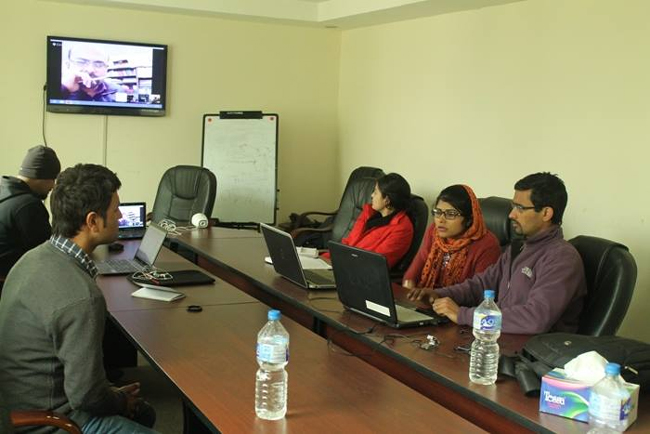
choutari-meeting-1

Technological Demo

This was a meeting among Choutari editors, originally supposed to be a “training” where Shyam was going to walk us through the kinks of technology before discussing how to translate technological affordances into professional purposes. The plan was to ensure that editors are proficient in the use of WordPress blog platform and functionalities: how to add new posts, save drafts, schedule for certain dates, order by time stamps, create table of content, hyperlink using part of preview link, integrate images and other media, learn how to tag and categorize posts, and so on. Shyam did start by emphasizing that the technology is largely a tool that we need to learn how to use with command (meaning everyone must learn how to post/schedule, edit, link, organize, and manage posts and pages on the blog) but the focus must be on how to achieve the professional objectives that the tools are used for achieving. We used the metaphor of hasiya, kodalo, and bancharo and how we keep them sharp and ready but don’t look at them as the focus of our harvest seasons.

However, within a few minutes of trying to walk the rest of the group through the dashboard of the WordPress blog, using Google Hangout’s Screen Share functionality, he realized that the participants already knew the basic applications and functions–or at least they could teach each other basic features and more quickly and easily. In fact, more people than we knew prior to the meeting turned out to have their own blogs and have mastered fairly advanced functions. Going into details of advanced functions like managing widgets, plugins, theme and customization, exporting content, and managing pages could make the meeting more boring than productive; and more advanced functions should also come from gradual development of expertise. Some roles such as approving comments can be assigned to certain editors because they need some attention and understanding (such as spotting and excluding spams; Uttam and Praveen seem to be doing this now, and that looks like a good plan).

So, the conversation naturally and quickly moved on to the agenda of maintaining quality, promoting collaboration and efficiency, and modeling for as well as engaging the community.

Maintaining Quality: Making Review Process Effective and Efficient

We started this segment by summarizing the notes that were shared with the group prior to the meeting. It is worth highlighting that editors fully familiarize themselves with the rules provided to writers; these rules are outlined and even demonstrated under the section “Join the Conversation.” We also later discussed the overarching objectives of the forum spelled out at the top of the Team Charter. The specific best practices and general mission statements are worth viewing as giving us a sense of direction with regard to quality of the publication and engagement of the community. Below is a rundown of what we discussed in terms of making the objective of maintaining quality/standard efficient from a collaborative perspective. Please don’t read these as instructions; they were discussed as suggestions for effectiveness and efficiency. Everyone agreed that a more efficient process for collaboration is needed.

  1. Submission: All submissions must be made to the official email, neltachoutari@gmail.com in order to avoid various types of possible confusions and inefficiencies. First, promote the “Join the Conversation” section; when any authors submit their drafts to individual editors, they should request the writer to resubmit it to the official email address (create a template email if necessary); or just forward the email to the official email, copying the author. Even this much will make a huge difference in terms of streamlining the review process.
  1. Reception & Assignment: The lead editor of the next month should respond to all submissions made between, say, 16th of the previous month to the 15th of the current month. Lead editors can choose to respond from the official email if they prefer; otherwise, lead editors can respond to writers of each submission during the time window and copy one reviewer (and if necessary one mentor), asking everyone to complete the review process and submit the article by, say, the 24th of the month before publication. If a lead editor can distribute the burden of review among different editors/reviewers, starting with his/her subeditor(s), this will allow the lead editor to be more creative, to try to cover more base, to run the conversation, and to better maintain the overall quality. To avoid confusion, editor/reviewers not assigned to work on any draft should leave it to the assigned editors/reviewers. We also discussed the driving principle that “collaboration” and “taking turns” are two very different things, and what we need is the first!
  1. Collaborative Review: Using Google Doc as a general rule can make a positive difference, though it may be necessary to give individual writers the choice of opting out and using email with his/her reviewer (and mentor if any). Lead editor can create a new Google Doc each within the official account, giving edit access to the writer (as well as editor/reviewer and any mentor). Again, while some writers may not be able to use Google Doc (due to technological limitations of skill, tools, internet, anxiety, etc), even those who are able to do so will significantly eliminate the need for email- or phone- based updates among the writer, reviewer, and coordinating editor. Just the lead editor being able to see where the review process for some of the submissions can save a lot of time and hassle. Finally, some writers may not want the review process to be open to all editors, but the solution to this is to make the review process more professional (and respectful of authors) rather than relapsing into privacy–because the idea of privacy among editors doesn’t make sense anyway. A standardized folder and file naming convention should be developed through a Facebook Group conversation.
  1. Assessment of Quality: Lead editors should sort submissions into three or four groups, such as: 1) ready for publication with minor edits, 2) worth reviewing and publishing next month, 3) worth assigning a mentor as well as reviewer, and 4) impossible to improve. While the general principle of a community like this should be “reform not reject,” there may be some cases of #4, such as plagiarized or already published content, not at all related to ELT, etc. Drafts in category #1 can be managed by lead editors themselves (no need to assign a reviewer); drafts in category #2 would be the majority; drafts in category #3 should be directed to the coordinator of of the Choutari Mentoring Project, Uttam Gaulee, or at least copied/coordinated. The idea here is that even though a blog should not be about rejecting or accepting articles like conventional journals, shifting the focus from personal to collaborative/communitarian is in everyone’s benefit. We also briefly touched upon the following issues as a yardstick for assessing how to approach different types of drafts/submissions:
  1. Relevance and Significance: The draft is not relevant to ELT, doesn’t situate or even relate the main idea to ELT or to education at large in a significant way. Or, the draft doesn’t have a significant, interesting, or engaging point from the perspective of our readers–because the subject is outdated, the topic too broad/vague, the argument diluted, etc.
  2. Organization and Connection: The draft doesn’t start with an engaging and clear introduction that provides a sense of direction, a sense of scope, and a sense of organization to the readers–and there doesn’t seem to be an easy fix, such as moving the key idea to the beginning and adding transition sentences for better flow between sections that are in themselves focused on the main idea.
  3. Focus and Strength of Main Idea: The draft has long a long background and/or includes barely relevant paragraphs/sections that can’t just be deleted (because the rest of the draft would be insufficient or affected by the removal of parts), or the overall writing doesn’t develop a main idea with a focus and a perspective.
  4. Originality and Use of Sources: The author uses external sources without proper/effective citations, seems to use external sources without citation but it is hard to determine by simply Googling chunks of text, or cites correctly but the citations are not integrated and used effectively alongside his/her own ideas–for instance, there are large chunks of citations that are not yet framed within the writer’s own ideas.
  5. Language and Style: The writing is highly formal, academic, or abstract and therefore in need of “translation” to make it more accessible to the blog’s readers–or it is extreme on any other end, such as too informal, too gimmicky, etc.

Fast Tracking Review: Taking drastic but intellectually sensitive approach as editors: especially when there is little time and not enough material, blog coordinator and/or editors/reviewers may have to take a drastic approach. But the authors must always be given the opportunity to review and approve any and all changes/edits made to their work. Here are some time-tested strategies that may be handy.

  1. Do/Show: cut/paste the main idea if it comes late in the draft to the beginning, add a sentence or two in the beginning (esp. within the first two paragraphs) in order to provide context and/or overview of the post, foreground or add topic sentences within the body paragraphs;
  2. Tell Directly: highlight and directly tell the author to delete any sections that are irrelevant or go too far in one direction, ask the author to condense an elaborate section into a certain proportion such as two-third or one-fourth, etc, and
  3. Ask Bold Questions: ask the author if any section can be deleted, condensed, or elaborated as necessary.
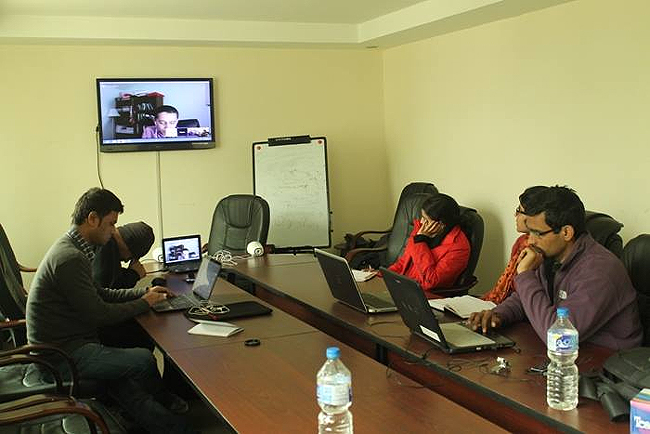
choutari-meeting-2

Team Spirit: Team spirit is very important. Both facilitators highly emphasized that Choutari is a forum with tremendous value and impact in the world of ELT and that it also has huge potentials for the editors’ professional growth; but both the impact on the profession and the person heavily depends on maintaining a team spirit, keeping one another inspired and energized, cultivating a positive attitude, going for the positive, inspiring the community, giving the best back. And, for a community that depends on virtual communication, all the above heavily depend on regular communication among the team as well as strong, positive messaging from the team to the community.

Reflective Editorship: We also touched upon the idea of “reflective editorship,” which means that if lead editors start, carry out, and end their coordination by engaging the rest of the team in an ongoing conversation, assessment, and reflection, there will be continued learning and inspiration for all involved. No one comes to Choutari already knowing what exactly to do; if we do, we would still be quickly outdated! The community continues to develop new ideas, columns, strategies, etc; and this starts by building one set of guidelines and trying to achieve the shared objectives, then gradually updating and improving the strategies through ongoing conversation and reflection. The Team Charter is a starting point, not a stone tablet with rules.

As we were engrossed in the conversation, paratha arrived. Amid the rustle of unwrapping packages and as our colleagues back home served themselves the mouth-watering breakfast, and with our mouths watering from two ends of a country on the other side of the world, we wrapped up the conversation. Very deep intellectual discussions branching out from technological topics, laughter and giggles, multi-tasking, using alternative channels when the lights went out, bantering about the men in Kathmandu forgetting to turn the camera to the chelis . . . made the meeting both inspiring and memorable.

The Choutari brings people together, people who are on their way to their own professional destinations (or rather journeys), people who care enough to stop by, to share their ideas– in spite of the crazy busy lives they live, in spite of the seven seas separating them. The virtual Choutari has a lot in common with the physical. This too is on the way to somewhere, as the physical choutaris usually are. This too gets its meaning when people stop and talk, rest and energize themselves. The burdens we carry may have become abstract–for as teachers, scholars, we transport ideas on our backs–the journey we make may be to places around the world, and the travelers we meet may be citizens of the whole world. But we still share the same concern to keep our community informed, our bonds strengthened.

It was 2.30am by the time we finally left the Google Hangout. The snow was still piling up in New York, Uttam had to go home by the last university escort at 3 am, and colleagues in Kathmandu had half the day left and work to be done.

Photos (above): Jeevan Karki

shyam

Dr. Shyam Sharma is an assistant professor of Writing and Rhetoric at State University of New York, Stony Brook University. His professional interests include composition (writing and rhetoric) pedagogy and theory, writing in the academic disciplines and professions, multilingual and multimodal writing and scholarship, rhetorical traditions, and research and program development for professional development of university students.


Uttam Gaulee is a doctoral student in Higher Education Administration and Policy program at the Department of Human Development and Organizational Studies in Education at the University of Florida. After working as an English language teacher at Tribhuvan University colleges in Nepal, he joined the University of Pittsburgh as a Fulbright scholar, before joining UF. He is Associate Director of Community College Futures Assembly at the Institute of Higher Education and also serves as Graduate Affairs Chair of Graduate Students Council at UF. Uttam is leading the new Choutari Mentorship Program.


Storytelling for Learning Language with Fun

Santona Neupane

As teachers, we often ask ourselves, “How can we develop creative thinking of our students? How can we ensure that our lessons are fun making and useful for them?” We, the teachers today always seek to find new ways to help the learners unleash their creativity. In this post, I share with you some thoughts about how we can use storytelling to help our students learn language in effective and enjoyable ways.

When I was a young, my sister used to fascinate me and the rest of the family because she had a very captivating way of unfolding events that kept the audience glued to their seats. I remember getting so engrossed in the story that I fell off the stool. Stories, and creative and effective expression still fascinate me, because stories not only made my childhood fun but they also greatly enhanced my language development. As the old Nepali saying goes, those who can tell good stories are worth adorning with garlands of flowers and . Hearing a story is heartwarming and a storyteller can make the world come alive for the listener. The power of storytelling is attested by sayings like this in many cultures. And as language teachers, we all know that power. When telling stories, speakers develop language skills, as well as build confidence for communicating their ideas.

Storytelling in the Context of Teaching/Learning Language

In the context of learning language, storytelling allows learners to learn and express new ideas, use new vocabulary and grammatical structures, and put such language skills to use within the broader context of events and ideas in the story. Storytelling gives learners the opportunity to use language in a holistic way.

Highlighting how the use of story in language classroom is a powerful tool in the language learning process, Jones (2012) argues that “Once learners get into conversational storytelling, it is an enjoyable experience for both them and the teacher.” There’s no doubt that stories can be fun and also there is more to storytelling than it meets the eye. One has to ensure successful learning of language as well. According to Morgan & Rinvoulcri (2003), successful second language learning is “far more a matter of unconscious acquisition than of conscious, systematic study.” The stories could be such method of unconscious input that can ensure creative output. Stories unconsciously draw a learner towards them. “They capture and hold the imagination of learners; they create empathy as children identify with characters and situations in the stories; they present language in authentic contexts, thus promoting both grammatical and vocabulary development; they facilitate acquisition through multiple repetition (both of the language in the story, and as the story is told over and again)” (Maley, 2008, p. 4).

Hence, storytelling can be a powerful tool for teaching language. Stories also help students to be expressive, imaginative and capable of using language naturally in real context. Telling stories is a natural way of engaging students to communicate complex ideas. Stories when used in classroom help students practice communication and expression. If we as a teacher can help students love stories, we will pave way for them to be extensive readers in the future.

It is worth noting at this point that storytelling is more than just reading aloud. Actually it is NOT reading out loud. When a story is told live, the teller can engage listeners and can create an intimate bond through his/her voice and eye contact. Another obvious benefit of storytelling over reading aloud is improvisation through the use of mimes, gestures and body language.

What Type of Stories?

It  is not enough for us as a language teacher to go to a class with any story. If you plan to tell a story to a class full of eager minds, there are two questions to consider first.

Is this the story I enjoy telling?

Is this the story my students would find entertaining or thought provoking?

The stories that you choose to present in the class should touch you and your students should be able to relate to it the way you relate to it. Your reaction to the story and your enthusiasm can really ignite a desire in your students to be better recipient and eager participants. Choosing a good story is a crucial part of storytelling. Don’t tell a story just for the sake of storytelling. Let the story be a part of you. Know your students well and choose a story that might easily be their story.

For my English lesson, one day, I chose a fairly easy story about a tortoise, having a bad day, decides to run away from home. I planned my lesson around it and decided to use this story in two different levels: one primary and another secondary. I chose grade 5 in the primary level and grade 10 in the secondary level. I told the same story to the classes, improvising and detailing the story as per their level. After an initial round of storytelling, I got the students talking about their feelings. I asked them if they could relate to the  character and if they have ever in their life felt like running away. All the students responded with “Yes”. When I asked them to write down a similar story, I saw them eagerly opening their notebooks and writing energetically. In the story, the main character returns home after learning the value of his family and friends. The story not only helped them in their language learning process, it also helped them to meditate on their lives by relating themselves to.

Stories are everywhere; in fact stories are our way of life. “Stories are central to what it means to be human. The human mind seems to be hardwired for the creation and reception of narratives. It is even true to say that we are the stories that make us up: stories we have heard, we have told, we enact daily” (Maley, 2008, p.4). There are lots of sources of story. We can choose our stories from fairy tales, traditional folklores, culture, proverbs, pictures, newspaper clippings, films, personal anecdotes, rumors, imagination etc.

Who can Benefit?

As a teacher of language, I have found storytelling very helpful. However we should not just limit its use in language classroom. Stories can be used in a math, science and social studies classes as well. Stories are not limited to kindergarten only but can be useful for secondary classes as well. Stories can be told to any level of learner. Beginners can benefit through it and it will aid their literacy and language learning. Even advanced learners are benefited through storytelling; they can refine their already learnt language skills and polish their ideas. Stories give them opportunity to be creative with what they have already learnt.

Classroom Activities

Storytelling is an effective alternative to traditional language teaching activities. There are a lot of ways through which we can use storytelling in our classroom. As stated by Morgan & Rinvoulcri (2003), storytelling activities range from introspective to interactive, beginner to advance, written to oral, individual to group. Stories can be planned and delivered in such a way that it achieves its objectives. If our objective is to help students with grammar, then we can choose a story with recursive pattern of words and phrases. Our telling can give them exposure to the target language. Apart from grammar, we can focus on vocabulary, intonations and phonetics to help them acquire English language easily and successfully.

Choosing a good story is a crucial part of storytelling. The main part is storytelling itself. Your relation and attitude towards the story matters a lot. Once the story has been delivered you need to plan various activities to help the students contemplate the impact. Group discussion based on various probing question can help the students relate to the story. You can prepare the questions beforehand and have the students talk about it with each other. The questions can range from their reaction to various elements or aspect of the story. If your students are advanced learner you can have them discuss the literary aspect of the story. Have the students paraphrase the story individually and they can even write a reflection on it. Another activity would be to write a similar story on a totally new context.

Dramatizing the story is another method of exploiting stories. Either you dramatize the storytelling itself or have your students retell it in a form of drama. Role playing and role taking helps the students with revision and in doing so they get familiarized with the grammatical, semantic, structural aspect thus unconsciously learning language. Retelling a story is fun and enjoyable. Getting the students to narrate their story in the class often creates a receptive environment in the classroom where more than one student will be willing to share similar experience. Tannen (1984) has stated that one person’s narrative may often be taken up by one or more of the listeners who will add similar narratives of their own to create what she refers to as  a “story chain”.

Apart from storytelling, creating similar stories through parallel writing helps them a lot. Get the students create a story with the help of theme words either individually or in a group. Instead of the teacher telling the story, students can also do the telling. This will help in a successful two way communication in a language classroom while giving an opportunity to the teacher to evaluate the learner.

Using pictures and shapes, together the teachers and students can create a new story to tell. Sometimes we can tell an incomplete story and have the students complete it and tell it. Taking an event from a newspaper clipping and telling it in a form of story can also help the students.

Conclusion

Storytelling, which is an integral part of human life, can be vital in language teaching. Basing the language lessons on stories have creative impact on the students. If we cultivate a love of stories in our students through storytelling, we can help them learn without giving them the monotonous drill and bland role play. Stories add a humanistic element in teaching making it quite effective. Various classroom activities based on stories not just make your lesson comprehensible and useful, it also adds fun to your teaching.

References

Jones, R. (2012). Creating a storytelling classroom for a storytelling world. English Teaching Forum, 2-9.

Maley, A. (n.d.). From story literacy to reading literacy. Literacy in the language classroom, 4-7.

Morgan, J. & Rinvoulcri, M. (2004). Once upon a time: Using stories in language classroom. Cambridge: CUP.

Tannen, D. (1984). Conversational Style: Analyzing talk among friends. Norwood, NJ: Ablex.

Wright, A. (n.d.). Creating stories. Literacy in the language classroom, 23-34.

————————————————————————————

santona

Santona Neupane is a scholar pursuing her M. Ed. in ELT at Kathmandu University, School of Education. She is an English teacher in a private school in Kathmandu. She has recently joined the editorial team of Choutari.

Five Books That ‘Changed’ My Life

Hem Raj Kafle

‘Change’ is not my word in the title above, but I agree to use it. Do books change our lives? Someone said it is the reader who has the potential to change; the book only triggers that potential. And one who does not have that potential does not respond to the trigger. I agree to this, too.

But I am not here to present a thorough appreciation of ‘five classics’. Not that I avoid reading classics, but I am willing to write about those books that have told me their actual worth.  Each of the five books came to me almost ‘out of nowhere’ and left a lasting message. Not that any of them should ever satisfy your intellectual need if you someday decide to read.  I write here simply because I have deemed them contributory to my own growth as a teacher. An English teacher.

I was delighted when the Choutari Team asked me to write on five books that ‘changed’ my life. I decided to speak up: I have already read a book with the same title and loved it so much. It is The Book That Changed My Life (2006) by Roxanne J Coady and Joy Johannessen. A book about books, and about how books change one’s life – I had loved this idea long ago. The Book indeed was a reward, such as Coady herself would like to regard as a gift “from heaven”.01. The Book That Changed My Life

I bought it in the summer of 2008 at Books and Books, Coral Gables, Florida, only as a memento of my US visit. And, because it was a casual pick, my interest in it turned into epiphany as I read through the short essays inside. This was an opportunity to peek into seventy one writers’ celebration of “the books that matter most to them.” These seventy one people gave credit to certain books and their writers as their life’s important change agents. So, the writers’ appreciation of their favourites helped confirm that none of my previous and recent cravings for ‘good books’ were without meaning.  Anyone, even you, will subscribe to Coady’s prefatory justification for publishing this book, so will I.

Reading is a way to live more lives, to experience more worlds, to meet people we care about and want to know more about, to understand others and develop a compassion for what they confront and endure. It is a way to learn how to knit or build a house or solve an equation, a way to be moved to laughter and wonder and to learn how to live.

One book that has made great sense to me as a teacher of English is The Elements of 02. Elements of StyleStyle, the tiny work of William Strunk Jr. and E. B White. You may wonder why such commonplace as ‘elements of style’ would strike anyone who boasts of degrees in English and years of teaching in a reputed University’s central department. But I realized, after having gone through the authors’ terse admonitions against verbosity and carelessness, that degrees and years of teaching do not make one a writer and a teacher of effective communication. The actual prerequisite of being a writer is not only the mastery in grammar and vocabulary, but craftsmanship in stylistic and rhetorical choices. 

The Elements offers an extremely concise treatment on style. I have nurtured the following assertion more than anything in life and, of course, for writing in Nepali as well:

Vigorous writing is concise. A sentence should contain no unnecessary words, a paragraph no unnecessary sentences, for the same reason that a drawing should have no unnecessary lines and a machine no unnecessary parts. This requires not that the writer make all sentences short or avoid all detail and treat subjects only in outline, but that every word tell.

Strunk and White made me aware of the beauty of brevity in writing. Then Writing Tools by Roy Peter Clark, a writing instructor at Poynter Institute, Florida, helped polish this awareness. The “50 essential strategies,” more as rich illustrations of good and bad samples from various established sources than commonplace imperatives, have best corresponded with my zeal for learning rhetorical styles.  Clark taught me writing as an artful yet serious activity and knowledge of grammar a means to shape the artistry of expression.03. Writing Tools

Assuming the role of highly active, playful teacher along the “strategies,” Clark encourages every aspiring and established writer to become an entertainer, a performer. He likes to take writing for carpentry, and then has this to say: “You can borrow a writing tool at any time. And here’s a secret: Unlike hammers, chisels, and rakes, writing tools never have to be returned. They can be cleaned, sharpened, and passed on.” 

Clark’s metaphors of gold coins, ladder of abstraction, internal cliffhangers, X-ray reading etc. will surely tickle one’s sense of sufficiency as a writer and editor. Initially, he makes you skeptic about every sentence you write yourself and read from others. As you move on, because Clark will not allow you to drop midway, you become a better writer, better reader, better editor. Clark follows you directly into your profession. He is with me – in lectures, in instructions, in formal presentations – and now as I write these lines.

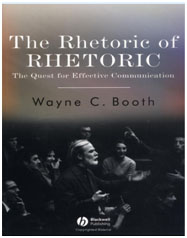
I got Wayne Booth’s famous book The Rhetoric of Rhetoric at a time I was trying to get clear knack on rhetoric in scholarly, philosophical and practical terms.  Booth proved a rescuer, and a guide to the fact that rhetoric is a vastly developed academic discipline way beyond its everyday currency as a signifier of a cheap lie or a political 04. The Rhetoric of Rheotricbombast.   

Booth observes rhetoric’s relevance as much in persuasive communication and study of such communication as in the resolution of conflicts, teaching of science and general upbringing of people. Of special value to me has been his idea of “rhetorology” defined as a “deepest form of listening rhetoric: the systematic probing for ‘common ground’”, which in other words involves a practice of paying attention to opponent views during a conflict situation.

Booth emphasizes that rhetoric is simply the way we think and communicate in the process of creating a better life, and eliminating slippery situations. So, I believe, after Booth, that “the quality of our lives, moment by moment, depends on the quality of our rhetoric.” Isn’t it then even more appropriate to say that the kind of political system and social structure we see/experience “depends on the rhetoric of our leaders and our responses to them”?  Booth is equally true in his belief that “our children’s future depends on how they are taught rhetoric.” That is, by us.

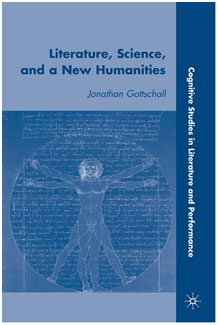
Literature, Science and a New Humanities by Jonathan Gottschall is one of my recent readings. It has made much sense in my decision to work across humanities and other disciplines in Kathmandu University. It has reshaped my understanding of the common tension of where humanities needed proper overhaul.

05. Literature, Science and a New HumanitiesGottschall makes readers aware of three main fault lines of the current humanities scholarship. The first includes the excessive use of jargons and “theories of human nature that are defunct.” The second is a methodological problem involving the impossibility of getting tangible evidences unlike in science because the “theory-generated hypotheses” in humanities are not “closer to truth.” The third problem involves attitudinal dilemmas where the dismissal of the “possibility of generating reliable knowledge” is critical among humanities scholars.

Reading Gottschall coincides with two very important contexts of my academic life. The first involves a larger concern of the humanities ‘fraternity’, to which I belong. This is the concern for the visible decline of interest and intake in certain traditional university programmes like geography, history, political science, psychology and philosophy. That some people still desired to study English literature or journalism is nothing of a solace to a career-ambitious young man in that it is gradually subjected to preparing ‘service’ writers or higher-secondary teachers. Personally, working in an institution heavily focused to profession-specific academic programmes in science and engineering, I have always felt the need of reconfiguring my disciplinary orientation to more goal- or job-centric terrains. The second context has to with the recent shift in my disciplinary priorities. I moved from where I liked to work (social sciences) to where I loved to belong and contribute (humanities and sciences). The move has also added a challenge of helping to interface the mutually complementary facets of communication, teaching, management, entrepreneurship, and economics in the promotion of engineering and science education.

I feel now that Gottschall’s book endorses my decision to work across these terrains. It lends adequate confidence in the goal “to establish a  new  humanities  on  surer  foundations.” The foundations would then take more conciliatory yet “diverse and sophisticated methodological toolkit, and the pursuit of disinterested inquiry.” I have subscribed to Gottschall’s “call to move closer to the sciences in theory, method, and ethos.” I have accepted this mandatory, though difficult, challenge to “participate more fully in revealing the ultimate subject of the humanities: humans.” To this my life is directed with tenacity. To reiterate, I have set conciliatory, empathetic performance in scholarship to be the main motto of my further scholarly priorities.

Finally, books do not respond to the extent of leading to change unless you approach them with love and passion. Love for books comes with birth.  This love becomes passion when books become a part of your upbringing. Books shape our thoughts which shape our actions. Thoughtful actions are change agents. A book’s contribution to change lies here. With this belief I seek to read good books, more and more.

————————————————————————————

Hem-Raj-Kafle-bioHem Raj Kafle is one of the senior editors of NELTA Choutari. He is an Assistant Professor of English at the Humanities and Management Unit, School of Engineering, Kathmandu University. For more of his literary writings and works at his personal blog: http://kaflehem.wordpress.com/

An Access Teacher’s Reflection on ELT Training

Mandira Adhikari

I have attended a number of training sessions on English language teaching facilitated by both national and international trainers. And I have conducted some training sessions myself. Whenever I attend or conduct such sessions, I ask this question about their significance: Will I be able to translate (transfer) the ideas into my classroom? If such session doesn’t seem relevant to my classroom setting, I return with a sad face, thinking that the time, money and resources invested in that session went in vain. However, I returned home with a happy face from a recent training organized by NELTA in Kathmandu on 20th and 21st December, 2013. Access teachers from the different parts of Nepal participated in the two-day English teachers’ training. I found it very effective for my classroom and I learned several new ideas and concepts to implement in my classroom. In this blog entry, I am going to reflect on my experiences.

FIRST DAY

Following the introduction of the participants, the first day of the training began with ‘Gallery Walk’ and concluded with two different sessions ‘Songs in Access Classroom’ and ‘Co-Teaching’.

Gallery Walk

Through a gallery walk, we reflected on our success stories from Access Program being implemented at different district branches of NELTA. I found the activities of the Access Centers unique, fascinating and different from one another.

Let me begin with GorakhaCenter. The teachers had their students engage into convening an educational fair and they learnt that the students could learn different things when they are engaged in organizing such programs. Similarly, they had organized a literacy campaign targeting the illiterate people of their community with a view to raise awareness, motivate, and encourage them to be literate by joining literacy classes.

Kathmandu Centers had done something remarkable. They had taken the Access Students to the US Embassy, Kathmandu, where the participant students observed various equipments operated with the help of solar power. And the painting titled ‘Wall of Hopes’ highlighted violence against women. On the International Human Rights Day, they showed a movie related to human rights. They also made their students participate in ‘English by Radio‘ program, which is aired through radio stations in partnership of NELTA and the US Embassy.

Unlike Gorkha and KathmanduCenters, PokharaCenter had facilitated their students to prepare and perform a ‘Drama’ on the occasion of ‘Thanks Giving Day’. I like the concept of students’ engagement in the drama as it helps them to be confident, creative and to improve their speaking skills.

BirgunjCenter had their own uniqueness, in celebrating ‘Raksha Bandhan’—a popular Hindu festival of the love between brothers and sisters celebrated in Terai, southern part of Nepal and also in many parts of India and Mauritius. In this festival, sisters tie the thread and attractive rakhi (simple, woven and colorful thread or may be intricate with amulets and decoration on top of it) on wrist of their brothers for their long life, welfare and protection. Other remarkable activities in Birgunj —Traffic Week and Ocean Day—impressed me. Students’ engagement in traffic management over a week has not only helped traffic police but also they have learnt traffic rules. Considering busy traffic in Kathmandu and need of traffic knowledge in our students, I wish I could replicate such activity for LalitpurCenter where I am an Access teacher. I think that the celebration of Ocean Day could be adapted in the context of our Access Centers too.

I was fascinated by the special idea of developing reading skills among our students from KanchanpurCenter. They have formed a readers’ group and a book reviewers’ group. We had conducted classes on ‘Book Review’, students, however, have not been confident enough to write the book reviews. I think the idea of forming of groups of readers and reviewers would help me further building on their confidence.

Songs in Access Classroom

Following Gallery Walk Session, Suman Laudari, former Access teacher facilitated a session on ‘Songs in Access Classroom’. Based on his own experience as an Access teacher, he highlighted on the effectiveness of the use of songs for language learning. Songs are the great exposure to our students and using songs is one of the best ways to teach pronunciation with a fun. We can also develop classroom test activities such as gap filling, match the words with their meaning, and put the shuffled stanzas of the song in order. Through this way, language learning can be a fun making for them.  On the other side, while using songs in the classroom, some possible challenges such as offensive words and deviated forms were explored in our discussions. However, the learners should be pre informed not to use offensive words and consider deviated forms because they are more often used in songs.

Co-teaching

Access Program has a salient feature of co-teaching at its Centers. As an assessment for such a feature, Ganga Ram Gautam and Miriam Corneli jointly facilitated co-teaching. During the facilitation, they introduced ‘Tree Metaphor’, as a tool for effectively analysing our co-teaching. Using tree metaphor, the assessment and analysis of co-teaching was carried out by participants from different Centers in terms of fruits, shoots, seeds and roots. We found our analysis of co-teaching almost similar. For instance, when I and my co-teacher analyzed our co-teaching classes, the fruits of our co–teaching –making   classroom a fun zone, our shoots –utilizing our experience to make our classes effective by discussing with each other, the seeds—about five hours’ discussion to prepare a lesson plan and though we haven’t been successful in executing it yet to and the roots—we both are from education background and quite familiar with different methodologies. We both are co-operative and flexible. As a result, our co-teaching has always been successful.

The co-teachers at Access Centers are co-operative and they have been successful in making their classes effective, applying a variety of teaching methods. Before both the facilitators concluded the session, they provided us the effective model of co-teaching, which further helped us to improve our co-teaching further. Our co-teaching would have been more successful and we would not have faced challenges in managing the roles while implying this concept if the training on ‘co-teaching’ was provided before the Access classes started.

SECOND DAY

The second day of training consisted of four different sessions; ABCD model of lesson planning, public speaking, group discussions and American culture.

ABCD Model of Lesson Planning

Upon the presentations of the lesson plans made by respective Centers, Hemant Raj Dahal, president of NELTA made comments on them. Based on his observation and experience, he shared that most of the teachers usually miss the important parts ‘context’ and ‘expectation’ of our learners while planning their lessons. The discussion became livelier when Access teachers shared their challenges for preparing an effective lesson plan. To address those challenges, facilitator Dahal concluded the session with the introduction and use ABCD model of lesson planning for preparing effective lesson plans.

Public Speaking

The second session ‘Public Speaking’ facilitated by Motikala Subba Dewan was worth effective as it provided us the ideas of public speaking in various contexts. During the session, we were divided into different groups and each group was assigned a topic to prepare a speech. After the group leaders delivered their respective speeches, they were analyzed in terms of both strong areas and the areas to improve. I found the session constructive for not only for speaking in public but also for facilitating students to present their ideas in our regular classroom instruction.

Group Discussions

In the third session, Sara Denne Boltan facilitated us how to conduct group works effectively in our classrooms. She presented to the idea of evaluating the involvement of group members with the help of questionnaire.  It can be an effective tool to actively involve all our students in a group work. The handouts and materials provided by her were helpful for our Access classes while organizing group discussions. She also facilitated us with how to play ‘Dice Game’, which can act as an important catalyst to energize our students for developing speaking skills.

U.S. Values and Culture

Besides improving English language skills, Access Program aims to impart the knowledge of the U.S. values and culture to the participant students and sensitize them about cultural differences. The session facilitated by Sara helped us better understand the American culture that students are expected to learn. Her presentation included contextual conversational patterns, different meaning of facial expressions, and notion of leadership, concept of ‘self’ and other different American cultures.  She further clarified that Access students are expected to learn visible parts of American culture such as the food Americans eat in different festivals, their language and music.

Acknowledgements:

As an Access teacher, I got this wonderful opportunity to attend the training I have reflected above. For this, I am grateful to ‘English Access Microscholarship Program (Access Program)’ implemented by Nepal English Language Teachers’ Association (NELTA) with sponsorship and support of the U.S. Embassy Kathmandu/the US Department of State.

————————————————————————————

Mandira

Mandira Adhikari is currently working as a teacher for the Access Program in Lalitpur. She has completed her M.Ed in ELT from Kathmandu University. She is also a life member of NELTA.

Easier said than done …

… but if worse comes to worst, just hang in there!

Umes Shrestha, Lecturer, blogger and a podcaster

Right on the outset, let me state that I am taking a very controversial stance here. Because many supporters of World Englishes believe that for second language learners of English, gaining native like competence of English is a myth. It’s not possible, and, in essence, it’s not necessary. Let’s face it, they also tell you that the‘coded-down’ version of English (or the English as Lingua Franca) is the only way forward because English will eventually lose its standard-ness.

Fine by me but here’s my stance. If a learner wants to speak (or write) English better, he/she has to try and learn how the native speakers of English use the language in real life context. In addition to acquiring the sense of vocabulary, structure, forms and semantics, the learner also has to develop the pragmatic fluency in English. (I am not talking about American accent or British accent or any such accent, though.) Therefore, I strongly believe that only by learning and acquiring unique characteristics and nuances of English language will the learners become more competent and proficient in it.

Some of the areas of such nuances in a language are the use of figurative expressions (idiomatic expressions, phrases, proverbs, etc). Similar to our own Nepali language, English language is also very rich in such figurative expressions. Using these expressions (let’s say: idioms) add color and imagination in speech and in writing. This obviously holds true for all the language. Nepali language would most certainly be pretty bland if it didn’t have any figurative expressions. So, by mastering the use of English idioms, one’s English can become more natural and less awkward, more articulated and less dull. Learners and users of English will be able to produce and interact in English at a different creative level.

Normally, we don’t find any trace of this concept in standard textbooks because the curriculum and syllabus are usually ‘water-downed’ for general learners of English. Just flip through Our English books for Class 9 and 10. Why there’s no focus on this aspect of English is quite beyond me. English magazines, newspapers, stories, TV shows, movies are however full of figurative expressions. Imagine the shock and dismay when learners discover the real English used in real contexts, when they find that the English in real life can be quite different than the English in textbooks. Hence there are always chances that students and learners know English language but do not know how to use and understand English language competently and fluently.

And even when students use or try to understand the meaning of idioms, they try to translate them word-for-word at a very literal level. But translating the idioms into one’s mother tongue will only compound the problem. Figurative expressions are unique properties of a language and when translated into another language, they usually lose their true essence and purpose.

For instance, let’s consider the sentence with a very common idiom:

Sentence 1: He insulted me and I lost my temper.

In Nepali the literal meaning of ‘to lose’ is ‘haraaunu’.

Sentence 2: I lost my money. (maile paisa haraaye)
Sentence 3: I lost my book yesterday. (maile hijo kitab haraaye)

These two sentences 2 and 3 make sense even when translated into Nepali. But. If a Nepali learner of English translates the Sentence 1 in the similar vein, he/she will only come up with confused and even nonsensical meaning. This is the reason why the figurative expressions are difficult to learn, acquire and eventually master.

Similarly, the following sentences can be difficult for Nepali learners to understand and to use in their real contexts because, again, translation doesn’t help.

Sentence 4:      I can’t stand Science class because it is way over my head.
Sentence 5:      You don’t stand a chance of getting good score in Science because it is
way over your head.

And, here are some real instances from my classroom.
Me:                 Alright students, let’s wrap up today’s lesson.
Student:           (with a confused face) Sir, wrap ta gift lai garne hoina?
Sir, we only wrap gifts, don’t we?

Me:                 Guys and girls, keep it down.
Student:           What to keep down?

Thus, unless a learner ‘develops a knack’ for figurative expressions through practice and enough exposure, it will be difficult for him/her to develop English language competency.

Moreover, using figurative expressions adds ‘fun’ to the English language. It’s thrilling and it’s entertaining. Many a times, it’s defamiliarizing. (Here’s the buzzword!). And it goes without saying that ‘enjoying the language’ is one of the most essential requirements to learning and acquiring a second language. We can also call this fun element an ‘intrinsic motivation’ or ‘internal drive’ to get better and to prosper in the language one is learning.

So, I request my fellow English language teachers to incorporate figurative expressions in their teaching as per their discretion. We all know… we will have to put in a little extra effort because it may not be in the textbooks. But don’t give it a second thought. Implement it. You’ll enjoy it. The students will enjoy it.

I hope you will just give it a shot!
Great!

Some links:

Devil’s Advocate vs Vicki Hollett on ELF
http://chiasuanchong.com/2012/03/04/devils-advocate-vs-vicki-hollett-on-elf/

Chia Suan Chong speaks about English as a Lingua Franca
http://www.youtube.com/watch?v=oB6traNccQQ

Developing creative- linguistic abilities through classroom poetry

 Dinesh Kumar Thapa, Lalitpur


“Poetry and hums aren’t things which you get; they’re things which get you.  And all you can do is go where they can find you.”-Winnie.

Classroom poems are funny and full of variety. They make a class really lively and motivating. Poetry can be oral or written, or both. They can be read aloud for developing oral- pronunciation ability, or they can be written to develop creative- linguistic abilities in English. Poems demand a lot of expressive ability on the part of the learners, so they engage the learners for the creation of meaning. Besides, using poetry in the class allows the children to express in the ‘little English’ they have developed in the beginning years of learning. It develops confidence in the learners for producing English and motivates them to learn more English. Poems are interesting for all, and even more interesting for the little kids.

For the purpose of this article, I have used the term poetry to encompass all English teaching activities which involve musical quality, which are aesthetic and expressive, and which do not demand rigid grammar rules to carry them out. Activities such as rhymes, songs, riddles, musical compositions, jingles, etc. have been included under classroom poetry here. The teacher here does not need to worry about such concepts as the theme, form, metaphor or the criticism of poetry, as they are not such academic poems for critical study. Rather, for us, poems are simply a tool of developing English in the learners! The activities suggested here are appropriate for junior/ primary level students, yet they can equally be employed in the higher levels with modifications.

1.     Naming poems: This technique involves creation of a poem out of the names of the students with some additional details for the name.

Laxaman is always late and Geeta is great,
Hari becomes hungry, but Rabin becomes red.

The list goes on for each student. Here, the initial sound of the first name has been matched with the corresponding initial sound of the adjective that tells something about the person.

2.     Event- making poems: Here, learners create a poem based on the theme of an event, e.g. making a party, celebrating the school day, organizing a cultural show, etc. Each line in the poem will be telling who will be involved in the event in what way.)

Making a Party
This is Bina with a big banana,
This is Suman with some soup,
This is Rabina with red raspberry,
And this is Kanchhi with a clean cup.

Each upcoming line here includes the necessary preparation to be done for the event including each student’s roles. Here, the initial sound of the name has been repeated with the corresponding initial sound of the adjective and the noun that tell about the event.

3.     Attribute poem: It is a technique which involves creation of a poem using common adjectives and nouns in a pattern of rhyme.

My Family
My mummy is thirty- nine
But she is very fine.
My dad is good,
But he has a sad mood.
My puppy is nice,
But it eats much rice.

The lines continue until all/ most family members are included through with appropriate attribute words. Here, common nouns and adjectives have been used in patterns, both in structure and rhyme; the use of conjunction, ‘but’ shows a contradiction in meaning.

4.     Chain poem: It is a technique to create a poem expressing as much as possible on a single topic, possibly adding something on each upcoming line.

Wai Wai Noodles
Wai Wai,
Wai Wai is delicious,
Wai Wai is delicious, marvelous,
Wai Wai is delicious, marvelous, satisfying,
Wai Wai is delicious, marvelous, satisfying, so tasty,
Sweet Wai Wai for all.

Here, more and more words have been added to tell different feelings about the topic.

5.     Narrative poem: In this technique, a poem is created for telling a story, a past experience, a journey or an event.

Lagankhel Trip
I was going to Lagankhel,
And I was carrying my favourite bag,
My little, brown beautiful bag,
My father had recently bought for school,
And it was the rainy time,
I was looking my head downs and ups,
Into the tall houses and big shops,
And I slipped on the banana cover,
Very painful, I felt so bored,
Because me and my new bag got splashed in the muddy road.

The lines go on until the complete story is narrated. Here, more and more past experiences and feelings are added to the initial beat.

7. Instructional Poems: for creating a poem using instructional lines, students here think of diverse ethical/ moral codes of conduct and write either positive or negative statements with expression of results intermittently. 

Mind Your Manners
Don’t drum on the table,
Don’t play with your food;
Don’t talk while you’re chewing;
Because it’s terribly rude!

Don’t litter the room,
And don’t slam the screen door.
Don’t throw dirty laundry;
Because it’s making mom angry more!
Don’t fight with your young sister,
And don’t pull the cat’s tail;
Don’t pelt stones on the street,
It might be more dangerous than a nail!

8.     Metaphorical poems: in this technique, the teacher and the learners work together to brain- storm ideas and create a poem using poetic devices like metaphor and simile.

[Theme: My Country; associated adjectives: small, famous, peaceful, amazing, historic, etc. Other nouns associated to the descriptive words, as for the adjective ‘small’- doll, fingers in the hand, etc.; for ‘famous’-  our president, Meri Bassai Serial, Pele, etc.]

My country is small
Like the doll in the bag and the fingers on my palm;
My country is peaceful,
More silent than the market and school.
My country is amazing,
With so varied cultures, languages and mountains.
My country is so beautiful,
I must feel proud and grateful.

Here words (especially noun words) related about a theme are collected first; then adjective words are associated to each initial noun words, and further extensions are made until students’ vocabulary permits. Then the associated words are stated in sentences attempting a higher order of imagination.

9.     Bio- poem: Employing this technique involves creating a poem using biographical information of persons/ places using WH- question probes, real or metaphorical.

[Topic:  Nepal; Some words that describe the place: beautiful, peaceful and romantic

What it has? Who loves? Who gives? Who feels? Who wants? Who fears? Etc.].

Nepal
Beautiful, peaceful and romantic;
Has a lot of mountains, lakes and rivers;
Who loves the varied races, cultures and people;
Who gives education, peace, security and progress;
Who wants us all to grow and to learn the best to live happily;
Who fears war, insecurity and national challenge;
My motherland Nepal.

 Here the teacher arranges for a brainstorm using different WH- bio probes in order to include most salient pieces of information as they are needed for a biographical understanding of a place/ person or thing. After having adequate information, lines are composed in line with the probes.

10.  Other techniques

We can also use jingles, rhymes, mimes and other expressive techniques. We can also ask the students to tune the poems with the local rhythm, like folk song- tune, pop- tune, etc. and to perform to the whole class individually or in groups.

Some thoughts about teaching English in Nepal

The English language is the most important international language in this century. These days, English is not only the language of Britons and Americans; rather it has become a world language. It is now the language of international trade, business and diplomacy, language of higher education, wider cultural understanding and more job opportunities. Recognizing the very importance, the public and the Government have also given due consideration in the promotion of English in Nepal. Expenditure on teaching English is also huge for developing courses, materials, assessment and so on. Besides these, every workplaces and classrooms are also ripe with the talks of learning English. Today’s parents also demand at least communicational literacy in English for the children. Also, many Nepali medium community schools have started teaching through the medium of English at different levels. Besides, the charm of English medium school is quite obvious for us. But, despite all these assets, the result of our children is not so encouraging. The exam results and different assessment studies show that the proficiency of learners’ English in Nepal is not on par with the expectation; be it in the primary or tertiary grades.

The low level of student achievement, however, is the result of multiple factors. The teacher alone is not and cannot be made responsible for such. It is true that our children come from difficult backgrounds; parental level of conscious is low. We also may not have audio- visual support in the classroom. Besides, we are also not well trained in teaching English. These are our realities. However, we cannot get free from our responsibility; neither can we skip from the problems. So it is wiser to search for the bright side of the dark cloud. At least our parents have believed in us and have sent their children to us; at least we have the physical presence of the child, so we become teacher. If there would be no children, whom would we be teaching to? So, it is upon us, specifically the English teachers, and all teachers in general, to realize the aspiration of the parents and the students. Our sincere efforts and dedication are the only solution for the time being, as we cannot expect a drastic change overnight. Our small initiatives will definitely result into the improvement of English teaching scenario. The future of the innocent ones is in our hands, is not it English language teachers!

[I was inspired for writing this piece by the Asian English Teachers Creative Writing Group Seminar held in Nepal in 2009, especially from the presentation by Mr. Lekhanath Pathak and Ms. Maya Rai.]

Towards Multilingual Education in Nepal

Reflections on MLE Conference 2013

Praveen Kumar Yadav

We not only use language for daily communication; we also use language to express our identities and cultures and to represent our lifestyles and communities. So, as we all know, the loss of language is loss of both culture and identity of the community speaking the language. Because communities that lose their languages–and thereby their culture, identity, and pride–also lose their status and confidence in society, the process of language loss often leads to broader and adverse social consequences such as marginalization, poverty and poor health, social evils such as drug abuse, and so on. Hence, it is important to preserve languages in the world, especially the languages of the minority groups.

Those who are ignorant about the value of language diversity tend to believe that communities that adopt a more dominant/mainstream language “gain” new power and opportunity; they even go to the extent of arguing that linguistic minorities shed the burden of multiple languages when they leave behind their local languages. The truth about multilingualism, however, makes such understanding absurd. Language is the key to engagement and therefore to sustainable development. The World Bank Research Report titled “Assessing Aid: What Works, What Doesn’t, and Why” (1998) showed that development initiatives that sought beneficiaries’ involvement achieved 68 percent success, while those that did not achieved a success rate of just 10 percent. Engaging with the beneficiaries needs the use of their local languages. Such a linguistic and cultural immersion with the target communities contributes to establish two-way communication for people’s meaningful participation and to adopt bottom up approaches in order to achieve sustainable results. Trying to supplant local languages with outside language (whether that is done for efficiency or in the name of “empowering” local communities) is like trying to make one’s neighborhood greener by cutting down existing trees and planting new ones–or worse.

Language is the key to inclusion and inclusion is a must for democracy. For instance, Nepal being a multiethnic and multilingual country will become a true democratic nation when it fully overcomes more than 250 years legacy of linguistic and cultural discrimination against indigenous and minority groups. It is only possible when children of minority groups are provided with the access to education in their mother tongues. Promoting multilingual education in the country–where minority language communities can build upon their local linguistic, cultural, and knowledge resources even as they learn new languages–is a roadmap for true democracy.

In particular, the promotion of local languages is the key to effective education. Education is a basic human right in international law, widely accepted by governments throughout the world, and language is a medium of instruction as well as a subject matter to achieve the basic human right of expression and self-realization.

MLE Conference in Bangkok

Insights like the above brought together hundreds of educators, linguists, government and civil society delegates and development workers from the Asia Pacific region and beyond at the fourth international conference on language and education recently convened by the consortium of organizations ‘Multilingual Education Working Group (MLE WG)’ in Bangkok, Thailand from Nov 6 to 8, 2013.

Representing a development activist and educationist from Nepal interested in MLE, I attended the conference on the theme ‘Multilingual Education for All in Asia and the Pacific: Policies, Practices and Processes’. The theme was very relevant as it provided a common platform to adopt a common understanding of MLE and its importance in Asian context. This conference did showcase promising practices so as to increase understanding of the importance of expanding access to effective MLE and strengthen the momentum for this issue in the AsiaPacific region. The event did not only determined the factors that enable effective, efficient and sustainable MLE by sharing challenges and lessons learned from current MLE practice but also identified recent policy developments in the Asia-Pacific region. The researches and papers presented in the conference revealed that the role of MLE network and collaboration with the governments, non-government organizations, universities and language association played a significant role in making the government formulate and revise education policies in respective countries and putting the MLE practice into action at schools.

Towards Multilingual Education in Nepal

The research studies and papers on policies and practices towards multilingual education in Nepal occupied a substantial space in the conference. Altogether eight different research studies and papers were presented by Nepalese MLE practitioners, academician and NGO activists. Director General Dr. Lava D. Awasthi from Department of Education, Nepal and profound linguist Prof. Dr. Yogendra Prasad Yadava from Tribhuvan University, Nepal talked on multilingual education in terms of policy manifestations and pedagogical practices in Nepal and MLE policies and practices in Nepal as an appraisal respectively. Both the papers showed the variations, challenges and gaps in MLE practices introduced by Government of Nepal as well as national and international agencies in the country.

Even though Nepal is a multilingual and multiethnic country with 123 languages and more than 103 ethnic communities, children in most ethnolinguistic communities are deprived of basic education in their respective mother tongues. Teaching in unfamiliar languages has hindered cognitive development in the children. Language not only helps promote equality and empowers people but also is a key factor for the social inclusion in ethno-linguistic communities. MTB-MLE is the most important mechanism for achieving the goal of education for all among minority communities. However, the policy adopted by the government is not conducive for such a purpose. Curriculum and textbooks as well as reading materials are not compatible to the socio-cultural setting of the communities. Making these arguments in her paper, Dr. Ambika Regmi from Tribhuvan University concluded her sharing claiming that only appropriate strategies can access to MTB-MLE be guaranteed in all ethno-linguistic communities of Nepal.

Reviewing the education policies addressing minority language use in basic education in Nepal, Pushker Kadel, director of Language Development Centre, an NGO shared the impact on the community, students and teachers of pilot MLE programs initiated by Department of Education in eight languages and MLE projects initiated by I/NGOs. Blending his own experience of MLE initiatives taken by local NGOs and the reported outcomes of the existing MLE projects, kadel made recommendations for effective MLE practices in Nepal.

MLE Practice: Case of Rajbanshi

Pamar Rajbansi from Nepali National Languages Preservation Institute

(NNLPI) an NGO and Kimiko Abe from Summer Institute of Linguistics (SIL) Nepal presented a case study of a multilingual education (MLE) program implemented in the Rajbanshi speaking areas of Jhapa and Morang in southeast Nepal. This case study showed how a quality MLE program can provide efficiency, effectiveness, and sustainability of education for students who speak non-dominant languages. The case study also illustrated that high quality program can persuade local governments of the value of providing education in the students’ strongest language, creating a sustainable policy and funding environment for MLE program. The three key factors that made the Rajbanshi program successful included community involvement as implementers of the program, child-friendly teaching methods and environment and capacity building and professional development support to the teachers.

Similarly, undertaking another case study of a Rajbanshi medium school in Jhapa of eastern Nepal, Surya Prasad Yadav from Tribhuvan University Nepal shared MLE practices in Nepal through his paper. The findings of his studies showed that children from Rajbanshi-medium school are more motivated towards education and are more regular in class attendance. Owing to the use of the mother tongue, the rate of their dropouts has decreased and there has been a reduction in the number of out-of-school children. Finally, he discussed the ways to address the challenges of MLE practices in that case and further claimed that such a case could be replica for other similar schools in the country.

MLE: A Case of Rana Tharu

The Rana Tharu language spoken by Rana Tharu community, indigenous inhabitants of Kailali and Kanchanpur districts from far western Nepal, is gradually being lost due to dominant language Nepali, which is only medium of instruction used in schools and literacy class. Children from such community face difficulties in education due to Nepali and English being the medium of government and private schools respectively.  Literary rate of the community is lower than that of Nepali-speaking communities. Presenting the above linguistic contexts, Prithivi Chaudhary from Transformation Nepal, an NGO shared another case of MLE practice from Rana Tharu Community, which showed a perspective on language development for the sustainable use of Rana Tharu in schools and literacy classes. The findings carried out from a linguistic survey utilizing participatory tools, informal interviews and observations conducted in Kailali and Kanchanpur in 2012 show that Rana Tharu community lacks access to education, particularly in the mother tongue and lags far behind other Nepali communities in awareness, development and technology.

MLE for Adult Literacy in Nepal: A Case of Lhomi

Literacy programs in rural Nepal are quite common, but practitioners often experience low literacy rates among these rural communities. One difficulty related to literacy programs in Nepal is that many people do not speak Nepali as their first language, but literacy programs are required to teach literacy in Nepali. However, the joint presentation by Yee-may Chan fromSIL Nepal and Chhejap Bhote fromNepal Lhomi Society (NELHOS), an NGO strongly argued that literacy programs are allowed to teach literacy in another language, as long as literacy in Nepali is included at some point. Their paper explained how the Lhomi Mother Tongue-based Multilingual Education (MTB-MLE) Adult Literacy program applied principles from MLE programs designed for children to literacy programs for adults. For instance, culturally appropriate mother tongue teaching materials relevant to the participants’ daily lives were created and used; teaching materials used in the classrooms moved from simple to complicated, from known to unknown; the participants’ mother tongue was the medium of instruction. The experience of the program showed that participants mastered basic literacy, numeracy skills, and simple mathematics within five months. Their experience further showed that after participants learned to read in Lhomi, they quickly learned to read Nepali (which uses a similar writing system). Some participants went even further, learning English, which uses a different writing system. The Lhomi program has demonstrated that best practices of language acquisition for children can be relevant for teaching adults as well, a finding that makes the local community, funding partners, and government authorities satisfied.

Alternative models of MTB-MLE for multilingual classrooms in Nepal

The language composition of the local communities in Nepal shows that most of the schools are linguistically diverse, with the presence of two or more languages. And, the mother tongue-based multilingual education (MTB-MLE) program with a single mother tongue as medium of instruction fails to ensure equal access to quality education and linguistic rights for all students. Effective implementation of a MTB-MLE program depends on the appropriateness of the model in each school environment. Some innovative strategies have emerged in the multilingual classrooms from the continuous interaction between the principles of MTB-MLE and classroom language situations during the initial phase of program implementation. These strategies shared by Laxman Ghimire from Tribhuvan University, Nepal include development of multilingual textbooks, preparing multilingual teachers and allocation of school hours for each language in the classroom. His sharing added another insight that some other strategies were employed informally, such as policy negotiation and reformulation in the local context. Although these strategies have been emerged in the local context, it can be crucial for the development of an appropriate model of MTB-MLE in the linguistic and sociolinguistic context of Nepal.

Conclusion

Education acquired through mother tongue alongside other languages, which is termed as multilingual education (MLE), is stable, that it greatly bolsters children’s cognitive development, and that it prepares them to face the challenges of real life through education in much more effective ways.  The practice of MLE has shown that it is very useful for addressing global educational challenges like low participation and high dropout rates. The studies have already shown that use of mother tongue has powerful pedagogical and social justifications. Recognizing the profound importance of language for education and development, British Council has recently changed its position to English language teaching with a multilingual framework.

Nepal, where about ten dozen languages are spoken as mother tongue can serve both as opportunities, and by virtue of it being a developing nation with limited resources and sticky political problems, as challenges for the implementation of MLE. Despite of linguistic diversity, Nepali is the sole official language used as the medium of instruction in primary education throughout the country. However, there have been recent initiatives on multilingual education in Nepal’s primary and adult education. The MLE policy is enshrined in the various constitutional and legal provisions in Nepal in relation to MLE-related international laws and human rights obligations. Nepal has recently shifted the monolingual ideologies and established linkage between Nepal’s MLE policies, plans, programs, and interventions and their manifestations in schools. MLE piloting and local-level initiatives have significantly contributed to developing models for MLE expansion and mother tongue based pedagogies in different languages with the focus on creating indigenized materials, setting strategies and processes, and identifying good practices that have shown visible results in multilingual classroom settings.

In the context where community schools are shifting their medium to English from Nepali languages and guardian’s growing tendency of sending their children to English medium private schools, there are a lot of challenges of multilingual education in Nepal. However, the replica of best MLE practices along with local linguistic and cultural immersion, substantial awareness and advocacy at grassroots level and extensive MLE intervention for basic education and literacy class followed by proper joint monitoring by concerned GOs and I/NGOs could be the ways for effective MLE in Nepal.

Acknowledgements: I am grateful to Mahidol University, Thailand and Multilingual Education Working Group (MLE WG) for providing me the scholarship to attend the international conference in Bangkok. I am equally thankful to Plan Nepal for creating conducive environment to attend the event.

Socio-Cultural Identity of EFL Teacher in Nepal

Ashok Raj Khati

Many school authorities rejected Shiva Luitel, a member of one of the teachers’ union and a 15-year teaching professional, when he sought for confirmation for his transfer from the present workplace. Moreover, he was immediately provided permission for transfer from his present workplace. Shiva Luitel, who holds a strong sense of socio-cultural facets of Nepalese society, is not understood as a ‘professional’. Manushi Dahal, a young EFL teacher, on the other hand, is much concerned with her students, English language teaching (ELT) pedagogy, content and new trends in the field. Despite of being highly professional, she had to quit teaching job in her 3rd year, as she was not ‘preferred’ by a community in Nepal for several reasons. She faced the problem of identity reformation in a new situation. Many teachers face socio-cultural and professional challenges in different stages of their career. It is more significant in Nepal where the sense of professionalism is very weak and the writ of the concerned authorities is ineffective. If someone gets him or her jobless and failure in other professions, then he or she is expected to join teaching. Further, majority of teaching professionals bring fixed assumptions, beliefs and attitudes to the profession which remain unchanged throughout the career.

This write-up attempts to provide a basic insight on teacher identity. It further examines the socio-cultural identity of English as a foreign language (EFL) teacher in Nepal.

Teacher identity

Identity generally refers to special characterization of something or someone. Wenger (1998) views identity as showing social, cultural and historical aspects of a person. She stresses the role of social settings; through our attendance in social situations, we construct our identities and learn to understand ourselves, our actions and our mind. Identities are therefore temporary, constructed in social settings, constantly in process, containing historical, present and future experiences of a person. In many respects, identities are about negotiating new subject positions at the crossroads of the past, present and future. Individuals are shaped by their socio-histories but they also shape their socio-histories as life goes on (Block, 2007). Hence one’s identities are products of the culture that one is born into or one’s identities can be considered to exemplify cultural aspects (Wenger, 1998).

EFL teacher identity in recent literature has been described as an immensely complex phenomenon and a profoundly individual and psychological matter. EFL teacher identity is closely linked with foreign language learning itself. Becoming a teacher is often considered a constantly moving and developing process; one needs to develop constantly and adapt to new situations, development and changes in the area. Many foreign language teachers are migrants. They have traveled and lived in other countries either to learn or to teach a foreign language. Language teachers in any setting naturally represent a wide array of social and cultural roles and identities: as teachers or students, as gendered and cultured individuals, as expatriates or nationals, as native speakers or non-native speakers, as content area or TESL /English language specialists (Duff and Uchinda, 1997). EFL teachers, like other groups, also get stereotyped which may be based on gender, age, ethnicity, race, religion, sexual orientation, social class. In many instances, socio-cultural identities of teachers have been found split, hybrid and mixed.

Native and Non-native Identity

Teachers’ identity is not fixed but is developed and accentuated by being compared with others. Native vs. non-native is related to the center and the periphery. The Center/Peripheral dichotomy was imported into ELT by Philipson (1992). To the center belong to powerful Western countries where English is native language, whereas, the periphery is constituted of underdeveloped countries and English is the second or foreign language. In recent years, the glory once attached to the native English speaking teacher (NEST) has faded, and increasing numbers of ELT experts assert that the ideal teacher is no longer a category reserved for NESTs.  It is becoming a generally accepted view that outstanding teachers cannot be squeezed into any pigeonhole: all outstanding teachers are ideal in their own ways, and as such are different from each other (Medgyes, 2007). Nonnative teachers usually feel a sense of threat and otherness with a marginalized line that might be given by themselves and their students; as in a lot of English as second language (ESL) programs, the majority of the students showed a decided preference for White teachers over non-White teachers (Amin, 1997). When the students put out a message that they consider their teacher to be a nonnative speaker and therefore cannot teach them “native-like” English, the teachers are unable to effectively negotiate a teacher identity. Their confidence that teachers are supposed to have before their students is harmed, resulting in their construction in the identity of teacher less successful. The concept of native and non-native English speaking teachers has been gradually declining in Nepalese contexts; nonetheless there are many occasions, when these EFL teachers and even students themselves do prefer NESTs. However, in recent decades, there has been a greater global mobility of people for education, and Nepalese EFL teachers seem to be fully confident in diverse socio-cultural settings in terms of proficiency in English, content and pedagogical knowledge. Some theoretical and historical foundations interest me to examine primarily the socio-cultural identity of Nepalese teachers from inside and outside perspectives.

‘Homogeneous’ identity

An inside viewpoint entails a more uniform and pre-scientific nature of professional identity. Connelly and Clandinin (1999) have studied teacher identities from a narrative point of view. They stress that identities and stories depend on the life situation and social situation one happens to be in. There are multiple identities that appear in different situations, e.g. at work, home, with friends and relatives and so on which are considered to be fairly fixed but in case of tensions or conflicts they can change. The narrative approach has similarities with the structural stage approach. There have been multiple ways of analyzing structural stage approach of identity but the main thing remains the same; identity is considered to develop through stages over time (Kroger, 2000). These stages change and develop but the basic structure remains the same.

A teacher brings certain qualifications, training skills and experience when he or she is employed. University degree or pre-service training plays the most important role in building teacher identities where content knowledge, pedagogy, teaching philosophies and practice become interwoven. But there are always some gaps between teacher education and what teachers actually do in their classrooms. Teachers’ personal beliefs and attitudes toward truth is also important part of it. They hold a set of moral values, and right and wrong concepts in Nepal. They commonly bring some positive attitudes to the profession, love of children, for instance. They are passionate, creative, fair, kind and happy. In the psychosocial philosophy, professional identity is seen to be developed and internalized gradually. It is  considered as a part of one’s individual development. Thus, personality also plays a huge part in one’s identity formulation. For instance, the choice of a profession can be taken as an expression of one’s personality. Each teacher’s personality can affect the way they perform and the way they feel their roles. But this view does not take account of the social settings, past experiences, each school, class and students separately, culture, socially set ideals. In our context, female teachers are more favored in lower grades as they are supposed to be loving and they handle children with care, it seems to be uniform as the gendered identity across the country. Another inside perspective of identity is the necessity to choose teaching for survival. Teachers live in a highly competitive and materialistic world where ‘helmet teacher’ identity is popular in urban areas. At their workplace, they find themselves as actor, poet, author, manager, singer, dancer, researcher and orator and so on.

‘Heterogeneous’ identity

This outside perspective contradicts with earlier one. It is not the teacher who creates his/her identity, it is made by others. Teachers primarily exist only because of students. Students not only in inside the classroom but also outside the classroom create teacher identity through different interactional discourse. This dialogical perspective emphasizes that teacher identity is formed in social situations, particularly in interaction with others; hence it is constructed in dialogues. Feedback and other’s responses frame conceptions of oneself as a teacher and according to those they mould their future identity (Kroger, 2000). Therefore EFL teacher identity is always relational, dialogical and, socially and culturally constructed. Perception and approval of teachers’ identity around them is always inconsistent. Approval of teacher identity in surrounding assists for more life satisfaction and enhance greater effect in different social activities.

University lecturers, researchers and schoolteachers are perceived differently in terms of recognition and different roles they perform in the society. At the other side, teachers at private English-medium institutions seem to be more hard working and result oriented than government aided ones. Many novice EFL teachers grow professionally in these English-medium institutions in Nepal. Government appointees enjoy more financial and in-service training opportunities as well as complete job security. Teachers in urban setting enhance more professionalism, they enjoy more economical opportunities, they are more techno-friendly and they have adequate teaching resources than those of rural settings. In the past, there was a common belief that Sanskrit language teachers and teachers from Brahmin communities seized more prestige and they were more accepted in the society. But this trend has shifted to the teachers of English education background.  Scholars educated in western universities and in Darjeeling are equally preferred particularly in private institutions nowadays. In Nepalese multicultural context, there are very less instances of comparing each other. They are different in terms of ethnicity, topography and schooling, rankings and so on, which ultimately lead the different identities of teachers. This seems to be the most suitable to state that teacher identify is discursive as it takes into account several crucial issues such as history, social settings, interactive relationships and the possibility of reformation. Accordingly, it considers identity to be under constant reformulation where one’s past, present and future have important roles and they together affect the formation of identity. In our society, teacher’s positional and authored identities retain power as an active change agent, and sole source of knowledge and information. They bear more social responsibilities in Nepal like countries in the east than in the west (Poudel, 2013).

Likewise, professional identity of a teacher is formed and reflected through the policies and guidelines of the nation-state, which outlines definite values, duties, and structures of basic education and it gives frames for teaching. When these policies, values and duties are not identical for all teachers, teacher identity will be more heterogeneous. Mid-term evaluation report of SSRP (2012) has raised concern over the substantial variations in pay structures, perks and privileges, opportunities for career advancement and professional development of teachers in Nepal. Multiple identities of teachers ‘manufactured’ so far have deepened ‘endorsed’ divisions in the same profession in Nepal.

Nevertheless, EFL teachers in different social and cultural situations are contributing the society in a larger frame.  Rima Magar, an EFL teacher in Ramechhap, leads a language association for Magar community. She is investing her effort to preserve and promote Magar linguistic identity. Another EFL teacher in next village is an active member of association for managing the product of sweet oranges (Junar). Bishal Shah, an EFL teacher in Lalitpur promotes the sale of handicrafts. Shusila Karki from Bhaktapur empowers girls in her community through education and vocational training. Madan Raut in Pokhara, in his free time, guides tourists and arranges their visits to different places. Padam Sapkota from Chitwan advocates for child rights. Kalpana Singh donates to a childcare centre. These different social responsibilities, roles and activities definitely affect the way EFL teachers think and the way they perform in EFL teaching and learning situations. Kalpana seems to be kind and more supportive to the students. Rima always provides the place for learning English for instrumental purposes. Bharat Shah inspires his students for drawing, painting and preparing handicrafts in school where as Madan always gives focus on fluency in spoken English. Shusila always supports the girls in schools who need especial cares and assistance. Teachers carry certain social values, attitudes and aptitudes into their profession. It shows that sociality, ethnicity, gender and other socio-cultural aspects form distinct identities of EFL teachers.

Conclusion

Teacher identity is both an individual and social matter. The discipline of teaching one comes into has its own history, and it cannot remain apolitical. Going back to recent decades, teachers retained charismatic identity in 80s, they were regarded as liberator, inspirational teacher and guardian. In 90s teachers held the role of educator. They were reflective practitioners, teacher as learners and theorists. Later teachers became trainers, skilled craftsperson, organizers and technicians for novice. In post 2000 teachers holds the pragmatic identity as an effective and eclectic teacher, and teacher as a non-political agent. Though the notions of being a teacher are much more personal, they sit inside these historical, political and social discourses (Moore, 2004). Teacher identity is an evolving construct as it is constructed and reconstructed in particular time and context. At this hour, socio-cultural identity of Nepalese EFL teachers is markedly dominant contributing in a wider socio-cultural milieu.

References

Amin, N. (1997). Race and Identity of the Nonnative ESL Teacher. TESOL Quarterly, 31, 580-582.

Block, D. 2007. Second language identities. London: Continuum.

Connelly, M.F. and Clandinin, J. D. (1999). Shaping a professional identity: stories of educational practice. New York: Teachers College Press.

Government of Nepal (2012). Mid-term evaluation of school sector reform programme. Kathmandu: Ministry of Education.                                                                                

Kroger, J. (2000). Identity development. Adolescence through adulthood. California: Sage Publications.

Moore, A. (2004). The Good Teacher. Dominant discourses in teaching and teacher education. London: Routledge.                                                                                      

Morgan, B. (2004). Teacher identity as pedagogy: Towards a field-internal conceptualisation in bilingual and second language education. Bilingual Education and Bilingualism, 7(2/3), 172-188.

Phillipson, R. (1992) Linguistic Imperialism. Oxford: Oxford University Press.                   

Poudel, T. (2013). Class notes: Facet of English studies. Kathmandu: Kathmandu University.       

Wenger, E. (1998). Communities of practice. Learning, meaning and identity. Cambridge: Cambridge University Press.

Acknowledgements

I am grateful to Mr. Arjun Basnet, a research scholar at Kathmandu University for his insightful ideas and comments on the topic.


In the Mission of Grooming Young Creative Minds

*Jeevan Karki, www.merocreation.com

jk.pravat85@yahoo.com

Hello Sir!!!!! 

am (I’m) missing u a lot especially when the english periods go no quite monotonous. anwy (anyway) am f9 (fine) n doing gud. hope u r also f9 n u know wt(what) sir i started writing poem frm grade 10 n till date i hav completed 50 poems. shocking na!!!! n sir i would really lik to thank u as u inspired me to write the poems. eventhough that time we didn’t use to write bt (but) with the passage of tim i also got the knowledge abt why u were so eager regarding student’s creativity. all the credit goes to u. thank u so much sir!

really missing u sir!

Sakshi

I received this mail on July 20, 2012. The sender by now is obvious. She is one of the students I taught in grade eight, two years before the date mentioned above. I used to teach her both English language and literature. In the parents-teachers meeting, the parents often used to complain (and still do) about their children not being creative and just cramming overnight for exams. Most of the time, we teachers keep the issue of creativity aside by telling them it is the matter of innate quality, hard work of students and support of guardians. Blah, blah, blah. However, the kind of activities we do in the classroom and the sort of home assignment we assign also have something to do with students’ creativity. Soon after the parents-teachers meeting, a three-week winter vacation was going to kick off. As a vacation work, this time I thought of assigning a bit different work rather than telling them ‘do exercises from page number this to that’. I gave them some reading work and creative writing. As for the second one, they were supposed to come up with some kind of free writing such as poems, stories, songs, travelogues, essays, diary writing (memorable days), etc. First, they looked puzzled, for they were not used to this kind of assignment. So I gave them guidelines to write and also declared that best writings would be sent for newspapers in order to encourage them. The vacation was over. However, I was not very hopeful that everybody would bring their assignment. To my surprise, everybody brought some writing. Some even brought two writings. I went through them in my free time and found most of them original and creative. Now I was in trouble. As I promised, the writings had to be sent to the newspapers but there were too many. Then I decided to publish a class magazine and shared the idea. Then, I divided the responsibility, making sure that everybody is involved. They worked with their group members in their free time in school and at home without disturbing their regular studies. After a month, each class had their own mesmerizing wall magazine. The parents were pleased to see the outcome in the final parents- teachers meeting and the school administration also took the effort positively and published that news in the school news bulletin too. It could also be one of the reasons that I got a promotion the next session. However, I did not wish to continue working there because I got a better opportunity in another institution.

In the next institution too, I pondered some better ideas of developing creativity of these young minds through free writing. In place of a wall magazine I was thinking of other reliable and long- lasting alternative, which could also include young students from other schools. However, the session was towards the edge without materializing any concrete idea. There was one creative colleague, who belonged to computer faculty, Mr. Krishna Subedi. He is also a web designer and developer. I talked to him and finally we decided to do something on the Web. Then we launched a website or webzine on May 2012. We named it merocreation.com.

We started this small venture for giving young creative minds an open creative platform with the motto “encouraging and energizing the young creative”. Initially, only two of us used to work. Mr Subedi looked after technical aspects while I devoted myself to the content area. We started with the creative writings of the students of our schools. Later, the visitors multiplied and we started receiving the writing from other institutions too. We kept modifying and beautifying the site but because of the overflow of the visitors only we two could not handle it. So we developed a team of thirteen members, including an advisor. It was after two months of the inception of the webzine, I received the above mail from Sakshi.

The mission of creative writing has kept me in touch with so many old students, including Sakshi. There is a boy named Samyam Shrestha, who published few stories in the webzine (he had published not a single story anywhere). His stories are mostly read and liked by the visitors. He mailed me around six months back and said that he wanted to publish a story collection. He is an eleventh grader now. There is another girl named Reeti KC from the same level. She is very good in poetry and has published many poems in the webzine and also in the national newspapers. She mailed me recently stating she has made up her mind for publishing a poem collection and asked me to edit it. It shows that something is going on. Something is happening. The webzine has been grooming these young minds and providing them with an interactive platform. This is also a part of language teaching; language teaching through creative writing.

How to accommodate creative writing in the language class?

It is a frequently asked question by language teachers. They say that they have to complete the syllabus, focus on exams and all students expect good grades. Therefore, there is no time for creative writing. Please do accept that I also have the same problem like yours. We are the birds of the same feathers. Despite all these things, it is possible to accommodate creative writing in the language class.

The first and basic thing is to be self-conscious about our students’ creative writing. When we assign them any writing, we have to make sure there is an adequate space for creativity. Whatever students do and write, we can give it a creative flavor. I call this process an inductive approach to creative writing. Here the teacher gives students the usual class assignment or home assignment, but it is given consciously having space for imagination, logic and noble ideas. Then when students submit the assignment, the teacher has to check the writing through the lenses of creativity. As per the feedback, the teacher can point out the area where the juice of creativity and elements of imagination, logic and noble ideas can be incorporated. Also, they should be asked to re-write so that their writing is publishable somewhere. Let’s take an example, how we can change letter writing into a creative activity.

Suppose, I am teaching students of the lower secondary level to write a letter to their brother or sister who is addicted to social networking sites. The letter can include some constructive suggestions to minimize the habit of always hanging on the sites and also the ideas of using social networking sites for educational purposes. If the letter includes these things, it will be an informative article for many people and hence it is publishable as a creative writing. However, the ideas need to be practical and the language needs refining. Here comes the role of a teacher. There should be discussion and brainstorming before assigning such an activity. After they write, the teacher can ask students to read each other’s writings and offer feedback. Similarly, he or she can also form a group of more-able students as the editors of the class. In the first phase, they can help the teacher to sort out the writing then the teacher can go through them. This will develop a habit of learning in collaboration, a sense of responsibility and togetherness in the language class, which after all will minimize the teacher’s burden.

Similarly, if I am teaching letter writing to students of secondary level, it is not necessary I always teach them to write letter to their fathers for asking pocket money and so on. I can also teach them writing letter to Prime Minister regarding how to stop corruption in the country.  It will be a highly creative writing and publishable in the newspapers, webzines and other magazines. The same technique can be applied to other types of writing like paragraph writing, essay writing and so on. To the same token, in a bit long break, we can give students the writing tasks which are creative by nature like poems, stories, essays, travelogues, songs, book/film reviews and so on. In my case, in the vacation like term break, Dashain-Tihar vacation, winter vacation, I assign them to read novels or story books and write their own reviews (applicable especially for the secondary level). In this way our students do creative writing without being much conscious that they are doing it. That is why I call it the inductive approach to creative writing. Without telling anything like, “Okay class, today we are going to do CREATIVE WRITING…!” we can engage our students in creative writing activities. However, the continuity of this process depends on teachers’ readiness and reward. As per the first one, as you are reading this article, it is sufficient that you are ready for students’ creative writing and now it is the second one to think of. It is very important that students be rewarded for their creative work, and the most valuable reward for them is publishing their work in magazines or webzines.

Why webzine?

I said that the publication of students’ creative writing is the best award and it is true. There is a girl in my class, who is very good in her study. Seeing her friend publishing articles in the newspapers and magazines, she also sent some but they never got published. She got frustrated and never tried again. Then she stopped writing completely. I came to learn about that and asked her to show her writings. I checked them, gave some feedback and asked her to rewrite. She did and it was published in the webzine. The publication of her article sparked a wave of euphoria in her and she resumed her writing. Now she often writes and publishes. There might be many hidden potential young minds not getting a suitable platform. Of course, there are newspapers and children magazines, which publish the creative writings of students but they are few and have to look all over the nation and hence cannot give space to all children. So we need to look for an alternative. In order to promote language and creative writing, we can publish school magazines giving space for all the students in school. Similarly, we can also publish the class wall magazine, which can give space to more students of a class. I tried these and found them only being confined to school and failing to be long lasting. Then I started this webzine, which has multiple advantages. Students can get their writings published instantly. It has global access and the writing can be viewed anytime from anywhere. Students can also share it with their relatives who are in another corner of the world. Similarly, another important thing is it is highly interactive. They can get instant feedback from their readers. In this forum, they can find so many like-minded young people writing, publishing, reading and commenting each others’ work. This will give students a creative and productive environment. All these things will encourage them to keep writing. However, they do not find all these facilities in the print media. In the same way, students (especially from the town area) today spend their time surfing the Internet rather than going through the printed materials. So this is also an attempt of developing a culture of doing academic activities in the World Wide Web. It is undoubtedly a great platform for developing language and creative writing among young learners.

However, it does not imply that all English language teachers need to have their own webzine. If you can have, that’s superb. If it is not possible, you can try the alternatives discussed above. In the same way, you can consider this webzine as your own and send the writings of your students to publish there or encourage them to send themselves. As being one of the content editors of the webzine, I suggest teachers that they read the writing of their students and give feedback before sending for publication. Spending some time in this webzine will help students develop their language and creativity. Besides creative writing, they also can find some useful academic and non-academic resources in this webzine. This is purely an academic and creative mission; a mission to develop language through creative writing. We are trying to teach language to our students but now let’s also try to teach the creative use of language. Let’s teach them to play with words and learn art of words. Children have a lot of energy and ‘crazy ideas’. They are highly imaginative. Let’s provide them with some scaffolding. Let’s convert their energy and ideas into creativity. Merocreation.com can be a forum to groom young and creative minds to be a creative citizen of the globe. So let’s join our hand together in this mission.

Finally, I’d like to express my gratitude to Mr. Subedi, Kigan Khadka, a web designer and developer, and all team members: Akrin Adhikari, Jeevanpanee, KP Ghimire, Kumar Narayan Shrestha, Megh Raj Shrestha, Ranjana Khaniya, Richa Bhattarai, Sanjaya Karki and Upendra Subedi for their support and inspiration.

* Jeevan Karki teaches at Graded Medium English School (GEMS), Lalitpur. His areas of interest include creative writing, translation and documentary making. 

My Experience of Learning English: A Reflective Account

*Kamlesh Raut

NELTA Birgunj

It has been more than seventeen years when I began learning English. Today when I am ready to step into the higher level of education, i.e. Master Degree in English education, I have mixed experiences of learning of English. Having chosen M. Ed. for my study, my future career of teaching English further makes me think and rethink on teaching situation. I look back and try to recall from my memory how I began learning English, how my teachers oriented me to the journey of learning English, how I went through the ups and downs in my journey of learning English and how I feel at this stage. Familiar with the paradigm shift in English language teaching in the global scenario, I try to compare the ways I was taught English in those days against the backdrop of new global trends in the field.

It is still vivid in my memory when I was admitted to a pre-primary grade popularly known as the sishu class then, now they call it playgroup in private schools. I think my learning of English almost began with learning of my mother tongue. It is because before I was put into a school my father taught me some basic things of English at home. They included English alphabet and some English words. Though formally English started from grade IV, one period per day was allocated for English and we were taught names of some objects then. Today, many government-aided schools are being converted into English medium schools. However, it was not the case then. Being a native speaker of Bajjika, I perceived both Nepali and English as new languages for me and was so curious to learn both of them. My time of learning language was divided into English and Nepali both. Sometimes, Bajjika helped me learn these languages at other times it affected my learning of these two languages badly. At home and in neighborhood, I spoke and heard Bajjika and could hear both Nepali and English only within school premises. The exposure to English and Nepali both was very limited for me. Until grade IV, my teacher taught English, i.e. letters, words, and some simple sentences such as Ram is a boy; Sita is a girl, etc. My teacher spoke each sentence with translation in Nepali but Nepali was also not so familiar to us. So he translated the sentence into Bajjika also. In grade IV, when I could see the textbook I jumped with joy. The book contained some pictures, stories and many more things. It was the first book in English I had ever seen. I had higher regard for English than any other subjects. First day of that course, our class teacher wrote some words with their pronunciation and meaning on the blackboard and we were asked to parrot them. Parroting vocabulary was almost regular. So was the case with most of the subjects. Most teachers would ask us to parrot as homework whatever they taught us. I hardly tried to understand things then. By education, I meant parroting and reproducing before teachers or in exams. The more the students parroted the contents, the more they were rewarded by teachers. Language teaching or let us say English language teaching was also like parroting. I could hardly realize ever that language is a means of communication. My teacher never talked to us in English, my friends never talked to me in English and nor did I. We mugged up English at home and school most of the time because we considered it as a hard subject. Once we were finished with mugging up the vocabulary, the teacher would select the text and would translate it into Nepali and also sometimes into Bajjika, sentence by sentence. This practice of word meaning teaching and translation continued up to grade IX.

When I reached grade X, we got a new teacher to teach English. First time in grade X, I studied basic grammar such as article, voice, narration, preposition, tag question, causative verbs, etc. Our teacher gave priority to those things which were likely to be asked in exams and omitted those which were not important for exams. The teacher would tell us “These are VVI questions for exams, so prepare them well”. “Leave those topics, they will not be asked in exams”. I can still recall those days vividly now. We studied to pass exams. All subjects, including English were taught from the examination perspective. I had to appear for practical exam of English during my SLC exam. First time in eleven years of learning English, I came to know that there are four language skills–listening, reading, speaking and writing. I could understand that all language skills are equally important. Alas! I wasted my ten years in memorizing vocabulary, their spelling, pronunciation, meaning, understanding the text, mugging up the questions and their answers and reproducing them in the exam papers. I wish my teacher had opened my eyes in those early stages of my life. I could hardly speak any good sentence in the speaking exam. Similarly, I heard things from the cassette but could hardly understand more than 30 percent.

I could understand English as a language only when I joined my Proficiency Certificate Level. On completion of school study, I joined Thakur Ram Multiple Campus, Birgunj for my higher study majoring English. I could see and understand that the teaching and learning of the college was quite different from my school. In the campus, I was taught by five university teachers but I could not be very much satisfied with their way of teaching either. Again there, many of the teachers were exam-oriented and more authoritative in nature. We were not allowed to answer the questions according to our wish. According to them, we had to supply the same answer as given in the book –all words and sentences. Even the medium of instruction was either Nepali or Bhojpuri and sometimes English. Some days later I came to know that many of them were using the same notebooks that they had prepared ten years back. Dictation was the pet technique of most teachers. This shows we had two types of teacher.

I do not claim that English language teaching and teachers are the same everywhere. However, I suppose that many of you (especially those who were taught in government aided Nepalese schools) might have faced the situation similar to mine. When I have learnt that English language teaching in the world has seen a lot of changes in theories and practices, I recall those days, the poor state of affairs of teaching English. When I see and read the changes brought in education and ELT by technology, I remember my own poor classrooms with blackboard. When I hear people speak English fluently and eloquently, I recall my teachers’ broken English and its effect upon my own learning of English. When I read others’ beautiful and powerful English, I just curse my own poor English. When I see teachers teaching English involving students in interaction and activities, I recall my own days when teacher hardly allowed us to speak anything in class. I wish I were taught English differently.

*Kamlesh Raut is a budding multilingual poet. He writes in Nepali, Bhojpuri, Maithili and English. 

Feedback and Language Learners

*Khem Raj Joshi

Tribhuvan University, Kirtipur

In this brief blog entry, I have made an attempt to highlight the significance of feedback for language learning. This article presents with the feedback from the theoretical aspects, followed by different types of feedback such as negative feedback, negation and recasts and concludes with awareness for language learning.

Feedback

It is self-evident that language learning is not possible without input or evidence. In the literature on language learning, this evidence is discussed in terms of two categories: positive evidence and negative evidence. Positive evidence refers to “the input and basically comprises the set of well formed sentences to which learners are exposed” (Gass, 2003:225). In other words, well- formed sentences that provide learners with the input are called positive evidence. These sentences are made available to learners from spoken and/or written language. Such sentences provide learners with what is possible in the target language and they are also called models. But positive evidence cannot be a sufficient condition for language learning.

Learners should also be made aware of what is not possible in the target language as well. In other words, they need negative evidence in the form of feedback. Feedback comes as a result of interaction. When the learners come up with L2 output, we can see what sort of feedback they need. This interactional feedback is a very important source of knowledge for learners because it provides them with information about what further rules they need to learn. Feedback could be explicit or implicit.

Now I would like to briefly present some sorts of feedback that play an important role in L2 teaching learning process.

Negative evidence

Negative evidence is some kind of input that lets the learner know that his or her utterance is deviant and is unacceptable in the target language. It refers to “the type of information that is provided to learners concerning the incorrectness of an utterance” (Gass, 2003:225). Negative evidence can be explicit in the form of direct correction (e.g., ‘That’s not right’; No, we say……). It can also be implicit (e.g. ‘What did you say?’) in the form of indirect question. On the basis of when negative evidence is provided to the learners, it is of two types: pre-emptive (that occurs before an actual error) or reactive (that occurs after the error has been committed).

Negotiation

It is also a way of providing learners with feedback. When learners face communicative difficulties, they struggle to overcome them. It is the joint effort made by the interlocutors. It is defined as “those instances in conversation when participants need to interrupt the flow of the conversation in order for both parties to understand what the conversation is about” (Gass and Selinker, 2009:318). Since the teacher and the students negotiate to understand what is not understood, this is also known as conversational adjustment. In other words, learners come across several difficulties due to their limited L2 knowledge. In this case, the teacher provides them with the scaffolded help to make them understand the L2. The teacher provides them with feedback. This feedback obtained through negotiation serves a corrective function. As negotiation specially focuses on incorrect forms, it is said to serve as a catalyst for language learning, which facilitates L2 development.  Negotiation requires both attentiveness and involvement. In other words, for successful language learning, a learner should actively be involved in the negotiation process and s/he should also be attending to the incorrect forms.

Recast

A recast is another form of feedback. Mackey (1999) says that recasts are the responses to non-target non-native speaker utterances that provide a target like way of expressing the original meaning. It is the reformulation of a learner’s incorrect utterance without losing the original meaning. In other words, it is such instance in which an interlocutor rephrases an incorrect utterance with a corrected version, while maintaining the integrity of the original meaning.” (Gass, 2003:239). It is an implicit feedback. Philp (1999:92) gives an example of recast:

Non native speaker: what doctor say?

Native speaker: what is the doctor saying?

In the above example, the native speaker is correcting the non-native speaker implicitly by adding the auxiliary.

There arise some challenges while discussing the types of feedback mentioned above.  For example, if the negative evidence is provided implicitly, the learner may not understand that he or she has committed an error and the feedback is intended as a correction. When the teacher tries to correct the learner’s error implicitly by repeating his or her utterance along with correction, the learner may even think that the teacher really did not hear what was said. As a result, the correction may not be accepted and incorporated in the subsequent utterances. Here I would like to cite an example from a class I recently observed in which the teacher was trying to provide the students with feedback in the form of recast but it was not noticed by the students:

S: I used to play marbles in the past but now I use to play videogame.

T: Now you play videogame.

S: Yes, I use to play videogame.

So, in many contexts, explicit feedback is relatively more helpful to raise learners’ awareness of what they have done. Similarly, many teachers prefer to provide feedback in the form of negative evidence before an actual error is committed by the learner. This is probably due to their wish to prevent the learners from committing the possible errors. But until and unless learners take part in interaction and commit the actual errors, it cannot be a pertinent feedback. Once the learners’ output exhibits some deviant forms, the teacher comes to know what feedback is relevant in such contexts. So, in my opinion, reactive feedback could be more helpful than pre-emptive feedback.

Raising learners’ awareness

Interactional feedback certainly focuses on learners’ attention on those parts of their language that deviate from the target language norms. It helps them notice the mismatches between the correct target language forms and the forms produced by them. Schmidt (1994) argues that attention is essential to learning. He distinguishes the attention into two types: i) Noticing– It refers to the process of bringing some stimulus into focal attention. For example, when one notices the odd spelling of a new vocabulary item and ii) understanding and awareness– It refers to explicit knowledge: awareness of a rule or generalization (p.18).

Through feedback, teachers can help learners be attentive. And through this attention, the learners notice a gap between the target language forms and their own inter-language system. For this reason, language teaching methodologies earlier engaged learners in consciousness raising activities provide direct and explicit means of making learners aware of L2 forms. In other words, feedback makes learners aware of the incorrect forms they have produced. They modify their output on the basis of feedback they receive during interaction. The more learners are made aware of their unacceptable speech, the greater the opportunity  for them to make appropriate modifications. Learners’ awareness on any aspect of language (e.g. phonology, morphosyntax, lexicon) could be raised.

To conclude, I argue that second language is not simply learned from positive evidence alone. Learners should also be provided with negative evidence which provides them with information about what is not possible in the target language system. Raising the learners’ awareness on different aspects of language leads to better language teaching learning process.

*Mr. Joshi teaches at the Department of English Education, Tribhuvan University, Kathmandu, Nepal. He is an executive member of NELTA Central Committee.

References

Gass, S.M. (2003). Input and interaction. In Doughty, C.J. and M. H. Long (eds). The handbook of second language acquisition. Oxford: Blackwell Publishing.

Gass, S. M. & L. Selinker. (2009). Second language acquisition: An introductory Course. New York: Routledge.

Joshi, K. R. (2012). English Language Teacher Development. Kathmandu: Intellectual’s Book Palace.

Mackey, A. (1999). Input, interaction and second language development. Studies in second language acquisition. 21:557-581.

Philp, I. (1999). Interaction, noticing and second language acquisition: An examination of learners’ noticing of recasts in task based interaction. Unpublished doctoral dissertation, University of Tasmania.

Schmidt, R. (1994). Implicit learning and the cognitive consciousness: of artificial grammars and SLA. In N. Ellis (ed). Implicit and explicit learning of languages. London: Academic Press.

Resource of the Month

For the November issue of Choutari, we would like to share with you a wonderful resource for teaching English to young learners of pre-primary and primary level –http://www.mes-english.com/.  The shared link, which requires no registration to access, is very useful for the teachers of young learners in under resourceful context like ours. It offers free downloadable as well as printable flash cards, worksheets, handouts to match, phonics worksheets, projects and lesson plans, ESL games and many other English learning activities for young learners. We hope you would find them more useful and more effective for your classroom.

– Eds

Creative Writing for Students and Teachers: Some Practical Ideas

 Alan Maley

UK


Writing creatively is a joyful component of learning a language in real life. Creativity, as creative writers have tasted, adds flavor to writing. Many more language teachers might have a rigid mindset because of having had to be bound to the framework provided by syllabi, textbooks, exams, etc. Anyway, they can be hopeful for the change they really wish by introducing at least some elements of creativity in their teaching.


There are a number of general points which will help make implementing creative writing activities more likely to succeed:

Try to establish a relaxed, non-judgmental atmosphere, where your students feel confident enough to let go and not to worry that their every move is being scrutinized for errors.

Ensure that the students’ work is ‘published’ in some way. This could be by simply keeping a large notice-board for displaying the students’ work. Other ways would include giving students a project for publishing work in a simple ring binder, or as part of a class magazine. Almost certainly, there will be students able and willing to set up a class website where work can be published. Performances, where students read or perform their work for other classes or even the whole school, are another way of making public what they have done.

Encourage students to discuss their work together in a frank but friendly manner. We get good ideas by bouncing them off other people. Help them establish an atmosphere where criticism is possible without causing offence.

Explain regularly how important accurate observation is, and encourage ‘noticing’ things. They also need to be encouraged to be curious and to follow up with ‘research’ – looking for more information, whether in books, on the Internet or by asking people.

Make it clear that what they do in the classroom is only the tip of the iceberg. To get real benefit from these activities, they need to do a lot of work outside class hours. Most of what we learn, we do not learn in class. You can capitalize on that fact.

Do the activities regularly in order to get the best effects. Maybe once a week is a sensible frequency. If you leave too long between sessions, you have to keep going back to square one. That is a waste of time and energy.

The following are simply a sample of some possible activities:

Hello/Goodbye poems

  1. Tell the class that they are going to write a poem. It will have only two lines, and each line will have just two words. The first line will start with ‘Hello’, the second with ‘Goodbye’.
  2. Give students one or two examples:


Hello sunshine,

Goodbye rain.


Hello smoking,

Goodbye health.


Hello paper,

Goodbye trees.


Then, ask if they can think of any new ones. Note them on the board.

  1. Ask students to work in pairs (or alone if they prefer), and try to come up with at least two new poems. Allow 10 minutes for this task.


  1. Ask for their examples and put them on the board. Ask students to give feedback on each other’s examples.


  1. Collect all the poems. Display them on the class notice-board or upload them onto the class/school website.

The activity is very simple yet it does require students to call on their vocabulary store and to think about words that have a mutual or reciprocal relationship of meanings (smoking/health etc.) If you prefer, this can be used as a short warm-up for other activities.

Stem poems

  1. Explain to students that they will be writing some lines that will fit together into a poem. Then, write up the stem you intend to use. For example: I wish I could…

Elaborate further by eliciting samples of completed sentences, as in these examples:

I wish I could have an ice cream.

 I wish I could speak French.

 I wish I could visit Australia.


Then, ask each student to write three sentences following the same pattern.

  1. After about 10 minutes, ask students to work in groups of four and to share their sentences. They should choose six sentences that they think are most interesting and then decide what order to put them in to form a 6-line poem. There is no need for the poems to rhyme but if they do, fine. Lastly, tell them to add one final line, which is: But I can’t.
  2. Ask groups to read their poems aloud to the class. Can they suggest any ways to improve the poems?
  3. Collect all the poems. Display them on the class noticeboard or upload them onto the class/school website.
  4. You can decide on other stems to use in subsequent classes. For example:


Loneliness is…

 I used to… but now…

 I love the way…

 Nobody knows…

 Who knows…?

 I don’t know why…


It would be a good idea to choose stems that give practice in language points you are working on with the class at that time.

Acrostics

An acrostic poem is based on a word written vertically. The letters then each form the first letter of a word, and all the words are related to the meaning of the original word. For example:

Docile

Obedient

Growling


  1. Explain what an acrostic is and write up one or two examples on the board. Then, ask them to write an acrostic based on their own name or the name of someone they know well. The words they choose should somehow describe the person. For example, Vuthy:


 V Very

 U Unlikely

 T To

 H Help

 Y You

  1. Collect all the poems. Display them on the class notice-board or upload them onto the class/school website.
  2. Ask students to write at least one more acrostic before the next class. This time, they can choose any word they like (it doesn’t have to be someone’s name). For example:


Lying

Everywhere –

Autumn

Falling.


Acrostics involve a kind of mental gymnastics that engages students in reactivating their vocabulary in an unusual way. Acrostics do not usually produce great poetry but they certainly exercise the linguistic imagination.

Acknowledgement: Some of the ideas were developed by Tan Bee Tin.

If you were …

  1. First you make copies of this outline:

If I were a fruit, I would be ….

 If I were a vegetable, I would be…

 If I were a tree, I would be…

 If I were a flower, I would be…

 If I were a fish, I would be…

 If I were a bird, I would be…

 If I were a book, I would be…

 If I were a song, I would be…

 If I were the weather, I would be…

 If I were a season, I would be…


Then distribute the sheets that you have prepared. Ask students to work individually for about 10 minutes, completing the outline of the poem with words they prefer. For example: If I were a fruit, I would be a grape.

  1. Let students share what they have written in groups of four. Then conduct a class discussion and go through the poems line-by-line, asking for examples of what they have written.


  1. Ask students to think of someone they like and to write the person’s name as the title of their poem. They then write a 12-line poem addressed to that person using the following format:

Line 1: describe the person as a kind of food.

Line 2: describe the person as weather

Line 3: describe the person as a tree

Line 4: describe the person as a time of day

Line 5: describe the person as some kind of transport

Line 6: describe the person as an article of clothing

Line 7: describe the person as part of a house

Line 8: describe the person as a flower

Line 9: describe the person as a kind of music/a sound

Line 10: describe the person as something to do with colour

Line 11: describe the person as an animal

The last line should be the same for everyone: ‘You are my friend’.

So, their poem would look something like this:


For Sharifa

You are mango ice-cream

You are a cool breeze on a hot day

You are a shady coconut palm

You are dawn

You are a sailing boat crossing the bay

You are my comfortable sandals

You are the sunny verandah

 You are jasmine

 You are a soft gamelan

 You are light blue

 You are a playful kitten

 You are my friend.


Metaphor poems

  1. Make copies of this list of words and phrases for use during the class:

Love an egg Hate a tooth brush Disappointment a vacuum cleaner Marriage a spoon Friendship a knife Hope a mirror Life a window Work a cup Time a banana

  1. Check that students know what a metaphor is – a form of direct comparison between two things. Give examples of metaphors in everyday life:


  • A blade of grass
  • A sharp frost
  • Spending time
  • Save time
  • Opening up a can of worms
  • She’s a snake in the grass
  • He clammed up
  • He shelled out
  • A wall of silence

In fact, everyday language is so full of metaphorical expressions that we hardly notice them. They have become an accepted way of speaking. Explain that poets make great use of metaphor to make their words more vivid and easier to visualise.

  1. Hand out the sheets. Tell students to write three metaphors by combining one item on the left with another on the right (students will have to join the words using ‘is’). They should not spend time thinking about the combinations. For example:
  • Life is a window.
  • Friendship is a knife.
  • Love is a vacuum cleaner.
  • Marriage is a banana
  • Hate is a mirror.


  1. Now, ask them to choose just one of their new metaphors. They should now write two more lines after the metaphor to explain what it means. For example:

Marriage is a banana:

 when you’ve eaten the fruit,

 only the skin is left.


 Hate is a mirror:

 it reflects back

 on the one who hates.


Tell students not to use ‘because’ as it is unnecessary, and to keep the lines short.

  1. Ask students to share their metaphor poems with the class. Students should then make an illustrated display of their work. Acknowledgement: This idea is adapted from Jane Spiro’s brilliant book, Creative Poetry Writing (OUP)

Now we can have a good start to enjoy learning some ‘real’ language.  Creative writing promotes self-motivation and makes language teaching and learning effortless. You are always curious to find out something and encounter new things and learn them willingly. How interesting this can be! Good luck and happy writing!

Motivation Through Writing

Myrtis (Doucey) Mixon, Ed. D.

University of San Francisco


How can we motivate our students to be excited about their classes? One way is to tell them stories. Another way is to ask them to write stories.


Stories educate, enrich, and entertain everyone.  Find easy stories in English.  But for now, I will whet your appetite by sending you two of the stories that will be published in the forthcoming book of stories called “Untold Tales” written  by English ACCESS Microscholarship Students in Nepal, These are the stories that they wrote at the winter camp in 2013 in Pokhara.


These anecdotes and tales of exprience provide an enjoyable opportunity to increase vocabulary, reading comprehension, listening and speaking and, ultimately, writing. The stories and exercises together are a whole-language anthology designed to improve communication skills. These stories include exercises that employ the cooperative/collaborative learning philosophy and address multiple learning styles.


Using stories is a magical way to teach, effective at any age.  Here’s a summary of how stories aid language-learning:

  • provide motivation for reading
  • heighten listening skills
  • develop speaking skills
  • use cooperative learning strategies
  • foster creative language growth
  • provide content-based material
  • Serve as model for further writing

All learners, from babies to grandmothers, learn better with stories; they are energizers. Integrating stories as an adjunct to the teacher’s repertoire in the classroom setting is not only simple, but makes perfect sense.  We hope you use these stories to open new worlds of content and learning possibilities.  We also hope they serve as a springboard to motivating your own students to write stories.


Enjoy the stories. If you want some more, write to me at “myrtis101@mac.com” and I will send you more. These two are from Kathmandu and Gorkha, but I have many  others, some from Butwal and Birgunj.


My Story


One early morning, on my way to temple, I saw sparkling eyes in ragged clothes.  I saw their creative hands and bright smiles.  These children are strangers to me but no different from our own children whom we always love and support.


Two days later, I visited the prison of Sundhara, Kathmandu, for my class in social work.  I saw many such faces who reside in prisons alongside their incarcerated parents and I became sad.  These children have done nothing wrong.  They are simply caught up in something they don’t understand.


I couldn’t forget them so a few months later, along with some friends, we opened up a child daycare centre in a rented house.  My parents were not happy and they told me to leave it.  However, I was determined to take those children out of prison and look after them and educate them for the future.


When I started this, I was 21, and nobody believed in me.  People thought I was crazy.  They laughed at me.


After two years, in 2005, I established The Butterfly Home for the children.  Then, I travelled to many other places, speaking with jailers, parents and authorities, preparing to bring children out of prison.  My own parents now understood and helped me.  We were so touched by the children’s plight, that they are forced to live with their impoverished, incarcerated parents because there is no one to look after them on the outside.


It has been eight years since I began gathering the children from Nepali prisons and bringing them to live in a centre in the capital, Kathmandu, providing them not only with food and shelter, but also education and motherly love.  I am happy to be recognized as their mamu.  Now I have become the second Nepali woman to win the 2012 CNN Hero Award at the star-studded award ceremony held in Los Angeles.  But still 80 children are living in prison and I am going to take them out of the prison soon.


My name is Puspa Basnet and children are my hope.  I believe the world is their place where they can carve their future with their own hands.

Prashanna Mahat, 15

Kathmandu


Exercises

Understanding the Story

How did Puspa Basnet get involved with helping the children?


Vocabulary

sparkling    reside    incarcerated         determined   plight    impoverished  carved

1. The stars were ______________________________________________ in the sky.

2. The children’s parents  are __________________________________ in the prisons.

3. The children have nowhere to ____________________________ out of the prisons.

4. Puspa Basnet was _______________________ to get the children out of the prisons.

5. Many people were affected by the ______________________ of these poor children.

6. To make something out of something can be to ____________________________ it.

7. The parents in the prison have no money; they are __________________________ .


Now you Talk

1. What would it be like to be one of those children living in the prison?

2. Where do they go to school?

3. Is there a way you could help these children?


Now you Create

1. Write a letter to the mayor of your town asking for help.

2. Draw a cartoon strip about this problem.


Role Play

1. Mother in prison, her son: talking about his going to school.

2. That son, another student: talking about where he lives.

3. Two Girls who live with parents in prison: talking about their lives.

4. Two guards in prison: planning to help the children

5. Puspa Basnet, mayor of town: talking about helping more children.


The Kidnappers


This is a true story that happened in Dada Gaun village near Laxmi bazaar in 2012.


One Saturday, Rina and Rehan, a brother and sister asked their  parents if they could go to the park.  Their parents said, “Please, go safely.  There are so many bad people in the road.”


Rina said, “Don’t worry.  We will be careful.”  They crossed one town where many busses went here and there.  They went to the park.  While they were walking on the road, a micro bus stopped just beside them.  The door opened and a man jumped out, grabbed them both and put them in the micro bus.


They were taken to the jungle which is near the park.  They were so afraid and they cried a lot.  Many hours went by.  The kidnapper went near Rina and laughed. Rina asked, “Why are you laughing?”


The kidnapper said, “You are my one corore rupees.  That is the ransom we will get from your parents.  Give me your phone number.  But Rina didn’t give it to him.  He slapped her and said, “If you don’t give me your father’s phone number, I will kill you right now.”


Rina was afraid of him and gave the number.  Meanwhile, the children’s parents were worried when they didn’t come home by evening time.  Then their mobile phone rang.  The kidnapper demanded one corore rupees as a ransom.  The kidnapper said to him, “If you don’t give me the ransom money, you will see your children’s dead bodies.”

Hearing this, the father became more afraid.  Then the father thought of a trick.  “Where are you?”  asked Rina’s father.  The kidnapper said, “I am in the jungle near the park.”


While the father kept talking to the kidnapper, the mother called the police station and said,  “Please save my children.  They have been kidnapped.  They are in the jungle near the park.  The kidnapper demands one corore rupees as ransom.  I don’t have even thousands.”


The police hurried and drove very quickly.  They stopped the car in the park and walked into the jungle.  They surrounded the microbus and caught the kidnapper.  The children were saved.


Their parents gave many thanks to the police.  They told the police not to let the kidnapper free because if he is free he would kidnap other children.  After that he was put into the jail for his whole life.


Kasam Ale,  15

Gorkha


Exercises

Understanding the Story

What is a moral for this story?


Vocabulary

Fill in the blanks of the summary with the words below.

ransom     surrounded      kidnappers     tricked

microbus     worried      careful      grabbed


The children wanted to go to the park.  Their parents were __________________ They said, “Be very _________________ .  While the children were walking, a _________________ stopped and a man jumped out and _______________________ them.  The men were __________________________.  They demanded  a _____________________ .  The father ________________  the bad men.  The police ____________ the kidnappers.


Now You Talk

1. What would you do if a kidnapper grabbed you?

2. How can you solve a crime with a mobile phone?


Now You Create

1. Draw a picture of the kidnappers.

2. Write another ending to this story.


Role Play:

1. Mother, girl: warning about bad people.

2. Girl, kidnapper: he asks for her phone number.

3. Sister, brother: planning how to get away from kidnappers

4. Father, police: planning to catch kidnappers.

5. Mother, girl: talking about their capture.

Technology Resources in English Language Learning

Gretel Patch

USA


Introduction

I’ve been kindly asked to contribute a few words for this month’s blog edition. I have had the privilege of meeting many of you, though not all, so let me briefly introduce myself. Online I am known as the EdTech Didi and I blog at www.edtechdidi.com. I have my Masters of Educational Technology and am a Technology Integration Specialist. I have a passion for using technology in creative and innovative ways, especially to support education and learning. I work hard to help parents, students, and teachers use the best resources for their learning adventures.

We recently lived in Kathmandu for two years and I was able to assist in what I call “technology outreach” with several of the English Access Microscholarship centers throughout Nepal. I tried to expose teachers and students to technology basics that could support them in their English studies, and I tried to instill a broad overview of what 21st Century learning is all about. In my limited time with the students, and also within limited classroom connectivity, only so much was possible. Still, I tried to lay a foundation to help them realize that technology is much more than texting, Facebook, and YouTube, and that there are many tools to help  them reach their educational goals.

Language Learning from Native Speakers

We currently reside in Washington, D.C., while my husband studies Kurdish, a language spoken in northern Iraq. In his profession he routinely receives language training before moving to a new country. Before we moved to Kathmandu, he studied Nepali for one year. The facility where he receives his training has 100,000 enrollees annually and offers courses in roughly 70 foreign languages

[source 1=”<a” 2=”2="2="href="http://www.state.gov/m/fsi/">http://www.state.gov/m/fsi/</a>""” language=”:”][/source]

. As you can imagine, this is no small undertaking. If you roamed the halls, you might overhear phrases in Urdu, Thai, Swahili, Croatian, Hungarian, Chinese, Arabic, French, or Armenian. While there are many language learning models and strategies, one requirement for this particular program is that only native speakers are allowed to be instructors.

With larger world languages, there are many qualified candidates to choose from. With small and regional languages, however, sometimes it is difficult to find qualified instructors. With specialized languages or dialects, sometimes there are limited resources to use as course materials and instructors must rely on current newspapers, for example, instead of established textbooks. Sometimes the teacher hasn’t lived in his/her native country for many years and the vocabulary and issues have changed. Nonetheless, this model places significant importance on learning a language from a native speaker.

In Nepal, it is not feasible to utilize a similar methodology, so what can be done to help ensure that students learn English with the proper dialect and vocabulary?

Technology Resources

Fortunately, there are many online resources and software that can help students be exposed to native English speakers. It is of critical importance that students are encouraged to use them and take advantage of such opportunity.

http://prezi.com/axirm4my1qbf/?utm_campaign=share&utm_medium=copy&rc=ex0share

I created this Prezi with you in mind. It includes the problem, integration strategy, relative advantage, and the expected outcome for using each type of tool with the students. Various tools and resources are provided as links, such as:

Using the Internet for instruction, e.g. tutorials, eBooks, and videos

Tool software, e.g. word processing and presentations

Instructional software, e.g. vocabulary games and drill-and-practice activities

Productivity software, e.g. concept and word mapping to strengthen writing skills

Some other excellent resources are:

Voice of America: Includes lessons, videos, idioms, audio, and practice activities using current events.

Yale Center for Language Study: Links to various websites students can use to practice grammar, punctuation, spelling, slang, listening, speaking, writing, and reading.

Cultural Resources

There are a variety of other resources that can expose students to cultural awareness, values, and traditions as they explore the world “virtually” in a way they may not ever get to do otherwise. I am a Google Certified Teacher, which basically means I received some great training at Google’s offices and am an ambassador-of-sorts for the power of Google’s products in education. A few of my favorite resources are:

Google World Wonders Project: Virtually explore many of the great wonders of the world.

Google Art Project: Explore and experience many of the world’s great art museums

Here are two other virtual tours that help students “travel” to Washington, D.C., for example:

Interactive White House tour: Go inside the White House through photos and videos

National Museum of Natural History: Students may not be able to visit this Smithsonian, but you can download this interactive tour and learn as though they were there.

Conclusion

It is not possible to try everything, especially with limited computers, Internet access, and connectivity. However, with a little effort and determination, English language teachers can choose a few resources and technology tools that will greatly enhance student experiences and expose them to native English speakers. When used purposefully, technology can be very engaging and exciting for students. Teaching, especially teaching well, is not an easy task, but it is a crucial one if we are going to make a difference and ultimately change the world – one student at a time.

I wish you the best in all of your efforts with the wonderful students entrusted to your care. They truly are the future.

For more resources created with Access students and teachers in mind, please visit: http://www.edtechdidi.com/outreach.html

Effective Practice for Vocabulary

William Wolf

Chittagong, Bangladesh

Students often ask me, “How can I learn English better and faster?” and I have trouble giving them an answer. I have taught English for more than 20 years and I have been a student of languages for more than 30, but I am still not sure how to answer their question. The problem, I think, is that they are looking for the one way to learn a language. But learning a language effectively requires that we use a number of different methods. In this blog, I want to address what I think is the single hardest part about learning a language to a high level—vocabulary—and to suggest a number of ways that learners can improve their knowledge and skills in this area.

Learning vocabulary is a real problem

In my experience as both a teacher and a student, the most time-consuming part of learning a language is usually vocabulary. People often worry about the problems of learning a new alphabet, script or other writing system, but although this is a problem in the beginning, it is really something in which we can make a lot of progress in just hours. There are some exceptions, Chinese being the most famous. But if someone wants to learn Arabic, Greek, Russian, Burmese, or some other script, ten or twenty hours of careful practice spread out over a few weeks will usually be enough. People also often worry about grammar, and it’s true that this will take longer. Here, it’s a matter of many months of practice.

But when it comes to learning vocabulary, it’s a matter of years, not of weeks or months. Many language learners discover that when they’ve reached a high intermediate level, they’re able to discuss, with some difficulty, many topics, but that even books written for ten-year-old native speakers are often too hard for them to understand. Why? When I ask students to take a page from a text and then to use two different colors to mark the grammar and the vocabulary problems they have with this text, they quickly see that they usually have only a small number of grammar problems per page, but they might have 20 or 50 or even more words whose meanings they cannot understand.

Reading even a book for a fifth grader requires a knowledge of thousands of head words. Ordinary conversation probably uses no more than one or two thousand head words. This means that simply relying on conversation will not give us a vocabulary large enough to read even texts that teenage native speakers can understand. If our goal is to be able to read university level materials, our work will be even harder.

Of course, if the language we are studying has a vocabulary that is closely related to a language we already know, then learning vocabulary won’t be so difficult. Spanish and French share a large percentage of their vocabulary. Both are descended from Latin and both have borrowed many technical words from Latin, so a person who knows one will find it quite easy to learn the vocabulary of the other. Similarly, most North Indian languages are closely related. Hindi, Bengali, Nepali, Gujarati, and many other languages are both descended from Sanskrit and have borrowed many of their specialized words from Sanskrit. A knowledge of one of these languages helps immensely in learning any of the others.

But when we are learning a language whose vocabulary has few connections with other languages that we know, we will have to spend hundreds, if not thousands, of hours reading, using dictionaries, memorizing, and practicing if we want to be able to function at a university level.

Learning vocabulary is a real problem. So what to do about it?

1 – Choose the right things to read

The simplest piece of advice for learning any skill is “practice…a lot.” But it’s not enough to simply practice, we must use effective practice, and this is where things start to become more difficult. In addition to the problem mentioned above—the very large number of vocabulary that must be learned—there’s another problem, namely, that to effectively learn vocabulary we need to concentrate on words that are appropriate for our level. The best way to do this is to find texts that are at the right level. If the texts are too easy, we won’t find enough new words to learn, but if the texts are too difficult, there will be too many new words and these words will often be too hard for us to use (that is, to practice) in our own speaking and writing.

The most important thing we can to do make learning vocabulary more effective is to choose texts that have about the right number of new words. Dr. Willy A Renandya is a senior lecturer at Singapore’s National Institute of Education, and he has done a great deal of research on extensive reading. He argues that the best texts to use are ones that are rather easy for the learner. What does “rather easy” mean? In percentage terms, this means that for extensive reading we should be using texts where only about 2% of the words are unknown to us. A paperback novel might have about 250 words per pages, so he suggests the Rule of Five. If the text is the size of a paperback novel, count the number of unknown words on page, and these should be fewer than five. If they are more than five, the learner will probably only be able to read a small number of pages before giving up in frustration.

There are several ways we can find such “rather easy” texts. One way is to use texts written for younger native speakers or language learners. Children’s books and school textbooks are two obvious choices. Poetry and songs will usually be harder than prose, and comic books are often not a good choice since they use so much slang.

Another source is graded readers. Graded readers are books that are written to match different levels (here called “grades”) in terms of both vocabulary and grammar. There are many publishers of graded readers: Oxford, Cambridge, National Geographic, as well as South Asian publishers. Most of them use some form of a 6-level scale to describe the difficulty of a text. They also publish a wide range of titles and genres; there’s fiction (both original and adapted), travel, science, geography, history, and many other topics. I urge my learners to start with a book at level 3 and read a few pages and apply Dr. Renandya’s Rule of Five. If the book is too hard, then they should choose a level 2 book and try it. If the book is too easy, then they should try a level 4 book.

But choosing the right level is only part of the solution. It’s also important that we chose the right kind of book. If we have a very specific purpose in learning a language, we should concentrate on texts connected with that purpose. For example, if our only interest in learning a language is to read biology texts, then we should focus on vocabulary connected with that field. Of course, we need to find levels at the right level of difficulty, so we could use graded readers about science and the environment or books for primary and secondary school students. However, if our goal is to function at the level of an educated person, we should not limit our reading. Instead, we should read texts from a variety of genres and about a variety of topics: science, fiction, travel, politics, religion, movies, food, sport, family, holidays, everything.

2 – Find the definitions

Finding the definitions sounds easy but actually can be the most boring part of learning vocabulary. There are a number of common mistakes people make but also several solutions.

The worst thing to do is to stop everyone time we find an unknown word and to then look it up in a dictionary. This completely breaks our attention. What should we do? I recommend using a highlighter (I happen to use an orange one for this purpose) to mark the unknown words as one reads. After I reach the end of the chapter, I’ll then go back and choose which of the highlighted words to actually look up in a dictionary. If I’ve chosen a book that’s not too difficult, there should be no more than five unknown words per page, which would mean perhaps 20 to 100 words per chapter.

I am a big believer in using flashcards. These are pieces of stiff paper on which we can write things that we want to memorize. I should emphasize three things. First, many language learners think that all they need to do is make flashcards and memorize the words in order to learn a language. That’s not true. We also need to practice how to use these words correctly, an issue I’ll address a bit later. A second problem is that many native speakers of English don’t like using flashcards and urge their students not to use them. In my experience, these native speakers tend to recommend that learners simply use context to guess the meanings or that they just absorb new vocabulary from books, TV, movies or other sources. In my experience, such people very often fail to learn any language to a university level. Although using context to guess meaning is very important, most learners are not able to learn thousands of words simply through methods like these. Third, many monolingual native English speakers insist that their students only use English-English dictionaries. I have little patience with this. Although once we reach an advanced or superior level, we might use such dictionaries, for lower levels the best choice is a bilingual dictionary.

Once I have finished a chapter or some other part of the text, I will choose which of the highlighted words to learn. Often I will try to learn all the words, especially if I’ve chosen a text with not too many unknown words. I use flashcards that are 3 centimeters by 6 centimeters and that are made of stiff paper like that used to make business cards. Some people prefer to use larger cards, but I find that this size, although small, is easy to hold in my hands. I write the unknown words on the cards and then I organize them alphabetically. Next, I use a dictionary to find definitions and I write these on the cards. I know that the next point will sound foolishly simple, but it’s important. When you write the definition on the card, make sure you write it on the back of the card (English on one side, and your own language on the other) and also be sure to turn the card upside down. Having the words on one side written upside down with respect to the other will make it much easier to flip the card for learning and reviewing.

3 – What kind of information to include on the flashcards?

For learners of English, it will often be necessary to write the pronunciation of the word on the flash card. If you are right handed, you will probably be holding the cards in your right hand, so I suggest writing the English word in the center of the card and then writing the pronunciation in the bottom right corner. This way, you can hide the pronunciation with your right thumb and use it to help to guess and study the pronunciation.

It also makes sense to write irregular forms (especially for verbs), and for this I recommend also using the lower right corner. And for the small number of irregular plural nouns (child – children, ox – oxen, woman – women, etc), you can do the same.

Another kind of information to include is derivatives. For example, for the card with the word reason on it, you might also want to write reasonable and rational on the English side and then to give the definition of each on the back.

It can also be useful to include together words that you often confuse. For example, beginners often have trouble with kitchen and chicken. Putting both on the same side of one card can help you practice them and can help you remember that they’re different.

4 – Collocations are important, too

Learners should certainly also include collocations. A collocation is a fancy word for a group of words that often come together. Some of these might be phrasal verbs: get over, get across, break up, break through, come off, drag into, see off. Others can be phrase: have a good time, be on top of the situation, find a solution to the problem. It’s not possible to learn all of these, but when we’re making flashcards, we should probably include some collocations.

5 – Moving beyond the dictionary: finding useful phrases

A dictionary won’t have every phrase that we want to say, but a could source to find this is our extensive reading. When we are reading, many times we’ll see a phrase or a sentence and think, “I didn’t know this before, but I can guess the meaning and I really need to learn how to say this!” When I read, I underline these useful phrases with a green ink pen (green = “go forward” in my mind, so I use green since I want to be able to go forward with these phrases). For example, when I was studying Bengali, I didn’t know how to ask “What does this word mean?” but one day I saw a sentence in a Bengali book and I was able to use context to understand that sentence. I immediately underlined it in green and also made a flashcard so I could practice it.

6 – Going from the discrete to the holistic

So far, most of the things I have emphasized have been discrete skills or discrete pieces of knowledge. “Discrete” means “in small pieces”. Although important, we also have to practice more holistic kinds of language. “Holistic” means “in wholes, not in pieces”.

One way to do this is to make short sentences from the words we see on our flashcards. We shouldn’t always just memorize these words as discrete (isolated) items but should also use them holistically (to make sentences, to have conversations). It’s especially easy to do this with collocations, but we should also try to use individual vocabulary items in sentences.

And what next?

Learners will find that after they get about a thousand or more flashcards, they will have trouble organizing them. It will no longer be possible to review all of these cards each day, nor will it be effective. Many words won’t require daily review to be remembered. In a future blog, I’ll consider the issue of how to organize one’s flashcards. I’ve been using flashcards regularly since the 1980s and for at least half a dozen languages I have more than 5,000 flashcards (for each of these languages). I agree that organizing them and also using them to maintain one’s knowledge of vocabulary is a real challenge, but I think I have some useful ideas. But that will have to wait.

English Language Teaching and Larger Pursuits of Life

Indra Bahadur Ter

Far Western Development Region, Nepal

For decades we have been teaching the English language primarily as an end in itself. The question whether English should be taught as an end in itself or as a means to achieving larger pursuits of life has been a matter of constant debate among ELT scholars, language experts and language theorists. Equally mighty question is whether larger pursuits can be achieved only after gaining a proficient command of the English language, or any other language for that matter, or, the desired proficiency comes only after we engage in larger pursuits of life.

By larger pursuits of life I mean all those creative sorts of activities that demand either field-specific professional excellence or that bring happiness to our lives with a sense of well-being or euphoria which I take art and literature for preciseness. The latter sort of pursuits become imminent from the very idea that the chief end of everybody life is the pursuit of happiness. Undeniably, this type of happiness derives from self-actualization, the highest level of need in Maslow’s hierarchy, and art and literature are the best ways towards self-actualization.  In this article I shall attempt to establish a relationship between language command and these larger pursuits of life with special reference to the English language.

Field-specific professional excellence

In the past English was taught solely as a language of communication and was by and large used as a means of communicating with the world community, and its secondary application was for literary activities. However, within the last two decades, the world has undergone a vast transformation with its explosion of knowledge and English has pervaded our life and culture. The world has been anglicized, so to speak, and new types of professional needs have emerged. Now, the scope of the English language has broadened. In this changed context an ESL/ EFL teacher has now not only to deal with English and its grammar, linguistics, ELT but also there are a number of disciplines like philosophy, literature, anthropology, psychology, mass communication, journalism, and above all those registers of English that are used in an indeterminately large number of fields and situations, that most often pass over the heads of a majority of English teachers.  As a side note, English teachers need  to acquaint themselves with all those varieties of English used in different English speaking communities and different professional contexts so they can help their students deal with world realities in relation to English use.

English for Specific Purposes: English for Specific Purposes (ESP) is the English for professional needs of learners and requires field-specific knowledge of English. Why ESP? This question should be clear from the following anecdotes from my own life.

I had just passed Master’s in English when my spouse complained of abdomen pain during her last months of pregnancy and we visited a doctor, who noticing my flaunting of English, replied in English. He used medical register: “She has a minor cervical fissure. Miscarriage might result if we don’t resort to caesarian.” I didn’t have the faintest idea of what he said but I just uttered a faint “Yes”. So deplorably I wished I could have a dictionary handy then.

At another time I was invited to write a bank guarantee for an organization for a loan that would be sanctioned to the organization on their written request along with the collateral. I spent the whole day trying and re-trying and ended up with what looked like an abstract literature. Ah, it was a horrible experience.

As a matter of fact, some of us might aspire to write a proposal for an organization that might bring up ludicrous incomes to us; some of us might aspire to write an influential article for a newspaper, a film script, a dissertation, a legal document, an advert, or a book, for that matter. But our own English comes as a barrier when we proceed. We lack the knowledge and skills of field-specific register of English. In a world where knowledge is a measure of power and where English sells as a commodity, why can’t we sell our knowledge of English? Why in certain vacancy announcements where sound knowledge of English is a must, preference is given to other disciplines rather than English? Rarely have English language graduates got the posts like manager, project coordinator, executive officer, proposal writer, and the likes solely on the basis of their English skills. Why can’t we sell our English skills in larger world markets? It may be perhaps because we don’t study/ teach field-specific professional English that can in technical terms be called ESP. Certainly ESP is a lot different from General English.

So what? Teaching the English language as merely an end in itself is not the demand of time. The demand of the hour is teaching need-based English. For this, whole the programmes and curricula of English right from beginners’ level have to be re-looked and revised.

English for art and literature: a euphoric pursuit

After so much reading of the English language, grammar, linguistics, research articles, critical theories, newspapers, journals and so on and so forth, we should be prepared to create something of worth for the real world audience – a poem, a piece of fiction, an essay, a travelogue, or a book worth reading. Well, yes, we do really well when our audience is our students but our ability starts to answer when our audience is the literati from the world community. Many of us might even fail to interpret and appreciate a piece of art or literature written in the current trend, for we are still reading/writing structured literature of the romantic age and modern age. Facing postmodern literature is a challenge for us. If we cannot read and enjoy art and literature, we have no right to call ourselves connoisseurs of art and literature. Reading, appreciating and creating art and literature to cultivate a sense of well-being or euphoria is what I mean by “euphoric pursuit”. Art and literature are something that make our life meaningful and worth living, and there is no gainsaying the fact that these entities are the stairs that lift us towards self-realization and self-actualization. These pursuits should be at high end of ELT/ ELD.

However, the way we teach literature in English classes is no way better than spoon feeding – mere discussing the gist or summary of the literary text, dictating the summary or a stereotypical summary to them and getting them to learn the end-of-the-text question answers, which WILL only blunt their creative potentialities rather than sharpen them. When shall we encourage our students to read, interact with and appreciate the literary texts, making out their own enquiries into the text to distill their own interpretations of the text, and generate their own critical thinking and creative writing?

Is There Any Best Approach, Method and Technique for ESL Classes? I Like all; I Like none

                                                                                                                                                 Jagadish Paudel

Nothing is right, nothing is wrong; everything is right, everything is wrong.

Nothing is best, nothing is worst; everything is best, everything is worst.

One day, I asked my B. Ed. students, “Which is the best method for teaching English?” They quickly responded in a single voice that the communicative method (CM) is the best method. I remained silent for a while looking around the class.  All the students had the same answer. Even the students who did not respond seemed to agree in the same matter. Similarly, when I went to Bhajhang, Bajura, Doti, Dadeldhura for examination conduction and research work, I asked the same question to some English teachers there. They also answered that CM is the best method. Like them, I had the same understanding when I was a student, and before familiarizing myself with the concept of postmodernism and post-method pedagogy in ELT.

They do not seem to have postmodern mind. They were guided by the truth; rather than by a truth. They did not strive for potential perspectives and alternatives in ELT. They did not become critical rather became blind supporters. They viewed CM from BANA perspective. Postmodern mind believes that everything considerably varies according to contexts. In this connection, Tarnas (1993) writes, “There is an appreciation of the plasticity and constant change of reality and knowledge, a stress on the priority of concrete experience over fixed abstract principles, and a conviction that no single a priori thought system should govern belief or investigation.”

In this world, nothing is final, nothing is absolute and fixed; everything is relative and fallible. Postmodernism accepts multiples truths and realities in everything. The concept of postmodernism also applies in ELT. Many teachers and students are still unaware of this fact. Like in many spheres of life, innovations are also being explored in the field of ELT. Teachers and students should be familiar with the changing trends of ELT around the world. They should not be guided by the fixed ideas and values. This is the world of postmodernism; it is the world of options, possibilities, and alternatives. There are many options in every sector, for example, in education, media, communication, auto-mobile, mobiles, business, transportation, politics, manpower, politics, and fashion, etc. There is no hegemony of a single thing. The same applied in ELT. Postmodern pedagogy allows ELT to be flexible and contextual. It gives freedom to use teachers and students’ experiences, values, cultures. It also considers socio-economic status, political realities and local circumstances. Hence, we need to teach in local realities in which we find our values, cultures; rather than following others’ practices blindly. Teachers and students should keep abreast of the new trends and best practices of the world emerged in ELT, but act locally and contextually. Pertaining to it, Freeman (2008) has rightly remarked ‘think globally, act locally’.

In the past, ELT was virtually led by methodologists and experts. What they told was followed strictly by the teachers and students. The teaching learning activities which followed certain methods strictly would be counted as the good teaching. In the field of ELT, different methodologists have introduced different approaches, methods, techniques one after another rejecting and criticizing the previous ones and claiming theirs as the best ones. Over the last 100 years, the ELT professionals searched for a single, ideal method, generalizable across widely diverse student bodies around the globe. They vainly searched for the absolute method that would serve as the panacea in language teaching. However, they always failed to do so.  It is because they had wrong the assumption that they could find a universal method. As a matter of fact, searching a universal method is like peeling off an onion and never getting into its core.

During 1990s, the ELT professionals came to realize that no approach/method/technique can be ideal. Actually, all approaches, methods, techniques are context specific. They can be very effective, depending on a particular context, place, students, purpose, etc.  It is the context which determines how teaching and learning should take place. Hence, while teaching we should consider the contextual factors such as the place where teaching learning activities are taking place, the students and teachers, culture, time, available resources, socio-economic condition, purpose, motivation, etc. Teachers need to be able to use approaches, and methods flexibly and creatively based on their own judgments and experiences. They should look for alternatives, question the existing practices if they have doubts and explore their own practices that best befit in their contexts.

Going through the literature of language teaching, we find myriads of methods, approaches and techniques discussed by methodologists. Grammar translation method, direct method, audio-lingual method, communicative method, nativist approach, functional approach, oral structural situational approach, task-based approach, behaviorism, rationalism are to name but too few. All these have own importance in their own places. Most of these have well-established background and theory. Yet, they cannot be regarded as the best methods in all the places, for teaching all language items, and for all teachers and students. There are various views regarding the best way to teach a language. Prabhu (1990) writes:

…no single method is best for everyone, as there are important variations in the teaching context that influence what is best. The variations are of several kinds, relating to social situation (language policy, language environment, linguistic and cultural attitudes, economic and ideological factors, etc.), educational organisation (instructional objectives, constraints of time and resources, administrative efficiency, class-size, classroom ethos, etc.), teacher-related factors (status, training, belief, autonomy, skill, etc.), and learner-related factors (age, aspirations, previous learning experience, attitudes to learning, etc.). (p.162)

Regarding the best method, the prevalent notion is that if a method yields the best results in terms of learning outcomes that is the best method. Different methods are best in different teaching and learning contexts. A method which is regarded best in one context can be far removed from classroom reality, and become impractical in another context. Brown (1994, p. 15) maintains that “the best method is one which you have derived through your very own careful process of formulation, try-out, revision, and refinement.”  Likewise, Tarnas (ibid) writes: “One must try the new, experiment and explore, test against subjective and objective consequences, learn from one’s mistakes, take nothing for granted, treat all as provisional, assume no absolutes.”

Brown (ibid) says that different philosophical theories have appeared and disappeared in history, so have language teaching methods ‘waxed’ and ‘waned’ in popularity. Likewise, Harmer (2008, p. 48) writes: “Both             abstract theory and practical techniques have been debated,    have gone in and out of fashion, and have influenced what was and is included in classrooms and teaching materials.”

The above mentioned discussion implies that no approach or method or technique, etc. can be best or worst in its own right. It is the context which makes it effective or ineffective. None of them is universal.  Brown (ibid) mentions that no method can guarantee success, because every learner is unique, teacher is unique and every learner-teacher relationship is unique.

No single method can suffice to fulfill all the needs and expectations of all the learners at all times. If we talk in the context of Nepal, it is more complex. It is difficult to meet all the widely differing expectations held by individual students and too difficult to ensure that everyone learns by a single method. If we glance at most of the Nepalese ELT classrooms, we will find heterogeneous learners in terms of levels, competence, age, academic background, family background, economic background, mother tongue, personality, sex, language aptitude, learning style, culture, geography, etc. . Hence, it is a big challenge to teach ELT effectively and successfully by a single method. Hence, teacher needs to practice “enlightened” eclecticism. The teachers of English can use different approaches, methods, and techniques that can be suitable for their own classes. Therefore, some professionals started to speak death of the methods and the term ‘post-methods era’.

Richards and Rodgers (2002) have made some criticisms of approaches and methods.

 The top-down criticism

Almost all the methods typically prescribe for teachers what and how to teach; they fail to consider their potential application to practical situations. The role of the teacher is sidelined; his or her role is to understand the method and apply its principles appropriately. There is often little freedom for the teacher’s own personal initiative and teaching style.  Likewise, learners are sometimes viewed as the passive recipients of the method and must follow the prescribed exercises and activities strictly. But, today, it is commonly acknowledged that learners bring different learning styles and preferences to the learning process that they should be considered in the process of developing a teaching program, and that teaching methods must be flexible and adaptive to learners’ needs and interests.

Role of contextual factors

Pedagogical experts often propped up their approaches and methods as all-purpose solutions to teaching problems that can be applied all over the world and under any circumstance. That is to say, they regarded their approaches and methods as universal.   In the application of approaches and methods teachers ignored the context in which teaching and learning takes place, including the cultural context, the political context, the local institutional context, and the context constituted by the teachers and learners in their classroom.

The need for curriculum development processes

Curriculum planners view debates over teaching method as part of a broader set of educational planning decisions.  A careful examination of all available sources of knowledge, objectives, piloting of those methods and materials which are judged most likely to achieve the objectives which teachers agreed upon, the assessment of the work and objectives and feedback of all experience gained are to be taken into account in the process of curriculum development processes (Nicholls and Nicholls, 1972 as cited in Richards and Rodgers, 2002, p.248). Choice of teaching method cannot, therefore, be determined in isolation from other planning and implementation practices.

Lack of research basis

Approaches and methods are often based on the assumptions, claims, and assertions, without research evidence, so as to have the understanding of second language learning process. There is lack of clear evidence to be believed. Assumption cannot always be true in all contexts. Most of the approaches and methods are not empirically tested. Hence, there is the need of research over these approaches and methods.

Similarity of classroom practices

It is very difficult for teachers to apply approaches and methods in the ways that precisely mirror the underlying principles of the method. Theory and practice are not consistent with each other.

For Brown (1994) language teaching and learning should be “a principled approach” that is, having a finite number of general research-based principles on which classroom practice is grounded. He has mentioned the twelve principles, for example, automaticity, meaningful learning, the anticipation of reward, intrinsic motivation, strategic investment, language ego, self-confidence, risk taking, the language-culture connection, the native language effect, inter-language and communicative competence. This principled approach is oriented to diagnose the needs of students, to treat the students with successful pedagogical techniques and to assess the outcome of those treatments. For him, a teacher has to be engaged in diagnosing their learners’ needs, offer treatment as per the needs and assigning the effectiveness of their own practices.

Conclusion

To conclude, we can say that all approaches, methods and techniques cannot work in all contexts. We should not take them for granted. We should raise vital questions if we have some doubts and adapt them as per our contexts instead. Therefore, we should remake, reset, rethink, revisit, and reinvent the teaching learning activities for our lessons ourselves.

Author:

Mr. Paudel is a teaching assistant at Dandeldhura Campus ,Dandeldhura and he has been teaching English for Nepalese learners of English over the last seven years.                     

REFERENCE

Brown, H. D. (1994a). Principles of language learning and teaching. London: Prentice Hall.

                ___(2002). English language teaching in the “Post-method” Era: toward     better diagnosis, treatment, and assessment. In Richards and Renandya

(eds.). Methodology in language teaching. Cambridge: CUP.

Harmer, J. (2007). The practice of English language teaching. London: Longman.

                   (2008). How to teach English. London: Longman.

Prabhu, N. S. (1990). There is no best method- why? TESOL Quarterly Journal.

Richards, J. C. and W. A., Renandya (eds.) (2010). Methodology in language teaching. Cambridge: CUP.

Trana, R. (1993). The Passion of the western mind: Understanding the ideas that have shaped our ideas. Random House Publishing Group

Reflecting on the Talk on the ‘Critical’ in Language Education

Ashok Raj Khati

I attended a guest lecture on The ‘Critical’ in Language Education delivered by Bal Krishna Sharma on the 3rd of July 2013 at the School of Education, Kathmandu University. Bal Krishna is a one of the past editors of the Journal of NELTA and a doctoral candidate in applied linguistics at the University of Hawaii at Manoa, USA. There were 24 students of MPhil in English Language Education. In this brief reflective essay, I am going to share some key points of the lecture and discuss how the ‘critical’ aspect of language education is an important for language teachers and researchers.

I had come across the term ‘critical’ many times during different courses in MPhil and discourses of English language education; however the talk made me broaden my perspective particularly on how we can introduce ‘criticality’ in the classroom in Nepalese ELT settings. Before the class, he had assigned us to read an article on ‘the practicality and relevance of second language critical pedagogy’ by Graham Crookes (2009) so that we could have better perspective on the topic and better participated in the talk session. I found that the article (see appendix)  addresses eight different areas including EFL critical pedagogy and it also highlights the practical relevance of critical pedagogies of second language (L2) in several areas. This write up is very relevant and useful to see the practicality of critical pedagogy in EFL or ESL classroom.

The aim of his talk session was to introduce the ‘critical’ in language pedagogy. Nevertheless, his talk did not only introduce the term ‘critical’ but also illustrated with examples giving practical insights on how it can be integrated into language education. Bal Krishna’s talk mainly focused on four kinds of the ‘critical’ in language pedagogy. They were critical discourse analysis, critical pedagogy, critical language awareness and critical literacy organized together in the talk. He first presented the general overview of such terms and then the examples. Each of them contained an assignment or project work for the audience. Firstly, critical discourse analysis (CDA) takes place through an analysis of how power and inequality constructed through different discourse like naturally occurring interactions (e.g. classroom), photographs, images, media (movies, newspapers and documentaries), websites, textbooks, policy documents, etc. We critically observed the cultural and authenticity aspect in some examples of English textbooks. Finally, we attempted to explore possible critical discourse analysis through a list of assignments given as follows:

  • Collecting naturally occurring interaction data in a language classroom and analyze how the teacher and the fellow classmates treat a stuttering student.
  • Analysing how professional roles are represented in terms of gender in English textbooks of Grade 9 and 10.
  • Analysing how ‘Nepali’ culture is constructed in English textbooks.
  • Critically analyzing how VP Paramanda Jha’s oath in Hindi is constructed by media.

It was an exciting discussion in the sense that the instances taken in the talk were of Nepalese context.

Secondly, Bal Krishna discussed critical pedagogy. He defined, following Freire (1972), Giroux (1981) and Apple (1982), critical pedagogy is primarily concerned with critiquing existing educational institutions and practices, and subsequently transforming both education and society. I came to know that critical pedagogy has several names like radical pedagogy, feminist pedagogy, pedagogy of possibility, pedagogy of empowerment and transformative pedagogy. I understood that Social Responsibility Interest Section in TESOL and Global Issues Specific Interest Group in IATEFL are address the concerns of critical pedagogy. I realized that there are two important aspects of critical pedagogy—Give students voice and Critical analysis skills. At the end of the discussion on ‘critical pedagogy’, he introduced an example of the Tamang Project entitled ‘Privileging Indigenous Knowledges: Empowering Multilingual Education in Nepal’ led by two Nepalese and a foreign researchers. The major focuses of the project are on:

–          herbal medicines and healing practices,

–          traditional and modern knowledge and skills,

–          History, numerical systems, weights and measures,

–          Relations, belief systems and practices and

–          Life rituals, feasts and festivals, songs, lyrics and poems.

Thirdly, in his presentation he defined critical language awareness as it refers to importance of ‘noticing’, applicable to marginalized language speakers and it argues to deconstruct the standard language ideology. It covers dialect awareness, non-standard language awareness, pidgin and creole awareness native/heritage language awareness (think of internal migrants). The following assignment was given at the end.

–          Develop a lesson or activities which ask all of the students to discuss and present on their languages and cultures and how they make use of their languages in their lives, both in and out of school. The students can bring in an artifact from home which represents their home language(s)/culture(s), and they can be encouraged to teach the class some expressions in their home language. The Tharu language in Chitwan, for example. The students should also be encouraged to work with their parents.

I found the discussion on critical literacy was more useful from the perspective of global citizenship. I was highly interested in the issue. We came to know that critical literacy as an educational practice that focuses on the relationship between language, social practices, citizenship, intercultural relations and global/local issues, with several implications for our understanding of language, our pedagogical practices and the role of teachers. I occasionally used issue-based teaching in my class but came to know this time that it was critical literacy. To teach life skills to the learners through critical literacy was quite convincing to me. The inspiring examples for critical literacy like makingsmall scale interventions within the existing institutional constraints (Shin and Crookes, 2005), raising students’ consciousness on matters relevant to their lives (Konoeda and Watanabe, 2008) and connecting ESL pedagogical practices to issues of power, equity, and social justice (Ajayi, 2008) added value to the discussion.

The assignments based on different ‘critical’ in language pedagogy were so useful on the part of the students since they worked as clue to prepare theses, design project work, develop a lesson plan or activity and organize a workshop from critical perspective. Besides, I found his talk very relevant to Nepalese context where there is a need to look into such issues and bring a change in traditional chain of learning. It has really enabled all of us who attended the talk and made us really thoughtful on such issues with reference to multilingual context of Nepal. Following the talk, we some of our friends had larger discussion and interaction realising our concern to work together for this. I will largely incorporate such issues at different professional avenues in the days to come.

Before he concluded his two-hour talk, he shared with the audience his research project and opened the floor for question answer session.  At the end of the session Associate Prof. Laxman Gnawali, Kathmandu University, summarized the talk and appreciated Mr. Bal Krishna Sharma for his contribution to the M.Phil in ELE program of Kathmandu University.

Author:

Mr. Khati is a life member of NELTA and currently pursuing his MPhil in ELE from Kathmandu University, Nepal.

APPENDIX

Here is the pdf version of Mr. Sharma’s presentation slides and the article by Crookes (2009).

1. Critical at KU for Choutari

2. Crookes, critical pedagogy

Let’s Integrate Technology with Teaching

Maheshwor Rijal

Technology has affected all the aspects of our life and pedagogy is not an exception. The use of technology in teaching English as second or foreign language (ESL/EFL) has an immense value. Before I conclude this blog entry with the importance of technology in ESL or EFL classroom suggesting the integration of technology into pedagogy, I will share my reflections on the online teacher training course offered by an American University (I have recently attended) and experience of integrating technology into pedagogy. I believe such sharing based on both the reflection and the experience of learning and using technology in the classroom through this blog entry will be worthwhile motivating the readers especially the teachers to introduce and integrate technology in the classroom for effective teaching learning activities.

Reflection on Online Teacher Training Course

A couple of months ago, I attended an online teacher training course titled Building Teaching Skills through the Interactive Web’ offered by the University of Oregon, USA.

I spent altogether 10 weeks for this course, which gave me lots of inputs to use technology into the classroom. The course was designed so systematic and practical in the sense that I had to do lots of assignments. Creating professional blog, nicenet and wiki classroom were the most useful tasks assigned to me. As a result, this web skill course enhanced me searching for innovative ideas.

First, I have bookmarked useful websites in my delicious bookmarking page. Like the name of the host page, this which encompasses the bookmarks of useful websites, offers really delicious tips for teaching and learning. Then, I created my blog on blogger, where I have shared my ideas, experience, reflections and learning. I found that using blog is an effective means for sharing ideas and professional development. Nik Peachey, freelance learning technology consultant, trainer and writer has developed learning technology blog (click here) which combines video tutorial with pedagogical suggestions to help teachers exploit free web based technologies. Likewise, Peachey (2011) says, this blog and also this are useful blogs for the teachers’ professional development.  I have used them and found very much useful for enhancing my professional career as Yadav (2011) argues that blogging is a helpful technique supporting the professional development of English language teachers largely through collaborative learning. He further adds that the blogging helps in building networks among English language teachers and promoting professional dialogues. Using technology in learning was a great opportunity for me to share experiences, knowledge, thoughts or plans with teachers of the same interest around the globe.

The use of nicenet is equally useful for organizing online English project which helps to run parallel to face to face tutorials.  This is all about virtual English classroom. This web tool is useful for organizing interactions among the participants around the globe, link sharing, uploading information, sending the personal message to tutors and others. Learning technology for teaching and experience of integrating technology into teaching has realised me the fact that I am in novice stage and I need to update myself with the changing need of technologies as per the demand of the time.

My experience of integrating technology with teaching

It was difficult for me to introduce technology in the classroom because there was no internet connection and lack of computer in the school. However, I used my own laptop without internet connection in the class for teaching and learning. I had already figured out how I could incorporate it into my lessons and it was—listening activities. First I connected speakers with my laptop and then played the audio materials related with lesson, which I had already downloaded at home. I found the students really enjoyed my lesson which was different from previous times. When asked them what they had learned, majority of them replied the correct pronunciation. They further added that they felt difficult to listen to the sound but later they easily understood. After I got back from the class, I downloaded more different listening activities, authentic speeches, and sometimes captured radio programs using internet at home. For example, I have used this website, as it consists of different communicative exercises and these were helpful for making the classroom more interactive and recreational.  Moreover, I have downloaded and used different games, riddles with the help of internet to make my teaching more interesting.

After I have used technology into the classroom, I found that students’ motivation and interest has increased in a greater amount, making a difference when compared to the classroom without technology. Now I realised that it is useful for revealing the great potentiality of the students and bringing a variety of changes.

Importance of technology in the classroom

Using technology in the classroom does not only associate with the PowerPoint presentation but also the use of different web tools for teaching and learning four language skills; listening, speaking, reading and writing. The use of technology shows the teaching and learning is not only limited within the periphery of the classroom but the teacher can do many more beyond the classroom using blog, nicenet, and wiki class. As a result, students can have access to learn beyond the class with the use of different web tools and the same set of tools can make the language classroom more interesting and lively. Such activities will certainly make the classroom activities fun and interaction oriented. My experience and learning show that these stuffs in the EFL classroom are also helpful for developing professionalism on the part of teacher. To conclude, the use of technology in the classroom opens the windows to access the free and open treasure of vast and worldwide knowledge.

Bill Gates says, “Technology is just a tool, in terms of getting the kids working together and motivating them, the teacher is the most important”. This is age of networking and this is possible by connecting with virtual world. The teacher development is an ongoing process through networking. For this, the use of nicenet, blogging and creating wiki class will certainly have enormous effect for making classroom interactive and bringing synergic effects. By using this, you can post the course information, different assignments and hyperlinks. Moreover, such kinds of web tools are helpful in establishing stimulating environment.  This also provides access to authentic learning materials and considerable amount of exposure to a wide variety of native sounds.

The following sites will be helpful for the teacher to make teaching and learning more interactive:

We need to start doing something different, new and extra through the use of new web tools before it is too delay. Now, it is the time to believe in technology, which is today’s reality.

However, using web technology in the EFL classroom particularly, in remote public school in Nepal is not feasible due to lack of availability of technologies and facilities like electricity, internet access, computer, and other resources and infrastructure required. And, the places where there is such access and availability have challenges like illiterate teachers in terms of knowledge and skills to use technology and reluctance to adopt and adapt modern teaching techniques. Fullan (1991, as cited in Maggioli, 2004) opines that schools are facing problems and challenges because of the “fragmentation, overload and incoherence resulting from the uncritical acceptance of too many different innovations”.

Conclusion

The above sections of this blog entry suggest that there are both opportunities and challenges ahead while integrating technology with pedagogy. Maggioli (2004) adds that language teaching profession is faced with accountability issues that call for improved teacher development as means of improving student learning.  While integrating technology in the classroom, teachers ask themselves key five questions for professional development and this will be useful for implementing any new ideas in the classroom.

1. What am I doing?

2. Why am I doing it in this way?

3. What impact is it having on learners?

4. How might I do things differently?

5. If I did things differently, what impact might it have on learners? (Nolan and Hoover as cited in Maggioli, 2004)

The journey of thousand miles starts from a single foot. There is a need to change the traditional methods of teaching with integrating with technology. The curriculum developer, subject expert and others concerned need to introduce and integrate technology into the course of study for B. Ed. and M.Ed. degree. And such integration should be included in pre-service, in-service and refresher training modules too.

We can bring avenue of progressive change in Nepalese ELT and this is only possible when we have passion to update ourselves adopting and adapting modern global trends. We are not only the teachers but also change makers in ELT. Let’s integrate technology with teaching!

Author:

Mr. Rijal is pursuing his M. Ed. in ELT at Kathmandu University, Nepal.

REFERENCE:

Maggioli, G.D. (2004) Teacher centered professional development. ASCD: USA

Peachey (2011) A checklist of digital skills for teachers and trainers. The Teacher Trainer, Vol. 25, No. 1: A Pilgrims Publication ISSN:0951-7626

Yadav, P.K. (2011) Blogging as a Means of Professional development for ELT professionals. Journal of NELTA: Nepal English Language Teachers’ Association (NELTA) ISSN: 2091-0487