All posts by admin

The Write Way

Mabindra Regmi

When I graduated from my high school, I thought I was a great writer. I had written for countless assignments and examinations. I had written poems and stories. I had scored relatively high marks in English during my high school final examination. How could I not be a writer? It was a bitter shock when reality crashed in and I had to redefine my so called ‘expertise’ in writing when I faced the challenge of writing a proposal for an educational endeavor. I spent many a night poring over the proposal and scribbling on a piece of paper in that pre-ubiquitous-computer era to keep my inflated writing ego alive.

When I look back in retrospect after what seems like eons, and teaching writing to students for over a decade, a few questions arise. Why did I feel that I was ‘good’ at writing when I apparently wasn’t? What were the factors that I had missed altogether to write well? What were the strategies that I had to adopt in order to enhance my writing skills? And what it takes to create your niche in the world of writing- specifically academic writing? Continue reading The Write Way

Reflections on TSC written test

Praveen Kumar Yadav

After a gap of nearly 17 years, recently Teacher Service Commission (TSC), the government body to appoint teachers for community schools, has recruited teachers for Secondary, Lower Secondary and Primary levels across the country. The process consisted of both written and oral examinations. For written examinations, a total of a total of 413,000 examinees across the country had appeared. Based on results of the written examinations, those successful candidates were called for the interview.

NeltaChoutari would like to congratulate all those who succeeded in TSC exams and have recently become teachers in government owned community schools.  

Out of those successful teachers, the three have shared their experience and reflections through this blog entry. They have been  appointed by the government to teach English in secondary levels. Specifically, they have presented their reflections under three different sections included in the written test. Continue reading Reflections on TSC written test

Speakers’ Club for Professional Development

Umes Shrestha

As we wrapped up the June 20 session of our Speakers’ Club (KU), I remembered how a small dream that I always had turned into a magnificent reality. I had a dream of getting involved in a professional club like the Toastmasters but with English language teachers as its members. And in this article, I want to share the reasons why I wanted to set up the club and talk about how the club helped me in my journey of personal and professional development.

After joining KU’s M.Ed ELT program, I had this idea – the idea about setting up a speaking forum – in my head and luckily my professor Dr. Laxman Gnawali had also thought about it for some time. After spending some time with some seniors and my classmates brainstorming about how to set up such forum and discussing on its name and modality, on August 2013, we officially started with the first session of the Speaker’s Club. It had the participation of students of M.Ed. ELT and M.Phil. English Language Education as well as a number of faculty members. Continue reading Speakers’ Club for Professional Development

Reflection on ‘Behind Academic Publishing-Why, How & What’

Krishna Prasad Khatiwada

‘Get your name registered!’… I excitedly followed the post on the timeline of NeltaChoutari, after I came to learn that Mr. Bal Krishna Sharma was the facilitator of the workshop titled Behind Academic Publishing: Why, How and What. I find the workshop as a crucial step forward for an aspiring writer like me to know more about how to write academic journal articles and get them published. Upon signing up for the registration, I made a call to Umes, one of NeltaChoutari editors, prior to the scheduled workshop to confirm my participation. Finally, I participated in the three-hour workshop which I believe paved a way toward academic writing and publishing with the knowledge and styles that the facilitator shared with us during the session. Continue reading Reflection on ‘Behind Academic Publishing-Why, How & What’

Choutari Workshop: Photo Blog

Texts by Praveen, Photos by Umes

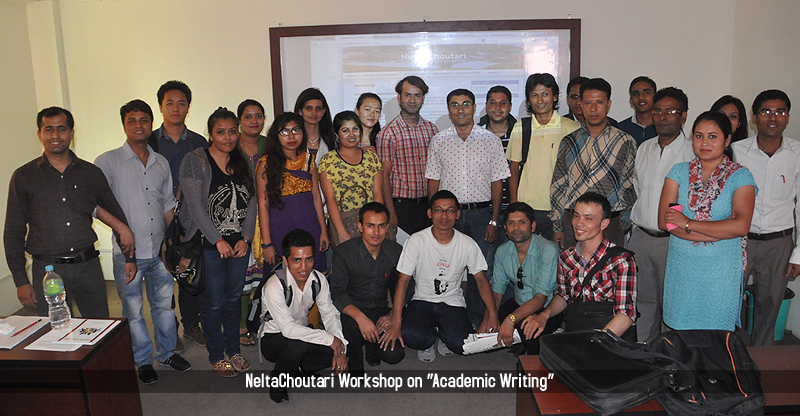
NeltaChoutari organized a workshop titled Behind Academic Publishing: Why, How and What at King’s College, Babar Mahal in Kathmandu on June 28, 2014.

choutari-workshop-01

Bal Krishna Sharma, a founder of NeltaChoutari and a Ph. D. scholar at the University of Hawaii at Manoa, USA, facilitated the one-day workshop, attended by over 30 emerging authors, especially English teachers and students from Kathmandu University and Tribhuvan University. Continue reading Choutari Workshop: Photo Blog

NeltaChoutari June 2014 Issue

June-Issue-2014

Towards Student Friendly Testing System

Editorial

Human life is full of tests. We test our blood pressure or temperature in order to make sure our body is functioning well. If the pressure or temperature is at a normal level, then we think that our life style is fine, whereas if any indicator is above or below an acceptable level, we go for treatment. Thus, testing helps us find out about a situation and work accordingly.

We teach our students and assess how much learning has been achieved. In order to do so, we take the help of tests. The tests help us assess the achievement of our students and ultimately our own achievements. It further helps us diagnose what worked well and what did not, and go for remedial measures after the diagnosis. Moreover, the test result serves basically two functions- forward looking and backward looking. However, in our context the test in the most cases serve only the forward looking function. In other words, we interpret the result of students and make decision of either promoting or failing them, and the role of test is over. Isn’t it necessary to explore the detailed causes of the failure? Isn’t there chance of fault in the curriculum itself or in the teaching methodology? But nobody seems to bother. We have rarely heard that School Leaving Certificate (SLC) board or universities doing needful to explore the causes of poor result and improving the tests. The authority seems like a machine to give a tag of either PASS or FAIL. Where is interaction? Where is research? Where is change? and when we do not look back after the result, we never get to correct the faults in the system and keep victimizing students.

Apart from this, major problems are seen in our test administration system. There is problem in the quality of tests. Be that the SLC or universities tests, the condition is rather pathetic. The English language test papers themselves contain deviated language forms- forget about other quality! We know that a test paper goes through a number of phases before going to examinees. After a test is constructed based on a specification grid, it is piloted. Then it is improved and finalized on the basis of feedback of the pilot. However, our test papers are so powerful, whatever faults they contain, they manage to escape from the grip of our skillful experts! If we compare our so-called standardized test with teacher made test, in the many respects, the latter stands out. Such poorly constructed paper-pencil test of few hours makes decision about a student’s life- a strong decision that determines career and future of the student. In this regard, the test is very serious and critical thing. However, it is taken very lightly in our context. A test of few hours is set randomly and marked impressionistically to make judgement about students’ life. Is the ability of students only what they can fill in the paper in few hours? If not, the test does not have right to make decision about anybody’s life. A test is supposed to test abilities, knowledge, understanding and attitudes of students. However, our test is testing something absurd. It is testing students’ memory (if not memory then cheating skill) and writing speed. This paper pencil test tests mostly students’  memory, calligraphy and writing speed. They are not meant for assessing students’ originality, innovation and creativity. In fact, it is stupid to talk about testing such abilities of students with a few hours memory- driven calligraphy marathon competition! It is this unscientific test that contributes to develop test anxiety in students. They dislike tests as tests are not doing any justice to them. Their actual abilities are never tested through tests. However, their quality is measured with reference to the certificate of such test in the outer world. In fact, this paper-pencil test is destroying the life of many making them mentally handicapped and how can we expect them to love tests.

The testing has gained a bad impression because of the faulty process. However, the situation is not as hopeless as it seems. We can do something to make tests worth practising and the subject teacher or expert can be a saviour here. The language teachers can devise students’ friendly test, which will be a modification of formative assessment. Our students’ now need to be assessed based on their classroom performance. Garcia and Pearson (1994) has termed such test as performance assessment. Students’ throughout the session/semester do a lot of things in classroom (at least in schools). They read and write plenty of things, get involved in classroom discussions, express their views, and work in peer or group to solve problems. This requires them to perform actual language skills and abilities. Besides that, they get involved in different co-curricular activities in or outside the institution. Moreover, teacher should assign them to do project works, mini-researches and different other tasks that involve language, abilities, knowledge, understanding and attitudes. Meanwhile, the ongoing internal tests/formative assessment will along. In such a way, whatsoever activities are performed by students in or outside the classroom, teachers need to keep record of  them in an individual portfolio. Based on such records, students’ actual assessment can be made, and such assessment is more valid and reliable than a paper-pencil test. This sort of assessment captures actual performance of students. In addition to that, it also encourages them to keep learning throughout the year, which makes students’ learning oriented not merely test-oriented. Furthermore, such assessment makes tests common to students and they no more get scared of tests. However, this kind of assessment demands individual record of students, which maximizes the work pressure of teachers. Therefore, the work pressure of teachers should be balanced.

The performance assessment can replace the traditional paper-pencil test in the days to come. However, at present, we can at least use it as a supplement to the paper-pencil test, which can minimize the dominance of memory- driven calligraphy marathon competition!

What is in this issue?

We have attempted to make this issue language testing special as we thought that it is necessary to create a discourse on language testing in order to change the face of present language testing system. So, let’s wonder, ponder, share and care about language testing in this issue. Besides making this issue a language testing special, we have invented a new genre, i.e. ‘interactive article’. The idea is to bring together the experts and readers to discuss and interact on a particular theme and to explore more among ourselves the unlimited possibilities.

One of the challenges of the thematic issue is to maintain variety. However, we have attempted to overcome this challenge by raising multiple issues within an issue. In the interactive article, we have brought forward a number issues of language testing in our context, which include multilingual competence testing, formative assessment, professionalism in testing, quality of test including testing listening and speaking in secondary level, faulty test construction process, and administration and validation. Similarly, in the next entry, Balram Adhikari shares his reflection on his own experiences of marking answer sheets of university. His thought-provoking article reveals the quality of students’ writing in university and compels us to ponder upon the impressionistic way of marking the answer sheets. Similarly, it also brings forward the issue of language versus content debate in marking the answer sheets. Not only have we raised the issues but also have attempted to offer some suggestions. Ashok Raj Khati and Manita Karki offer us alternative practice of language testing through classroom assessment based on a lecture delivered by a prominent scholar Prof. Dr. Tirth Raj Khaniya. On the other hand, Umes Shrestha shares his ideas about the faulty system of paper-pencil test in our context and shares his practices of marking the answer sheets in a liberal way. Moreover, he also offers some alternatives to existing testing system. In the same way, in the next entry, on his research based article (Based on his Master’s Thesis), Bhupal Sin Bista explores that listening skill is neglected in teaching as well as testing in most of the cases in the secondary schools of our country. He further explores a distinct gap between teachers’ theoretical knowledge and its application in classroom. He then suggests ideas to teach and test listening skill effectively.  Last but not the least; we have attempted to add a bit black humour by depicting a part of scenario of language testing through pictorial.

Here is a list of contents included in this issue:

Now, I request you to share what you read and like, drop your comment to encourage writers and join the conversation by writing new entries in the upcoming issues of Choutari.

Lastly, I extend my sincere gratitude to Shyam Sharma and Balram Adhikari for their rigorous support and constructive feedback in every step to make this issue possible. Similarly, I am indebted to Praveen Kumar Yadav, Umes Shrestha and Ushakiran Wagle for their physical and moral support to materialize this issue!
Happy reading!

Jeevan Karki
jk.pravat85@yahoo.com
Editor
June Issue, 2014

invert me


Testing the Testing System of Nepal: An Interactive Article

Choutari Editors

Testing is inevitable although not desirable. It is necessary in order to keep the track of overall progress of language teaching programme. Debates have been going on for and against the testing. However, the important point to note here is that it is the faulty process of testing that is being criticized not the concept of testing itself. In fact, such criticism is necessary as it can help improve the system. The sphere of language testing in Nepal is also not free from criticism. Therefore, we decided to test the testing system of Nepal in this interactive article. We have attempted to explore the existing problems in the field of language testing and possible solutions to them after an interaction with experts and readers. We believe such interactive can play a significant role to reform the system. A thematic question was asked to language experts as well as Choutari readers. The question was ‘What is a major problem in language testing system of Nepal and what can be the solution to it?’ Among the responses collected, we have presented the opinions of eight respondents here:

Shyam Sharma:
There are many problems with current language testing regime (as well as some good things). One issue that’s come up in our conversations is how testing practices typically ignore multilingual competencies. At first, this may seem like an impossible ideal, but if you look deeper, the question becomes why not. Ours is a multilingual society and students’ language proficiencies are not isolated; their English is a part of a complex sociolinguistic tapestry; their other languages don’t “hamper” English; languages aren’t just mediums but rich epistemological resources; and, humans have always spoken multiple languages without seeking a monolingual standard. So, when we face the task of teaching and testing students’ English abilities in isolation, we shouldn’t act like helpless slaves of the system; when discussing the roots and stems and branches and bitter fruits of the current regimes, there’s no need to surrender to the “reality.” The reality includes politics, power, and possibilities beyond their grips, and thus, we must broaden the base of our discussions so we can see testing as a broader phenomenon than, well, testing. Scholarly conversations under the tree here can and should help the community rethink the fundamentals.

Shyam Sharma is an Assistant Professor in the Program in Writing and Rhetoric at Stony Brook University (State University of New York)

Prem Phyak:
I call it an ‘issue’ rather than a ‘problem’; why do we still ‘test’ monolingual ability (although our students have bi-/multilingual ability)? Another issue embedded within this issue is: How can we test students’ multilingual ability? First, we must be clear that ‘testing’ is not a ‘fixing-shop’ where you can fix a ‘problem’ rather it is a complex discipline which needs a critical scrutiny from multiple perspectives for a valid evaluation of students’ ability. Our assumption that ‘language testing’ should only test ‘monolingual ability’, meaning that multilingual testing is impossible, is the major challenge for reforms in language testing. This dominant assumption decontextualizes language testing from students’ cultural, linguistic and educational contexts. So, the major issue is: our tests are not context-sensitive. For example, I still remember that we were often asked to write an essay in SLC (School Leaving Certificate) exam about different highways in Nepal but I had never seen any highways (when I was in school). We were asked to memorize their lengths, construction dates and so on. I could not even conceptualize what a ‘highway’ was. However, I could write more and better when I had to write about ‘my village’ or ‘my school’.

The issue of contextualization is closely associated with testing multilingual abilities; locally-contextualized test items require students to work with their abilities in more than one language. For example, when I had to write an essay about my village I used to think in Limbu, Nepali and English. I (and my friends) could not think about the topic in only one language – no separation of languages! But the tests did not allow me to use my Limbu and Nepali abilities while writing essays in English. This is the major issue, right? If language tests are meant to test ‘language ability’, why don’t we test students’ functional abilities in multiple languages? This applies to Nepali language tests as well. For example, when students speak Nepali they simultaneously use English as well (and/or other local languages if their first language is other than Nepali); one cannot create the fixed boundary of a language. Suppose a bilingual student writes “आजको class मा कस्तो frustrate भएको…” (I had frustration in today’s class) for her Nepali essay (it can be more complex than this in the case of Maithili and Newari children, for example), how do we evaluate her Nepali language ability? The first reaction could be ‘असुद्द” (incorrect –literally impure). However, she is expressing her views fluently by using both Nepali and English in her repertoire. She cannot separate one language from another. This means that monolingual tests do not test students’ bilingual or multilingual abilities. Unfortunately, the students who show their bi-/multilingual abilities in language tests are considered ‘deficient’ and ‘poor’. However, the above example represents the use of language in the real-life (authentic) context.

There are ways to test multilingual abilities. For example, an inquiry-based formative assessment, which engages students in doing research and working with teachers to receive qualitative feedback on their work, can be one way to help them fully utilize their multilingual abilities. Such assessments encourage students to translanguage (use multiple languages to perform different tasks) to achieve the goals as specified by the test criteria. However, any kind of so-called ‘standardized test’, which are guided by the monolingual assumption, cannot test bi-/multilingual abilities. We should say a big ‘NO’ to the standardized tests if we truly believe in developing equitable language testing.

Prem Phyak is an MA (TESOL), Institute of Education, University of London, UK, M.Ed., Tribhuvan University, Nepal

Tirth Raj Khaniya:
Lack of professionalism is the main problem of English Language Testing in the context of Nepal. Professionalism is known as ability of applying fairness, ethics and standards in exam related issues. While dealing with exam related matters we need to be fair. We assume that we are professional but in reality we are not professional thus the test is not testing what it is supposed to test.
In language testing for teachers’ to be professional they require both necessary skills and abilities and application of those skills and abilities in a proper manner. To maintain professionalism it is necessary to have wide discussion among teachers and therefore all those who are involved in exams will have clear understanding.

Tirth Raj Khaniya has a Ph. D. in Language Testing from University of Edinburgh, UK. Currently, a Professor of English Education, he teaches language testing in the Department of English Education, TU.

Ganga Ram Gautam:
The main problem of language testing in Nepal is that the test itself is faulty. It does not test the language skills but test the memory of the text materials given in the textbook. There are also other several problems that include the issues with the test writers, test item construction, test administration and validation of the tests.

One solution of this problem could be to develop standardized tests and administer them in the various key stages such as primary level, lower secondary level and secondary level. In order to do this, we need to train a team of experts to develop the test and the test should be standardized by going through the reliability and validity testing. Once the tests are developed, they should be administered in a proper way so that the real language proficiency of the students can be obtained.

Ganga Ram Gautam is an Associate Professor at Mahendra Ratna Campus, Tribhuvan University and former president of NELTA.

Laxman Gnawali:
There is no need to reiterate that the aim of the learning a foreign language is to be able to communicate in it. In order to find out whether English language learners in the Nepalese schools have developed communicative skills in this foreign language, there is a provision for the testing of listening and speaking at the SLC level. I feel that this test is not serving the purpose. The lowest marks students get in speaking is 10 out of 15, which is 66%. However, when we communicate with the SLC graduates (let alone who fail the examination), most of them perform very poorly. There are two reasons for this inflated marking: the speaking test includes predictable questions for which the responses can be rehearsed: personal introduction, picture description and one function-based question (which is repeated so often that students can prepare a limited set of responses and be ready of the test). Secondly, there is a kind of extreme leniency in the examiners; they just award marks irrespective of the quality if the responses.

Two interventions could improve the situation. Firstly, the examiners should be trained to ask very simple everyday realistic questions which students cannot respond without knowing the language. Secondly, each test should be video recorded so that inflated marks can be easily scrutinised. Administrative issues should not come in the way of quality testing which has far-reaching consequences.

Laxman Gnawali is an Associate Professor at Kathmandu University and Former Senior Vice President of NELTA

Laxmi Prasad Ojha:
I think we are giving too much priority to examinations and tests in our education system. We do not understand the purpose of testing and evaluation. We don’t test the comprehension and understanding of students. This is the main cause of the failure of our education system in many cases, including the language teaching programmes.

Uttam Gaulee:
I think “formative” should be the key word here. Laxmi ji, pointed out an important bottleneck we have experienced due to lack of purpose of testing and evaluation. If we think of a typical Nepali school, we do give more importance on summative tests than the formative ones. What we seriously lack (and that’s why we have a tremendous opportunity to work on) is systematic feedback for student.

Uttam Gaulee is Graduate Research Fellow, University of Florida College of Education, Gainesville, Florida

Bal Krishna Sharma:
Yeah, one way would be to introduce and practice more formative type of assessment. This will evaluate and test students’ ongoing progress and learning outcomes.

Ph.D. student, University of Hawaii at Manoa

Although the issue was one, the thematic question unbelievably raised so many genuine issues. The respondents highlighted the issue of testing multilingual competencies apart from only testing monolingual ability and also suggested some ideas on how to test students’ multilingual abilities. In the same way, the interaction raised the issue of lack of professionalism in language testing. Similarly, the respondents also urged that our memory-driven testing system itself is faulty. Furthermore, there is problem in test construction and administration and suggestion is put forward to develop and practise standarized tests to minimize the problems. In relation to the problem in testing listening and speaking in SLC exam, it emphasized that the test items are predictable and examiners are lenient and award marks irrespective of quality. The solution proposed is to train the examiners properly and introduce the system of video recording students’ performance. On the other hand, overemphasizing exams and not testing what it should test is characterized as a problem. The solution discussed over such problem is to give more importance to formative test rather than summative test, which helps keep the track of students’ achievement.

Now the floor is open for you. Share what you think is the problem of testing system in our context and what can be the solution. We believe such interaction contributes in the development of innovative ideas in ELT.

The Taste of Testing Students’ Test Papers

Bal Ram Adhikari

“How do you find marking students’ answer sheets?” To this question once asked abruptly by a friend of mine, I replied, “It tastes rather awful.” “What about teaching?” he asked another question. “Oh, don’t you compare teaching with testing!” That was my immediate reply.
As a teacher, my job is not over with the completion of the courses. The another important job that awaits me is testing or marking students’ answer sheets of the annual written examination. I enjoy teaching. My passion for teaching has now turned into a necessity rather than a desire. I often find teaching as a process of other-transformation and self-transformation. However, once I sit with my students’ answer sheets to rate their written performance in the subject, I find the same charm no more. Sometimes I question myself– What am I doing with these answer sheets?

I find testing itself intrinsically problematic

I find the notion of testing itself intrinsically problematic. The process itself tastes rather bitter. I read their written performance. I try to make sense of what they are trying to communicate through their words. I end up with a certain impression. I pause for a while. I mentally categorize the impression into such headings as language, content, and organization. Language is further divided into accuracy, brevity, clarity; content into relevance, details and depth. Then I quantify the overall impression. I try to find the appropriate numerical values for the impression. Say, it could be five, six, seven or even eight out of ten full marks. It might be two or three. Then I circle the marks in red ink at the end of the answer. However, the whole process from the first reading through interpretation to quantification of the impression takes me by surprise– What does it mean to present my impression of their answer in the numerical form? What does it mean when I assign six out of ten? How does the impression lend itself to quantification? Impression is intangible while quantification is tangible. It is the very process of converting the intangible into the tangible that puts students into two different bins: the pass and the fail. The passes are again ranked as first, second, third and last creating the notion of comparison and competition. The quantification also functions as a gatekeeper. How I quantify my impression of their answers might be detrimental (if low marks) or beneficial (if high marks) to their future academic as well as professional life. Similarly, the marks can also be detrimental or beneficial to the student’s self-esteem throughout their life. Isn’t it a funny as well as fatal game to play? Someone else’s impression of your performance determines your career and remains that with you throughout your life? Accepting this as part of academic and professional life, I enter into the process of evaluation. However, it tastes even bitter when I begin turning over the pages of the answer sheets.

Why does testing taste bitter?

Most of the answer sheets that I have marked leave the bitter taste behind. First, it is hard to make sense of what most of my students are trying to communicate. Here, I would like to present some sample sentences that I have picked up from the written performance of Masters’ second year students:

• Translator should also have bilingual as well as bicultural.
• On the above topic I am going to write argue for
• The main concern of today is only deconstruction. It is always starts with questions and goes beyond the logocentrism.
• I support this sentence by my heart due to culture is a inseparable element at translation process.
• In translating metaphoric expressions, there occurs different problems.
• The distinguish between them can be listed in the following ways. The time makes the clear distinguish between them. Anyway, translation and interpretation are same.

Such expressions abound the answer sheets of the advanced level students specializing in English. These are but few pieces of evidence out of 200 hundred sentences I have collected from students’ academic performance. When I run into such pidgin-like English, it strikes me– What did I teach? What did they learn? Or worse, did I teach them at all? Did they learn from my teaching at all? These questions are worth contemplating in terms of subject matter and the language they use to communicate to the prospective readers.

It is really hard to interpret their answer sheets when they are poor in terms of grammatical accuracy and clarity. Despite this, as a teacher, I try to make sense of what they are trying to communicate keeping the language matter aside and bringing the content to the fore. However, they are advanced English students. Subject matter knowledge and accurate writing ability must have the equal weight. Sometimes, the latter may get more priority. Now, it is hard for me to continue reading such answer papers which are hardly intelligible. How many marks should I assign them on what criteria? Should I penalize them for their language? I often grow ‘sympathetic’ to their poor level of language performance with the thought that development of writing proficiency is a life-long process. At least, they have demonstrated some knowledge in the content area. They will improve their language in course of their professional life. I console myself. However, the difficulty does not end here. My thought of being liberal to their level of language is immediately followed by another problem i.e. the complex interaction between language and content.

Language and content are inviolably interdependent. Is it possible or desirable to assign marks to their writing being ‘sympathetic’ to their language? Can we make such a separation in practice? Isn’t it something like running contrary to McLuhan’s famous dictum “the medium is the message”? I find myself in the helpless situation. I have to drop most of the criteria of marking that I happened to mentally outline before setting about the job. It makes my job rather difficult. I cannot fail the majority of the students for their poor performance in writing. Nor can I assign them the pass marks only considering their subject matter knowledge. In either case, I feel guilty. My students’ poor performance hints at the quality of my own teaching. Their failure means my failure too. I am testing myself as a teacher while testing them. The tester himself is tested. Nevertheless, I cannot, nor should I assign marks only to pass them. This means the information quantified in the form of marks is not valid. I am giving the invalid information to the concerned authority, and the professional organizations that rely on the marks for the purpose of selection. I have been in such a quandary for years while testing my students’ test papers.

1924893_829718523720484_26654504_n

Bal Ram Adhikari
Lecturer
Mahendra Ratna Campus,
Tahachal, Kathmandu

Teaching and Testing Listening at Secondary Level

Bhupal Sin Bista 

This article discusses the techniques and activities used by the secondary level English teachers while teaching listening. It also sheds lights on the gap between the teachers’ theoretical knowledge and its use in classroom teaching, including situation of testing listening in Nepalese schools. For this, data were collected from different secondary level English teachers teaching in Kathmandu district, which helped explore the techniques and activities employed by the teachers in classrooms.

Background
For many years, listening skills did not receive priority in language teaching. Teaching methods emphasized productive skills, and the relationship between receptive and productive skills was poorly understood. (Richards & Renandya, 2010). In fact, among the four language skills, listening is the primary language skill. A child becomes able to speak after getting enough exposure to the language through listening. Researches show that congenitally deaf children are unable to acquire language though they are given enough exposure. Therefore, listening is the most important skill of all.

In the context of our country, teaching listening has been highly focused in the present English curriculum of secondary level. As the curriculum is based on the communicative approach, teaching listening is a must for the development of communicative competence in students. Taking into account the worth of listening skill, it is taught in the secondary schools of both the community and institutional (private) schools. However, only teaching is not enough. There should the use of right appropriate methodology. In this context, it is imperative to explore whether listening skill is taught as it should have been or not. Furthermore, it is equally important to find out the gap between the teachers’ theoretical knowledge of teaching listening and its application in the classroom. Thus, the research was carried out in order to find out the reality.

Teaching Listening
In this study, teaching listening refers to teaching listening comprehension. Listening is an activity of paying attention to and trying to get meaning from something we hear (Underwood, 1989, p. 1). It involves understanding a speaker’s accent and pronunciation, his grammar and vocabulary and grasping his meaning. For successful communication, listening skill is essential, so it should be taught to students. In order to teach listening comprehension effectively, the teacher should be clear about the skill to be developed in students. According to Rivers (1978, p. 142), before the teacher can devise a sequence of activities which will train students in listening comprehension, he must understand the nature of the skill he is setting out to develop. Field in Richards & Renandya (2010, pp. 242-247) examines a commonly used format for teaching listening, one which involves three stages in a listening activity: pre-listening, listening and post-listening.

Listening skill should be taught properly to the students at school. Instead of leaving it to be developed as part of a pupil’s general education training, it is to be taught explicitly to them. Students spend half of the classroom time in listening, so it should be developed properly. In this context, Hron (1985, as cited in Rost, 1994, p. 118) suggests that listening should be developed in all school children since it is a vital means of learning that may be as important as reading. In order to teach listening properly and effectively, appropriate approaches should be used. Without employing the appropriate approaches, listening skills cannot be taught well. For the development of appropriate approaches to teaching listening skills, it is essential to understand the nature of listening. In this regard, Nunan in Richards and Renandya (2010) mentions two types of models: the bottom-up and the top-down processing model. The bottom-up processing model asserts that listening is a process of understanding meaning from phonemes to complete texts. The top down processing model, on the other hand, views that listening is a process of understanding meaning on the basis of the listener’s shared or prior knowledge. In this way, these models are to be taken into account while teaching listening.

Stages of Teaching Listening
There are generally three stages of teaching listening, viz. pre-listening, while- listening and post-listening stages. They are also known as listening techniques.

1. The Pre-listening Stage
This is the first stage of teaching listening. At this stage, students are given some background information about the audio. Indeed, this is the preparatory phase of teaching listening in which students are prepared and motivated for listening and performing the tasks. Following Underwood (1989, p. 3), it consists of several activities like giving background information, looking picture, topic discussion, question answer, etc.
2. The While-listening Stage
In this stage, the students listen to audio, perform the activities and do the tasks based on the listening comprehension. This is the actual listening stage whereby students are asked to do exercises based on the audio. The main purpose of this stage is to help the students develop the skill of eliciting messages from spoken language.

3. The Post-listening Stage
This is the final stage where follow¬-up activities are done. As its name implies, post-listening stage embraces all the activities related to a particular listening activity which are done after the listening is completed. In a way, this stage is the extension of the activities done at pre-and while-listening stages. Problem- solving and decision-making activities, interpreting activities, role-play activities, written work, etc. can be exploited at this stage.

Testing Listening
Listening is one of the crucial language skills. Therefore, like other skills it should be taught and tested properly and regularly. While testing listening, different aspects of language should be tested. These generally encompass grammatical knowledge, discourse knowledge, pragmatic knowledge, sociolinguistic knowledge, etc. In this way, testers have to test the different aspects of listening skill. Listening perception and listening comprehension skills are to be taken into account while testing listening skills. In this regard, Buck (2010, p. 105) says that test developers would choose the following aspects of language competence which met the requirements of their test.

  • Knowledge of the sound system
  • Understanding local linguistic meanings
  • Understanding full linguistic meanings
  • Understanding inferred meanings
  • Communicative listening ability

Listening Skill in English Curriculum of Secondary Level
The present English curriculum of secondary level is based on the communicative approach to language teaching. It has incorporated four language skills and language functions in its content. Listening skill is also focused in the curriculum. In the examination, 10% of the total marks is allocated to listening skill. For the development of listening skill in students, there is a provision of listening lesson in each unit of the textbook. For the purpose of teaching listening, Curriculum Development Centre (CDC) has developed audio cassettes for classes nine and ten. The curriculum has mentioned the following objectives of teaching listening:

  • Listen to spoken text, understand the gist and retrieve specific information from it.
  • Record in note or make summary from the main points of spoken messages.
  • Respond appropriately to spoken directions or instructions.

Teaching and Testing Listening at Secondary Level
The secondary level curriculum of Nepal aims at developing the communicative competence in students. That is to say, it is based on the communicative approach to language teaching. The teachers teaching at this level, therefore, are expected to teach the listening skill in accordance with the objectives of the curriculum. This skill should be equally focused as other skills of language teaching but in reality, this skill has been neglected. During the research, it was found that listening skill was not taught in the secondary level of Nepal. However, some schools were found giving importance to teaching this skill. The researcher visited different schools and used different tools for the purpose of research. From the theoretical point of view, almost all the teachers were found having sound knowledge of teaching listening. However, this knowledge was not used in the actual classrooms.

Teaching and testing should go simultaneously. Teaching listening should be fostered by testing as testing is an integral part of teaching. Whatever is taught in the classroom should be tested, for the items neglected in the testing are generally neglected in the teaching as well. Therefore, for the effective teaching of listening, it should be tested seriously in examination. However, in the secondary schools of Nepal, listening skill is not tested properly. There is the provision of testing in the curriculum. However, its implementation is very poor. Testing listening has merely become a matter of formality. It is not tested properly even in School Leaving Certificate (SLC) board examination. Listening is also one of the crucial components of language learning. Without having detailed knowledge of listening, the learners cannot achieve sound communicative competence.

Findings
The major findings of the study are as follows:

  • The majority of the teachers were found using only two stages of teaching listening (i.e. pre- and while- listening).
  • Although the majority of the teachers were found having sound knowledge of teaching listening, they were found not employing their theoretical knowledge in the classroom teaching. Only a few teachers were found using this knowledge while teaching listening in the classroom. Thus, there is a vast gap between the teachers’ theoretical knowledge of teaching listening and its application in the classroom teaching.
  • No teachers were found conducting listening as the course prescribes. Most of the teachers were found not conducting listening consistently: sometimes they conducted listening once a week and sometimes even once a month.
  • The majority of the teachers were found not giving priority to listening skills. They did not take listening as one of the most important language skills.
  • Listening skill was not tested properly in the secondary schools of Nepal.

Recommendations
The following recommendations are made on the basis of the findings of the research:
• All the teachers who are teaching listening at secondary schools should use at least the following listening techniques and activities.
a. Pre-listening stage
– Giving background information of the listening text
– Picture discussion
– Discussion on the topic and/or situation
– Reviewing the areas of grammar
– Simplifying the meaning of difficult words given in the text.
b. While-listening stage
– Short answer questions
– True/false items
– Fill in the blank items
– Multiple choice items
c. Post-listening stage
– Writing or presenting the summary
– Parallel writing
– Dictation
• Most of the teachers were found having sound theoretical knowledge of teaching listening. However, they did not apply the knowledge in the classroom, Therefore, seminars and workshops should be organized to refresh and enhance the skills of the teachers, especially, NCED should develop special training package for teaching listening.
• Most of the teachers were found neglecting and not giving priority to listening in their teaching. Therefore, it should be made an important part of examination and tested properly. As a whole, teachers and other stakeholders should be made aware of the importance of listening via conferences, seminars, workshops, etc.
• Secondary level English course prescribes listening lesson in each unit. However, teachers were found not teaching listening according to the course. Thus, teachers should be encouraged to use enough listening materials in order to give sufficient exposure to students.
• Some schools were found not having appropriate listening materials. Thus, the concerned authority should make the mandatory provision of managing required materials in every school.

References
Buck, G. (2010). Assessing listening. Cambridge: CUP.
Cross, D. (1992). A practical handbook of language teaching. London: Prentice Hall International Limited.
Crystal, D. (1994). An encyclopedic dictionary of language and languages. Harmondsworth: Penguin.
Harmer, J. (2007). The practice of English language teaching. Edinburgh Gate: Pearson Education Limited.
Harmer, J. (2008). How to teach English. Edinburgh Gate: Pearson Education Limited.
Lynch, T. (2007). Study listening. London: CUP.
Richards, J.C. and Renandya, W.A. (Eds.). (2010). Methodology in language teaching Cambridge: CUP.
Rivers, W. M. (1978). Teaching foreign language skills. London: University of Chicago Press.
Rost, M. C. (1994). Introducing listening. Harmondsworth : Penguin English.
Underwood, M. (1989). Teaching listening. London : Longman.
Ur, P. (2010). Teaching listening comprehension. Cambridge : CUP.

Bhupal Sin Bista
Master in English Education,
Mahendra Ratna Campus,
Tahachal, Kathmandu

Classroom Assessment: A New Era in Language Testing or An Additional exercise?

Presented By: Ashok Raj Khati and Manita Karki

Language testing cannot be separated from the changing understanding of the nature of language, language abilities, and language teaching and learning. Accordingly, what is to be tested in language teaching has drastically been changing in recent times as a result of changes in what is to be taught. In this regard, we have entered a new era in language testing, which is classroom assessment also termed as performance assessment.

In recent years, there has been a growing discussion on whether classroom testing should replace other tests. In this essay, we suggest that it should work as a supplement to paper and pencil tests. The method may not be capable of replacing established methods of testing but there are a number of benefits that make classroom-based language testing more genuine and better attuned to effective language teaching and learning by today’s standards.

Let us begin with the central role of teacher in classroom assessment through this real story.

In an award giving ceremony to School Leaving Certificate (SLC) graduates, a teacher stepped forward and asked a particular student whom he had taught for years, “How did you get the first division, you deserve the second division.” Though the student passed SLC and got certificate of the first division, the teacher remarked so confidently that he should not have got first division.

It indicates the fact that teacher spend long time with his/her students and are able to evaluate them more or less rightly. In many countries, a teacher is the authority. If a student is unable to sit in the final examination because of certain reasons; the teacher has a right to recommend grades or percentages to examination board based on the students’ internal/classroom assessment and the board accepts it. Doing that makes teacher fair and ethical. However, there are many other contexts where teachers have not gained this sort of credibility. The point is it is the teacher who can best judge his or her students and it the classroom tests which allows teachers to do so. Therefore, classroom assessment is accepted as being close to what we are struggling for a long time.

Secondly, in most of the cases, we make a machine type of judgement when we test students through paper and pencil beyond the class but it is a human mind or brain that is involved in making judgement on classroom assessment. It used to be believed that everything can be tested by using a paper and pencil test but now people have started asking how? There are things that we want to test which cannot be tested by paper and pencil based test. The answer to this question is classroom testing. There are so many things that we can do in classroom which cannot be done through a paper and pencil test. We cannot test all types of abilities and skills by paper and pencil test because of expertise, time, and other limitations, but classroom assessment is genuine and it is worth implementing.

Class room assessment or performance assessment is genuine because one cannot test people’s actual language ability while they are not actually performing an act by using it. It is the classroom that allows learners to perform. In this regard, classroom assessment captures genuineness. Many scholars have realized that paper and pencil test, whether it is based on communicative approach or something else, cannot authentically test students’ performance. Especially a large-scale test cannot be a performance based test. There were classroom tests after 2010 but those tests were used for internal assessment. Classroom tests are different, they are bound to be different and they are of different designs.

Classroom assessment is collaborative in nature. When students obtains marks in board examination, one common thing they cannot figure out is on what basis was their answers marked and consequently, they think they are given less and what they deserve. However, in classroom assessment, teacher works with students before, during, and after the assessment. The present of students makes teacher cautious and transparent. Thus, the teacher makes judgement of the students in a collaborative manner. Further, teachers can also assess students’ performance by assigning group work that makes classroom testing different from large-scale assessment. That adds one more dimension to collaboration.

The best thing about classroom testing is that it is learning focused. As a result, it has positive wash back. It mainly focuses process and less product. Teachers get enough opportunities to observe the different learning processes of their students in classroom assessment. By contrast, paper and pencil test may not be able to create situations and offer adequate opportunities to demonstrate different abilities and skills, and perform certain tasks on the part of students. It is more product-oriented. It is only classroom test that can make learners perform tasks while being tested.

In the same way, classroom assessment is a social phenomenon. The classroom is a society. A school is run for teaching and learning but at the same time, we mange it in a way that that would be the representation of the society. Thus, the classroom assessment is a social phenomenon where we promote classroom assessment and students learn and practise performance based activities, which they will continue to practise outside the classroom.

In terms of creativity, classroom testing is not an entirely new approach because in some way prior approaches also tried to capture what this approach tries to do. A good example of this is how Bloom’s Taxonomy captured a range of simple to complex competencies. It is very difficult to capture the psychological processing of learners in many occasions. We have to be tentative to assess it. Testing cannot be a science; it is different from many other activities. The focus of language testing is: what is the content of the language, where is it, how do we get hold of it? Scholars who are advocating for communicative testing have now realized that what they were trying to accomplish with it is something different. Icons of language testing has different views on communicative testing. Some say that it is not necessary to test communicative abilities through communicative approach. After 2010, testing has moved into assessment, assessment has moved into performance, and testing tends to be always indirect unless one asks students to perform certain tasks. It is not the test that test; it is the tasks that test. It may be hard to determine whether or not classroom testing can entirely replace communicative testing. However, classroom-based testing can be a focus of testing because it is very close to reality since teachers will be asking students those tasks in the classroom which they are supposed to do outside the classroom in their real lives.

While talking about classroom-based testing communicative testing, there may arise a question of construct. The construct is the basic characteristics of activities of an event, the psychological and the philosophical aspects of skills and abilities, and the quality of the content. The construct in communicative language testing may be assessed in an indirect way by bringing language performance into the classroom and assessing it. The concept of communicative language teaching and testing in a real sense has been changing. Henry Widdowson, one of the prominent scholars in the field of Applied Linguistics, wrote a book in 1979, “Teaching English as Communication”. Once in 2000, he said that he if he were to revisit that book, he would call it “Teaching English for Communication”. He realized that it is not possible to teach English as communication. He was excited to talk about communication in 1980s but later he found that it was not easy to capture communicative activities and bring them into the classroom and make it happen. In some ways, it has to be indirect, less communicative and difficult to bring communication in the classroom.

In a way, the philosophy behind the communicative language teaching (CLT) is the continuity of what we have been doing for the last 70 years. Somehow, CLT is also based on a paper and pencil test. At the end of the day, teachers give test to students to perform where they may not authentically perform language use. Based on the change from CLT to language teaching and testing, teachers and scholars began to realize that classroom assessment should be an additional learning exercise. Therefore, a genuine assessment must be a performance assessment and an inherent part of the whole process and that is the next era of language testing. It does not mean that communicative language testing has nothing to do with language teaching and testing in the days to come. We are still using 1960s’ multiple choice items. All previous methods of language testing have made lots of contributions to language testing but we are moving toward something new. Communicative approach in testing will also continue because it has strengths and potentialities but at the same time, the thrust of classroom assessment needs to lead classroom teaching and learning activities.
In sum, classroom assessment is an important approach to language testing. It appears to be very close to what we have been trying to find out. It may take time to make a strong ground to be a prominent approach. So for now, classroom assessment is an additional option- not a replacement. It will contribute to make assessment more authentic and better attuned to current understanding of language learning. It will be a good instrument for us to improve teaching and testing in the classroom.

(The piece is based on a lecture delivered by Prof. Dr. Tirth Raj Khaniya at the School of Education, Kathmandu University)

Ashok Raj Khati

M. Phil
ELE,
Kathmandu University

Manita Karki

M. Phil
ELE,
Kathmandu University


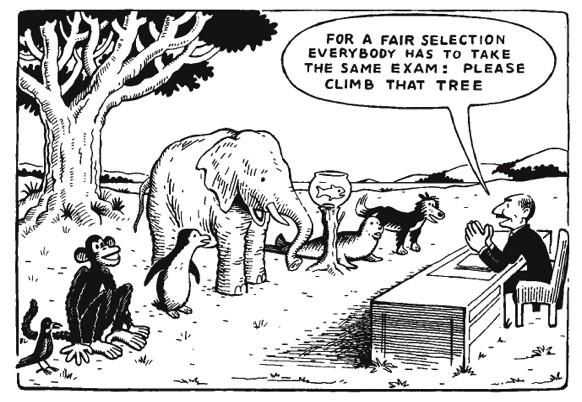
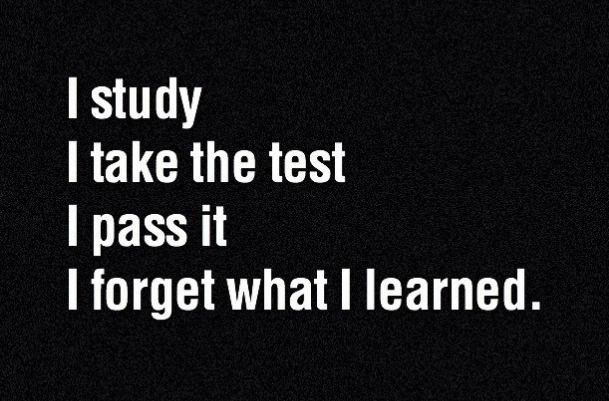
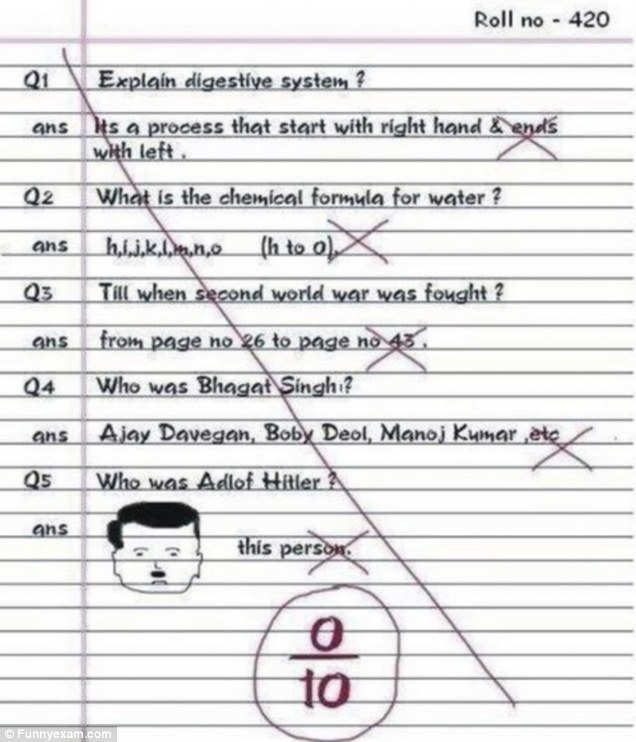
It is Funny and Yet Serious!

All in one basket!!
All in one basket!!


Isn't it true?
Isn’t it true?


Whose fault is it- test taker's or testee's?
Whose fault is it- test taker’s or testee’s?


See, it doesn't leave in the dream too!!
See, it doesn’t leave in the dream too!!


A route to THESIS!!
A route to THESIS!!


After-effect of test!!
After-effect of test!!!

Source: Internet

Giving a Benefit of Doubt During Assessment

Umes Shrestha

I am a teacher who likes being very liberal while checking answer papers and in this article I am going to talk about why I detest our testing system; why I give a benefit of doubt to the students; and why doing so, I believe, helps foster their confidence and reinforce their learning. I’d like to start by talking about how difficult it is for me to fare with tests and exams, and suggest that we stop doing to our students what many of us as teachers can’t bear ourselves.

Besides teaching, I am also pursuing a Master’s degree in Education. It is a semester system, which means there’s a final examination every six months. And I find it really stressful; in fact I have always found examinations very stressful throughout my life. I may not know my strengths but I know one of my weaknesses for sure – I cannot read books or notes to memorize answers. I do understand the overall concepts but I can’t memorize them in order to spill them all over the answer sheet. I can’t do it even if my life depended on rote memorization. Far worse, my attention span is shorter than an ant’s tail. I cannot remain calm for more than 10 minutes. I am always drowning in a sea of distractions. Family. Friends. Facebook. Music. Home. Job. Deadlines. I can’t quite keep up the concentration. I get itchy and I have to take a short break every 10 minutes or so. My mind operates that way.

While taking exam, I can’t think fast enough to frame and organize my answers. I need time to generate ideas, plan a structure and write essays. I make a lot of spelling errors because I heavily rely on spell checkers. My handwriting and presentation look impeccable in the first two pages but they soon start deteriorating as the clock in the exam hall ticks away in a flurry.

That’s my story. I don’t like being tested in such constrained time and in such ominous hall. I feel it is completely unfair to be judged on what I write in three hours. And to add to my frustration, I am always haunted by the usual mentality of language teachers who are very strict while checking answer papers. And I’m pretty sure there are many out there, both teachers and students, who can perfectly relate to me. Therefore I believe this extreme emphasis that our educational system puts on summative testing as the only mode of assessment could be very damaging to our students and, as a consequence, to our society at large.

So let me ask you to do this: imagine yourself being a teenager, surrounded by technology and media, having access to unlimited knowledge and resources, having friends who are hyperactive on the internet and social networking sites, having too many options at hand. Imagine yourself sitting in the class for hours and hours, sitting on the same desk and ‘listening’ to the teachers who use the same deadbeat methods day in and day out. Imagine yourself not knowing (or doubting) the relevance of the traditional education, getting certificates, getting degrees, joining the workforce and doing the same old jobs.
exam-makes-no-sense

(Pic: a screenshot of one of my student’s facebook status. This student is perfectly clueless.)

And we ask them to sit for exams. We ask them to write an essay on festivals of Nepal. Or we tell them to compose a speech on Nepal’s historical figures. We tell them to write a complaint letter with date, salutations, body and closings in a precise format. We tell them to write coherently and cohesively. And we want them to write without any spelling errors.

Worst of all, we don’t try to find alternatives to the discouraging test-driven system. Instead, we make the overall process and environment of learning frightening for students by using the fear of exam to work like slaves throughout the year, by focusing on what they lack all the time, and by being strict when assessing their work.  And at the end, even when we could have done otherwise, could have at least made a better combination, we just tell them to sit for three hour exams and expect them to compose perfect essays with their perfect handwritings. We stress on neatness and cleanliness; we write comments, underline wrong answers, we circle misspellings and with red ink we cross out answers that don’t match our expectation. That’s what we usually do, don’t we? There could be different ways to assess our students but at the end of the day, we (have to) judge students based on written examinations.

It would seem as if in the present context, there is absolutely no way out of this final written examination module but dear teachers, here are some of the things I do, and as a teacher, this is what I propose you to try out these and similar things as well.

I give my students a benefit of doubt while checking their answer papers. I understand, they don’t take exams because they like it. I have never come across any student who loves taking exams. On top of it, they have to take exams of seven or more subjects every term. I can perfectly relate to the maddening pressure to perform. They have no option, and neither do we. So while I check their answer papers, I gently remind them of their spelling mistakes but don’t deduct any marks for it. I overlook minor errors and slips like she don’t have friends. If they write any brilliant essays with a logical framework, I get super joyous about it. And I give it 10 out of 10. Why not! (This one student glared me back with disbelief and said: Sir, you gave me 10 out of 10? And I said: Yes, you deserved it.) If their essays look messy and are riddled with terrible structures, I don’t butcher their effort thoughtlessly. They would have done it better if they didn’t have any time constraints or if they had time to draft and re-draft the essays. I try to be sensible about their handwriting too, because writing for three hours straight is a real pain in the ass and the wrist. I go through the same pain every time I take an exam. One reason, many of us are used to typing on computer rather than writing with a pen. And I am never picky about grammatical errors. I have seen my professors at the university make grammar errors. I have seen me making horrible grammatical errors. We all do.

I try to keep track of the students, their progress, their assignments, classroom participation, portfolios – but I don’t judge them based on one written examination. I am definitely not seeking an easy way out. I communicate with the students who are lagging behind and make them feel safe. I do demand high, push their limits but I want to be realistic, and set realistic goals and realistic expectation. At the end of the day, I feel like I have done my part and go to bed without any resentment or bitterness.

Our testing system is full of holes, and it desperately needs a facelift. However, we can’t change the entire system right away, let’s be realistic. But what we can do is empathize with the students. Therefore, dear teachers, give your students a benefit of doubt, because sometimes we too need it.

I’m going to wrap up my ‘rant’ with one more facebook status that I came across –  just to add to my argument.

umes

Umes Shrestha

M.Ed. ELT

Teaches Business Communication and Literature to undergraduate students

Welcome to Choutari: May 2014

choutari-may-issue

Editorial

Welcoming New Year

with Another Series of Serendipity

Ushakiran, Praveen, and Umes

Whenever the New Year arrives, we renew the journey planner of our life; our life begins once again with great excitement that promises new success. The planner doesn’t discriminate what is doable and what is undo-able; it simply acts as a path setter. We follow the path, which guides, and what actually happens is serendipitous. Life is like that. Our professional life is not very different from that. It resonates our normal personal life.

The journey of NeltaChoutari has also been renewed recently with the arrival the Nepali New Year 2071. And yes for sure, we have resolutions for this year too. We don’t have a written planner, a chart or a calendar where we can make notes, but, we have a portable plan with organizing chart in our mind. This is our beacon for the year ahead. We are sure this planner will help us by directing our best efforts to make the Choutari able to gear up with its success. It will open newer avenues that will lead us to chart news horizons. Our journey is sure to be serendipitous. Be ready to become the surprisers. Choutari has set to serve such surprises, not at one time, but successively in the months to come.

Our success is based on your (you, the readers) effort and collaboration that come through your contribution of articles and your readership. Choutari team of editors will always be busy supplying you with substantial information along with materials but your participation is what makes a difference. We have planned to expand activities of Choutari by incorporating a variety of reading materials and resources important for your research work, paper writing and, of course, for classroom teaching. The benefits will be serendipitous.

The May 2014 Issue is serendipitous in real sense. This month we have come up again with a variety of blog entries, ranging from teaching grammar and vocabulary, and learned centered approach to teachers’ development through teachers’ club, and self-reflection of using YouTube and journal writing for developing fluency and writing in English. Besides, for this issue, we have a special blog entry on post-colonialism in Indian literature.

Here is the list of blog entries for this month:

  1. If Only, It Were True: The Problems with Grammar Teaching, by Pramod Kumar Sah
  2. Games for retaining Vocabulary, by Pema Kala Bhusal
  3. Learner-Centered Teaching: Some Considerations, by Guru Prasad Poudel
  4. Professional Development through English Teachers’ Club, by Shashi Kayastha
  5. YouTube: My Best Friend Forever, by Chandra Pd. Acharya
  6. My Journey of Journal Writing, by Santona Neupane
  7. Post-colonialism in Indian literature, by Prakash C. Balikai

Isn’t it an array of diverse ideas and experiences?  We hope you find these stuffs useful.

Now we invite you to join the conversation again by sharing your responses as comments under any posts, by liking and sharing them with your network, by contributing your own posts for future issues, and by encouraging other colleagues to do the same.

Happy serendipitous reading!

Choutari Team

—- Please note: Choutari Mentoring Program is ongoing. We would like to extend our utmost honor to two participating mentors and cordial thanks to three mentees currently engaged in the program. If you are interested in providing mentorship to emerging scholars or seek a mentor to grow, please click here.

If Only, It Were True: The Problems with Grammar Teaching

Pramod Kumar Sah

Can teachers do a good job by prescribing grammar rules to their students? I imagine “No!” would be the most common answer to this question if asked to a gathering of contemporary English language teachers. We now seem to have that realization by now. However, same ineffective and purposeless grammar teaching continues to dominate in majority of Nepali classrooms. What can we as English language teachers do? I discuss the pros and cons of grammar teaching, highlight some problems of grammar teaching in Nepal, and suggest some aspects that can be incorporated to make grammar teaching more effective.

Grammar teaching is still a controversial issue in the field of second and foreign language instruction. It has been of great interest to researchers and teachers to find out whether it is worth teaching. Apparently, despite Krashen and Terrel’s (1983, p. 114) and some others’ negative view, linguists like Cowan (2009, p. 3) and Thornbury (1999, p. 16) believe grammar instruction has a lasting effect in learners. As ‘grammar’ is an inevitable aspect of language teaching, what counts is the meaning of ‘grammar’ taken as in the classroom. Is it a set of rules thatsubsequently drives us to interpret the rules stated in the marketed textbooks? Thus, questions arise as:

Is teaching of grammar textbooks advisable?

I am much concerned about the practice of using textbook in our grammar lessons provided it helps with set guidelines to reach objectives. Be of my opinion that, this is merely a mythological grammar teaching if we are explaining the textbook page by page, getting the students to complete the exercises and eventually setting a test of those exercises and quantifying their level of learning.More miserably, we have chances to observe the classes where students are seen reciting grammar rules and definitions of terminologies by rote. The majority of empirical researchers have found these practices of no worth as Bright (1947) finds “….a knowledge of the technical terms gives no guarantee that the pupils can use the language.” Thus, I would prefer to use textbook merely as a resource book.

Instead of following a mere textbook, at first, I would choose a grammatical item to expose to my students. Choosing an item again depends on Second Language Acquisition paradigms, such as the hierarchy of acquisition. In particular, SLA research shows that the ‘Present Continuous Tense’ is acquired  prior to the ‘Present Simple’; thus, despite textbooks introducing the ‘Present Simple’ first I would opt for the ‘Present Continues’ alternatively. Then, I would plan my own lessons with comprehensible input and tasks. Nevertheless, ways to make input comprehensible, what we teach of a particular grammatical item and what are the issues undertaken in a grammar lesson will occur later in the article.

Should we teach grammar rules?

I would say, ‘no’. Jespersen discovered this fallacy in the early 1900’s and was re-emphasized by Bright in late 1040’s, but it still governs language classrooms and textbooks not only in Nepal but in some other contexts as well.  Introducing grammar rules deductively to our students brings nearly no development in the students’ production. It helps them know the rules; they can tell, for instance, the simple present tense is composed of Subject+ verb + object/complement, but unfortunately will not be able to express their present habits accurately and fluently.The exhibited below  demonstrates this dilemma:

Teacher: The difference is the present simple expresses habitual actions, but the present continuous actions that are going on now while you speak.

Tiresome child: Please sir, why are you sayingwhile you speak?”

Teacher: I’m sorry. It would have been better to say “while you are speaking”.

Tiresome child: Was what you said wrong, sir?

Teacher: No.

Tiresome child: I’m sorry. I am not understanding.

Teacher: Look. There are some verbs that are exceptions. We never use the present continuous of the verbs “to understand”, “to see”, “to hear” and so on. Now you really must go away. I ‘m seeing the headmaster in five minutes and it’s time I started.

Tiresome child: You are seeing the headmaster, sir!

Teacher: Go away!

[source 1=”Bright” 2=”(1947)” language=”:”][/source]

Thus, prescribing grammar rules hardly boosts up the learners’ production in the target language. Consequently, what I would rather teach themis ‘patterns’ of language, explicitly and inductively. I would give them implicit exposure; this doesn’t hold the ideas that I oppose explicit instruction. Then, the learners are asked to work on the language (i.e. examples) to explore ‘patterns’ of that particular language. Once the patterns are noticed, the information processes to their short-term memory that needs to be practiced to drive to long-term memory. The explored patterns are practiced communicatively with appropriate tasks. The more they are given chance for production, higher is the possibility for the information to reach to automatic processing or to say long-term memory.

Furthermore, in our context, we lack the authentic data to use as an exposure to our students. Here, I doubt at making use of the marketed textbooks since the language used in them are barely authentic or based on any study. In this regard, corpus study has been a great means to us. It is advised to check Using Corpora in English Language Teaching by HimaRawal in February issue of this blog for detailed information.

Should we teach to speak according to the rules of grammar? 

I’ll agree with you if you said ‘yes’. The significance of speaking according to the rules of grammar cannot be ignored butconsciously using rules while speaking not only obstructs fluency but also increases likelihood of using language out of context. In normal speech, the mind of the speaker certainly does not think of a rule and then work out a sentence to fit it. While speaking, a fluent speaker does not think of grammar at all, s/he thinks of the meaning of what s/he wants to say. Thus, as a language teacher, we need to teach studentsto speak comprising meaning in the context rather than the rules of grammar. However, there might be an argument that a conscious knowledge of grammar rules is obligatory for new learners of a foreign language. Thus, what can be the best idea is that we provide them rules of grammar and then give them ample opportunities to practice those language points by creating natural settings so that the patterns of languages are discovered  by the students in such a way that rules become a subconscious part of language learning endeavour eventually leading to a condition where the learner can use language even without worrying about remembering the rules.

Moreover, it is not always necessary to stick to formal grammar while speaking. The utterances, like ‘How are you doing?’, ‘I am going to go home now’, ‘Do you want to have coffee?’, ‘Are you all right?’ and so on will seem quite odd in spoken discourse. Thus, I would teach my students to speak like, ‘How you doing?’, ‘Gonna go home now’, ‘Wanna have coffee?’, ‘You all right?’, but they should be made aware that they cannot use these forms in written discourse. If we attempt to teach our students as we were taught, we will not do any justice to them. We need to understand the need and interest of this iphone generation. They do not even bother grammar rules while speaking, face-booking, twittering, or texting electronically. What counts for them is communication and they areright. If native speakers are doing so, why cannot they? On contrary, formal grammar must not be ignored in written texts.

In a nutshell, we should start teaching ‘spoken grammar’ as well. Out of my personal interest, we must be thankful to course designer of Tribhuvan University for prescribing the textbook ‘Exploring Grammar in Context’ which is primarily grounded on corpus data and indeed a descriptive grammar textbook. The most significant aspect of the book is that it incorporates spoken grammar, but unfortunately we witness the section being ignored in classroom practice and has been taken as of less importance. This attitude is born from the question patterns of the annual examination that hardly composes any question from the section, and this has assisted me to assume the avoidance of spoken grammar. It is advised to give equal importance to the section and be honest to students. The knowledge of discourse marker, back-channelling, ellipsis, headers and tails, filled and unfilled gaps, etc. is equally notable to tense, mood, passive sentence, reported speech and so on.

If we teach grammar anyway, let’s consider these 4 aspects

The most crucial aspects of grammar teaching that must be taken into account are ‘noticing’, ‘consciousness- raising’, ‘grammar in context’, ‘information processing system’ and ‘focus on production’. This short article will not discuss these aspects in details, but attempts to deal them briefly.

Grammar teaching without giving students chance to notice a language is meaningless. Noticing can occur when the learners are paying conscious attention to a form within input. Schmidt (2010: 725), the propounder of Noticing Hypothesis, defines the term as ‘conscious registration of attended specific instances of language’ and emphasizes the idea that no noticing means no learning. Thus, a teacher has to help learners develop noticing. And, this is only possible when we expose plenty of comprehensible input and get the students to work on the input to explore their own grammar rather than explaining prescriptive grammar rules to them.

In addition, by consciousness-raising we mean to device activities that help them ‘to construct their own explicit grammar’ (Ellis, 1993: 10). Put it other way, we develop activities that will get the students to understand a particular grammatical feature, how it works, what it consists of and so on. The students attempt to raise their consciousness towards a form of language through noticing. This does not necessarily mean students are able to produce sentences but it helps to understand a form that is eventually brought to their production through practice.

The next concept is the need of teaching grammar in context. The real acquisition is not completed until the learners are able to use them in communicative context asNunan (1998)views “…effective communication involves achieving harmony between functional interpretation and formal appropriacy… by giving them tasks that dramatize the relationship between grammatical items and the discoursal contexts in which they occur” (p. 102).Thus, instead of just giving them a set of rules, we are supposed to give them optimum opportunity to explore grammar in context.

Finally, our grammar teaching activities might as well be based on the theory of information processing. When a learner is provided with input, it is not necessary that all input turns into intake. Some type of filtration takes place where the noticed input processes to short-term memory that needs to undergo practice to eventually reach to long-term memory. The language reached to the long term memory finally becomes automatic whenthe learners are able to produce a language.

Incorporating these factors(noticing, consciousness-raising, providing context for language use, and authenticity can give purpose for the teachers and may significantly increase the effectiveness of learning. Johns and King (1991, p. 3) find DDL, a new style of grammar teaching incorporating learners own discovery of grammar based on evidence from authentic language use. This approach initially makes use of corpus data that is exposed to learners where they are asked to notice patterns of a language. While working on the data, students consciously notice patterns and raise their consciousness on the given patterns. Later, the   discovered patterns are practiced in set tasks where the learners get chance to produce the language.

It is always heard from teachers saying grammar teaching is a problematic area, but in my opinion, the problem is we do not take on new experiments to see if new approaches work. We are much preoccupied and grounded by the age-old “grammar” books that shamelessly prescribe “correct” rules. It’s high time we consider minimizing the use of prescriptive grammar rules with aids to textbooks and allow learners to explore their own grammar through comprehensible input, especially making use of authentic data.

References

Bright, J. A. (1947). Grammar in the English syllabus. ELT Journal. 1 (7), p.173-177. 

Cowan, R. (2009). The teacher’s grammar of English. Cambridge: CUP.

Ellis, R. (1993). Second language acquisition research: how does it help teachers?. ELT Journal. 47 (1), pp3-11.

Johns, T & King, P. (eds.). (1991). Classroom Concordancing. (Birmingham University: English Language Research Journal 4, pp 1-12).

Krashen, S. & Terrell, T. (1983). The natural approach. Oxford : OUP

Nunan, D. (1998). Teaching grammar in context: ELT Journal. 52(2), pp101-109.

Schmidt, R. W. (2010). Attention, Awareness and individual Differences in Language Learning. In W. M. Chan, S. Chi, K. N. Cin, J. Istanto, M. Nagami, J. W. Sew, T. Suthiwan., & I. Walker ( Eds.), Proceedings of CLaSIC 2010, Singapore, December 2-4 (pp. 721-737).Singapore: University of Singapore Centre for Language Studies.

Thornbury, S. (1999). How to teach grammar. London: Longman.

pramod

Pramod Kumar Sah
M. Ed. in English, Tribhuvan University

Currently Pursuing MA in TESOL with Applied Linguistics at University of Central Lancashire, UK.

Games for Retaining Vocabulary

Pema Kala Bhusal


I would like to begin this article by stating what Wilkins said to show the importance of vocabulary – “Without grammar, very little can be conveyed and without vocabulary, nothing can be conveyed” (Wilkins, 1972). Vocabulary acquisition is crucial for second language learning. However, many second language learners feel that learning new vocabulary is a tedious and laborious process. On this paper, I first discuss about the problems faced by my students while dealing with vocabulary. And then I will offer some guidelines and suggestions on ways to retain new vocabulary.

I remember my tutors at KU teaching ‘Teaching Vocabulary’ by using different games and by using flashcards, ball, realia etc. The games helped me learn collocations, synonyms, and different words very easily. I was not completely aware of those words, but now they are still in my mind. I came to realize that games are very effective tools for retaining new words.

During my school days, I never saw my teachers using games in the classroom. We learnt the meaning of difficult words through rote learning. When I started teaching, naturally, I didn’t have any knowledge that vocabulary could be taught through games. When I saw my teachers using different games at my university level, I seemed to be unfamiliar with them and I felt having very less knowledge about vocabulary. I imagined what if I had a chance to enjoy these kinds of games in school! My vocabulary knowledge would have been stronger than now.

When I taught lower secondary level students in the public school, I found that the students had many problems regarding vocabulary. For instance, when I asked them to describe a picture, they were unable to do so. They could not make logical connections among words. To make it worse, they couldn’t find the right words to describe the picture.

After gaining knowledge about using games in the classroom, I used different games such as ‘Kim’s game’, ‘Relia’, ‘What’s missing?’, ‘Erase’ and ‘TPR verb game’ to teach vocabulary. When I employed the different games through different physical activities, the students had lots of fun and they were learning the words quickly and effectively. Since that day, they kept telling me to use such kinds of games in my classroom as they had never done such activities before.

I realized that it is important to understand this issue from their perspective because they have been practicing and learning English in their native language from the very beginning. They always carry an unknown fear of using English, especially while speaking. This might be the result of the teaching trend as well, which is – the teacher comes in the classroom, asks the student to look at the book and he/she translates the passage into Nepali. The students are still taught English using a conventional approach like a grammar translation method. (I don’t mean that grammar translation method is not a good method to use in the classroom. We can use it depending upon the context and situations. Sometimes the students can understand more easily when teachers use this method.)

Similarly, if we teach vocabulary through drills, it might become boring for the students, especially those who have limited expertise in language study. Forgetting the word is also another problem. Most of the students complain that they forget words soon after learning them and they don’t exist for a long time. I recently observed an English language classroom of grade 8 at a public school. During my observation, I found the English teacher using Nepali language all the time. I felt very sad about the situation and thought how the students would never develop their English language that way.

Now let me share a few strategies I have used in my classroom for the enhancement of my student’s vocabulary. The first strategy was I asked them to read the passage before coming to the class, assuming that the more they read the more they can see new words to learn. Then, I asked them some words related to the passage. When I did so, some of the students responded from the context and some got confused. Therefore, I made them familiar by showing some pictures, realia and engaged them into conversation. This strategy helped them learn the words easily because I think interaction is the key to succeed in language learning.

Likewise, I asked the students to come in front of the class and touch some objects without looking at them, recognize the objects and describe them to the class. They were very curious and enjoyed the sensual learning activity. Another game I used frequently in my class was the game called ‘Erase’. I used this game to teach the name of the animals, classroom objects, etc. For this, I asked my students to tell me the name of the animals they knew. After that, I made a circle on the board and wrote them down around the circle. In this way, I elicited the names of the animals. After that, I randomly wrote them down on the board. First of all, I asked them to repeat the words in chorus so that they could remember the words for the game. Then, I arranged the students into two groups and lined them up into two teams. After that, I provided the first student in each team an eraser and they raced to the board to erase the word I have yelled out. The game was played in the same way to the end. The first student who correctly erased the word won a point for the team. Finally, I scored the group that won. This is one of the examples of a game I have used in my classroom.

In this way, I used several games to teach vocabulary. From their active participation and involvement, I came to know that integrating games, both physical and mental, helps the students to keep their mind alert. Not only this, they were able to reduce their boredom and retain the words easily.

To sum up, games play a very important role to motivate the students in learning activities. From these experiences, I have realized that acquiring and retaining vocabulary in a foreign language is a challenging job, but learning vocabulary through games is one of the effective ways that can be applied in any classroom. They can be used not only for mere fun, but more importantly, for the useful practice and learning purpose. There is a good Chinese proverb “tell me, I will forget; teach me, I will remember; involve me and I will learn”. This saying also proves that if we ask the students directly to write or tell the unfamiliar words, they would probably be unable to do so and feel discouraged, but they can write or tell if they are involved in different fun activities.


prema

Pema Kala Bhusal
M.Ed. ELT, 2012
Kathmandu University School of Education

Learner-Centered Teaching: Some Considerations

Guru Prasad Poudel

There has been an enormous push to introduce learner-centered teaching strategies to pupils in both elementary and higher level institutions worldwide. The underlying assumption held by many is that learners will be more successful if they have an opportunity to enjoy while learning. However, the challenge is how to create learner centered teaching environment inside the classroom. This article aims to present few considerations on how to implement learner centered teaching in our daily pedagogic endeavors. In addition, the article includes tips, principles and challenges of learner centered teaching.

Over the past fifty years the ‘how’ and ‘why’ of what we teach has been the focus of much thought, research and deliberation. From Grammar-Translation to the Communicative Approach and beyond, the best methodology for English language teaching (ELT) has supposedly been discovered many times. While many changes have occurred in ELT over the past five decades, good teaching is learner-centered one. In learner centered class, an effective teacher helps each student connect to the material and the subject and pay more attention to their activities rather than his own.

As the years pass, the daily routine of teaching the same material through same method day in and day out starts to diminish the passion that was once so prominent years earlier. So what do we do? We do what so many of us have done when times get dull. The need is we have to recharge the batteries and break the routine of daily instruction. It is the time to employ new strategies to increase the intrinsic motivation of our learners so as to strengthen their language acquisition. Thus, learner centered teaching is assumed to be new recharge in our instructional practices. Equally, it is urgent to gear up teaching learning responsibilities to the learners, instead of having them only in the shoulders of teachers.

Tips for learner-centered classroom

The following ideas can be used in the classroom to create learner centered atmosphere in the classroom.

i. Cultivate a relaxed atmosphere before the beginning of instruction.

A relaxed atmosphere is conducive to free expression. A skillful teacher can create an atmosphere in which the student feels enough ease to struggle through a situation, and to find the words to express oneself.

ii. Praise the students when it is deserved

The teacher should compliment students when they do well. He/She should make it a practice to reinforce a good performance with encouraging comments. He/She should be careful, however, to be discreet along this line, setting high standards for the class.

iii. Be enthusiastic and engender enthusiasm

Enthusiasm is one of the most important factors to involve learners in a conversation class. The teacher should feel joy at the prospect of engaging them in learning, and put things into practice learned in the classroom.

iv. Listen to the students

The teacher should not dominate the learner’s responses. He should try to get the students to speak as much as possible.

v. Be patient

Patience, necessary in any encounter with students, is especially important in a learner centered class. The teacher should put himself in the place of the student. He should think of how he himself had to struggle to express his ideas when he was first learning a new topic.

vi. Be alert and foster alertness

Since the learner-centered class provides practice in both speaking and understanding what is said, the teacher should stay alert and see to it that the attention of the students does not wander. For example, when a student is not paying attention, the teacher can call him; ask him back to the practice by directing a question to him; or he can ask him to repeat something that has been said. The teacher can also ask him to repeat a question he has just asked him another student.

vii. Making corrections

What should the teachers do about mistakes in pronunciation, vocabulary, grammar and meaning? This is a delicate area in a learner-centered class. Students tend to insist that they want to be corrected. The teacher should let them find the good answers from the alternatives that he provides. He should always correct flagrant violations the moment they are made. As Halt (1980) says, “We must not fool ourselves…into thinking that guiding children to answers by carefully chosen leading questions is in any important respect different from just telling them the answers in the first place…the only answer that really sticks in a child’s mind is the answer to a question that he asked or might ask of himself”. The teacher should not overlook the value of an attention-getting-comment that might prevent a repetition of the mistake. He should not be necessarily rigid in their mistakes in such classroom.

viii. Avoid oversimplification

The principle behind the learner-centered class is that ‘learning is something only the learner can do’. The teacher cannot learn for the pupil, he can only provide good conditions within which learning may take place. If things are made too easy for the learners, they will not be inclined to use their own learning resources. As Halt (1980) says “If we taught children to speak, they would never learn”. What he means is that as teachers, we would want to break up the learning process into a series of gradable steps and prevent movement form one step to another until the first step had been mastered.

ix. Treat the individual student as a person, on an equal basis with all the members of the class.

A learner-centered class becomes successful if the teacher treats every students on an equal basis. He must look carefully at his classes to be certain that all the students are included equally. He shouldn’t be biased toward the brighter and more energetic students. A teacher’s effectiveness depends on his equal treatment toallhis students.

x. Leave emotional baggage outside the classroom

Another consideration for a teacher in learner centered classroom is that the teacher must manage his emotional activities. The classroom is a stage; and to be effective, the teacher must in some cases be an actor. For this, he must speak naturally with smile and concentrate on the student.

xi. Lead learners to understand language outside the classroom too

Krashen and Terrell (1983) argue that the purpose of child-centered language instruction is to lead learners to ‘understand language outside the classroom’ so that they can ultimately utilize the real world, as well as the classroom, for progress’. They indicate that the purpose of the child-friendly classroom instruction is to facilitate and encourage the students to interact with speakers in the target language outside the classroom.

General Principles for Language Lesson in Learner-centered Class

A good language class is much more than a series of activities and exercises that the teacher has strung together to occupy the available amount of time. As language teaching is a career in a field of educational specialization, it requires a specialized knowledge base obtained through both academic study and practical experience. A good language lesson, therefore, reflects the specialized thinking and knowledge of an educated language teaching professionals and in planning for their teaching, they should think carefully about how they understand the nature of the teaching and learning they will be participating in (Nunan & Lamb, 1996).

Some programs may seek to induct students into a particular method or approach (such as communicative language teaching, genre based teaching or task-based instruction) where, as other may operate on the basis of principled eclecticism, where teacher are introduced to a variety of teaching approaches and encouraged to blend or adopt them based on the contexts in which they will teach in learner-centered class (Richards and Rodgers, 2001). In most of the cases: teachers think of methods in terms of techniques which realize a set of principles or goals and they are open to any method that offers practical solutions to the problems in their particular teaching context heading to learner centeredness.

Kumaravadivelu (1994) purposes ten general principles that can be used as guidelines to be adopted or applied based on the need of learners as well as of specific situation. The principles are:

  • Maximize learning opportunities.
  • Facilitate negotiated interaction.
  • Minimize perceptual mismatches between teacher’s intention and learner’s interpretation.
  • Activate intuitive heuristics (for example, by providing enough textual data for learners to infer underlying grammatical rules).
  • Faster language awareness.
  • Contextualize linguistic input.
  • Integrate language skills.
  • Promote learner autonomy.
  • Raise cultural consciousness.
  • Ensure social relevance.

In developing learner-centered class, teaching should be much more than a performance by the teacher. Above all, a successful lesson makes the learners, rather than the teacher, the focus of the lesson. So an English language teacher must conceptualize the questions like – was the lesson content something students could relate to and that was relevant to their needs? Were the activities students took part in during the lesson sufficiently challenging to engage them but not so challenging that they became frustrated and lost interest? Were the students motivated during the lesson? Did the lesson provide opportunities for active participation by all the students in the class or was it dominated by one or two students who monopolized questions and discussion? These ideas will explore how one can move from a teacher centered approach to teaching to a learner-centered one, that is, on in which student’s needs, interest and preferences take priority in teaching (Richards and Farrell, 2011).

Features Focused on Learner-centeredness

An important skill in teaching is the ability to make learners the focus of teaching. This involves understanding learners’ needs and goals, communicating trust and respect to them, acknowledging diversity of needs and learning styles, giving feedback on their learning in ways that help develop their confidence and self-esteem and minimize loss of face, and using strategies that help develop an atmosphere of collaboration and mutual support among learners. Dornyei and Lamb (2003) mention that in some lessons, the focus is more on teacher performance than learner engagement, however, in learner-centered lessons, teachers achieve a more learner-focused approach to teaching, as is reflected in features mentioned below. These features show the focus of teaching on learner centered class.

  • the degree of engagement learners have with the lesson
  • the quantity of student participation and interaction that occurs.
  • the learning outcomes the lesson produces.
  • the ability to present subject matter from a learner’s perspective.
  • how well the lesson addresses learner’s needs.
  • how the teacher reshapes the lesson based on learner feedback.
  • how the teacher responds to learners’ difficulties.

Practical Benefits of Learner-centered Teaching

Undoubtedly, an English language class consists of many different kinds of learners – some with similar needs and goals and some with a great diversity of need. The nature of such class may be fairly homogeneous with students of a similar age, educational background, interests, goals and needs. In order to bring them in the mainstream of learning, learner-centered teaching becomes a tool of success. Benson (2001) argues that learner-centered teaching is practically more effective than other modes of teaching for several reasons:

  • It is sensitive to individual needs and preferences.
  • It encourages construction of knowledge and meaning.
  • It draws on and integrates language learning with students’ life experiences.
  • It generates more student participation and target language output.
  • It encourages authentic communication.
  • It breaks down barriers between in-class and out of class learning.
  • It opens up spaces for discussion of motivations, learning preferences, and styles.
  • It encourages students to take more personal responsibility for their learning.
  • It challenges the views that learning is equivalent to being taught.
  • It offers a wide range of preferences for particular kinds of classroom activities, styles of teaching, classroom arrangements, aspects of language and mode of learning.
  • It creates a community of learners by encouraging interaction within the class, helping them find learning partners and groups they are comfortable with, encouraging a sense of friendship among the students and to share interesting experiences to each other.

Challenges in Learner-centered Class

Keeping our students’ needs and interests at the forefront of our teaching is not always easy. Managing the processes and routines of teaching can sometimes distract us from the real point of teaching, which is to facilitate learning on the part or our students. Whenever possible, we should think through our lessons and the teaching activities we make use of from the point of view of our learners and use the focus points discussed above to help make our teaching more learners centered. According to Wright & Bailey (1999), some of the challenges faced by teachers in such classes can occur in:

  • the way in which teachers support and manage the processes of language learning.
  • the way in which teachers create opportunities to participate in the communicative and interactive uses of language.
  • the way in which teachers involve their learners in individual and group activities.
  • the way in which teacher use materials by all means to all the students of the class.
  • the way in which teachers address individual differences in needs and interests, background and cultural perspectives of the learners.
  • the way in which teachers focus individual learners in tests and assessments.
  • the way in which  teachers manage time, routine, course and institutional conditions.
  • the way in which learners participate in classroom discussion, learning and evaluation

Conclusion

An important goal in language teaching is to create opportunities for students to participate in authentic uses of language in order to facilitate their language learning. Learner-centeredness is an approach which emphasizes on creating opportunities and giving optimum time and space to the students to participate in authentic classroom activities. Similarly, learner-entered teaching refers to teaching that reflects learners’ individual differences in cognitive styles, motivation needs and interests. Teachers have sole authority in teacher-centered teaching however such authority is deliberatively handed over to the students in learner-centered teaching. Developing a learner-centered focus to our teaching involves drawing on students’ life experiences, creating opportunities for students to interact and co-operate, and to develop a sense of shared interests and concerns.  If we can engage our students in our classroom activities in real sense, we can ensure effective teaching and learning.

References

All Wright, D. & Bailey, K. M. (1991).Focus on the language classroom: An introduction to classroom research for language teacher, Cambridge: Cambridge University Press.

Benson, P. (2001). Teaching and researching autonomy in language learning, London: Longman.

Durnyei, Z. & Lamb, T.E. (2003).Individualizing learning: organizing a flexible learning environment, Oxford: Cambridge University Press.

Jackson, A.L. (2012). The conversation class.English Teaching Forum, 50 (1), 29-31.

Kumaravadivelu, B. (1994). The post method condition: Emerging strategies for second/foreign language teaching. TESOL Quarterly, 28 (1), 27-48.

Richards, S.C. & Farrell, T.S. (2011).Practice teaching: A reflective approach,Cambridge:Cambridge University Press.

Guru-Prasad-Poudel

Guru Prasad Poudel
Department of English Education,
TribhuvanUniversity, Kirtipur.
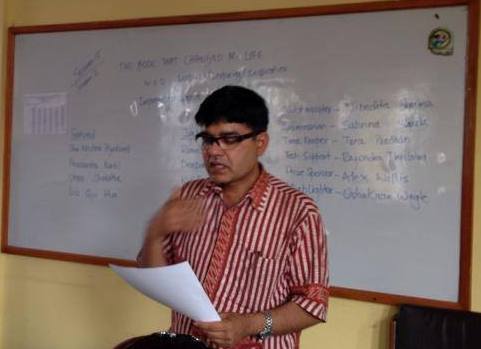
Professional Development through English Teachers’ Club

Shashi Kayastha

Teacher development is a continuous process which includes teacher’s regular engagement, constant support and constructive feedback from peers and tutors, innovative platform, self initiated steps and committed dream. In the scenario of growing need for establishing professional communities of learning, English teachers’ club is one of the effective initiatives to collaboratively develop teachers. It is a platform for English teachers where they associate and network with other members of the same profession through collaborative engagement in capacity building activities. In this blog entry, I briefly introduce English teachers’ club, followed by its significance and finally highlight on the importance of joining such associations.

English Teachers’ Club

Mutual problem solving and collaborative learning draw teachers into a community seeking for their development. Padwad and Dixit (2008) advocate the need of professional learning communities in the context of shifting teacher education from product-oriented mode to social constructivist, process-oriented mode of working. It motivates the teachers to strive for the continuous and ever innovative processes of “change and mend” sequence where they learn to collaborate, commit, construct and contribute in local level to the global scenario, and activities that involve professionals in open and dynamic discussion enhances professionalism.

Teachers association is an essential platform for the teachers that associates and network with English teachers in a community for continuous growth through different professional practices. In recent decades, such association or networking has been established as one of the effective means of professional development for the teachers across the world. Teachers’ club is one of such associations and it is a small professional community. The club might be formal and informal, but both of them primarily serve the purpose of a professional association. Compared to other like-minded communities, it is more focused on building on capacities of teachers for their professional growth.

English teachers’ club (ETC) is a network of like-minded English teachers who are seeking to enhance their capacity and collaboratively develop effective teaching methods for their career development. Further, it helps to establish better working relationships among colleagues and creates a forum for exploring new teaching ideas or addressing perceived (or unperceived) problems and concerns.

Significance

Unlike various governmental and non-governmental efforts to develop English teachers, English teachers’ club can be a creative way of identifying local issues and needs of English teachers and accordingly build strategies in sorting out them through collaborative approach. It emancipates teachers from territory of accumulating fixed knowledge of one-size-fits-all approach since it builds a kind of channel to exchange the ideas, innovate the  ways to surpass the issue related to the teaching, search out the genuine and contextual knowledge that is applicable in local context and situation. The teachers, who are engaged ‘teachers’ club’, get access of varieties of sources of knowledge within the community they connect and they can also put their efforts to build on contextual theories based on best practices. Besides, they enjoy sharing and caring of each individual of their community for collective improvement.

Legutke & Ditfurth (2009) elucidate that knowledge does not just develop by accumulating information but is shared, negotiated and constructed through experience in the communities of practice in which individual participates. The teachers’ club provides them a platform and opportunities for them to share their experiences and discuss among themselves.  Similarly, Hord (1997) points out regarding the benefits of any professional learning community that it helps to reduce loneliness of teachers, motivate them to be committed to the mission and goals and the teachers starts taking joint responsibility for the success of the student and ultimately gets the work satisfaction leading to higher morale etc.

Benefits of joining English Teachers’ Club

Socialization

The basic need of 21st century is to learn to live together with the acceptance of sociocultural, religious difference. The culture of socialization starts with the sense of oneness in difference and attitude of compassion, respect, and understanding. Teachers club is the society of teachers that socializes one for the convenient and the successful life in the planet of teaching. It brings out the teachers from the confined territory of the cultural and social constrains to the land of acculturation. Thus, associative team activities are the crucial one to administer the overall development of an individual’s sociocultural aspect. It is mainly significant to the language teacher since language teaching and learning is an interactive process. Richards and Burns (2009) emphasize the teachers’ collaboration as they say “teacher learning is not something that teacher need achieve on their own –it is a social process that is contingent upon dialogue and interaction with others”. They add that “teachers can come to better understand their own belief and knowledge as well as reshape these understanding through listening to the voices of others”. That means socialization incorporates the habit of listening to others, respecting the contrary views, collaboratively deciding, assisting, advising, participating etc. In the other words “engaging with other means accepting the difference” (Singh, 2002). Teachers in ETC joins for fulfilling this requirement .They co-work, co-think, co-coach, co-operate, collaborate with the common sets of goal and action. The co-operative nature in positive competitive environment expands the possibility of creation.

Language development

Teaching is an art; the art requires pedagogical knowledge, creativity and proficiency of content so that teacher can well manage the class, deliver the content, make the learning possible in any situations.  The basic prerequisite of language teacher is that they should be well versed in language skills. English teacher’s language skill basically refers to teachers’ proficiency in listening, speaking, reading, and writing. As it has already been underpinned in the theory of education that language skills can be developed through the active participation in interaction, peer teaching and correcting process, ETC arranges the suitable and convenient environment for the teachers to involve in different collaborative learning projects such as collaborative action research, team teaching peer observation. Teacher can plan and implement the need based activities for skill enhancement. Teachers can engage in their need analysis where the basic needs of the teachers regarding language skill are identified, and they collaboratively prepare feasible and effective action plan, and put them into practice. In the process teachers assesses one another’s improvement, they provide feedback. It also orients the teachers with a variety of language teaching skills and strategy.

I hereby exemplify some strategies we use to enhance the language skills:

Strategy 1

We mostly organize a reading theater in our mini club where the entire group is divided into three: reader group who perform reading different literary and non literary genres, audience group as the active listener who jots down some notes as per the understanding and share, analyst group who analyze the whole process of the reading and audience group. We take the assignment to read and write refection which is peer checked in the following week.

Strategy 2

Collecting different national and international talk show, lecture, interview videos and audios and assembling for the listening practice where we the watch and listen the videos and share, comment and rethink about the topic in the group. It proved to be interesting and useful for the gradual improvement listening as well as the enhancing creativity and criticality, which but for being in group would be once in a blue moon.

Building Confidence

No matter what qualification and degree I have, until I have the deep faith deep inside me that I can do, no where I perform the best. The sentence seems very negative but it is the reality. Student starts gossiping on your unusual movement and babbling talk, counts how often you scratch on your hair, caricatures your perplexed look. All the content you give goes in vain and the teaching becomes the daunting task “leaving us with such physical symptoms as sweating and shaking”(Fifield, 2006). Hence it is necessary to build up the confidence along with improving the skill so that one can better perform what he /she knows. As already discussed collaborative approach in the teachers club is helpful in getting language skills as well as professional skills. Ganwali (2011) explains, “The members of an association will have greater confidence in their activities if we learn what our colleagues elsewhere are doing in the context” (p.189). In my experience, constant working with the people of the same profession of with different qualification, practices and potentiality equip you with daring and exploratory attitude towards teaching.

Accountability

Accountability is a policy of holding schools and teachers responsible for students’ academic progress. Accountability is taking responsibility for your words and actions.

ETC assists to grow a socialized teacher with the content, confidence that is sure to be aware of duty to self, duty to other. One pre service teacher viewed “Working with other teachers collaboratively created a synergy that helped me to look at teaching in ways I hadn’t considered…I now examine student motivation, teaching strategies, and accountability differently.”(Cited in Bates, 2010, p.63), that’s how the teachers’ whole perspective can be changed by the co-working environment of teacher club. Loughran (2005) explains that a communal practice where others are esteemed provides better prospects to reframe situation and that helps to modify one’s thinking about practice.

Empowerment

Establishing teachers’ community or networking through ETC is one of the fundamental objectives. The club is a medium through which the teachers get empowered and have access to higher level due to peer support and sense of group spirit. Hence, awareness in empowerment triggers several opportunities for professional growth.  In other words, it brings teachers networking, and networking is the strength to combat and create. ETC collects English teachers under a single roof as the united force to combat with the individual to the global issues of teachers that horn out leadership quality governed with knowledge and conscience in teacher, consequently leading him/her to get better career opportunities and especial identity. It has the power to place the teachers in professional competency to policy making level. Since the teachers remain informed and oriented of the worlds system and affairs in teachers networking, and gain maximum exposure to the different ideas in the area of their profession.

To sum up, the concept of the teacher club is not entirely new since we are familiar with different book clubs, teacher study circle, collaborative study groups, teacher associations, networks and so on.  English teacher clubs might be a possible forum to improve teaching as well as other professional skills. In a nutshell, it is entirely beneficial to the teachers to grow professionally.

References

Bates, A. J.(2010).Book Clubs as professional development opportunities for pre service teacher candidates and practicing teachers:An Exploratory Study6,56–73.  New York: The New Educator.

Fifield, A.(2006). (Retrieved from http://www.teflcorp.com/articles/79-tefl-how-teachers-can-increase-confidence-in-class/248-building-teachers-confidence-in-the-classroom.htm .)

Gnawali, L. (2011). Promoting ELE in Nepal NELTA way. In L. Farrell, U.N. Singh &

R.A. Giri. (2011). English language education in south Asia: From policy to pedagogy. India: CambridgeUniversity press.

Hord, S.M.(1997). Professional learning communities: Communities of Continuous Inquiry and Improvement.Austin: SEDL.

Loughran, J (2005) Teacher professional development in changing conditions.In D. Beijaard, P. C.Meijer, G.M. Dershimer & H.Tillemaet Springer(Eds.). Netherlands: Springer.

Padwad, A.& Dixit, K.K. (2008).Impact of professional learning community participation on teachers’ thinking about Classroom Problems. Retrived from http://teslej.org/ej47/a10.html.

Richards,J.C.,& Burns,A.(Eds.).(2009).The Cambridge guide to second language teacher Education. New Delhi: Cambridge University Press.

Singh, A. (2002). Setting the site. In C. Doyle, W. Kennedy, A. Rose, &K. Ludloweds, Teacher training: A reflective perspective. New Delhi: Kaniska publication.

Shashi

Shashi Kayastha
M. Phil. ELE
Kathmandu University

YouTube: My Best Friend Forever

Chandra Pd. Acharya

Before I started pursuing my master’s degree in English education at Tribhuvan University, Kathmandu, I didn’t have any inkling that YouTube, a video sharing website, was there. On my birthday, one of my girlfriends gifted me a laptop and she suggested me to spend some of my study hours on YouTube surfing educational videos. For the first time, I learnt about the video sharing website. No sooner had I came to know about this than I befriended with it since it turned to be like a friend in need is a friend indeed. In this blog entry, I have shared my experience of using YouTube for enhancing my English language competency.

In the initial days, I did not exactly know how to use YouTube. I did some researches on web and however, some odd months later, I got the idea as a result of learning by doing, and kept on using it to the fullest. The English pronunciation that I have commanded over today is the outcome of watching English videos uploaded on YouTube. My current English is gratifying me, even some of my friends find it awesome. But, I love to opt for ‘good’ rating for the good has a chance to learn it for the better as learning begins from cradle and lasts to grave. So my English learning through YouTube surfing could by no means be an exception provided that I had in one way or the other fallen in love with it. Once in love, forever in love, I think I internalized this adage. To be honest, surfing YouTube videos time and again became my forte and I am damn sure it will continue till my last breath. Maybe this is because of my forever longing. Now I feel I should immensely grateful to three former PayPal employees Steve ChenChad HurleyJawed Karim who fathered YouTube in February 2005.

The point I want to make is YouTube for me was the best way to learn English however there are a lot of means available these days. So choose whichever you think the best. Truly speaking, my passion for YouTube surfing was and is to expand the storage of vocabulary and to polish the fluency in speaking English. Hence my penchant for YouTube surfing gives birth to this article.

As I believe fluency in English is the key important factor for people around the world for communication in English. It is one of the important language components to be developed. Fluency is a speech language pathology which means the smoothness or flow with which sounds, syllables, words and phrases are joined together when speaking quickly. Hence, fluency in English can be termed as ease and smoothness of speaking.  Stressing much on this feature of language, Brumfit (1984, p. 56) opines fluency as natural language use.

Generally, we need to make our fluency a comfortable one so that the communication moves ahead between the parties (encoder and decoder). It gets matured through simple day-to-day tea talk to public speaking. Likewise we have to know the organization, pronunciation, word use, body language etc. Here, I am pinpointing some of the important guidelines required to become those who want to develop their fluency in English through YouTube.

1. Technical Qualities

Here ‘technical qualities’ refers to overall qualities of videos available in YouTube. This includes clarity, video resolution, sound effect, etc. As suggested by Mullen & Wedwick (2008) and Trier (2007), quick access to vast quantity of video database provides a great deal of opportunities in enhancing learning. The video clips downloaded from YouTube or other similar websites are very educational and practical to use. For instance, in the technical dimension, many users claim that online videos clips are high in quality. According to Hubbard (2009), attributes like fine audio and visual are very important in aiding learning and sustaining the interest of learners. Thus, the quality of freely available YouTube videos is good, and learners can be benefitted from them without difficulties.

2. Content Focused

The contents of selected video clips do not only meet individual learners’ need, but also help them learn how to present the information attractively and effectively. Muniandy & Veloo (2011, p. 177) conclude that “the claim of many users and researchers on content of video clips uploaded online are indeed presented in a dynamic way that can enhance mastering of English language among students.” This is highly concerned with the language used is appropriate or not, the language used is conversational in nature or not, the videos scaffold constructive learning or not etc.

3. Engaging

The next important this that a learners should consider while surfing YouTube is whether the videos can engage learners or not. Mostly the content of online video clips are indeed engaging and could help learners to be more focused. At the same time one should consider the following things in his/her mind i.e. whether the contents of videos are attractive or not, either they are well organized or not, whether the duration of the videos are appropriate or not, is the content easily understandable or quite difficult.

4. Optimistic Attitude

‘Optimistic attitude’ refers to the positive expectancy that one gets after surfing the videos in YouTube channels. Frankly speaking the learners themselves should be very optimistic about the outcome of surfing the video clips. To this one should be sure that they learn something and the reforms will take place. Thus optimistic attitude and keenness is also a strong indication so that the learning goes at pleasant manner and becomes strong one near natural future. To this, the criteria to be considered are; whether the video more interesting or not, whether the videos can capture and retain ones’ attention or not, can the videos generate new ideas or not.

As similar to the saying, ‘the better learners today are the better teachers tomorrow; a learner should keep the above mentioned things in one’s mind in order to strengthen fluency in speaking English. There is a belief based on research findings that the more one use video clips either from YouTube or any other online sites the better the fluency s/he develops. And the ability they earn woks as a mechanism in their future teaching. This can be their public image among the learners they deal with.

Likewise, I think it would be better if I mention some of the links of YouTube videos I went through and visit these days too in timed conditions for developing fluency in English. One of the effective video clips I went through in the beginning days was ‘Learn How to Speak English Fluently and Confidently’ [youtube=http://www.youtube.com/watch?v=va8ESm0tQCI]. This was a tutorial like video clips that added some skills of speaking fluently on my side. The clip suggests that the more one listens the better he speaks.

Similarly, a video clips entitled ‘Fluency in English’[youtube=http://www.youtube.com/watch?v=E_uTu3dGI84] talks about the suprasegmental features such as stress, length, rhythm, tone etc. in a practical basis. The video further suggests that practice and practice until one gets what he wanted to get is the key thing in developing fluency in English.

The other effective video clips that taught me a new kind of lesson was ; ‘How Do You Speak English? Speaking Exercises To Improve Your Fluency in English’ [youtube=http://www.youtube.com/watch?v=sKuu3Wwr_3g] What I learnt through this video is that I have developed fluency one need to speak as s/she sings a song in his/her native tongue. Regarding this ideas, here I would like to connect suggestion from one of my Gurus that if one needs to be a good speaker in English,  s/he needs to speak it as similar to his/her native language.

However,  one of major problems in teaching students I have noticed is how to make the teachers’ talk comprehensible to the learners. Traditionally, the input, the subject matter in general, had been directly translated into the students’ mother-tongue. Teacher used to be like a bilingual dictionary having meaning of one word into two languages. The job of students was not to exercise mentally to extract the teachers talk but to memorize and repeat spelling and meaning time and again to form habits. But, at present this approach has become obsolete. Now, the main objective of teaching speaking skills is to make students able to make teacher talk as comprehensible as possible so that the learners can themselves be familiar with the content delivered in different contexts. So, a teacher needs to use numerous ways to make input comprehensible so that the pattern of rote learning gets avoided.

Another  significant problem with developing fluency in speaking English is that what has been learnt today is often forgotten tomorrow. Hence, to speak smoothly, smart usage of vocabulary is also important which can also be possible through English videos. For this, one should surf the videos in an appropriate time interval. Besides,  to boost up fluency in speaking, it is advisable not only to revise the video clips periodically, but also start each day with a new clip and practise, and imitate it throughout the day. In addition, it is necessary to develop the habit of making casual talks with the friends.

Frankly speaking, for me, to develop my fluency in speaking I didn’t felt hesitation to make talks in English with a tourist from core English speaking countries to varsity teachers from home and abroad either through online video calls or the face-to-face context-specific conversation.

To draw a conclusion from my experience shared here, I feel myself proud of developing an adage that the enormous number of video clips available online or offline can be a gateway to success in developing fluency in speaking English. However, one needs to be careful to select appropriate clips based on his knowledge and understandings in English so that the pace of his/her making fluency in speaking English gets matured in a natural way.  This will help the users capable for earning bread and butter in their career. 

Now I would like to retrospect to reiterate if she was the best friend, who gifted the laptop with internet access, or the laptop with internet access. But I feel the latter is the best of the best for me because YouTube has been a great companion to develop my fluency skills. 

References:

Brumfit, C. (1984). Communicative methodology in language teaching: The roles of fluency and accuracy. Cambridge:                                                                CambridgeUniversity.

Hubbard, P. (2009). A general introduction to computer-assisted language learning. In Japan. Retrieved on 11th Feb, 2011 from                                              http://www.robon.org/gary/captioning

Mullen, R. & Wedwick. (2008). Avoiding the Digital Abbys: Getting Started in the Classroom with YouTube, Digital Stories and                                                                        Blogs, Vol.82 (2), 66-69.

Muniandy, B. & Veloo, S. (2011). Managing and Utilizing Online Video Clips for Teaching English Language: Views of TESOL Pre                                                                        Service Teachers. 2nd International Conference on Education and Management Technology.                                                                               IPEDR vol.13 (2011) © (2011) IACSIT Press, Singapore.

Trier, J. (2007).“Cool” engagements with YouTube: Part 1. Journal of Adolescent and Adult Literacy 50:408–12.

aacharya


Chandra Prasad Acharya

Masters in English Education, TU

My Journey of Journal Writing

Santona Neupane

A few months back I found myself counting the notebooks and diaries I had received in 2013 alone. They were given to me by my near and dear ones, assuming I would put them into good use, owing to the fact that I love writing. Including the two that I had bought for myself, the total was nine. Embarrassing thing though, was that, all the notebooks-except one- were empty. It was high time I did something about those notebooks. To put them to good use, I started to reflect on my days and jot them down on those notebooks. Not only did I put those notebooks into good use, I even established a writing habit: the one that helped not only me but would eventually help my students as well. In this article, I am going to talk about how journal writing helped me and my students become more expressive and creative in our writing. Further on, I will discuss why I think teachers need to implement this technique to improve students’ writing skill.

I teach in a secondary school and the students I was teaching were not good at writing creatively. We know teaching is a dynamic process and we learn as we teach. When things do not go as you plan, you have to look for alternatives. And thus I looked around for different approaches that might help my students. As I guided and taught them a thing or two about writing, I found that they did write but they were not enthusiastic about it. And, improving their overall language skills was another matter. That’s when I thought about journal writing, as it was helping me as well in my writing.

I hence proposed the students a journal writing project. The requirement was simple – write down about your day, every day. The students were under no restrictions except to write daily. They were free to write whatever they liked, however they liked and write how much long they wanted to. My condition was I would check their work initially to provide feedback and when it would be evident that they are able to do it on their own, I would read their work only if they wanted me to.

The initial entries included what they did at certain time that day.  Now as a reader that’s hardly something that excites. I suggested them to drop the conventional diary writing style they had acquired and to focus on only one important moment or event of the day. To break established habit is quite difficult and it was really hard for them to change their habit yet with persistence and practice they were able to achieve this.

The next step was to help them describe their day in terms of their senses. We had a class specially focused on five senses. At first, the students were given a magazine cutout of a beautiful scenery. They had to imagine themselves in that particular place and describe it in term as of sight, smell, sound, taste and feeling. This proved to be a useful exercise which helped the students to be expressive about their feelings.

Following the example of my own teacher, I asked them to be personal in their journal writing. I told them to be reflective and that their writing needed to mirror their individual self. Even though I had told them I wouldn’t read their entry if they didn’t want to give it to me, they insisted I read it and provide feedback. Following a month or so the writings they produced went through some transformation but there were still some exceptions. Once, on reading the entry of a class, I saw that everyone had written about the same event that had happened the previous day. Though the event was same, the perspective differed with different entries. With the permission of the class, the students presented the entries and we held a discussion on how each of them had different perspectives. This proved to be an interesting topic for discussion and by the end of the lesson students were aware of the difference and had a new understanding.

I would be lying if I said that journal writing transformed each and every student’s writing skill. Some of the students continued to produce uninspired entries. No doubt, they had followed my instructions yet their entries lacked life as they had detached themselves from their entry. But I asked them to continue writing to establish the habit. Once I found an approach of a student quite innovative and interesting; and with her permission, I shared it with others as well. She had described a typical winter morning in such a way it seemed as if everything was gloomy and dreary. Then her writing moved on to describe a transformation: as the fog cleared she described how she could see things clearly which only moments before, seemed blocked. This opened a new dynamics for others. They started to experiment different forms as there weren’t any particular restriction on how to write. Some of the entries that were produced were in the form of verse, drawings, haikus etc.

This writing project was a stepping stone for me as a teacher and for my students as writers. We did not have a separate time allocated for this writing class. As the work progressed I guided, taught and provided feedback to them within the regular classes and sometimes during break time. Time and again I shared my entries with them and that helped them.

Journal writing can be a special tool for your students to improve their writing skills; one that doesn’t take much resource and time. There is a high chance of this turning into a habit for life. It encourages them to reflect on certain element of their day and examine it. It awakens the writer in them and as is the nature of humans they look for ways to be more creative with it. This even helped my students produce poems and stories. It became a medium to share their views, ideas, opinion and feelings. The continuous writing helped them to be descriptive and expressive in their other writings as well.

Not only this opened a new way of understanding for my students, it also helped me to develop myself as a teacher. The problem had been bugging me for a long time and it encouraged me to look for ways. I had to do something. My personal experience, few suggestions from my teacher and inspiration from a Hollywood flick helped me conceptualize this project and few adjustments along the way helped this journey to be smoother.

santona

Santona Neupane
M.Ed. ELT, Second Semester
Kathmandu University


Post-colonialism in Indian literature

Prakash C. Balikai

Decolonization, which sets out to change the order of the world, is clearly an agenda for total disorder. But it cannot be accomplished by the wave of a magic wand, a natural cataclysm, or a gentleman’s agreement. Decolonization, we know, is an historical process: In other words, it can only be understood, it can only find its significance and become self- coherent insofar as we can discern the history-making movement which gives it form and substance.

Decolonization is the encounter between two congenitally antagonistic forces that in fact owe their singularity to the kind of reification secreted and nurtured by the colonial situation, Their first confrontation was colored by violence and their cohabitation-or rather the exploitation of the colonized by the colonizer-continued at the point of the bayonet and under cannon fire. The colonist and the colonized are old acquaintances. And consequently, the colonist is right when he says he “knows” them. It is the colonist who fabricated and continues to fabricate the colonized subject. The colonist derives his validity, i.e., his wealth, from the colonial system.
– The Wretched of the Earth, Fanon

Fanon is the pioneer of postcolonial studies in the world. He is the first thinker to begin to realize the dire consequences of colonialism and again he is the first writer to register his strong opposition to various forms of colonialism. To overcome the trauma of colonialism and to challenge it, he thought, the process of decolonialization had to be initiated.

If the literature written during the hay day of imperialism to support the empire is called colonial literature, then, literature written after the empire ceased to exist to challenge the dominance of the empire on the so called colonized nations is called postcolonial literature. Postcolonialism is an umbrella term which is inclusive of all discourses that challenge the dominance of all kinds of hegemony in all walks of human life.  “Postcolonial scholars have pointed out that when two cultures sharing unequal power confront each other, the weaker culture seeks different alternatives to meet the situation. If imitation and internalization of the values of the dominant culture is one of the responses, to struggle to retain its identity by turning to its roots is another”. For instance, the seeds of British imperialism can be seen in Shakespeare and Marlowe who happen to be the two most significant British renaissance writers. It is Queen Elizabeth who gave the royal consent to the British Navy to sail across the European oceans and reach the far off places for the purpose of trade and commerce which eventually led to the establishment of the British colonies creating a new chapter in the history of British Raj. Prospero in Shakespeare’s Tempest, for his own political reasons, comes to an island for shelter for him as well as for his only daughter. He , in the course of time, acquires control over the original inhabitants of the island, considers them as savages, uncivilized brutes who need to be taught lessons in life and treats them as inferior forgetting the fact that he himself is an outsider and has come here to get shelter. He hates the culture, language and manners of the inhabitants living on the island and thinks that he has come here to redeem them from what he considers to be an uncivilized way of life. We hardly see any difference between what Prospero did on the island and what the British did when they annexed a large part of India. Similarly, we find no big difference between what the former British Imperialism did in their colonies and what the American neo-imperialism is doing now in some parts of the globe today.

One of the most exciting features of English literature today is the explosion of postcolonial literatures– literatures written in English in former colonised societies. This has given rise to a range of theoretical ideas, concepts, problems and debates, and these have been addressed in a range of articles, essays, talks and books. Here an attempt is made on to look at the postcolonial studies in Indian literature. It was a period which witnessed many changes in Indian society. The impact of Western education and industrial developments were led to radical changes in society. The writers like Rabindranath Tagore, Bankimchand Chatterjee, Sarat Chandra, Premchand, O. Chandumenon, Gulwadi Venkata Rao and many others from different parts of India wrote about the colonised India. They have addressed various developments and reforms in their works. People of that period including political leaders, nationalists, writers and the masses started to think in their own ways. However, colonialism became the centre of discussion for the people of all sections. In the early 19th century most of the writers focused more on social issues of the society. The social reformists played a significant role in changing the society. The social reformists like Raja Ram Mohan Roy, Dayanada Sarswati, K.C. Sen, Ishwar Chandra Vidyasagar, Annie Besant, Surendranth Banerjee and Jyotiba Phule have tried to give a new life to the decadent contemporary society and thought about the social problems of the society through their writings. The intellectuals of this period started spreading the message of progressive and rational ideas.

Indian society in the colonial period was very rigid and was beset with social evils like the Sati, widow-remarriage, the caste system and the social, religious as well as all kinds of hegemony. The primary aim of the writers of this period in most of the Indian vernaculars was to alert people of the consequences of these evils and also to bring awareness among them. For instance, in Malalyam, O. Chandumenon in his work Indhulekha (1889) takes “issue with the colonial characterization of Nair society and especially of Nair women.”2 “The modern education Indhulekha received gives her a necessary strength to shape up her own life. She is able to use the new education to help consolidate the strength of her own community in relation to the Nambuthiris.”3  In Kannada Gulvadi Venkatrao in his novel Indirabai (1899) presents the question of widowhood and supports widow remarriage in the transition period.  M.Vedanayakam Pillai in his collection of poems Penputtimalai (The Garland of Female Wisdom) emphasises the need for women education. Ishwar Gupta in Bengali and Dalapatram in Gujarati wrote poems about widow remarriage, women education and patriotism.4 The sati system, child marriage, marginalisation of women, widow-remarriage were in vogue during the period. The intellectual-reformists tried to uproot such evil practices from society and to translate their dreams into reality, they used theory writing as a tool to bring these issues to the notice of the people of their times.

In postcolonial writing a greater emphasis was put on the process of colonialization and attempt was made to record a strong resistance to the masters of the colonized societies besides insisting on contemporary realities of life. It deals with the literature written in colonized countries about the sufferings of the masses and also about the resistance of the people who were at the receiving end. Postcolonial writings can be considered as the historical marker of the period because it deals the literature which comes after decolonization.  Postcolonial writers engaged themselves in opening up the possibilities of a new language and a new way of looking towards the world. Their writings can be taken as a medium of resistance to the former colonizer. Their themes focus on the issues like identity, national and cultural heritage, hybridity, partition, contemporary reality, human relationships and emotions etc.

The rise of Indian English writing in postcolonial era was a significant development in Indian English literature. In the Indian context, postcolonial writing with its new themes and techniques makes its presence felt in the English-speaking world. Subaltern study is also a major sphere of current postcolonial practice. Gayatri Chakraborhy Spivak, Kancha Iliah, Ranjit Guha and others have focused on the subaltern issues in their works.  The literary works of the colonial nationalist period revolved around themes like marginalization, widowhood and widow remarriage. It was Bankim Chandra Chattopadyaya, who for the first time, sought to bring the national movement and patriotism in his novel Anandmath (1882). Later, it was followed by Ishwar Chandra Vidya Sagar, Sri Aurbindo, Rabindranath Tagore and others. Tagore’s Gora (1910) is also the product of the colonial period, which ultimately questions nationalism and the reader at the end of the novel wonders whether nationalism is an illusion or a reality.

The entire history of Indian English novel can broadly be divided into two periods—pre-independence novel and post-independence novel. The pre-independence period witnessed a slow growth of Indian English novel. It begins with the publication of Bankimchand Chatterjee’s Raj Mohan’s Wife in 1864. Most of the novelists of this period like Bankim Chandra Chattopadyaya, Rabindranath Tagore, and Raja Rao wrote mainly under the influence of Gandhism and nationalism. They exposed social evils, customs and traditions, rites and rituals, poverty and illiteracy, bonds and bondages in their novels on the one hand and on the other, they made their writings a powerful medium to highlight the east-west encounter and thereby to spread the nationalistic ideas of the great leaders like Mahatma Gandhi among the people. Mulk Raj Anand, R.K. Narayan and Raja Rao presented the radical social and national issues in their novels. The novels produced in the pre-independence period depicted the changing socio-political scene.

But a paradigm shift took place in the post-independence novels both in terms of content and style and novelists like Mulk Raj Anand wrote novels extensively dealing with social evils such as exploitation of the untouchable, the landless peasants, tea garden workers and the problems of industrial labour. The novels like Untouchable (1935), Coolie (1936) Two Leaves and A Bud (1937) and The Village (1939) are milestones in Anand’s journey of social reform. These novels concentrated on social reforms so much. The trend of presenting the social issues for the purpose of social reform got strengthened with the publication of G.V. Desai’s All About Hatter and Bhavani Bhattacharya’s So Many Hungers. While G.V Desai’s All About Hatter concentrates on the frontiers of social realism and stresses the need for social reform, Bhattacharya’s So Many Hungers studies the socio-economic effects of Bengal famine of early forties. Many women novelists in postcolonial period like Anita Desai, Arundhati Roy, Jhumpa Lahiri, Shobha De, Kamala Markandaya, Nayantara Sahgal, and Kiran Desai carved a niche for themselves in Indian English fiction.

References:

Vijaya G. and Vikram V. (2009). Chakori: The Indigenous in the Postcolonial World. Sahitya Academy. Indian Literature,                                                                                          Vol. 53, No.6. pp. 197-201.

O. C. (2005). Indulekha.  Oxford Indian Paperbacks. p. Xvii

Das, S.K. (2005). A History of Indian Literature: 1800-1910. Western Impact: Indian Responses, New Delhi: Sahitya Akademy.         

10092011025_2


Prakash C.Balikai

(Research Scholar)
Department Of English
Central University of Karnataka
Gulbarga, India.
Email:balikaiprakash02@gmail.com