Every old year ends with a new resolution. One month ends and another begins. One year ends and another begins. The cycle in the calendar keeps on revolving. The ELT practice in the shed of Choutari is a push that we, as ELT practitioners, need to do is to keep on moving like the calendar. As we move, we leave the familiar grounds and find us into a new territory. The more we move ahead, the more we grow.
In the new territory, our past learning and experience contribute to our continuous journey, the journey of ELT. We, the team of Choutari, are always ready to explore new possibilities to accelerate our journey. As we look back, we can reflect on how we have been moving and how we can move since the terrain has changed. We need to look into how we used to do things and explore the possibilities of how things can be done now. In order on to keep moving, we might have to keep aside the things holding us and move forward to welcome the changes. We are committed toward embracing the changes even if they are not pleasant.
As we move, we grow. As we move, we evolve. As we move, we get fit. Maxwell Maltz has put it precisely in words “Man maintains his balance, poise and sense of security only as he is moving forward”.
Here is the list of articles for December issue that reminds us to keep on moving:
December is a month of ‘letting go of the old’ and ‘looking ahead to the new’. We may move slowly or move fast. We may run a mile in matter of days or only crawl an inch or two in a year. As long as we move, we will continue to grow.
Last but not the least, I would like to thank our contributors of this issue and also urge our valued readers and contributors to please share your comments/views on the blog posts, SHARE them with the community, and press LIKE buttons on social media.
As a teacher of English, I have often noticed my students having problem in learning functions of language. Theoretically, they learn even much better than we expect but practically they are found struggling with basic functions of language. Almost three or four months ago, when I joined a new school to teach, I was shocked the first time when I heard students having difficulties in choosing and using appropriate language functions. Here basically students were found to have lack of knowledge of language functions. When I came to realize this, I started to talk to my colleagues and principal of school. They also agreed with it and asked me how to make the students learn language functions creating such environment so that students would be able to use them fluently and accurately in practical life. Since then I started to think of and look for the proper ways and techniques of teaching language functions in order to make them capable to use in appropriate time.
Therefore, I as a teacher read different articles and books regarding how to teach language functions to make it easier for my students to use language functions and came up with some ideas. So here in this article, I would like to talk about what language functions are, how language are presented, ways of practicing them, what are the stages of teaching language functions and some activities to teach language functions. Continue reading How to teach Language Functions→
Writing simply refers to the graphic representation of language. It is taken as an act of transmitting thoughts, feelings and ideas from mind to paper. As a student of ELT, I cannot write a paragraph, compose a poem or even narrate a short story. I have been practicing to write for more than fifteen years but I cannot write what I want, and how I want. The problem I was facing with regard to creative writing encouraged me to look out for the issues and challenges in teaching creative writing. Had my teacher taught me about creative writing while I was in school, I would have been able to write creative writing such as poetry, drama, story and so on. Creative writing is personal writing where the purpose is to express thoughts, feeling and emotions. Creative writing is expressed in an imaginative, unique, and sometimes poetic way. According to Harmer, “The term creative writing suggests imaginative tasks, such as writing poetry, stories and plays.” So it represents teaching writing of all genre of literature such as drama, fiction, poetry, personal narration, story and so on. According to Gaffield-Vile (1998), “Creative writing is a journey of self-discovery, and self-discovery prompts effective learning” (p. 31).
Morley (2007) states, “Some people believe there is something new or untested about the discipline of creative writing” (p. 7). Teaching creative writing is a very challenging job to the teachers even though they have lots of knowledge about subject matter. It is because of developed form or genre of language which expresses ideas, information and thoughts by graphic representation. I believe that the aim of teaching creative writing is to make the students able to express themselves in different literary forms. If a teacher gives imaginative writing tasks to the students, they will be engaged and self motivated to write frequently, so it is effective way to improve their skill and ability of language. There are so many issues and challenges of teaching creative writing like critical analysis, formation and structure, wider area, individual variation, untrained English teachers, insufficient time for instruction, lack of resources and materials which are discussed below in details.
Issues and Challenges of teaching creative writing
Harmer (2008) states, “The kind of writing we ask students to do (and the way they we ask them to do it) will depend, as most other things do, on their age, level, learning styles, and interests” ( p. 112).
Different Genre/forms of literature
There are various branches or forms of literature which is called genre. Harmer (2008) states, “A genre is a type of writing which members of a discourse community would instantly recognize for what it was. Thus we recognize a small ad in a newspaper the moment we see it because, being members of a particular group, or community, we have seen many such texts before and are familiar with the way they are constructed” (p. 113). These genres have their own rules, regulations, norms, values, principles, theories, structural patterns, features, types, formations and so on. The teachers have to build creative writing. For this they have to engage the students with creative writing activities which are easy and interesting to take part in, so it helps students to achieve the success in their writing. When students have gained sufficient knowledge of creative writing they can develop writing habit. Therefore the teacher should have the knowledge to teach different genres to make his/her students able to write creative writing.
Individual difference
Different individual may produce equally good results through widely different process. This means that there is probably no one ‘right’ system of writing that we should recommend; rather, we should suggest available various possible strategies, encouraging individuals to experiment and search for one that is personally effective (Ur, 1996).
Lack of Motivation
Motivation is commonly thought of as an inner drive, impulse, emotion or desire that moves one to a particular action. It is the main determinants of teaching creative writing. “It is easier and more useful to think in terms of the ‘motivated’ learner: one who is willing or even eager to invest effort in learning activities and progress” (Ur, 1996 p. 274). The more you motivate the students the more students are motivated and get ready for creative writing so it helps the teachers to teach creative writing effectively. Motivation promotes students’ active participation, so it helps the students to give uniqueness in learning, background for creative writing, and process of creative writing. Motivation helps teachers to provide ability to the students and make learners write creative writing. So we can say that motivation aids the students to achieve success in their creative writing attempts.
Untrained English teachers
The untrained teacher cannot teach the process of different genre of literature as equal as trained teacher. S/he lacks proper knowledge and will not be able to provide good ideas to write creatively and use different strategies and techniques to involve the students in creative writing. For example there are various ways of teaching poem like, acrostic poem (a poem where certain letters in each letters spells out a word or phrase), opposites poem (a poem where two opposite things can exist side by side in a person or situation), group poem (a poem written in a group where at least a line will be contributed by one person of a group) and so on.
Insufficient time for instruction
Teachers and students have limited time for their teaching and learning process in given time framework of institutions. Both students and teachers are inhibited by time, so creative writing is compelled to be taught only for the completion of the lessons. As a result, all the composition lessons are given to the students as homework and another aspect to the students’ difficulties is the perception that taking much time to write a composition is a sign of failure on their part. Unfortunately, students and teachers apparently fail to utilize the opportunity to process writing to fulfill their tasks satisfactorily. “The lack of the use of time to develop students’ creative writing skills led problems in teaching creative writing”(Adeyemi, 2012).
Focus on Surface Errors
Teachers are habituated to assess the students’ writing on surface errors by their profession. They give feedback to the students regarding spelling, punctuation instead of students’ creativity which doesn’t help to improve students’ creative writing ability. As the main focus is on structure as opposed to content or meaning, the students’ compositions will be meaningless and valueless. So intentionally or not, unsatisfactory message goes to the students, which indicates their lack of grammar, structure, punctuation rather than main issues or students’ intention of creative writing. Their intention, their creativity, their ideas and their effort goes unnoticed as teachers mostly focus on the surface errors and fail to acknowledge the hard work the students have attempted. It makes students hesitate and frustrated in themselves in their writing because of spelling, surface error, and punctuation marker. Certainly, there is more to composition writing than the mere issues of spelling and punctuation. Thus it indicates that it is not easy to teach creative writing to the students.
Writing Process
Writing process is also an issue in teaching creative writing. Some of the learner differences are because of their age, practice, motivation, cultural background, particular group etc. These create challenge to teach writing process to the students. Harmer (2008) states that, when students are writing for writing, we will want to involve them in the process of writing. In the real world; this typically involves planning what we are going to write, drafting it, reviewing and editing what we have written and then producing a final version. We will need to encourage students to plan, draft and edit for teaching creative writing so it is very challenging task for the teachers.
Prevention of issues and challenges of teaching creative writing
In order to prevent these issues and challenges, I have discussed some prevention and solutions in detail.
Assessing creative writing
Assessing creative writing helps students know their position and about their creativity through writing. So the teacher should evaluate creative writing by using the same criteria as for different genre. Morley (2007) states that, essays and examination materials tend to be assessed using the same criteria as for an expository essay. Creative writing is judged mostly by literary criteria, and these criteria may fit the critical mind but are not always sympathetic to emotional and personal matters (Hunt, 2001). They should give more emphasis on the importance of original creative writing and evaluate to give appropriate grade by feeling, imagining and involving as like as a real writer of creative writing.
Effective Instruments
Students must have access to high quality instruction designed to help them meet high expectations regarding creative writing. So the teachers should employ different strategies such as motivating; providing opportunities to write creative writing, providing concepts and teaching them to write creatively and employ those concepts; providing imaginative thinking and writing that connects their writing across different genre of literature and providing individual guidance, assistance, and support to fill gaps in background knowledge of creative writing.
Clinical Teaching
Clinical teaching takes place in the context of patient care. It is an intensely personal relationship between students and teacher so it is carefully sequenced. First teachers teach skills, subjects, concepts and process of creative writing; then they re-teach different strategies or approaches to the students to involve them in creative writing such as poetry, story, and drama to those who fail to meet expected performance level of creative writing after initial instruction; finally, they evaluate and provide feedback of creative writing to the students. Teachers conduct creative writing assessment to monitor the students’ progress and instruct them to modify their writing if necessary. Teacher should deal with anxiety, challenges to authority, and lead stimulating discussions and labs. To teach effectively, the teacher should respond appropriately to shy, withdrawn, or disruptive students and use technology more and more for clinical teaching effectively.
Collaborative Writing
Collaborative writing makes the students active in writing that helps teacher to teach creative writing to his/her students in effective way. Harmer (2008) states that, students gain a lot from constructing texts together. For example, if teacher sets up a story circle and provide the hints or starting line and asks the students, the students easily form or construct whole story by discussion and prediction. Strip story activity also helps to teach story to the students in a collaborative way and helps students to engage in creative writing with their full interest.
Creative writing exercise
Teachers should offer some well-tried classroom activities that may motivate students to want to write in English. It proves, ‘practice makes a man perfect’. Likewise doing some creative writing exercises during the class and in leisure can help the students’ to write creatively. If the teacher asks the students’ to write lots of creative writing exercises, it can give support their creative writing and generate in them creative ideas. So the very best method to teach creative writing is by providing creative exercises to the students.
There are different types of teaching writing; guided writing, parallel writing and free writing that will help students to produce appropriate texts even with fairly limited English. However, as their language level improves, we need to make sure that their creative writing begins to express their own creativity through different genre of literature.
Conclusion
Teaching creative writing is very challenging task to the language teachers because of lack of time, motivation, lack of training and building the writing habit as well as creative writing involves various genre of literature such as drama, fiction, poetry, personal narration, story and so on. So it is very difficult to teach creative writing to the students. The main problems in teaching creative writing are different genre/forms of literature, individual difference, lack of motivation, untrained English teacher, insufficient time for instruction, focus on surface errors, writing process and to prevent these issues and challenges of teaching creative writing we can employ assessing creative writing, effective instruments, clinical teaching, creative writing exercise, instant writing, collaborative writing, writing in other genre, using music and pictures and so on.
The author is perusing his Master’s degree in ELT at Kathmandu University School of Education (KUSOED). Currently, he is teaching in a private school in Kathmandu as a secondary level English teacher.
REFERENCE
Harmer, J. (2008). How to teach English. Longman, England: Pearson Education Limited
Hunt, C. (2001). Assessing Personal writing, Autobiography
Mills, P. (2006). The Routledge Creative Creative writing Coursebook . Routledge .
Morley, D. (2007). Introduction to Creative Writing . Cambridge: Cambridge University Press.
Spiro, J. (2004). Creative Poetry Writing . Great Clarendon Street, Oxford: Oxford University Press.
Ur, P. (1996). A Course in Language Teaching. Cambridge: Cambridge University Press.
My learning accelerated as I learnt to read and more I read, more I understood, more I understood more I found my horizons expanding. As my horizon expanded, I realized that I could impart my knowledge and experience to others. My learning was aided by reading and I believe as I teach, my teaching will be aided by my reading. A teacher is first a reader than only a teacher. Here are the views of the two teachers and a learner on a teacher as a reader:
Saroj Mandal:
Teachers help students to get knowledge for the fulfillment of their needs, desires, wishes etc. in their life. So, one can say they totally depend on their teachers. Students always learn from elders not because elders are always right but because they have more experiences of being wrong. Elders express their ideas, thoughts, opinions etc. through various literary forms. Among them one of the effective forms is print like newspapers, magazines, books, articles, poems, stories, essays, novels etc. More teachers will be in touch with these sources, they will have more practical and up to date knowledge which they can use in their profession. If teachers are good readers then not only can they recommend some reading materials to their students but they can also be mediator between students and the writers. Without teachers recommendation students may select inappropriate reading items which can demotivate them or lead them to a wrong paths. That’s why teacher needs to be a good reader as well.
Pabitra Gurung:
It was the color that attracted me the amazing sounds the heterogeneous meanings that I was amused by
I was mistaken by the comics blindfolded by the text irritated by the comprehension I hated and rejected because of exams
happy, encouraged, excited for the first class struck by some new words I gasped hurriedly looked into the dictionary WHAT!!! I already knew it
continued the text, so many words, already read but never had thought
now on more than 100th books, teacher has a very less new word look “you are confused, read the sentence UNDERSTAND, don’t be amused”
Teachers know everything, yes they should and must, no, teachers are human not gods, I doubt, if you are teaching then you should know, or teach the level you can help them grow
I am a teacher and I am proud I read because I have to make my knowledge sprout
Read then you understand your child, Read then you love into the wild, Read then there won’t be new words, Read then you speak your guts, Read then you will understand the world Read then you will understand you
It’s better if you are reader then teacher but when you are reader, you won’t be a teacher, you are facilitator or creator, BUT if you are teacher and reader, you are satisfied and happiness transmit you are knowledgeable and the learned one whom all understand as the case already done
Jiwan Subedi:
He took out a notebook from his back pocket and dictated his lecture of the day. It did not take long for the class to decipher that the data he provided was ten years old. The notebook was in tatters. This was a lecture in the first week of my University. We stopped attending the Professor’s lectures. A decade back, he had switched into being a one-way organism that had stopped taking in and only gave out information and ideas. They said, he had become a Professor with promising credentials, and was then an embodiment of excellence. The person had changed when he stopped reading; the once-stellar brain received nothing to process and fell into disuse.
Throughout my school life in a government school of Nepal, I never felt the need of reading English language in classroom. Those days are still fresh in my mind when my English teachers used to paraphrase and translate reading texts into Nepali and students had to remember words meaning, answers to the questions asked and other tasks. It was teachers who would read the text and make us understand the content, especially by translating them in Nepali and Maithili. Generally, we did not have anything to do with reading the text. It would be teachers’ job to read the text, answer the questions and finally write those answers so that we could copy those in our notebooks and remember them for test. English used to be the toughest subject for almost all students because we had to remember so many things like vocabulary, question answers, structures, rules, examples etc. In spite of such hard effort, we could hardly pass in English test. The students would be considered very bright and talented if they could get pass marks.
Furthermore, while teaching reading text, teachers used to ask us to read aloud in the class and we would do it. However, we would rarely understand the text given to us. I am not sure whether we were not up to the level or the difficulty level of the texts provided to us were beyond our comprehension. But in both cases, we had problem in making sense out of those texts, hence we did not like reading. Sometimes, when we were asked to underline the difficult words, we would have many underlined words in the text and teacher used to write meaning of those words, make us learn them by heart and then he would deliver very long and fine lecture on the content of the text. I passed my school days without even knowing the necessity of reading English texts. I had neither any reason nor any interest to read those difficult and boring texts.
Most of the students, especially those studying in government school of Nepal, have faced similar situation in school level. Now equipped as a language teacher, when I reflect back on how I had been taught reading passage, I can easily notice so many problems in teaching reading in our context. Therefore, in this article, I am going to analyze issues and challenges in teaching reading in EFL classroom of Nepal especially focusing on the issue of selecting right kind of reading text and designing appropriate tasks for it. Continue reading Issues and Challenges in Teaching Reading in EFL Classrooms→
“I’ll miss you,” I told my colleague on her last day at work.
“Why would you leave such a good job?,” I further inquired.
Little did I know, that question would produce such a response that would also force me to leave my comfort zone and follow my calling. “Yes, the job is good but it’s not what I want to do. I took this job because I want to teach but if I can’t then what is the use hanging on.” That evening when she walked out of the door I couldn’t help but notice the radiant smile on her face and the bounce on her step. Seeing her like that, I vowed to myself that one day I will have that smile on my face and bounce on my step. Not long after that, I resigned from my administrative duty and resolved to follow my dream: to teach.
With bubbles around my head, I set out to follow my dream. Do I love teaching? Yes I do. And did I have what it takes to be a teacher? I thought I had. I got my first teaching job on grounds of my passion for teaching, not on grounds of my experience. I was all set and ready to show the world I could be the best teacher ever. But little did I know, I had a long way to go.
The first mistake I made was to assume that I would make a good English teacher just because I loved English. Confidently I walked in to the class adorning all the English I have ever learnt: Ready to bombard my students with every possible missile of English. The first class ever in my career and I start off talking about myself. My students were just sitting there silently as I told them about their new teacher, the ways they will be taught and the teacher’s expectations. Unknowing to me, by then my new students had already labelled me a boring teacher; one they might never relate to. I talked and talked without ever giving them chance to have their say. I just forgot to create rapport with them. I might have created an impression of someone with good English but at what cost? I was already put in a box labelled teacher not a facilitator. I assailed them with English without realizing their fluency and proficiency level. I was making them bored instead of making things interesting. Instead of teaching them, I was showing off and they recognized me for what I was – a phony show-off.
My school year was dominated by teacher centred teaching. My teachers showed off their English, they made an impression on us and made us feel like a criminal if our English was not as good as theirs. I made it a point in my study to polish my English and people started complimenting me on my English. I never even stopped for a moment to think if my English was as good as they said it was. And I just assumed I would make a good English teacher because people said I had good English. And then I also assumed that teaching English means talking in English. Without even realizing I became what I did not like- My teachers – and did what they used to do. English, English, English, Blah Blah, Blah.
As an English Teacher we have every authority and necessity to use English. Without English our class will not function but with English also if we are not careful about how we use and with what attitude, there will definitely be teaching but I doubt if there will be adequate learning.
My first class went off without a hitch but even on the first day of my career I was quick to spot how little difference I had made in their learning. My class lacked enthusiasm and most of the students were elsewhere. Had there been a technology to illustrate their thoughts in a balloon like they have in cartoon strip, I would have seen one of my student eating lunch, another one fighting a WWE match, the boy in the corner would be facebooking, some would be rapping and some snoring where as others would be dreaming about their crush and others might be lost in their own world.
I might have been good with my language but my language will not singlehandedly deal with my classroom. My language will not help them learn. My language will only be a tool in facilitating learning. I was boxed and labelled a ‘Teacher’ and to get out of that box, I realized I have to be armed with more than good English.
I made lots of mistakes and in course of teaching I learnt from my mistakes. There are lots of mistakes I have committed. An important lesson I learnt was that good language may be effective tool in teaching but if it is not accompanied by other teaching tools it will be useless. As much as language matters in an English class, I also learnt that how certain things are taught matters most. I made a mistake in assuming good English will automatically make us a good English teacher but I learnt that continuous, contextual learning makes one a good teacher.
The author is one of the editors with ELT Choutari.
World Teachers’ Day 2014: Invest in Teachers, Invest in Future
Having the right academic degrees on the subjects we want to teach doesn’t make us effective teachers. We also need to involve in professional development activities such as mentoring, training, publication, researches, interaction, and networking within our professional community.
Teachers’ involvement in professional development program not only enhances their capacity, but it also ultimately contributes in improving the quality of education as a whole. This fact was implied in the theme of The World Teachers’ Day 2014 last month–“Invest in Teachers, Invest in Future.”
Teachers and educators have contributed five different pieces of their writings for the November issue of Choutari. Here’s the navigation list of the blog entries included for November.
We hope you find the articles insightful, interactive and interesting to read. We’d be grateful to our valued readers if you could please share your comments/views on the blog posts you have read, SHARE the ideas with the community, and press LIKE buttons on social media.
We wish you all a very Happy World Teachers’ Day 2014.
Camila Lucchesi , English Teacher/Teacher-in-charge at Minds English School, São Paulo, Brazil
My first mentor was my mom. She taught me things ranging from the letters of the alphabet to how to look at complex issues in the world. She taught me that even with a simple action, you can open the skies to a person, if you know how. Inspired by my mother, when I was six, I decided to be a teacher. I told everybody that I would be that girl, like my mom, who would open people’s mind to new worlds and make them achieve their dreams.
My first teaching in a real class was when I was 17. I had no idea about what I was doing or how it was supposed to be done. I just knew that it was my dream coming true.
My mentor, amazing teacher with all the background of big teachers, sat in front of me. After the class he had watched in silence, he looked into my eyes and said:
“You know, you are the worst teacher I´ve ever met. You are terrible. You can´t teach this way, because to be a teacher, you have to be the best. Nothing more, but nothing less than the best.”
I remember the taste of the tears coming down my face while he pointed all my mistakes and when he stopped, I did not know what I was doing there.
“Do you really want to be a teacher?” he asked me, and I just nodded.
“So I will teach you. Call me your mentor for now, but don’t expect me to be your daddy or anything like that.” And then he stood up, went to the board and taught me the class, the same that I didn’t know how to teach.
First thing I learned that day: being a mentor is speaking the reality no matter how hard it is. Because you are just going to learn if someone tells you how to do it right or show you how to start that. If you don´t tell the truth, you are just creating a little monster who will never be able to listen and improve.
Second thing I learned that day: there is nothing more important than a feedback, especially when it is given by a person who is interested in your improvement. Only when you can get better people are going to share their time and experiences with you; otherwise, what´s the point? And, when you give feedback, always come up with solutions to the problems you see. If you don´t know how to solve it, take notes, search for the solutions and just then tell the person. Trust me, it´s much better if you do this way.
Third, it doesn´t matter who you are, but if you mentor someone well, you could be like a God to them. They are going to look at you waiting to learn more. You are the example. They watch your classes, don´t accept less than the best from you. And that´s a good thing. I used to not care about myself before being a mentor, but now I see that there is more to be shared than just feedback. You have to be hardworking, committed to the person you mentor, giving your best support.
With my mentees, I learnt stories of improvement, challenges and successes. I could share with them stories of people who came from nowhere and became the best in their areas. I could see people struggling to be better, fighting for a better future. Sometimes, I became a absorbed their excitement and strength to improve and cheer myself up.
It doesn´t matter who you mentor, you learn more than you share. I remember once when I mentored a teacher who didn´t have had any experience before, and he made so many questions that I got dizzy. Just few days later, he asked to watch his class just to show me how he improved. And actually, I got surprised with how far he had got.
I remember how many times mentees come to me sharing their lives´ stories, or their problems, or just to talk about their future plans and dreams. They always become mentors´ inspiration to succeed and get better every time.
I think being a mentor is sharing whatever you have, but it´s also improving yourself. As for me, I became the mentor I would like to have, plus the person people expected me to be. As a mentee, I could learn how to listen to people. I learnt that a person interested on you is going to help you no matter what. I learnt that being the person people expect you to be is not so easy, and teaching is a complicated science that you are going to spend your whole life to master it.
As a mentor, I learnt that it does not matter how good you are, there is always a challenge expecting you somewhere. I learnt that people are different, but you are just yourself, and there are many ways of helping others. And I learnt that there is nothing more beautiful, exciting and rewarding than the sparkle in someone’s eyes when they are under your mentoring, getting the opportunity and support for them to continue to improve.
Undoubtedly, we all agree that critical thinking is one of the life skills in the 21st century. However, there are debates and discussions on how this very skill should be included in education system so that students, from the very beginning of their schooling, learn this skill subconsciously and become rationale citizens. Also, there are controversies whether or not we can promote this skill in second or foreign language teaching and learning, for example, learning English in the context of Nepal. With a view to shedding lights on these issues, Lal Bahadur Rana, ELT Choutari coordinator for October issue, had a chit-chat with Prof. Kedar Bhakta Mathema, who is the forerunner of introducing the concept of critical thinking in Nepalese academia. Here is the excerpt :
Lal: Welcome to the October Issue of ELT Choutari. This special issue, we have focused on how critical thinking can be used in ELT. As the forerunner for the implementation of critical thinking in the context of Nepal, could you please tell us the how you conceived of it?
Mathema: Well, thank you very much. It’s my pleasure to be interviewed for the special issue. Critical thinking is something important in an education system. I think for the past several years, since beginning, I would say, we have been putting emphasis on lower level of thinking such as recollection of facts. We never encouraged students to think independently and creatively. Similarly, we never encouraged students to synthesize or analyze anything. As far as English teaching is concerned, I remember my days at the university while teaching to the student in the faculty of education, I used to bring extracts from the newspapers such as Herald Tribune and New York Times and teach those texts to the students. Although these texts were very difficult for the learners, I would make them read. At first, very general questions such as What is the text all about? were asked. Later on, I would ask them difficult questions in the second, third, fourth or fifth reading, especially implied questions. When I was the Vice-chancellor of Tribhuvan University, I came to realize that our education system right form schools to university focused lower level of thinking. Then I thought of introducing critical thinking in the university. But, unfortunately, I somehow could not introduce there.
Ramesh Khatri Lecturer in English Mid-Western University Surkhet, Nepal
Two years back I was offered to facilitate a course titled ‘Critical Thinking and Analysis in Management’ at Masters of Business Administration (MBA) in the Faculty of Management Studies, Mid-western University, Surkhet. In the beginning, I did not accept the offer since the subject seemed to be quite new. Later, despite a number of challenges I dared to teach the course to the MBA students at the University. As I started teaching, I had a hard time in preparing and delivering the contents relating it to management. I was about to discontinue my teaching after two weeks. Nevertheless, I thought critically over my teaching career, faced the challenges, and turned it into an opportunity. My critical thinking helped me survive in my profession. Since then when I am faced with any problem, I think over the case critically, make an informed decision, and implement it into practice. It helps me a lot to select the best alternative and make an informed decision in life. So it has become a “life skill” for me.
Before we discuss what critical thinking is and why to be a critical thinker, let’s read the following brainteaser.
This post discusses critical thinking as a conceptual fruit for practice of several activities in planning a course. It simply deals with traits, questioning modes, practices, and critical sketches of general ideas for generating the real flavor of learning.
Introduction
Critical thinking is a part of creativity and variety creations on any thematic ideas, especially the thoughts of varieties. It is an essential component of personal and professional development. To me, it leads to the creations of thoughts on the basis of perception and reflection. It surely denotes the concept of multiple realities because it is the concept of seeing the same thing through different perspectives and making rationale decision. So critical thinking is the collection of ideas in each perception of doings and happenings. In my opinion, it anticipates, collaborates and browses similarities and differences on bringing out the ideas.Continue reading Critical Thinking from Theory to Practice→
This is a short narrative write-up in which I attempt to explore some challenges emerged in the Nepalese ELT context based on my experiences and observations of more than a decade. Here, I reflect on how critical thinking strategies proved very useful for helping my students learn English. In addition, I have included a lesson plan along with the materials.
Background
Teaching English in Nepal was started during Ranarchy from Darbar High School hiring English teachers. It was further expanded during post-democracy era when schools mushroomed in Nepal. Then, English was taken as a stimulating vehicle of an ideal culture and development. It was formally introduced in schools and colleges after the recommendation of National Education System Plan (NESP) 1971. At that time, it was taught as a subject; rather than a language for communication. Neither language skills nor aspects were focused; but the content was solely focused. The trend exists even today after more than two scores of years.
Nowadays, English is being introduced as a medium of instruction form primary schools to universities in Nepal. Thus we can say that there has been paradigm shift in English language teaching in Nepal, because it has become a means to achieve certain ends. Nevertheless, whether or not we should use it as a medium of instruction has already become a matter of debate and discussion. To comply with the new tradition, new methods and pedagogies have been searched; and courses have been prepared with a view to preparing learners compete globally. However, teachers who handle those courses have still hangovers of their experiences, which is why they encounter many challenges in their classes. These challenges have caused students’ poor performance in English.Continue reading Critical Thinking Strategies for Resolving Challenges in ELT→
Exploring the context As being a facilitator of English course not only of school level learners but also of university level learners, I did not find myself in the position of creating opportunities to think critically on various subject matters; but in the position of preaching the content without letting learners think even a single minute during my time frame of teaching.
When I was a student of both my school level and university level, I wished my teachers provided me opportunities to share something on the subject matters they were imparting to us. At that time, I would think that I could contribute something participating in different activities. However, our teachers used to come in the class with empty hands, ask for the textbooks from us; and start the lesson directly without consulting their learners. We used to listen and watch the teachers’ activities during the class period. After sometime, they used to ask some questions and if there were no accurate answers from us, we had to be ready for the punishment decided as per their whims. After completing my school life, I got an opportunity to be a university student. Though a regular student of my class, I was hardly introduced with my teachers; and got chances to share something among a large number of classmates. When I got an opportunity to be a university level student of teacher education, I got the exposure of various dimensions of learners, learning strategies, teaching principles and strategies, current trends of teaching learning practices and findings of researches and experiments.
As soon as I graduated from the university, I got an opportunity to teach in Surkhet Campus (Education), a constituent campus of Tribhuvan University, as a part-time teacher where I was assigned to teach the course entitled Reading, Writing and Critical Thinking in B.Ed. first year. This is the course studied by the students, who are specializing in English Education. As its name suggests, this course is highly based on the reading, writing and critical thinking activities with active participation of the students. Before I began to teach the course, I thought of going through the course thoroughly; and then plan and present the lessons so that I could present overview of the course; and make them feel that I could teach them well. I did as I had thought and prepared my first lesson and then went for the presentation. Here, I am going to share with you all how I presented my first lesson on the course.Continue reading Let Learners Think Critically→
Praveen Kumar Yadav, team coordinator for ELT Choutari, had a chit-chat with successful Nepali ELT mentors, Ganga Ram Gautam, Reader in English Education at Tribhuvan University and Dr Laxman Gnawali, Associate Professor at Kathmandu University School of Education, who are not only involved in English Language Teaching, but they has also been mentoring ELT practitioners over one and a half decade. This chat with the ELT mentors and experts delves into the tradition, practice cultural variations, and existing perception and attitude toward mentoring with reference to their own mentoring experience. Please enjoy this insightful conversation with these experts.
Choutari: Could you please briefly talk about mentorship culture in Nepalese context? How do students and teachers in Nepal perceive mentoring?
Gautam:
Ganga Ram Gautam, Reader in ELT Tribhuvan University, Nepal
Mentorship is not a new concept in Nepal. Mentorship was an excellent way of building capacity of a person in the Gurukul education system and it continued for a long time in the tradition. Similarly, helping the young ones by the senior was in-built in our cultural system and the metaphor that we often used for mentorship is पन्थेदाउने which means training the novice person by engaging them in the work under the supervision of the seniors.
Currently, the western education system gave it a new name and it is being discussed in the education discourse. Informally, mentoring is there but at the formal level, it is not very widely used. Gnawali:
Laxman Gnawali, PhD, Associate Professor (ELT) Kathmandu University School of Education
Nepalese society had a tradition of mentoring model of education and training until the modern schooling system started for the public in the 1950s. Whether it was about the skills of family occupation and family crafts or the art of war, the experienced ones used to pass down the skills to the young generation by way of mentoring. Take for example a daughter learning to weave paddy straw mat or a tailor’s a children learning to stitch clothes or a priest’s son learning to perform rituals or a young prince learning the tactics of rule. In all cases, the knowledge transfer took place in the mentoring model. Later, the modern schooling system introduced mass education and the mentoring was no longer practicable for most trades. The teaching and learning now embraced cascade model.
From my interactions with the teachers and students, I have gathered that mentoring is not a common practice in the formal education. Though the traditional skills transfer still continues in the mentoring model, stakeholders of the mainstream education are happy to see the cascade model of knowledge transfer function. Ironically, teacher education in which mentoring model would make a difference follows a straight cascade model except in a very few cases.
Choutari: Kindly share with Choutari readers any of your mentoring experience (as a mentee) that you think has added values to your life.
I was having an informal talk with a boy of tenth grade regarding growing disinterest of students in the home assignment. To my question of why students do not show their interest in doing home assignments, he replied that home assignments are NOT interesting. He further said if the work is interesting, we simply cannot wait to complete it. We choose to do the interesting work first among others.
I pondered on his view. In fact, he is right. His views give us the insight that if teaching learning activities, including the home assignment are interesting enough, students get involved in them without knowing they are doing them. The same is the case with all of us. We all enjoy doing the compelling work because we do not feel that we are doing it rather we feel that we are riveted to it. The above instance shows that students expect some changes in our day-to-day teaching learning activities. Therefore, we need to review the activities we use in our classes and add some stimulating and compelling flavor to them. However, interesting activities should not be mistaken for some thrilling and adventurous activities. In my view, they imply the activities that are a bit challenging and allow students to use their wit, skills, imagination and innovation. It means that even usual activities that we use in our teaching learning process can be made interesting. However, there should be a little creative touch and modification from teachers, which necessitates teachers to be creative to some extent. Now my question is– can every teacher be creative? Yes, they need to be creative.Continue reading Talking about Creative Consciousness in Teachers→
Since the day I joined M.Ed. ELT program, it was my dream to be an ELT trainer and fortunately for me, it came true recently. As a part of Teacher’s Development course, I conducted training sessions in Janakpur and Tanahun in July and although it was my first experience of delivering training, I gained tremendous knowledge and experience. I experienced that conducting a teacher training session is a very challenging job where a trainer has to manage everything for the sake of in-service teachers’ satisfaction. In this article, I am very glad to share my experience.
I had heard about ELT teachers’ training before getting enrolled in Kathmandu University but when I got an opportunity to be a part of the ELT program here, I learnt many things related to English language teaching, learning and training. I neither had experience of a trainer nor a trainee but once when I got a chance to attend an in-service teacher training delivered by our seniors, I got many ideas about the teacher training and started dreaming to be a trainer. And at the same time, I became more interested in teaching and learning English as a foreign language.
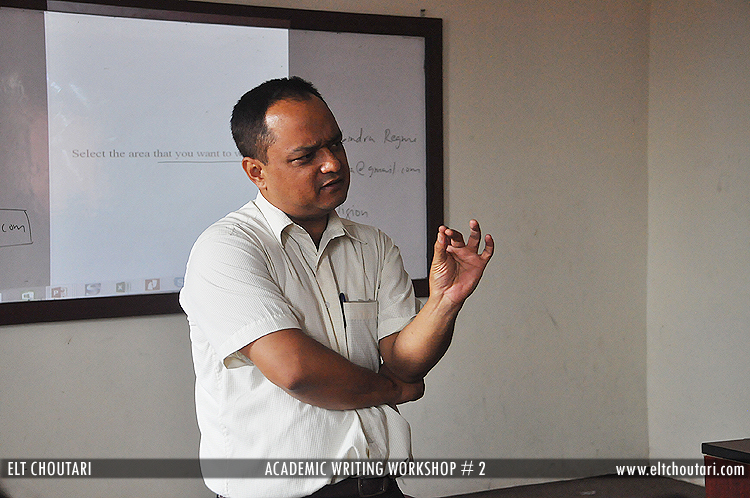
ELT Choutari organized a workshop titled “Problematising, Organising, Introduction, Conclusion and Abstract while Writing Papers”at King’s College, Babar Mahal in Kathmandu on July 26, 2014.
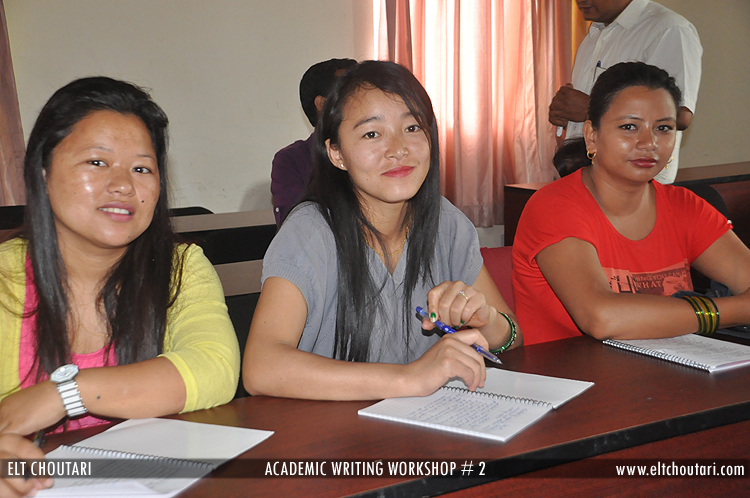
Mabindra Regmi, an adjunct lecturer of KU School of Education, facilitated the one-day workshop, attended by 18 writing enthusiasts – teachers and students from Kathmandu University and Tribhuvan University.
Regmi talked about why many researchers and novice writers get ‘stuck’ while writing the introduction, conclusion and abstract of papers and research article; and he walked through the workshop giving tips and guidelines on how to get over the obstacle.
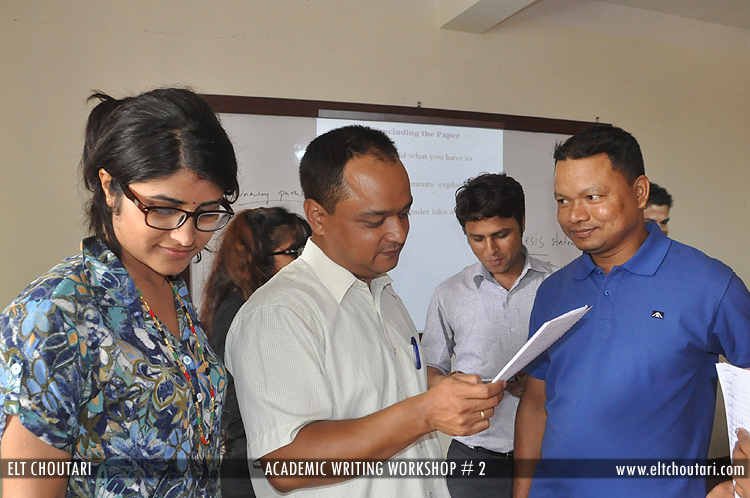
Regmi involved the participants in brainstorming and problematizing/contextualizing their interest area. Then the participants came up with a draft of the introduction for their topics and got involved in a feedback session.
Professional development is an ongoing learning process in which teachers engage voluntarily to learn how their language can be made effective in order to meet the learning needs of their students. It focuses specifically on how teachers construct their professional identities in ongoing interaction with learners, by reflecting on their actions for professional enhancement and adopting them to meet the learners’ expressed or implicit learning goals.
Reflections do not only summarize what happened, but also reflect on those experiences and report on what the authors have learned. Through reflection, language teachers share how to improve professional practice, discover what is working and what is not, and explore personal strengths and the areas of improvement. Hence, reflections are not only for action, but also are in and on action to ultimately help teachers develop their professionalism.
As continuity to the same ongoing professional development process through reflections, the July issue of Choutari includes a series of reflections on from this year’s examinations of School Leaving Certificate (SLC) and Teacher Service Commission (TSC), to other aspects of professional development such as mentoring, speakers’ club, writing and ELT.
First, Shyam Sharma expresses his deep concerns about the failed national exam of SLC in Nepal that annually labels a huge number of youth as failures. In his well-crafted piece, he argues that we are carrying SLC exams for too long for nothing. The title is obvious: Ditch it: SLC Exams but there is a lot more Mr. Sharma has to say on why SLC is “obsolete, misguided, and if you think about its purpose and effect, absurd.”
In the second post ‘How my mentor transformed me’, Priyanka Pandey shares her story of transformation from a hesitant soul to a confident teacher. Her story is extremely relevant for the useful insights for anyone in a mentoring relationship or seeking to be in one.
Likewise, Mabindra Regmi reflects on the ups and downs of his writing journey in the third entry ‘The Write Way’. Mr. Regmi’s rediscovery of his own writing not only shares useful insights on how writing can be continuously improved, but also how it can be a collaborative effort.
The fourth post is a compilation of reflections on written test of Teacher Service Commission (TSC), as told by the three successful candidates in the recent massive results. These High School English teachers’ experiences passing the national qualifying test conducted by Teacher Service Commission (TSC) is obviously useful for the incoming cohort of candidates.
“The club has made a tremendous impact on me, personally and professionally,” says a stellar writer. Wonder how? The secret is out in Umes Shrestha’s reflective piece titled Speakers’ Club for Professional Development.
The excitement brought about by the Choutari workshop is palpable in Krishna Prasad Khatiwada’s piece ‘Reflection on Choutari Workshop: Behind Academic Publishing-Why, How & What’. This reflection piece lists useful tips on finding publishing venues, to avoiding plagiarism, and overcoming procrastination.
Finally, the photo blog scribbled with texts brings alive the spirit of emerging writers participating in the academic publishing workshop organized by NeltaChoutari, and facilitated by Bal Krishna Sharma. Combining the sophisticated tools and successful tips, the participants felt equipped to produce academic writing with a fuller understanding of why, how, and what of the academic writing.
Here is the list of contents for convenient navigation:
Now we would like to take this opportunity to sincerely thank all the contributors including the Choutari Team for their support and contribution and we expect more contributions of yours on Chouatri for the upcoming issues.
We always welcome your constructive feedback to make our publications more reader friendly in terms of the content and issues in ELT. Hence, we urge you to join the professional conversation on Choutari by posting comments or sharing among your circles via social media networks like facebook, twitter, google plus, pressing likes under the blog entries you have read.
Happy Reading!
Praveen and Umes
On behalf of Choutari Team
I now teach at a prestigious university within the largest and one of the best American public university systems, the State University of New York.
But twenty-four years ago, when I first appeared the SLC, I failed.
Now, I am not about to tell you a wonderful story. Sorry, there are more stories of suicide than of success in this regard. I am instead telling my story, for the first time beyond my family, in order to make a very broad point about the SLC exam and our society. Continue reading Ditch it: SLC Exams→
I feel very fortunate for getting a mentor when I started my teaching career. My mentor was an experienced and skillful teacher who guided me, changed my perceptions regarding teaching profession, and later made me determined to be in the field of ELT.
The school I worked for (Tiny Seeds Pre-school, Kathmandu) had a system of assigning two teachers in one class; a grade teacher and an assistant teacher. I was selected to be her assistant but initially it was very stressful because I didn’t have any idea about “play-way” method. Being a student of Education, I knew how to make lesson plans in theory, but I didn’t have clear idea about how to make practical lesson plans and how to teach effectively in English medium. Continue reading How my mentor transformed me→








 Mathema: Well, thank you very much. It’s my pleasure to be interviewed for the special issue. Critical thinking is something important in an education system. I think for the past several years, since beginning, I would say, we have been putting emphasis on lower level of thinking such as recollection of facts. We never encouraged students to think independently and creatively. Similarly, we never encouraged students to synthesize or analyze anything. As far as English teaching is concerned, I remember my days at the university while teaching to the student in the faculty of education, I used to bring extracts from the newspapers such as Herald Tribune and New York Times and teach those texts to the students. Although these texts were very difficult for the learners, I would make them read. At first, very general questions such as What is the text all about? were asked. Later on, I would ask them difficult questions in the second, third, fourth or fifth reading, especially implied questions. When I was the Vice-chancellor of Tribhuvan University, I came to realize that our education system right form schools to university focused lower level of thinking. Then I thought of introducing critical thinking in the university. But, unfortunately, I somehow could not introduce there.