What I as a student expect from an English teacher

Manju Pokhrel

BBA, Pokhara College of technology (LaGrandee College)

Simalchaur, Pokhara

In this entry, as a business student learning English for global communication, I am writing about what I expect from a ‘good’ English teacher. A good teacher is the one who actually aims to make students understand his/her teaching. I expect good English teacher should be built with different characteristics- i)Proficiency in English ii)Good organization iii)Effective body language iv)Patience v) Knowledge vi) A good sense of humour vii) Good attitude ix) Adaptable to the environment x)Vocabulary knowledge

It’s a genuine fact that an English teacher should have knowledge of English so s/he can teach students with fluency and in right manner. The teacher should also have a good preparation and organization of the materials s/he is presenting in the very time. The detail knowledge on subject matter is very crucial. The vocabulary power assists the teacher to be strong in their lecture or class. The continuous speed up or steady teaching cannot be effective, hence sense of humour play a role for this purpose of holding the class within the control of teacher. Perception of an individual differs according to the attitude of a person. Good attitude can be also an important factor for determining the perfection of teachers. Good attitude leads to positive response from the listeners. The environment is a dynamic factor; therefore teacher should be able to cope within given educational environment whether it suits his/her personality or not. They must  pave a way to develop congenial environment where they are teaching.

In fact, the expectations I put on were fulfilled when I was at graduation level. On remembering my English teacher, today also I felt so warm about her and her teaching. Writing about her teaching is like describing the natural beauty that adds value to the environment. Really I am privileged by this chance on putting words about the personality whom I admire. The smiling face, so poised and elegant nature adds her personality. Her speaking was pellucid; her soft and sweet voice, attracting the attention of whole class; the class which used to be noisy in other’s lecture. Her presence makes the class dear and lovely. Her vocabulary was fabulous and power to make whole class understood is admirable. She had full knowledge on subject matter she was talking on. She was conscious about her words and used to alert timely so students’ attention can be gained. Her encouragement on better writing and good speaking made us careful on our doing. She used to delineate on how to impress the reader by the simple and meaningful writing. I still remember the fact she said – use of difficult or unfamiliar words do not add to clarity and impressiveness of writing; rather writing should be clear, precise and trustworthy to draw the attention of the reader. Her role was remarkable in my life time. She encouraged me in learning English to the extent I need. She used to dictate each and every ideas and information on the topic. She never felt bored and irritated by my questions. In return, her answers used to be reasonable to the questions asked. Today whatever I am able to write freely is the result of her teaching and her inspiration.

As an English teacher it is false to view that a teacher should memorize the whole dictionary or the whole concepts on English but he/she should be an expert in the subject matter, in classroom management and in teaching techniques.

Branch Highlights: Tanahun, Kaski and Makwanpur

Dear Choutari Readers,

In an attempt to provide you glimpse of the great things ELT that take place across the country, we invited brief reflective reports from our colleagues in NELTA branches. This time we have quick snapshots. Ideally, we want reports in the form of “blog” entries so that readers find them quick and interesting to read. We ask that our contributors take some time to learn and write blog entries as reflective pieces, whatever the content and subject may be. So, if you would like to share about professional development activities in your branch with the community via Choutari, please look at the guidelines for writing more substantive and reflective pieces on this page. And please see this example.

Editors

 TANAHUN, KASKI AND MAKWANPUR

Training: ‘Teaching Poems and Creative Writing’ organized by NELTA

Facilitated by Motikala Subba Dewan, Sarita Dewan, and Mr. Batuk Lal Tamang, this training involved the participants in writing their own brief creative work on the spot and then discussing how to teach creative work in the ELT classroom. More than 50 teachers participated in the event.


KASKI BRANCH

Training: Basic Level Teacher Training

Organized by PABSON Lamjung and Athrai Publication, this training was facilitated by Khim Lal Adhikari. The theme of the training was Child-friendly Pedagogy, Child-centred method and How to teach English. Fifty five English teachers from different schools participated in the training.

 Teachers Training on Teaching English Website

With the assistance of the British Council, Kaski branch organized a two day Teachers’ training focused on the Teaching English Website 8th & 9th Sep., 2011. Altogether 60 life members of NELTA, Pokhara from different campus, school and academic institution took part in the training. The training mainly focuses how to get the teaching materials from website on line so that the teaching learning activities will be more effective. Smreety Dewan and Asim Kharel from British Council facilitated the training.

Support in PABSON Spelling Contest

PABSON Kaski organized an English Spelling contest for Lower secondary Level from 10 to 12 August, 2011 in Pokhara. The programme was coordinated by Karna Gurung and assisted by other members. 198 students from 66 different PABSON schools participated in the contest.

Need-based Teacher Training by D.E.O.

NELTA, Pokhara worked together with the District Education Office, Kaski to prepare the Teacher Professional Development (TPD)  training manual as well as the training packages for all the levels beginning, intermediate and secondary levels. Min B. Gurung, NELTA chair and Khim Lal Adhikari including other ELT teachers and school supervisors prepared the training manual at the end of the academic session 2067.

MAKWANPUR BRANCH

Training: English Language Teaching: Breaking its Boundaries

This one-day conference was attended by about 200 members. It was facilitated by scholars like Kamal Poudel, Sajan Karn, and Ekadeve Adhihari.

NELTA Makwanpur Committee 2011-2013: (From left: Mr. Surya Pd. Ghimire, Mr. Ganesh Pd. Humagain, Mr. Kishor Parajuli, Mr. Shyam Pd. Dahal, Ms. Srijana Paudel, Mr. Dadhiram Chapagain, Mr. Thakur Ram Bhandari, Mr. Sangam Chaulagain, Mr. Rajeshwar Thakur, Mr. Mohan Waiwa and Ms. Reena Acharya)

Three Day Training on ELT

A three-day training on ELT for primary level English teachers was conducted by Makwanpur and was attended by 35 teachers from PABSON affiliated schools. This training was facilitated by scholars like Kashiraj Pandey from NELTA Center.

Third Anniversary Issue (January 2012)

.

Editorial

– Shyam Sharma.
First of all, thank you for being with Choutari another year, for contributing your work, for reading, and most importantly for posting your comments and contributing to the discussion. The conversation is key to the forum.
.
The world of publication is changing–and it should. In journalism, bloggers usually report the news first, and often report it best; so, media outlets tap into the power of citizen journalism. In education, publication is still stuck in slow and often unfairly selective processes that are rather out of sync with how scholars actually learn and communicate with their professional communities; worse, many scholars in the global periphery are locked out of even that exclusive party. The world of educators can be better. Especially in the age of social and professional networking, we can and should actively promote learning by sharing, collaborating and resource-building… and breaking barriers. Just think about it: with one click of a “like” or “share” button a week, one comment a month, and one article a year, you can help build one of the best blog-based professional ELT forums in the region–and, if many other colleagues like you make one small contribution at a time, it could even be in the world!
.
We should remember that our colleagues across the country continue to have limited access to the web–on top of half a day or more of load shedding–and, in fact, even the relatively privileged among us have limited time and incentives for engaging in professional conversations and resource-building. But if we consider the level of engagement that we have seen nonetheless in the last two years, we can be very optimistic and enthusiastic as well. If we want to inspire one another, we can! And we should.
.
Looking forward to the fourth year with the hope–in fact, confidence–that as writers and readers, we will all participate with even more energy and enthusiasm, and wishing you a
.
HAPPY NEW YEAR 2012!
.
Editors
Shyam, Bal, Prem, Sajan, Kamal, Hem
.
Table of Contents

Interview with NELTA President, Mr. Hemanta Dahal

Mr. President, You are aware that even while many of our fellow teachers across the country do not have access to the ELT resources, conversations, and communities on the web, the increasing number of Nepalese ELT professionals who have access look up to your office for supporting initiatives like Nelta Choutari from the level of policy, resources, or at least moral support and encouragement. What would you like to tell the readers of Choutari about how you have supported this or similar volunteer initiatives in the past? 

NELTA has genuinely taken this issue and has adopted some strategies to address it. Part of the strategies, a number of the Journal of NELTA has been uploaded in its website in a pdf format so that many of our fellow teachers can have access to the journals free of cost. Moreover, NELTA recommends the Regional English Language Office (RELO) based in the US Embassy, Kathmandu for online teacher training courses for our members. Some of the NELTA members have already been benefited from these courses sponsored by the US State Department and conducted by the US universities. To take a few examples, some of our members from Surkhet, Dang, Gorkha, Birganj and Kathmandu have already completed the online courses, and some are doing it. Several NELTA members also got chance to participate in the series of webinars presented by the US professors and the ELT experts who have given considerable insight to our friends’ vocation.

In order to promote English language proficiency of the professionals in teaching and beyond, NELTA in collaboration with the US Embassy and Radio Sagarmatha aired English by Radio for one and half-year. The materials were developed by the NELTA experts. With the consent of NELTA, the US Embassy has arranged to air 54 episodes of the programs through ten FM stations in Nepal.

Considering the importance of Nelta Choutari, we have been disseminating some sample works in Choutari, among our fellow members on different occasions. One of the most important occasions to give its visibility is the international conference of NELTA, in which our colleagues give a plenary about Choutari to more than 700 participants. The conference will take place in Kathmandu on 18-20 February and in Chitawan on 22-23 February 2012. I would like to invite the ELT professionals to participate in the conference.

Choutari team–and other volunteer teams working for promoting professional development of NELTA members–have used approaches, platforms, and talents of its members in pursuing NELTA’s visions and missions towards supporting professional development needs of NELTA members. Please tell us a few specific ways in which you might have thought NELTA can collaborate with or support such volunteer initiatives. 

First of all, I would like to take an opportunity to salute the Choutari team and volunteers for helping promote professional development of NELTA members through the regular publication of Nelta Choutari. Special thanks are due to Shyam Sharma, Bal Krishna Sharma, Kamal Poudel, Prem Phyak, Sajan Karn and Hem Raj Kafle.

NLETA highly regards the value of Choutari. However, just valuing it is not enough for promoting its visibility in the professional arena. The agenda has already entered in central committee meetings to print selected materials from Choutari and disseminate them among NELTA branches. NELTA has 33 branches across the country covering almost 50 districts. Given the need to reach widely, we are looking for resources for Choutari’s resources for teachers across the country.

Some other ways to support Choutari and similar initiatives would be to include their resources in the NELTA newsletter, journal, international conference booklet, flyers, website, etc., which is possible in terms of cost and efforts. I will certainly consider this as an agenda in the forthcoming meeting of NELTA, and I am sure my team will implement it immediately.

Choutari is a forward-looking professional development initiative in the sense that it seeks to build the platform before it even seems possible for many NELTA members to participate. What are some of NELTA’s official programs that similarly look into the future where you may want us to join hands with such initiatives? 

NELTA has been exploring the opportunities for how it could be instrumental in developing the English language teaching situation in Nepal. NELTA, with the support of the RELO office has planned to donate the ELT books to all 33 branches of NELTA and 82 public schools. RELO office has kindly agreed to allocate 40,000 US dollars to buy the books and administer the donation programme. NELTA already received fifty per cent of the books and distributed them to 38 schools, many branches of NELTA, Tribhuwan University, Faculty of Education, Kathmandu University School of Education, Mahendra Ratna Campus, Tahachal and Gorkha Campus. Rest of the books will arrive in March, and then distribution will take place in rest of the branches and the school, including some education campuses in the country. These books will certainly be useful for the teachers and teacher educators to bridge the gap between the theories and practices so that they could share their views to others.

NELTA  has started brainstorming for English by Radio program with a focus on the teachers. Moreover, discussions are underway to collaborate with the British Council for providing the NELTA members the access to the British Council global products.

We are also exploring the possibilities for how the Choutari can be linked with the websites of the British Council, RELO, IATEFL and TESOL so that more and more people can have better access to the resources. British Council has abundance of global products – many of them come online. TESOL has enormous online materials which could be shared with NELTA members via uplink. TEFL International is another key institution working for internationally accredited training such as TESOL Certificate and TESOL Diploma. The entire modules of TESOL Diploma are provided online. Collaboration between NELTA and TEFL International could be insightful to look into the opportunity for sharing the training materials.

Which Choutari article that you have read in the past three years did you like most and why?

There is no single article, I could refer to that I am impressed by. However, I would like to mention the one by Mr. Kent Grosh entitled ‘So Many Textbooks, So Little Time‘.  Mr. Grosh begins with the practical notion of teaching mathematics linking the ideas of teaching English as a second language. In the context of Nepal, the teachers are obliged to rely on the textbooks to the great extent whereas majority of the textbooks are far too difficult compared to the learners’ schema. Consequently, both the teachers and the students waste a lot of time rather than being self-aware of critical thinking. Therefore, there is an urgent need of revisiting what we do and what we are required to do.

Please suggest any areas of professional conversation that Choutari is yet to pay attention to. 

I would suggest publishing more practical teaching and learning tips in each issue of the Choutari.

Finally, do you have any message for Choutari readers? 

First of all, the more the readers could disseminate the work of Choutari, the more English teaching professionals get access to the forum. I would like to urge the readers to provide comments and feedback regarding the materials published in Choutari and also submit articles, teaching and learning tips and life experiences related to teaching and learning of English.

Multilingualism in/and Nepalese Education

Shailaja Jha

We all know that Nepal is an extremely multilingual society. But what is the status of multilingualism in educational context of Nepal? In this essay, I describe multilingualism and the spread of English in Nepal. I also discuss multilingualism as a means for creating social harmony as well as enhancing teaching and learning in general. I conclude by highlighting the role of teachers in promoting multilingualism.

Most of the Nepalese people are multilinguals, and many people don’t even have a clear order of first and second languages. For example, my home language is Maithili but, interestingly enough, I cannot speak it very well. Instead, I have learned Newari in addition to the mainstream language Nepali. This means that we are such a multilingual society that some of us even get confused as to which language is our “home” or “heritage” language.  In fact, most of the world’s population speaks more than one language but most of the population in western cultures is monolingual in one of the “major” languages in spite of being exposed to other languages mainly in the school context. So, multilingualism is the norm rather than exception of human societies, except that educational and political institutions try to create artificial situations where one or a few languages are given systematic privilege without realizing that suppressing language diversity is counterproductive as well as insensitive.

“There are almost no territories [in the world] in which only one languages is used by the citizenry” (Cenoz & Genesee 1998). In South Africa eleven languages are given a constitutional recognition as official ones; in India, this number is twenty-two! When people are left to their own linguistic devices, especially in the urban environments which are increasingly the norm of life in this country, their speech behavior is characterized by fluidity, interconnection, multi component code switching and easy transcendence of notional linguistic boundaries. This is true particularly of informal domains.

Also, if we look at the issue of multilingualism in societies like Nepal, South Africa, and India, we will see that there is no single and simple definition of multilingualism. Multilingualism can be rigidly defined as being native-like in two or more languages, but it can also be loosely defined as being less than native-like but still able to communicate in two or more languages. Multilingual speakers have acquired and maintained at least one language during childhood, the so-called first language (L1). First languages (sometimes also referred to as mother tongue) are acquired without formal education, by mechanisms heavily disputed. Children acquiring two first languages since birth are called simultaneous bilinguals. Even in the case of simultaneous bilinguals one language usually dominates over the other. This kind of bilingualism is most likely to occur when a child is raised by bilingual parents in a predominantly monolingual environment. It can also occur when the parents are monolingual but have raised their child or children in two different countries.

Many people believe that Nepali language has always been the majority language of Nepal; in reality, Nepali was called Khaskura spoken by a group of people that was probably no larger than other groups like Magar, Tamang, Sherpa, or Limbu today. Nepali (Khaskura) evolved from the language spoken by a group that became politically powerful in the last two centuries, and in fact it also spread far and wide into Bhutan, India and Myanmar. Nepali language is also the official language of the state of Sikkim in India. At present, almost half of the total population of Nepal speaks Nepali; the other half of the population speaks almost a hundred different languages. If you think about it, Nepal is not only home to more language families than all of Europe combined, but also has more distinct and individual languages in one country than the whole of the European community (Yadava, 2003). However, there is the lack of study and discussion of endangered minority languages and the possible reasons of their status of being endangered for the integrated development of the country. Negligence of Government on Language policy towards poor, rural ethno-linguistic communities, and overemphasis on one language policy considering Nepali as the official language and as the medium of creating national identity and homogenization also can be pointed out major influential reasons for disregarding minority ethnic and indigenous languages. The state policy of the government takes endangerment and extinction of minority language as the matter of mere ‘language shift’ whereas the members from the ethnic and indigenous community might take it seriously as the matter of as Skutnabb-Kangas (2000) states as ‘linguistic genocide’. Some linguists diplomatically point towards political and ideological perspective in regard to the matter of endangerment, extinction of minority languages.

The newest and most important dynamics in Nepali multilingualism is the entry of English as a medium of education and a language of business, diplomacy, and cross-cultural communication. On the one hand, everyone knows the benefits of multilingualism: they would like to teach their children not only English but also other languages. But on the other hand, it is difficult for the next generation to develop the same level of language proficiency for academic and professional communication, for higher learning and sharing of complex ideas if they only use their local languages for basic communication and use English only for educational, professional, and intellectual purposes.

Educators understand that multilingualism helps to facilitate access to curriculum and to learning in school. It also improves communication between different linguistic groups. Multilingualism provides children with ability to share in a wide range of intercultural experiences such as literature, entertainment, religion, and other interests. Children can become fluent in more than one language and for many people throughout the world multilingualism is very common. The level of fluency depends on factors such as the language programme children follow in school and the extent of parental support. The ability to speak the mother tongue as well as the national language and an international language creates a much wider range of life choices for individuals but can also achieve national unity. There is no scientific evidence that learning more than one language is intellectually damaging. Children who have a good understanding of how different languages function are more likely to have good analytical skills and are often more effective communicators.  Therefore, there is no doubt that multilingualism is a positive social and personal resource.

As teachers of language and literacy, we also know that there is no evidence to show that multilingual societies are more disadvantages than monolingual countries. Social disadvantage is caused by factors other than language. It is important educationally that children learn in their mother tongues in the early years of schooling. Our Government also make policy regarding this.

However, the forces of globalization, prevailing myths about the power of English (as if it is a magical potion that will create jobs and opportunities and intellectual progress on its own) make it very difficult for societies to develop educational systems based on their understanding of multilingualism. Due to the globalization of English, parents and teachers are attracted towards giving education to the students in English medium right from the very beginning. They wrongly believe that students will be able to better succeed in the competitive world if they have English proficiency. In reality, it is knowledge and skills that students most need. A lot of research regarding multilingualism shows that supporting children’s first language will enhance the acquisition of the second and third language. Similarly, there is a link between multilingualism and creativity. Multilingualism broadens access to information and offers alternative ways of organizing thoughts. But unfortunately, these realities get lost in the maze of myths about the magic of English.

Just consider the work of a businessperson; most business people need to travel around the world, communicate with people who speak different languages. It is very clear that if your students can speak multiple languages they will be much better business people who can not only sell better but will also create and maintain goodwill with a lot more people in the future. Or consider your students who may become diplomats, administrators and managers of multinational corporations or the United Nations, writers and journalists. There is no profession that I can think of where our students will not do better if they are multilingual. But remember, it will not be enough for them to “know” how to conduct basic communication in all the other languages except English. Only if we allow, encourage, and facilitate the use of multiple languages at higher levels of education can our students be efficient multilinguals in their future careers.

Many educators wrongly believe that promoting multilingualism is costly, impractical, or difficult. The reality is that such assumptions are simply wrong. Promoting multilingualism need not cost anything: you can just encourage your students to use and develop different languages by asking them to express their ideas in different languages in the classroom (maybe as long as everyone understands). Similarly, there is nothing impractical about equally respecting and promoting different languages that your students speak; instead, the opposite should be seen as unprofessional, unethical, and shameful for educated people and educators. Finally, multilingualism is becoming a profitable business in many areas. Think about a student who is able to translate documents. Realizing the importance of multilingualism, nowadays many software companies are developing multilingual interfaces, multilingual applications for translation, multilingual communicative mechanisms, etc.

Yet another problem with educators is that they believe that they are not qualified to teach or promote multilingualism. While it may be true that you are not “qualified” to teach different languages, there is no reason why you should not promote and encourage multiple languages among your students. And, there is absolutely no reason why you should suppress students’ languages. Just think about it: you have no right to do that in the first place.

Yes, politicians try to divide the society along linguistic lines. But as educators we can help our students speak the languages of different ethnic groups and thereby help them become cross-cultural citizens and promoters of cultural harmony. For this we need to realize that we are very rich in culture and its aspects, we need to utilize our culture to create peace and harmony among the people of Nepal not for fighting with each other in the name of culture and language.

As teachers of language in a rich multilingual country, it is our duty to facilitate multicultural education among our students. Trust me, if we do so we will not betray our students’ need to learn more English. If our students continue to learn new ideas, if they grow up as citizens of the world who understand and respect different cultures and their languages, in the long run, their English will be better.  We need to prepare students for the real world and the real world is multicultural and multilingual. At the very least, we need to draw on students’ linguistic and cultural experiences and knowledge, allow them to utilize those resources, and never try to suppress them—whether intentionally or not. Teacher in multicultural classrooms should be open to their students and put forth the effort needed to know their students inside or outside the classroom. Evaluating cultural diversity, teachers should build multicultural programs, show appreciation of differences, avoid stereotypes, acknowledge differences in children and discover the diversity within the classroom. If we think about it, respect and promotion of multilingualism could be the basis for a new kind of thinking among the future leaders and citizens of this country—different from the monolingual presumptions that lie at the heart of violence, protest, strike, kidnap, rape, robbery and mass brutality in our time.

References

Crystal, D. (2003). Dictionary of Linguistics and Phonetics. Blackwell publishing.

The Interim Constitution of Nepal. (2007). Part 3, Article 17)

Phayak, P. (2009). MA in Teaching of English to Speakers of Other Languages, Institute of Education, University of London.

Yadav ,Y.P. (2007). Linguistic Diversity in Nepal Perspective on language policy, Kathmandu, Nepal.

Kansakar, T. R.  (1996). Multilingualism. Nepal, Kathmandu.

Subedi, D.P (2010).  Multi cultural classroom issues in the Nepalese context, Journal of Education and Research Nepal, Kathmandu.

Koirala B.N. (2010). Opportunities for multi lingual Education in Nepal,  Journal of Education and Research, Nepal, Kathmandu.

NELTA Branch Formation in Rautahat

As a member of NELTA, nothing could be more satisfying to me than to see a brand new branch coming into existence. On December 10, 2011, the Rautahat branch of NELTA was formally established amidst a programme held in Gaur, the district’s headquarters. Following the inauguration of NELTA Rautahat branch, a training (focusing on “Emerging Trends in ELT”) was led by Mr. Sajan Kumar Karn, executive member of NELTA Central Committee; the programme was actively participated by general and executive members of the new branch, as well as general members, members of the advisory committee, and guests. There were altogether 50 participants in the programme.

Inauguration Ceremony

The inauguration ceremony started with the singing of national anthem by students from International Bal Academy and lighting of 5 candles (representing each letter of N-E-L-T-A) by various dignitaries. Distinguished guest and facilitator Mr. Karn presented the “organizational profile” of NELTA with its history, mission, vision and goals, NELTA branches across the country, its various programmes and activities organized at branch levels and central level, collaboration and partnership with different national and international agencies. He also shared the branch-by-laws and requested all the participants of the programme to get associated with NELTA for the professional development.

The ad-hoc committee of NELTA Rautahat, which was chosen unanimously, was then announced (please see list below).

The inauguration programme concluded with best wishes from the Guest of Honour Yogendra Prasad Yadav.  NELTA Rautahat constitutes 31 members of NELTA including 20 life members, 7 annual members and 4 life members who are already members at NELTA Birgunj from Rautahat.

Training Programme

With the aim of encouraging ELT aspirants to change, the training programme on “Emerging Trends in ELT” was organized following inauguration ceremony. Mr. Karn facilitated the training that was participated by 50 participants including English language teachers and students, campus principals and section officer of DEO Rautahat. He discussed paradigm shifts and the cause behind the emerging trends in ELT Today, thereby motivating the participants to adopt and adapt different changes taking place in ELT.

Some of those trends include learner autonomy, globalization and ELT, methodology and pedagogy, English versus Nenglish, digital ELT, and updating ELT practice. Mr. Karn urged the participants to grow more digitally in order to survive and succeed in the networked academic world.
Affiliate to a professional associationHe further made an appeal to update themselves convincing them stating that academic qualifications once acquired are not enough forever. He concluded the training suggesting the following different ways of updating oneself professionally:

  • Read journal
  • Write articles
  • Carry out action research
  • Participate in trainings, conference, literary talks, lectures, workshops, seminars and panel discussions
  • Share ideas and problems with colleagues
  • Utilize web resources

Mr. Karn invited the participants to join the upcoming 17th International Conference and National Conference of NELTA to be held in February, 18-20, 2012 (3 Days) in Kathmandu and 22-23 February, 2012 (2 Days) in Chitwan respectively. He also requested them to visit   www.neltachutari.wordpress.com  www.nelta.org.np and www.neltabranches.pbwork.com. Finally, the participants shared their experiences and reflections, before they were given certificates of attendance. To conclude the day’s programme, Mr. Anil Kumar Nidhi, chair of NELTA Rautahat extended his gratitude to NELTA Central Office, all the participants and those who contributed in the formation of NELTA Branch in Rautahat district. The programme was conducted by Praveen Kumar Yadav, member of NELTA Birgunj.

Newly formed executive committee:

Members: Mr. Anil Kumar Nidhi as chair, Mr. Mukesh Prasad Patel as vice-chair, Mr. Sachindra Yadav and Mr. Upendra Raj Kafle as secretary and vice-secretary, Mrs. Anita Shrivastava as treasurer and executive members Mr. Dipendra Thakur, Mr. Jamun Yadav, Mr. Dharmendra Kumar Singh, Mr. Ram Kripal Yadav, Mr. Rakesh Sharma and Mr. Devendra Sah.

Advisors: Mr. Chandeshwor Raut, Mr. Asha Ram Sah, Mr. Ramanand Yadav, Mr. Chandrika Das and Mr. Devendra Yadav.

The Process-Genre Approach: Some Ideas for Teaching Writing in Nepal

Madhav Raj Belbase

Are you teaching a writing course in a college of university in Nepal? If you are teaching in a school, is writing an important component of your language curriculum? Do you help your students write multiple drafts of a text or do you just ask them to submit final versions? Do you only provide a final score on students’ writing or do you provide feedback during different phases of their writing? Do you pay attention to the type of writing genre you are preparing your students for (e.g. emails, letters, websites, creative writing pieces like poems or essays, newspaper editorials, etc) or do you just focus on grammar, vocabulary and spelling? While the curricular mandates, time constraints, and availability of resources will largely determine what you can and cannot do, as teachers we also have a certain level of control over how we want to teach our students how to write and to facilitate their growth as writers.

Here is my proposal for teaching writing in our context—the process genre approach. In my experience, English teachers in the Nepalese context face unique challenges in teaching writing: while teacher education courses expose pre-service teachers with theories and ideas of teaching writing developed in the West, our teachings are mostly motivared by exam-driven product-based writing assignments that encourage students to reproduce what they learned in the classroom. Despite such tensions, “efficient teachers” can implement their “hidden” curricula where they can adopt an eclectic approach to teach writing and prepare students for the global world making them able to write a range of tasks, instead of just memorization and reproduction in exams.  In order to build expertise in such a pedagogic skill, teachers need to be familiar with a range of teaching pedagogy options available to them. Here I try to present a model of an approach called the process genre approach that blends two approaches – the process approach and the genre approach. This approach takes account of different steps, for instance, preparation, modeling, planning, joint constructing, independent constructing, and revising and editing. However, before that I present some major shortcomings of product approach to writing which is dominant in the Nepalese context at present.

The product approach

In the product approach, according to Brown (1994), teachers focus on what a final piece of writing will look like and measure it against the criteria of vocabulary use, grammatical use, and mechanical considerations such as spelling and punctuation, as well as the content and organization. The normal procedure is to assign a piece of writing, collect it, and then return it for further revision with the errors either corrected or marked for the student to do the corrections. This approach has received much criticism because it ignores the actual processes used by students, or any writers, to produce a piece of writing. Yan (2005) claims that it focuses on imitation and churning out a perfect product, even though very few people can create a perfect product on the first draft. Another criticism is that this approach requires constant error correction, and that affects students’ motivation and self-esteem. The product approach does not effectively prepare students for the real world or teach them to be the best writers. I encourage the English teachers in Nepal to critically reflect on their approaches to teaching writing and think about making necessary changes.

The process approach

The process writing originated in the first language (L1) classroom, where it was developed in reaction to traditional types of teaching writing. This approach, for Caudery (1997), assumes that writing normally takes place through the making of series of multiple drafts of text. The process approach identifies four stages in writing- prewriting, drafting/composing, revising, and editing. These stages are recursive, taking place many times over in the course of composing. This approach emphasizes revision, and also feedback from others, so students may produce many drafts with much crossing out of sentences and moving around paragraphs. The correction of spelling and punctuation is not of central importance at the early stages. Caudery (1997) points out that the process approach is in many instances potentially extremely motivating and, to teachers and students alike. Most often it involves students in new and stimulating learning experiences. Peer feedback, for instance, is which students show each other their writing and obtain comments on it.

The genre approach

The genre approach to the teaching of writing developed as an approach inAustraliain the 1970s which is now gaining recognition throughout the world. By investigating different genres such as essays, editorials, and business letters students can perceive the differences in structure and form and apply what they learn to their own writing. Following Cope and Kalantzis (1993), the genre approach to writing consists of three phases: (1) the target genre is modeled for the students; (2) a text is jointly constructed by the teacher and students; and (3) a text is independently constructed by each student. Badger and White (2000) support that the approach acknowledges that writing takes place in a social situation and reflects a particular purpose and that learning can happen consciously through imitation and analysis, which facilitates explicit instruction. This approach seems more capable in showing students how different discourses require different structures. In addition, introducing authentic texts enhances students’ involvement and brings relevance to the writing process.

The process-genre approach

Today many ESL researchers have recognized that the teachers should not rigidly adopt just one approach all the time in the writing classroom. I also encourage English teachers in the Nepalese context to reconsider their own current practices and welcome insights from this model of teaching writing. Combining of approaches results in a new way of thinking about writing. One example is synthesis of the process and genre approaches, which Badger and White (2000) have termed the process genre approach. This approach allows students to study the relationship between purpose and form for a particular genre as they use the recursive processes of prewriting, drafting, revision, and editing. Using these steps develops students’ awareness of different text types and of the composing process. The different activities included in this approach ensure that grammatical and vocabulary items are taught not in isolation, but in meaningful, interactive situations and derived from the particular genre.

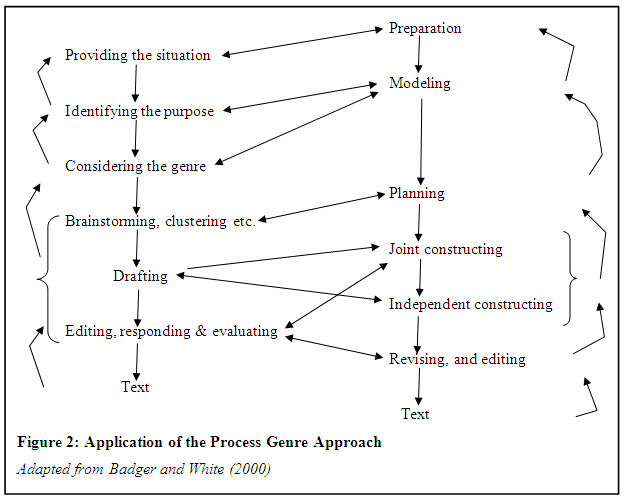
According to Badger and White (2000), the teaching procedure for the process genre approach is divided into the following six steps: (1) preparation, (2) modeling, (3) planning, (4) joint constructing, (5) independent constructing, and (6) revising. Figure 2 illustrates how these six steps interact in a recursive way with themselves and with other writing skills.

A short description of what occurs during the six steps will also illustrate how elements of the process and genre approaches work in unity.

Preparation

The teacher begins preparing the students to write by defining a situation that will require a written text and placing it within a specific genre, such as a persuasive essay arguing for or against an issue of current interest. This activates the schemata and allows students to anticipate the structural features of the genre.

Modeling

During this step the teacher introduces a model of the genre and lets students consider the purpose of the text. For example, the purpose of an argumentative essay is to persuade the reader to act on something. Next, the teacher discusses how the text is structured and how its organization develops to accomplish its purpose.

Planning

This step includes many meaningful activities that activate the students’ schemata about the topic, including brainstorming, discussing, and reading associated material. The aim is to help the students develop an interest in the topic by relating it to their experience. Since they have to participate and contribute in the classroom, learners will find the activities interesting and entertaining.

Joint constructing

In this step, the teacher and students work together as a beginning of writing a text. While doing so, the teacher uses the writing processes of brainstorming, drafting, and revising. The students contribute information and ideas, and the teacher writes the generated text on the black/white board. The final draft provides a model for students to refer to when they work on their individual compositions. It fosters collaborative writing. This step can be boosted by providing a very caring and sharing environment by the teacher. This step will provide students with a chance to write in a group and to prepare them for individual work.

Independent constructing

By this time students will have examined model texts and have jointly constructed a text in the genre. They now undertake the task of composing their own texts on a related topic. Class time can be set aside for students to compose independently so that the teacher is available to help, clarify, or consult about the process. The writing task can also be continued as a homework assignment. The teacher has to clarify what students should do for writing homework.

Revising and editing

Students lastly will have a draft that will undergo final revision and editing. This does not necessarily mean that teachers have to collect all the papers and mark them one by one. Students may check, discuss, and evaluate their work with fellow students, as the teacher again guides and facilitates. The teacher may make an effort to publish the students’ work, which will impart a sense of achievement and motivate the students to become better writers. Their final achievement will foster self-esteem among learners as they have produced something.

Final Thoughts

Things are easier said than done. Learning to write in a foreign language is a demanding task that can easily leave learners unmotivated. It can be more discouraging when students are evaluated on the basis of their writing products only, as we now observe in the Nepalese context. To combat this problem, teachers have to play more agentive role in order to empower the learners with their ability to perform real world writing tasks. We are not preparing our students just for exams, but for the global world that may require an unpredictable set of writing skills. We language teachers are the change agents even if our curricula are constrained. Use of the process-genre approach to writing allows teachers to help students recognize the steps they go through to create a written text which should lead to less stressful and motivated writing. The fact that learners are encouraged to discuss, asses, and analyze their own writing made them feel more confident and less threatened. Theoretical ideas can be confusing and conflicting at times; it is the teacher who is responsible for translating abstract ideas into a classroom practice. Further the practice to produce optimal learning benefits, teachers should constantly and systematically record, contemplate, and analyze what they have done in the classroom, and use their reflective experience as a basis for improving their instructional practice.


Works Cited

Badger, R. G. & G. White. 2000. A process genre approach to teaching writing. ELT Journal 54(2): 153-60.

Brown, H.D. 1994. Teaching by principles: An interactive approach to language pedagogy.Eaglewood Cliffs,NJ: Prentice Hall Regents.

Cope, B. & M. Kalantzis. (eds). 1993. The powers of literacy: A genre approach to teaching writing.Pittsburgh,PA:University ofPittsburg Press.

Coudery, T. 1997. Process writing. In Glenn, F. (ed). Writing in the English Language Classroom. Hertfordshire: Prentice HallEurope ELT.

Teacher training: for money or for professionalism?

                       -Ram Abadhesh Ray

      In this piece of writing, I hope to discuss English teaching profession. Teaching, professionally, is a very precarious and sturdy job. In the context of Nepal, teaching has become inferior or substandard one due to politicization on it. Because of unstable government system and its fragile education policy, the teaching career has become in miserable condition. The government of Nepal trained almost all the teachers but the teachers are still ‘literate but not educated’ , following Sajan Karn’s argument. I think most of the teachers are trained but they are resourcefully untrained because they are still facing lots of problems for effective teaching and for bringing drastic progress in the students. This article also begins with the current teaching trend of the government schools teachers’ i.e. Old Fashioned Method of teaching. Then it also mentions some solutions to the problems that are faced by the teachers.

                          Under School Improvement Program (SIP), the Educational Manpower Development Centre has prepared various instructional materials, scientific and innovative technique to make the teaching livelier in order to develop the teacher’s capability in effective teaching.  The Conceptual Framework has been prepared on the basis of the received feedbacks from national and international level workshops. At first, so many ideas and experiences were gathered from almost one hundred and fifty teachers from different seven districts. Not only this but also from the trainers of these centers, from the DEOs (District Education Officers) and from professors of related field, the ideas and experiences has been accumulated for the preparation of this TPD.

                          Due to fragile and ineffective accomplishment of teaching policies of Nepal, there has not been found more achievements in the field of training system of TPD. Though it has commenced all over Nepal, it is not in its entire height. One of the main cause of its being letdown is also due to lack of wakefulness in teachers of Nepal. Most of the teachers of remote and semi urban areas are still surviving with their old weapons of teaching in the class room for just passing the time anyway for the sake of the government’s obligation and for the sake of their earning. Generally, teachers in the context of Nepal especially in far remote areas have been junked due to lack of innovative teaching technique and due to lack of their activeness to learn something worthy for their professional development. The same means of teaching i.e. after five or ten minutes of ringing the bell of first period, they with attendance register and a stout stick go to class room as they are forcefully being sent to the class. As soon they enter the class, they as usual do the attendance and instruct the students read themselves and they instead of teaching the students with their daily lesson plan, sit on the chair outside the gate comfortably thinking and waiting for the next period. They don’t want to change themselves into modern era of teaching. They look as if they have been worried and seriously ill. Actually the system of providing training in the context of Nepal is not an apt. Here, instead of providing training the teachers are given a very handsome allowance that becomes their additional income. Their salary is not deducted from the government side so they get double benefit. It has become a sort of tendency for the government schools’ teachers to get allowance and then participate in any sort of training. When there is less allowance in any training then the teachers don’t seem even talk about such training. By this, we can assume that such teachers can never transform themselves for learning in any sort of training if it is even giving a large sum of allowance to them. They always have intension to be present in the training and after the break, they go for shopping and again next day same thing happen.

I can still remember the very first NELTA training held in the then SEDU and now ETC by Dr. Bal Mukund Bhandari, the then treasurer of NELTA, Center when I was in  M. ED. First year. Almost 60 English teachers participated in the training session. Dr. Bhandari inaugurated the session and his facilitator was Mr. Sajan Kumar Karn, the then teaching assistant of English M.ED. Program of Thakur Ram Multiple Campus, Birganj and secretary of NELTA, Birganj. The program was successfully commenced and all the teachers were very much curious to listen the speech by Dr. Bhandari. As soon as Dr. Bhandari announced that the training was without allowance, the faces of the reputed teachers of the government school were to see. They started feeling disappointment and as there was break for half an hour and then after break no government teachers were seen in training session and Dr. Bhandari was amazed and we too. Just after a year, I got another opportunity to be participated in a workshop provided by the Examination Control Office, Sanothimi, Bhaktpur at the same venue and there was a large gathering of the government school teachers but there were limited seats for participants. Everyone was wishing to be the participants and I was stunned to see that and thought it a very good workshop. But the reality was something else, I felt myself very fortunate to be one of the participant. I at that time was in Mount Edmund English Secondary School, Birganj and I was sent to participate in the training. The workshop was run for three days and on the last day, one of the head teachers said forcefully to the trainers to stop training and distribute the allowance. The trainers also agreed and within some minutes training program was postponed and then the time of receiving allowance came and asked whether I would also get something. One of the teacher asked if I was new fellow to go there and I agreed. My name was also called and I went to receive the allowance. I couldn’t believe myself that how all teachers were very much curious to take participate in training. It was all for the allowance not for learning point of view.

Now you can easily conclude that where there is allowance the teachers go there and where there is no such facilities the teachers won’t go. Since then I deduced that teachers participated in training only for earning, not for learning. Among such teachers, some bad concepts have emerged about training that government is compelled to train them and then why should they care for such training. They always ask about the facilities i.e. lodging and dining a very common term in training and then only they are ready for participating. Sometimes the teachers surprise me by asking the questions if the training is going to take place in any grand hotel or not. If it is so they are ok and vice versa. The tendency of providing allowance to the teachers by government has created lots of problems for NELTA fellows to conduct any sort of conference in local level for the teachers here demand the same too.

                            In the context of Nepal the teaching doesn’t take place as it is shown in the model  in  every nook and the corner of the nation but in some part of urban areas of Nepal, there is such teaching which is very expensive and the common people are not going to bear that. However, we can make our teaching effective by our entire effort and honesty with the help of the teaching aids which are locally available. But most of the teachers of our country have been fossilized from very beginning in the traditional way of teaching. For them the teaching aids are stout stick and ruthless sound in the classroom while teaching. Look and just imagine how the teachers in the European countries are teaching their students with great fun, scientific equipment and hovering around the students with great love and affection.

The entire teacher should be like a professional teacher and enjoy his/her work every now and then and then after there will be something new changes in the field of effective teaching. A teacher should go in training not for allowances rather for learning and being refreshed for removing their junk old traditional method of teaching. If one has to be a professional then he/she has to revolutionize his/her attitude towards scientific teaching from that of traditional one. They must understand their responsibility being honest in their teaching.

Conclusively, I can state that some of the old fashioned teachers and even some new who have been habituated to act in their teaching learning activities are to change themselves for their satisfaction in teaching. For that very purpose, the government should also take any massive action against such dead habits of teachers by improving in the education policy according to the change in pace of time. Then only something worth can be expected in the field of scientific and innovative teaching. Unless there is drastic modification in the trend and attitude of such teachers, the government, education policy maker cannot bring change in them and in their profession.

 ——————————————————

The author is an English Teacher at Shree Nepal National Higher Secondary School, Kalaiya, Bara, Secretary, NELTA, Birganj Branch  

Mixed Ability of the Learners: Challenge for ELT Teachers

Mandira Adhikari

Most of us teach large classes. One of the unavoidable challenges of having many students in the same class is that there will be a wide range of language proficiency levels in the class and it is hard for us to adjust our lesson plans to fit the learning needs of all the individual students. In this article, I want to share a few ideas about how to address that problem, additionally challenging the conventional wisdom that large classes only have drawbacks by showing that there are also benefits to large classes with mixed levels of ability.

In most of the schools of our country, whether private or public, there are more than 35 students in the same class. It is the duty of the single teacher to control them and to deliver the lesson plan effectively.  I used to teach two different classes of the same grade in one of the schools. In one section, students were arranged in terms of their ability; average students were in a section and mixed students in another section. I used to prepare one lesson plan and teach in both the sections. There was no problem in the section where there were average students, but there was always problem in the class having mixed ability because some of them used to understand before I taught, but some of them didn’t understand even if I taught the same thing five times. Thus, the situation was really challenging for me.

Benefits of having mixed ability classes

Before I elaborate the challenges of mixed ability classrooms, let me quickly note that contrary to conventional wisdom, mixed level or multi-level classrooms can also have some benefits if teachers know how to make use of the difference as a positive asset.

Hess (2001) has presented some of the advantages in a mixed level classroom are as follows:

  • There are always enough students for interaction,
  • We get a rich variety of human resources,
  • The teacher is not only pedagogue ,
  • We are never bored,
  • Professional development occurs naturally (p. 2-4).

When there are students having mixed ability in the same classroom, each individual can bring different and new ideas. They may be from different cultural backgrounds having different world-views and values, which mean many different experiences and many styles of learning. If they share the same experiences with their friends the poor students can be benefitted as well as it will be helpful for the teachers as well. This ability of the students help the teacher to apply different student- centered methods inside the same classroom. So, students don’t need to depend only on the teachers for learning.

Mixed ability classes are really challenging. So while facing those problems, we need to develop new ideas and while dealing with such problems teacher also becomes creative in teaching which is interesting and it directly helps us to develop our professional skills because these types of situations provide opportunity to develop skill of facing problems, we sometimes can get new idea from our learners as well.  Now let us look at the challenges.

Challenges of having mixed ability students in the ELT classroom

I have found most of the teachers are worried about having mixed ability students in the same classroom. It is because if there is variety in the classroom, it is very difficult for the teachers to implement their lesson plan because teachers need to take care of each student equally. It is difficult even for the students because those who understand easily feel bored with more explanation, but it is necessary for other students. Hess (2001) has presented some of the challenges that a teacher need to face in a mixed level classroom such as:

  • We often feel out of control
  • In large class we sometimes feel trapped in the problems
  • It is difficult to provide for individual learning style
  • Activating the quiet student is difficult (p. 4-6).

Thus, as Hess indicates, in a multilevel classroom teacher often feels out of control. In such classroom management becomes a formidable obstacle. In large multilevel classroom it is very difficult for the teacher to take his/her lesson ahead because some of them have better understanding than others. The most challenging job for ELT teachers in such classroom is to guide students according to their pace. The most difficult task in the mixed level class is the problem of managing the class and checking the home assignments. I have often found that in such classes active students are always active, whereas passive remains passive if the teacher doesn’t pay attention to them equally. As there are mixed abilities of the learners only one method isn’t suitable for all and it is again the challenge for ELT teachers to provide different techniques as their individual need and it is somehow impractical in practice.

Possible strategies to cope with the problem

As I have already mentioned there are a few benefits of having mixed level students in a classroom alongside more challenges of it. Let me now describe some of the strategies to cope with such problems. In order to handle such situations, teachers have to think in a different way. They need to find such strategies which will be helpful for all types of learners of the classroom. For example, audio- visual materials will be equally helpful for all the learners. Copur, in his article entitled ‘Coping with the problems of mixed ability classes has provided some points that are useful for ELT teachers to deal with mixed ability classes. They are: appeal to all senses, contingency plans, in-class activity, open ended plans, personalizing the tasks, games, competitions and dramatization, extra homework, portfolios, group-work activities, Self -access centers.

Therefore, to cope with mixed ability class, teacher has to think about such strategies so that it will be helpful for all the learners. Teacher can divide the whole class into different groups and different student centered methods can be very helpful such as: In-class activity, game competition and dramatization extra homework can be very helpful. Similarly, teacher can ask students to make their portfolios as well as self access centers will be very helpful for the learners to improve their study and motivate them towards learning.

Similarly, Sharma (2006) in her article entitled “Ways of effective language teaching in heterogeneous class” has presented some of the points to manage effective classes in heterogeneous classes or classes having mixed level learners. They are: planning, teacher’s leadership, communication, the well managed classroom, voice, effective presentation, pause and pacing, chunking, verbal aspect, visual, student’s participation, positioning, posturing and movement, movements, eye contact, gestures , use of teaching aids, and evaluation. Thus, above points are also helpful to deal with mixed level classroom because the planning and the leadership of the teachers are very helpful to deal with the situation. If ELT teachers are able to bring variety in the class, the chance of being out of track in the classroom decreases. Using different teaching aids in the classroom helps to motivate all the learners. Continuous evaluation of the learners helps teacher to identify poor learners so that they can improve them accordingly.

Conclusion

Mixed ability of the learners is universal and we find mixed ability students in almost all classes. There are challenges for the teachers to deal with such classes because there is variety and teacher feels out of control in such cases. But if we try to apply the benefit of such classes and apply learner centered methods inside the classroom it can be the easiest way to deal with stronger as well as weaker students. Teacher can apply different strategies for teaching four skills of the language, especially by specifying the different task for stronger as well as weaker students.


References

Hess, N. (2002). Teaching large multilevel classes. Cambridge: Cambridge University Press.

Negi, J.S. (2010) “Teaching English to Multilevel EFL learners in Large Classroom: A Pedagogical Discussion.” Paper presented at the 15th international conference of NELTA, Kathmandu, Nepal, 19-21 February 2010.

Sharma H.M. (2006) “Ways of effective language teaching in heterogeneous class. Journal of NELTA , 11(2), 115-118. 

Millennium Development Goals, Education for All and the Issue of Dominant language

Uttam Gaulee

Although official statistics show a progressive improvement in elementary education in Nepal over the last several years, an alarming number of children are still not in school. The number of these children is more than one million according to Global Movement for Children. What does this data say about our education system? How does the government or our society look at education? Is education still a privilege or a right of every individual? Let’s look at these questions in the light of Millennium Development Goals (MDGs) and Education For All (EFA) global initiatives. Furthermore, as teachers of language and literacy, let us consider the relationship between the big picture of education and the emphasis on “English as education” in Nepal. How would respect for and promotion of education in local languages make a difference? Would the use of local languages for literacy and education better connect formal education to informal learning in the world outside school?

What are millennium development goals?

The Millennium Development Goals (MDGs) are the key development targets declared by world leaders at the end of the millennium. “Achieving universal primary education” is one of the key goals because without basic education, it is difficult to meet other goals which are related to hunger, poverty, health and environment. Hence, the goal to providing basic education to everyone has been the main agenda of international development even before the declaration of MDGs. Government of all countries including Nepal have already agreed to Education For All (EFA).

What is EFA?

We know that a million children are not going to school, but we do not have statistics to show how many Nepalese people consider basic education a basic need and a human right. EFA is the official international declaration by all governments recognizing that basic education is the right of every individual. Government representatives from all around the world came together in Jomtein, Thailand in 1990 to declare unequivocally that every single person on earth needs basic education. The very first article of the declaration for Education For All clearly affirms the right of every individual—child or adult alike—to get fundamental education:

Every person – child, youth and adult – shall be able to benefit from educational opportunities designed to meet their basic learning needs.

This declaration stimulated governments to provide basic education to all. However, opening schools, having teachers and textbooks is not enough to provide education for all. There are many other issues such as the student’s personal, emotional, and linguistic and social backgrounds. We will discuss the issue of the dominant language here.

Which Language?

So, basic education is for all, but in which language? Providing education in one dominant language is the norm and that doesn’t serve the purpose for all in multilingual societies. Children who speak a language other than the language of instruction confront a substantial barrier to learning. Basic education should be given in the indigenous language of the children. This question cracks open another complicated question which has also been a matter of contention for a long time. The other question is related to the effectiveness of native language in instruction. Many studies have shown that instruction in native tongue is effective so much so that even proficiency of English or French language is better if taught using the mother tongue (Brock-Utne, 2000).

The African Experience

Africa is the continent where all kinds of language experiments have taken place. Most of Africa was colonized by England, France, and Portugal. The part of the continent colonized by England had English as the dominant language and this part was known was Anglophone Africa. Similarly, the part under the control of France had French as dominant language and was known as Francophone Africa. And, the part colonized by Portugal as Portuguese and was known as Lusophone Africa. Education was only available in the dominant language. The language barrier prevented many children from education. The language policy of such colonized countries was marked by the widespread use of the dominant language, particularly for pedagogical purposes. For example, mastery of French was the primary goal of education in Francophone Africa. Education in indigenous languages was also discussed.  However, the opinions were divided and the opportunity of protecting and promoting indigenous languages was ironically foiled by the Africans themselves.

Taiwanese Experience

Taiwan’s case is one of the complex cases. While they had multiple indigenous languages, Mandarin remained the dominant language. Taiwanese people had a hard time protecting their local languages. According to Tsao (2008), Taiwan government had to introduce some measures to protect indigenous language such as:

  • official prohibition of the punishment for speaking the minority language at school (in 1987)
  • the revision of Broadcast Bill  allowing the use of native languages in domestic broadcasts (in 1993)
  • formulation of the local language-in-education policy, allowing the teaching of Taiwanese local languages, cultures and histories in primary school beginning in 1993. (Tsao, 2008, p. 286)

However, after fifty years of high-handed promotion, Mandarin has become the first language of a large group of Taiwanese who have grown up speaking the language in public domains as well as in family. To these people, the use of such other Chinese varieties as Southern Min or Hakka is non-pragmatic and has no value other than fostering ethnic solidarity (Ibid, 287). Eventually, the current tendency is that the government, parents, and publishers all show a far more enthusiastic attitude toward the teaching of English than towards the teaching of local languages (Ibid, 293).

Should English be the language of education?

It is not uncommon to consider the mastery of the dominant language as the goal of education itself. It has happened in many societies in various times in history. Bruck-Utne mentions that French was considered to be the education (p. 144) in West Africa, when it was colonized by the French (as mentioned above). While considering mastery of a language as education maybe ridiculous, it is endemic. In Nepal, government has produced textbooks in indigenous languages and opened schools in order to provide elementary education in students’ own vernacular. Ironically, studies have found that parents are not willing to send their children to those schools fearing that their children will remain marginalized forever by doing so. They want their children to learn the widely spoken language Nepali. Moreover, more and more parents in urban areas are sending their children to English medium schools. They want their children to be proficient in the “language of the world.” People listen to you if you speak English, no surprise English is largely taken as the language of education. Anyone found to be speaking in local language is fined in many prestigious schools in urban areas. Actually, children watch each other and report on who breaks the so called rule. This phenomenon has been poignantly depicted by Bruck-Utne in the African context. She metaphorically describes this situation as children being turned into witch-hunters and traitors to their own linguistic community (p. 145).

Now, does that happen in Nepal and Africa only? Indian scenario is not very different. Although English has official status of assistant language, it is the most important language of India. It is the most commonly spoken language after Hindi and probably the most read and written language. Indians who know English will always try to show that they know English. “English symbolizes in Indians minds, better education, better culture and higher intellect” (Daniel, 2000). My curiosity prompted me to look how it is working in China, where people are aggressively learning English. I ended up with a projection that “. . . by 2025 the number of English-speaking Chinese will exceed the number of people speaking English as a first language in the rest of the world” (Andrews, 2011). Here’s a video link describing the “craze for English” in China which my colleague Shyam suggested. As teachers, policy makers, researchers, what do we do about this reality? Maybe we can’t do anything about it. Maybe we can.

Politics of the donors

There are arguments that the spread of the English language all over the world did not happen automatically. This has been systematically proliferated by agencies and this proliferation is still on. Languages are often imposed by powerful countries to foster their own languages. Robert Phillipson‘s book, Linguistic Imperialism published in 1992 discussed this issue in great detail. Brock-Utne has strongly denounced the politics of donors to support English or French language by the proliferation of English or French text-books. She argues that Britain and France want to recolonize the African minds through these languages again. According to her, these countries first spend money on expanding the use of their language and then ultimately aim to create more demand of English textbooks and materials. Among bilateral donors, however, there are also those that support the use of African languages as a language of instruction, first and foremost the German development agencies such as DSE and GTZ and the Swiss. There are also examples of financial support given by Nordic NGOs and Nordic donors to publishing of learning materials in local languages (Brock-Utne, p. 162). Why do parents, societies, and educational systems favor dominant languages against their own local languages? One of the most important reasons for this is the invisible hands of money. When countries or educational establishments receive cash from someone, they have to meet the expectations of the donors.

Conclusion

The questions remains: what do we do as educators about the fact that people and societies and entire nations favor dominant languages and often destroy their own indigenous linguistic, cultural, epistemological heritages? Is it part of our job to worry or do anything about it? Or is this a question that is more relevant for policy makers than for teachers?  Is it worth fighting the fight? If yes, for what reasons? Is it an academic issue or a political one?

An English teacher who has taught for three decades in the Gulf, Patricia Ryan makes a very sensible point that as educators there is no reason why we should suppress linguistic diversity in favor of a misguided craze for a world language. She says in this Ted video that we do need a global language but we need more than that. We need to promote multilingualism because languages are the storehouses of knowledge. We need the global language to learn from other societies and share our knowledge with others. With a foreign language as the only medium of learning and expressing thought, the very development of thought process will be negatively impacted in the first place, and we will not receive a great return by emphasizing too much on the language itself.

Are we just jumping on the bandwagon with the masses, are we more interested in the donors than our students’ learning . . . or are we thinking and working like informed educators?

References

Andrew, G. (11, March, 2011). China makes unprecedented English-language push. In Indianapolis Business Journal. Retrieved from: http://www.ibj.com/

Brock-Utne, B. (2000). Education for All—In Whose Language? In Whose Education for All? : Recolonization of the African Mind. London, UK: Garland Science.

Daniel, A. (2000). English in India. Retrieved from: http://adaniel.tripod.com/Languages3.htm

Global Movement for Children (2011). Nepal: Disadvantaged Children Missing Out on Education. Retrieved from: http://www.gmfc.org/en/about-us/introduction/about-this-site

Tsao, F. (2008). The language planning situation in Taiwan : An update in Kaplan, R.B. and Baldauf, R.B. (ed.) Language Planning and Policy in Asia, Vol 1 : Japan, Nepal, Taiwan and Chinese Characters.

World Conference on Education for All Meeting Basic Learning Needs (5-9 March, 1990). World declaration on education for all and framework for action to meet basic learning needs. Jomtien, Thailand.

Your Voices

What do you think about Nelta Choutari? What kinds of new materials would you like us to include in the future? These were questions that we asked our readers, writers, and well-wishers a few days ago. For supplementing to the responses that we received, Praveen Kumar Yadav, one of the most active participants in Choutari, kindly provided us with similar responses that he had collected last year. These responses highlight the importance of professional networking and knowledge-sharing in which we engage as a community. Enjoy!

What do you think about Nelta Choutari?

“For me, Nelta Choutari is a source of fresh ideas about ELT which helps me continue in my ELT journey better and faster.” – Hari Maya Sharma, Gorkha Campus, Gorkha

“I am currently teaching a compulsory subject in Hong Kong, and about half my students are of Nepali descent. Reading the blog makes me focus more on teaching them English as a foreign language.” – Carlos Soto, University of Hong Kong

“Nelta Choutari is a very special resource for professional development for me, because I use it for updating my professional understanding with new information in ELT theories and practices, finding lesson plans to teach various aspects of ELT, reading the wonderful stories of our friends’ experiences, reading the reflections and best practices of our friends from home and abroad, and expanding my network with colleagues at home and abroad. This forum has also given me some space to share my professional experiences and learn from NELTA colleagues while working in leadership positions.” – Ganga Ram Gautam, Immediate Past Present of NELTA, Kathmandu

“NELTA Choutari is a live platform for the ELT community from Nepal and abroad, providing excellent opportunities to teachers for sharing their practices with others from around the world. Of course, it is only available to those who have access to the internet.” – Prithvi Shrestha,  Lecturer in ELT, The Open University, Milton Keynes, UK

“A forum that inculcates your skills and knowledge required to be a professional English teacher.” – Mukunda Kumar Giri, Surkhet

“Nelta Choutari is a good platform for English language teachers and practitioners to share our experiences and learn from one another. It is an e- rendezvous for those who belong to English language/literature teaching and learning.” – Ishwor Kadel, Chitwan

“Professionalism is all about sharing and being updated with the emerging trends. Choutari helps us with professional development by allowing us to participate in professional conversations about ELT.” – Uttam Kumar Gaulee, Fulbright Scholar, University of Pittsburgh, Pennsylvania, USA

“NeltaChoutari is an open forum for all those inclined to teach English and interested in sharing their ideas and experiences with others. It serves as a common platform with equal recognition of all participants, which I have found highly motivating. Choutari has the potential of bringing together English teachers, educators and students for highly productive conversations about different issues on English language teaching and learning.” – Suresh Shrestha, Zenith English Language Institute Birgunj

“NELTA Choutari is a professional blogging webzine that helps the ELT Practitioners all over the world get to know about recent trends and developments in the field of ELT.” – Eka Dev Adhikari, Jana Jagriti Higher Secondary School, Pithuwa, Chitwan

“It’s a forum for the professionals to write, read discuss and comment and become professionally stronger.” – Dinesh Raj Dahal, Janajyoti Higher Secondary School,  Sindhuli

“The monthly webzine of NELTA, NeltaChoutari is a powerful resource for whole ELT community of Nepal.” – Ashok Raj Khati, Gauri Shankar Multiple Campus, Ramechhap

What kinds of new materials would you like us to include in the future?

“Choutari is praiseworthy as it is, but it would be better if it could address real problems that we teachers face in our classrooms. Choutari should be the place where people share their ground realities and get ready to face them with domestic weapons next time.”  – Ishwor Kadel

“I would like to see additional materials of oral literature, sharing of best practices from home and abroad, links to professional development opportunities such as scholarships and fellowships, links to classroom materials for teachers of all levels of education etc. I sincerely thank the Choutari team for working so hard for the benefit of the Nepali ELT community, and I am sure that this forum will prove itself as an ELT antenna to help us develop as well as access the best ELT materials available worldwide.” – Ganga Ram Gautam

“Real case studies to let readers learn how students are improving their English language from their classroom activities. ” – Mukunda Kumar Giri

“NeltaChoutari has already initiated to encourage and connect more and more teachers and students of English. It can be more general and reach the grass-root level even better. It has not yet reached students of education in colleges and universities.” – Suresh Shrestha

“[To increase readership] Spreading the word through branches, coordinating with the ministry of education, department, district education offices and resource centers, advertising in national media, particularly in “Shikshak” magazine might be effective. Also, rewarding or recognizing the comments from readers such as “the comment of the week” could work. New contributors should be encouraged.” – Uttam Gaulee

“Choutari should continue to work in the development of ELT situation in the country by bringing out articles from across the world, discussing issues regarding ELT and asking the experts to comment and commend in the webzine and help foster the situation.” – Eka Dev Adhikari

“It should touch the reality of Nepalese ground. We are following others’ practices but not focusing on what our reality is. No doubt, it should update us on modern practices around the world, but it is far more necessary to look at what our fellow teachers at home are doing and help them when they are at crossroads of new challenges and confusions about teaching English in their situations.” – Hari Maya Sharma

“I am not local to Nepal, but I do get a sense in reading the blog about the local context. I also see conditions which are less bound in local context that I can relate to. The blog creates a strong link between teaching and research, which is important. [I recommend] More articles which explicitly link theory with classroom practice.” – Carlos Soto

“Choutari should increase readership widely, connect the ELT practices of remote parts of Nepal to the rest of the world, and support the teachers working in those areas” – Ashok Raj Khati

“Choutari should address the readers in rural and marginalized areas with the discussions and guidelines on practical issues.” – Dinesh Raj Dahal

“For increasing the readership of Choutari, NELTA should produce monthly or bi-monthly Choutari bulletins for students and teachers, teachers should encourage their students to visit the site, Choutari should create more space for young writers including university students, add interaction between students and teachers, and add articles that have direct relevance to teaching in the classroom in Nepal.” – Suresh Shrestha 

“Choutari already publishes a variety of articles, anecdotes and classroom tips, and continuing them in the light of the changing landscape of ELT including the influence of language learning technologies would be great. A minor suggestion is to minimise long articles for Choutari as they can be published in the Journal of NELTA.” – Prithvi Shrestha

“I would like to suggest Nelta to include the following in the coming days: 1. It should address the issues related to nepalese teachers of english language; 2. In the coming days Nelta Choutari should incorporate those issues which have been facing by Nepalese teachers along with their solutions.” Parmeshwar Baral, P. N. Campus, Pokhara

Choutari Oral History (Interview with Prem Subedi Jan 2012)

“Good Teaching is the Same, Center or Periphery”

Under its “Oral History” project, Choutari has been collecting and publishing interviews with teachers from across Nepal. This interview was taken by Hem Raj Kafle with Mr. Prem Subedi, a seasoned English teacher who had also taught Hem in high school a long time ago. Mr. Subedi remembers his early days of teaching, shares a few things that he wants to remember and value about being a teacher, and reflects on the changing ways in which we teach. He suggests that good teaching is the same whether you teach in a city or the rural backwaters of Nepal. He adds that in order to be a teacher you need some special qualities.

As we enter a new year in our professional lives, let us consider what qualities we want to cultivate as teachers. Let us also think how we can share ideas and support for one another across geographical and sociocultural borders.


on behalf of Hem Raj Kafle
Shyam Sharma

NeltaChoutari, December 2011

EDITORIAL

Shyam Sharma

Dear Colleagues,

We have a great set of materials for you this month, including entries about the status/role of women in academe, Quality Circles, ELT program building, envisioning one’s role as a teacher, developing your professional learning network,  and a spicy entry on Nepali English!

We hope that you will enjoy the entries and also contribute your thoughts as comments to the posts. It doesn’t matter if you have a grand idea or a related experience that you can quickly share, and it doesn’t matter if you are an expert on the subject and want to add to the author’s idea or if you are not very familiar with the topic and just want to ask a question. It is important to share an idea or experience, to add something to the conversation. With that request, here are the ELT khuraks of this month:

1. “Why Can’t Women Do It?” — a book review and reflection on the phenomenon called the Madam Curie complex, by Sewa Bhattarai

2. “Quality Circle for Life: A Quest for Possibility” — an essay adapted from a conference paper on Quality Circles in education, by Lekhnath Sharma Pathak

3. “Learning-Centered ELT Programs in Nepal” — an article on how to make language classrooms as learner-centered as possible, by Krishna Bista

4. “What-like What-like English?” — an entry that includes some humorous examples of Nepali English in private schools, by Parmeshwar Baral

5. “Knowing Your Role as a Teacher” — an essay about the use of metaphor for developing awareness about the type of role we want to play as teachers, by Bal Krishna Sharma

6. “The Power of Professional Learning Networks” — an essay about the importance, benefits, and process of developing networks for learning and sharing ideas for professional development as teachers-scholars, by Shyam Sharma

Happy reading!

———————————-

IMPORTANT ANNOUNCEMENT

For the Third Anniversary issue of Nelta Choutari, we are currently accepting contributions. Please send your work—essays/brief articles, narratives, reports/updates, reflections, commentaries/opinions, etc—to neltachoutari @ gmail . com. Please see submission guidelines here.

Why Can’t Women Do It?

A book review and reflection on Julie Des Jardines’s The Madam Curie Complex 

Sewa Bhattarai

If women really are talented and can do anything that men can, why are there few famous women philosophers, scientists, writers, musicians, and politicians? Why have women been unable to achieve anything notable in history? Are women really oppressed or are they making much ado about nothing? Underlying these questions continuously thrown at women is the assumption that opportunities are available equally to men and women, but women are just not capable enough to utilize them. This issue of women’s inability to break the glass ceiling seems striking to education in general and ELT in particular, because growing up I have heard these limitations resonate in the experience of every female teacher in Nepal (my mother and several aunts being among them).  Though teaching is a popular occupation with women, very few women are found in positions of leadership. The widely adopted explanation for this phenomenon is that women can only do women’s work: housekeeping, cooking and raising babies. In this post, I first share a review of the book “The Madam Curie Complex” by Julie Jardines, who completely overturns this traditional view. I then ask readers to consider how the situation compares to the field of Nepalese academia.

Jardines has researched and listed a number of limitations faced by women in science. Interestingly, those limitations sound eerily familiar to any woman in higher education, and even more so in societies like Nepal. Jardines begins the book by tracing the image of science right from the foundations of Western thought. The earliest philosophers like Aristotle and Plato declared that men are objective and analytical, while women are feelers and sentimental beings. Other rational thinkers also Descartes followed in the tradition and perfected this image. The field of science, as a result, has come to be seen as very virile and physical. In the post- World War II era, following the success of atom bomb, scientific victories were treated like military or sports victories. Male scientists, including Albert Einstein, became a prominent part of art and culture, featuring in superhero movies. Already, the well was poisoned against women who wanted to become scientists. How did the definition of science as male affect women scientist?

Madame Curie is probably the most famous woman scientist of all. After radium was discovered, the French academia lobbied to have the prize given only to her husband, just because Marie curie was a woman. Even though she had started the work on radium before her husband Pierre joined the team, and she was the team leader even after her husband joined. Her husband insisted to the Committee that his wife was the driving force in the research before the committee relented and awarded the prize to the couple. Even so, at the award ceremony the prize giver quoted the biblical story of Adam and Eve “God saw that man was alone and sent him a helpmeet.”

Such condescending attitudes awaited all women who wanted to pursue a career in science. Jardines lists the case of a woman whose examiner did not come to take her oral exam and said he had been sleeping, though it was 2 pm. Women who graduated in the traditionally male fields did not find employment. Like many other women, Ellen Swallow Richards took on menial job as a janitor and sweepers just to be a fly on the wall and learn about her subject anyhow. A talented woman like Rosalyn Yalow who later went on to win the Nobel prize in physiology had to take stenography courses because no one would employ her.Due to anti nepotism policies active in those days, only one of the spouses was employed by an organization. Unsurprisingly, it was mostly the male half of the couple who was employed, even if he was less qualified than his wife. Marie Curie’s husband was appointed a professor at university while she was not. And after the death of Pierre, she was allowed to take over his post, but not as a full professor that he was, only as an assistant professor. Laura Fermi, the wife of Enrico Fermi was herself a fully qualified scientist before she gave up her career to pave the way for her illustrious husband.

Besides the sneering attitudes of the top people in the field, women also faced many practical day to day problems. There were no often no women’s bathrooms in the buildings. Women were often barred from attending public lectures because there were no female seats. Men bonded over nights out at bars and made work related decisions while socializing, which women were not allowed to attend.

And what was happening to these women’s home lives as they struggled inthe professional arena? Today, Madame Curie is remembered as a motherly figure who had nothing on her mind but to discover a cure for cancer through radium. But the reality was far from it, Madam Curie had no interest in curing cancer, but instead was a very passionate scientist. This image of a motherly, caring woman was created for the sake of publicity so that more women could identify with her and fund her to get more radium. The slightest departure from this image could be disastrous: when Marie Curie won her second Nobel Prize, it did not make much news because the newspapers were busy writing about her alleged affairs. These allegations destroyed her reputation; in contrast, the affairs of Albert Einstein were treated indulgently by the press.

Other women scientists also struggled to maintain such an image, without which they were shunned by the larger society.  Even though they were scientists, they were expected to fulfill all the duties of a mother. Rosaline Gilbraith was said to sew buttons, make lunch, and attend all the school plays for her children, while Rosalyn Yalow lived only one mile away from her laboratory so that she could walk there after she had put her children to sleep. Even Marie Curie’s otherwise supportive husband left the childcare to Marie and his father. Jardines quotes Charlotte Whitton who famously said that “a woman has to work twice as hard to be thought half as good as a man.”

And if any woman, despite these hardships, managed to climb the ladders of her professional career, she would face the biggest roadblock of all: the Nobel Prize. The Nobel Prize is awarded to at most three people at a time. Rosalind Franklin unluckily happened to be the fourth partner in the team that won the prize for discovering the double helix structure of DNA . Naturally, she was the one axed from the team, even though it was her photograph that provided conclusive evidence of the structure.

For a woman, it was not enough to be talented to be recognized. They also had to be patronized by the men in the field. Exceptionally talented women like Lisa Meitner, whose work contributed to building the atom bomb, ended up losing out on the prize. Meitner’s partner of thirty years Otto Hahn received the prize alone. As a consequence, Jardines calls the life of Maria Mayer charmed, even though she had taught without pay for most of her life as no one would give her work. Mayer won the Nobel prize for her work. Her husband was a physicist and she socialized with other respected physicists like Enrico Fermi. In contrast, talented women like Eleanor Lamson, Florence Sabin and Williamina Fleming, who had no defending husbands like Pierre Curie, were employed in subordinate positions while the credit for their work was taken by their male superiors. Jardines acknowledges that Nobel Prize discrimination sometimes happens to men too. However, the ratio of discrimination towards deserving women is much higher than the same for their male counterparts.

Many of these problems do not exist any longer. We have laws in place that bar discrimination, and many people have begun to concede that women can be successful in scientific careers. Many (not all, but many) men are willing to help out in the house and coordinate double careers. Thankfully, women can usually find bathrooms at workplace. And yet, the ratio of women in science remains low. A typical engineering class contains about 10% of girls. Girls are even rarer to find in pure science subjects like pure math or physics.

Many of the social glitches that dogged these earlier women still continue to pester today’s women in all fields of career. Jardines writes that once at a conference, a humorous picture of a bikini clad woman was displayed, and the men present burst out in raunchy jokes. How is a woman to handle a misogynist joke? Should she laugh along and hurt her feelings? Or should she express her feelings and jeopardize her career?Most of the socializing takes place in the evenings over drinks. In Nepal, most women still do not stay out late and drink. Work ideas are shared and camaraderie is built over the socialization, out of which most women are shut off.

In conclusion, this book gives an insight into the systematic exclusion of women from science. Jardines explains why it was so hard for them to make inroads into science and proves that the absence of women in science is not a factor of their genetic makeup. In fact, these insights are helpful for women in any field to realize the limitations facing them, and to gradually face these challenges. Hopefully, as time passes and more and more women enter all kinds of subjects, the path will be easier for future women.

As stated above, teaching is a popular career for women, maybe because it falls in the traditionally feminine fields of caring and nurturing children. Today there may even be more female teachers than male teachers in Nepal. But it would be laughable to say that a Nepalese woman can move ahead in her career as well as her male counterparts just by the dint of her talent and hard work. First, the gender hierarchy that prevails in the Nepalese culture as a whole largely shapes the roles that men and women play within the academia: men are expected to, want to, and quite often have the privileges to take relatively superior roles like that of administrators and supervisors compared to women. Second, the burden of work that women have at home doesn’t allow them to invest nearly as much time, to gain as much academic/professional expertise, and to aspire as much as men at work. Third, women who do desire and get into leadership positions are not given the same respect by men simply because they are not men. Fourth, when women are elected or invited to take on roles with authority and leadership, men tend to see their very entry into the position as representation. It would be rare for men to see the entry of a woman into the scene as a privilege for the men to have a female colleague who can add new perspectives and strengths to the institution/organization and its mission. I could go on, but I will leave it there and ask you to add your own perspectives on the issue. I hope you will join the discussion and point out issues that you have observed or experienced in Nepal.

Which of the situations described in the review above have you seen happen in Nepal? Does a particular example resonate with your or one of your colleague’s professional experience in the academia? How far have we come from, say, 30 years ago in terms of women leading or shaping the field of education? I would be delighted to read comments from the NELTA community about this subject.

Quality Circle for Life: A Quest for Possibility

Lekhnath S Pathak

Tribhuvan University/QUEST-Nepal

Introduction In a previous entry that I contributed to this blog (where I am delighted to see many responses from readers since it was published two years ago), I had focused on Quality Circles within the context of ELT. This entry deals with how tools and techniques as used in Quality Circle may also be used in various aspects and stages of life. If you are wondering why the larger issues of life matters to us as English teachers, the simple answer to that is that enhanced motivation, productivity, and satisfaction in life outside shape and influence students’ learning and success in school. So, let’s see the implications and application of QC in life at large.

 From Industry to Education 

The concept of Quality Circle originally extended from the industry in which the focus was on the enhancement of the quality of the products in the industry to the educational institutions in which the focus is on the enhancement of the quality of the human resource. Japan, an emerging super power during Second World War which could destroy one of the strongest frontiers of the USA, Pearl Harbor, got a severe jolt when America destroyed its two big cities of Hiroshima and Nagasaki. The subsequent years saw the depression among Japanese and it took them over a decade to get back to its feet. From military, Japan began to focus on economy. But the Japanese products around that time were very poor and didn’t have world market. So, one of the things that the Japanese did in order to come out of that desperate situation was to invite a brilliant American scholar named Dr. W. Edwards Deming, who, in his famous lectures “urged managers, engineers and scientists to adopt 14-point principle which called for everyone to look at quality management from different perspective which we today know as Total Quality Management” (Chapagain, 2006:137)

It is this adoption of TQM that revolutionized the Japanese industry and we saw the emergence of Japan as a leading economy in the world market. Many educational leaders around the world then adopted and adapted concepts of TQM to enhance teaching and learning. Prof. Dinesh Chapagain has been its harbinger in Nepal, who introduced it into Nepali academia in 1999. Since then it has been growing rapidly in the schools across Nepal through QUEST (Quality Circles in Education for Students’ Personality Development) –Nepal established in 2006

Slowly, in the development of SQC movement, a further possibility of extending the concept to different stages of life is also being explored. The concept seems to have tremendous possibilities. Let’s try to explore whether this concept can be made to work to make our life better managed and more qualitative.

The four stages of life

If we apply the four stages of life – brahmacharya, grihastha, sanyasa and banaprastha–  as outlined in Hindu philosophy, in our life, which seems to have a universality, it can be broadly discussed in the following ways. It is in these four divisions that the possibility of applying quality circles is explored in this essay.

1. Brahmacharya ashram:The Life of Preparation

Brahmacharya means celibacy, or a stage meant for preparing oneself for intellectual life, abstaining from any other attractions of society. In our case, a student’s entire academic life from day care to post graduate degree may be considered to constitute this stage.

At this backdrop, we have initiated Students’ Quality Circles (SQC) in Nepal and other parts of the world where this approach is applied at the school level among the students in the age group roughly 8-18 years. In our case, so far, we have started as early as with grade five students to grade nine students, with some higher grade students also undertaking the case studies and now attempts are also being made with lower grade students as well.

The main focus of SQC has been on human resource development, by teaching students to solve their own problems, be it at home or in the school. “That the problem gets solved is only a by-product of this approach, the end product is the evolution of a child into a complete human being” (Pathak, 2009). This is what we have started to call in the field of SQC as TQP, Total Quality Person.

In this approach, likeminded students form a circle of 4-10 students, who identify the problems that they are facing either at home or in the school, by brainstorming. Once the problems have been listed, they are prioritized in order of importance by collecting data from around the school and narrowed down to ultimately on one problem. The main causes and root causes are identified using Ishikawa (also called cause-and-effect or fish-bone) diagram. Countermeasures are planned after identifying the causes and implemented and monitored using control chart and the result compared after certain period as planned before. If the problem has been solved, another cycle is started otherwise further future plans are made to eliminate the problem completely.

The kinds of problems that the students take up are like bullying, use of filthy language in the school, excessive TV watching, exam phobia, dirty school premises and so on. They are taught to start with their own problem only which can be solved by their own initiative. For example, they are not encouraged to work on problems like too much theoretical classes or strict teachers, unless they can solve the problems on their own.

The children learn the steps of problem identification, analysis and solving. Use of basic Quality Control tools is what the children began to work with. Using check sheet to collect data, plotting and organizing data using line graph,bar graph and pie-chart, using Pareto diagram to prioritize the problems, fish bone diagram to systematically summarize the relationships between problem characteristics (the effect) and their causes, control chart at the solution implementation level to check whether a method adopted for an activity or a process is within control or not, scattered diagram to check for correlation between the sets of data. It is the ability to play with these tools in problem solving that makes children smart and infuses in them the skill of scientific problem solving attitude. The ability to use these tools also prepares them for higher order professional skills.

Brainstorming for ideas at different stages of problem solving, adoption of PDCA (Plan, Do, Check, Act) cycle as suggested by Deming to continuously improve the situation, the use of 5W1H questions at the level of implementation plan are basic to Students’ Quality Circles.

SQC movement that is spreading in schools in indifferent parts of the word is preparing students with scientific problem solving mind set and thus is making them GOOD and SMART so that they can embark on the second stage of life as adults more successfully and meaningfully.

2. Grihastha Ashram: The Life of Settlement

This is the most active and most meaningful stage of one’s life: when an individual marries, settles down in life, has children and has taken up a job or started one’s own enterprise to be able to live the life well. The stage can fall roughly between the age of 25 and 50. In our case upto around 60 years (58 years is the retirement age for bureaucrats and 63 for teachers). If this stage has not been managed well, life becomes a complete waste. This is the stage of family and profession (which is to sustain the family). It can be called the age of Responsibility, in which one is to take upon the responsibility of the family: spouse and children and also of parents; the responsibility in the workplace, no matter what kind of job or profession one holds; the responsibility towards oneself for one’s own growth.

At this stage, one will have to manage home and work well. Both are complementary to each other. Therefore, a balance of professional and personal life is necessary. It is here that the adoption of Quality Circle to suit the situation might come handy.

Quality Circle at home

The domestic problems at home need very sensible handling so that the problems are solved without blaming anyone at home and maintaining the family harmony.  The problems that can occur at home can be sibling rivalry, too much demand in children from the parents to perform better, parent dependent children, eating habits of children, too much of TV watching by children, paying less attention to the studies, children wasting food, eating junk food rather than home cooked food and so on.

Forming a circle at home: The circle can be formed consisting of both the parents or parents and grandparents depending on their relationship and presence and among the children. Or, the entire family can form one circle since the problem relates to everybody at home, every member can become involved in problem solving. This will also increase understanding and bond in the family. The most assertive member, be it the father or the mother can become the leader of the circle to ensure implementation of the solution. It will not require presentation at the end but final evaluation and further steps will be useful.

The same tools, techniques, and steps would be applicable.

Quality Circles in work places

Quality Circles, actually, started from the work places. When Ishikawa introduced it in Japan, it was in the work place only – in the industries, where the workers and supervisors worked on improving the quality of the goods produced.

What kind of Quality Circles can we have in work places? It depends on the profession we are in. So we can have Teachers Quality Circle, Principals Quality Circle, Managers Quality Circle, likewise circles for doctors, nurses, engineers, journalists, cooks, police, army, traffic, clerks, politicians and so on.

Each of these works and professions will have their own kind of problems. Teachers may have the problem of how to make the class more effective, how to relate more effectively with the students and management. Principals may have the problem of how to mobilize and make the best use of the resources, how to keep the teachers and students happy, how to get the most of their efforts. Grihastha Ashram is the most active and productive stage of one’s life. It is managing this stage more effectively that ensures the future of oneself and one’s progeny. The tools and techniques of Quality Circles can be easily modified to suit any of the profession. The circles can be formed based on the size and sections of the profession.

3. Sanyasa Ashram: The Life of Retirement

This is the stage of Retirement. This stage can last after your retirement till you can lead an active life. Let’s say this could mean 60 to 75 years. This leaves us with more than half a decade of active life even after retirement. This is the stage when we are done with the responsibility towards family and work place. The children by now are mostly grown up and settled. And one is free with one’s life. This stage can be managed well by making voluntary contributions to the society, to improve the situation in and around.

In this context, it is pertinent to recall the Senior Quality Circle initiated by Prof. Richard Ennals of Kingston University, UK. In the paper, he presented in the 13th International Convention of Students’ Quality Circle, in Kathmandu in 2010, he writes:

We argue the case for a new structure towards the end of working life, as older workers, including teachers, prepare for the transition to life outside work, or after work. Older workers accumulate experience, skill and tacit knowledge, which may be lost to the education system when they retire. Senior Quality Circles could have an important role in intergenerational learning. Furthermore, they provide a filter and translation facility between the technologically driven world of younger generations, and the human-centred concerns of older generations, whose lives could indeed be eased by the appropriate use of technologies to assist living (Ennals:2010)

This stage can be used to fulfill the realization of one’s dreams of making some substantial contribution towards society. Prof. Ennals’ experiment was with the senior faculty of the university as to how they can contribute to the society as senior citizens. Senior citizens and retired people, specially, the ones who retire from quite influential positions, they can make tremendous contribution to the society.

4. Banaprastha Ashram: The Life of Departure

Literally, banaprasthameans ‘towards forest’. Here, ‘forest’ is a metaphor for ‘the unknown’ into which we disappear after life. Hinduism talks about mokshya which means ‘liberation’. This liberation is, liberation from life. Buddhism talks about nirvana, which translates as ‘extingushing’. Both mokshyaand nirvana refer to the point of exit from the world. How does Quality Circle help in this stage? In many cultures, there are old age homes for old people, whereas in many they are at the mercy of their children or government.Like-minded old people like to sit together and ruminate about the ‘good old days’ or deliberate on spiritual matters, especially in the East. There is also a concept of Satsang which means ‘good company’ in which the spiritual aspects and moral and ethical ways of life are deliberated upon. There is also the concept of going for tirthatan, that is, pilgrimage, visiting holy places. The idea of Quality Circle is related with intervention but it also works very well in this stage of banaprastha, because it can be used for self-management of the old age. The tools to be used for this stage may not necessarily be all the tools used in the previous three stages where all the tools are used.

Conclusion

The epoch-making concept that started with Deming’s Statistical Quality Control (also SQC) got extended to Quality Control Circle by Ishikawa.  This translated into Students’ Quality Control Circle as an innovation by Jagdish Gandhi in academic circle and finally only as Students’ Quality Circle as visualized by Nepal’s SQC movement by Prof. Chapagain with the concept that unlike machine made products, human potentials are unlimited.So the human promises and potential for growth need not be controlled, has seen a continuous improvement or Kaizen as inherent in the concept of Quality Circle. As discussed above the concept of Quality Circle does not only make each stage of life more manageable but also helps, as pointed by Prof. Ennals,  in making transition from one stage to the next. This might usher in a new approach to life which is based on time tested and proven scientific ways of problem solving. Let’s give this possibility a chance.

References

Chapagain, Dinesh P. (2006). Guide to Students’ Quality Circles: An Approach to Prepare Total Quality People. NQPCN: Kathmandu

Ennals, Richard (2010). Creating Collaborative Advantage: Students’ Quality Circles. A paper presented in the 13th ICSQC 2010, Nepal.

Pathak, Lekhnath S. (2009). Evolution of a Child into a Complete Human Being. In The Convention Handbook of 5th National Convention of Students’ Quality Circle 2009. QUEST-Nepal: Kathmandu

Pathak, Lekhnath S. (2009) Guniya Chakrako Sambhavana (Possibility of Quality Circle). Kantipur National Daily, November 27, 2009. Kantipur Publications: Kathmandu

Pathak, Lekhnath S. (2010). Students’ Quality Circle for Language Development. A NELTA Monthly Talk Series in British Council, Nepal on May 15, 2010

Pathak, Lekhnath S. (2010). SMART and GOOD: What does it mean? In The Convention Handbook of 13th International Convention of Students’ Quality Circle 2010. QUEST-Nepal: Kathmandu

Pathak, Lekhnath S. (2011). Shaping the Minds of Young Children through SQC. In The Convention Handbook of 7th National Convention of Students’ Quality Circle 2011. QUEST-Nepal: Kathmandu

About the author

Learning-Centered English Language Teaching (ELT) Programs in Nepal

Krishna Bista, krishna.Bista@gmail.com

This essay reviews the major features of learning-centered English Language Teaching (ELT), also known as English as a Second Language (ESL) Programs at the selected colleges in the U.S. In the context of Nepalese ELT, the author suggests the possibility of developing learning-centered ELT programs applying the features of American English programs where instructors highlight learning environment, goals, performance and feedback, and rubrics.

What is a Learning-Centered College?

The learning college puts students’ learning first. Every single activity, program or decision carried out in a learning college is focused on learning. The learning college offers educational programs and experiences available for learners based on individual need. The learning college explores the full potential of learners, and provides them with support systems to meet their goals. The model is based on the assumption that educational experiences are designed for the convenience of learners rather than for the convenience of institutions and their staff. Boggs (1999, p. 9) identified four tenets of the learning paradigm that support a learning centered college concept:

  • The mission of colleges and universities should be student learning rather than teaching or instruction.
  • Institutions should accept responsibility for student learning.
  • Supporting and promoting student learning should be everyone’s job and should guide institutional decisions.
  • Institutions should judge their effectiveness and be evaluated on student learning outcomes rather than on resources or processes.

Instructor-Centered Teaching versus Learning-Centered Teaching

Teacher- centered teaching is focused on the process of teaching and less concerned with what is learned or how it is learned. In teacher centered teaching, according to Wagner and McCombs (1995, p.32), “teachers decide for the learners what is required from outside by defining characteristics of instruction, curriculum, assessment, and management to achieve desired learning outcomes.”

In contrast, the learning-centered teaching focuses on student learning. This model emphasizes a variety of teaching methods in which the teachers facilitate student learning.  It can be problem-based learning and focused on creating an effective learning environment so that students achieve at high levels of learning, and teachers offer more feedback on student work. In this approach, students become active participants in the learning process. The learning college, according to O’Banion (1997, p. 47), “engages learners as full partners in the learning process, with learners assuming primary responsibility for their own choices.”

How to Create a Learning-Centered ELT Program?

This section examines learning oriented materials and activities are used in the ELT classroom. If the learners are given the opportunities to be responsible for their learning according to their needs and choices, the learning would be more fruitful and students would be responsible for their own learning.

A Learning-Centered ELT Classroom

In ELT, classroom setting plays a crucial role in addressing issues of diverse students. Classroom environment has a great impact on learning. Students learn better when they are in brain-friendly classrooms.  Students feel actively engaged and motivated if they are in an open classroom setting. The more materials that are displayed in the class, the better the classroom outcomes. One of the examples of the learning-centered classroom is seen in the English as Second Language teaching classroom at Tompkins Cortland Community College in New York. The language class is structured in such a way that the physical environment stimulates learning emotionally, socially and physically. Wide windows, circular furniture and live plants in the classroom improve the physical aspect of the ESL/ELT classroom.

Student/Faculty Interaction

There is not enough interaction between students and faculty on learning models in ELT departments. Instructors should be familiar with updated pedagogies concerning teaching diverse students. Interaction, meetings, seminars and peer teaching would strengthen the concept of learning-centered model in colleges. When teachers are friendly, cooperative and collaborative in their teaching, they can seek innovative and effective ways to apply learning based principles in their classes.

Prince George’s Community College is an example of a learning college and has launched a program called “PGCC Faculty Members Model for Excellence” to improve courses and revise curricula in their academic divisions and departments (“PGCC faculty,” n.d.) Faculty participated in workshops, conferences, read journals on teaching, used appropriate technology and fostered student success.

Learning Technology in the Classroom

Internet and computers should be the cornerstones in English learning programs. Technology based activities help motivate learners and increase critical thinking. In ELT courses, learners actively participate in classroom learning when they are asked to use software applications for listening, reading, writing and speaking activities. Students can develop sound files by using multimedia software. Various Internet websites and online learning forums create a community of collaborative work for both teachers and students. Language emersion and user-friendly translation programs are a must for ELT students.

Software based-learning helps these students work on their fossilized language errors and learn grammatical aspects of a new language. For example, students in the NLII Project at Arizona State University used audio, video, simulation and technology-based presentations in the classroom as a part of the learning activities to help these special students (“Mapping the learning space” n.d.).

Syllabus and Rubrics

The ELT syllabus should include materials related to learners’ background, nationality, work place, language, and culture. Lessons that integrate multiple areas related to the student would increase student participation and create fruitful learning environments.  Syllabi that include integrated activities place the course emphasis back on the learner.

Rubrics in ELT courses should be clearly written in order to provide feedback to the learner to promote student growth. King’s college and Inver Hill College, for example, have focused on rubrics in their ESL curricula. Many students do not get helpful feedback that they can use to improve their language skills.

Learning Communities for Students

Where can a student practice English? Is classroom interaction enough practice for students to learn another language which is not their native tongue?  Do our ELT programs combine language learning theory and actual practice? How can we make second-language learning a lifelong experience? Many colleges have developed learning communities across academic disciplines and outside the college. In American colleges and universities, programs such as Home Stay, Happy Families, and Community Outreach are available for English language students. In Nepal, schools and colleges can request native English speakers who come to visit Nepal as volunteers or scholars from Fulbright programs so that students would get opportunities to interact with native speakers. The main goal of learning communities is to offer student active engagement and reflection. For example, the learning communities at Kingsborough Community College in New York began in 1995 with the Intensive ELT program (“Learning communities at Kingsborough,” n.d.).

Rewarding Goals and Motivation

ELT programs should make the connection between the classroom materials and the outside classroom activities, which may support intrinsic motivation. At Olivet College, for example, every incoming student affirms a commitment as “I am responsible for…my own learning and personal development… “(Tagg, 2003, p. 137). It is important to understand the goals of the students who join the ELT program. Program goals should support student goals and not just be a cash cow project for universities.

Student performances

In ELT programs, the instructors should develop an active curriculum with extracurricular activities to emphasize student’s performance. Language learning should be collaborative, service-based and practical. Alvrno College’s curriculum, for example, has included eight abilities—communication, analysis, problem solving, decision making, social interaction, global perspectives, effective citizenship and aesthetic responses (“English as Second Language,” n.d.)  

Conclusion

ELT teachers in Nepal can make their classes and materials student-oriented to engage learners while teaching English. Without changing the traditional structure of the college, the teacher can make some changes in his or her classroom the way I have observed in English language classes at American colleges. The debate of the instruction versus learning paradigm, even in American higher education, is not over because of a number of barriers in the implementation of the learner-centered approach. Yet pieces of the learner-centered college can be put immediately in place, and instructors, who have access to the learning resources and skills to modify the culture of learning, can implement learning-centered activities to help their learners in ELT and other academic programs thrive. ELT instructors should change their hearts and minds to bring a culture of learning-centered program. In traditional context of Nepal, teachers should be “the change” to cultivate a new learning environment in their colleges.

References

Boggs, G. R. (1999). What the learning paradigm means for faculty. Learning Abstracts 2(4).

Barr, R.B., & Tagg, J. (1995). From teaching to learning: A new paradigm for undergraduate

education. Change: The Magazine of Higher Education. 27 (6), 13-25.

English as Second Language (n.d.). Alvrno College. Retrieved Nov. 10, 2010 from

http://www.alverno.edu/campus_resource/Academic_support/english2.html

Learning communities at Kingsborough. Kingsborough Community College. Retrieved on

Nov. 20, 2010 from http://www.kbcc.cuny.edu/faculty/learning_communities/

Mapping the learning space: Technology uses in teaching and learning (n.d.). National

Learning Infrastructure Initiatives, Arizona State University. Retrieved Nov. 5, 2010 from http://west.asu.edu/nlii/technology.html

O’Banion, T. (1997). A learning college for the 21st century. Washington, DC: American

Association of Community Colleges and American Council on Education Series on Higher Education and the Oryx Press.

O’Banion, T. (1997). Creating more learning-centered community colleges. Phoenix, AZ:

League for Innova­tion in the Community College.

PGCC faculty members model for excellence (n.d.). Prince George’s Community College.

Retrieved Nov. 4, 2010 from

http://www.old.pgcc.edu/pgweb/pgdocs/faculty/Faculty_excellence.html.

Tagg, J. (2003). The learning paradigm college. Boston, MA: Anker Publishing.

Wagner, E. B., & McCombs, B. L. (1995). Learner centered psychological principles in practice:

Design for distance education. Educational Technology35(2), 32-35.

What-like what-like English?

Parmeshwar Baral

We have boarding schools now, imparting ‘education’ in English medium. Teachers use classroom routines in English, teach lessons in English, probably not paying attention to whether the learners understand them or not. Following are some funny Nepali-English expessions you might encounter in English medium schools in Nepal. I leave up to the Choutari readers to make their  interpretations in relation to what this means to our society, identity, and role of English in the Nepalese context.

1. There is no wind in the football.

2. I talk, he talk, why you middle talk?

3. You rotate the ground 4 times.

4. You did no homework? You go and under stand the tree with one leg and catch your ears.

5. I’ll give clap on your face.

6. Bring your parents with your mother and father.

7. Why haircut not cut?

8. Why are you looking outside at monkeys when I am in class?

9. Throw paper in dustbin or I’ll throw myself.

Knowing your role as a teacher: The teaching metaphor project

Bal Krishna Sharma

There are several ways of learning and development for language teachers. For example, you can read articles/chapters and research reports published in journals and books, critically understand the ideas there, and import them to your classroom teaching. You adopt and adapt the textbook ideas rather than picking them up and trying to implement them wholesale. You can also talk to your peer teachers, share teaching stories and experiences, or observe each other’s class and borrow some ideas from there. A third way, which I have recently been relying heavily on is a reflection of my own teaching, critically assessing what worked and what did not in my class, and focus on improving my teaching and tasks next semester.

I taught an academic reading course to international students last year. In order to train myself in teaching reading lessons effectively, I took a second language reading course from a professor at the University of Hawaii at Manoa. This class had several mini-assignments that proved instrumental in bridging my academic knowledge with my teaching experience in Nepal. I will explain to you one of those mini-assignments here, which was called a ‘reading metaphor project’.

Around the beginning of the semester, my professor asked all the students to think of a metaphor that would represent our role as a reading teacher. Many of us chose such metaphors as ‘mid-wife’, ‘football coach’, ‘driver’, and so on. Then the professor asked us to think about refining the metaphor and its meaning, or shifting to a more appropriate metaphor by the time we finish the course at the end of the semester. Following is a description of my metaphor:

I chose two metaphors during this semester. Metaphors are a useful way to compare the teacher’s roles and duties in a reading class. First, I compared a reading teacher with a tour guide. A tour guide shows ways to the tourists who otherwise would have a hard time to travel on their own. A guide shows ways to the visitors, takes to new places, explains the history and importance of those places, and also suggests other places to visit or stay. Then I thought this metaphor is too simplistic. Comparing a reading teacher with a tourist guide is very straightforward and gives more power to the teacher. When I believe in student-centered teaching, I thought I would need to find a metaphor that would minimize the role of the teacher. Then I compared a reading teacher with a ‘walking stick’. I remembered my childhood days and I remembered the tourists from different countries visiting our places inNepal. Everybody had a walking stick with them. Then I also remembered my reading class taught by my teacher. I also reflected on how I taught reading to my students. Obviously, there were differences in my and my teacher’s teaching styles and roles. However, a common thread I could think of was the role of a ‘facilitator’ or a ‘supporter’. A walking stick thus is a support; it does not walk in itself. Second language readers can take the support of the stick. Learning to read is a long journey. I compared reading journey with a trekking of several days. While trekking inNepalone has to climb up the hills through small trails and rarely through steps. There come plain and flat places as well. In case of those straight ways, the role of the walking stick is minimized or sometimes neutralized. Learners of reading are also similar. When there are difficult texts and words, there is a teacher to help the learners in some way: direct explanation of the meaning or teaching the students the reading strategies, for example. But when there are easier texts, the students can read on their own, teacher’s role is minimized.

So what?

Writers in NeltaChoutari have discussed the need to be careful against lifting pedagogical ideas that have been proven effective in different contexts than our own without necessary appropriation, so the concept has floated here as well quite often. I hope that you will find this concrete activity valuable towards implementing the idea into practice. Such reflective practice is useful whether we are novice or experienced because reflection and critical assessment are important for any efficient language teacher. If you are a teacher educator, or a teacher trainer, please try this out in practice and respond to this post with your thoughts so the rest of will learn from actual practice. I am always eager to hear more.


The Power of Professional Learning Networks

Shyam Sharma

Your “social” network is probably represented fairly well with who is on your Facebook “friends” list and how you engage with those people. But what does your professional learning network look like? In fact, what is a professional learning network?

In this entry, I share with you a powerful concept called the “professional learning network” (PLN) and share a few specific tips on how to develop–or become more conscious and deliberate about–a professional learning network in order to enhance your professional development as teachers and scholars, and what is more important, also help others in your professional community develop professionally by sharing your knowledge with them.

The concept of PLN originated from Personal Learning “Environment” (PLE), which referred to the situation and mechanism that a learner develops and uses for setting learning goals, managing learning process, and assessing outcome. With the advent of information technologies, it evolved into Personal Learning “Network” (PLN). More recently, many educators and other professionals have adapted the idea into “professional” learning network (also PLN; here’s some description and here’s some history).

With the advent of powerful networking technologies, professionals as well as learners are now able to access vast amounts and variety of information, aggregate and organize that information, prioritize what to read and/or respond to and how, with which community to share what and how much, and so on. As an example, here is an image in which I attempt to visually describe my own personal/professional learning network (you can click to see a larger image or right-click to download the file). I am still unsure how to integrate many other things that are not in the image and how to better organize an relate what are there, but trying to visually represent my PLN really helped me to think about my professional goals, management of time and energy, and so on. I call mine personal and/or professional because my roles as a learner and a professional overlap quite significantly.

Having introduced the concept, let me now share a few suggestions about how we can develop our professional learning network (both for ourselves as individuals AND in order to benefit one another).

1. Subscribe to blogs in your areas of interest. This means asking the blog to send you an email alert when a new entry is posted. Except with blogs (like those of news outlets) that may publish too many entries, blogs don’t usually flood your inbox. I guarantee that this blog will only sent you a few emails and only once a month, and I reassure you of that in order to (yes) suggest that you can go ahead and subscribe now.

2. Follow professionals on Twitter. Twitter, as many of us know, is a microblogging site where people share very brief (140 characters max) messages–breaking news, teaching tips, pithy comments, humor, hyperlinks, and whatnot–with their network. Compared to blogs, these are short and therefore good for mobile devices, as well as busy/mobile people. Compared to the full experience of social networking on Facebook (including its silliness, narcissism, distracting pictures and videos, and worst of all, too many “friends” ranging from the principal of our childhood school to maila kakaki saliko jwainko bhatijaki soltini to NELTA colleagues around the world to what-the-heck-when-did-I-add-this-guy kind of people)–okay, compared to Facebook, microblogging allows you to “follow” professionals in your field(s) of interest and let people “follow” you… and I don’t think maila kaka will follow your ELT Twitter feeds and hashtags, unless he happens to be an ELT person, which would be great.

3. Use Social Bookmarking. How often do you find yourself sending a link to an interesting article or educational video to a colleague, or two… well, post it on NELTA’s Yahoo Mail and flood the inboxes of 500 (?) people? You don’t have to share resources on the web like that. Just save your bookmarks in applications like Diigo or Delicious (install extensions on your browser) and people can see what you have “saved for later” and you can see theirs. That “theirs” could be people you know or it could be the whole social bookmarking community who have used “tags” to describe their findings on the web. (Here’s a fun video intro to  social bookmarking.)

4. Sign Up on Listservs and/or Mailing Lists. You probably are on NELTA’s Yahoo mailing list, which will send you a copy of all mails any member sends to the list. While it’s no longer the most efficient mode of conversation (though it is a still a good means for organizations to update its members), being on mailing lists is very important to stay updated. Listservs are more advanced forms of mailing lists.

5. Remember to Use Plain Old Personal, Human Contact. Motivated professionals as well as learners communicate with their colleagues and peers with both the intention of socializing and the intent of learning. Attending training events and workshops, conferences and seminars, and just asking questions or sharing ideas with colleagues are all extremely important aspects of persona/professional learning network. It is on top of this basic network that we want to take, as much as the resources allow us, that we take the human network into the web and extend it to people you may not be able to meet in person, add the affordances of synchronous and asynchronous exchange of ideas, conveniently store and retrieve information, and use the technology to help you aggregate and organize information for you.

There are many benefits of PLNs. First, it not only increases access to information and ideas that are relevant to us, it also allows us to organize that information. Second, the accessing/aggregating and organizing of information is mostly done by the invisible hands of technology, saving us huge amounts of time. Third, even when we are not using too advanced technologies, the very process of identifying our learning network and planning and organizing it makes us more efficient learners and professionals. Fourth, the network takes us from the isolation of our roles as “masters” of our classrooms where students do not engage with us as an equal into an open society where we can talk to our own learning peers. Fifth, we get the opportunity to learn by sharing our own knowledge  with others (and most of us learn by teaching!), and because we share that knowledge and experience with like-minded people, we also get useful response in return. (Here’s an interesting representation of the benefits of PLN).

Before I paint any rosy picture, let me add an important caveat about PLN that we, as members of a smaller, younger professional community, need to keep in mind. For us, it is not enough to sit there and try to access and organize knowledge and experience shared by others; very often, there are simply not enough sources or people for you to gather the information from. We must create and share new knowledge with one another. By contrast, if you think about teachers in Europe or America, because of the number of teachers and scholars in those societies who have access to the web, the resources that they need, the amount of time they have been on the web, etc, individual teachers there can access cache of information even without giving as much back. In our case, if we want our professional learning network to be rich in local/relevant and really useful information, we must contribute to our own new pool of knowledge, as well as utilize what is available from teachers/scholars from other societies. Let us use a specific example. If you have read the humorous examples of broken English shared by Parmeshwar Baral in this issue, no one else but Nepali English teachers can explain and help us understand/tackle these error patterns. So, we need to share our knowledge with others, as well as learn from them, if we want to make our PLNs useful.

Using the comment function, please share with other readers of this blog any general or specific ideas about your own PLN. Let us use this forum to exchange ideas among as many of us as possible, rather than use it to passively read the ideas of a few of us. Thank you in advance for your time.

NeltaChoutari November 2011 Issue


Editorial 

Critical Thinking and Nepalese ELT

The mind is not a vessel to be filled but a fire to be kindled”

Plutarch, a Greek historian, biographer, essayist

Critical thinking unveils the shade of black clouds that had blinded us for years, breaks the wall of Berlin which had concealed pearls for ages and leads us from the corridor to headways and highways. In a nutshell, critical thinking guides us from darkness unto light. A critical thinker is one who does not take for granted what her eyes observe, what her ears hear and what her mind perceives at a glance but coalesces  her inner mind and heart both to examine things against observation and perception, asks questions and finally arrives at inferences or conclusions that leads to the elucidation of the problems in a reasonable and the best possible way.

The importance of critical thinking in human life can hardly be exaggerated. Unfortunately, most people are not critical thinkers. They do not ask questions. They do not try to understand why they are doing what they are doing. They just live life in the way it comes to them. Even if they think, their thinking is transient, momentary, only of immediate value.  They think for themselves, for their own life, not for the whole lives. Both their thoughts and actions are self-centered. This is the crux of the problem. An aware life demands thinking-in fact critical thinking. A conscious citizen is one who thinks and acts for society, does not only try to fill up her own stomach but thinks and acts in such a way that others eat first and try to  quench her hunger with the leftover. She thinks and acts both reasonably and responsibly.

Critical thinking is needed in all professions; however education requires comparatively more critical thinking. Particularly, teachers and students are required to think critically. Human life is heaped with piles of issues and it is on the part of conscious educated citizens to think about them critically and address them. Thus, education system of any country requires that its stakeholders –teachers, students, educationists, course designers, textbook writers, test writers, examiners etc. are critical thinkers, that is, they understand the purpose of the activities they are doing. They understand that if their thoughts and activities are not much worth and therefore,  they think and seek other ways.

With deep concern, I have to say that in the paucity of critical thinking element, Nepalese education has remained more stagnant and less progressive. Most professional lectures/teachings have been one way provoking little participation and thinking on the part of students. Most examinations have merely promoted rote-learning. Most textbooks do not tend to stimulate thinking and interactions in the classrooms, let alone critical thinking. Consequently, educational issues have remained unaddressed, piled up. There is very little Nepalese education has contributed in improving life. There is very little Nepalese education has alleviated society.

Nepalese ELT is not different either. It is staggering with the issues discussed and many more. There are a few courses that aim to involve students into critical thinking: most of them encourage committing and reproducing. There are a few teachers who enjoy critical thinking approach in classroom: most of them prefer to recite the same old mantra they recited decades ago. There are a few students who want to take part actively in teaching learning: most students want the readymade capsules prepared by teachers that they can chew and spew it back in the exams. There are a few test papers that require students to argue and reflect: most of them only measure if students are good quality parrots or bad ones. Where is language and where is language teaching?  Where is language learning and where is language testing?

Recently a few courses in ELT seem to have incorporated bits of critical thinking which is of course worthy of appreciation, but  just a drop in the ocean. From course designing to teaching, from teaching to testing, we require to integrate the component of critical thinking.  We require asking questions-a lot of questions. Should we keep doing what we are already doing or there are better alternatives? If yes, why not try them?

We have long been learning and forgetting and relearning Bloom’s taxonomy of three domains: cognitive, affective and psychomotor. Categories of cognitive domain knowledge and comprehension, we have still been stuck to, higher order thinking such as application, analysis, synthesis (create) and evaluation have virtually been missing from Nepalese education and ELT. It is high time we leaped towards higher order thinking and reshaped Nepalese ELT for better outputs. What do you think?

Sajan Karn

Editor

NLETA Choutari

This issue of NELTA Choutari contains a very critical piece of writing by Professor Govinda Raj Bhattarai where he wishes his childhood days were back since the English language for which he deserted his age old family culture and tradition; for which he spoiled his own pious religion eating eggs, with which he has been involved for the last three decades, has merely thrown him at the state of great loss and void. In an interview by Professor Chandreshwor Mishra admits the fallacies in Nepalese English education and unveils his plans of action to adjust them in his tenure. In his article, Lal Bahadur Rana argues that critical thinking approach could prove immensely beneficial not only in developing communicative competence of the language learners but also in inculcating intellectual traits in them. Archana Shrestha and Sarah Chevalllie in their experience based write-up, share their successful practice of encouraging team activities in order to address the imbalance in classroom participation. Finally, it also consists of a Critical Thinking Lesson Plan for teaching a poem which adheres to four conditions of A (Audience), B(Behavior), C(Condition) and D(Degree).Please, do not go after my words, read them yourself to find what is worth and what is not and share your reflections straight away.   

CONTENTS

Reminiscing My Childhood Days  by  Professor Govinda Raj Bhattarai

Exam-oriented Nepalese ELT: An Interview with Professor Chandreshwor Mishra

Critical Thinking in ESL Classroom by Lal Bahadur Rana

The Power and Potential of the Classroom Collective  by Archana Shrestha &  Sarah Chevallie

A Critical Thinking Lesson Plan   by  Sajan Karn and Uzma Arshad (Pakistan)