Category Archives: Teaching Tips

My Reflection on Birgunj Conference

Kanokon  Opasmongkonchai

Thailand

One of my great experiences which I’d like to share with you was to attend the conference that took place in Birgunj, Nepal on 12 -13 March 2013. It was Asian English Teachers’ Creative Writing Conference (2013), in which apart from gaining knowledge from expert creative writers, Prof.Alan Maley, Prof. Jayakaran Mukundan, Dr Kirk Branch, Prof. Dr. Govinda Raj Bhattarai, Dr. Vishnu Singh Rai and other scholars, I also obtained friendship with warm hospitality, as well as Nepalese cultural learning.

In fact, I had been there in Birgunj in a team four days before the conference. We had a three-day pre-conference session of only core group members. In the session I got acquainted with some new faces. We shared our poems and stories and had peer-editing that offered an ample opportunity to understand and learn how uniquely we take up creativity. The second day was much more memorable. We had a trip to Trikhandi on a bus. It was about three hours to the south of Birgunj. There I saw mountains stand very close all around and a clean stream rush down. I felt it special for getting intimacy with nature. We were there to empower our creative writing being close to nature. We all carried some stones of our choice and I brought back a heart-shaped one. On the third day we had a great time sharing our poems and stories that we had composed on the stones we had carried. It was of the greatest significance, since we had penned what we had observed on our field trip. It gave us another but the most crucial lesson how to find our surroundings in our literary work.

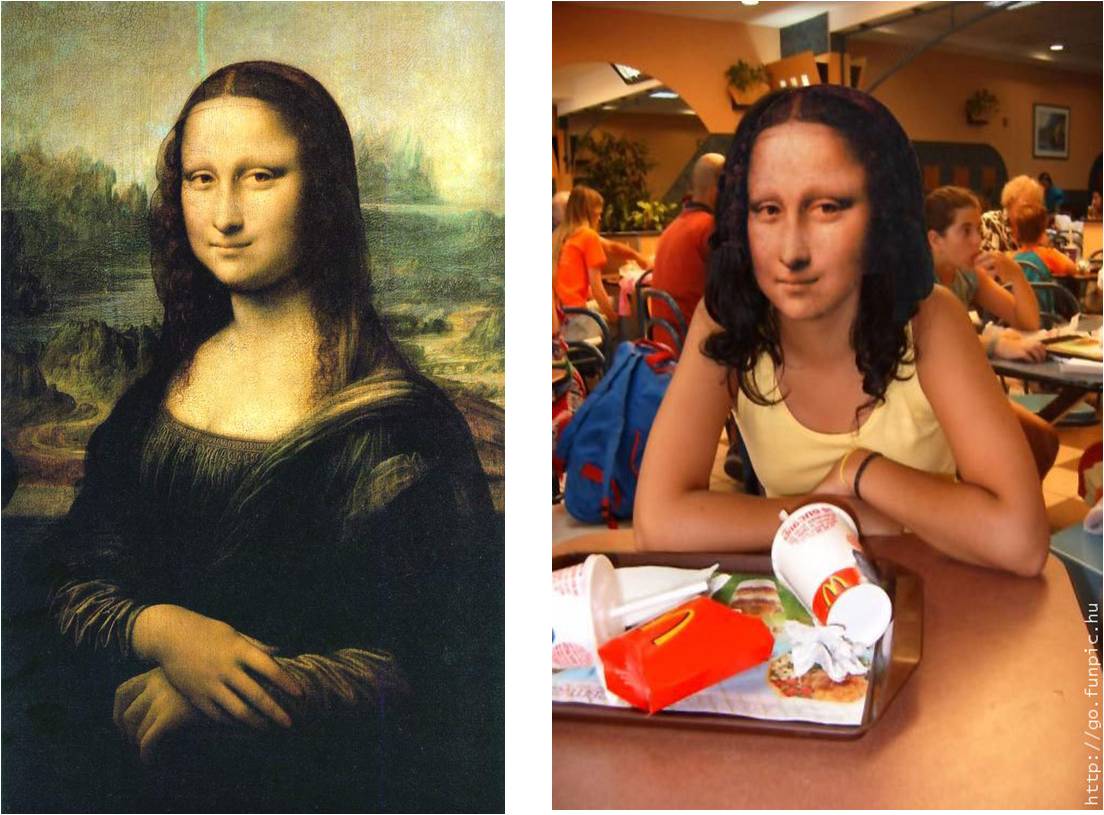
It was on March 12, the first day of the conference after the key speech by Prof. Alan Maley and a plenary session by Dr. Kirk Branch, I had a paper to present in one of the buildings of a nearby college. I was delighted to have about 35 participants to join the creative writing activity with me “Using a Picture to Stimulate Creative Writing.” I was very much impressed by participants who paid a great attention to the activity. While making a presentation, I wondered if the picture would be too difficult for them to write on or not. But, with their abilities and talents, it was obvious that they could write poems and short stories rapidly and colorfully, indeed.

Here are some of the poems on the pictures that they composed during the session and that I would love to share with you hoping that you may also try writing:

My Heart Says  

Oh, Dear
You look as fresh as dew
I don’t have many words to say
But only few
You are the old one for others
But in my sight, you are always new
I am the sky, you are my moon
When I see you, I forget the morning or noon
I have devoted my heart to someone and that is you
No matter you love me or not
But dear, really I love you

(Krishna Chaudhary)

Mona Lisa’s Change  

Oh, Mona Lisa
Pure and pretty woman
You’re born in a palace
And you end in the Mc Donald’s
Why you change your life?
I know well, my Mona
You don’t like the servants
You just wish a coca- cola!

(By Spanish participant)

……………………………….

What eyes she has,

What eyes!

It’s hardly a surprise

That millions have looked into them –

She looks so calm and wise.

But if, by some strange chance

We passed with a quick glance

Today,

Would we even spare the time

To ask her for a dance?

Or simply walk away?

(Alan)

………

And my friendly souvenir to you:

Let’s Smile!

Nothing to pay
When you smile.
So, let’s smile.

Something you gain
Is friendship
Hope
Joy
Peace
So, let’s smile.

Anything makes you pain,
Forget it awhile.
So, let’s smile.
Smile! Smile! Smile!
(Kanokon Opasmongkonchai)

Pictures used in the workshop:
Picture1

To my mind, participants were quite active and confident of doing the activity with me. They had proudly presented their writings. It was very nice that they had different views-points to write, so it made the workshop more interesting, making me feel that they could secure their own space for potential writers to grow out of them! Best Wishes!!

After the paper presentations on the first day, we got back to the Town Hall to observe the cultural program held by cute school boys and girls. Several times they got me to feel like singing and dancing next to them. They sang songs and danced so well that I couldn’t at all feel how swiftly time had flown away. I also learnt about the diverse cultures in the country through their dresses.

On the second day just before the closing ceremony we had another literary taste. It was a poetry recitation. Several participants including Prof. Maley, Dr. Branch, Prof. Bhattarai, Dr. Rai recited their poems in different languages – English, Nepali, Bhojpuri, Maithili, etc. Although I could not understand the poems in the languages other than in English, yet I could perceive their elegance through the ways they were recited. It was really a good example of multi-lingual harmony in Nepal.

In my view, creative writing is the best challenge to accept if you are learning to write. It requires a great deal of patience as well as love to do that. Maybe love should come first. Self-discipline to practice writing with figurative languages together with observing things around us deeply and correctly with imagination is a very important qualification of being a good creative writer. It is certain that it gives us pain when the idea doesn’t come out and in particular when we write in English, which is not our mother tongue. But, when the good result ripens, I dare say it’s worth it, indeed!

Before taking leave, what I am feeling now is:

Loneliness is…

Loneliness

Is

Fungus:

It’s fast to grow

It’s hard to heal

Its root

Is too deep

To eradicate

And

Ready

To come back

Terrible!

(Kanokon  Opasmongkonchai)

Stay in touch to ward off the feeling of loneliness.

Cheerio!
Blog on Creative Writing Workshop and Conference in Birgunj, Nepal

Li Wei

China

March 9-13th, 2013

This is my fifth time attending Creative Writing Workshop since 2006. I have been to Vietnam, Indonesia, and Nepal with other core group members during the past few years. Birgunj has been my second trip in Nepal. I have had wonderful memories about the beauty of local natural scenery and the hospitality of local people. The experience in Birgunj has deepened the unforgettable impression of Nepalese culture and people.

Every time when I prepared to attend the creative writing workshop, I went through a very energetic and productive period of writing. The time constraints pushed me to engage in the writing, thinking, creating and rewriting cycles. My mind has been occupied by the inspiration of creative impulse and the floating images occurring from my life experience and my imagination. I was often tortured by the writer’s block at the very beginning. Facing the blank paper, my mind was full of unknown thoughts. It seemed so difficult to get started sometimes that I switched to absent-minded state. Usually, the nervous mind got relaxed during the time. Then the inspiration returned little by little and the writing process started from the moment I typed in words on the computer screen. Once I started writing, my hands would be led by the inner talk or ideas appearing in mind. As an effective way for me to keep writing creatively, free writing helped a lot.

Writing leads to rewriting. It becomes much easier to rewrite or revise once there are plenty of words on paper waiting to be reshaped and processed. Our brain works better under a little bit pressure but not so well under an enormous burden of the external or internal pressure. Facing a blank page brings much more pressure for a novice writer, which stops him or her to pick up courage and start writing. While facing a fully occupied written page, the brain is more relaxed and ready to cut dissatisfied parts and add more details from visualization. After some practice, gradually I come to understand the tips of overcoming writer’s block, which are free writing without self-judgment or self-criticism and fast writing without thinking too hard or worrying too much. Free writing and fast writing are the two best ways for me to start writing and keep on writing whenever I face the blank page. In addition, extensive reading and journal writing can also bring inspiration now and then.

Things are getting much easier when the first draft is ready to be read. Revision is cooking a ready-made dish with some sources and refreshing views. Inspiration only comes naturally after racking one’s brain. It is a bit like giving birth to a baby. Thinking is the pregnant process and inspiration is like the hard push. The new-born baby looks ugly as if the first draft seems rough and imperfect at the first glance. Revision and rewriting are the upbringing process, which take a lot of energy of the writer but the writing piece is taking shape after some hard work. In the creative writing workshop, every participant shows others his or her prepared writing as if showing the photos of the cute baby. Then the readers are supposed to give comments or suggestions to the writer.

The communication between the readers and the writers is crucial during the revision process. The writer can receive different opinions from different readers and find out the weaknesses or shortcomings in his or her writing as well as the positive feedback about the writing. The whole communication process is carried out in a friendly and helpful atmosphere. No one should be laughed at or belittled during the mutual comment process. It is often an interesting process to discover how your readers understand your story or poems in a slightly different way according to their own life experiences and cultural backgrounds. If the writing touches the heart of the reader, it can be shared in experience universally no matter which culture it might represent. There are a lot of commonality among human life experiences and emotions. Cultural differences bring diversified settings and environment into the story and show various mentality of the main character, but the basic emotions are in common.

In our creative writing workshop we worked as a team. We read one another’s story and poems, and then we gave our comment to the writer. I could often learn a lot from my readers and realize how to revise my work. For example, as core group members, we were required to write about a picture called Nighthawks. It was interesting to discover that everyone saw the same picture in different ways. Although the main theme was the same about solitude or loneliness, the writers in different ages and from different cultural backgrounds did illustrate the picture in their own way. It was inspiring to read various poems written about the famous painting Nighthawks. The universal emotion of human being was very influential and powerful. Writing from observing a picture was also an effective way to learn to observe carefully and write something out of box. The picture was the stimulator and the restraint. We need to observe the characters in the picture and we also need to think imaginatively out of the picture. As creative writers, we should not be locked into the picture itself like the main characters in it, but we should jump out of the frame and write something unseen.

Talking about my presentation during the concurrent session, it had attracted a roomful of audience and most of them were students in the university. They were eager to listen to my talk and I could feel their enthusiasm from their eyes. I divided my talk into two parts. The first part was about what creative writing meant to me. I thought creative writing had made me love writing much more than before. It was a process of learning to write and also a process of self-discovery. Whenever I tried to create a character, my life experience and people who were familiar to me were jumping into my mind. I thought creative writing could not come from an empty space. The seeds of a story must lie somewhere in our daily life. Through reflection and observation, stories would take shape in some way or another. The second part was about activities which could be used in English writing classes of different levels. Even some very simple activity could lead learners to create unexpectedly beautiful poems through right guidance. For example,

‘When I think of …

I can see…

I can smell…

I can taste…’

One girl in my presentation room wrote about sunset in the form of the above simple pattern. It was so beautifully written that I could not help offering my praise to her in front of the audience. Her poem really inspired me to use the simple-form poem activity with more advanced students because their imagination and language expression were more interesting in a way. Although the form could be simple, the ideas and the feelings were thought-provoking without limitation. Once learners knew how to play with words within the restraints of the form, their thoughts and imagination could be as flexible as the flowing water which could be filled into any shape. I felt the most rewarding experience of doing creative writing was that the potential inner creativity of oneself could be stimulated in the process of word play. The sense of achievement was fulfilling for most English learners. To find your own voice and express your inner thoughts in a foreign language were very challenging as well as exciting. The happiness of composing a short poem or a short story was so strong that the painful producing process seemed bearable.

In a word, the Birgunj Creative Writing Workshop and Conference were very successful and unforgettable with the help of many organizers and participants. I believed that there would be more creative writers appearing in Birgunj who would love to share their stories and their poems with the rest of the world in both Nepalese language and the world language English. Let’s write and enjoy!

How to use Newspapers in ELT


Praveen Kumar Yadav
praveenkumaryadava@gmail.com


Background

Teaching English through the use of authentic materials can prove effective, creative, innovative and interesting for both English language teachers and learners. What we mean by authentic materials in teaching is the materials that have not been designed for teaching purpose. For example, a letter written by your friend, a press release, a notice and other materials that are not meant to have developed for teaching can be authentic materials for English language classroom.  Teaching English through the use of newspapers in ESL/EFL class is one of the popular sources of authentic materials.

A newspaper refers to a printed publication daily or weekly containing news, advertisement and articles on various subjects. The NEWSPAPER has an acronym in which ‘N’ stands for North, ‘E’ for East, ‘W’ for West and ‘S’ for South respectively. That is to say, the newspapers report the incidents from all four directions of the place or the world.

Newspapers, obviously, are authentic teaching materials for English language classroom. They can be used for a variety of purposes in English language teaching. For example, they can be used to motivate students, to present new structures and practise them, for communicative activities, for teaching free compositions writing and vocabulary and so on. The newspapers include different sections and columns like editorials, news, book review, advertisements, condolences, letter to the editors that can be cut out for preparing different teaching materials for ESL/EFL classroom.

Unlike most language textbooks, this information builds from day to day—what is learned in reading a story today can be applied to an updated version of the same story tomorrow.

In other words, the newspapers are more current and updated in comparison to the course books.

Suggested Activities

  1. 1.      News in Brief

    In some newspapers e.g. Newsdigest as in The Kathmandu Post, there is a ‘news in brief’ section consisting of many short news items (one paragraph each).

–         Give each pair of learners one of these news items for reading

–         Ask them to write a headline for it on a separate slip of paper.

–         Collect all the stories and the headlines.

–         Paste them on the board or put them on a table and ask learners to match the stories and the headlines.

  1. 2.      Caption Writing

–         First of all, let the learners read the captions under the photos and learn the structures and patterns used.

–         Assign them to write the caption of some photos

–         Collect the captions written by the learners and paste them on the board to decide the one which is the best of all.

  1. 3.      Letter to the Editor

There is a letter to the editor section in each and every English Newspaper. For example, Voice of the People in The Kathmandu Post, letters to the editor in The Himalayan Times.

–         Direct learners to the letters to the editors section of the newspaper.

–         Ask them to read some of the letters and discuss in pairs which ones they find most interesting/ controversial/ easy to understand. Feedback on this as a class. There is often more than one letter in the letter to the editor section that can spark discussion or a controversy.

–         Now ask learners to write their own letter to the editor. They can respond to one of the letters on the page, or they can write about a recent news item. They must write between 25 and 75 words. When they have finished, ask them to compare letters with a partner and try to peer correct any big mistakes. Circulate and monitor. Then post the letters to the editor around the class. If someone responded to an earlier letter then they should copy and cut out the original letter to which they are responding.

–         If possible, email the letters written by the learners to the respective newspapers. If published, they will be encouraged and it would also act as a reward to them.

–         Ask the learners to read the news or article and let them write a letter to the editor responding the news and article.

  1. 4.      What’s this?

–          Cut out some photos from various newspapers (not necessarily English newspapers) of recent news items which are familiar/ relevant/ of interest to your learners.

–         Put the learners in pairs. Demonstrate the activity by holding up a picture.

–         Let them speak and describe what is in the picture (there is… there are… a man is talking… two women are walking….)

–         Speculate about what the news story could be (it could be… it must be… he might be…)

–         Ask learners to do the same with their picture in pairs. As a follow up they could write the caption for the photo on a separate piece of paper. Collect the captions and photos. Redistribute them to the learners, who now have to find the photo to match the caption.

  1. 5.      Newspapers as a prompt

We can always use newspapers as a prompt to start a discussion on a given topic. Just as we would show a picture of something to prompt discussion, do the same with a newspaper article. If our aim is discussion and speaking skills, then why not use a newspaper written in the learners’ L1 to prompt discussion? Learners will be able to skim an article much quicker in their own language, especially at lower levels. If the issue is local, all the more reason to do so.

A variation of this would be to ask the learner to read something from the newspaper in their own language and explain it to you in English (of course this works best in small classes or one to one classes).

  1. 6.      Newspaper as a prop

We can use a newspaper in class without learners having to read it at all. For some role play speaking activities give out props. For fidgety learners, having something to hold while they are speaking can help!

For example, role-play a conversation between two people over a coffee in the morning. To help them get started, give them the following options to start a conversation:

A (reading a newspaper) – Can you BELIEVE this?
B – What is it?
A – This is an outrage. Listen to this…
A – Are you listening to me?
B (reading a newspaper) – Hmmmm?
A – I was saying…

  1. 7.      Role-play the news

    Choose an interesting article or story from the newspaper and make enough copies for every pair of learners. There are often “human interest” stories in the newspaper which adapt themselves well to role play (“Man finds long lost brother”; “Lottery winner buys a house for pet dog” etc.). Ask learners to first read the newspaper and then improvise a short role play. Role plays from newspapers are often conducted one of two ways: 1) one learner plays the journalist and the other plays the protagonist of the story; the journalists does an interview, or 2) learners each take the role of a person in the story and act out the story, or something that happens before or after the story.

8. What’s in the news today?

– Distribute the newspapers, one for each group of two or three learners.

– Tell them they have a time limit with which to skim through the newspaper.

– When the time limit is up, ask two groups to get together and report to each other   everything they remember that is in the news.

They must do this in English, and cannot refer to the newspapers (this is important, because otherwise we may get one or two learners who bury their heads in the paper and don’t participate!). Do feedback as a whole group. This is a combined reading and speaking activity, although the time limit forces learners to use the reading skill of skimming.

9. Newspaper show and tell

Give each learner a newspaper and tell them that for homework, we would like them to take the newspaper home, choose an article and prepare a report on it to classmates. The report must be no longer than five minutes, and should include peer teaching on new vocabulary that the learner encounters in their article. This encourages reading outside the classroom, as well as dictionary use. Set up a schedule and have the last five minutes of every class devoted to news reports by a learner or learners and make this project part of our class routine.

10. Newspaper Quiz

Give each group of four or five learners a newspaper and a piece of paper. Tell them that they have ten minutes to make a quiz based on that section of the newspaper. Suggest different kinds of questions, e.g. How long has X been… Where is …? How many people…? What happened in …? Who is…? Who won…? How much did…pay/cost…?

In groups, learners write six questions. Circulate and monitor, checking the grammar and spelling in the questions (and making sure that questions are not too difficult!)

When the groups are finished, they pass the paper and the questions to another group. Set a time limit for new groups to do the quiz. Repeat the process if you have time. Do feedback and check the answers to the quizzes. This is good to practise the reading skill of scanning for information.

These are not only the exercises that can be used for English language teaching using the newspapers. A number of creative activities for different language skills can be prepared based on the different items of the newspapers.

Conclusion 

Newspaper is a useful tool in the ELT classroom for improving reading skills and enhancing students’ knowledge of current affairs. However, it depends on the teacher or facilitators how they work out with the newspaper materials. Therefore, they should be able to select the items that suit the need of the language learners. They should keep in mind that learners should be left free to select an article that interests them, work on it and report back to other learners. They should get learners to read outside the class as much as possible.

If we teachers can get our learners to regularly dip into English newspapers, their reading skills, writing skills and vocabulary will improve.  We can talk about reading and comprehension of English texts with our learners as well, and share strategies that they use while reading. If used in a more inspiring way, newspapers can help both the teachers and learners achieving their goals.


Teaching Language Functions as a Broader Concept

Mandira Adhikari

As a student, I learned English largely through Grammar Translation method, but when I studied the subject “ELT Theories and Methods” in the university, I became aware of much better methods for teaching English. As a result, when I started teaching, I was able to teach my students by using communicative and other methods. I used language functions as a key concept to teach communicative skills, and I found teaching language function very much helpful to develop the other language skills of my students and after a short period of time they were able to speak in English. However, when I studied advanced ELT Methods in Kathmandu University, I began to wonder if role play is sufficient for teaching language functions? Are there other alternative methods for it? How can I develop other skills with the help of language functions?

What are language functions?

In order to do anything with and through language, we take help of the certain exponents of language. The purpose of language use is called language function. As Blundell, Higgens & Middlemiss (2010) state, we only speak or write with a purpose in mind: to help someone to see our point of view, perhaps or to ask their advice or to reach agreement with them.  The functional use of language is not only based on certain language structure or grammatical rules, it is how we understand the context and use the language in order to fulfill those purposes. For example, sentences in the imperative form may perform a variety of different functions:

Give me your book. (Order)
Pass the pen, please. (Request)
Turn right to the corner. (Suggestion)
Come to visit us on Saturday. (Invitation)

The above exponents are used by the speaker of language in different situations. Thus, language function refers to the purpose for which an utterance for which a form of language is used as a means of communication.

Stages of teaching language functions

Teaching language function is very similar with teaching grammar. There are three stages of it. The three stages are described below:

Presentation

This is the first stage of teaching language function. In this stage, the teacher presents a language function either in a dialogue form or by creating context. S/he holds discussion with the students regarding the possible exponents for the language function to be taught. This stage can also be taken as a pr- communicative activity as it is a pre-step to develop communicative activity. Some of these activities are; Contextualization, Description of the social settings of the language use, Motivation and preparation, Identification of the participants, Setting, Acting emotion, determining purpose etc. Doff, Jones & Mitchell (1997) says “This stage is concerned with controlled practice of a new language. It ranges from simple manipulation of structures to more imaginative practice in which students use language in real life situation” (p. 9)

Thus, in pre- communicative activity, the teacher creates the context and provides description on where to use such language function or in which situation.

Practice

At this stage, the students are given opportunity to practice language function presented. For this purpose, they may be involved in pairs to conduct mini – dialogues. They practice the language function by means of mechanical, manipulative or communicative drills. In this stage, they mainly memorize as well as learn how to use different exponents and realize their meaning.

Production

This is the last stage of teaching a language function which focuses on using the new language function, in free or real life situation. Richards (2006) says that students practice using the new structures and in different context often using their own content or information in order to develop fluency with the new patterns. Thus, this stage focuses more on the fluency of the language rather than accuracy. Thus, this stage is also known as communicative stage. In this stage, students can be asked to work in pairs or a small group to share the ideas. Some of the activities of this stage are; mini- exchange, role plays, oral games, guessing games, interviews etc. (Note: An example of teaching language function for class nine students using these three steps are presented in appendix).

Some other activities for teaching the language functions

Though the P-P-P model is very popular in teaching language function, it is criticized for being limited in certain functions. (Skehan (1996), as cited in Richards (2006) says “The underlying theory for a P-P-P has now discredited. The belief that a precise focus on a particular form leads to learning and automatization”. Thus, only the three stages of presentation practice and production is not sufficient for teaching language function.  Role play is very popular activity to develop language function. More than role play, there are other activities which are very helpful to teach language function. As it is very similar with teaching grammar, we can utilize the techniques of teaching grammar for teaching language function. Ur. (2003) has presented different types of grammar practice such as: awareness, controlled drills, meaningful drills, guided or meaningful practice, discourse composition and free discourse. Among these activities, drills, discourse composition and free discourse are really helpful to teach language function because while writing the discourse students should use different language functions that are used in our daily life. Highlighting the focus on meaning and situation of language used, Doff (2010) says that there is a way to show meaning through a situation i.e. to think of a situation from outside the class, in which the structure could naturally be used which may be real or imaginary. So, a teacher can create a context and ask students to use different language functions in those contexts which also can be a technique of teaching language function. Moreover, some other techniques of teaching grammar are presented below:

Information gap activities

It is an activity in which a learner knows the information but other does not know.  It is necessary for communication to occur so that the listener actively decodes and reacts. Then the listener speaks becoming the informants for a while. Some of the information gap activities are; discovering missing information, discovering secrets, the role of customer and shopkeeper.

Pair work or group work

The teacher can provide a situation and language function and ask students to discuss that situation and develop dialogues according to the context and present it in front of the class.

Strip story

Strip story is a technique of presenting a story part- wise in a small slips of paper called strips. This activity is also helpful to develop communicative activity among the students because students need to discuss in pairs where there can be interaction, thinking and sharing. While sharing the ideas they need to use different language function such as describing, negotiating meaning etc. students also develop problem- solving activity from this technique.

Communicative drill

This is also a technique which is very helpful in teaching language function. It is a type of drill in which the type of response is controlled but the students provides his or her own content of information. For example:

Teacher                                                                                    Student

What did you do after breakfast?                                           I —————

Say how you greet to your teacher in the morning.                    ————————–

Thus, this type of drill is also very useful to develop communicative skill of the students and can be used as a technique to teach language function.

Problem Solving

The teacher can provide a problem in groups so that they should have to do lots of interaction and while interacting with their friends they should use different language functions. For e.g.; requesting, description, questioning, refusing etc. thus, this is also a helpful technique to teach different language functions.

Communicative Games

Communication games are designed to provoke communicative activity among the learners. For e.g. oral games, guessing games, solving the puzzles etc. they are very helpful to teach language function as well as to motivate learners towards learning.

Oral Speech (telling stories or experiences)

While sharing experience or the story among the students, they need to use different types of language function which is more helpful to develop the use of language function. Thus, it is also a technique to develop communicative skill of the language with the help of language function.

Developing other language skills

Teaching language functions is very helpful to develop other language such as: listening, speaking, reading and writing.  When we are teaching a language function we can develop other language skills as well and it is the most important aspect of language to develop other language skills.

The main aim of language teaching is for communication and communication of language can be developed when we learn to use language in different context and language function is the way to develop communication among the learners. My experience as I have presented above also shows that teaching language function can help developing speaking skill of the learners. Similarly, above mentioned methods not only help in developing speaking skill but the other skills as well. For e.g. when we are using strip story technique students should speak in order to communicate with their friends as well as they should develop a story based on the strips so that they will use different language functions while writing. They should listen the response of their friends as well as it may be necessary sometimes to read in order to complete the task.

Conclusion

The basic model of teaching language function can be the P-P-P model as in grammar teaching which means presentation, practice and production. Any language function can be taught being based on this model in an effective way. Regarding the techniques of teaching language function, role play is a very popular technique however; there are other techniques such as: strip story, communication games, communicative drill, oral speeches, information gap activities, pair work or group work etc. We can use these methods to teach language function to our learners. Moreover, while teaching language function to our learners we can develop other language skills as well.

References

Doff, A. (2010). Teach English. New York: Cambridge University Press.

Doff, A., Jones, C., Mitchell, K. (1997). Meanings into words (teacher’s book). New York: Cambridge University Press.

Richards, J.C. (2006). Communicative language teaching today. New York: Cambridge University Press.

Ur, P. (2010). A course in language teaching. New York: Cambridge University Press.


Research for Tertiary Level Presenters

Hem Raj Kafle

This article presents basic ideas of research based on my experiences of teaching a tertiary level course in English communication skills. The purpose is to outline some down-to-earth steps to address the presentation needs of students with moderate competence and performance.

What is research?

To start with the relatively obvious, research is as simple as trying to find a little more than what removes confusion.  It is the attempt to know things to the extent of being able to claim ownership and originality. The teacher can make it a point that presenters must know much more than they present. So, the only basic value to emphasize would be what Booth, Colomb and Williams (2003) postulate about research as the attempt to “free yourselves from ignorance, prejudice, misunderstanding and the half-baked ideas that so many charlatans try to impose on us,” and to “improve not the whole world, but at least your corner of it.” This at least would not sound idealistic given that the tertiary level orients a considerable portion of curriculum to research-based projects, and that the students are already prepared to face a professional work environment ahead.

I propose that the teacher encourage students to work on three main factors in the form of a research activity – knowing the audience, finding and organizing the contents and determining right strategies.

Knowing the audience

Research starts with the care for the audience. A presenter should work with the awareness and recognition of audience in view of their interests, orientation and competence on the subject being presented. Siddons (2008) contends, “Not knowing your audience is lethal. How can you engage people if you don’t have a clue what really interests them?” Knowing the audience requires a process of listener analysis, which according to Careers Skills Library (2004) involves the following considerations:

Ask yourself the following questions: What do my listeners want to know? If you don’t provide information that interests them, you’ll put them to sleep. Find out what they care about and cover this material in your talk. … How much do they already know? They may be experts or they may know almost nothing about your topic. You don’t want to “talk down” to your listeners. But you also don’t want to speak over their heads. Determine what your audience knows and pitch your talk to your audience’s level of understanding. Where do they stand? Your listeners may be likely to agree with what you’re saying, or they may need a lot of convincing. Find out their attitudes; then determine what to say to persuade them of your point of view. [emphasis added]

Search for contents

In addition to the knowledge of the nature and needs of the audience, research entails a thorough search into the content itself. The following three steps would help develop the contents of a presentation.

Somewhere to go:

Research should involve movement, both physical and mental. Even while you are surfing the internet you are moving, or navigating. In addition, you may travel to search for facts and figures, to take samples and to gather data. Going to library from your residence, going to the study from the living room – all comprise the action of going, the bottom-line for research. When you go out, you use your senses to perceive the world outside. You see, hear, touch, smell and probably taste things. Activation of senses helps you get the fuller picture of the phenomena you are exploring. The result is you experience your subject well, and will later present it with great involvement and positive attitude thereby activating your thoughts and polishing language competence.

Someone to talk with:

Research involves interaction with people. The basic purpose of such interaction is to include people’s minds in your venture for finding more knowledge.  This can be done both formally and informally. Talking formally refers to interviews or (focused) group discussions. Informally, it is more than structured interaction. What about asking people where a certain place is, whether such and such book is available or even whether there is someone who knows the subject more? And it does take into account the queries to the instructor or anyone she refers to. Even the SMSs, chats and emails may have substances. Meeting and knowing people both opens up the avenues of new resources and offers opportunities for building a professional connections.

Something to read:

Reading sounds simplistic; anyone at the tertiary level does read. But do students read enough in order to build competence in communication and learn new things beyond the curriculum? Most student presenters start in complete ignorance of what to do. A few get ready with very personal subjects like their most favourite (place/celebrities/idols) and the most unforgettable (events/days/experiences) which may not involve further study.  But the teacher should set a bottom line. In the beginning, the teacher must solicit the presentation all the way from the choice of a topic to final delivery. Thus reading should be compulsory so that it will involve learning. It should teach new ideas as well as ideas of oral communication.

Reading can include multiple types of texts: guidelines for presentation skills (preparation and delivery), handouts on a topic for students who have already got topics, list of possible topics for those who have not fixed them, interesting texts to get ideas on a possible topic, and even a list of things to do before ending up with an idea – visit library, talk with someone, see samples of earlier presentations, among others.  The texts can be of any length and genre: anything that one comes across once the ‘unrest’ and curiosity about a topic starts. It can be a piece of newspaper article, texts on a hoarding board, an advertisement slogan, writings on a new brand T-shirt and so on.

Beyond content

Researching through physical mobility, interaction with people and reading of relevant materials enables presenters to internalize the contents of presentation. But research must involve more work beyond the content.  Because it is a tertiary level class and students are already conscious of building professional attributes, they should be asked to develop certain strategies of organization and delivery. What would be the most appropriate beginning given the nature of the content and audience? What would be the degree of formality/informality both in demeanor and language use? What aids (handouts, chart papers, multimedia) are relevant to facilitate the presentation and audience involvement? What jokes, anecdotes and facts would embellish the content as well as trigger the audience’s positive attitude?

Research is inevitable for developing original content, for competence in knowledge and confidence in delivery. It helps build up credibility in the presenters by according them sincerity and diligence.

 References

  •  Booth, Wayne C., Colomb, Gregory G., & Williams, Joseph M. 2003. The craft ofresearch. 2nd ed. Chicago: University of Chicago Press.
  • Careers Skills Library. (2004). Communication skills. 2nd ed. New York: FergusonPublishing Company.
  • Siddons, Suzy. (2008). The complete presentation skills handbook. London: Kogan Page Limited.

An incident that changed my attitude: Remember to check homework

-Madhu Neupane

If we are asked to list some of the things that learners should do to improve their learning, I think we would not miss to say that they should do homework regularly. Though we teachers have our own assumptions and attitudes about different things, we have positive attitude about giving homework in one form or the other.

We are aware of the advantages of homework. We know that it promotes the practice of independent learning; helps students to reinforce basic skills learnt during school days; allows them for the use of resources and materials not available in the schools; provides parents with information about the progress of their children; provides appropriate opportunities for long term research; provides opportunities for teachers to differentiate work for children.

These benefits can be categorized into immediate benefits (better retention and understanding of information, development of critical thinking and concept formation, and improvement in processing information) and long term benefits (encouragement to learning, improved attitude towards schools, and better study habits and skills). Furthermore, homework is supposed to have long term non academic benefits such as greater self direction and self discipline which we want to inculcate in our learners.

Giving homework is not sufficient. Equally important is the checking of the homework. It is necessary to check homework to reassure learners that what they have understood is right; to provide repeated exposure to aid acquisition; to provide them with a record of correct language for future reference; to encourage thinking about why an answer is correct or how they have reached a particular answer; to provide support for different levels of learners; to provide them with a sense of satisfaction from discussing and sharing something they have spent doing; and to allow learners to play an active role throughout the learning process by encouraging learner independence.

What impact does it have if you give homework but do not check it? Even a single event or incident may bring a great change in our life. The same thing applies to teachers as well. I want to relate this to one of the incidents that changed my attitude towards homework checking. For this reason I want to call it a success story. This has been a great lesson for me who used to sometimes not check homework because of lack of time or other thing.

One day I was teaching in my bachelor first year class. The learners in that class came from very diverse backgrounds. Especially they were from the government schools in rural areas so we can mostly imagine their level of English. Some of them were really good. I encouraged them to take homework every day and do whatever they can at home. One day I gave them a homework that was solving exercises given in the book and said that if any one of them did not do homework I would proceed without doing the lesson for it was also their duty to do some reading themselves. Next day I checked the homework and found some of them not doing the homework. I told them to do the same task again by convincing them that it did not matter if their answers were wrong. What mattered was their attempt. They seemed to have been convinced.

The next day I had to attend a meeting with the head of the department about terminal exam so I went to the class a bit late and started the lesson. That was a reading lesson. I did not care about the work that I had given to the learners. While I was about to leave the class one of the learners stood up and said, “Madam I stayed up to 11 O, clock to do the homework. There was load shedding (power cut) so I did my homework with the help of candle. I had to prepare for the class test of other subject but I felt so strongly about the work that I did it even putting the task aside. But unfortunately you did not check the homework today. I would not do homework next time”. He said this with tears in his eyes. I felt so guilty that I put my things on the table again and put my hand on his head.  I said “Sorry Rabindra, I just thought that I would check your homework next time. Take out your homework. I would check it now”.  He took his homework out of his bag and I checked that. He had done it very well. However, he was not happy because he realized that I just did this because he had said so. I left the class with a feeling of guilty.

In spite of giving me a sense of guilty, this incident had really positive impact on my attitude towards homework. So, I want to recall it as one of the success stories in my teaching experience. It taught me the lesson that checking homework is very important.  From that day onward I have felt so strongly about the work that give that I never miss to ask whether the learners have done the work that I gave them and give some positive comments on that. It does not take me much time. Sometimes, I just have a look on their work going from front to back. If I think some learners have done it really well I read it for the whole class and if most of them have got it wrong I provide possible answers on the board.

I have found that going through learners work very quickly if we do not have time to go thoroughly can have surprisingly good impact on learners. It gives them a sense of achievement. That is, I think, greater learning experience than anything else. Since the success is the accumulation of small steps we should not forget that “small things matter”. Checking homework may just be a small thing in leading learners towards a greater success.

=====================================================================================

Ms. Madhu Neupane (Bastola), Lecturer, has been teaching at the Central Department of English Education, Tribhuvan University, for 6 years. She completed Master’s Degree in English Education in 2003 and Master’s Degree in English Literature in 2008. She has published some articles and books and presented papers in different conferences. She has experience of teaching English from Primary Level to Master’s Degree. She has conducted some research in the area of ELT. At present she is an executive member as well as life member of NELTA. Her interests include teaching and conducting research in ELT.

For contact:

Phone Number:           01-4332867 (Res) 9841738920 (Mobile)

Email:                           madhukneupane@gmail.com

Skype:                          madhu.neupane2

The Process-Genre Approach: Some Ideas for Teaching Writing in Nepal

Madhav Raj Belbase

Are you teaching a writing course in a college of university in Nepal? If you are teaching in a school, is writing an important component of your language curriculum? Do you help your students write multiple drafts of a text or do you just ask them to submit final versions? Do you only provide a final score on students’ writing or do you provide feedback during different phases of their writing? Do you pay attention to the type of writing genre you are preparing your students for (e.g. emails, letters, websites, creative writing pieces like poems or essays, newspaper editorials, etc) or do you just focus on grammar, vocabulary and spelling? While the curricular mandates, time constraints, and availability of resources will largely determine what you can and cannot do, as teachers we also have a certain level of control over how we want to teach our students how to write and to facilitate their growth as writers.

Here is my proposal for teaching writing in our context—the process genre approach. In my experience, English teachers in the Nepalese context face unique challenges in teaching writing: while teacher education courses expose pre-service teachers with theories and ideas of teaching writing developed in the West, our teachings are mostly motivared by exam-driven product-based writing assignments that encourage students to reproduce what they learned in the classroom. Despite such tensions, “efficient teachers” can implement their “hidden” curricula where they can adopt an eclectic approach to teach writing and prepare students for the global world making them able to write a range of tasks, instead of just memorization and reproduction in exams.  In order to build expertise in such a pedagogic skill, teachers need to be familiar with a range of teaching pedagogy options available to them. Here I try to present a model of an approach called the process genre approach that blends two approaches – the process approach and the genre approach. This approach takes account of different steps, for instance, preparation, modeling, planning, joint constructing, independent constructing, and revising and editing. However, before that I present some major shortcomings of product approach to writing which is dominant in the Nepalese context at present.

The product approach

In the product approach, according to Brown (1994), teachers focus on what a final piece of writing will look like and measure it against the criteria of vocabulary use, grammatical use, and mechanical considerations such as spelling and punctuation, as well as the content and organization. The normal procedure is to assign a piece of writing, collect it, and then return it for further revision with the errors either corrected or marked for the student to do the corrections. This approach has received much criticism because it ignores the actual processes used by students, or any writers, to produce a piece of writing. Yan (2005) claims that it focuses on imitation and churning out a perfect product, even though very few people can create a perfect product on the first draft. Another criticism is that this approach requires constant error correction, and that affects students’ motivation and self-esteem. The product approach does not effectively prepare students for the real world or teach them to be the best writers. I encourage the English teachers in Nepal to critically reflect on their approaches to teaching writing and think about making necessary changes.

The process approach

The process writing originated in the first language (L1) classroom, where it was developed in reaction to traditional types of teaching writing. This approach, for Caudery (1997), assumes that writing normally takes place through the making of series of multiple drafts of text. The process approach identifies four stages in writing- prewriting, drafting/composing, revising, and editing. These stages are recursive, taking place many times over in the course of composing. This approach emphasizes revision, and also feedback from others, so students may produce many drafts with much crossing out of sentences and moving around paragraphs. The correction of spelling and punctuation is not of central importance at the early stages. Caudery (1997) points out that the process approach is in many instances potentially extremely motivating and, to teachers and students alike. Most often it involves students in new and stimulating learning experiences. Peer feedback, for instance, is which students show each other their writing and obtain comments on it.

The genre approach

The genre approach to the teaching of writing developed as an approach inAustraliain the 1970s which is now gaining recognition throughout the world. By investigating different genres such as essays, editorials, and business letters students can perceive the differences in structure and form and apply what they learn to their own writing. Following Cope and Kalantzis (1993), the genre approach to writing consists of three phases: (1) the target genre is modeled for the students; (2) a text is jointly constructed by the teacher and students; and (3) a text is independently constructed by each student. Badger and White (2000) support that the approach acknowledges that writing takes place in a social situation and reflects a particular purpose and that learning can happen consciously through imitation and analysis, which facilitates explicit instruction. This approach seems more capable in showing students how different discourses require different structures. In addition, introducing authentic texts enhances students’ involvement and brings relevance to the writing process.

The process-genre approach

Today many ESL researchers have recognized that the teachers should not rigidly adopt just one approach all the time in the writing classroom. I also encourage English teachers in the Nepalese context to reconsider their own current practices and welcome insights from this model of teaching writing. Combining of approaches results in a new way of thinking about writing. One example is synthesis of the process and genre approaches, which Badger and White (2000) have termed the process genre approach. This approach allows students to study the relationship between purpose and form for a particular genre as they use the recursive processes of prewriting, drafting, revision, and editing. Using these steps develops students’ awareness of different text types and of the composing process. The different activities included in this approach ensure that grammatical and vocabulary items are taught not in isolation, but in meaningful, interactive situations and derived from the particular genre.

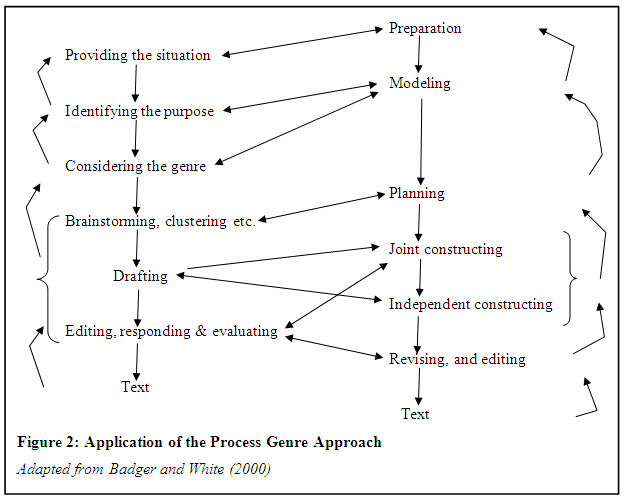
According to Badger and White (2000), the teaching procedure for the process genre approach is divided into the following six steps: (1) preparation, (2) modeling, (3) planning, (4) joint constructing, (5) independent constructing, and (6) revising. Figure 2 illustrates how these six steps interact in a recursive way with themselves and with other writing skills.

A short description of what occurs during the six steps will also illustrate how elements of the process and genre approaches work in unity.

Preparation

The teacher begins preparing the students to write by defining a situation that will require a written text and placing it within a specific genre, such as a persuasive essay arguing for or against an issue of current interest. This activates the schemata and allows students to anticipate the structural features of the genre.

Modeling

During this step the teacher introduces a model of the genre and lets students consider the purpose of the text. For example, the purpose of an argumentative essay is to persuade the reader to act on something. Next, the teacher discusses how the text is structured and how its organization develops to accomplish its purpose.

Planning

This step includes many meaningful activities that activate the students’ schemata about the topic, including brainstorming, discussing, and reading associated material. The aim is to help the students develop an interest in the topic by relating it to their experience. Since they have to participate and contribute in the classroom, learners will find the activities interesting and entertaining.

Joint constructing

In this step, the teacher and students work together as a beginning of writing a text. While doing so, the teacher uses the writing processes of brainstorming, drafting, and revising. The students contribute information and ideas, and the teacher writes the generated text on the black/white board. The final draft provides a model for students to refer to when they work on their individual compositions. It fosters collaborative writing. This step can be boosted by providing a very caring and sharing environment by the teacher. This step will provide students with a chance to write in a group and to prepare them for individual work.

Independent constructing

By this time students will have examined model texts and have jointly constructed a text in the genre. They now undertake the task of composing their own texts on a related topic. Class time can be set aside for students to compose independently so that the teacher is available to help, clarify, or consult about the process. The writing task can also be continued as a homework assignment. The teacher has to clarify what students should do for writing homework.

Revising and editing

Students lastly will have a draft that will undergo final revision and editing. This does not necessarily mean that teachers have to collect all the papers and mark them one by one. Students may check, discuss, and evaluate their work with fellow students, as the teacher again guides and facilitates. The teacher may make an effort to publish the students’ work, which will impart a sense of achievement and motivate the students to become better writers. Their final achievement will foster self-esteem among learners as they have produced something.

Final Thoughts

Things are easier said than done. Learning to write in a foreign language is a demanding task that can easily leave learners unmotivated. It can be more discouraging when students are evaluated on the basis of their writing products only, as we now observe in the Nepalese context. To combat this problem, teachers have to play more agentive role in order to empower the learners with their ability to perform real world writing tasks. We are not preparing our students just for exams, but for the global world that may require an unpredictable set of writing skills. We language teachers are the change agents even if our curricula are constrained. Use of the process-genre approach to writing allows teachers to help students recognize the steps they go through to create a written text which should lead to less stressful and motivated writing. The fact that learners are encouraged to discuss, asses, and analyze their own writing made them feel more confident and less threatened. Theoretical ideas can be confusing and conflicting at times; it is the teacher who is responsible for translating abstract ideas into a classroom practice. Further the practice to produce optimal learning benefits, teachers should constantly and systematically record, contemplate, and analyze what they have done in the classroom, and use their reflective experience as a basis for improving their instructional practice.


Works Cited

Badger, R. G. & G. White. 2000. A process genre approach to teaching writing. ELT Journal 54(2): 153-60.

Brown, H.D. 1994. Teaching by principles: An interactive approach to language pedagogy.Eaglewood Cliffs,NJ: Prentice Hall Regents.

Cope, B. & M. Kalantzis. (eds). 1993. The powers of literacy: A genre approach to teaching writing.Pittsburgh,PA:University ofPittsburg Press.

Coudery, T. 1997. Process writing. In Glenn, F. (ed). Writing in the English Language Classroom. Hertfordshire: Prentice HallEurope ELT.

Knowing your role as a teacher: The teaching metaphor project

Bal Krishna Sharma

There are several ways of learning and development for language teachers. For example, you can read articles/chapters and research reports published in journals and books, critically understand the ideas there, and import them to your classroom teaching. You adopt and adapt the textbook ideas rather than picking them up and trying to implement them wholesale. You can also talk to your peer teachers, share teaching stories and experiences, or observe each other’s class and borrow some ideas from there. A third way, which I have recently been relying heavily on is a reflection of my own teaching, critically assessing what worked and what did not in my class, and focus on improving my teaching and tasks next semester.

I taught an academic reading course to international students last year. In order to train myself in teaching reading lessons effectively, I took a second language reading course from a professor at the University of Hawaii at Manoa. This class had several mini-assignments that proved instrumental in bridging my academic knowledge with my teaching experience in Nepal. I will explain to you one of those mini-assignments here, which was called a ‘reading metaphor project’.

Around the beginning of the semester, my professor asked all the students to think of a metaphor that would represent our role as a reading teacher. Many of us chose such metaphors as ‘mid-wife’, ‘football coach’, ‘driver’, and so on. Then the professor asked us to think about refining the metaphor and its meaning, or shifting to a more appropriate metaphor by the time we finish the course at the end of the semester. Following is a description of my metaphor:

I chose two metaphors during this semester. Metaphors are a useful way to compare the teacher’s roles and duties in a reading class. First, I compared a reading teacher with a tour guide. A tour guide shows ways to the tourists who otherwise would have a hard time to travel on their own. A guide shows ways to the visitors, takes to new places, explains the history and importance of those places, and also suggests other places to visit or stay. Then I thought this metaphor is too simplistic. Comparing a reading teacher with a tourist guide is very straightforward and gives more power to the teacher. When I believe in student-centered teaching, I thought I would need to find a metaphor that would minimize the role of the teacher. Then I compared a reading teacher with a ‘walking stick’. I remembered my childhood days and I remembered the tourists from different countries visiting our places inNepal. Everybody had a walking stick with them. Then I also remembered my reading class taught by my teacher. I also reflected on how I taught reading to my students. Obviously, there were differences in my and my teacher’s teaching styles and roles. However, a common thread I could think of was the role of a ‘facilitator’ or a ‘supporter’. A walking stick thus is a support; it does not walk in itself. Second language readers can take the support of the stick. Learning to read is a long journey. I compared reading journey with a trekking of several days. While trekking inNepalone has to climb up the hills through small trails and rarely through steps. There come plain and flat places as well. In case of those straight ways, the role of the walking stick is minimized or sometimes neutralized. Learners of reading are also similar. When there are difficult texts and words, there is a teacher to help the learners in some way: direct explanation of the meaning or teaching the students the reading strategies, for example. But when there are easier texts, the students can read on their own, teacher’s role is minimized.

So what?

Writers in NeltaChoutari have discussed the need to be careful against lifting pedagogical ideas that have been proven effective in different contexts than our own without necessary appropriation, so the concept has floated here as well quite often. I hope that you will find this concrete activity valuable towards implementing the idea into practice. Such reflective practice is useful whether we are novice or experienced because reflection and critical assessment are important for any efficient language teacher. If you are a teacher educator, or a teacher trainer, please try this out in practice and respond to this post with your thoughts so the rest of will learn from actual practice. I am always eager to hear more.


The Power and Potential of the Classroom Collective: A New Approach to Class Participation and Behavior Management


Archana Shrestha &  Sarah Chevallier

In any classroom, there is a constant struggle to balance the needs of the individual against those of the collective. This struggle is visibly manifested in the push and pull between class participation and classroom management, particularly within the context of teaching English as a foreign language in Nepal.

Many Nepalese classrooms are dominated by two equal and opposing forces: the highest and the lowest performing students. Spurred by a system of individual praise, top students dominate class discussion and participation. Conversely, the lowest-performing students, who frequently have no confidence in their ability to answer questions correctly, seek attention (albeit negative) through misbehavior and disruptive tendencies.

The obvious losers in these classrooms are those students in the middle, cowed into silence by the raucous behavior of the lowest-performing, and scorned into shyness by their domineering higher-performing peers. These students rarely volunteer to participate in class activities, exhibit sometimes spectacular reticence to speak when called upon (due to the fact that their errors are frequently mocked by both ends of the performance spectrum, as these dominating forces seek to re-secure attention), and generally display a lack of confidence in spoken abilities, preferring instead to focus their energy on the lower-pressure context of written homework. These middle students form an impenetrably meek and mute collective, unmotivated by the lure of individual reward, given the potential for individual rejection and ridicule.

In our own English classroom, we have decided to address this imbalance through the implementation of team activities to encourage in-class participation, and collective rewards for homework completion. In this way, we hoped not only to address individual needs and behaviors, but also to render the collective mastery of material more effective and class time more productive, as the students would take on the responsibility for participation and behavior management.

Practical Effects of Collective Reward and Punishment

We have found that this method of regularly combining students at various performance levels into teams for group activities and games has proved immensely valuable in our classroom. First, it has served to create a sense of unity and equality, as it impresses upon them that they all have an equal role to play in their team’s success or defeat and by extension in their own individual reward. Students’ immediate focus is transferred from the individual response to team performance – the highest-performing students are no longer able to simply answer every question; the lowest-performing students’ energy is harnessed, directed, and motivated by the promise of reward; and those in the middle (given more opportunities to perform) are inherently more likely to perform well, and their efforts are thereby positively reinforced and more likely to be repeated.

Beyond the innate merit of this team dynamic, however, it has become even more effective through a consistent implementation as a system of reward and punishment. In our classroom, this has taken the form of tracking teams’ wins and losses, rewarding the first team to win a total of five games. After this reward, both teams start again at zero. We have also expanded this concept of teamwork to apply to homework – when all the students have completed five consecutive homework assignments, they are rewarded. If one student does not do his or her homework, the class tally is returned to zero. In this way, homework becomes more than an easily avoided classroom formality – it becomes a class-wide team effort in which their opponent is their own lack of motivation. In this way, students learn the value of consistent and cumulative effort.

Finally, an unintended but certainly welcome effect of this system has been the transferring of responsibility for class behavior onto the students themselves. When misbehavior disrupts a game, or results in the withholding of a game entirely, students become incredibly apt to police one another’s behaviors, attention, and participation. If one student does not complete his or her homework, he or she then suffers the consequences of letting down their classmates. If one student’s disruptive behavior results in the class copying silently from the book rather than playing a game with the hope of eventual reward, that student will hear about it from his or her classmates.

In this way, the collective’s interest polices the actions of the individual, and the classroom dynamic shifts from an individual struggle to a team effort to master English.

A Reflection on Teaching English in Large Multi-level Classroom

A Reflection on Large Multi-level Classroom

Janak Raj Pant

This is a short reflection on my teaching experience in a large multilevel class at university level in Sindhuli. In this piece, I discuss the opportunities and challenges in a large multi-level classroom. My focus is on how large classrooms can be made maximally beneficial for the students. I conclude by emphasizing that all language classrooms are diverse in one or another way and the larger a class the more diverse it is likely to be. It is our level of awareness, attention and devotion as a teacher that can address the challenges of the large multilevel class into opportunities for the students in their learning.

There are varied perceptions of a large classroom among the ELT professional as well as the other stake holders. For a teacher who does different activities for which the students need to move around a class in which such activities cannot be done very efficiently because of the high number of the students is a large class. For a teacher who basically delivers lectures the same class might not be a large class so far he or she is audible, can maintain non-verbal communication with the students, and can monitor the activities of the students. In the both of these contexts, the idea of large class is at substance level different but still it is not different at pragmatic level. So, it seems more beneficial not to leave it to the teacher to define a large class in their context, based on their teaching strategies, the resources available, and the strategies they can execute. As Baker and Westrup (2000) state, ‘A large class can be any number of students, if the teacher feel there are too many students for them all to make their progress’.

The class I am going to talk about is the class of B. Ed. first year students a community college in Sindhuli.  Usually more than 80 students attend the class. It is a class on general English. Different learners have different level of language proficiency varying from beginner to upper intermediate. Some of them study major English while others study other subjects such as Nepali education, population education. I found them differing in terms of their interests. Some of them have keen interest to learn English for academic purpose while others are keen interested in English for communication. However, for majority of them to pass the examinations is the ultimate aim. It is quite significant to note that for some others it is simply matter of formality to attend the class no motivation in learning at all. For some of them, being inside the class is equal to learning, they expect everything done by teachers for their learning expect copying, they remain silent in the class. The peer influence, family background, their own life orientation has deep rooted integrative influence in them. There is even terrible group of the students who have their pleasure in disturbing the class and do not have any intention to study. They just behave like visitors; for them learning is not any goal at all.

However, in spite of limitations like the above, there are a number of good things about large classes. First of all, the learners with higher level of English language proficiency have been good model in the classroom and it is good to push the weaker learners too. The learners with higher level of language proficiency have been the source of motivation for the weaker ones. Actually they are made the source of motivation.

Likewise, the learners with different cultural background have been significant in order to create communication gap in the classroom activities so as to form genuine language learning activities. It is also useful to address and illustrate several social issues in general English course.

In such large classes, I have always found willing volunteers to actively participate in classroom activities. Such classes are livelier than the smaller ones. So, it is easy to move them towards any direction. I have found the students learning from each other. One the one hand, it has been source of motivation for the one who have been supporting and on the other hand, he could support rest of the friends. This promotes mutual learning and challenges each learner appropriately. In this case brighter learners have challenges to maintain their position while the weaker ones have challenge to be as good as the brighter ones.

There is another advantage, such situation reflects real life situation as real life situations are also full of diversities. It has caused a number of challenges as well. First of all, it is quite difficult manage appropriate level of input in course of instruction. It is impossible to satisfy individual need as well. It is so because the same input becomes easy for on group and very difficult for another group. However it is possible to address such problems by some of the ways to make the lesson useful for all the learners in one or another way. Hadfield and Hadfield (2008) have shown the possibility in the following words:

It may feel like an impossible task to try to satisfy all the individual needs of your students, and you are right! But there are some practical things you can do to make sure that there is something for everyone in each of your lessons (p.152).

Similar is the case with other activities. Setting home work is even more complicated. In order to overcome this problem, I usually set the multilevel task and graded exercise to promote independent learning of an individual student. I found learning more useful than in a normal case as because we have variety of learners with the varying with varying expectations.

Having outlined some of the advantages of large classes, let me now turn to the drawbacks of them, because it would be unfair to not do so at the same time. But while presenting the challenges, I will also include how to address those challenges.

In large classes, it is difficult to monitor classroom activities and conduct class progress tests because if the teacher cannot reach all the students in order to monitor and we cannot have enough time for individual feedback and whole class feedback might not be very effective. Gallery walk and group feedback can be helpful for addressing this challenge.

Large classes also make it very difficult to counsel the students individually, mainly because of the number of students. In many cases we might not have detailed information in order to support students. When I teach a large class, I know little about most of my students; as a result, I don’t how to counsel students even if I can manage some time for them.

Sometimes, in large classes, students with low motivation influence the students with high motivation level. There is always possibility that students are influenced by the peer pressure. It is equally possible for the laborious and sincere learners to influence the lazy or insincere ones and vice versa. The existence of the latter case is challenge for me. I have found acknowledging former instance has been helpful and somehow preventive for the latter case.

Students in large classes are often likely to dodge classroom activities and can go off the task. Such class is also likely to go noisy. Immediate performance based task can help us to improve the situation. There are always some late arrivals and some passenger students (the students who enjoy the lessons like passengers view (not focused, not intensive, not rigorous). For me nothing is as helpful as being strict in terms of the norms of the classroom.

In large classes, the teacher always has to speak very loudly in order to be audible in the class. Occasional written instruction and the systematic and consistence use of gesture is significant for me in many cases. The existing diversities in such situation takes longer time and how carefully you design the activities in the classroom the are student for whom it does not become very much relevant. It is also difficult to remember their names which can become another complexity in setting activities and designing the activities.

Obviously, dealing with a large group of people requires a complex set of social and professional skills. Let us take a very simple example. Let us suppose that someone slaps a child. What will he or she do? There are so many possible ways in which the child will behave: the child will flee, will respond violently, will start crying, will ask you  why you slapped him/her, will rush to his or her parents and ask them to slap you in turn, and so on and so forth. The same might be the case of positive response. Let’s say you offer a candy to a child in the street: what will the child do? Takes your candy and thank you, looks at you feels shy and goes away, take the candy and goes away, does not take your candy and says “no thank you”, becomes afraid of you and leaves the place, and so on.

Learners in the class have diverse experience, cultural understanding, self esteem, level of motivation, needs, aims, interests, context, facilities, attitude, etc. So, naturally they are likely to behave differently in the language class as well. The similar is the case even in smaller classes so diversity is the norm of language class rather than the exception. You will have diverse students whatever criteria you use in grouping them. It is essential to some extent as well. So, teaching, more than dealing with people in ordinary situations, requires highly advanced skills.

Larger class exerts some pressure on the side of the teachers to be more efficient and deal with the existing challenges. So, it makes teachers strategic and more competent in their profession.

References

Dewan, S. (2003). Teaching large multilevel classes. Journal of NELTA, 8:158-162.

Hadfield, J. K. & Hadfield, C. (2008). Introduction to teaching English. Oxford: OUP.

Baker, B. & Westrup, H. (2000) The English Language Teacher’s Handbook: How to       teach large classes with few resources. London: Continuum.

Ur, P. (1996). A course in language teaching. Cambridge: CUP.


Bubbles are bound to burst

Eak Prasad Duwadi

Kathmandu University

Be it students or administrators, everyone used to praise me for engaging learners satisfactorily in the class; and I was very self-motivated. In fact, I was started imagining myself to be one of the best teachers in the world. Was I a snob?

Well, I have been teaching English as Foreign Language at reputed schools and colleges in Nepal for more than five years. Besides having degrees, I possess dozens of ELT workshops certificates. Whichever class I go to, learners see me off with broad smiles. Not only they produced what I asked in class but also did every assignment promptly. So I used to feel proud and maintain my learner-friendly status.

However, some time back I had gone for a month long rigorous training along with four other trainees. Besides, theoretical perspectives and language games, we were required to go to real schools along with lesson plans and materials.

It was my first teaching practice of that training. It was also an opportune time to prove one’s worth as a teacher. The instructor and peers would observe the class so as to give feedbacks later. I was so confident that I thought I was the best teacher in the world. I entered the classroom of Grade 10, and started my lesson that had to do with grammar (direct/indirect questions).

As a warm up, I drew some pictures for context setting, and displayed a chart. To my surprise, before I had finished half of the lesson plan, the bell rang, and it was time to wrap up. I felt so guilty that I nearly burst into tears. My ego got dismantled as fragile pane. What I realized was that I was having a vicious circle of self scorn. I was not a perfect teacher as I still had to learn hundreds of methods and countless exposures. It laid bare the threads the fabric of superiority that I had cultivated. Above all I had never thought about timing which is very important. Returning to school, my peers and instructor reflected on my strengths and weaknesses.

I found the first was insignificant in comparison to the second. Obviously, the trainer asked for ‘Repetition’. Although very bitter, I accepted their remarks and promised to do better from another day. It was but another lesson learnt: learning and familiarisation continues all throughout life; and no one is perfect.
