Category Archives: Miscellaneous
Principles of Instructed Language Learning
A Report on 17th NELTA Conference
The following sessions (plenary presentations, workshops, poster presentations, symposium, and papers) were presented in the 17th International Conference (18th -20th Feb, 2012 Kathmandu (Phase I) and 22nd – 23rd, Feb 2012, Chitwan (Phase II))
In the workshop What is a task? Prof Rod Ellis suggested that ‘task’ is a fuzzy construct and that therefore it is not possible to determine whether an instructional activity constitutes a ‘task’ or an ‘exercise’. This workshop provided participants with an operational definition of a ‘task’ and then explored to what extent it could be used to distinguish tasks from non-tasks by examining a variety of instructional activities. In addition, participants examined how they could modify ‘exercises’ to convert them into ‘tasks’.
In the session Consciousness-Raising Tasks for Grammar Teaching, he began by explaining the difference between two types of second language (L2) knowledge – implicit knowledge and explicit knowledge. It then considered the role that explicit knowledge plays in both the use and the acquisition of an L2. One way of developing explicit knowledge pedagogically – through consciousness raising tasks – was discussed in terms of both its advantages and its limitations. A framework for designing such tasks was presented by examining ‘data’ and ‘implementation’ options. A number of studies that were investigated consciousness – raising tasks were discussed.
Angi Malderez in On Stories in ELT expressed, ‘Have we forgotten to use the oldest didactic technique we have? This talk provides a current rationale for the use of stories in ELT. The talk was illustrated by, and demonstrated the use of four stories – one for a primary language classrooms, one for a secondary classroom, one for teacher development, and one for mentor development. Sources for more stories are also provided.’ And in On Noticing she expressed, ‘In this workshop, participants will be involved in exploring the importance of noticing in effective teaching and teacher development, and in some of the many challenges we all face in noticing accurately. How to use what we have noticed to manage our own on-going learning is discussed, and a recent term in education – learnacy – is also introduced.’
In the presentation Vocabulary Building as a Response to Students’ Present and Future Needs Prof F. Stoller expressed, ‘Our students are typically the first to tell us that they are either at a loss for words or that they desperately need more vocabulary. And from our own experiences learning other languages, we know how critical vocabulary is for speaking, listening, reading, and writing. Although students can learn a lot of vocabulary incidentally, through language input, they benefit greatly from explicit attention to vocabulary learning in the classroom. In this presentation, we’ll explore important principles of effective vocabulary teaching and learning that can be used with students at all proficiency levels. Emphases will be placed on vocabulary selection criteria, principled ways to teach vocabulary, teaching techniques for recycling vocabulary, and instructional options that encourage students to see key words in relation to other words.’
In the workshop Techniques for Developing Students’ Reading Fluency she said, ‘Second language reading is a complex skill that requires main idea comprehension, discourse awareness, vocabulary learning, reading strategies, reading for different purposes, motivation, and fluency (Grabe, 2009; Nation, 2009). Sadly, fluency training is often neglected even though research has demonstrated that it contributes to reading comprehension abilities. Teachers sometimes believe that they lack the time to devote to fluency training; they assume that students will develop fluency on their own; and/or they are unaware of the many activities that can be integrated into their classrooms to promote reading fluency. Workshop participants will be introduced to the key elements of reading fluency (e.g., automaticity, accuracy, reading rate, word- and passage-reading fluency) and then explore various ways in which reading fluency can be addressed in the classroom with existing reading materials.’
Aaron P. Campbell’s presentation Guided Imagery for Language Learning focused on the use of text, photos, audio, and video as the primary means of content delivery in language learning. However, how often do we draw upon the imagination of our learners for the same purpose? The presenter introduced a guided imagery technique used in EFL classes with Japanese university students. In addition to giving participants a chance to experience the technique firsthand, the presenter also shared feedback from learners who practiced the technique repeatedly over a semester.
Afsana Laila and Ashik Sarwar’s presentation The Interior of EFL Classroom and the Tertiary Learners in Bangladesh focused on whether there was motivational and de-motivational relationship between the student’s peripheral learning and the interior design of an EFL classroom at the tertiary level. The focus of this study was on the environment, specially, the decoration of the classroom, the shape of chairs and musical background. The survey was on the Bangladeshi tertiary level of education where most classrooms are designed in such a way that they unintentionally develop learner’s tension affecting learning. This study drew on the Suggestopedic method that was concerned with affective filter and positive learning outcome.
Amber Powers’ presentation How to Make Exams Fair and Useful deliberated the assessments that come in all shapes and sizes, but one of the classic assessment tools is the written exam. This presentation discussed the benefits of creating term and mid-term exams and reviewed the rules for designing effective and fair exams for students in English medium classes. Moreover, it also looked at the examples of effective and ineffective test questions and tasks, and reviewed the process for designing, giving, and correcting tests. Amber Powers’ another presentation How to Teach While Students Play focused on all children who are born with a natural curiosity and love of learning. In this session, the presenter discussed easy ways to teach and assess younger students through playful, hands-on activities. They presented real examples from public school classrooms where teachers transform lessons from English medium government textbooks into engaging, rich learning experiences that efficiently teach students important concepts and vocabulary.
Amitpal Kaur’s paper Innovations: Crux of ELToffered some innovative classroom practices for the promotion of originality and divergent thinking through the teaching of English. They include issues like approach to teaching, role of learners, assessment methods and use of language outside the class. Creating humorous situations help to achieve useful results. In that, learners need to be self-motivated and tasks should provide multiple interactions.
Ananda Sharma and Laxman Gnawali’s presentation on Dictionaries and Foreign Language Learning discussed the importance of dictionaries in teaching and learning language cannot be stressed too highly. Often, however, the language users simply confine the use of dictionaries in finding word meanings, spelling and pronunciation. However, in fact, dictionaries come closer than grammars and textbooks to dealing with language as a totality. A good dictionary contains information on grammar, usage status, synonym discrimination, application of derivative affixes, and distinctions between spoken and written English. Such information is barely found in any grammar or textbook even in rudimentary fashion. Thus, the dictionary becomes an indispensable weapon in teacher’s arsenal, and discussions on its preparation and practice seems important in every teacher-training program.
Anil Gaman Ahire’s The Bonding of Culture and Language in the Language Learning Process
dealt with the teaching situation and teaching methods used in English Language Teaching (ELT) that needs to be changed to involve culture instead of language knowledge only. Teachers need to know to what extent cultural background knowledge influences language learning and teaching, and how teachers can take advantage of that influence in listening, speaking, reading, and translating.
Aniruddha Burm’s presentation MI Theory can be Used for Teaching and Learning of English
focused on language games and songs can be very effective tools in language teaching. Visits to places of environmental degradation can be made a source of teaching and learning both language and literature. Group Discussion, debates, quiz programmes, dramatization, seminar etc may be other ways of teaching language and literature. Charts, tables, diagrams, pictures can also be used for teaching language.
Anongnard Nusartlert’s presentation The effect of Thai Orthography on English Final Consonants Pronunciation deliberated that the Thai orthography (Karunt) is used for expressing the absence of sound especially when transcribed from foreign language into Thai. The objective of study was to analyze whether it affects English final consonants pronunciation. The data was collected from 10 Thai native speakers by reading target words. The analysis shows that Thais pronounce English final sound partly in accordance with their orthography and final sound pronunciation according to English loan words in Thai under constraints. It can be concluded that Thai orthography partly play important role on English pronunciation.
Antara Basak expressed in the presentation Classroom Action Research: An Effective Technique for Teaching Plan that carrying out the action research, he selected the students of class VIII of a school to check their efficiency in the use of “–s” and “-es” morphemes with the third person singular number in present indefinite tense.
Arup Ratan Das in Primary Teachers’ Attitudes towards English Language Teaching and Learning expressed that teachers’ attitudes are a crucial variable in any change (of materials, methods, etc.) in teaching-learning process. The introduction of new materials and methods need to be supplemented with the change of teachers’ attitudes and beliefs. English in Action (EIA), a language development programme is currently piloting a facilitative pedagogy to teach communicative English in Bangladesh. EIA aims to engage students and develop teachers’ practice through innovative classroom resources. This session explored primary teachers’ attitude using the new methods and materials.
Ashley Hager’s presentation Using Literature to Encourage Critical and Creative Thinking and English Language Proficiency dealt with learning how to use books, other than text books, to encourage critical and creative thinking and to promote English language proficiency. More specifically, teachers would understand the difference between critical thinking and memorizing, use fiction and non-fiction children’s books to ask questions to encourage critical and creative thinking and to design lessons use children’s books to design lessons that promote English language proficiency.
Ashok Sapkota and Mahendra Poudel’s presentation Choice of Languages by Nepalese Multilingual Speakers concentrated on Multilingual speakers’ aims to explore the different contexts where multilingual speakers use different languages. It tried to find out the attitudes of the participants towards the language they speak. The study revealed the fact that multi lingual speakers use different languages in various domains. Mainly eight domains: family, friendship, religion, education, job, business, mass media and health were taken in the study. The study tries to find out how multilingual speakers were benefitted by using multiple languages which help to reflect their multiple identities in context of Nepal. Likewise, Sapkota’s another presentation on Bringing E-technologies to EFL Classroom dealt with the use of several internet sources such as: blogs, ELT websites, several texts related video clips useful for higher secondary schools and web-based resources that are useful in the EFL classroom. It provided a practical on-line discussion to create blogs, search for ELT materials through web, and participant in the discussion shared their classroom experiences or problems related to it. It also tried to focus on the different teacher related on-line resources and the discussion forums that are useful for teachers’ professional development.
Ashutosh Ramakant Vardikar’s paper Teaching of Grammar: A Task-based Approach clarified that grammar teaching is an essential part of teaching of English language. The first part of the present paper briefly looked at basic issues in teaching grammar and discusses the principles of teaching grammar, as well as procedures that could be used in the classroom. The second part showed how grammar could be taught communicatively. It also described the characteristics of a good grammar task and how such tasks could be constructed.
Glocalizing Teaching of English as Communication by Avinash Yograj Badgujar mentioned that a problem in the teaching of English as communication in the rural scenario has come into particular prominence over the past few years; the presenter suggested a way in which it might be resolved. The problem is that students from rural area, who have received several years of formal English teaching, frequently remain deficient in the ability to use the language and to understand its use, in normal communication, whether in the spoken or written mode.
Vygotsky’s Theory of Scaffolding to Develop Students Reading and Writing by Babita Sharma Chapagain expressed when students learn new topics and begin new tasks, they may not have prior knowledge of the topics and tasks introduced, so they start panicking from where to begin or what to do. If their teacher ignores this reality, it can create a blockage that slows or hinders students’ learning process.
Barbara Law in Increasing Fluency and Speed in Reading discussed that fluent reading is essential to academic success. However, most texts students and teachers read are at either the instructional or the frustration level. It is difficult to increase reading and fluency when a reader has to struggle with vocabulary, complex sentence structure and unfamiliar content. This practical workshop demonstrated ways to increase fluency and speed in reading. Together participants read sample texts and discussed ways of improving their reading.
Bhawana Pokhrel’s presentation Essay Writing: Challenges and Fascinating Facilitation mentioned that writing is an arduous activity. This paper explored strategic approaches to facilitate learners/writers to write better essays creatively at the expense of less effort. It focused on starting strategies, innovative ways for generating ideas, ending strategies and know-how of the transitional words.
Bhirawit Satthamnuwong’s Teaching, Learning and Sharing: Implementing Genre-based Approach in a Writing Course proposed a genre-based lesson plan for teaching writing. Burns and Joyce’s Teaching-Learning Cycle model (1991) is implemented which includes four stages: ‘hands-on’ exploration of the genre; analysis of the rhetorical structure and lexico-grammatical features; joint-construction; and individual text construction. Learners explored the genre meaningfully and purposefully by scaffolding tasks, co-operative learning, and negotiation of meaning though class and group discussion.
Textbook in Action’ Through Technology by Bikash Chandra Sarkar and Malcolm Griffiths presented a scenario in Bangladesh. The national primary English textbooks in Bangladesh intend to focus on a communicative approach, yet there is little opportunity to practice listening and speaking skills in the classroom. English in Action (EIA) aims to improve communicative skills using innovative methods and materials.
English for Academic Purpose to the Students of Science and Technology by Bir Bhadur Shahi and Suvash Gautam highlighted the different activities carried out in English by the science and technology students, asking whether or not there is compatibility between the needs specified by the science and technology students and teachers. The major focus of the paper was to suggest to teachers, students and planners how science can be taught effectively through English.
Shadowing and Summarizing: Developing Fluency and Accuracy with Inspiring Stories by Brian McMillan presented the opinion that shadowing is the complete or partial repeating, either silently or out loud, of another person’s speech. By shadowing stories, learners can internalize phrases and grammatical structures which can later be recycled as they retell the stories, leading to improved fluency and accuracy. In this session, participants were shown how to introduce shadowing to their students, and tried shadowing and summarizing with stories that can motivate learners and promote new ways of thinking. Ideas for using split stories, action logs, class newsletters, and shadowing with movie scenes were also discussed.
Brian McMillan’s Curriculum and Materials Design for False Beginner to Pre-Intermediate Learners showed how teachers at a Japanese university planned an EFL course for non-English majors, designing learning materials targeting language from the A1 to B1 levels of the Common European Framework of Reference for Languages (CEFR). Participants viewed and discussed sample lessons and feedback collected from teachers after initial classroom trials. Other aspects of the course, including vocabulary learning, speaking tests, autonomous learning activities, and classroom language policies were also discussed.
Paraphrasing Stratégies & Techniques by Caroline Ouyang focused on English language learners’ composition abilities with a specific emphasis on the techniques and strategies the learners employed in paraphrasing outside sources in their original compositions. The presenter found that language learners’ paraphrasing strategies differ according to their level of mastery of the target language. The results of this project offered insight to the teachers in how to guide students in citing third party texts appropriately and references in personal writing.
Chiranjivi Sharma’s Dealing with the Building Blocks of Writing Compositions highlighted the problem of not being able to create effective compositions. The paper discussed techniques of writing effective paragraphs as prerequisite of a composition.
Big Class, Few Resources Activities by Christine Stone talked about the issues of the availability of few resources in teaching a big class in the developing countries like Nepal. The workshop also involved the participants in some general activities that can be adapted to any level and type of school where this is difficult.
Communicative Activities for Research Paper Writing by Corrie Wien presented communicative activities that help students improve such skills as avoiding plagiarism, using a variety of reporting verbs effectively, and practicing effective source integration. Participants also tried out some of these activities during the workshop and leave with handouts detailing others.
Daniel Stead’s Paraphrase Power: Paraphrasing Tasks that Support Language Development focused on the teaching of paraphrasing as a powerful tool for language learning and development. It also explored what paraphrasing is, how it is done, and why it is such an important but underemphasized language skill. The workshop showed how structured practice in both written and oral paraphrasing can help students expand their vocabulary and knowledge of grammatical structures and improve both productive and receptive language skills. The workshop was interactive, and audience participation was expected.
Authentic Language in the Classroom: Teaching Spoken English with Video by David Norton focused on strategies to use authentic language video clips as an interesting and accessible context to develop awareness of spoken English pragmatic devices and vocabulary. The presentation included sample mini-lessons and a discussion of possible sources of authentic language for classroom analysis and conclude with a discussion of other possible language forms to focus on using this technology, and a note on how to best meet the needs of your particular students using authentic language.
Teaching Effectively through Project Based Learning (PBL) by Dhundi Raj Giri gave a talk on how Project Based Learning (PBL) aims to teach the students without textbooks involving them in the real tasks in real life experiences to develop communication, critical thinking, and problem-solving skills. PBL can be effectively used in EFL classroom.
Teaching Writing through Short Stories by Dilruba Jahan and Ms. Sarah Asefa Zaman demonstrated the effectiveness of short stories in teaching writing to the first year students with empirical data. Data were collected from the learners’ performance in group works, discussions, and from the end products. The findings indicated that using short story facilitate students’ writing skill more effectively because of the motivational benefit rooted in the stories.
Dilruba Jahan and Sarah Asefa Zaman’s Using Literary Texts/Poetry Writing in ESL/EFL Classes illustrated the benefits of using literary texts ( poetry/ short stories) in ESL/EFL classes to motivate students to use English in different situations as it will improve not only their understanding of the target language but also improve their vocabulary, grammar and pronunciation.
Benefits of Reading Strategy Instructions by Dilruba Jahan presented how reading has been a gateway to all other knowledge. She shared how students, in Bangladesh, are exposed to reading comprehensions from a young age, yet their performance at the tertiary level is not quite satisfactory. This paper also aimed to discover the strategies used to teach reading in different language courses in some private universities in Bangladesh, effectiveness of these strategies and, keeping the context in mind, it tries to offer some useful strategies for the language teachers.
A Radio Programme in English by NELTA Sindhuli: Exciting Experience by Dinesh Raj Dahal and Khemraj Dhungel (Pramod) shared their exciting experience of running a radio programme at rural EFL setting of Nepal under NELTA Sindhuli, in the mid-eastern part of Nepal. They have been running a radio programme in English for one year. It has successfully completed more than 30 episodes. The goal of the programme is to assist English language learners, teachers, trainers and other who are interested in English language in general and English language pedagogy in particular. This talk session
English Language Teaching Aids in Under-Resourced Classrooms by Durga Prasad Pandeya offered variety of techniques on designing and using various contextual language teaching learning aids and materials in under-resourced classrooms especially for elementary school children. Moreover, this paper also dealt with communicative way of language learning and multipurpose usage of the same teaching tool with no more consumption of time and energy if a language teacher is conscious in the language class.
Eak Prasad Duwadi’s Use of Local Myths in Teaching EFL facilitated ELT practitioners to help their students learn examples of some grammatical rules and to create stories by using local myths, stories based on tradition which has a deep symbolic meaning. The great power of the meaning of myths, to the culture in which they developed, is a major reason why they survive for thousands of years. Uses of Local Myths in Teaching EFL Class draw students’ attention in class since it assists them become more imaginative and resourceful.
Engaging Students into Developing Rubrics to Ensure Learner Autonomy by Effat Hyder and Hasna Khanom focused on how students can be involved in setting the rubric for group, pair or individual writing tasks or speaking presentations and also discusses the effectiveness of this involvement in ensuring learner autonomy.
Human Rights and the English Classroom: A Practical Activities Workshop by Elizabeth M. Muller demonstrated practical activities including games, worksheets, discussions, and debates that can be utilized and adapted by teachers of all levels to educate students not only to be conscientious citizens of their own communities and countries, but of the world. Additionally, this paper also talked about how incorporating human rights and tolerance education into the English language classroom can foster understanding and open-mindedness, while also teaching positive and empowering human rights language and law to English learners of all ages.
The workshop Inter-Textuality in the Teaching of Reading by Ercilia Delancer was intended to demonstrate that EFL students who aspire to study in an American university would benefit from learning how to read pieces of text and to connect them to other reading materials in their own culture and other fields. Inter-textuality refers to the interdependent ways in which a text stands in relation to one another (as well as to the culture at large) to create meaning. So, the students must be familiar with the repeated uses of metaphors, alliterations, clichés, allusions, quotations, parodies and other literary devices form an integral part of the text to generate meaning.
Esmat Azizi’s presentation on Newsletter and Motivation talked about how writing newsletter is one of the best ways to combat this common problem, as it brings about an element of authenticity to their writing. It was a four-week long project, in which a group of five or six students completes an actual four-page newsletter. Each student writes at least one article on the topic of his or her choice. The emphasis is on originality, creativity, fun and teamwork.
Is Writing really Difficult or we Do Make it? by Faisal Naseer highlighted the fact that most teachers are accustomed to teach writing skills with a strong focus on completing syllabus, teaching grammar, intensive exercises and tasks based on isolated expressions and sentences. This brings students to bookish knowledge and experiences, whereas, the fresh minds could do wonders if their imagination is properly stimulated.
The Need for Nepal Studies and CLIL (Content Language Integrated Learning): Combining the Study of English and Social Studies by Sudhir K Jha, Babita Labh Kayastha, Hem Raj Khatiwada, Narayan Prasad Sharma and Ewan Davies looked at important aspects of syllabus design of Nepal Studies within the GCE A Level curriculum framework in Nepal. In collaboration with Ministry of Education, the Curriculum Development Centre, principals of A Level schools and the British Council a syllabus design approach has been completed that integrates important aspects of both Social Studies content knowledge and the English Language. This paper discusses the importance of combining the teaching of content knowledge through the medium of English.
The presentation Teaching English in large and under-resourced classes by Farzana Lodhi focused on the classroom practices of an English language class in Hyderabad Pakistan. The findings posit that the professional training has impacted practices more than the size of the classroom.
Submitting Our “Gems” for Publication in English Teaching Forum, and other professional journals, a presentation, by Fife MacDuff highlighted the issue that English teaching practitioners are sometimes reluctant to submit for publication. He explained that often what needs to be done is not clear and the supposition is that it is far too complicated. A step-by-step walk through the process, using English Teaching Forum as an example, will help future authors develop the confidence to submit their contributions.
Native Speech in Non-Native Classrooms: An Effective Tool for Teaching Pronunciation by Fauzia Janjua aimed at presenting her finding on the effectiveness of the use of native speech in English language classrooms. The results of the study were compared with the help of t-test and it was found that experimental group spoke English with more native like accent and was able to understand native speech quickly as compared to control group. The results of the study call for the use of native speech listening material in the spoken language classrooms to develop the pronunciation skills of second language learners.
Reflection- Mirror in Teaching, a Poster Presentation by Ganesh Gnawali discussed that most of us see our face in the mirror daily and remove our marks but how often do we observe ourselves professionally? He raised a question, ‘Do we need to see our past and reflect on it?
I’ve been Doing the Same for a Decade, a presentation by Ganesh Shrestha & Ashok Raj Khati initiated discussions and presented some experiences of six English language teachers from around the globe to give an example of how can the monotony of English language teachers in under-resourced part of Nepal generally find their profession, i.e. teaching English, monotonous and boring both inside and outside of the classroom.
Gary Cook’s presentation on Vocabulary Testing for Dummies” Starting from Scratch talked about the process of designing, an engaging computer-based vocabulary test to help with freshman and Sophomore to improve their English to better represent the words used in the BECC curriculum.
Assessment – an indispensable Part of the Curriculum, a presentation by Gayatri Khanna highlighted the issue that a curriculum is what constitutes a total learning-teaching program composed of overall aims, syllabus, materials, methods and assessment. Assessment, not only measures the progress and achievement of the learners, but also the effectiveness of the teaching materials and methods used for transaction. Hence, it should be viewed as a component of curriculum with the twin purpose of effective delivery and further improvement in the teaching-learning process. Thus, assessment improves a student’s performance by identifying his/ her learning difficulties at regular time intervals and employing suitable remedial measures for enhancing their learning performance.
Gayatri Khanna’s presentation on Dictionary: Indispensable Part of Life highlighted the fact that the use of dictionary can never be undermined to everybody who uses language, especially to students, teachers, and researchers. The average language user (and often translator) relies on a dictionary as authoritative source of information. It is not merely a compilation of words with their meanings but also their right utterance, syllable structure; part of speech, usage and etymology. Idiomatic expressions and phrasal verbs are often too difficult to guess, thereby necessitating the use of dictionaries. Clearly the dictionary improves students’ writing skills with practical tips and step-by-step guidance through the planning, writing, and editing stages. Rightly so, then most people typically refer to the dictionary; not a dictionary.
Auto-ethnography: An Emerging Trend in Research, a presentation by Gokul Sharma, focused on how auto-ethnography emerged and its style of writing. Auto-ethnography is grounded on the postmodern philosophy and is linked to growing debate about reflexivity and voice in social research. In auto-ethnography, the author explores the state of understanding auto-ethnography as a research method and describes the experience of an emerging qualitative researcher in learning about this new and challenging genre of inquiry.
Gopal Prasad Bashyal’s presentaion on Learner Autonomy: Enabling Learners as Self-directed Learners talked about strategies that help them make the learners more independent, self-directed learners.
Gopal Sharma’s presentaion on Wrappers and Teaching Beyond the Text-Book focused on how Wrappers (realia) brought in classroom stimulate spoken or written language production. Its value in fostering an active teaching-learning makes English language input comprehensible. It builds an associative bridge between the classroom and the world around learners. These wrappers describe the ways of target culture and understanding. These are sets of teaching aids that simulate experience in the target culture. They give multi-sensory impressions like seeing, touching, and manipulating. These authentic materials are contextual and students bring into contact with language in the target culture. They enhance vocabulary, and are language learning tools beyond the classroom text books.
Gyanu Dahal and Bikash Rimal’s presentation on ‘Analyzing and Addressing Forgetting Problem among School Children’ focused on one of the common problems among the school children. It explored the causes of forgetting in the context of our school children and suggests some ways to minimize the problems. It has close relationship with the ways of presenting the lesson. The session tried to link different theoretical aspects and their practical application in our context.
Hannah Haegeland’s Teaching Hamro English: Developing Critical Thinking Skills highlighted how the English classroom is an ideal place to develop critical thinking skills. Emphasizing the unique capacity of every individual student to contribute is pivotal if we are to graduate thoughtful students who are responsibly engaged with the world.
Hannah Haegeland’s presentation on ‘Teaching Creative and Analytical English Writing in the Nepali Classroom’ stressed how to teach analytical or essay-writing and creative writing—including poetry, “free-writing,” stories, and descriptive pieces—to students.
Hannah Haegeland’s presentation on ‘The Globalization of English: Contextualizing Language Learning in the Nepali Classroom’ showed how EFL teachers in Nepal can make the language relevant to the South Asian, and specifically Nepali context for better learning and comprehension
Hari Maya Sharma’s presentation on ‘Just 45 minutes; 40 Students and Teaching Reading Interactively: How? suggested some steps to involve students in reading activities even in a short lesson in a large class. The presenter also shared interactive reading lesson in which the students participate in the reading activities.
Harry Samuel’s presentation on ‘Interview Role Play’ demonstrated a lesson in which members of the audience participate in a simulation of an interview. Some play the roles of interviewers and others play the people being interviewed. Problem solving skills are also practiced through participating in a selection process. This activity can be performed using a variety of situations including an employment interview, a university admissions interview, an academic exchange interview, and many others.
Task Based Language Teaching, a presentation by Hikmat Bahadur Oli and Mukund Kumar Giri shed light on the emergence of TBLT, its theoretical foundation, framework, components, types of tasks, procedures and advantages.
Ishwor Adhikari’s presentation on English Language, Globalization and Teachers’ Role focused on English as an interdependent global village with discussion on how teachers stimulate, participate and link lessons with real life world.
Teaching Oral Communication Skills using Task Based Method, a presentation by Ishwor Prasad Kadel, described the applications of the task-based approach to teach oral communication skills in an academic setting. A course ‘Oral Communication Skills’ is taught to the language learners from any walks of life.
James Stabler-Havener’s presentation on ‘Using the Action-Research process to Develop Teaching Themes in State Curriculum’ introduced the participants to the cyclical techniques of action-research (1. identifying a problem, 2. systematic data collection, 3. analysis, 4. reflection, 5. data-driven action, and 6. problem reformulation.) to address practical classroom challenges and then was described how action research can be used to develop teaching themes.
Janak Raj Pant and Ram Prasad Niraula’s presentation on English Through Games and Rhymes: An Initiative for Child-friendly Teaching presented some techniques and tips for applying games and rhymes in an English language for making the teaching learning activities fun for the students and easy going for the teachers who have to deal with the students of varying levels.
Using Innovative Methodology on Task-Based Language Teaching, a presentation by Janakie Chandrani Jayalakshmi Gunatilake involved the participants in group activities. Each group got a picture to describe so, they have to study it carefully and contribute their own ideas.
Off the Page, On the Air by Joseph Dwaileebe showed that listening activities can be created to fit materials being taught in any of the other skill areas and in grammar. A wide range of original exercises were presented and the participants, after doing them, discussed and evaluated their merit.
How to Check Meaning? by Jovan Ilic explored ways of how to check that your students understand language. A review of traditional techniques was followed by a focus on ‘concept check questions’ and ‘time-lines’; on why they work, and more importantly, on how to do them.
On Testing by Jovan Ilic reviewed the main types of tests that are administered, in particular achievement and proficiency tests. He then looked at the three key indicators in determining whether a test would be effective: Validity, Reliability and Practicality.
Received Pronunciation as Panacea for Second Language Learners, a presentation by K. Balasubramanian projected RP as the standard model for learning English pronunciation. Then the presentation was followed by the discussion that English teaching/learning would become holistic only when its pronunciation is emphasized.
Kamal Poudel and Padam Chauhan’s presentation on ‘Facilitating Learners’ Reading Efficiency’ focused on facilitating learners’ reading efficiency involving communicative activities. The workshops gave away some handy ideas that can be replicated in classroom while doing reading lessons.
Growing Without Tears: Games and Activities in the EFL Context, a presentation by Kamal Poudel and Florence Droza concentrated on how language learning can be made easy. Learning a new language is always a big challenge to the students in the context where they have to memorise and follow the rules in a structural pattern. If the learning of foreign language is accompanied with the games and activities that involve them more actively, the learning enhancement will be in smooth move which is characterised by the first language acquisition. The learning slowly moves towards the pattern of acquisition, and this enables the learners grow the linguistic skills without anxiety.
Kamal Raj Devkota’s presentation on ‘Teaching Free Writing: Link with the Real-Life Experience of the Learners’ shared the classroom practices that the presenter carried out while teaching it to the students using semi-controlled and free activities that enhanced free writing skills.
Kamal Raj Lamsal’s presentation on ‘Critical Thinking in the Classroom’ aimed at helping teachers design activities for fostering critical thinking, e.g. 1. What letter is next in this sequence? M, A, M, J, J, A, S, O, __. 2. Which is faster, heat or cold?
Use of Internet in Teaching of English at Undergraduate Level by Karandikar Vallabh Shankar dealt with different uses of the Internet, which has given a new dimension to our modern digital world, in the process of teaching of English as the Internet and English are inseparable from each other. The Internet provides various types of reference materials and sources, which are extremely useful for teaching of English at undergraduate level.
Teaching of English Narratives in India, a presentation by Kavita Ashok Chouhan and Niteen Vasant Dandekar focused on the teaching methods used for the teaching of English narratives. It focused on the feasibility of various teaching methods in teaching and learning of English narratives in India.
Word: Root of Creativity by Keshab Prasad Joshi and Dib Bahadur Sherbuja focused on encouraging the students not to use the same words and sentences repeatedly for better writing skills. They discussed on the issue that students should be inspired to produce varieties of sentences which is ultimately “answer in own words.”
Shared Experiences: Collaborative Learning Theory, Methodologies and Techniques, a presentation by Kevin Ramsden explained the advantages of collaborative learning as an effective model of learning/teaching, and looked at why it is believed to contribute to a more positive learning experience for a broad cross-section of students at the high school level and undergraduate level in tertiary institutions.
Kh. Atikur Rahman and Md. Nurunnabi’s presentation on Use of ICTs in English Teachers’ Professional Development in Bangladesh shared the opportunities created and the challenges faced while using ICTs in teachers’ PD.
Developing the Art of Interpretation: A Pedagogical Device by Khedkar Sandip Prabhakar attempted to explore possibilities of interpretations to use in the teaching of celebrated poems.
Creating a Communicative Context to Develop a News Story by Khila Sharma Pokharel revolved round the features of communicative language teaching and its application to developing a news story in a communicative context with very limited resources.
Dictionaries and Foreign Language Learning by Krishna Niroula and Phatik Poudel highlight the importance of dictionaries in teaching and learning language and how it assists second language acquisition. Furthermore, they also presented the theories with activities to use a dictionary effectively in a language classroom.
Culture Issue in English Language Teaching by Krishna Prasad Suwal focused on gathering the views of the participants on is it good or bad to incorporate our cultures in teaching English with rationale to incorporate culture in an English classroom.
Critical Thinking Strategies: Useful Tools to Foster Creativity and Increase Learner-centeredness in EFL/ESL Classes by Lal Bahadur Rana and Bimal Nepali highlighted how critical thinking strategies have been used to help learners develop higher level of thinking. However, they have also been found to be very instrumental in order to foster creativity among the learners, and to increase learner-centeredness in EFL/ ESL classes, because those strategies require learners to carry out various kinds of activities on their own.
Laxman Gnawali in ELT Conferences and Teacher Professional Development: Exploring the Thread deliberated that English teaching professionals attend ELT conferences for a number of reasons: some may attend to get new teaching tips while others may come to network with colleagues from another country. Whatever intentions the attendees may have, the conference experience is an opportunity for their professional growth and development. But for the experience to become professionally enriching, the attendees must know how to best avail from these professional events.
In the presentation, Handwriting Improvement through Different Activities by Laxmi Aryal explained that handwriting is not a big issue in the language classroom. The presenter addressed the following questions. Why handwriting problem isn’t focused in the classroom? Is copying only the way to improve handwriting?
Which Accent to Follow? by Laxmi Bahadur Maharjan dealt with the significance of the accent in every English language teacher. An intelligible accent is always considered a characteristic feature of not only an English language teacher but all and it enhances our will power and personality. There are no good or bad accents. Accents are all absolute. Any inadequate instruction in speech/pronunciation can result in a complete breakdown in communication.
Activities for Large Classes by Lisa Roegner deliberated that trying to create student-centered activities in a large class of 50 or more students can be challenging for many instructors regardless of the learning context. However, there are some ways to make such classes less teacher centered and more dynamic for second language learners.
Empowering Trainee Teachers to Use Drama and Theatre-in-Education in their Classes by Logamurthie Athiemoolam provided an account of the strategies implemented in the English methodology class to empower trainee teachers with skills to use drama and theatre- in-education in their classes. The focus of the training is on experiential learning whereby students are provided with the contexts for their own creative pieces. Some of the techniques that students are exposed to include short role play exercises, frozen image building, the creation of improvised plays and the use of short scripts for play production. The students are also afforded opportunities to create their own piece of theatre which they present to an audience.
Using Art as a Tool in ELT by Mobindra Regmi explained that expression through art is sometimes more effective than expression through words. Many learners may find it more comfortable to use art as a means for expression, especially if they are reluctant or unable to use words instead. Afterwards, the art form can be translated into words through description or reflection as spoken or written activity in English Language classroom. This session looks into ways that medium of art can be useful in the field of English Language Teaching. After all, as the old adage goes, ‘A picture is worth a thousand words.’
Madhu Neupane (Bastola)’s Strengthening Teacher Association for Professional Development discussed that the role of Teacher Associations for professional development of teachers cannot be overemphasized. In the present day world no knowledge can be used for long time; only truth in this dynamic world is ‘change’. The idea of a person as an expert has now been questionable. Teacher Associations are helping teachers grow professionally by taking their situations into consideration, by providing them with the platform to share their ideas and learn from each other and create knowledge locally. The strength of any teacher association lies in the preparation and implementation of strategic planning. This presentation helped the participants to strengthen Teachers Associations by giving them the practical ideas for preparing strategic planning
Incorporating Literary Texts in EFL Classroom for Creative Writing by Madhukar K.C. discussed that the role of an English teacher today is not just to teach students, but to make them self-dependent learners .The success of a teacher depends upon how he remains in motivates students to use their creative energy. Ironically, creative writing and creativity is rarely dealt with in EFL classrooms in Nepal because of teachers’ belief that their students can ever create something of their own. This presentation focuses on how the teachers can motivate their students for creative writing using various literary texts.
Improving Handwriting of EFL Learners by Mandira Adhikari Nibedita Sharma presented the findings of an action research carried out with the primary level students in order to improve their handwriting. Thirty-eight participants of the action research had problems with their handwriting: the problem was greater when they shifted their handwriting from four line cursive writing notebook to two line normal notebook.
Manju Basnet and Shailaja Jha’s Techniques for Teaching Vocabulary in EFL Context involved the participants in various activities with the aim to develop vocabulary without making learners feel threatened. It also presented innovative strategies which made the presentation more enjoyable experience for both participants and the presenter.
The session Use of Mini-Speeches in ESL Classroom by Mark (Max) Dodds dealt with the use of ‘mini-speeches’ in the classroom to help students develop the ability to briefly and logically state their point of view using appropriate vocabulary after which they must defend their view by answering classmates’ questions. The session included methods of eliciting topics, and some practical exercises to build the vocabulary needed for the speeches.
Teachers Benefiting from Researching their Own Practice by Mark Wyatt presented how the teachers can benefit from researching their own practice. This paper reported on a University of Leeds BA TESOL project in Oman with in-service primary and secondary school teachers of English. The BA TESOL encouraged the participating teachers to engage in research projects of their choice for their final year dissertations. Benefits reported by the teachers were discussed, as were lessons that could be drawn from this experience that were applicable to other geographical and educational contexts.
The session presented by Muhammad Saeed Akhter on Impact of Syllabus on ELT Methodology: SAARC Countries Perspective explored the impact of syllabus on English language teaching methodology in SAARC countries. The sample of the study was 1040 students and 340 teachers of English, selected randomly. The findings indicated that the present syllabuses did not conform to the requirements of the effective methodology for teaching English. Suggestions were given for process oriented and task based syllabus.
Symposium on Creative Writing presented by Maya Rai Motikala Subba Dewan Sarita Dewan discussed various aspects of creative writing activities for teaching English. This symposium was a part of regular activity of Asian Teachers’ Creative Group. In this symposium, they proposed to involve participants in the following creative writing activities and discuss how those activities can be applied in teaching English.
1. Writing poems
2. Performing creative writing (e.g. Slam poetry)
3. Story writing
Md. Abdullah Al Mamu and Rasel Babu’s presentation on We Want to Learn English: Voices from Bangladeshi Learners presented the result of the study which explored secondary level learners’ motivation for learning English. Data were collected from 400 secondary students and 10 English language teachers of ten secondary schools of two different districts of Bangladesh. Data had been gathered through students’ questionnaire, focused group discussion (FGD) with students and English teachers’ interview schedule. Six students participated in each FGD. Data had been analyzed following both qualitative and quantitative approaches of research. Findings of the study showed that Bangladeshi learners have different sources of motivation for learning English like passing exam, getting good job, using modern technology, upgrading self status in society etc.
Leveraging Mobile Phones to Make Bangladesh’s ‘Vision 2021’ a Reality by Md. Sikander Mondol reported on English in Action’s (EIA) field test of mobile phones, audio and visual resources and portable rechargeable speakers to realize the government’s goal of creating a ‘Digital Bangladesh’. Drawing on qualitative and quantitative data, described the uptake, results of how these kits help both teachers, and students learn communicative English.
Ensuring Fairness in Marking Students’ Writing: The Question of Inter-Marker Reliability presented by Md. Zulfeqar Haider Takad Ahmed Chowdhury explored the way students’ writings are marked by the different markers at selected private universities in Bangladesh. The study addressed two questions – do all markers follow the same criteria while marking a piece of writing? and, do test takers know the criteria used by the markers? The paper compares the marks awarded to selected samples of writing by several markers and collects the views of markers and test takers. The findings showed little evidence of inter-marker reliability. It was also evident that the test takers were not made aware of the criteria used for marking their writing.
Mehedi Kayser Pabitra’s Business World in Language Classrooms: An Effective Language Acquisition Model presented a simulation model of an authentic communicative platform to develop students’ business communication skills in speaking, reading and writing. Carried out for a group of ESL/EFL Business English course students, intended to help them experience business world settings inside and outside the classroom, the paper discussed the teaching techniques, the learning outcomes, and the stages of the simulation model. It also outlined the major benefits, hindrances and suggestions of simulations for ESL/EFL classrooms.
This paper cum workshop on Strategies in Teaching Listening by Molly Jo Gorevan and Sarala Bhattarai deliberated easy way to teach listening skill. The approach discussed in this paper offered a means of empowering teachers to help students deal with problems in listening movement. This paper discussed the method of listening. It is important to prepare the students for the listening by setting the context, introducing vocabularies and ideas and helping the learners predict what they will hear concentrating on extensive and intensive listening.
Mostan Zida Alnoor’s “Does Open and Distance Learning work for Teachers’ Professional Development?” discussed the idea that the teachers always need scope for continuous learning. In Bangladesh, on-going support remains limited. English in Action– has opted for a specific mode of Open and Distance Learning (ODL). ODL is an advanced step of distance learning which attempts to make learners’ learning easier by freeing them from constrains of time and place and offers flexible learning opportunities (UNESCO, 2003).
The paper on Changing Teaching: Changing learning by Mostan Zida Alnoor Sharmistha Das focused on how students’ learning is strongly linked to the quality of teaching and teachers’ professional development. Improving the quality of teaching does mean changing teachers’ beliefs on learning, their thinking and understanding of classroom practices. In Bangladesh, professional development is a challenging concept, especially in relation to life long-learning and reflective practices. In this situation, English in Action (EIA)-has initiated an innovative technology-driven teacher training and supports programme including, periodic face-to-face support, distance support and peer learning. This paper focused on the successes and challenges of the pilot phase of this initiative.
The Lens of Linguistic Difference and Institutional Interactional Practices in Pakistan presented by Mohammed Ali khan used the lens of linguistic difference to interpret the concrete discursive practices of four research sites in Pakistan. The findings suggested that understanding of the socio-economic inequality of local actors is and investigates these gives insights into the ways participant respond to ELT teaching on their everyday institutional lives.
Translation has crossed innumerable bends. In its journey from ‘random practice’ to systematic ‘translation studies’, numerous scholars have appeared, and contributed a lot in consolidating its trademark. Remaining in touch with them, Nabaraj Neupane’s Strategies Applied in the Translation of Nepali Culture-Bound Terms into English attempted to analyse its different definitions and perspectives, traced out major gaps and recommended some of the major strategies to bridge the gaps which occur in translating culture-bound terms in English. Newmark (1988), Hervey and Higgins (1992), and Harvey (2000), are adapted in the context of translating Nepali texts into English, in cases of ‘Socrates Footsteps’, ‘Muglan’ and ‘Blue Mimosa’.
Critical Thinking in ELT Classroom by Narendra Narayan showed how critical thinking enables the teachers and learners to determine their own criteria and accurate facts on the basis of plausible sources, how it is precise for a lifelong learning, unbiased and free from logical fallacies. How it equips with logically consistent and strong reasoning power.
In Motivate your Students in EFL Classroom by Narendra Singh Dhami and Ashok Raj Khati presented that learner motivation has a powerful influence in language that makes the learning productive. It is very easy to tell others: “motivate the students”. But how to motivate the students is not an easy job. Moreover, motivation in teaching EFL is different from that of teaching other subjects. In the National Curriculum for the Secondary levels, there is hardly any focus on English Literature in the English syllabus. Students in Dhaka University face great difficulty in tackling literature.
Introducing Literature Critically and Creatively to Bangladeshi University Students by Dr. Nevin Farida and Begum Shahnaz Sinha aimed to show how we meet the needs of our learners. They drew upon the techniques of close reading and stylistics to develop their critical and creative abilities in order to respond to literature. The workshop presented the approach and shared some of the materials and activities used.
Niteen Vasant Dabdekar and Kavita Ashok Chouhan’s presentation on Teaching of English through Literature focused on the use of literature as an innovative technique for teaching basic language skills LSRW and grammar in multilingual India. It also focused on the feasibility of using literature in teaching language. It studies the issues, challenges and opportunities in the use of literature for the teaching language. At a young age, we are taught to tolerate and even embrace the innate differences each person possesses. Why then, do educational practices continue to standardize instruction for a uniformity in students, which does not exist? Differentiated Instruction refers to an educational approach in which instruction and assessment are altered to accommodate the needs of every individual student.
English for Everyone: Differentiating ELT Instruction and Assessment by Olivia Drabczyk highlighted valuable practices of differentiation to implement in the ELT classroom; and emphasized the imperative of transitioning ELT in Nepal from rote learning and memorization to a multi-faceted approached in which each individual student can flourish.
Parash Malla and Janak Raj Pant’s Web-Based Learning Materials: Boon for the ELT Classroom presented some techniques/tips for applying online resources in an English language class for making the teaching learning activities fun for the students of varying levels and interest, moving from traditional classroom practices making the transition smooth. The participants were provided with a set of CDs based on British Council website.
Teaching English as a Gateway to Diverse and Integrated Learning by Parvati C. Mazumdar demonstrated how English Language teaching learning can become an instrument to widen students’ conceptual learning of different subjects other than what is traditionally considered English Language and Literature syllabus. Teacher-participants learnt how to use grade appropriate texts and multi-media to enhance listening, oral and writing skills of students. This model of integrated teaching-learning of English with other subject areas will enable English language teachers in primary, secondary and non-formal settings, to enhance their given curriculum using local resources and drawing upon the experiential knowledge of their students in a constructivist way.
Principles of L2 Vocabulary Learning by Paul Joyce deliberated that the acquisition of vocabulary is an extremely important part of L2 language and teaching. However, in order to develop your lexical knowledge as quickly and efficiently as possible, it is important to understand the principles of vocabulary learning. This workshop helped participants to develop a framework for their vocabulary acquisition by addressing such questions as: How many words do you need to know? What does it mean to know a word? How should you learn vocabulary?
Language Choice and Religious Identities: Pedagogical Implications by Phyllis Ghim-Lian CHEW presented that each language carries the particularities of its socio-cultural and historical contexts and each language cuts markers on the landscapes, maps out the cognitive terrain and provides the thought pathways whereby we may habitually traverse. This paper was a comparative study of language choice and religious identities of three Singapore madrasas. The study revealed how language chance or the medium of instruction, be it Arabic, Malay or English influence, is intricately connected to religious identities as manifested in an array of classroom semiotics and pedagogical practices. The methodology used includes ethnographic research methods ranging from field notes, participant observations, audio and video tapes to interviews with pupils, teachers, and parents.
Vocabulary Comes First by Prassanna Karki and Tika Maya Rai discussed that teaching vocabulary is essential. It can be taught in various ways. They shared ideas on teaching and learning of vocabulary through games, songs and pictures for enhanced English language learning.
How Communicative is the Communicative Approach? :The German Teacher’s Experience by Pratiti Shirin stated although reservations remain, the English language classroom has accepted CLT as the dominant approach to teach English. The German language teaching classroom is no exception. But how communicative is the communicative approach really?
Children’s rights to acquire basic education through Mother Tongue by Praveen Kumar Yadav discussed that Nepal is a home of diverse linguistic communities with more than 92 languages. The children with mother tongues other than Nepali cannot compete with Nepali speaking children. They feel inferior, isolated, or incompetent and are forced to remain as a disadvantaged group in our school situation. There is low enrollment of non-Nepali speaking children at primary level, their low achievement and higher dropouts. The present paper made an advocacy for children’s right to acquire basic education through Mother Tongue.
Experience from a Bangladeshi Primary School: Milestone in English Learning by Pushpen Chandra Paul focused on how a primary school and its community can be helpful for the tender aged students for practicing English language. Motivated learners, devoted teachers, sincere school administration, joyful learning environment, enthusiastic parents and community found as the components behind the success.
Rabeya Binte Habib’s Teacher Education Policy in Bangladesh: Gap to be Bridged dealt with the fact that the government of Bangladesh has also become serious in promoting ELT in order to gain economic growth Despite taking different plans and projects, the teacher training program in Bangladesh did not develop efficiently to meet the demand of time. This empirical research delved into the prospects and challenges of EFL teacher education at pre-university level with a view to closing the gap between policy level expectations and actual practices.
Muteness in Teaching: an Awesome Practice by Raj Kishor Chaudhary and Kishori Sharan Yadav’s explained that communication in the ELT Classroom generally takes place in the aural-oral form. Non-Verbal communication (NVC) is also one of the vital ways of communication. NVC is communication through sending and receiving wordless messages. His presentation shared that an understanding of NVC can improve the effectiveness of communication.
Raju shrestha’s Current practice of TPD: From insiders’ perspective presented current practices of teacher professional development in. He shared findings of the investigation about the potential areas of teacher development practice and explored the ground reality. This paper concluded with the practical ways to enhance teacher professional development practice focusing on local solutions to local problems.
Cambridge Advanced English Test at a Glance by Ram Sharan Dhakal focused on a general overview of Cambridge Advanced English (CAE) offered by Cambridge University ESOL.
Ramesh Khatri’s Attitudes of Student-Teachers towards Practice Teaching Programme presented attitudes of student-teachers towards practice teaching at Tribhuvan University. Practice teaching aims at helping students put their theoretical knowledge of teaching into practice and work jointly with and learn from teachers and supervisors. A questionnaire was constructed and administered to 90 informants. It was found that 72.38% respondents have positive; 20.31% have negative and remaining 6.84% respondents have neither positive nor negative attitudes towards the programme.
Rasel Babu’s Learning English at Primary Level: Fun, not Fear discussed that English-in-Action (EiA) is a project working in Bangladesh to develop learners’ English language skills. This study explored the success story of the project. Data were taken from ten primary schools of EiA intervention areas through classroom observation, focused group discussion with students and teachers’ interviews. In those schools, students learned English through games, songs, rhymes and different interactive activities. This paper highlighted the English class activities of EiA Primary schools through which students started to enjoy their lessons and became motivated towards learning English, while leaving all their anxieties behind.
English Curriculum of Bangladesh: Prescription and Implementation by Rasel Babu deliberated that English Curriculum of Bangladesh was introduced in 1995 by National Curriculum and Textbook Board (NCTB). The curriculum suggested different instruction for English language teaching-learning. The study aimed to explore to what extent the instructions of curriculum has been implemented in the real context. As the findings, the study revealed some mismatches between the prescribed English curriculum and its practice, especially in case of classroom interaction and assessment system. So, this paper presents the major findings of this research study.
Encouraging Collaboration through Project Works by Richard Hawking was a poster presentation that focused on a project in which ESL students collaborate to prepare and deliver a presentation, and then act as ‘teachers’, leading the class and guiding other students through communicative activities. Though this project was designed for university students, using PowerPoint during the presentation, it could easily be adapted to be used with ESL students of any age, and in teaching environments with even very basic facilities.
Robert Kirkpatrick’s presentation IELTS Writing test: reliability and raters explained the IELTS writing module, including a detailed look at rater training. It highlighted the difficulties involved in scoring writing tasks and the ways that the IELTS organization attempts to achieve objective and reliable rating. Explanations of the band scores should help students understand what good academic writing is and what they need to improve so that their own writing becomes clear, structured and focused.
Rokshana Shirin’s workshop Text Based Teachers Training focused on findings from a pilot training project that having a planned text book is not the core thing for effective second or foreign language teaching. The objective of any well-formed lesson planning is for learners to comprehend which requires highly text based trained teachers.
Roxana Ahmad Chowdhury and Golam Kader Zilany’s presentation Drama: Proven Essentials of BRACU CFL to Create Competent Learners focused on incorporating drama which is one of the most unique features of the Foundation Course in English at BRAC University Centre for Languages. This feature has been integrated aiming to make learners overcome fear and introvert attitudes at the very beginning of their academic life. Beside this there are some other much needed faculties for the learners like; creative/productive, cultural awareness and critical responsiveness nurtured during pre, while and post drama classes. The presentation uncovered how drama works and how objectives are achieved in the classroom situations with abundant practical evidences.
Sabiha Sultana’s presentation Learning English: Reshaping Students’ Aspirations focused on all learning arrangements revolve around students’ needs, this paper investigated learners’ aspirations and preferences about learning English. The data were collected from five groups of students at grades VI to VIII using group interviews from five rural schools in. The analysis of data shows a new dimension of students’ ambition about learning English.
Sagade Balasaheb Babanrao’s presentation Use of Computer& Internet in Teaching English: Activities for Teachers talked about Today Teaching of English, as learning of English is no more just a classroom phenomenon. The computer revolution has dissolved the differences between rural and urban students. Internet not only supports teaching but also accelerates the speed of learning English. Teachers have significant function to play in helping students achieve their goals while using the Internet. The researcher intended to explore possibilities of multifaceted use of Internet in teaching English, virtual class room, on line lectures of experts, video conferencing ,websites and other much more support services can be perceived in the pedagogical light. It will explore some internet based activities for teachers.
Sagun Shrestha’s workshop Can I Be a Blogger? Emphasized Blog is a common electronic forum for a teacher and students in a language classroom these days. They can post their thoughts and opinions on a regular basis and get immediate feedback which paves the way to be more creative and critical. Teacher blog, student blog, class blog and project blog have really transformed the traditional language classroom into techno-language classroom.
Sajan Karn’s presentation Why we are not doing what we are not doing? Integrating critical thinking into ELT Lessons emphasized that most human beings take things for granted. In other words, they have developed the habit of doing things conventionally without questioning. This is because they are not critical thinkers. The importance of critical thinking in human life can hardly be exaggerated. So is its value in education. However, Nepalese ELT seems to have virtually ignored the element of critical thinking. In this paper, he questioned why we are not doing what we should have been doing and why we have been doing what we should avoided doing during teaching of English.
Sally White conducted the workshop Look, Listen, Feel – Matching your Students’ Learning Styles. In this interactive workshop, participants were guided through Neuro-Linguistic Programming (NLP) techniques that serve to enhance teacher and learner autonomy in the classroom. The focus was on identifying and using the three systems of visual, auditory, and kinesthetic in teaching and learning. Through awareness of individual preferred learning styles, students can take charge of their learning and teachers can more effectively meet the learning needs of each student. Participants were engaged in activities involving reading, writing, discussions, focused observations, and gentle physical movement.
Samjhana Pradhan’s presentation English Teaching Techniques in Business Education explored teaching techniques to Business students graduating from Bachelor’s programme. It discussed methods and approaches of teaching, the role of English teachers in Business education. Teachers undergo teacher training and teacher development programme. Despite their knowledge on language and literature, the teachers need to understand business individually as a consumer in the world business.
Sarah Elisabeth Howlett’s workshop Rapping with Obama: The Power of Music in Understanding English Texts explained Essay writing is a challenging concept for any student, whether they are native or foreign language speakers. This workshop aimed to demonstrate how complicated English texts can be broken-down and restructured into songs, thereby enabling students to extract fundamental information from a given piece of writing and simultaneously comprehend the components of formulating an essay. Furthermore, students are encouraged to exercise their creativity and their concluding performances not only entertain all, but provide valuable lessons in teamwork. Students come to appreciate the value in English writing and, through their own ingenuity, understand that English essay construction is not such a daunting task.
Saraswati Dawadi’s presentation Testing plays a very important role in teaching learning process discussed five assessment principles that are important when designing any type of test. In addition, it provided varieties of techniques and strategies to make our test a good test. The participants were involved in various activities so that they can experience and understand the five important aspects of testing and get equipped with the standard techniques to design an authentic test.
Hermayawati Setijadi’s presentation Improving Speaking Skill of Domestic Migrant Worker Candidates Using FELM focused on English Module designed for improving overseas job-seekers speaking skill for survival needs. It is effective to use in the Authorized Institution of Indonesian Overseas Worker Candidates (for alpha was 0.04) to improve a hundred overseas job-seekers in Yogyakarta, in 2010. The training project funded by the Department of Education aimed at improving their speaking skill to increase their bargaining position abroad and to communicate with employers. This program was a community service project in the form of English training using FELM as my previous research finding.
Teaching English in Large and Under- Resourced Contexts by Shaila Ahmed discussed that most schools in Bangladesh have large, under-resourced classes. As a result, teachers are constantly applying various methods and approaches to make their ESL class successful and provide the best opportunities to every individual. Group work and pair work may be good methods for not only reaching out to large classes but also helping back benchers, under-motivated and shy students. This paper presented the findings of an action research done to determine the benefits and disadvantages of group work or pair work in large and under-resourced classrooms.
Shama Rajbhandari Shrestha and Jolly Shrestha Subba’s presentation Games In EFL Classroom
Focused on language learning skill which can be taught through different language games, students learn more if they are involved in language through games. Different language games are required for strong motivational impact on learning language upon students. So the presentation focused on how teachers can motivate their students by the help of language games in EFL classrooms.
Sharmila Sitaula and Kalpana Paudel’s presentation An action Research: How to make Grammar Class Interesting? Explored the possibilities of teaching grammar in interesting ways, grammar seems to be a boring part for the ESL learner. ‘To be an effective teacher and to make learner enjoy with the grammar’ an attempt was made with the questions viz, “How do we teach grammar in the ESL classrooms? Can it be taught in an interesting way?” They shared how difficult and problematic component of grammar can be taught in interesting and interactive way in ‘teacher friendly’ environment.
Experience of Developing Reading Materials for Bangladeshi L2 Learners by Sharmistha Das and Masuda Khatoon highlighted the challenges and opportunities of a context where additional readers need to be integrated with the mainstream English language curriculum and English in Action in Bangladesh. In Bangladeshi Government schools, children are hardly exposed to any English reading materials except their course books. In the classroom, reading is treated as a mere process of decoding linguistic components rather than an interactive approach to developing the skill in a meaningful context. To expose primary children to a variety of English reading materials, English in Action has introduced a pilot reading scheme initiative.
Shawn Huizenga’s presentation Content Based Instruction: Approaches and Considerations highlighted on content-based instruction which is an increasingly important aspect of second language education. As one of the broadest of all pedagogic categories, however, it presented unique challenges to language instructors. This presentation addressed some of these challenges, discussing the nature, benefits and practical applications of content-based instruction. The presentation was of interest to educators interested in expanding their current English courses to include greater substantive content as well as instructors who are teaching content-based classes and are interested in exploring new methods of instruction.
Shefali Kulkarni’s presentation Listening and Speaking Activities for Under-Resourced and Large Classes conveyed the fact that under resourced and large classes cause great anxiety to teachers. In this workshop, they talked about listening and speaking activities where the class is large and under resourced and the teacher and the students become the resource themselves. The participants experienced predominantly listening and speaking activities and class management techniques to handle large classes. The three activities would be a scenario created by a team on the instructions of another team, a cheating dictation and a jig-saw story-telling with presentations where the resources are extremely limited.
Shyam B. Pandey and Suman Laudari’s workshop Teaching Grammar: Not a Problem Any More stressed on some handy ideas to teach grammar to teachers teaching English at different level. The workshop began with a warm-up activity and was followed by some intensive communicative activities to teach grammar. Then, the presenters presented the rationale of the activities and briefly highlight the theories of teaching grammar.
Suresh Kumar Shrestha’s presentation Fossilization: shall we challenge a challenge? focused on fossilization as a hindrance to language learning which appears naturally, when it comes to learning foreign languages. It is the result of having incorrect linguistic stuff set by repetition. So what about all those correct assets we possess through long practice? Can native speakers avoid their naturalness? Isn’t it fossilization? We know attitude dominates aptitude.
Susan Deith’s session Teaching IELTS Skills explored some motivating and interesting ways to present and teach a number of IELTS skills for each of the four sections i.e. reading, writing, speaking and listening. In her another paper, Making Learning Fun – without Paper!! By Susan Deith conveyed the fact that we have all been there when we need to start a lesson with something to grab our students’ attention and then finish it where you have time to fill! In this active, hands-on session, participants learned paperless or low resource activities for all ages and abilities.
Sushma Parvathini’s presentation Grammar in Communicative Approach: Classroom Practice focused on the nature of grammar teaching in the communicative classroom. The situation is examined in the Indian context. The paper provides a clear picture of teacher perceptions in teaching grammar through the communicative approach and an understanding of how these perceptions are realized in classroom practice. An attempt has also been made to develop a pedagogic framework for teaching grammar through the communicative approach. The study is based on the data collected through classroom observation, questionnaires and informal interviews.
Language as a Medium to Teach for Social Change by Sylvan Blignaut highlighted on South African society which has undergone dramatic educational changes in the past decade. Considerations about redress and equity have now been elevated to the top of the agenda. Although many policies have emerged in post-Apartheid South Africa, addressing issues of race, redress and equity, racism and poverty continues unabated in the society. In this paper, the presenter argued that a focus on language teaching offers the best possibility to mitigate racism and move the society towards social cohesion and a more democratic and just future. Without social justice teaching, ideals like reconciliation and the “rainbow nation” could never be realized.
Tania Hossain’s presentaion Native- vs. Non-native-Medium Schools in Bangladesh: Inequalities and Policy Options highlighted that in Bangladesh disparities between native- and non-native-medium schools are fuelled in part by government actions such as resource allocation and administrative oversight that determine institutional policies and practices which lead to societal inequality. Students from resource-poor schools, where English teaching is at best perfunctory, are significantly disadvantaged. The implications of these findings for reframing current language policy are presented. A four-pronged ethnographic method was used to find out the differences between observed Native medium and Non-native medium schools. Results indicated that students from resource-poor rural schools are fraught with pedagogical inequalities, and call into question the government’s current educational policy.
Tapasi Bhattacharya’s presentation Beyond the Binary: English in Nepali highlighted on the magical power of English Education in the Nepalese context from the South Asian perspectives in course of the globalization process. She attempted to address the policy documents on English in Nepal and trace the history of the changing status of English Education in Nepal illustrating and referring to different texts from the Nepali scholars and foreign scholars, she also discussed how English have greatly influenced the Nepali context, the Nepali vernacular and also the Nepali society. Finally, she also demystified the hurdles to achieve the national goal and suggest some remedial measures.
Making Your Classroom an “English Zone” by Tara Bates emphasized For most students who study English, the classroom is their only chance to practice. Many teachers would like to set up an environment where the students speak English without translating into their native language — but it can be hard to get the students to follow along. This workshop showed how to start out the school year right with simple activities that create an “English zone.” As your students begin to listen, speak, and think in English without translating, you will see an amazing improvement in their skills!
Tasik Mumin’s presentation Teaching Speaking English: Nervousness or More? Justified that most ESL students are either shy or nervous to speak English, be it at personal level or public sphere. There are different opinions regarding the methods and techniques to improve speaking skills. While developing speaking abilities of students, ESL teachers experience multi-faceted challenges such as cultural barrier, methods to be adopted, class size and mixed ability class. This paper enquired into the reasons behind students’ hesitation at tertiary level in Bangladesh and suggests ways to overcome the barrier within limited time-frame.
Tazin Aziz Chaudhury and Md. Ziaul Karim’s Presentation, CLT Approach in Developing English Reading Skills in Bangladesh focused on the methodology known as Communicative Language Teaching (CLT), in relation to other teaching methods and explore its applications for enhancing reading skills of the English language learners in Bangladesh. It also focused on the different understanding of CLT from teachers and students, its misconceptions and perceptions and also its future prospects in Bangladesh. Finally, it suggested guidelines for employing it more successfully in ELT classrooms with the view to developing English reading skills.
Learners’ Acceptance of Feedback on Their Writing and its Impacts by Tazria Islam Discussed the effective role of different types of feedback (oral, written and peer) for improving the students writing skill in a large class room and learner’s perception about the feedback strategy that they prefer as their assessment tools for the composition class. About one-twenty Bangladeshi English Non-Major Students of Stamford University Bangladesh took part in the investigation. The result showed learners’ positive attitude towards oral and written feedback. They also suggest that the first draft of writing should be checked by their peers, but the teacher should provide the written feedback on their final drafts of writing.
Thakur Prasad Bhusal’s presentation Developing Extensive Reading in EFL Classroom discussed that with the changing context in ELT stressed on to develop such a reading skill in their students in which they could get the real taste of reading as independent fluent readers which, in fact, is the ultimate goal of teaching reading. In this sense, to maximize benefits from reading, students need to be motivated and should be involved in both extensive and intensive reading. In this regard, this presentation revealed the research findings on what several kinds of motivational strategies English teachers find useful and of great importance for making the learners motivated toward extensive kind of independent reading development.
Tirtha Raj Wagley’s presentation Decision Making in ESL Classroom clearly expressed different approaches have been introduced in the field of second language teaching. Therefore, ESL teachers are often required to make the best decisions to suit a particular goal while planning, teaching and evaluating the students. The teachers are unable to make right decisions because of lack of appropriate training. The workshop created feeling of self-awareness in teachers making them able to select the right options, which helped to develop their professionalism. The paper has been divided into three sections: Planning Decision, Interactive Decision and Evaluative Decision. Each of them presented some reflective questions and tasks for discussion, which helped create self-awareness in teachers.
Tushar Madhukar Kamble’s paper Cultural Influence on Teaching English focused on the fact that the learning of a second language entails conscious analytical efforts. It encompassed several components such as syntactic, semantic, and communicative competence. Learning second language does not only mean to get command on vocabulary, pronunciation and grammatical structures but to incorporate cultural elements, which are inseparable from language itself. Second language learning plays a crucial role in paying respect towards one another’s culture. The disconnection of the learner and teacher with cultural roots of second language may lead into a confused state.
Introducing Humour in English Language Classroom by Ushakiran Wagle focused on the fact that lesson stands a better chance of success if it is based on the learning-through-fun principle. This principle is realized when the language lesson includes elements of humour. Humour is the ability to amuse others: the quality of being funny. Applying this ability to amuse in the language classroom can be a good way of making our students motivated towards learning. Motivation definitely makes our lessons effective. Come and join me in my session in which she shared some ways of using humour in the language classroom. Bring some humour with you, too.
Cambridge ESOL Examinations in Nepal by Uttam Panta clarified about the importance and usefulness of ESOL Examinations. It covers different examinations that Universal Language & Compute Institute (ULCI) administers in Nepal. These exams are beneficial to students, teachers and people of all occupations. ULCI is the University of Cambridge ESOL Examinations Testing Centre in Nepal. ULCI administers
• Teaching Knowledge Test (TKT)
• Key English Test (KET)
• Young Learners English (YLE
• Preliminary English Test (PET)
• The Business English Certificates (BEC)
In the paper Role of LI in English Language Classroom: Does it help or Hinder?, Huma Khan reviewed the role of L1 in English Language Classroom and to determine to what extent L1 might be utilized to maximize in learning English at tertiary level. She further deliberated that the general assumption that has prevailed is that English ought to be learnt through English, and not by the use of L1. Consequently, several teaching methods and trends support the use of L1 as a helpful teaching and learning tool.
Role of English Consonant Letter Name in L2 Spelling Development by V.E.Venkatasamy explained learners’ use of knowledge of letter name to spell words. Two sets of learners, typically developing learners (TDL) and visually impaired learners (VIL), across 4th, 5th and 6th grades were selected. The result showed that learners use their knowledge of letter name in vowel consonant letter names. In comparison to the TLD, VIL are developmentally slow but not developmentally deviant and the letter-name error percentage among learners decreased with a rise in their proficiency and age. The study argued for a need to develop phonemic awareness skills.
Ms. Valerie Pflug’s presentaion Discourse Analysis: A Tool for Reflection in the Language Classroom conveyed the fact that as language teachers, we want our students to have as many quality opportunities as possible to practice the target language during a class session. Therefore, it behaved us to eliminate classroom talk that is not productive, and behaviours that cause some students to be excluded. Discourse analysis was an invaluable tool for creating a reflective practice in which the conversational exchanges between teacher and students are examined.
Varpe Machhindra Govind’s presentation Linguistic and Communicative Competence in English focused on time when English education was started in India. It argued the different Education Commission views about the importance of English. It suggests two types of competences – Linguistic and Communicative competences. Linguistic competence consists of phonetics, phonology, morphology, syntax and semantics.
Vocabulary Learning Strategies adapted by Nepalese Secondary School English as Foreign Language Learners by Vim Lal Shrestha presented a paper based on an academic research. It has explored the vocabulary learning strategies adapted by Nepalese secondary level students. On the basis of gathered literatures, the presenter analyzed the Nepalese learners’ experience through the qualitative paradigm. Qualitative is a methodology and philosophy this research study.
Vishnu S Rai conducted a workshop on Creative Writing: Getting out of the Box. Creative writing helps learners not only to develop their writing skills but all other skills. It breaks the monotony of the class and brings fresh air in. Many people wrongly believe that creative writing cannot be taught, that it is only for a few genius students. It is true that by only teaching creative writing we cannot make Eliot or Hardy. However, that is not the main purpose of creative writing: the main purpose is to help learner develop their language competence for which nothing is better than creative writing. My experience is that students like creative writing, that it boosts their moral as they realize that they can write in English and that they take more interest in learning because creative writing activities are fun. It is therefore, desirable for the teacher to know use creative writing activities in their class.
Symposium on Creative writing by Tapasi Bhattacharya, Maya Rai, Motikala Dewan and Sarita Dewan presented various aspects of creative writing activities for teaching English. This symposium was a part of regular activity of Asian Teachers’ Creative Group. In this symposium, they proposed to involve participants in the following creative writing activities and discuss how those activities can be applied in teaching English.
1. Writing poems
2. Performing creative writing (e.g. Slam poetry)
3. Story writing
Professor W. Jon Lambden’s presentation Taking Stress out of the Test emphasized on testing which is an integral part of both learning and teaching but it doesn’t have to be nor should it be stressful. The presenter discussed student attitudes and fears and highlight the most useful and appropriate techniques to moderate and overcome stress in testing not only in the classroom but also in periodic and annual assessment events such as the SAT,GRE, GMAT and TOEFL.
Turning Students into Temporary Teachers: Effective Techniques for Teaching Pronunciation by William Wolf focused on teaching pronunciation, which is especially difficult in large classes: generally, there is only one person (the teacher) who knows how to produce the correct sounds. Quite often, teachers use methods in which only the teacher is active and in which students only listen passively. However, several techniques allow teachers to turn students quickly into co-teachers. When students are co-teachers, it becomes possible for them to be far more active in class (in peer-group activities, for example). This workshop shows a clear step-by-step method to turn students into temporary teachers and to build learner autonomy.
Yadu Prasad Gyawali’s presentation The Reflective Teacher introduced reflective teaching as a significant way to facilitate teachers to build their professionalism. It also talks about the levels and time of reflection. It attempted to split out the causes of non- reflective behaviour of English language teachers in the second language context. A strong ethical component emphasizes the several techniques available in our context. This presentation suggested every teacher needs to be reflective-friendly in the real world of teaching and professionalism.
CLT Materials/Assessments at the Secondary Level in Bangladesh: Teachers’/Learners’ Perception by Golam Kader focused on CLT (Communicative Language Teaching) which was introduced in Bangladesh a decade ago, but to what extent has it accomplished its target? The CLT materials are tools to implement this approach. Furthermore, the mode of assessment, a major parameter to assess learners’ performance, is expected to be designed to prepare more competent language users. The presentation was about the CLT materials being used and modes of assessment being practiced at the secondary level in Bangladesh. The presentation also uncovered the teachers’ and learners’ perception about CLT from a survey of 20 teachers and 200 learners.
The 18th International Conference of NELTA will take place on 16th – 18th, February, 2013 and 20th – 21st , February, 2013.
The Use of English Loan Words in Teaching ESL in Jaffna
Dr.T.Karunakaran
University of Jaffna,
Sri Lanka.
The contact between English and Tamil, one of the national languages of Sri Lanka, and the consequent expansion of bilingualism caused the borrowing of many English words into Tamil. The verbal communication between bilinguals and monolinguals in different situations led to the penetration of English words into the speech of monolinguals. The variation in the sound systems and the number of phonemes of English and Tamil is the main reason for assimilation. Especially, the Tamil monolinguals who are not concerned about the root of the English words employ them comfortably in assimilated forms.
Although equivalent Tamil terms have been made available for some technical terms, the English terms are enjoyed in the casual communication of Tamils due to the reputation of English words. The translated or transliterated forms of English words are used in written texts. A severe decline of English bilingualism can be seen in Jaffna now, especially following the introduction of Tamil, the first language as the medium of instruction in government schools and other higher educational centers in 1945. There are many other factors that hamper the acquisition of English in Jaffna. Jaffna students do not have chances to have a good contact with English. Because of the long standing civil war, tourist industry and business and cultural activities have been paralyzed. Interruption in the transport service obstructs free contacts with those living outside Jaffna peninsula. This kind of obscured and culturally confined surrounding in Jaffna turns out to be shutters against the English oriented world.
The purist feeling of Tamils also posed restriction on the use of English. There have been propagandas emphasizing the use of Tamil technical terms possibly for all general concepts and common objects. A lack of enthusiasm can be seen among the Jaffna people in acclaiming the English programmes delivered by the electronic media like radio and television and internet. Indifference to English programmes and materials might be attributed to the deficiency of English proficiency.
However, influx of several hundred household articles, electronic tools, consumable goods and so on cause innumerable English terms to penetrate into the communication of speaking and writing of Tamil. In business transactions and bargain, financial institutions such as banks and normal social interactions, the mingling of many English words can be seen. The economy in usage and assimilation of such English words urge people to mix them. There are instances where speakers make effort to use English words with prestige motive in showing themselves as literate ones in order to create a social identity.
The authors of modern literature make effort to introduce new genres and adopt western literary modes in their works. They try to bridge the divisions which are found between the themes, language, and style of the conventional literature and western literature chiefly the English influences which are becoming more and more a part of the experience and a way of life. To attain this goal, they focus on the new literary language that is flexible enough to put across the experience of the changing set up of social and intellectual trend that can reach out to large middle class reading public that is anxious for reading material but not intellectually competent enough to read classic literature. At present, social relevance has become an important issue. All works on literature whether fiction, poetry, or play concentrate on political and social matters and themes.
The application of English borrowings as part of the English impact over the social and political experience of people has turned out to be unavoidable in the modern Tamil literature generated particularly by writers of Jaffna. The use of English borrowings is adopted as a literary tool to emphasize ideas and form impression of humour and mockery. Moreover, the unavailability of Tamil equivalents or translation and in case of certain borrowings the greater familiarity of people with the practice of these borrowings make writers select borrowings to insert in their works. The use of English borrowings in the modern Tamil literature makes it easy for the writer to convey the theme effectively.
The infiltration of English words has in fact enhanced and extended the Jaffna Tamil lexicon. The use of English borrowings has facilitated one’s expression of ideas with ease and effect. Despite certain degree of criticism with regard to the language purism that may be damaged by the fusion of borrowings from other languages, the very truth that the scope and a merit of a language expand and flourish through addition of foreign linguistic elements. Unequivocally, the linguists and philologists with the positive perspective would recognize the presence of English borrowings in Tamil. The following discussion illustrates how the presence of English borrowings in Tamil could facilitate ESL teaching.
Through the adoption of certain manipulation pertaining to teaching, the ESL teacher can focus on teaching some language areas like vocabulary, phonetics and to some extent English grammar. For instance, the ESL teacher in Jaffna context, when teaching vocabularies can quote a borrowing that deals with its different shades of meanings in different contexts. The spelling and correct pronunciation of words must be treated properly, since in the case of totally assimilated forms, the pronunciation is vastly deviated while interpreting the meaning of an English word. It is advisable for the teacher to offer a Tamil equivalent for the English word, so that the students will be able to understand the meaning more easily. The presence of a Tamil equivalent would enable the students to identify the concept for the object and associate it with its social and cultural background in the better sense. For example, the word ‘cigarette’ is pronounced as ‘si:krat’ ,when it is used as a borrowing. Here, it is a responsibility of a teacher to make the students aware of the spelling of the word and the actual pronunciation of the words as well. Then, students will be mentally more comfortable in getting the right pronunciation through linking the spelling of the word with a pronunciation of the uttered word by the teacher. A Tamil equivalent for cigarette does not exist in usage and the students will not expect the teacher to give an equivalent for it, as the frequency of this word is very high. Another interesting example that somehow baffles the teacher is that, when the teacher looks for its Tamil equivalent, is the word ‘boycott’. An equivalent frequently used in Tamil for ‘boycott’ is ‘pakiskarippu’ that is not of Tamil origin. Despite its origin, being of another language other than Tamil, when the teacher equates ‘boycott’ with ‘pakiskarippu’, students are psychologically at ease. Here, the teacher’s effort to supply the available equivalents in Tamil for English borrowings is stressed. It is very much essential that educationists and curriculum designers should venture in creating technical terms in order to eliminate famine for Tamil equivalents. The need of the availability of technical terms or Tamil equivalents for English borrowings is felt necessary, since the literary compositions or research pursuits in Tamil compulsorily require Tamil terms instead of translated forms of English borrowings.
The use of English borrowings in Tamil can be successfully applied in the English classes to teach certain portions of English language structure, such as nouns, verbs, adjectives and adverbs. The Tamil ending ‘-ai’ is added to the borrowings in Tamil, if it is a noun: for example, in Tamil ‘vayarai ǝu’ (Take the wire), the ending ‘-ai’ is added to the English ‘wire’. Further example, ‘tiai kui’(Have the tea). If the borrowing is a verb, word ‘paṇṇu’ (Do) goes with ‘vayarai yoin paṇṇu’(Join the wire). Similarly, test paṇṇu(Test).If the borrowing is an adjective, the Tamil ending ‘a:na’ goes with ‘ni:a:na velai’ ( Neat work). In case the borrowing is an adverb, it is combined with the Tamil ending ‘a:ha’ as in ‘silova po:na:n’(He went slowly) and visia: irukkiraan(He is busy).
Highlighting the above features which are involved in the Tamil expression entailing English borrowings, teacher can explain as to how English nouns, verbs, adjectives, and adverbs can be distinguished and identified. Sometimes, it is difficult to differentiate distinction code-mixing from borrowing due to lack of linguistic evidence. It is encouraging to say that currently a greater stress is given to the production of technical terminology in Tamil. Immense efforts are made in India and Sri Lanka in this regard.
Special focus needs to be given to produce a set of standardized technical terms at least in the academic discipline to evade puzzle caused by the presence of various Tamil translations for the same English word. Further, in some texts, Tamil translations and in some other texts Transliterations are used for the same terms. Hence, it is necessary to plan whether an English term, whether it is borrowed word or not, needs to be in transliterated form or it should be restored by a Tamil translation. Considering the economy of effort in pronunciation, proper meaning expression needs to be taken into account.
References
Canagarajah, S. (1995). Use of English borrowings by Tamil fish vendors: Manipulating the context. Multilingua 14: 5–24.
Canagarajah, S. (1997). Challenges in English Literacy for African-American and Lankan Tamil Learners: Towards a Pedagogical Paradigm for Bidialectal and Bilingual Minority Students.Language and Education, no1,Vol.11.
Gunesekera, M.(2005).The Post colonial Identity of Sri Lankan English .University of Kelaniya, Sri Lanka.
Karunakaran, T. (2008). English Borrowing in Jaffna Tami from 1993 to 2006.
Unpublished Mphil thesis, University of Kelaniya, Kelaniya.
Three-Day Teacher Training in Tanahu and Siraha
-Shyam Bahadur Pandey
Background
This training course was especially designed to the primary level English language teachers of public schools who possessed very low level of English language proficiency. Based on the teachers’ needs, the course consisted of some basic understanding of English language teaching methodology as well as some teaching techniques viz. classroom language, English sounds, four language skills/grammar/vocabulary and reflection. Classroom language sessions were based on the book titled Classroom English and sessions on four language skills/grammar and vocabulary were focused. These sessions were believed to provide guidelines to the teachers to deliver their class in communicative approach. These sessions were also implemented by Action Plan; a reflective session which helped teachers to reflect over the techniques they had experienced/learned. Sessions on classroom language/four language skills/grammar/vocabulary was basically designed and practiced considering the Communicative Language Teaching (CLT) techniques (pair work, group work, role play, dramatization, gestures, facial expressions, games, rhymes, etc.) so that the training would be the blend of teaching pedagogy and language input in order to improve the teachers’ proficiency of English language and their classroom practice simultaneously.
This training was conducted in two different NELTA branches viz. Tanahu and Siraha which were selected based on the exposure of teachers. The life members have been rarely getting chance to involve in such trainings. The sponsor of the training was Ms. Kate Miller who is from the UK and she has been proved herself as a true NELTA family member who did not only sponsor the training but also accompanied with the trainers to Tanahu. She minutely observed the training sessions, guided them and delivered one/two sessions in Tanahu, too. Her guidance, mentoring and suggestion to the trainers, to NELTA center, NELTA branches are really praiseworthy. She sponsored for the training and came to Nepal from UK to observe and see the training personally on her own eyes. In short, this training was a joint venture of the sponsor Ms. Kate Miller, NELTA, trainers and the teachers of Tanahu and Siraha.
Trainers
NELTA selected four teacher trainers who have spent a long time in training the school teachers. These trainers were in different NELTA branches many times through NELTA. They have been actively contributing to NELTA in other such programmes, too. The selected four teacher trainers were Mr. Janak Raj Pant, Ms. Sarita Dewan, Mr. Uddab Bhattarai and Mr. Shyam Bahadur Pandey.
1. Janak Raj Pant: Mr. Pant has done M.ED. in English Education from Tribhuwan University and he is a teacher trainer cum training coordinator of Global Action Nepal (GAN), as well as NELTA teacher trainer. He has been to different parts of Nepal with short and long term training packages. Recently, he has been doing the TESOL Diploma from Kathmandu, Nepal.
2. Ms. Sarita Dewan: Ms. Dewan, is working as the head of department in Little Angels’ School, she has done PGDE from Kathmandu University, Masters in Sociology from TU, has devoted more than 10 years to NELTA, has visited different NELTA branches with short term teacher training packages. She is a master trainer of Student Quality Circle (SQC) Nepal. She has done the TEFL International TESOL Course from Kathmandu, Nepal. She is a member of creative writing. She is the Scholarship Winner of the 46th IATEFL Conference too who participated the conference held in Gloasgow, Scotland, UK in March, 2012.
3. Mr. Uddab Bhattarai: Mr. Bhattarai has done M.ED in ELT (English Language Teaching) from Kathmandu University and he is a professional teacher trainer who has conducted more than 10 long-term school level teacher trainings in different parts of Nepal through different INGOs and NGOs (Good Neighbors Nepal, COSAN, RRN, WVIN, GAN, NELTA and so on). He is also a roster trainer at Training Institute of Technical Information (TITI). Recently, he has been doing TESOL Diploma Course from Kathmandu, Nepal.
4. Mr. Shyam Bahadur Pandey: Mr. Pandey has done M.ED in ELT (English Language Teaching) from Kathmandu University, Nepal and he has been actively serving to NELTA since last 5 years and has been to different NELTA branches to conduct school level teacher trainings. He is a lecturer at Brilliant Multiple Campus, Chabahil, Kathmandu who teaches English literature and grammar to the students of tertiary and Bachelor of Arts. He is a Program Coordinator of NELTA as well as English Access Microscholarship Program (The U.S. State Department sponsored program implemented by NELTA into the different parts of Nepal). He has done TESOL Core Certificate and Young Learners Course from Wisconsin University, USA and Teaching English to Teenagers (TET) Course from University of Maryland, Baltimore, USA. He is also a TEFL International TESOL graduate and recently he has been doing TESOL Diploma Course from Kathmandu, Nepal. He is the Scholarship Winner of 46th IATEFL Conference who presented a paper in the Conference held in Glasgow, Scotland, UK.
Selection of Location
NELTA centre selected two NELTA branches; Tanahu and Siraha, which are newly established branches. These branches have not got any such chances of conducting trainings yet. People in Tahanu and Siraha do not know much more about NELTA. Based on the especial request of the branches: Tanahua and Siraha, NELTA centre selected these two branches for the three day training.
Participants
This training was totally focused on the teachers who have been teaching in the primary level because comparatively primary level teachers get less chance to get involved in training. Generally, they enter in teaching right after their SLC or intermediate. Therefore, they mostly are not familiar with the newly practiced teaching techniques. Since primary level is the base of other levels of education, it is a very crucial phase in the foundation of education. Until and unless the primary level teaching gets improved, one can/should not expect the progress in education. Considering this fact, the participants were selected from primary level only. Although some participants’ level of English was not up to the desired level and some of them were higher than others, most of them were similar in their level of English which added plus point to make the training more effective.
Objectives
This training was grand to achieve the specified objectives. Similarly, it was able to give a kind of impression to the teachers about the language teaching techniques. Though the training is was not long, it is expected that the teachers got maximum benefit through the training because the modality of the training was not ‘top down’ rather ‘bottom up’ as it was based on the needs of the teachers. Prior to the training program, it aimed to achieve certain objectives which were as follows:
a) This training will make aware about the different language skills of language teaching in the participants’ class e.g. four language skills, grammar, and pronunciation.
b) This training will enable the participants to use communicative language teaching techniques such as pair work, group work, role play, dramatization, gestures, facial expressions, songs, games etc. in their classroom.
c) The participants will be able to use classroom English confidently with their students.
Tanahu
17—19 November, 2011: Nepal English Language Teachers’ Association (NELTA) organized a three day teacher training programme for the primary English teachers in Tanahu. The training was inaugurated by Ms. Kate Miller, the sponsor and Mr. Chakra Adhikari, the NELTA Tanahu Branch Chair. There were two NELTA trainers; Ms. Sarita Dewan and Mr Janak Raj Pant who facilitated the training simultaneously turn by turn. On the middle of the training sessions, Ms. Miller took one session on pronunciation. The training basically focused on modeling the teaching skills along with the content that the primary English language teachers need to deliver in their classroom so as to make them familiar with the different teaching techniques and activities that are more fruitful for their classroom practice. The content of the training basically focused on was the two major areas; English language improvement and English language teaching techniques. For example: the basic concept of grammar along with the language teaching tips, reading, writing, listening and speaking/ vocabulary along with some useful techniques, pronunciation, classroom dynamics and classroom English.
Based upon the aforementioned major areas, the training was guided by the participatory approach. In other words, this training was designed to highlight some teaching tips for the primary teachers; no matter they might have heard some of the techniques previously. The reflection at the end of each day gave some insight to the trainees and trainers both about the adoptability of the techniques in the local context. The training modality adopted was very close to loop input method in which content as well as process was focused using the same session. The trainers tried to make the sessions maximally participatory and reflected over those activities immediately after the activities so that they can relate it to their training context. Regarding the delivered sessions of the trainers, refer to the appendix I please.
Siraha
24—26 November, 2011: NELTA organized three-day teacher training for the primary level English language teachers in Lahan, Siraha. The training was inaugurated by Dr. Anil Kumar Yadav, Chair NELTA Siraha. Dr. Yadav briefly highlighted the importance of training in teaching English. There were two NELTA trainers; Mr. Uddab Bhattarai and Mr. Shyam Bahadur Pandey. Mr. Pandey shortly talked about the generosity of Ms. Kate Miller, the sponsor of the programme. Ms. Miller has been to Nepal many times with different teacher training programs into the different NELTA branches. She is a life member of NELTA as well as a true friend of NELTA.
The content and nature of the training was quite similar to the training of Tanahu in terms of the objectives. This training was focused to use everyday English, to use different language teaching techniques in the classroom such as pair work, group work, role play, gestures, facial expressions, songs, games, matchstick figure, etc., to teach students using the phonic method to improve pronunciation and to make them able to help themselves to develop their professional development in teaching. The training basically focused on modeling the teaching skills along with the content which teachers’ need to deliver in their classroom so as to make them familiar the techniques and activities that would be fruitful for their classroom practice. The major two aspects of the training were English language improvement and English language teaching techniques. For example: the basic concept of grammar along with some useful language teaching tips, reading, writing, listening and speaking/vocabulary along with some useful techniques, pronunciation, classroom dynamics, and classroom English.
Standing upon the aforesaid major parts, the training was guided by the participatory approach. In other words, the training was designed to highlight some teaching tips for the primary teachers. The training modality adopted was very close to circle participation method of training teachers in which content as well as process was focused using the same sessions. The trainers tried to make the sessions maximally participatory and reflected over those activities immediately after the activities so that the trainees could relate it to their teaching context. It was completely workshop based. The participants were active throughout the day. They listened less, involved themselves more in different activities. The reflection at the end of each activity gave some insight to the trainee and trainers both about the adoptability of the techniques in the local context. English was the medium of training. Please refer appendix II for sessions’ details.
There were 27 participants who were the primary level English language teachers. They have been working in the local public schools of Lahan, Siraha. Although they were good enough to understand the instruction in English, they were hesitant to speak in English. Since the training was based on participatory approach, they were expected to actively take part in the training which went in accordance to the objectives. The participants were really active and worked hard during the training. They made an action plan and assured to implement the ideas in their classroom. They were impressed very much by the nature of the training. Almost all the branch executive committee members actively took part in the training even though some of them were veteran ELT experts for example Dr. Anil Kumar Jha, Mr. Pawan Kumar Shah and others. These people are University teachers but they used to ask to the trainers if the trainers could allow them to stay in the training session. They were allowed to stay in the training but they were not counted as participants because the training was not focused to them. The logistic support was very nice. It proved that the local people understood the spirit of the training which was for them to utilize the ideas in their local context. All the participants were provided the necessary stationery with free of cost, transportation and accommodation cost to the trainers were covered by the fund sponsored by Ms. Kate Miller.
The three-day programme was aired by the different local F.M. Radio stations. They did not forget to announce the name of the programme sponsor; Ms. Kate Miller.
Conclusion and Recommendation
Conclusion: Therefore, the trainings were able to achieve the specified objectives. It again proved by the remarks expressed by the teachers in their reflection sessions, too. Most of the participants were assuring and informing us that they first time in their life attended such trainings where they got many handy tips to teach English as well as they got some ideas to develop their level of English and professionalism together. Previously, they were hesitant to speak in English but at the end of the training, there were excited to speak in English. They had a kind of perception that training is meant to get some abstract philosophical and theoretical ideas but this training added training is/should be focused on the needs of the teachers. This training was able to give to the participants some useful teaching techniques which might be useful to their daily classroom. Before starting to the training, the participants were elicited different speaking tests but could not speak. Later, they were asked how they would engage their students in speaking activity and they were excited to share and promise to the trainers that they are going to engage their students into the different activities which they learnt in course of the training.
Recommendation:
• Although almost all the participants were from the primary level, some of them were high and low in their level of English language. This factor should be considered in the future. There should be need analysis before going into the training either it was short term training or long term.
• No matter for what level the training was focused on, if any teacher trainer minutely observes and takes interest into the sessions, he/she might learn something new and use those ideas in the future. Even though the training was especially designed to the primary level English language teachers in Tanahu and Siraha, there should be some local NELTA branch representatives so observe the effectiveness of the training as well as they can cash cede the ideas to the other local teachers. It was not found in Tanahu.
• In spite of the good coordination between NELTA Center and the NELTA branch there were some lapses regarding the logistic matters e.g. program banners, logistic support to the participants and signatories of the completion certificates, etc. which shouldn’t be repeated in the future.
Appendix I
Program Schedule
Date: 17, November, 2011
Location: Tanahu Day: First
Session Topic Remarks
First Session Introducing: interactive activities useful in language class Janak Raj Pant
Second session Teaching alphabet Sarita Dewan
Third session Classroom management: Job chart
Tea Break
Third Session Pronunciation: sounds Kate Miller
Fourth Session Janak Raj Pant
Fifth session Reflection Session Sarita Dewan
Location: Tanahu Day: Second Date: 18 November, 2011
Session Topic Remarks
First Session Grammar lesson Sarita Dewan
Second session Reading lesson [incorporating dramatization activity] [Three big fish] Janak Raj Pant
Third Session Teaching Vocabulary Sarita Dewan
Tea Break
Fourth Session Making letters Sarita Dewan
Fifth session Reflection Janak Raj Pant
Location: Tanahu Day: Third Date: 19 November, 2011
Session Topic Remarks
First Session [10:15-11:15] Listening through story telling
[Reflection
Running dictation] Janak Raj Pant
Second session [11:20-12:50] Writing Sarita Dewan
Third Session [1-2] Classroom English and manner teaching
[Starting to use classroom English: when English and when Nepali
Checking understanding
Teaching classroom English and Development
Classroom English
Practice ] Janak Raj Pant
Break
Fourth session [2:30-3:00] Action plan
Now please think about:
What new things
Kate and Janak
Appendix II
Program Schedule
Date: 24 November, 2011
Location: Siraha Day: First
Session Topic Remarks
Preparatory Session Workshop management:
Workshop Agreement
Responsibility Distribution
Appreciation Box
Expectation & Objective Sharing Uddab Bhattarai
Introductory Session Introducing myself through using five fingers
Introducing our group members
Shyam Bahadur Pandey
Uddab Bhattarai
Team Building Activity Two Truths and a Lie
Uddab Bhattarai
Tea Break
First Session Reflection our English Language Teaching Practices Shyam Bahadur Pandey
Second Session Material Development : the Dice and its usages in language teaching Uddab Bhattarai
Reflection Session Reflection on the Day’s Activities and Learning
Feedback Sharing Shyam Bahadur Pandey
Location: Siraha Day: Second Date: 25 November, 2011
Session Topic Remarks
Preparatory Session Report Presentation
Job Distribution Shyam Bahadur Pandey
Team Building Activity The Cocktail Party Uddab
First session Understanding and Eliciting Classroom English Shyam Bahadur Pandey
Tea Break
Second Session Techniques to use Classroom English Uddab Bhattarai
Third Session Material Development: Easy Learning Roll and its Usages in Language Classroom Uddab/ Shyam
Reflection Session Reflection on the Day’s Activities and Learning
Feedback Sharing Shyam Bahadur Pandey
Location: Siraha Day: Third Date: 26 November, 2011
Session Topic Remarks
Preparatory Session Report Presentation
Job Distribution Shyam Bahadur Pandey
First Session Ten Little Ducks: Using Rhymes/Songs in Language Classroom Uddab Bhattarai
Second session Life at the Age of Ten: An Speaking Activity
Uddab Bhattarai
Third session Writing our Own Story
Using Stories in Language Classroom Shyam Bahadur Pandey
Tea Break
Fourth Session Using Matchstick Figures in ELT Uddab Bhattarai
Reflection Session Reflection on the Day’s Activities and Learning
Feedback Sharing Shyam Bahadur Pandey
Closing Session Closing and Celebration NELTA Siraha, Trainers, Participants and others
Appendix: IV
Participants’ Feedback
Participants’ feedback has been always crucial to evaluate the effectiveness of the session/training/workshop. It not only helps the trainer to explore out what efforts remained effective and what are the areas to improve but also gives an insight for further works. We as practitioner trainers also collected feedbacks from the participants at the end of the workshop using focused group discussions and feedback sharing cards. The feedback sharing cards were given to each participant in which they had to write down two areas they appreciated and an area to improve. After they wrote their feedback individually again they were asked to discuss in their respective groups and come up with their groups’ feedback. Since there were four groups, each group’s feedback after some language edit is mentioned below in their own words:
Group A says,
“The training organized by NELTA followed a participatory approach from which we learnt how to make our teaching participatory. The contents which were delivered remained very fruitful to the teachers who are trying to enhance fluency in speaking. We as primary level English language teachers would be grateful to have similar kind of trainings time to time.”
Similarly, group B states,
“First of all we would like to thank to the sponsor Ms. Kate Miller who became so generous to us and NELTA for organizing this kind of training for us. We have learnt a lot of classroom English expressions in this training which would certainly influence our teaching in the coming days. Stories, jokes, songs and dances during the training created a comfortable learning environment. We are really thankful to you both trainers.”
Group C mentions,
“We learnt many things from the training such as the new and interesting way of introducing each other, the responsibilities distribution to make all the participants feel responsible for their learning, classroom English expressions etc. We also came to know that how to use classroom English expressions in our teaching so that students could use them in their day to day communication. We thank to trainers and the NELTA and the sponsor Ms. Miller from the bottom of our heart.”
Group D says,
“In this short period we learnt a lot. We never forget the lesson that we learnt from this training. We will always try to use classroom English expressions in our classroom teaching and maintain English speaking environment in our classroom. We had really enjoyed all the activities during the training. We are very grateful to Ms. Kate Miller and NELTA trainers for giving us this opportunity.”
Finally, group E, states,
“This NELTA training is really good for the teachers. It taught us new techniques to use classroom English expressions in our classroom along with so many refreshing activities. After attending this training, we came to know that there is still a lot to learn as English teachers. We, therefore, request you and NELTA to organize this type of training time and again. Thank you very much for this wonderful training.”
Training Glimpse
Figure 1) Ms. Kate Miller, UK inaugurating the three-day teacher training programme in Damauli, Tanahu on 17 November, 2011.
Figure 2) Teachers in Siraha in a group work activity on 24 November, 2011 which was facilitated by Mr. Shyam Bahadur Pandey.
Figure 3) Participants in Siraha at the training session learning to sing and act the children song which was facilitated by Mr. Uddab Bhattarai.
Figure 4) Participants enjoying with the balloons after winning the classroom expression making competition and the two trainers enjoying with the trainees.
Figure 5) Trainers and trainees in Siraha after the group presentation.
Figure 6) Participants after the completion of the three day teacher training in a single lens.
Editorial, March 2012 Issue
Shyam Sharma
Welcome to Choutari again!
First the contents.
Pursuing our interest for including practical ELT resources/ideas, we have included three entries that you might find relevant to your classroom teaching. The first is an entry on teaching language functions within a broader concept, the second an entry on teaching research, and the third one a reflective teaching experience about students who seemed to be inattentive in class. Because the 17th International NELTA Conference was just held in Kathmandu and Chitwan, we asked one of the rapporteurs to share a brief report (we will include more on this next month). Then there is a narrative piece on the idea of “teacher” as a verb/action. This time, we have included a piece based on poetry (and we’ll leave it to you to draw pedagogical implications from the entry). And, finally, there is a thoughtful piece on pedagogy in the age of digitally globalized world.
- “A Report of the 17th International Conference of NELTA” (a report from one of the rapporteurs, Praveen Yadav)
- “Mapping ‘Bottom Up’ Pedagogy in the Age of Digitally Globalized World” (an essay by Marohang Limbu)
- “Teacher as a ‘Verb‘” (a reflection by Prem Phyak)
- “Teaching Language Functions as a Broader Concept” (an entry containing teaching methods/ideas by Mandira Adhikari)
- “Research for Tertiary Level Presenters” (another entry with practical teaching tips by Hem Raj Kafle)
- “Strange Noise” (a reflection on a teaching experience by Parmeshwor Baral)
- “Language Communication Through the Spoken Word” (a piece related to the use of literature in the teaching of language, by Sarita Dewan)
Then a quick thought about Choutari.
For some time, I have been thinking about a title for an imaginary article: “Blackouts, ‘Bad’ English, and the Beauty of Blogging: Scholarship and Professional Development in the Global Periphery.” Such an article could be a nice tribute to the readers, writers, and those who have otherwise been a part of Choutari. It could also be a tribute to those who believe that the older mode of scholarly communication has changed, and in fact, it should keep changing.
First, there is the power cut (blackout) for incredible amounts of time in Nepal, further diminishing our readers’ access to the internet, which is already limited. But this community shows that where there is will, a community like this will find a way. Second, judged from the traditional standards of publication, the language (English) in the texts published in this blog-zine is not highly standardized. Editors of Choutari don’t have too much time on their hands, being a volunteer group; but even if they do, a polished language is not priority number one. We first spend time to collect materials, trying to find contributions by our fellow teachers in Nepal and sometimes from abroad, contributions that our readers (also mostly teachers across the country) might find useful. In whatever time remains, we help writers revise and edit, trying to help them do that wherever we can. What is most important is not the language and grammar, it’s the idea. Finally, a blog–even when it is turned into a magazine of sorts, like this one–is a blog, so we actually try to keep entries short, simple, and not too formal.
But therein lies the beauty. As a blog, this venue circulates new ideas quickly. It allows a community of teachers across Nepal and across the world read, share comments, promote posts, and contribute to the forum from wherever they are. And that is how in three years, we have more than 42,000 views, 200 posts, 500 comments, and countless shares and likes.
So, please enjoy another issue of the beautiful forum that you have helped build in your own way. Like the shade under a tree in a village yard or on the way to one, Choutari is yours, it is everyone’s place to gather and share ideas, to create new knowledge. Please do not forget to encourage the writers by leaving comments. Please also share entries on your social networking sites.
A Report of the 17th International Conference of NELTA
Praveen Kumar Yadav
In this post, I share some information about and my personal reflections of the 17th International Conference of Nepal English Language Teachers’ Association (NELTA) which took place in Kathmandu (18-20 February) and Chitwan (a city in western Nepal, 21-23 February). The theme of the conference was “Beyond Binaries: Sharing ELT Practices and Creating the Future.” Rod Ellis from the University of Auckland, New Zealand; Angi Malderez, an honorary senior fellow at the School of Education, the University of Leeds, UK; and Fredricka L Stoller from Northern Arizona University, USA, were the key panelists of the conference. The conference covered issues about various aspects of English Language Teaching (ELT) among ELT professionals, practioners, researchers, experts and scholars. It greatly helped to promote ELT in the country.
It is perhaps that first time in the ELT history of Nepal that More than 750 ELT professionals from 22 different countries including Bangladesh, India, Singapore, USA, Pakistan, Britain, Sri Lanka, South Africa, Oman, Indonesia, New Zealand, Kyrgyzstan, Kazakasthan, Thailand, Morocco, Turkmenistan, Tajikistan, Afghanistan, Malaysia and Japan presented, participated and held discussions on different burning themes in the mega event of ELT in Nepal. More than 270 research papers including 191 in Kathmandu and 80 in Chitwan were presented in the conference. However, unfortunately, I missed Chitwan conference, about which I learnt from colleagues that it added a new chapter in the history of NELTA via energizing ELT professions of suburbs via new trends and techniques in the field.
Other than the plenary sessions on the first day, I attended a few other panel discussions and concurrent sessions which I briefly reflect upon in this entry. I could attend three concurrent sessions on the first day, as one of the rapporteurs. Presenters of my sessions on the first day were from Bangladesh, Japan and India.
Rasel Babu, one of the researchers of EiA-DU-OU, Research Collaboration Programme at Institute of Education and Research of the University of Dhaka presented the research paper on learning English at primary level, fun not fear. Exploring the success story of English in Action (EiA) project (2008-2017) funded by UK-Aid and implemented by the government, he concluded that the project has recently changed traditional scenario of ELT at primary level in Bangladesh where English is taught as compulsory subject from grade-I to grade-XII. It has helped the students develop English language skills through games, songs, rhymes and different interactive activities, leaving all the anxieties behind. The most exciting things about the sharing was that the songs like good morning, hello and good bye have been developed during the project to make the students enjoy learning English language. Such projects could be implemented in Nepal as well since the context of Bangladesh is very much similar to Nepal. The government or the concerning stakeholders like NELTA can take initiative to implement the EiA project in our country Nepal as well in collaboration with UK-Aid or other developing agencies like US-Aid, I assume.
In the second session, Shawn Huizenga, a licensed attorney in the United States of America and associate professor in the law department of Kinki University in Osaka, Japan shared the Approaches and considerations about Content Based Instruction (CBI). Introducing the CBI and presenting the rationale behind it, he discussed about three general models of CBI: Theme Based, Sheltered Content and Adjunct model to organize the content based courses. Then he moved ahead referring Fedricka Stroller and William Grabe who outlined A Six T’s Approach to CBI: Themes, Texts, Topics, Threads, Tasks and Transitions. To address the challenges while following the CBI, he finally concluded his session with the considerations that worked well based on his experience. They were motivation, selection of appropriate approaches, introduction of vocabulary in advance, selection of level-appropriate texts, frequent repetition, breaking the lecture into short “mini-lectures” and questions in advance. It was very beneficial to those who are involved in teaching content-based classes.
Amitpal Kaur, a senior lecturer in English at Degree College, R. S. PURA (J&K) had her session on Innovations: Crux of ELT, which was very effective and useful for the teachers for making the students concentrate towards the learning with the help of visuals, realia, videos, movies, documentaries, etc. She focused her discussion largely on the use of information communication and technology in ELT classroom to bring innovations.
In the evening, the participants were thrilled to watch the cultural programme organized by the team of English Access Micro Scholarship Project implemented by NELTA in support of the US Embassy, Kathmandu to develop English language proficiency and cultural understanding for the needy children in Nepal. The access children performed their dances diverse culture representing Rai, Sherpa, Newari and Tamang Communities of Nepal. This is the first time NELTA has been able to organize a cultural show to give a flavor of Nepalese culture to attendees from abroad and to give some sort of recreation to the Nepalese attendees.
2nd Day (February 19, 2012)
The second day of the conference (February 19, 2012) began with the plenary talks by key note speakers Angi Malderez and Fredricka L. Stroller and Nepalese presenters Dr. Ananda Sharma and Laxman Gnawali.
Key speaker Malderez facilitated a plenary talk on Stories in ELT, wherein she demonstrated the use of four stories for primary language classroom, secondary classroom, teacher development and mentor development. At the end, she provided the participants the sources of more stories that can be used in ELT classroom. In another plenary talk on vocabulary building as a response to students’ present and future needs, key speaker Stroller has explored important principles of effective vocabulary teaching and learning that can be used with the students at all proficiency levels. The talk was focused on vocabulary selection criteria, ways and techniques to teach and recycle vocabulary and instructional options that encourage students to see key words in relation to other words.
Dr. Ananda Sharma, associate professor at Tribhuvan University and Laxman Gnawali, associate professor at Kathmandu University jointly facilitated a plenary talk on Dictionary and Foreign Language Learning. The joint talk attempted to break the confinement of the general language users regarding the use of dictionaries in finding word meanings, spellings and pronunciation. The session motivated the language learners to get out of the traditional box of using dictionaries in classroom and suggested them to use the dictionaries extensively for different purposes like grammar, usage status, synonym discrimination, application of derivative affixes and distinction between spoken and written English. They concluded the talk that the dictionary is an indispensable weapon in teacher’s arsenal and its discussion on its preparation and practice is a must for a teacher training programme.
Following the plenary talks, I attended five concurrent sessions on the second day of the conference. In the first concurrent session, Ushakiran Wagle, an M. Ed. in ELT from Kathmandu University presented a paper on “Introducing Humour in English Language Classroom”. Basing on the learning-through-fun principle, she suggested some of the ways of creating humour in ELT classroom. She concluded that introducing humour in the language classroom makes the learners motivated towards learning.
Bir Bahadur Shahi, Chair of NELTA Dailekh and the principal of Bhagwati Higher Secondary School Dailekh and Suvash Gautam, life member of NELTA at Dailekh presented a paper on English for Academic Purpose to the Students of Science and Technology. The presentation focused on suggestions to teachers, students and planners how science can be taught effectively through English.
Sharmila Sitaula and Kalpana Poudel, students of masters in ELT from Kathmandu University together carried out “An Action Research: How to Make Grammar Class Interesting?” in a primary school. Basing on the action research, they have relayed the findings that grammar can be taught about the teaching of grammar in an interesting and interactive way.
A Fulbright ETA Amber Powers who is currently teaching at Dapakhel, Lalitpur, Nepal had a presentation on How to Teach While Students Play. Illustrating public school classrooms where she taught English to younger students in Nepal, she discussed on easy ways to teach and assess them through playful and hands on activities.
The last concurrent session of the second day, I attended the session on English language, Globalization and Teacher’s Role, wherein Ishwor Adhikari, CEO of Pathshala Nepal Foundation and his co-presenter briefly presented the key roles of a language teacher for teaching English language in the globalized context.
At the end of the second day, Annual General Meeting (AGM) was held, where in the members of NELTA only gathered there.
3rd Day (February 20, 2012)
The third day of the conference began with two plenary talks and followed by concurrent sessions. Assistant professor at SIA University, Thailand and Editor-in-Chief of Language Testing in Asia Robert Kirkpatrick’s plenary talk IELTS Writing Test: Reliability and Raters, which mainly focused on IELTS writing module. He shed lights on difficulties involved in scoring writing tasks and the ways that IETLS organization attempt to meet the objective and reliable rating.
Professor of English and Journalism Ms Gayatri Khanna from India had plenary talk on Assessment: An Indispensable Part of the Curriculum. She argued that assessment not only measures the progress and achievement of the learners but also the effectiveness of teaching materials and methods used for transaction. The talk concluded with the argument that assessment should be taken as a component of curriculum that fulfills the objectives of effective delivery and further improvement in teaching learning process.
I participated in four concurrent sessions by the presenters from Mehedi Kayser Pabitra from Bangladesh, Laxmi Bahadur Maharjan, Sajan Kumar Karn and Sarah Elisabeth Howlett from Nepal. Pabitra, lecturer at American International University, Bangladesh (AIUB) presented his paper on Business World in Language Classrooms: An Effective Language Acquisition Model. The paper presented a simulation model of an authentic communicative platform to develop students’ business communications in speaking, reading and writing. The teaching of English to the students of Bachelor in Business Administration (BBA) he shared he was involved in was quite amazing and innovative. He changed the classroom as a corporate office and he played the role of manager and let students play the roles of employees of the corporate house. Even they were dressed up in the way that they looked as if they were in an office not in the classroom.
Laxmi Bahadur Maharjan, teacher at Department of English Education, TU Nepal presented a paper on Which Accent to Follow, which focused on the significance of the proper accent for English language teachers. Sajan Kumar Karn, lecturer Department of English Education, TU Nepal presented a paper on why we are not doing what we are not doing? Integrating Critical Thinking into ELT Lessons. He motivated the participants with his argument to integrate the elements of critical thinking into ELT lessons in order to pave the way for active learning. His argument was that Nepalese ELT is too much indulged in philosophy of presence and it was time to ponder over the things that have created gaps in Nepalese ELT. In order to bridge those gaps, critical thinking has been essential in perspectives and practices both.
The last concurrent session of the day was Sarah Elisabeth Howlett’s presentation on Rapping with Obama: The Power of Music in Understanding English Texts. Firstly, she handed over an essay on Barrack Obama, the President of the USA to the participants and let them comprehend themselves and she facilitated them in the meantime. Extracting the ideas from the essay, she finally asked them to prepare a poem or song and present it with music and they did accordingly. Hence, she beautifully presented her ideas to make the participant understand the texts with the power of music.
After concurrent sessions, following Ms Gayatri Khanna’s plenary talk on Dictionary-indispensible part of life, a closing ceremony was organized wherein Dr. Abhi Subedi was the chief guest and the main attraction of the ceremony.
It would be unfair if I did not mention the journals published by NELTA centre and branches which were made available to the participants of this conference. The journals and newsletters published by NELTA Centre and branches like Makwanpur, Siraha, Birgunj, Nuwakot, Sindhuli and Pokhara branches were released by Chief guest Prof. Dr. Jai Raj Awasthi, the first vice-chancellor of The Far Western University during the inaugural ceremony while journals of NELTA Rautahat and Surkhet were released by Dr. Abhi Subedi during the closing ceremony. The publication of the journals by NELTA branches increased this year.
NELTA Birgunj has celebrated the success of NELTA Choutari publishing its journal ELT Today that has included the materials retrieved from this blog. This is an attempt to bridge the “digital divide” created by the lack of access for many of our colleagues on the ground to the emerging conversations in online forums. Being web-based, this mode of professional conversation is not yet feasible for many of our colleagues across Nepal due to load-shedding, geographical difficulties, lack of internet access and adequate computer and internet surfing skills in most of the teachers —hence this attempt made by NELTA Birgunj is appreciative to provide some contents of Choutari offline—to encourage the readers and contributors along with editorial board to make it more productive.
There were more participants than expected in the conference. Finally, NELTA president Hemant Raj Dahal’s closing remarks wrapped up the conference held for three days at St. Xavier’s School Kathmandu.
Teacher as a ‘verb’
Prem Phyak
We know that ‘teacher’ is defined as a ‘noun’ in dictionary. We have a belief that a teacher is a ‘knowledgeable person’ having degrees and sufficient skills to perform. But what is that ‘knowledge’ we have? Is it fixed or dynamic? Is it one-off or on-going? Is it co-constructed or received? These are some general questions we, teachers of English (ToE), should consider to critically assess our own role to facilitate students’ learning. In a more reflective and subjective fashion, in this brief post, I discuss how language teacher is a ‘verb’ not a ‘noun’. I will nuance this issue by framing my ideas under major themes associated with reflection on my own language teaching.
A brief narrative
When I started teaching at primary level, some 10 years ago, I believed that I would be the best teacher if I could make students listen to me. I tried my best to learn the meaning of words (all literal) from dictionary and write them on the textbook itself. I remember that my books were full of word meanings. Sometimes I could not get the meaning of the words in dictionary which made me feel diffident in teaching. Honestly, it was really hard time for me to understand some stories and I could not really explain well to my students. I still remember that it ruined my sleeps and leisurely times. I had no idea what I was doing. I did not even know whether or not my students were learning. It was really a dreadful experience. My students never talked to me. I was not confident to engage them in classroom interactions. But I was happy that they did not make any noise in the classroom. I could feel that they did not make noise because they were not making sense of what I was teaching and they were overwhelmed with the word meanings I gave them. I was curious to know why my students were so silent and whether or not they understood the stories. But I was reluctant to ask my students’ feedback.
I was able to perform in class but I was never sure whether or not I was helping my students in ‘meaning-making’ process. I never thought that students could learn better if they were given chance to personalize and relate the stories in their situations. I never knew that they could learn words by allowing them to use those words in their own sentences. I never provided them with feedback on their home assignments rather I used to simply identify what errors them made. I could not help them learn from their own mistakes rather I grilled them why they made those silly mistake. As I was imposing my ‘teacher’s authority’, my students were scared of asking questions even if they did not understand what I was teaching.
Many things changed! (I am not describing all those changes to save space). Informed by new courses, readings, trainings, seminars, workshops and continuous teaching, I could do a critical analysis of what I did in the past and learn from those experiences. Although I cannot explain my entire professional trajectories, I can draw following major themes which can be issues for my further professionalism.
1. Co-construction of knowledge: I could say that I did not know that students had rich ‘capital’ or resources (linguistic, cultural, and social) that I could use in the classroom. Now I realize that the knowledge construction process in the classroom is not a ‘one-way’ process rather it is a mutual meaning-making process in which students bring their own worldviews and use them as a basis for negotiating with others in the classroom. This indicates that teachers should consider themselves only as ‘a member’ in the entire language teaching-learning process. It does not happen when teachers simply say that ‘now I am going to co-construct knowledge with you’ but it works only when teachers corroborate students’ views and beliefs as an integral part of learning process.
2. Addressing students’ agency: Every individual has ‘agency’. This means they can decide their goals and strategies to achieve those goals. And they can use their existing knowledge and experience to learn new ideas. When I go back to my own narrative mentioned above, I now realize that there were stories or plots in them which students could easily relate to their life and society if I had asked them. But I never did so. What I am trying to argue is that our beliefs about the role of students as a ‘passive-consumer-like-recipient’ of knowledge may be a detrimental for students’ learning. Working with students’ own personal experiences and socio-cultural capital as a starting point may help us promote more equitable and sustainable learning.
3. Transmission vs. transformation of knowledge: Any kind of teaching including language teaching is related to the production of knowledge. There are different ways to produce knowledge. Traditionally, though still dominant belief, we believe in the transmission of knowledge i.e. we consider ourselves as a repository of knowledge and transmit to students usually through lectures and dictations. Guided with this assumption, we consider knowledge as a fixed and a one-off artifact. But is the knowledge we learned some 20 or 10 or 5 or 2 years ago still relevant to address students’ needs and complex soci0-cultural changes? Does the taken-for-granted knowledge fit into all socio-cultural contexts? These questions imply that we need to rethink about how to generate or transform (not transmit) knowledge in the classroom. This works when students all given opportunity to transform the knowledge discussed in the classroom to their own personal and social contexts. One of the ways of doing this, as I think, is to engage students in exploring and discussing locally situated issues which they are familiar with and can talk about. This process will not only help students learn language but also make them aware of their society and culture, eventually contributing to the transformation of society.
We see that language teachers have challenging responsibilities ranging from promoting students’ individual agencies to contributing to the transformation of society. This requires a lot of transformations in our own deeds, especially belief system. In this sense, teachers are an ‘agency’ and ‘actor’ but they are not simply a performer of what they know. As we do a lot of contested, conflicting and ideological activities, as a professional to promote students’ learning, we teachers are not a noun we are, in fact, a ‘verb’.
Teaching Language Functions as a Broader Concept
Mandira Adhikari
As a student, I learned English largely through Grammar Translation method, but when I studied the subject “ELT Theories and Methods” in the university, I became aware of much better methods for teaching English. As a result, when I started teaching, I was able to teach my students by using communicative and other methods. I used language functions as a key concept to teach communicative skills, and I found teaching language function very much helpful to develop the other language skills of my students and after a short period of time they were able to speak in English. However, when I studied advanced ELT Methods in Kathmandu University, I began to wonder if role play is sufficient for teaching language functions? Are there other alternative methods for it? How can I develop other skills with the help of language functions?
What are language functions?
In order to do anything with and through language, we take help of the certain exponents of language. The purpose of language use is called language function. As Blundell, Higgens & Middlemiss (2010) state, we only speak or write with a purpose in mind: to help someone to see our point of view, perhaps or to ask their advice or to reach agreement with them. The functional use of language is not only based on certain language structure or grammatical rules, it is how we understand the context and use the language in order to fulfill those purposes. For example, sentences in the imperative form may perform a variety of different functions:
Give me your book. (Order)
Pass the pen, please. (Request)
Turn right to the corner. (Suggestion)
Come to visit us on Saturday. (Invitation)
The above exponents are used by the speaker of language in different situations. Thus, language function refers to the purpose for which an utterance for which a form of language is used as a means of communication.
Stages of teaching language functions
Teaching language function is very similar with teaching grammar. There are three stages of it. The three stages are described below:
Presentation
This is the first stage of teaching language function. In this stage, the teacher presents a language function either in a dialogue form or by creating context. S/he holds discussion with the students regarding the possible exponents for the language function to be taught. This stage can also be taken as a pr- communicative activity as it is a pre-step to develop communicative activity. Some of these activities are; Contextualization, Description of the social settings of the language use, Motivation and preparation, Identification of the participants, Setting, Acting emotion, determining purpose etc. Doff, Jones & Mitchell (1997) says “This stage is concerned with controlled practice of a new language. It ranges from simple manipulation of structures to more imaginative practice in which students use language in real life situation” (p. 9)
Thus, in pre- communicative activity, the teacher creates the context and provides description on where to use such language function or in which situation.
Practice
At this stage, the students are given opportunity to practice language function presented. For this purpose, they may be involved in pairs to conduct mini – dialogues. They practice the language function by means of mechanical, manipulative or communicative drills. In this stage, they mainly memorize as well as learn how to use different exponents and realize their meaning.
Production
This is the last stage of teaching a language function which focuses on using the new language function, in free or real life situation. Richards (2006) says that students practice using the new structures and in different context often using their own content or information in order to develop fluency with the new patterns. Thus, this stage focuses more on the fluency of the language rather than accuracy. Thus, this stage is also known as communicative stage. In this stage, students can be asked to work in pairs or a small group to share the ideas. Some of the activities of this stage are; mini- exchange, role plays, oral games, guessing games, interviews etc. (Note: An example of teaching language function for class nine students using these three steps are presented in appendix).
Some other activities for teaching the language functions
Though the P-P-P model is very popular in teaching language function, it is criticized for being limited in certain functions. (Skehan (1996), as cited in Richards (2006) says “The underlying theory for a P-P-P has now discredited. The belief that a precise focus on a particular form leads to learning and automatization”. Thus, only the three stages of presentation practice and production is not sufficient for teaching language function. Role play is very popular activity to develop language function. More than role play, there are other activities which are very helpful to teach language function. As it is very similar with teaching grammar, we can utilize the techniques of teaching grammar for teaching language function. Ur. (2003) has presented different types of grammar practice such as: awareness, controlled drills, meaningful drills, guided or meaningful practice, discourse composition and free discourse. Among these activities, drills, discourse composition and free discourse are really helpful to teach language function because while writing the discourse students should use different language functions that are used in our daily life. Highlighting the focus on meaning and situation of language used, Doff (2010) says that there is a way to show meaning through a situation i.e. to think of a situation from outside the class, in which the structure could naturally be used which may be real or imaginary. So, a teacher can create a context and ask students to use different language functions in those contexts which also can be a technique of teaching language function. Moreover, some other techniques of teaching grammar are presented below:
Information gap activities
It is an activity in which a learner knows the information but other does not know. It is necessary for communication to occur so that the listener actively decodes and reacts. Then the listener speaks becoming the informants for a while. Some of the information gap activities are; discovering missing information, discovering secrets, the role of customer and shopkeeper.
Pair work or group work
The teacher can provide a situation and language function and ask students to discuss that situation and develop dialogues according to the context and present it in front of the class.
Strip story
Strip story is a technique of presenting a story part- wise in a small slips of paper called strips. This activity is also helpful to develop communicative activity among the students because students need to discuss in pairs where there can be interaction, thinking and sharing. While sharing the ideas they need to use different language function such as describing, negotiating meaning etc. students also develop problem- solving activity from this technique.
Communicative drill
This is also a technique which is very helpful in teaching language function. It is a type of drill in which the type of response is controlled but the students provides his or her own content of information. For example:
Teacher Student
What did you do after breakfast? I —————
Say how you greet to your teacher in the morning. ————————–
Thus, this type of drill is also very useful to develop communicative skill of the students and can be used as a technique to teach language function.
Problem Solving
The teacher can provide a problem in groups so that they should have to do lots of interaction and while interacting with their friends they should use different language functions. For e.g.; requesting, description, questioning, refusing etc. thus, this is also a helpful technique to teach different language functions.
Communicative Games
Communication games are designed to provoke communicative activity among the learners. For e.g. oral games, guessing games, solving the puzzles etc. they are very helpful to teach language function as well as to motivate learners towards learning.
Oral Speech (telling stories or experiences)
While sharing experience or the story among the students, they need to use different types of language function which is more helpful to develop the use of language function. Thus, it is also a technique to develop communicative skill of the language with the help of language function.
Developing other language skills
Teaching language functions is very helpful to develop other language such as: listening, speaking, reading and writing. When we are teaching a language function we can develop other language skills as well and it is the most important aspect of language to develop other language skills.
The main aim of language teaching is for communication and communication of language can be developed when we learn to use language in different context and language function is the way to develop communication among the learners. My experience as I have presented above also shows that teaching language function can help developing speaking skill of the learners. Similarly, above mentioned methods not only help in developing speaking skill but the other skills as well. For e.g. when we are using strip story technique students should speak in order to communicate with their friends as well as they should develop a story based on the strips so that they will use different language functions while writing. They should listen the response of their friends as well as it may be necessary sometimes to read in order to complete the task.
Conclusion
The basic model of teaching language function can be the P-P-P model as in grammar teaching which means presentation, practice and production. Any language function can be taught being based on this model in an effective way. Regarding the techniques of teaching language function, role play is a very popular technique however; there are other techniques such as: strip story, communication games, communicative drill, oral speeches, information gap activities, pair work or group work etc. We can use these methods to teach language function to our learners. Moreover, while teaching language function to our learners we can develop other language skills as well.
References
Doff, A. (2010). Teach English. New York: Cambridge University Press.
Doff, A., Jones, C., Mitchell, K. (1997). Meanings into words (teacher’s book). New York: Cambridge University Press.
Richards, J.C. (2006). Communicative language teaching today. New York: Cambridge University Press.
Ur, P. (2010). A course in language teaching. New York: Cambridge University Press.
Language and communication through the spoken word forms of slam poetry
Sarita Dewan
The dictionary meaning of “slam” is to shut something with a lot of noise. In journalese, it means to criticize something very strongly. Poetry slam is a live competition in which poets perform original poetry and are judged by preselected members from the audience. The focus of poetry slam is not the mere written words; rather, it is the oral interpretation and performance with emphasis on the interaction between the poet and the audience.
Poetry slam is a relatively new phenomenon that emerged out of inner city Chicago in the mid 1980s. The structure of the traditional slam was started by construction worker and poet Marc Kelly Smith in 1986 at a reading series in a Chicago jazz club. The competition quickly spread across the US. Now it is popular all over the world, including Nepal.
Each poet must perform his/her original piece within the time constraints of the competition, and must seize the audience’s attention and captivate them with words. Five judges are picked randomly by the MC from the audience. After each performance, judges hold up score cards using a 1- 10 scale, with 10 being the highest. Of the five scores for each poet, only the middle three scores are counted, and the judges’ decision is final. Heat contestants are given a microphone, and perform in front of a live audience and get just two minutes to impress the judges (selected at random at each heat) with their original spoken word, poetry, hip-hop, monologues and stories.
Slam poetry can be considered a new generation poetry of spoken words. While formal poetry readings elicit the perception of literary value and lack confrontational criticism or judgment, slam poetry welcomes interaction and critique and it aims to provide immediate pleasure to its audiences.
Poetry slam can be used as a kind of authentic material to teach in EFL classes to motivate students to express their feelings through their poems. High school students are often found highly emotional because of their transitional period with emotional and physical changes, and communication is a means of coping with anxiety, which inevitably accompanies stress (Durbar, cited by Hurlock). Self-expression through slam poetry will allow students to identify and convey their thoughts and feelings through spoken word rather than internal or external acts of violence. It is often found that young individuals are able to manipulate language through and incorporate personal experience into their poetry, to affirm their identities through unique, personal knowledge of their individual positions.
In Nepal, the first poetry slam was held by Quixote Cove in 2010 with the support of American Embassy, almost twenty schools participated the competition. Danny Solis, Matt Mason and Karen Finneyfrock were the slam poets who held workshops, and presented their slam poetry in different places of Kathmandu and for the first time in Nepal. They made students present their own creation as poetry slam among the live audience. Since then poetry slam is not uncommon among Nepali audience.
There were ten top finalists in the competition. The following poem is one of them. While you read the poem, please consider how you may be able to incorporate such poetry in your own classroom, and to what effect.
A letter to my revered father
Dear father,
Creator of all, master of the universe.
It’s been long since I’ve written to you
Last time I did, the Second World War was on
I wrote it with bullets shredding at my windowpanes
Explosives bombarding at my place
Amidst the smell of gunpowder choking me
And the heat of the atom bomb burning me.
I had appealed to you,
“Father, please stop this devastation
Why are you ruining what you have created?”
You had answered me,
“Do not worry my child, I’m not destroying anything
But these self-destructing fools are
They do not destroy an inch of me, but destroy themselves.”
But then, the war halted
I felt serenity; I felt the storm was over
I felt, what a relief!!!!!!
But ….
But this letter, my father, I’m writing again
Before the damage is done
Before the storm even starts
Before the sun of cataclysm rises.
Because I sense
Because I sense the tranquility before the storm
Because I smell the danger in the air
Because I taste the blood before it has spilt
I foresee that the storm is near
Oh, the storm is near.
This time father, I’m appealing to you
Please save “My Mother Earth”
Her temperature is ceaselessly rising
She’s got this fever called ‘Global Warming’
Her precious crown of the sparkling Himalayas
Are flowing down as tears, with the heat
Leaving the precious tiara, barren and black
Unsparkling.
And do you know, she bears this excruciating pain
With a smile on her face, while her heart weeps
And so does mine
With unconditional love to give, while her soul is being killed
And so is mine
Her life saving crops have withered, famine has struck
I can’t bear to see my mother’s womb infertile
I can’t bear to see her fetus being aborted
Before it even is born.
But she still keeps us united, while she is falling apart
Managing to fill our treasury, while she is being ripped off
By the filthy hands of her own children
In the name of materialism, extravagance and unlimited wants
What disgusting murderers, what shameless deeds
Pushing their mother six feet under the ground
How can they happily watch her suffer????
Hands folded, eyes blindfolded, ears stuffed with earphones
With high volume songs, deafening my mother’s screams.
How can’t they feel the burning heat??????
Isn’t Global Warming enough????
They have physically wounded my mother too
With a shower of atomic fission and fusion
That they call ‘Nuclear Weapons’
Left unhealable scars on my mother’s once beautiful face
Her unfathomable children have gone against nature’s law
Against your law
They’re trying to take over your place, dear father
Trying to create a the Mighty God’s replica
But in vain father, in vain.
But the biggest reason why my mother weeps
Is because her own children are fighting
Trading vandalism for humanity
Against each other, sibling killing sibling
Why????????
For the lust of power????
For the love of land, that no one owns????
For the sake of religious supremacy
When God is one????
That’s you my father!!!!!
That’s you……
Please do something
Oh revered one
Do something
I beg you on my knees
Please, save my mother
I beg you on my knees
Please save my mother.
Yours sincerely,
Kumari
P.S: I’ll wait for a quick reply from you father. Please write back soon
Anudeep Dewan, National College, Baluwatar, Kathmandu
What I as a student expect from an English teacher
Manju Pokhrel
BBA, Pokhara College of technology (LaGrandee College)
Simalchaur, Pokhara
In this entry, as a business student learning English for global communication, I am writing about what I expect from a ‘good’ English teacher. A good teacher is the one who actually aims to make students understand his/her teaching. I expect good English teacher should be built with different characteristics- i)Proficiency in English ii)Good organization iii)Effective body language iv)Patience v) Knowledge vi) A good sense of humour vii) Good attitude ix) Adaptable to the environment x)Vocabulary knowledge
It’s a genuine fact that an English teacher should have knowledge of English so s/he can teach students with fluency and in right manner. The teacher should also have a good preparation and organization of the materials s/he is presenting in the very time. The detail knowledge on subject matter is very crucial. The vocabulary power assists the teacher to be strong in their lecture or class. The continuous speed up or steady teaching cannot be effective, hence sense of humour play a role for this purpose of holding the class within the control of teacher. Perception of an individual differs according to the attitude of a person. Good attitude can be also an important factor for determining the perfection of teachers. Good attitude leads to positive response from the listeners. The environment is a dynamic factor; therefore teacher should be able to cope within given educational environment whether it suits his/her personality or not. They must pave a way to develop congenial environment where they are teaching.
In fact, the expectations I put on were fulfilled when I was at graduation level. On remembering my English teacher, today also I felt so warm about her and her teaching. Writing about her teaching is like describing the natural beauty that adds value to the environment. Really I am privileged by this chance on putting words about the personality whom I admire. The smiling face, so poised and elegant nature adds her personality. Her speaking was pellucid; her soft and sweet voice, attracting the attention of whole class; the class which used to be noisy in other’s lecture. Her presence makes the class dear and lovely. Her vocabulary was fabulous and power to make whole class understood is admirable. She had full knowledge on subject matter she was talking on. She was conscious about her words and used to alert timely so students’ attention can be gained. Her encouragement on better writing and good speaking made us careful on our doing. She used to delineate on how to impress the reader by the simple and meaningful writing. I still remember the fact she said – use of difficult or unfamiliar words do not add to clarity and impressiveness of writing; rather writing should be clear, precise and trustworthy to draw the attention of the reader. Her role was remarkable in my life time. She encouraged me in learning English to the extent I need. She used to dictate each and every ideas and information on the topic. She never felt bored and irritated by my questions. In return, her answers used to be reasonable to the questions asked. Today whatever I am able to write freely is the result of her teaching and her inspiration.
As an English teacher it is false to view that a teacher should memorize the whole dictionary or the whole concepts on English but he/she should be an expert in the subject matter, in classroom management and in teaching techniques.
Multilingualism in/and Nepalese Education
Shailaja Jha
We all know that Nepal is an extremely multilingual society. But what is the status of multilingualism in educational context of Nepal? In this essay, I describe multilingualism and the spread of English in Nepal. I also discuss multilingualism as a means for creating social harmony as well as enhancing teaching and learning in general. I conclude by highlighting the role of teachers in promoting multilingualism.
Most of the Nepalese people are multilinguals, and many people don’t even have a clear order of first and second languages. For example, my home language is Maithili but, interestingly enough, I cannot speak it very well. Instead, I have learned Newari in addition to the mainstream language Nepali. This means that we are such a multilingual society that some of us even get confused as to which language is our “home” or “heritage” language. In fact, most of the world’s population speaks more than one language but most of the population in western cultures is monolingual in one of the “major” languages in spite of being exposed to other languages mainly in the school context. So, multilingualism is the norm rather than exception of human societies, except that educational and political institutions try to create artificial situations where one or a few languages are given systematic privilege without realizing that suppressing language diversity is counterproductive as well as insensitive.
“There are almost no territories [in the world] in which only one languages is used by the citizenry” (Cenoz & Genesee 1998). In South Africa eleven languages are given a constitutional recognition as official ones; in India, this number is twenty-two! When people are left to their own linguistic devices, especially in the urban environments which are increasingly the norm of life in this country, their speech behavior is characterized by fluidity, interconnection, multi component code switching and easy transcendence of notional linguistic boundaries. This is true particularly of informal domains.
Also, if we look at the issue of multilingualism in societies like Nepal, South Africa, and India, we will see that there is no single and simple definition of multilingualism. Multilingualism can be rigidly defined as being native-like in two or more languages, but it can also be loosely defined as being less than native-like but still able to communicate in two or more languages. Multilingual speakers have acquired and maintained at least one language during childhood, the so-called first language (L1). First languages (sometimes also referred to as mother tongue) are acquired without formal education, by mechanisms heavily disputed. Children acquiring two first languages since birth are called simultaneous bilinguals. Even in the case of simultaneous bilinguals one language usually dominates over the other. This kind of bilingualism is most likely to occur when a child is raised by bilingual parents in a predominantly monolingual environment. It can also occur when the parents are monolingual but have raised their child or children in two different countries.
Many people believe that Nepali language has always been the majority language of Nepal; in reality, Nepali was called Khaskura spoken by a group of people that was probably no larger than other groups like Magar, Tamang, Sherpa, or Limbu today. Nepali (Khaskura) evolved from the language spoken by a group that became politically powerful in the last two centuries, and in fact it also spread far and wide into Bhutan, India and Myanmar. Nepali language is also the official language of the state of Sikkim in India. At present, almost half of the total population of Nepal speaks Nepali; the other half of the population speaks almost a hundred different languages. If you think about it, Nepal is not only home to more language families than all of Europe combined, but also has more distinct and individual languages in one country than the whole of the European community (Yadava, 2003). However, there is the lack of study and discussion of endangered minority languages and the possible reasons of their status of being endangered for the integrated development of the country. Negligence of Government on Language policy towards poor, rural ethno-linguistic communities, and overemphasis on one language policy considering Nepali as the official language and as the medium of creating national identity and homogenization also can be pointed out major influential reasons for disregarding minority ethnic and indigenous languages. The state policy of the government takes endangerment and extinction of minority language as the matter of mere ‘language shift’ whereas the members from the ethnic and indigenous community might take it seriously as the matter of as Skutnabb-Kangas (2000) states as ‘linguistic genocide’. Some linguists diplomatically point towards political and ideological perspective in regard to the matter of endangerment, extinction of minority languages.
The newest and most important dynamics in Nepali multilingualism is the entry of English as a medium of education and a language of business, diplomacy, and cross-cultural communication. On the one hand, everyone knows the benefits of multilingualism: they would like to teach their children not only English but also other languages. But on the other hand, it is difficult for the next generation to develop the same level of language proficiency for academic and professional communication, for higher learning and sharing of complex ideas if they only use their local languages for basic communication and use English only for educational, professional, and intellectual purposes.
Educators understand that multilingualism helps to facilitate access to curriculum and to learning in school. It also improves communication between different linguistic groups. Multilingualism provides children with ability to share in a wide range of intercultural experiences such as literature, entertainment, religion, and other interests. Children can become fluent in more than one language and for many people throughout the world multilingualism is very common. The level of fluency depends on factors such as the language programme children follow in school and the extent of parental support. The ability to speak the mother tongue as well as the national language and an international language creates a much wider range of life choices for individuals but can also achieve national unity. There is no scientific evidence that learning more than one language is intellectually damaging. Children who have a good understanding of how different languages function are more likely to have good analytical skills and are often more effective communicators. Therefore, there is no doubt that multilingualism is a positive social and personal resource.
As teachers of language and literacy, we also know that there is no evidence to show that multilingual societies are more disadvantages than monolingual countries. Social disadvantage is caused by factors other than language. It is important educationally that children learn in their mother tongues in the early years of schooling. Our Government also make policy regarding this.
However, the forces of globalization, prevailing myths about the power of English (as if it is a magical potion that will create jobs and opportunities and intellectual progress on its own) make it very difficult for societies to develop educational systems based on their understanding of multilingualism. Due to the globalization of English, parents and teachers are attracted towards giving education to the students in English medium right from the very beginning. They wrongly believe that students will be able to better succeed in the competitive world if they have English proficiency. In reality, it is knowledge and skills that students most need. A lot of research regarding multilingualism shows that supporting children’s first language will enhance the acquisition of the second and third language. Similarly, there is a link between multilingualism and creativity. Multilingualism broadens access to information and offers alternative ways of organizing thoughts. But unfortunately, these realities get lost in the maze of myths about the magic of English.
Just consider the work of a businessperson; most business people need to travel around the world, communicate with people who speak different languages. It is very clear that if your students can speak multiple languages they will be much better business people who can not only sell better but will also create and maintain goodwill with a lot more people in the future. Or consider your students who may become diplomats, administrators and managers of multinational corporations or the United Nations, writers and journalists. There is no profession that I can think of where our students will not do better if they are multilingual. But remember, it will not be enough for them to “know” how to conduct basic communication in all the other languages except English. Only if we allow, encourage, and facilitate the use of multiple languages at higher levels of education can our students be efficient multilinguals in their future careers.
Many educators wrongly believe that promoting multilingualism is costly, impractical, or difficult. The reality is that such assumptions are simply wrong. Promoting multilingualism need not cost anything: you can just encourage your students to use and develop different languages by asking them to express their ideas in different languages in the classroom (maybe as long as everyone understands). Similarly, there is nothing impractical about equally respecting and promoting different languages that your students speak; instead, the opposite should be seen as unprofessional, unethical, and shameful for educated people and educators. Finally, multilingualism is becoming a profitable business in many areas. Think about a student who is able to translate documents. Realizing the importance of multilingualism, nowadays many software companies are developing multilingual interfaces, multilingual applications for translation, multilingual communicative mechanisms, etc.
Yet another problem with educators is that they believe that they are not qualified to teach or promote multilingualism. While it may be true that you are not “qualified” to teach different languages, there is no reason why you should not promote and encourage multiple languages among your students. And, there is absolutely no reason why you should suppress students’ languages. Just think about it: you have no right to do that in the first place.
Yes, politicians try to divide the society along linguistic lines. But as educators we can help our students speak the languages of different ethnic groups and thereby help them become cross-cultural citizens and promoters of cultural harmony. For this we need to realize that we are very rich in culture and its aspects, we need to utilize our culture to create peace and harmony among the people of Nepal not for fighting with each other in the name of culture and language.
As teachers of language in a rich multilingual country, it is our duty to facilitate multicultural education among our students. Trust me, if we do so we will not betray our students’ need to learn more English. If our students continue to learn new ideas, if they grow up as citizens of the world who understand and respect different cultures and their languages, in the long run, their English will be better. We need to prepare students for the real world and the real world is multicultural and multilingual. At the very least, we need to draw on students’ linguistic and cultural experiences and knowledge, allow them to utilize those resources, and never try to suppress them—whether intentionally or not. Teacher in multicultural classrooms should be open to their students and put forth the effort needed to know their students inside or outside the classroom. Evaluating cultural diversity, teachers should build multicultural programs, show appreciation of differences, avoid stereotypes, acknowledge differences in children and discover the diversity within the classroom. If we think about it, respect and promotion of multilingualism could be the basis for a new kind of thinking among the future leaders and citizens of this country—different from the monolingual presumptions that lie at the heart of violence, protest, strike, kidnap, rape, robbery and mass brutality in our time.

References
Crystal, D. (2003). Dictionary of Linguistics and Phonetics. Blackwell publishing.
The Interim Constitution of Nepal. (2007). Part 3, Article 17)
Phayak, P. (2009). MA in Teaching of English to Speakers of Other Languages, Institute of Education, University of London.
Yadav ,Y.P. (2007). Linguistic Diversity in Nepal Perspective on language policy, Kathmandu, Nepal.
Kansakar, T. R. (1996). Multilingualism. Nepal, Kathmandu.
Subedi, D.P (2010). Multi cultural classroom issues in the Nepalese context, Journal of Education and Research Nepal, Kathmandu.
Koirala B.N. (2010). Opportunities for multi lingual Education in Nepal, Journal of Education and Research, Nepal, Kathmandu.
The Process-Genre Approach: Some Ideas for Teaching Writing in Nepal
Madhav Raj Belbase
Are you teaching a writing course in a college of university in Nepal? If you are teaching in a school, is writing an important component of your language curriculum? Do you help your students write multiple drafts of a text or do you just ask them to submit final versions? Do you only provide a final score on students’ writing or do you provide feedback during different phases of their writing? Do you pay attention to the type of writing genre you are preparing your students for (e.g. emails, letters, websites, creative writing pieces like poems or essays, newspaper editorials, etc) or do you just focus on grammar, vocabulary and spelling? While the curricular mandates, time constraints, and availability of resources will largely determine what you can and cannot do, as teachers we also have a certain level of control over how we want to teach our students how to write and to facilitate their growth as writers.
Here is my proposal for teaching writing in our context—the process genre approach. In my experience, English teachers in the Nepalese context face unique challenges in teaching writing: while teacher education courses expose pre-service teachers with theories and ideas of teaching writing developed in the West, our teachings are mostly motivared by exam-driven product-based writing assignments that encourage students to reproduce what they learned in the classroom. Despite such tensions, “efficient teachers” can implement their “hidden” curricula where they can adopt an eclectic approach to teach writing and prepare students for the global world making them able to write a range of tasks, instead of just memorization and reproduction in exams. In order to build expertise in such a pedagogic skill, teachers need to be familiar with a range of teaching pedagogy options available to them. Here I try to present a model of an approach called the process genre approach that blends two approaches – the process approach and the genre approach. This approach takes account of different steps, for instance, preparation, modeling, planning, joint constructing, independent constructing, and revising and editing. However, before that I present some major shortcomings of product approach to writing which is dominant in the Nepalese context at present.
The product approach
In the product approach, according to Brown (1994), teachers focus on what a final piece of writing will look like and measure it against the criteria of vocabulary use, grammatical use, and mechanical considerations such as spelling and punctuation, as well as the content and organization. The normal procedure is to assign a piece of writing, collect it, and then return it for further revision with the errors either corrected or marked for the student to do the corrections. This approach has received much criticism because it ignores the actual processes used by students, or any writers, to produce a piece of writing. Yan (2005) claims that it focuses on imitation and churning out a perfect product, even though very few people can create a perfect product on the first draft. Another criticism is that this approach requires constant error correction, and that affects students’ motivation and self-esteem. The product approach does not effectively prepare students for the real world or teach them to be the best writers. I encourage the English teachers in Nepal to critically reflect on their approaches to teaching writing and think about making necessary changes.
The process approach
The process writing originated in the first language (L1) classroom, where it was developed in reaction to traditional types of teaching writing. This approach, for Caudery (1997), assumes that writing normally takes place through the making of series of multiple drafts of text. The process approach identifies four stages in writing- prewriting, drafting/composing, revising, and editing. These stages are recursive, taking place many times over in the course of composing. This approach emphasizes revision, and also feedback from others, so students may produce many drafts with much crossing out of sentences and moving around paragraphs. The correction of spelling and punctuation is not of central importance at the early stages. Caudery (1997) points out that the process approach is in many instances potentially extremely motivating and, to teachers and students alike. Most often it involves students in new and stimulating learning experiences. Peer feedback, for instance, is which students show each other their writing and obtain comments on it.
The genre approach
The genre approach to the teaching of writing developed as an approach inAustraliain the 1970s which is now gaining recognition throughout the world. By investigating different genres such as essays, editorials, and business letters students can perceive the differences in structure and form and apply what they learn to their own writing. Following Cope and Kalantzis (1993), the genre approach to writing consists of three phases: (1) the target genre is modeled for the students; (2) a text is jointly constructed by the teacher and students; and (3) a text is independently constructed by each student. Badger and White (2000) support that the approach acknowledges that writing takes place in a social situation and reflects a particular purpose and that learning can happen consciously through imitation and analysis, which facilitates explicit instruction. This approach seems more capable in showing students how different discourses require different structures. In addition, introducing authentic texts enhances students’ involvement and brings relevance to the writing process.
The process-genre approach
Today many ESL researchers have recognized that the teachers should not rigidly adopt just one approach all the time in the writing classroom. I also encourage English teachers in the Nepalese context to reconsider their own current practices and welcome insights from this model of teaching writing. Combining of approaches results in a new way of thinking about writing. One example is synthesis of the process and genre approaches, which Badger and White (2000) have termed the process genre approach. This approach allows students to study the relationship between purpose and form for a particular genre as they use the recursive processes of prewriting, drafting, revision, and editing. Using these steps develops students’ awareness of different text types and of the composing process. The different activities included in this approach ensure that grammatical and vocabulary items are taught not in isolation, but in meaningful, interactive situations and derived from the particular genre.
According to Badger and White (2000), the teaching procedure for the process genre approach is divided into the following six steps: (1) preparation, (2) modeling, (3) planning, (4) joint constructing, (5) independent constructing, and (6) revising. Figure 2 illustrates how these six steps interact in a recursive way with themselves and with other writing skills.
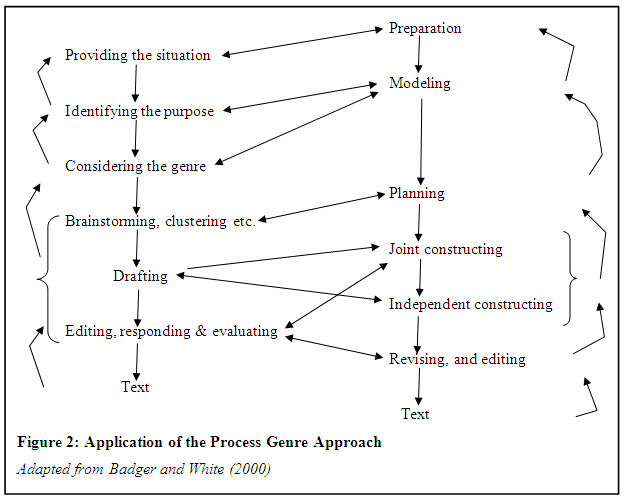 A short description of what occurs during the six steps will also illustrate how elements of the process and genre approaches work in unity.
Preparation
The teacher begins preparing the students to write by defining a situation that will require a written text and placing it within a specific genre, such as a persuasive essay arguing for or against an issue of current interest. This activates the schemata and allows students to anticipate the structural features of the genre.
Modeling
During this step the teacher introduces a model of the genre and lets students consider the purpose of the text. For example, the purpose of an argumentative essay is to persuade the reader to act on something. Next, the teacher discusses how the text is structured and how its organization develops to accomplish its purpose.
Planning
This step includes many meaningful activities that activate the students’ schemata about the topic, including brainstorming, discussing, and reading associated material. The aim is to help the students develop an interest in the topic by relating it to their experience. Since they have to participate and contribute in the classroom, learners will find the activities interesting and entertaining.
Joint constructing
In this step, the teacher and students work together as a beginning of writing a text. While doing so, the teacher uses the writing processes of brainstorming, drafting, and revising. The students contribute information and ideas, and the teacher writes the generated text on the black/white board. The final draft provides a model for students to refer to when they work on their individual compositions. It fosters collaborative writing. This step can be boosted by providing a very caring and sharing environment by the teacher. This step will provide students with a chance to write in a group and to prepare them for individual work.
Independent constructing
By this time students will have examined model texts and have jointly constructed a text in the genre. They now undertake the task of composing their own texts on a related topic. Class time can be set aside for students to compose independently so that the teacher is available to help, clarify, or consult about the process. The writing task can also be continued as a homework assignment. The teacher has to clarify what students should do for writing homework.
Revising and editing
Students lastly will have a draft that will undergo final revision and editing. This does not necessarily mean that teachers have to collect all the papers and mark them one by one. Students may check, discuss, and evaluate their work with fellow students, as the teacher again guides and facilitates. The teacher may make an effort to publish the students’ work, which will impart a sense of achievement and motivate the students to become better writers. Their final achievement will foster self-esteem among learners as they have produced something.
Final Thoughts
Things are easier said than done. Learning to write in a foreign language is a demanding task that can easily leave learners unmotivated. It can be more discouraging when students are evaluated on the basis of their writing products only, as we now observe in the Nepalese context. To combat this problem, teachers have to play more agentive role in order to empower the learners with their ability to perform real world writing tasks. We are not preparing our students just for exams, but for the global world that may require an unpredictable set of writing skills. We language teachers are the change agents even if our curricula are constrained. Use of the process-genre approach to writing allows teachers to help students recognize the steps they go through to create a written text which should lead to less stressful and motivated writing. The fact that learners are encouraged to discuss, asses, and analyze their own writing made them feel more confident and less threatened. Theoretical ideas can be confusing and conflicting at times; it is the teacher who is responsible for translating abstract ideas into a classroom practice. Further the practice to produce optimal learning benefits, teachers should constantly and systematically record, contemplate, and analyze what they have done in the classroom, and use their reflective experience as a basis for improving their instructional practice.
Works Cited
Badger, R. G. & G. White. 2000. A process genre approach to teaching writing. ELT Journal 54(2): 153-60.
Brown, H.D. 1994. Teaching by principles: An interactive approach to language pedagogy.Eaglewood Cliffs,NJ: Prentice Hall Regents.
Cope, B. & M. Kalantzis. (eds). 1993. The powers of literacy: A genre approach to teaching writing.Pittsburgh,PA:University ofPittsburg Press.
Coudery, T. 1997. Process writing. In Glenn, F. (ed). Writing in the English Language Classroom. Hertfordshire: Prentice HallEurope ELT.
Your Voices
What do you think about Nelta Choutari? What kinds of new materials would you like us to include in the future? These were questions that we asked our readers, writers, and well-wishers a few days ago. For supplementing to the responses that we received, Praveen Kumar Yadav, one of the most active participants in Choutari, kindly provided us with similar responses that he had collected last year. These responses highlight the importance of professional networking and knowledge-sharing in which we engage as a community. Enjoy!
What do you think about Nelta Choutari?
“For me, Nelta Choutari is a source of fresh ideas about ELT which helps me continue in my ELT journey better and faster.” – Hari Maya Sharma, Gorkha Campus, Gorkha
“I am currently teaching a compulsory subject in Hong Kong, and about half my students are of Nepali descent. Reading the blog makes me focus more on teaching them English as a foreign language.” – Carlos Soto, University of Hong Kong
“Nelta Choutari is a very special resource for professional development for me, because I use it for updating my professional understanding with new information in ELT theories and practices, finding lesson plans to teach various aspects of ELT, reading the wonderful stories of our friends’ experiences, reading the reflections and best practices of our friends from home and abroad, and expanding my network with colleagues at home and abroad. This forum has also given me some space to share my professional experiences and learn from NELTA colleagues while working in leadership positions.” – Ganga Ram Gautam, Immediate Past Present of NELTA, Kathmandu
“NELTA Choutari is a live platform for the ELT community from Nepal and abroad, providing excellent opportunities to teachers for sharing their practices with others from around the world. Of course, it is only available to those who have access to the internet.” – Prithvi Shrestha, Lecturer in ELT, The Open University, Milton Keynes, UK
“A forum that inculcates your skills and knowledge required to be a professional English teacher.” – Mukunda Kumar Giri, Surkhet
“Nelta Choutari is a good platform for English language teachers and practitioners to share our experiences and learn from one another. It is an e- rendezvous for those who belong to English language/literature teaching and learning.” – Ishwor Kadel, Chitwan
“Professionalism is all about sharing and being updated with the emerging trends. Choutari helps us with professional development by allowing us to participate in professional conversations about ELT.” – Uttam Kumar Gaulee, Fulbright Scholar, University of Pittsburgh, Pennsylvania, USA
“NeltaChoutari is an open forum for all those inclined to teach English and interested in sharing their ideas and experiences with others. It serves as a common platform with equal recognition of all participants, which I have found highly motivating. Choutari has the potential of bringing together English teachers, educators and students for highly productive conversations about different issues on English language teaching and learning.” – Suresh Shrestha, Zenith English Language Institute Birgunj
“NELTA Choutari is a professional blogging webzine that helps the ELT Practitioners all over the world get to know about recent trends and developments in the field of ELT.” – Eka Dev Adhikari, Jana Jagriti Higher Secondary School, Pithuwa, Chitwan
“It’s a forum for the professionals to write, read discuss and comment and become professionally stronger.” – Dinesh Raj Dahal, Janajyoti Higher Secondary School, Sindhuli
“The monthly webzine of NELTA, NeltaChoutari is a powerful resource for whole ELT community of Nepal.” – Ashok Raj Khati, Gauri Shankar Multiple Campus, Ramechhap
What kinds of new materials would you like us to include in the future?
“Choutari is praiseworthy as it is, but it would be better if it could address real problems that we teachers face in our classrooms. Choutari should be the place where people share their ground realities and get ready to face them with domestic weapons next time.” – Ishwor Kadel
“I would like to see additional materials of oral literature, sharing of best practices from home and abroad, links to professional development opportunities such as scholarships and fellowships, links to classroom materials for teachers of all levels of education etc. I sincerely thank the Choutari team for working so hard for the benefit of the Nepali ELT community, and I am sure that this forum will prove itself as an ELT antenna to help us develop as well as access the best ELT materials available worldwide.” – Ganga Ram Gautam
“Real case studies to let readers learn how students are improving their English language from their classroom activities. ” – Mukunda Kumar Giri
“NeltaChoutari has already initiated to encourage and connect more and more teachers and students of English. It can be more general and reach the grass-root level even better. It has not yet reached students of education in colleges and universities.” – Suresh Shrestha
“[To increase readership] Spreading the word through branches, coordinating with the ministry of education, department, district education offices and resource centers, advertising in national media, particularly in “Shikshak” magazine might be effective. Also, rewarding or recognizing the comments from readers such as “the comment of the week” could work. New contributors should be encouraged.” – Uttam Gaulee
“Choutari should continue to work in the development of ELT situation in the country by bringing out articles from across the world, discussing issues regarding ELT and asking the experts to comment and commend in the webzine and help foster the situation.” – Eka Dev Adhikari
“It should touch the reality of Nepalese ground. We are following others’ practices but not focusing on what our reality is. No doubt, it should update us on modern practices around the world, but it is far more necessary to look at what our fellow teachers at home are doing and help them when they are at crossroads of new challenges and confusions about teaching English in their situations.” – Hari Maya Sharma
“I am not local to Nepal, but I do get a sense in reading the blog about the local context. I also see conditions which are less bound in local context that I can relate to. The blog creates a strong link between teaching and research, which is important. [I recommend] More articles which explicitly link theory with classroom practice.” – Carlos Soto
“Choutari should increase readership widely, connect the ELT practices of remote parts of Nepal to the rest of the world, and support the teachers working in those areas” – Ashok Raj Khati
“Choutari should address the readers in rural and marginalized areas with the discussions and guidelines on practical issues.” – Dinesh Raj Dahal
“For increasing the readership of Choutari, NELTA should produce monthly or bi-monthly Choutari bulletins for students and teachers, teachers should encourage their students to visit the site, Choutari should create more space for young writers including university students, add interaction between students and teachers, and add articles that have direct relevance to teaching in the classroom in Nepal.” – Suresh Shrestha
“Choutari already publishes a variety of articles, anecdotes and classroom tips, and continuing them in the light of the changing landscape of ELT including the influence of language learning technologies would be great. A minor suggestion is to minimise long articles for Choutari as they can be published in the Journal of NELTA.” – Prithvi Shrestha
“I would like to suggest Nelta to include the following in the coming days: 1. It should address the issues related to nepalese teachers of english language; 2. In the coming days Nelta Choutari should incorporate those issues which have been facing by Nepalese teachers along with their solutions.” Parmeshwar Baral, P. N. Campus, Pokhara
The Power of Professional Learning Networks
Shyam Sharma
Your “social” network is probably represented fairly well with who is on your Facebook “friends” list and how you engage with those people. But what does your professional learning network look like? In fact, what is a professional learning network?
In this entry, I share with you a powerful concept called the “professional learning network” (PLN) and share a few specific tips on how to develop–or become more conscious and deliberate about–a professional learning network in order to enhance your professional development as teachers and scholars, and what is more important, also help others in your professional community develop professionally by sharing your knowledge with them.
The concept of PLN originated from Personal Learning “Environment” (PLE), which referred to the situation and mechanism that a learner develops and uses for setting learning goals, managing learning process, and assessing outcome. With the advent of information technologies, it evolved into Personal Learning “Network” (PLN). More recently, many educators and other professionals have adapted the idea into “professional” learning network (also PLN; here’s some description and here’s some history).
With the advent of powerful networking technologies, professionals as well as learners are now able to access vast amounts and variety of information, aggregate and organize that information, prioritize what to read and/or respond to and how, with which community to share what and how much, and so on. 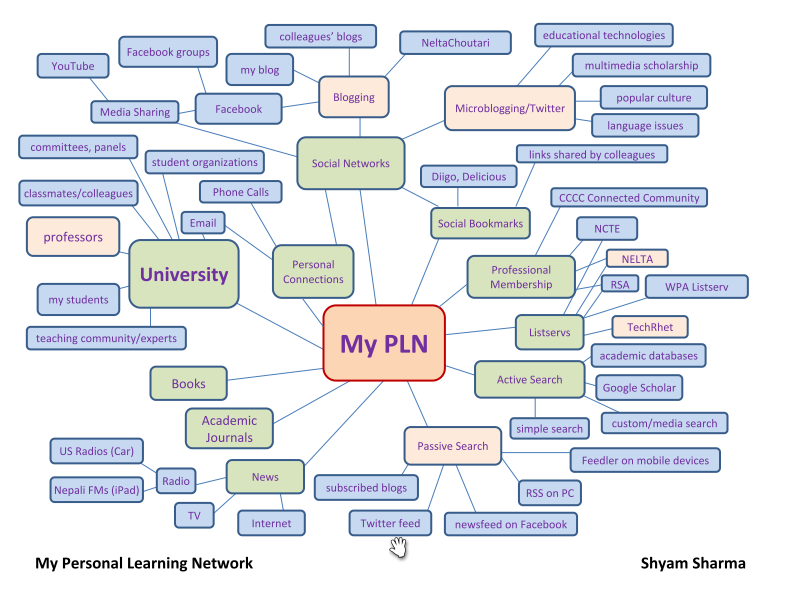 As an example, here is an image in which I attempt to visually describe my own personal/professional learning network (you can click to see a larger image or right-click to download the file). I am still unsure how to integrate many other things that are not in the image and how to better organize an relate what are there, but trying to visually represent my PLN really helped me to think about my professional goals, management of time and energy, and so on. I call mine personal and/or professional because my roles as a learner and a professional overlap quite significantly.
Having introduced the concept, let me now share a few suggestions about how we can develop our professional learning network (both for ourselves as individuals AND in order to benefit one another).
1. Subscribe to blogs in your areas of interest. This means asking the blog to send you an email alert when a new entry is posted. Except with blogs (like those of news outlets) that may publish too many entries, blogs don’t usually flood your inbox. I guarantee that this blog will only sent you a few emails and only once a month, and I reassure you of that in order to (yes) suggest that you can go ahead and subscribe now.
2. Follow professionals on Twitter. Twitter, as many of us know, is a microblogging site where people share very brief (140 characters max) messages–breaking news, teaching tips, pithy comments, humor, hyperlinks, and whatnot–with their network. Compared to blogs, these are short and therefore good for mobile devices, as well as busy/mobile people. Compared to the full experience of social networking on Facebook (including its silliness, narcissism, distracting pictures and videos, and worst of all, too many “friends” ranging from the principal of our childhood school to maila kakaki saliko jwainko bhatijaki soltini to NELTA colleagues around the world to what-the-heck-when-did-I-add-this-guy kind of people)–okay, compared to Facebook, microblogging allows you to “follow” professionals in your field(s) of interest and let people “follow” you… and I don’t think maila kaka will follow your ELT Twitter feeds and hashtags, unless he happens to be an ELT person, which would be great.
3. Use Social Bookmarking. How often do you find yourself sending a link to an interesting article or educational video to a colleague, or two… well, post it on NELTA’s Yahoo Mail and flood the inboxes of 500 (?) people? You don’t have to share resources on the web like that. Just save your bookmarks in applications like Diigo or Delicious (install extensions on your browser) and people can see what you have “saved for later” and you can see theirs. That “theirs” could be people you know or it could be the whole social bookmarking community who have used “tags” to describe their findings on the web. (Here’s a fun video intro to social bookmarking.)
4. Sign Up on Listservs and/or Mailing Lists. You probably are on NELTA’s Yahoo mailing list, which will send you a copy of all mails any member sends to the list. While it’s no longer the most efficient mode of conversation (though it is a still a good means for organizations to update its members), being on mailing lists is very important to stay updated. Listservs are more advanced forms of mailing lists.
5. Remember to Use Plain Old Personal, Human Contact. Motivated professionals as well as learners communicate with their colleagues and peers with both the intention of socializing and the intent of learning. Attending training events and workshops, conferences and seminars, and just asking questions or sharing ideas with colleagues are all extremely important aspects of persona/professional learning network. It is on top of this basic network that we want to take, as much as the resources allow us, that we take the human network into the web and extend it to people you may not be able to meet in person, add the affordances of synchronous and asynchronous exchange of ideas, conveniently store and retrieve information, and use the technology to help you aggregate and organize information for you.
There are many benefits of PLNs. First, it not only increases access to information and ideas that are relevant to us, it also allows us to organize that information. Second, the accessing/aggregating and organizing of information is mostly done by the invisible hands of technology, saving us huge amounts of time. Third, even when we are not using too advanced technologies, the very process of identifying our learning network and planning and organizing it makes us more efficient learners and professionals. Fourth, the network takes us from the isolation of our roles as “masters” of our classrooms where students do not engage with us as an equal into an open society where we can talk to our own learning peers. Fifth, we get the opportunity to learn by sharing our own knowledge with others (and most of us learn by teaching!), and because we share that knowledge and experience with like-minded people, we also get useful response in return. (Here’s an interesting representation of the benefits of PLN).
Before I paint any rosy picture, let me add an important caveat about PLN that we, as members of a smaller, younger professional community, need to keep in mind. For us, it is not enough to sit there and try to access and organize knowledge and experience shared by others; very often, there are simply not enough sources or people for you to gather the information from. We must create and share new knowledge with one another. By contrast, if you think about teachers in Europe or America, because of the number of teachers and scholars in those societies who have access to the web, the resources that they need, the amount of time they have been on the web, etc, individual teachers there can access cache of information even without giving as much back. In our case, if we want our professional learning network to be rich in local/relevant and really useful information, we must contribute to our own new pool of knowledge, as well as utilize what is available from teachers/scholars from other societies. Let us use a specific example. If you have read the humorous examples of broken English shared by Parmeshwar Baral in this issue, no one else but Nepali English teachers can explain and help us understand/tackle these error patterns. So, we need to share our knowledge with others, as well as learn from them, if we want to make our PLNs useful.
Using the comment function, please share with other readers of this blog any general or specific ideas about your own PLN. Let us use this forum to exchange ideas among as many of us as possible, rather than use it to passively read the ideas of a few of us. Thank you in advance for your time.
The Power and Potential of the Classroom Collective: A New Approach to Class Participation and Behavior Management
Archana Shrestha & Sarah Chevallier
In any classroom, there is a constant struggle to balance the needs of the individual against those of the collective. This struggle is visibly manifested in the push and pull between class participation and classroom management, particularly within the context of teaching English as a foreign language in Nepal.
Many Nepalese classrooms are dominated by two equal and opposing forces: the highest and the lowest performing students. Spurred by a system of individual praise, top students dominate class discussion and participation. Conversely, the lowest-performing students, who frequently have no confidence in their ability to answer questions correctly, seek attention (albeit negative) through misbehavior and disruptive tendencies.
The obvious losers in these classrooms are those students in the middle, cowed into silence by the raucous behavior of the lowest-performing, and scorned into shyness by their domineering higher-performing peers. These students rarely volunteer to participate in class activities, exhibit sometimes spectacular reticence to speak when called upon (due to the fact that their errors are frequently mocked by both ends of the performance spectrum, as these dominating forces seek to re-secure attention), and generally display a lack of confidence in spoken abilities, preferring instead to focus their energy on the lower-pressure context of written homework. These middle students form an impenetrably meek and mute collective, unmotivated by the lure of individual reward, given the potential for individual rejection and ridicule.
In our own English classroom, we have decided to address this imbalance through the implementation of team activities to encourage in-class participation, and collective rewards for homework completion. In this way, we hoped not only to address individual needs and behaviors, but also to render the collective mastery of material more effective and class time more productive, as the students would take on the responsibility for participation and behavior management.
Practical Effects of Collective Reward and Punishment
We have found that this method of regularly combining students at various performance levels into teams for group activities and games has proved immensely valuable in our classroom. First, it has served to create a sense of unity and equality, as it impresses upon them that they all have an equal role to play in their team’s success or defeat and by extension in their own individual reward. Students’ immediate focus is transferred from the individual response to team performance – the highest-performing students are no longer able to simply answer every question; the lowest-performing students’ energy is harnessed, directed, and motivated by the promise of reward; and those in the middle (given more opportunities to perform) are inherently more likely to perform well, and their efforts are thereby positively reinforced and more likely to be repeated.
Beyond the innate merit of this team dynamic, however, it has become even more effective through a consistent implementation as a system of reward and punishment. In our classroom, this has taken the form of tracking teams’ wins and losses, rewarding the first team to win a total of five games. After this reward, both teams start again at zero. We have also expanded this concept of teamwork to apply to homework – when all the students have completed five consecutive homework assignments, they are rewarded. If one student does not do his or her homework, the class tally is returned to zero. In this way, homework becomes more than an easily avoided classroom formality – it becomes a class-wide team effort in which their opponent is their own lack of motivation. In this way, students learn the value of consistent and cumulative effort.
Finally, an unintended but certainly welcome effect of this system has been the transferring of responsibility for class behavior onto the students themselves. When misbehavior disrupts a game, or results in the withholding of a game entirely, students become incredibly apt to police one another’s behaviors, attention, and participation. If one student does not complete his or her homework, he or she then suffers the consequences of letting down their classmates. If one student’s disruptive behavior results in the class copying silently from the book rather than playing a game with the hope of eventual reward, that student will hear about it from his or her classmates.
In this way, the collective’s interest polices the actions of the individual, and the classroom dynamic shifts from an individual struggle to a team effort to master English.
Beginning Teaching in an EFL Class: a Novice Teacher’s Experience
-By Ed Saul
The United kingdom
So, what’s the big secret behind Teaching English? The short answer: there is none. English, like any other subject, is completely open to the learner with an open mind and a strong will. Granted, it’s not the easiest subject to grasp though no one knows which the easiest actually is – but it is, on the bright side, one of the most rewarding.
Why exactly was it that you decided to become a TEFL teacher in the first place? It’s likely that your interest stems in a general interest in teaching, in a need to help others, in a need to broaden your horizons and see other places, and/or a need to have a steady, accessible job. You’ve made the right decision! However, all of these things come about through a steady and admittedly rough schedule of hard work. Most of it is enjoyable, luckily, so you shouldn’t have too much trouble!
What is English if not one of the most convoluted and constantly changing languages in the history of the Globe? English is rooted in Ancient Greek and Latin, and over the years it has spread through thousands of Nations across the world, from Ireland to the USA to Australia, and absorbed words from many other languages and dialects, such as French, Hebrew and Greek. Why is it that this Frankenstein’s-Monster language has survived all this time? No reason, other than simply because it’s so childishly easy to learn, and therefore just as easy to teach.
Granted, the Grammar and Pronunciation of English are no picnic for anyone to learn – take it from a bewildered native speaker – but they grow easier through constant practice and through learning to associate them with the innate knowledge already lodged within your own mind. Learning, for instance, the Phonetic Alphabet can be achieved in a matter of two or three steady afternoons of copying, reading out and writing practice sentences if the learner is able to properly assign the symbols to the sounds and letters which they have remembered since childhood. This is made especially simple by the fact that many of the consonant symbols of this alphabet (F, T, C, etc.) are basically the same as their regular English equivalents.
Grammar is similar though it may seem odd to think of words in terms of ‘Prepositions’, ‘Conjunctions’, ‘Complements’ and ‘Adverbials’, these are simply terms that the quick-minded learner can grow used to over time and become comfortable with in terms of their definitions; for instance, a Conjunction seems far less daunting when you are reminded that it simply means a word which connects two sentences, such as ‘And’, ‘Or’, ‘So’, ‘Then’. Eventually these difficulties become second nature, just as the more basic elements such as Nouns, Verbs and Adjectives are to a speaker of English.
But Teaching English as a Foreign Language, or alternatively, Teaching English to Speakers of other Languages, is not merely about the terminology or the work on paper. Over the course of your learning and teaching career, you’ll find that simple practice does a world of good towards improving upon even the most advanced skills as a language instructor. Your skills are only as good as the amount of times you’ve been able to use them, to test them out and improve upon them for lessons in future. So, don’t be afraid to go into a lesson and make mistakes! The worst that can happen is that you’ll learn something, and the best is that the students will learn something else.
What about the students themselves? This is your chance to make a genuine difference in their lives. Teaching English in a foreign country – or even in your own country of origin – can open up its learners to a world of possibilities that might otherwise be denied to them. By enabling them to converse in this simplistic tongue, one which, to reiterate, is spoken all over the world and used as a bridge between individuals from all the different cultures, races, and walks of life that you can think of, you are at the same time enabling them to seize a promising future for themselves and reach out towards a stable career.
For this reason, you’ll find that many of your students can and will be responsive and enthusiastic during your first few sessions of teaching. You can’t expect 100% performance from every class, and if you make allowance for the standards of teaching and school resources in some areas of your chosen field, you’ll find that at times either you or your students may be poorly equipped or badly prepared to carry out a lesson to your satisfaction. This is bound to happen for a number of reasons, not least the fact that certain schools are better funded than others.
But you cannot allow this to discourage you. Even during the most disastrous lesson (which isn’t usually all that disastrous – more like slightly different than as planned), students usually are attempting to try their best and to participate. A small amount of gentle encouragement, accompanied by fun games and warmers such as ‘Hangman’ or ‘Chinese Whispers’ to break the ice, will help them to come out of their shell and help you to gain their trust as a teacher.
Depending on the locale, your overall experience in becoming a qualified teacher may place you up against a cultural barrier, so that you find that many words, concepts and/or practices that are part of your everyday life are alien to your students – and vice-versa, particularly in stringent, tightly-run schools or institutions set up and managed by a church, such as Islam or Catholicism. This, too, need not be a great difficulty as long as you keep an open mind.
Alienation and a lack of communication between teachers and students are easily solved when the teacher focuses their methods on approaching from an equal footing – introducing English through universal, simplistic concepts (such as ‘Rain’, ‘Lion’, ‘House’) and building on that foundation towards more complex sentence structures (“The frightened Lion ran into the Three-Storey House to get out of the sudden rainstorm”).
Ultimately, becoming a teacher, especially a teacher of English is a task which enriches one’s own mind while additionally bringing about the opportunity to constantly enrich the minds of others. As long as you keep your determination, feel ready to face the challenges given to you, and remember to have fun with the subject, you’ll be guaranteed success in this, your chosen career. Smile, put your best foot forward, and be prepared to be professional.
Good luck!
Self-Directed Professional Development: Success Mantra or a Myth?
Tika Ram Bhatta
PhD Fellow
EFL University, India.
Abstract
Self-motivation and self-readiness are considered the sine qua non for teacher professional development since it does not just happen precipitately as soon as one gets involved in a profession. Self-directed learning therefore acts as a scaffolding device for a professional to augment his or her knowledge base and competency. Therefore, this article delineates how adoption of certain strategies assists teachers to gain professional development thereby making teachers self-directed. The strategies discussed in this article are more common to teachers teaching any subjects at any level; however, they have a great deal to do with English teachers in the Nepalese context where English is taught as a foreign language. The article begins with the introduction to professional development and self-directed learning and subsequently moves to introduce a few strategies for self-directed teacher professional development.
1.1 Introduction
There are several factors that substantially enhance the knowledge base, skills, attitudes and competency of a teacher causing him or her to gain professional growth. These factors may embrace both formal and informal learning experiences which contribute to the continual enhancement and maintenance of the professional skills, competencies and experiences (Guskey, 2000). Therefore, teachers assuming the responsibility as professionals need to be equipped with motivation for continuous and career-long learning which enhances sustainable, intellectual and service-oriented maturity. In order for teaching professionals to keep abreast with change – renew and review their own knowledge, skills and attitudes – they need to involve themselves in a number of learning activities such as self-directed learning, collaborative learning, reflective practices and experiential learning. Such processes can lead them along their professional trajectory whereby they gain both vertical and horizontal professional development. However, this increment or development does not happen precipitately, instead it is a time taking process, and only happens gradually in a piecemeal approach.
Professional development, therefore, subsumes not only the facilitated learning opportunities but also self-motivation, intention, systematicity and many other relevant factors. In order to sensitize professional development in teachers, they should, therefore, be encouraged to incorporate conditions of specialized knowledge, self-regulation, autonomous performance and a large dose of responsibility (Darling-Hammond & Berry, 1988) for learner welfare. Teachers, among all the stakeholders, are the only on-stage actors whose behaviour directly affects learners’ progress and accountability. Learner accountability can be strengthened only if teachers are imbued with spontaneous and self-motivated readiness to assume their responsibility for their own learning and development as lifelong learners (Knowles, 1975; Dickinson, 1987). Teacher learning, in the pursuit of their professional development, is, therefore a cornerstone in their career path. In this respect, teachers look back at their past activities and compare them with those of present and bring necessary changes in their behaviour and thereby they update their knowledge, skills and attitudes. Therefore, teacher professional development is a self-reflective process (Head & Taylor, 1997), and it extensively demands the use of self-directed professional development strategies so that teachers not only become professionally sound but also near themselves to achieve true professionalism.
The use of strategies coupled with intrinsic motivation is momentous in developing a language teacher as a self-directed learner because strategies are the specific action plans (Oxford, 1990) which essentially help teachers grow as true professionals thereby teacher-learners become teachers par excellence. Such strategies can be both self-initiated and learnt from others. Self-initiated strategies may differ from person to person. However, some strategies of language teacher development such as developing teaching portfolios, peer observation and journal writing are commonplace strategies that teachers can adopt as self-directed strategies for their professional development. In this sense, self-directed learning corroborates lifelong learning which edifies language teachers about becoming dynamic and informed adults. Self-directed learning therefore is both a crucial gateway and an essential strategy for lifelong learning (Harvey et al, 2003).
1.2 Self-directed Learning
Self-direction, according to Dickinson (1987), “refers to a particular attitude towards learning, one in which … the learner is prepared to take responsibility for his own learning” (p. 12). Guglielmino (2008) further clarifies self-direction in learning stating that it “can occur in a wide variety of situations, ranging from a teacher-directed classroom to self-planned and self-conducted learning projects developed in response to personal or workplace interests or needs and conducted independently or collaboratively” (p. 1). Therefore, the self-directed learner, as Dickinson (1987) states, is one who retains responsibility for the planning, decision making and implementation of the decisions throughout the period of learning. It does not necessarily entail that the learner is autonomous but it can be done by joining a formal course too. Knowles et al (2005) state that there are two dimensions of self-directed learning prevalent in the literature: self-teaching and autodidaxy. They say that “self-directed learning is seen as self-teaching, whereby learners are capable of taking control of the mechanics and techniques of teaching themselves in a particular subject … [and it] is conceived of as personal autonomy, which Candy (1991) calls autodidaxy” (p. 185-86).
Brockett and Hiemstra (1991), on the other hand, state that “self-direction in learning is a way of life” (p. 16). However, they further argue that it has been misinterpreted by some people. For example, it has been equated with self-planned learning, self-teaching, autonomous learning, independent study and distance education. But all these terms vary and are subtly different from each other. The early view of self-education is that it was thought to have been denoted as an achievement made by a learner without a teacher. Therefore, it needs to be taken as a lifelong perspective. This means that learning takes place across the entire lifespan. This can be made clear by comparing it with the formal education being acquired in the institution where the learner has no control over the objectives or means of their learning but in self-directed learning learners control both the objective and the means. In other words, self-education occurs outside of formal institutions but self-directed learning can occur within the formal setting too. Self-directed learning, according to Knowles (1975), describes a process in which individuals take the initiative, with or without the help of others, in diagnosing their learning needs, formulating learning goals, identifying human and material resources for learning choosing and implementing appropriate learning strategies and evaluating learning outcomes.
Self-direction in learning can be taken as an umbrella concept because it refers to “activities where primary responsibility for planning, carrying out and evaluating a learning endeavour is assumed by the individual learner” (Brocket, 1983b, p. 16 as quoted in Brockett & Hiemstra, 1991, p. 24). It refers to a process in which a learner assumes primary responsibility for planning implementing, and evaluating the learning process where an education agent or resource often plays a facilitating role in the process. It centres on a learner’s desire or preference for assuming responsibility for learning. Therefore, self-direction in learning refers to both the external characteristics of an instructional process and the internal characteristics of the learner where the individual assumes primary responsibility for a learning experience.
In this sense, the self-directed learner is one who takes responsibility for the management of his or her own learning being autonomous in all the processes without assistance. Self-directed learning, as Dickinson (1987) posits, is an attitude of mind towards learning rather than any particular techniques or activities. Self-directed adults are more frequent but are probably still a minority of learners. However, “it is not the case for the school children that they are the paragons of virtue who will learn a language unaided, but that it is possible to teach them to be self-directed” (Dickinson, 1987, p. 5). He further states that Self-directed learners have many of the qualities of good language learners. So, by promoting self-directed learning one is improving proficiency in learning in general and language learning in particular. The manifestation of self-directed learning differs according to the context, i.e. how far the context has been especially arranged to allow self-direction. Self-directed learning very well fits with autonomy individualized instruction auto didaxy and self-access. The distinction between them is made by their focus upon a learner or the material. Autonomy is one possibility within self-directed learning in which the learner undertakes all of the management tasks associated with his own learning.
1.3 Self-directed Professional development
Professional development is a process of continuous growth of teacher professionalism and behaviour which they gain by actively participating in various programmes, activities, conferences and workshops, designed in order to enhance their knowledge, skills, competency and attitude, both individually and in groups. Therefore, in many countries like Nepal, a number of days of work for teachers are included in the operation calendar of the school for developing teachers professionally with no loss of instructional days for students. During these days, teachers are provided with trainings, seminars, workshops and many other professional development activities in order to hone their skills, improve practice, and stay up-to-date with changes related to teaching and learning. However, self-directed professional development not only provides an opportunity to determine his/her own learning goals but also helps to identify activities and resources required to pursue these activities. It also helps teachers to reflect on their learning experiences in order to augment their own professional expertise. The well-planned and continual self-directed professional development yields more effective professional learning than one-shot workshops and conferences. Teachers, since they have intrinsically initiated such activities of development, get involved in them wholeheartedly thereby recognizing the necessity of continuous learning and reflective practice.
Self-directed professional development enhances teacher self-reflection whereby teachers have control over their professional experiences and are motivated by tasks or problems that they find meaningful. Because teachers are already aware of their strengths as well as needs, they create a self-directed professional development plan for them. These plans can be meant to be fluid, with the ability to grow and change over the course of the professional life in response to experiences and opportunities encountered. Self-directed professional development activities may include both collaborative and entirely individual activities whereby teachers, with or without the consultation of teacher educators attempt to diagnose their needs and solve them by themselves. The other forms of self-directed professional development activities may include action research, collaborative learning teams, peer mentoring and coaching relationships or lesson studies. In this way, self-directed professional activities are listless. It can include professional reading or the discussions with colleagues or may be attending conferences either being a sponsor teacher or mentoring a beginning teacher. The development of innovative programmes for use in the classroom either individually or by joining a teacher-research-group can also be coupled with exploring resources through internet in order to hone their professional knowledge and skills. Teachers can also participate in curriculum development they can write a subject related course or maybe they can visit the subject related bookstore or a university library and the like.
Self-directed professional development encourages self-reflection, commitment and responsibility with higher motivational attitudes and thereby increases staff satisfaction. Since teachers are cognizant of their needs and strengths, and also they have freedom to interpret and pursue interests and what they consider important, it increases contingencies of personal responsibility for their ongoing professional development. The role of the institution, administrators, supervisors, teacher educators is also crucial in this respect. They should facilitate the teachers with whatever the way it is feasible for them because objective feedback is an important gateway for successful acquisition of self-directed professional growth. Pierce and Hunsaker (1996) described self-directed professional development as a model of professional development for the teacher, of the teacher and by the teacher. This model is known as the School Innovation Through Teacher Interaction (SITTI) model. In this model the teachers agree on how they would like the school to look and be then they complete a needs assessment involving administrators in the process in order to decide on who will be the experts (from within the school) on the topics chosen to work on, and elect people as team members who will participate in peer coaching. Subsequently, the team experts develop a module to address the needs and topics chosen by all those involved. However, this model has not yet found practiced. Easton (1999) described a model self-directed professional development as “tuning protocols” which was developed by David Allen and Joseph McDonald. In this model, “a teacher presents actual work before a group of thoughtful ‘critical friends’ in a structured, reflective discourse aimed at ‘tuning’ the work to higher standards” (Allen, 1995, p. 2 in Easton, 1999, p. 54), and after discussing with the group of colleagues all the positive and challenging aspects of the work, the presenter reflects on how the work could be improved.
1.4 Strategies for Self-directed Professional development
The word ‘strategy’ is derived from the ancient Greek term ‘strategia’, which means the art of leading an army in a planned campaign of the optimal management of troops. Therefore, it implies that the basic characteristics of the term strategy involve planning, competition, conscious manipulation, and movement toward a goal (Oxford, 1990). However, “[i]n a nonmilitary settings, the strategy concept has been applied to clearly nonadversarial situations, where it has come to mean a plan, step, or conscious action toward achievement of an objective” (Oxford, 1990, p. 8). Strategies have been “transformed into learning strategies” (ibid) in the educational setting. Oxford (1990) enumerated twelve features of language learning strategies, most of which can be incorporated into strategies of teacher learning as well. According to her, language learning strategies:
1. Contribute to the main goal, communicative competence.
2. Allow learners to become more self-directed.
3. Expand the role of teachers.
4. Are problem-oriented.
5. Are specific actions taken by the learner.
6. Involve many aspects of the learner, not just the cognitive.
7. Support learning both directly and indirectly.
8. Are not always observable.
9. Are often conscious.
10. Can be taught.
11. Are flexible.
12. Are influenced by a variety of factors.
The aforementioned features of learning strategies encourage greater overall self-direction for learners and, therefore, are applicable in adult learning as well. For instance, the learning teachers, in particular EFL teachers, have to deal with peculiar situations in the classrooms, also known as critical incidents, and they have to act quickly where they do not get any support of others like trainers and they should find the way out by themselves and hence use strategies for the solution or it can be that they want to develop themselves for achieving greater professional augmentation. Adult learners are self-directed because they seek out learning activities to enhance their own knowledge in order to meet their needs. Besides, the adult learner wants to draw on their rich personal and professional experiences. If the learners are involved in their learning rather than becoming merely passive participants they are more likely to master the information or concepts presented, apply them to their practice, and retain the information presented. Self-directed activities include a variety of activities before, during and after the learning experience to engage the participant in active learning. Self-direction, according to Oxford (1990), “is often a gradually increasing phenomenon, growing as learners become more comfortable with the idea of their own responsibility” (p. 10). This assists them to gradually gain greater confidence, involvement, and proficiency. Overall she talks about such strategies as cognitive, memory, compensation, metacognitive, affective and social strategies that a language learner employs while learning a language. However, Richards and Farrell (2005) examined that teacher learning has been shifted towards self-directed, more democratic and participatory forms of teacher development from an authoritarian organizational structure in schools shifting responsibility for professional development from managers and supervisors to teachers themselves. Similarly, the power of experiential learning and action-based learning has also been recognized in today’s teaching-learning environment and this has given rise to self-direction.
Wallace (1991) emphasizes the use of self-directed strategies stating that teachers ought to be encouraged to become ‘reflective practitioners’ and thereby self evaluation takes place and the teachers can become cognizant of their professional competence. He stated that “teachers should be flexible, capable of further independent study, able to solve problems in a rational way, able to combine speed of response with depth of understanding” (Wallace, 1991, p. 26). Richards and Farrell (2005) discussed the strategies of teacher professional development. These strategies include: “self-monitoring, journal writing, critical incidents, teaching portfolios and action research” (Richards & Farrell, 2005, p. 14) each of which is discussed below.
1.4.1 Self-Monitoring
Self-monitoring is a strategy that a teacher can adopt for his or her professional development. Self-monitoring in teaching involves having a teacher record his or her teaching behaviour for the future reference so that he or she can go through it for self-appraisal. Self-monitoring can make the teachers aware of their current knowledge, skills and attitudes as a basis for self-evaluation. Teachers can therefore collect information regarding their classroom behaviour for future reference to bring about necessary changes. Richards and Farrell (2005) stated that self-monitoring refers to “activities in which information about one’s teaching is documented or recorded in order to review or evaluate teaching” (p. 34). According to them, there are three approaches to self-monitoring of language lessons: lesson reports, audio-recording a lesson, and video-recording a lesson. Self-monitoring provides an opportunity in order not only to better understand one’s teaching but also to review one’s own strengths and weaknesses as a teacher. Therefore, a teacher, especially an EFL teacher, should garner information about teaching behaviour and practices objectively and systematically such that this information can act as a basis for making decisions about whether there is anything that should be changed.
Larsen-Freeman (1983, p. 266) further explicated Richards and Farrell’s view saying that teachers need the heightened awareness, a positive attitude and knowledge in order to make informed choices about their teaching. She stated that:
I cannot make an informed choice unless I am aware that one exists. Awareness requires that I give attention to some aspect of my behaviour or the situation I find myself in. Once I give that aspect my attention, I must also view it with detachment, with objectivity, for only then will I become aware of alternative ways of behaving, or alternative ways of viewing the situation, and only then will I have a choice to make. (Larsen-Freeman, 1983, p. 266 as quoted in Bailey et al, 2001, p. 23).
Similarly, self-monitoring or self-observation embodies a systematic approach to the observation, evaluation, and management of one’s own behaviour (Armstrong & Frith, 1984; Richards, 1995) in order to gain better understanding and control over the behaviour. According to Richards (1995) “self-monitoring refers to the teacher making a record of a lesson, either in the form of a written account or an audio or video recording of a lesson, and using the information obtained as a source of feedback on his or her teaching” (p. 118). According to him, self-monitoring not only complements but also replaces other forms of assessment, such as feedback from students, peer, or supervisors. Richards stated that “it can help teachers in at least four ways” (ibid, p. 119). First, the amount of time available for professional development is quite short when compared to the length of our teaching careers, even though professional development should ideally continue throughout our teaching lives. Second, self-monitoring can lead to critical reflection about the work. Third, it can help the teachers to better understand their own instructional process and thereby bridging the gap between what we actually do and what we think we do. Finally, it relocates the responsibility for improving teaching squarely with teachers as an individual.
Richards and Farrell (2005, p. 38-47) present some of the procedures that teachers can employ in order to carry out self-monitoring in their pursuit of professional growth. They say that teachers can prepare lesson reports or a written narrative to record the incidents that have taken place in the classroom. According to them a lesson report serves as a way of documenting such observations as a source of future learning. Similarly, a written narrative consists of a descriptive summary of the lesson, which a teacher can go through later and make improvements in the necessary areas. Audio and video recording of the lesson or the use of checklist and questionnaires can also help teachers to make a record of the account of the classroom activities.
Dickinson (1987) also talks about the self-monitoring as an effective self-measurement device. According to him, the learner can become self-directed by keeping records of his or her own progress. It can be in the form of simple checklist of the items covered or it may include a self-rating scale on each item.
1.4.2 Journal Writing
In the pursuit of their professional development, teachers can keep a teaching journal as an effective device. Richards and Farrell (2005) explained that a teaching journal is “an ongoing written account of observations, reflections, and other thoughts about teaching, usually in the form of a notebook, book, or electronic mode, which serves as a source of discussion, reflection, or evaluation” (p. 68). Such journals are sometimes called teaching logs or teaching diaries, and, can be used as an important reflective device or the self-directed strategy for the professional development of a teacher. Journals are more elaborate and systematically written in their nature and therefore can work as an aid to “reflection on action” (Schon, 1983). A teaching journal enables the teachers to go back and see their thinking whereby creating a lasting record of thoughts that provides evidence of the teachers’ self-development. According to Blake (2005, p. 2), the goals and benefits of journaling include: “ (1) discovering meaning, (2) caring for self, (3) making connections, (4) installing values, (5) gaining perspectives, (6) reflecting on professional roles, (7) developing critical thinking skills, (8) developing affective skills, and (9) improving writing” (Blake, 2005, p. 2 as quoted in Utley, 2011, p. 92). Utley (2011) also stated that “[r]eflective journaling also provides an avenue for integrative learning experiences” (p. 93). According to her, integrative learning expands the concept of critical thinking.
The teaching journal provides a record of the significant learning experiences that have taken place. Equally, it helps teachers to keep themselves abreast with the self-development processes that have been taking place for them. The journal also provides an opportunity to foster a creative interaction between the novice teachers and the facilitator or more importantly it increases collegiality among colleagues if it is done by the experienced teachers and finally proves to be useful in their self-development process.
Richards and Farrell (2005) explicated that “Journal writing enables a teacher to keep a record of classroom events and observations” (p. 69) without which teachers hardly make substantial recollection of what happened during the lesson. They say that the experience of successful teaching can be the source for further learning. It opens up the way for a teacher to question, explore, and analyze how teachers teach. It not only serves as a device to demystify their own thinking but also clears the way for exploring their own beliefs and practices. Journal writing, in this way, offers a simple way to conscientize teachers about their teaching and learning whereby teachers gain growth and development in their profession.
Bailey et al (2001) highlighted that journal writing paves the way in furthering professional development and thereby offering an opportunity to view teaching more clearly. It not only helps teachers to explore teachers’ own teaching practices but also proves useful at probing the sources of frustrations.
Similarly, Dowrick (2007) stated that journal writing is a “gloriously self-directed source of inner development, yet it also makes the world beyond your own self more real and more vivid” (p. 2). According to her, a journal can become a companion that supports without any assessment. It can be a source of discovery, of learning, emotional relief and insight. Similarly, Stevens and Cooper (2009) define journal as a “sequential, dated chronicle of events and ideas, which includes the personal responses and reflections of the writer (or writers) on those events and ideas” (p. 5). According to them a journal has six defining characteristics that: the journal is written, dated, informal, flexible, private and archival. The journal appears in the written form consisting of information, ideas, thoughts, and questions and the like. All the journal entries are dated in a sequential order and are usually informal. Thus, teachers can write whatever they feel like in their journals because it is private and for a personal use such that they can archive information in the later phases as required.
1.4.3 Analyzing Critical Incidents
A critical incident is something we interpret as a problem or a challenge in a particular context, rather than a routine occurrence. It is a short description of an event that has taken place over a certain period of time. It can happen to anyone and anywhere in a real-life situation too. The incident is critical because it is important, essential or valuable in a way that it has some meaning. Critical incidents are based on real-life situations and typically involve a dilemma where there is no easy or obvious solution. The objective of critical incidents is to stimulate thinking about basic and important issues which occur in real-life situations. Tripp (1993) stated that “… a critical incident is an interpretation of the significance of an event. To take something as a critical incident is a value judgement we make, and the basis of that judgement is the significance we attach to the meaning of the incident” (p. 8). Tripp believes that incidents happen but critical incidents are created because of their importance. Therefore, for Tripp any lesson can be critically analysed and a particular event made critical by our reflection on it. In making incidents critical, one needs to ask not only what happened but also why it happened. This should then be situationalized for the future reference.
Critical incident in teaching refers to a particular occurrence that has taken place during a lesson. Teachers make it critical because they think it important and want to utilize it for future reference. Richards and Farrell (2005) stated that “a critical incident is an unplanned and unanticipated event that occurs during a lesson and that serves to trigger insights about some aspect of teaching and learning” (p. 113). They say that critical incident analysis refers to the documentation and analysis of teaching incidents in order to learn from them and improve practice. Such incidents compel teachers to ruminate the long-term implications they may have. This process of documentation and reflection provide opportunity for teachers “to learn more about their teaching, their learners, and themselves” (ibid, p. 114). Like Tripp (1993), Richards and Farrell (2005) also opine that the majority of critical incidents that happen in classrooms are commonplace events that are critical in the sense that they reveal underlying beliefs or motives within the classroom. At the first appearance, these incidents seem to be insignificant but soon they become critical when they are subject to review and analysis since they trigger a sense of weird occurrence in that particular situation.
Brookfield (2006) emphasizes the use of critical incident questionnaire (CIQ) in order to identify the feelings of the students regarding teaching out of which teachers can identify which incident is critical and which is not from the words of students. This activity can assist teachers to deal with similar incidents in the future. Brookfield (2006) stated that CIQ is a “quick and revealing way to discover the effects your actions are having on students and to find out the emotional highs and lows of their learning” (p. 41). Administering CIQ, according to him, is just a five-minute activity. The students are asked to write the answers to a few questions without putting their name on the form. If they do not know the answer, they can also leave the space blank. This is done on a weekly basis.
1.4.4 Teaching Portfolios
Teaching portfolios, often known as dossiers, are compilation of teaching materials and related documents that teachers employ during teaching and learning processes. Portfolios serve as tools for reflection, a way to thoughtfully document teaching practices and progress toward goals. Portfolio entries can inform professional growth plans. As actual artefacts of teaching, portfolios help teachers to systematically ponder over their practice, reflect on the problems they face, and learn from their experience. They provide direct evidence of what teachers have accomplished. Richards and Farrell (2005) defined teaching portfolio as “a collection of documents and other items that provides information about different aspects of a teacher’s work” (p. 98). The teaching portfolio not only exposes the teachers’ performance description but also facilitates professional development by providing a basis for reflection and review. The portfolios reveal how creative, resourceful, and effective the teachers are. They can also become the source of review and reflection and also they can promote collaborative work as well.
Teaching portfolio has been defined variously by various authors. According to Porter and Cleland (1995) teaching portfolio is “a collection of artifacts accompanied by a reflective narrative that not only helps the learner to understand and extend learning, but invites the reader of the portfolio to gain insight about learning and the learner” (p. 154). Similarly, Stronge (1997, p. 194) stated that “In its most basic form, a teaching portfolio is a collection of information about a teacher’s practice”. Seldin et al (2010) explicated that teaching portfolios offers an opportunity to reflect upon the teachers’ work and thereby they rethink strategies and methodologies, revise priorities, and plan for the future. Consequently, teachers get stimulated to hone and to improve their performance in a better way. They stated that:
A portfolio is a valuable aid in professional development for three important reasons: (1) the level of personal investment in time, energy, and commitment is high … and that is a necessary condition for change; (2) preparation of the portfolio stirs many … [teachers] to reflect on their teaching in an insightful, refocused way; and (3) it is grounded in discipline-based pedagogy. (Seldin et al, 2010, p. 8)
Portfolios offer a lot of opportunities for teachers for executing exercise of reflection. Therefore, apparently, portfolios and reflections go hand in hand. However, building automatized reflective skills is an arduous job; it requires huge patience in order to make reflection more natural. In this way, the most important use of portfolio is for self-reflection. Self-reflection encourages teachers to review their activities, strategies, and plans for their futures too. Broadly, the habit of keeping teaching portfolios empowers teachers with reflective strategies to help understand themselves as learners. Kerr (1999) explicated that portfolios are all about growing a person as learner. He said that “portfolio documents your growth in three areas: developing self-awareness, managing emotions, and building relationships” (p. 23). He further expounds that portfolio is all about both learning and making commitments.
1.4.5 Action Research
The application of research to educational problems in a particular classroom setting is known as action research. It is carried out not for the development of a theory or the generalization of the applications but it is done for the immediate application in order to find the solution of the problem. Therefore, it refers to “teacher-conducted classroom research” (Richards and Farrell, 2005, p. 171) that attempts to solve practical problems. Many teachers- whether deliberately or inadvertently- involve in conducting action research in their day-to-day classroom activities when they have to tackle a problem. Thus it is a crucial tool for a teacher for his or her self-development. Action research is, typically, a reflective process that allows for inquiry and discussion as a component of the research. Therefore, it also involves a cycle of activities such as problem identification, information collection, strategic plan, implementation of the plan and reviewing of the executed plan. Best and Kahn (2007) explicated that action research applies “scientific thinking and methods to real-life problems and represents a great improvement over teachers’ subjective judgements and decisions based on folklore and limited personal experiences” (p. 20).
The goal of action research is to improve the teaching and learning environment enabling teachers’ growth. Usually, action research is conducted in a small scale both individually and collaboratively. Rather than dealing with the theoretical aspects, action research allows practitioners to address those concerns that are closest to them, ones over which they can exhibit some influence and make change. Individual teacher research usually focuses on a single issue in the classroom or the teacher’s individual problems related to his or her professional development. The teacher, in this sense, may be seeking solutions to problems of classroom management, instructional strategies, use of materials, or student learning or his or her own professional development issues. Carr and Kemmis (1986) define action research as a “form of self-reflective enquiry undertaken by participants in social situations in order to improve the rationality and justice of their own practices, their understanding of these practices and the situations in which the practices are carried out” (p. 162 as cited in Burns, 1999, p. 30). This critical definition of action research- though reflective in nature- goes beyond classroom to society. It may therefore have some connection with the unexamined aspects of educational system rather than investigating the immediate practices. Therefore, action research being a reflective practice follows a cyclical process of planning, action, observation and reflection in which if the outcome is negative then this process begins again with a new hypothesis.
Nevertheless, like many other researchers, Burns (1999) prefers action research to be a highly collaborative practice. She has presented “not so much of the cyclical processes of doing an action research but a series of interrelated experiences involving the following phases: exploring, identifying, planning, collecting data, analysing/reflective, hypothesising/ speculating, intervening, observing, reporting, writing, presenting” (p.35). Thus, action research can also be a collaborative activity among colleagues searching for solutions to everyday real problems experienced in schools, or looking for ways to improve instruction for better student-achievement. Additionally, it helps to develop professionalism among teachers should they be involved constantly in researching and educating themselves about their expertise. However, this is different from the study of more educational questions that arise from the practice of teaching.
Collaborative action research differs from the individual teacher research in that the individual teacher-researcher may not prefer sharing the outcomes and the processes with the others like colleagues or the principals. He or she may not go for a formal presentation of the outcomes or submit written material to a listserv, journal or a newsletter. The findings may not be publicized. On the other hand, collaborative action research is done to address a common problem or an issue shared by two or several colleagues; the outcome of which is later shared and discussed. There may be a discussion during the research too regarding the issues that they come across. Therefore, action research- whether it is carried out individually or may be done collaboratively- can become a form of professional development because research and reflection allows teachers to grow and gain confidence in their work. Action research projects influence thinking skills, sense of efficacy, willingness to share and communicate and attitudes toward the process of change. Through action research, teachers not only learn about themselves and their students but also about their colleagues and administrators and the other concerned authorities such that it assists them to determine ways to continually improve. If done collaboratively, it allows time for teachers to talk with others about teaching and teaching and learning strategies. In this sense, they can share their teaching styles, strategies and thoughts with others. In this way, action research can provide teachers with opportunities to evaluate themselves in schools. It serves as a chance to take a look at one’s own teaching in a structured manner. Teachers can investigate the effect of their teaching upon their students.
1.5 Conclusion
To sum up, the professionals possess knowledge and competence acquired from highly specialized training and formal education. Professionals have respect and trust of community and peers that leads to a degree of autonomy and self-direction. In this way, they hold a set of moral as well as ethical values that allow the performance of the job to become more service-oriented. Various types of people engage in professional development, including teachers, lawyers, doctors, nurses, engineers, pilots and the like. These individuals often have a desire for career longevity and personal growth. They are, therefore, willing to undergo the necessary training to obtain these goals. Teachers, as professionals, therefore, go through the process of reflection to examine where they are and where they want to be in order to gain professional development. This is indeed an ongoing process.
Teacher professional development, being a self-reflective process extensively demands the use of self-directed development strategies to keep teachers abreast with the changes such that teachers not only become professionally sound but also near themselves to achieve true professionalism. Strategies such as self-monitoring and journal writing are essential wheels for driving teachers towards the realm of self-directed professionalism. Self-direction is highly found in technical field such as medicine in most of the parts of the world. However, this can add a new dimension if practiced in teaching and learning in the Nepalese context because of the barriers that relinquish teachers from attending training and other professional development activities. Self-directed learning is entirely a new phenomenon in the Nepalese education system. If the concerned stakeholders pay attention to self-directed learning, the gap that has been created in the professionalization of teaching, particularly in ELT, can then be filled in easily.
References
Armstrong, S., & Frith, G. (1984). Practical self-monitoring for classroom use. Springfield III: Charles Thomas.
Bailey, K. M., Curtis, A., & Nunan, D. (2001). Pursuing Professional Development: The Self as Source. Boston, Massachusetts: Heinle & Heinle.
Best, J. W. & Kahn, J. V. (2003). Research in Education. New Jersey: Prentice Hall Inc.
Brockett, R. G., & Hiemstra, R. (1991). Self-direction in learning: Perspective in theory, research and practice. London: Routledge.
Brookfield, S. (2006). The skillful teacher: On technique, trust, and responsiveness in the classroom (2nd ed.). San Francisco: Jossey-Bass.
Burns, A. (1999). Collaborative action research for english language teachers. Cambridge: Cambridge University Press.
Darling-Hammond, L. & Berry, B. (1988, March). The evolution of teaching policy (Report JRE-01). Santa-Monica, CA: Rand Corporation.
Dickinson, L. (1987). Self-instruction in language learning. New York: Cambridge University Press.
Dickinson, L. (1987). Self-directed learning. In Carver, D. & Dickinson, L. (Eds.), Self-directed learning: Collected papers in self-directed learning in English language learning pp. 1-12. Edinburgh: Scottish Centre Education Overseas, Moray House College of Education.
Dowrick, S. (2007). Creative Journal Writing: The Art and Heart of Reflection. Alexander Street, Crow’s Nest: Allen & Unwin.
Easton, L. B. (1999). Tuning Protocols. Journal of Staff Development. 20 (3), 54-55.
Guglielmino, Lucy M. (2008). Why self-directed learning? International Journal of Self-directed learning, 5 (1), 1-14.
Guskey, T. R. (2000). Evaluating professional development. Thousand Oaks, California: CORWIN PRESS, INC.
Hammond, M. & Collins, R. (1991). Self-directed learning: Critical practice. London and New York: Kogan Page.
Harvey, B. J., Rothman, A. I., & Richard, C. F. (2003).Effect of an Undergraduate Medical Curriculum on Students’ Self-directed Learning. Academic Medicine, 78 (12), 1259-1265.
Head, K., & Taylor, P. (1997). Readings in teacher development. Jordan Hill, Oxford: Heinemann.
Kerr, R. (1999). Self-discipline: Using portfolios to help students develop self-awareness, manage emotions and build relationships. Markham, Ontario: Pembroke Publishers.
Knowles, M. S. (1975). Self-directed learning: A guide for learners and teachers. New York: Association Press.
Knowles, Malcolm S., Holton, Elwood F., & Swanson, Richard A. (2005). The Adult Learner: The definitive classic in adult education and human resource development (6th ed.). Burlingon, MA: Elsevier.
Larsen-Freeman, D. (1983). Training teachers or educating a teacher. In Altis, J. E, Stern, H. H., & Strevens, P. (Eds.), GURT 83 applied linguistics and the preparation of second language: a rationale pp. 264-274. Washington D C: Georgetown University Press.
Oxford, R. L. (1990). Language learning strategies: What every teacher should know. Boston, Massachusetts: Heinle & Heinle Publishers.
Pierce, D. & Hunsaker, T. W. (1996). Professional development for the teacher, of the teacher and by the teacher. Education, 11 (1), 101-105.
Porter, C. J. & Cleland, J. (1995). The portfolio as a learning strategy. Portsmouth, New Hampshire: Boynton/Cook Publishers.
Richards, J. C. (1995). The Language teaching Matrix. New York: Cambridge University Press.
Richards, J.C. & Farrell, T. S. C. (2005). Professional development for language teachers: Strategies for Teacher Learning. New York: Cambridge University Press.
Schon, D. A. (1983). The reflective practitioner: how professionals think in action. London: Temple Smith.
Seldin, P., Miller, J. E., & Seldin, C. A. (2010). The teaching portfolio: A practical guide to improved performance and promotion/tenure decisions (4th ed.). San Francisco, CA: Jossey-Bass.
Stevens, D. D., & Cooper, J. E. (2009). Journal keeping: How to use reflective writing for effective teaching and learning professional insight and positive change. Sterling, Virginia: Stylus Publishing LLC.
Stronge, J. (1997). Evaluating teaching: a guide to current thinking and best practice. Thousand Oaks, California: Corwin Press.
Tripp, D. (1993). Critical incidents in teaching: Developing professional judgement. Abingdon, Oxon: Routledge.
Utley, R. (2011). Theory and research for academic nursing educators: Application to practice. Sudbury, MA: Jones and Bartlett Publishers.
Wallace, M. J. (1991). Training foreign language teachers: A reflective approach. The Pitt Building, Cambridge: Cambridge University Press.
Reflection on English Conversation in Japan
Sounds and Images… Thinking about Teaching
To the diversity of ELT khuraks of this month, let me add a different kind of material, a few inspiring web videos, with some reflections and questions on the issue of education in our time.
As a teacher, I believe that we must not just go to class with a lesson plan but we must have a broader understanding of the goals of education, a sense of how our education relates to the challenges of the larger society as well as our students’ futures, and the willingness to engage our students in thinking about larger issues than the textbooks provide–whenever and wherever possible or appropriate.
And as an English teacher, I believe that there is more to teaching this “global language” than language itself; for instance, we can teach English as a means for intercultural communication and understanding, as a means to access and contribute to global platforms of knowledge, and so on.
We need to think how we can adapt our teaching and make it more relevant to the changing needs and realities of our students’ and society’s present and future. If your bandwidth allows, let’s start by watching a video in which a British educational philosopher discusses the changing paradigms of education.
[youtube http://www.youtube.com/watch?v=zDZFcDGpL4U]
In the video, the scholar, Ken Robinson, says that the current education system(s) in the world–which Nepal has adopted and often lags behind in adapting to the society’s ground realities–was conceived of and developed in Europe in the age of Enlightenment, or the age when positivist science including rather simplistic developmental psychology, industrial progress, and a class division were the order of the day. For example, the very word “class” that we use for describing a group of students tells something about the structure of our education: students move, from year to year, in a linear manner, towards a “higher” grade, until they are ready, like coke bottles in a conveyor belt at a bottling company, to exit on the other side of the educational factory. We can see that this structure was modeled upon efficiency of the industry, and we should ask how it can be updated to fit the information society and the knowledge market where we should be training our students as producers of knowledge, capable of networking with intellectual and professional communities on a global scale, and so on–and not just train them with basic literacy and professional skills that the industrial model did. The structure matters, underlying epistemological worldviews matter.
The industrial/enlightenment model of education–which is physically structured like the conveyor belt and is philosophically based on the nineteenth-century European enlightenment values/beliefs–is highly efficient in some ways. But this model seems to also have outserved many of its original purposes. We need to think about what it still does well and what it does not. For instance, what if one student who has the potentials of Einstein in science or that of Picasso in art fails in math or English?–actually what about thousands of SLC students across the country who continue to fail in English, and therefore in “education,” as we watch or talk about “enlightenment bases” of modern education? What can we do at the level of the lesson plan, the exam we are giving tomorrow, the curriculum that we have the power to change as members of a university department’s curricular committee, or at the level of discussions among NELTA members in on and offline venues?
Again, if your connection is not bad, here is another video on the theme that shows how even in the “advanced” societies the persistence of the conventional model of education has clashed with the reality of who the students sitting in the classroom are, what their life is like, [youtube http://www.youtube.com/watch?v=dGCJ46vyR9o]and what their and the society’s changing realities and needs may be–and I am not thinking about changing education by adding technology or anything here, but instead rethinking education in terms of our local socio-cultural as well as material conditions.
Finally, here is another video–I’ll just link and not embed this one, but see the next one–in which another educational thinker, Mike Wesch talks about re-conceiving education from the perspective of what new technologies allow us to do. In our case, not many of Wesch’s ideas will apply very easily or directly; but maybe some of the developments in the fields of communication and information should make us think about how we can utilize those changes towards more locally adapted modes of teaching.
If you watched the three videos embedded or linked above, you might be thinking that we can’t do all those big things, that there’s not much benefit to just thinking and talking about those abstract things because you have to prepare students for the final exams within a system that you can’t change anything about… well, but watch the small things that these big thinkers do in their classrooms.
So, here’s Mike Wesch, the scholar with the big ideas in the video linked above, talking about some really small changes that he makes in his class, changes that we too can always make in our classrooms, not matter how well-resourced our classrooms are, no matter how capable we are making impacts/changes in the larger system of education. Certainly, this is not a community that lacks such simple ideas about improving teaching styles–I’ve learned thousands of things from the NELTA community since I joined it in the mid ’90s–but the changes in classroom teaching that Wesch is talking about here, and which I want to highlight in this entry, are changes that are connected to the larger questions of the goals of education, the need to make education relevant to students’ lives and societies, the changing paradigms of education as they matter to our local conditions and realities. [youtube http://www.youtube.com/watch?v=alhDCwRSHC4]
I will be delighted to read your response about anything. Thanks for reading.
