Category Archives: Creativity

Interaction in English language classrooms to enhance students’ language learning

Chura Bahadur Thapa & Angel M. Y. Lin *

Introduction

EFL contexts like Nepal seldom provide students with opportunities for authentic communication in English. Therefore, deliberate ‘interaction in the classrooms’ is emerging as one of the leading conventions to enhance the students’ linguistic resources as well as equipping them with appropriate skills for communication. The major intent of this entry is to share a teacher’s insider experiences of developing interactions in an ESL classroom in Hong Kong while fully recognizing that the contextual differences between Hong Kong and Nepal will necessitate teachers’ own creative adaptation or re-invention of whatever tips shared from elsewhere. We shall, first of all, present the concept of interaction from sociocultural perspectives and discuss various challenges for the front-line EFL teachers to plan and implement lessons that incorporate interactions in ESL or EFL classrooms. Then, insider experiences of the first author of this entry in overcoming those challenges are shared. Assuming that the textbooks and teaching materials play a vital role to promote and facilitate the interactions in classrooms, a sample activity designed for the Secondary Two (Class 8) ESL students in Hong Kong is also included and discussed.

Interaction in language classrooms

Classroom interaction has been considered one of the most important pedagogical research topics in language classrooms in recent decades, mostly due to the influence of the Russian psychologist Lev Vygotsky. Vygotskian sociocultural theory (Hall & Walsh, 2002) views the act of language learning as a social activity in which children build their knowledge through the help and scaffolding of more knowledgeable peers or teachers. Interactions in language classrooms are important social activities for students through which they not only construct knowledge, but also build confidence and identity as competent language users (Luk & Lin, 2007). In an in-depth ethnographic study of teacher-student interactions in Hong Kong, Luk and Lin (2007) found out that students develop multiple identities through their classroom interactions with their language teachers. Although the study took place in an ESL classroom where native English language teachers are available, Luk and Lin (2007:188) present a telling story about how students negotiate identity and cultural resources, which are “translated into non-institutionally sanctioned language practices and identities”. Perhaps, the social knowledge students bring into the classrooms might be those “non-institutional language practices”, which schools and teachers are supposed to build on in order to enhance their learning.

Interaction in the classroom refers to the conversation between teachers and students, as well as among the students, in which active participation and learning of the students becomes vital. Conversations are part of the sociocultural activities through which students construct knowledge collaboratively. Conversations between and among various parties in the classroom have been referred to as educational talk (Mercer and Dawes, 2008) or “exploratory talk” and “presentational talk” (Barnes, 2008:5). Presentational talk is the one-way lecture conducted by the teachers in the classroom, mostly featured in Nepalese EFL contexts, which contributes little to encouraging and engaging students in a communicative dialogue. Exploratory talk is a purposeful conversation, often deliberately designed by teachers, which provide opportunities to students to engage in “hesitant, broken, and full of deadend” conversations enabling them to “try out new ideas, to hear how they sound, to see what others make of them, to arrange information and ideas into different patterns” (Barnes, 2008:5). Given the limited linguistic resources the EFL students possess in their school years in EFL contexts like Nepal, these hesitant, broken and deadend conversations could be developed into spontaneous conversational skills. When students engage in interactions, they produce “symmetric dialogic context” (Mercer & Dawes, 2008:66) where everyone can participate, get respected and get the decisions made jointly. Students’ participation in interactions, therefore, can help them enrich their linguistic resources and build their confidence to communicate with others in English.

Designing interaction: challenges and ways ahead

When I started teaching English in a Hong Kong school, I noticed that students in Hong Kong like to talk a lot. These talks are often characterized as responses to the multiple stimuli such as various gadgets and social media. To realize the importance of students’ talks in their knowledge building was a paradigm shift in me, as my high school days in Nepal still remind me of the very quiet classrooms where often only the teachers talked. The process of designing lessons with meaningful interactions in my ESL classroom in Hong Kong posed several challenges such as incorporating various forms of interactions, achieving the lesson goals through such interactions, participation of students in meaningful interactions, and making sure that all the students engage in conversations and learn from the teachers as well as from themselves.

Secondly, of course students’ varying language abilities, topics that generated the conversations among them and matched their abilities presented a micro level challenges in managing interactions. Students in my class came from diverse cultural and linguistic backgrounds, and I believed that they brought with them their own unique knowledge base. Their varying English language ability might sound simple to some or unnoticeable to others, but addressing them in the classroom would very much influence how they view themselves and others (Luk & Lin, 2007) and make them feel how their cultural and linguistic knowledge base could be important in furthering their academic journey.

To overcome the underlined challenges, I took a closer look at other teachers’ practices and suggestions by researchers (Jong & Hawley, 1995). I found Jong and Hawley’s (1995) suggestions particularly setting up group roles, teacher monitoring and evaluation, peer evaluation, appropriate group size and configuration quite useful. Assigning group roles and group configurations could be thought during the planning stage. Teacher monitoring should be conducted at the while-teaching stage, and teacher and peer evaluations are elements to be incorporated at the post-teaching stage. I often incorporated three stages of interactions in my lessons.

  1. Interaction of the students with the teacher (Teacher Student Whole-Class Interaction): I often asked students to respond to a certain question related to a emerging topic or a topic that was already taught as part of the whole-class interactions. For the responses, students were randomly selected based on their ability, seating arrangements, gender and cultural groups to make sure that they all get represented in the interaction process.
  2. Pair Interaction (Interaction with their peers sitting together or next to them): This interaction often took place during the pre-teaching stage, for example to activate their schema on a topic. As part of assigning group roles, students were usually asked to interact with their partners on a topic given by the teacher and present it to the whole class.
  3. Group Interaction (Groups of 4-5 students): This form of interaction often took place during the while-teaching stage. After students read a text, for example in a reading lesson, they could pick up a concept for discussion. Their discussion could dwell on expanding the practical meaning of the concept, finding solution to a problem or bring up a creative issue out of the topic. Based on Jong and Hawley’s (1995) suggestions, students’ roles were often divided based on the nature of the topic such as a note taker, a facilitator, a presenter, and so on. Assigning these roles was crucial to prevent the students to digress from discussion their topics or and contribute meaningfully in the whole learning process.

The idea of teacher monitoring took place during the process of pair or group interactions. Teachers could evaluate the extent and forms of interactions students conducted during the process, and at the same time, provide feedback and support to the weaker students. I often walked around the class and monitored the students’ interactions to make sure that they are up to the tasks and are supported when in need.

Timing the interactions was another important aspect handling the students’ conversations purposefully and meaningfully. I often gave the students 5-10 minutes to interact among themselves and prepare a presentation poster or speech. The timing depended on the topic’s extent of difficulty and students’ ability as well.

Students were often asked to present the outcome of their interaction to the whole class in poster or speech forms. In order to ensure every students’ participation, they were trained and assigned with roles to make contributions individually even during group presentations. This was at this stage that the teacher and peer evaluation took place. I often adopted a range of techniques to evaluate students’ performances such as asking students to fill in an evaluation rubric or asking students about their peers’ performances and grade them on the board. Sometimes this process generated heated debates and quarreling, friendly though; among the students because they thought that some of their peers were not evaluating them fairly.

Last, but not the least, I also created teaching materials and worksheets conducive to the diversity of the students particularly in order to scaffold on their linguistic and cultural resources. Textbooks nowadays are found incorporating activities for some forms of interactions, but they often become irrelevant in the classrooms because these textbooks cannot address the range of students’ ability levels, skill levels and their cultural and linguistic backgrounds. Most textbooks in Hong Kong, for example, incorporate elements of Chinese and Christian festivals and ask the students to interact on that. However, students from Nepal, Pakistan, India, or Sri-Lanka in Hong Kong would not be able to use their cultural resources and construct knowledge from the interactions. Although English language textbooks in Hong Kong are considered to be the most advanced resources for ESL students, modifications often needed to suit to my students’ needs. These changes sometimes also needed to address the students’ willingness and skills to spontaneously engage in interactions. For example, some students in my class were very poor in English and found it hard to even properly construct questions to ask their friends, while others were at a native English speaker’ level.

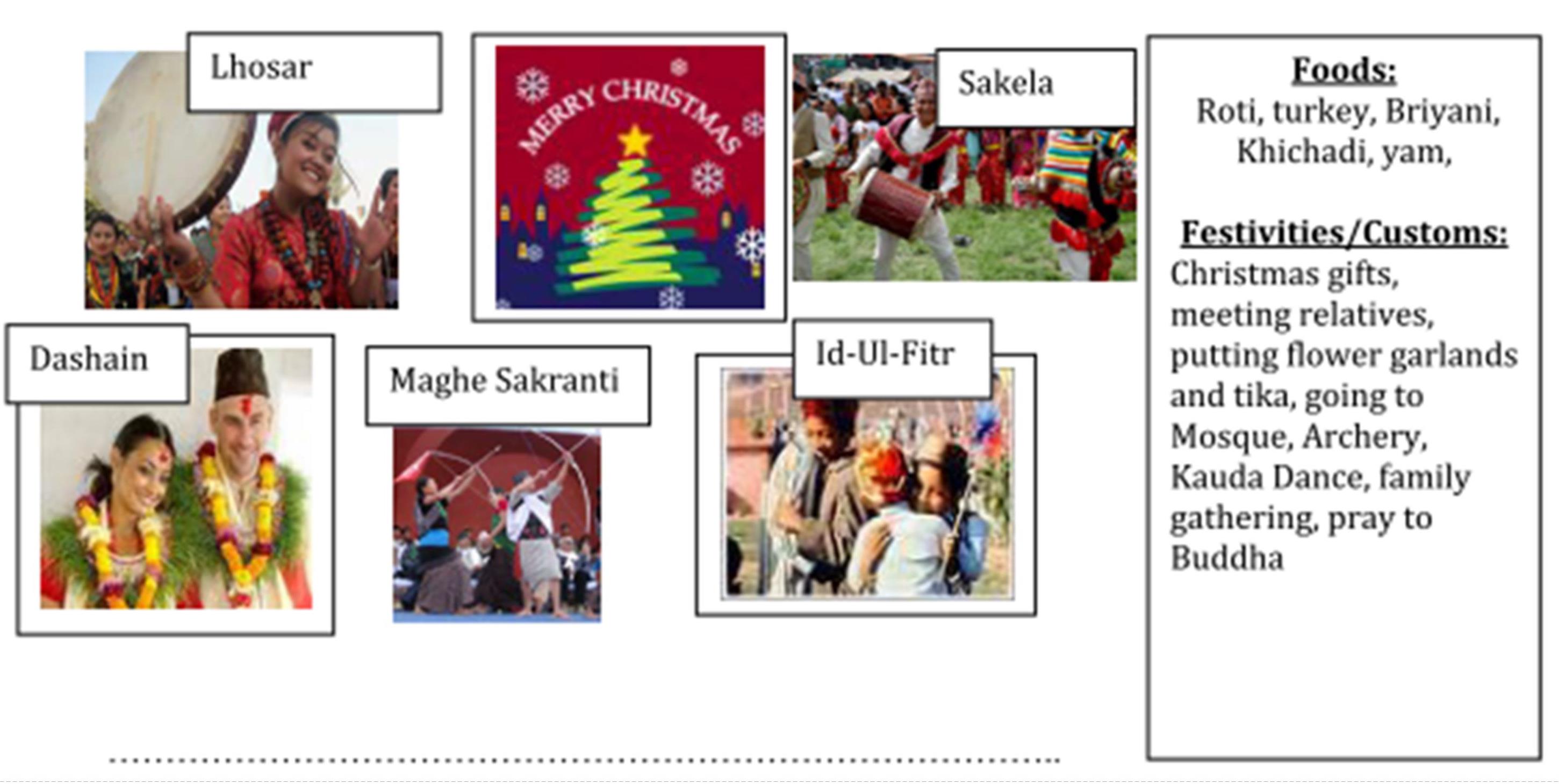
Taking these questions into consideration, we present an activity (Activity 1) that can potentially be used to promote pair interactions in an EFL classroom. This activity is a modified activity from a secondary two (Class 8) English language textbook in Hong Kong, which is believed to suit students with moderate English ability. The moderate language ability in this context is the students’ ability to use connectives and quantifiers in authentic situations. This activity incorporates multicultural elements in the context of Nepal as it contains pictures of various Nepali festivals as well as Western festivals such as Christmas. Students can ask their peers about their likes or dislikes and jot down their answers to present to the class. Phrases given in the boxes are meant to cater for learner diversity. For higher proficiency students, this activity can be presented in a different way to suit their levels.

___________________________________________________________________________

Activity 1:

Worksheet A

1. Study the pictures in the boxes in pairs. Ask questions to your friend about items that he/she prefers or doesn’t prefer more (or less) and why. Write your friend’s responses in the checklist at the bottom.

You may begin like this: Which festivals do you like more/less/most/least? Why?
 Publication1………………………………………………………………………..

Check List

2. Write your friend’s answers below. You may need to present it to the class.

* My friend likes ___________________________ more, because ______________

* My friend likes __________________________less, because _________________

______________________________________________________________________

* He/She likes ___________________________ the most, because _____________

______________________________________________________________________

* My friend likes ___________ the least, because __________________________

Conclusion

This entry presented the concept of interaction from a sociocultural perspective sharing the first author’s teaching experiences in a Hong Kong school. The sharing included the challenges as well as possible strategies a teacher might adopt to devise, implement and evaluate interactions in an EFL classroom. The sharing could present a model for EFL teachers to choose from many other pedagogical options in order to enhance the students’ English language learning. The activity presented in this entry is only one example of hundreds of such possible activities. The original activity might not be suitable to adopt exactly in Nepalese EFL classes, as there are diversities in terms of language, culture, students’ abilities as well as available resources based on geography, developmental level and proximity to urban life. Teachers need to bear in mind that they understand their students the best and they need to know how students can best interact and learn the language in the classroom.

*About the Authors:

1- Mr. Chura Bahadur Thapa is a PhD Student in the Faculty of Education at The University of Hong Kong. He was an English language teacher in a local college in Hong Kong for almost 7 years before joining HKU as a postgraduate student. He is currently researching the language learning and motivation of ethnic minority students in Hong Kong. His other research interests include- education of ethnic minorities, linguistic and cultural identity, intercultural communication and citizenship education. He can be reached at chura@hku.hk

2- Dr. Angel Lin received her Ph.D. from the University of Toronto, Canada. She is an Associate Professor of English Language Education at the University of Hong Kong.  Well-respected for her versatile interdisciplinary scholarship in language and identity studies, bilingual education and youth cultural studies. she has published six research books and over eighty research articles. She can be reached at angellin@hku.hk.

REFERENCES

Barnes, D. (2008). Exploratory talk for learning. Exploring talk in schools. Los Angeles, London, New Delhi: SAGE, 1-15.

Hall, J.K. & Walsh, M. (2002). Teacher-student interaction and language learning. Annual Review of Applied Linguistics, 22, 186-203.

Jong, C.D. & Hawley, J. (1995). Making cooperative learning groups work. Middle School Journal, 26 (4), 45-48.

Luk, J.C.M. & Lin, A.M.Y. (2007). Classroom interactions as cross-cultural encounters. Native speakers in EFL classrooms. Mahwah, New Jersey, London: Lawrence Erlbaum Associates, Publishers.

Mercer, N. & Dawes, L. (2008). The value of exploratory talk. In Mercer, N. & Hodgkinson, S. (Eds.). Exploring talk in schools. Los Angeles, London, New Delhi: SAGE, 55-72.
Creative Writing for Students and Teachers

Alan Maley

U.K.

Why is it that most institutional systems of education develop such narrow and unadventurous teaching procedures?  How is it that joyful learning somehow gets overwhelmed by institutional rituals: the worship of the syllabus, the obsession with ‘covering’ the textbook, the manic preoccupation with the exam, the compulsion to conform?  It seems that only in rare cases, through the determination of individual teachers, is joyful learning achieved.  In most other cases, the language is reduced to drumming in material as if it were a set of mathematical formulae in preparation for the exam, after which it can safely be discarded.  Small wonder that many students simply switch off  and develop a lifelong aversion to the language in question.  What they learn is neither enjoyable nor perceived as useful in the ‘real’ world outside the classroom.

This applies to much English language teaching too: all too often, it lacks a creative spark.  John McRae goes so far as to say,

“In future years, the absence of imaginative content in language teaching will be considered to have marked a primitive stage of the discipline: the use of purely referential materials limits the learner’s imaginative involvement with the target language, and leads to a one-dimensional learning achievement.  Representational materials make an appeal to the learner’s imagination…”  (McRae 1991:vii)

In this article I shall be arguing for the need to develop more creative approaches to writing as a way of enriching the learning experiences of both teachers and learners.


What is Creative Writing?

Creative writing is often contrasted with Expository writing.  I have summarized the principle differences between them in the following table:

   Expository Writing   Creative Writing


     Instrumental


     Facts


     External control


     Conventions


     Logical


     Analytical


     Impersonal


     Thinking mode


    Appeal to the intellect


    Avoidance of ambiguity


    Aesthetic


    Imagination


    Internal discipline


    Stretching rules


    Intuitive


    Associative


    Personal


    Feeling mode (plus thinking!)


    Appeal to the senses


    Creation of multiple meanings

When writing an expository text we are essentially instrumentally motivated. We have a quantum of facts, ideas and opinions to put across.  Expository writing rests on a framework of externally imposed rules and conventions.  These range from grammatical and lexical accuracy and appropriacy to specific genre constraints.  The aim of expository writing is to be logical, consistent and impersonal and to convey the content as unambiguously as possible to the reader.

Creative writing, by contrast, is aesthetically motivated.  It deals less in facts than in the imaginative representation of emotions, events, characters and experience.  Contrary to what many believe, creative writing is not about license.  It is a highly disciplined activity.  But the discipline is self-imposed: ‘the fascination of what’s difficult’ (Yeats).  In this it stands in contrast to expository writing, which imposes constraints from without.  It often proceeds by stretching the rules of the language to breaking point, testing how far it can go before the language breaks down under the strain of innovation.  Creative writing is a personal activity, involving feeling. This is not to say that thought is absent – far from it.  The ingenuity of a plot, or the intricate structure of a poem are not the products of an unthinking mind: they require a unique combination of thought and feeling – part of what Donald Davie (1994) calls ‘articulate energy.’  An important quality of creative writing however is the way it can evoke sensations.  And, unlike expository writing, it can be read on many different levels and is open to multiple interpretations.

The Case for Creative Writing.


It is reasonable to ask however, how we can justify the inclusion of creative writing, in addition to aesthetic reading, in our language teaching practices.  A recent small-scale survey (unpublished data) I conducted among some 50 leading ELT professionals, especially teachers of writing, yielded the following reasons:

1.  Creative writing aids language development at all levels: grammar, vocabulary, phonology and discourse. As learners manipulate the language in interesting and demanding ways, attempting to express uniquely personal meanings (as they do in creative writing), they necessarily engage with the language at a deeper level of processing than with expository texts (Craik and Lockhart 1972).  The gains in grammatical accuracy,  appropriacy and originality of lexical choice, and sensitivity to rhythm, rhyme, stress and intonation are significant.

2. Creative writing also fosters ‘playfulness’.  In recent years there has been a resurgence of interest in the role of play in language acquisition. (Cook 2000, Crystal 1998)  In some ways the ‘communicative movement’ has done a disservice to language teaching by its insistence on the exclusively communicative role played by language.  The proponents of play point out, rightly, that in L1 acquisition, much of the language used by children is almost exclusively concerned with play: rhythmical chants and rhymes, word games, jokes and the like.  Furthermore, such playfulness survives into adulthood, so that many social encounters are characterized by language play (puns, jokes, ‘funny voices’, metathesis, and so on) rather than by the direct communication of messages. In creative writing, learners are encouraged to do precisely this: to play creatively with the language in a guilt-free environment.  As Crystal states, ‘Reading and writing do not have to be a prison house.  Release is possible.  And maybe language play can provide the key.’ (Crystal 1998:217)

3. This playful element encourages learners to take risks with the language, to explore it without fear of reproof.  By manipulating the language in this way, they also begin to discover things not only about the language but about themselves.  They effectively begin to develop a ‘second language personality’.

4.  Much of the teaching we do draws and focuses on the left side of the brain, where our logical faculties are said to reside.  Creative writing puts the emphasis on the right side of the brain, with a focus on feelings, physical sensations, intuition, and the like.  This is a healthy restoration of balance between the logical and the intuitive faculties.  It also allows scope for learners whose hemisphere preference or dominance may not be left-brain, and who, in the usual course of teaching, are therefore at a disadvantage.

5.  The dramatic increase in self-confidence and self-esteem which creative writing tends to develop among learners leads to a corresponding increase in motivation.  Dornyei (2001), among others, has pointed to evidence that suggests that among the key  conditions for promoting motivation are:

‘5. Create a pleasant and supportive atmosphere in the classroom

6.  Promote the development of group cohesiveness.

13. Increase the students’ expectancy of success in particular tasks and in learning in

general.

17. Make learning more stimulating and enjoyable by breaking the monotony of

classroom events.

18. Make learning stimulating and enjoyable for the learner by increasing the

attractiveness of tasks.

19. Make learning stimulating and enjoyable for the learners by enlisting them as active

task participants.

20. Present and administer tasks in a motivating way.

23. Provide students with regular experiences of success.

24. Build your learners’ confidence by providing regular encouragement.

28. Increase student motivation by promoting cooperation among the learners.

29. Increase student motivation by actively promoting learner autonomy.

33. Increase learner satisfaction.

34. Offer rewards in a motivational manner.’(Dornyei 2001: 138-144)

All these conditions are met in a well-run creative writing class.  This increase in motivation is certainly supported by my own experience in teaching creative writing.  Learners suddenly realize that they can write something in the foreign language which no one else has ever written before.  And they experience not only a pride in their own products but a joy in the process.

6. Creative writing also feeds into more creative reading.  It is as if, by getting inside the process of creating the text, learners come to intuitively understand how such texts work, and this makes them easier to read.  Likewise, the development of aesthetic reading skills provides the learner with a better understanding of textual construction, and this feeds into their writing.  There is only one thing better than reading a lot for developing writing ~ and that is writing a lot too!

7. Finally, the respondents to the questionnaire survey were almost unanimous in agreeing that creative writing helps to improve expository writing too. In fact, by helping learners to develop an individual voice, it makes their factual writing more genuinely expressive.

All of the above factors were mentioned by the respondents to the questionnaire.  Respondents noted that students who become engaged in CW tasks demonstrate a robust sense of self-esteem and are consequently better motivated (Dornyei 2001).  They also become more aware both of the language and of themselves as learners. The virtuous cycle of success breeding more success is evident with such students.  As they become more self-confident, so they are prepared to invest more of themselves in these creative writing tasks.  Above all, students derive not just ‘fun’ but a deeper sense of enjoyment from their writing.

References

Arnold, Jane.  (1999).  Affect in Language Learning.  Cambridge: CambridgeUniversity Press.

Boden, Margaret.  (1998)  The Creative Mind.  London: Abacus.

Carter, Ronald.  (2004)  Language and Creativity: the art of common talk.  London: Routledge.

Cook, Guy.  (2000)  Language Play: Language Learning.  Oxford: OxfordUniversity Press.

Craik, F.I.M. and R.S. Lockhart (1972)  ‘Levels of processing: a framework for memory research.’  Journal for verbal learning and Verbal Behaviour II: 617-84.

Crystal, David. (1998)  Language Play.  London: Penguin.

Davie, Donald (1994)  Purity of Diction in English Verse and Articulate Energy.  London: Carcanet.

Day, Richard and Julian Bamford.  (1998)  Extensive Reading in the Second Language Classroom.  Cambridge: CambridgeUniversity Press

Dornyei ,Zoltan  (2001) Motivational Strategies in the Language Classroom.  Cambridge: CambridgeUniversity Press.

Gardner,  Howard. (1985)  Frames of Mind.  London: Paladin Books

Gleick, James. (1988)  Chaos.  London: Sphere Books

Koch, Kenneth. (1990) Rose, where did you get that red?  New York: Vintage Books.

Krashen, Stephen  (2004 second edition) The Power of Reading.  PortsmouthNH: Heinemann

Maley, Alan (ed) (2007 a)) Asian Short Stories for Young Readers.  Vol. 4.  Petaling Jaya: Pearson/Longman Malaysia

Maley, Alan (ed)  (2007 b))  Asian Poems for Young Readers. Vol.5. Petaling Jaya:Pearson/Longman Malaysia.

Maley, Alan and Jayakaran Mukundan.  (eds) (2005 a))  Asian Stories for Young Readers, Vol 1   Petaling Jaya: Pearson/Longman Malaysia.

Maley, Alan and Jayakaran Mukundan  (eds)  (2005 b))  Asian Stories for Young Learners. Vol. 2  Petaling Jaya: Pearson Malaysia

Maley, Alan and Jayakaran Mukundan (eds) (2005 c) Asian Poems for Young Readers.Vol. 3.   Petaling Jaya: Pearson/Longman.

Maley, Alan and Jayakaran Mukundan (eds) (2011a)) Asian Short Stories for Young Readers.  Petaling Jaya: Pearson Malaysia

Maley, Alan and Jayakaran Mukundan (eds)  (2011 b)) Asian Poems for Young Readers. Petaling Jaya: Pearson Malaysia.

Maley, Alan and Jayakaran Mukundan (2011 c))  Writing Poems: a resource book for teachers of English.  Petaling Jaya: Pearson Malaysia

Maley, Alan and Jayakaran Mukundan (2011 d))  Writing Stories; a resource book for teachers of English.  Petaling Jaya: Pearson Mal.aysia

McRae, John  (1991) Literature with a Small ‘l’.  Oxford.: Macmillan.

Matthews, Paul. 1994. Sing Me the Creation.  Stroud:Hawthorn Press.

Mukundan, Jayakaran.  (ed)  (2006) Creative Writing in EFL/ESL Classrooms II.  Petaling Jaya: Pearson Longman Malaysia

Rubdy, Rani and Mario Saraceni (eds) (2006) English in the World: Global Rules, Global Roles.  London/New York: Continuum.

Schmidt, Richard (1990).  ‘The role of  consciousness in second language learning’.  Applied Linguistics. Vol. 11, No. 2 129-158.  Oxford: OxfordUniversity Press.

Schumacher, E.F.  (1974).  Small is Beautiful.  London: Abacus/Sphere Books

Spiro, Jane  (2004)  Creative Poetry Writing.  Oxford: OxfordUniversity Press.

Spiro, Jane.  (2006)  Creative Story-building.  Oxford: OxfordUniversity Press.

Tan, Bee Tin (ed) (2004). Creative Writing in EFL/ESL Classrooms I  Serdang: UPM Press.

Tomlinson, Brian  (1998). ‘Seeing what they mean: helping L2 learners to visualise.’  In B.Tomlinson (ed). Materials Development in Language Teaching.  Cambridge: CambridgeUniversity Press.  265-78

Tomlinson, Brian (2001) ‘The inner voice: a critical factor in language learning’  Journal of the Imagination in L2 learning.  VI, 123-154.

Wright, Andrew and David Hill. (2008)  Writing Stories.  Innsbruck: Helbling Languages.

Writers Teach, Teachers Write

Kirk Branch

U.S.A.

Over 15 days, I traveled throughout the southern part of Nepal (“I went down,” I tell my friends in the United States, who expect to hear stories of the Himalayas), working with teachers and students – writers – who were looking for ways to incorporate creative writing into their English language classrooms. At the invitation of the U.S. Embassy, and hosted throughout by NELTA representatives in Kathmandu, Birgunj, and Kawasoti, my short trip will stay with me well after my return.

Before every workshop I ran, before the talk I gave in Birgunj, I asked participants a simple question: “How many of you are writers?” Sometimes, nobody raised a hand; occasionally, some raised a tentative hand, nervous about claiming the title of writer but unwilling to say that they weren’t. That question introduced the simple idea at the heart of all the workshops and conversations I had in Nepal: If you are not a writer, you are not qualified to teach writing. How can you teach guitar, if you can’t play guitar? How can you teach volleyball, if you don’t play volleyball? Of course you cannot, or at least you cannot do it very well.

And so, in all the places I traveled, we wrote. We wrote stories, and memoirs, and poems, haikus and slam poetry and fables. I heard stories about family members who sacrificed for their children, poems full of frustration at the current politics of Nepal, diatribes against the bandh. The writings were by turns funny, beautiful, sweet, angry. And we shared the writing, reading aloud, sometimes laughing, sometimes tearing up, sometimes feeling the anger and frustration, always supportive and always curious about what each participant had to say and wanted to explore.

In the process, I hope that the participants began to understand how to think like a writer. Writers know a few things about writing that non-writers don’t usually understand. Perhaps most importantly, writers understand that the rules provided in textbooks and in official curricula are usually too simple and often are just wrong. Some writers use an outline when they write, but most don’t. Some writers create texts with only five paragraphs, but most don’t. Some writers have a topic sentence at the front of every paragraph, but most don’t. Teachers who write as well as teach writing are better able to help other writers find things to write about and support them as they create a text, not by giving them strict rules, but by offering knowledgeable support.

All writers know that writing is hard, that becoming a more proficient writer requires regular practice, that even people who write for a living struggle with openings and agonize through several drafts to reach a level of satisfaction with their work. All writers know that at some point, they have to share their work with an audience, that their main job is to connect with that audience, and that all the questions they have about style and structure matter not because they are “rules for writing” but because style and structure are the ways the ideas of a writer become accessible for that audience.  All writers know that the work of learning to write never stops, that a piece of writing can always improve, that writers need support and encouragement as much as they need criticism and commentary.

By the end of the workshops I ran, by the end of my trip, more people raised their hands when I asked “Who here is a writer?” I hope that even more would raise their hands now. Being a writer, identifying as a writer, requires only that a person write, commit on a regular basis to the work of sitting with a piece of paper or in front of a computer screen and filling it with words, with language. I hope that these newly identified writers in Nepal experience the joy of discovery, of writing something they didn’t know they thought, of surprising themselves with a beautiful image or important idea or funny description. And I hope they share their writing with other writers and inspire them as well with their ideas.

Mostly, I hope these new writers – these writers who teach writing – use their experiences as writers to help their students engage with the task of writing and reading. I hope all the writers who are also teachers of the English language in Nepal will harness the creative power of their students to inspire each other and embrace the joy of creation, to write texts they care deeply about and want to share with other students.

Like teachers all over the world, teachers in Nepal must follow official curricula, must prepare students for tests required by the government. Like teachers everywhere, teachers in Nepal sometimes become frustrated by these requirements because they do not allow enough freedom for teachers. I hope that by joining with other teachers, by learning the power of creative writing, of helping students learn language – any language – by helping them become excited about what they have to say, teachers in Nepal can start to have more voice in shaping a curriculum they are excited to teach!

I end this piece with a poem I wrote during a workshop at the NELTA headquarters in Kathmandu, with a group of teachers and students who walked as much as 12 kilometers over the course of a 2-day bandh, to participate. I dedicate this poem to them, and to all the other participants I met in Birgunj and Kawasoti, who inspired and excited me to do my best teaching, who took my challenge to become writers, who I hope I will see again. It’s dedicated to all the people at NELTA who made my trip so wonderful and engaging. I hope I have a chance to meet some of you again. I promise I will never forget you!

Whose language is this, English?

Can I call it mine,

this language of my childhood stories,

my mother’s soothing,

my father’s rebukes,

my brothers’ tauntings,

my teacher’s lessons,

my lover’s caresses?

Yes, it is my language!

Does that mean I own it?

Do you own the water you hold in your hands?

Do you own the air you breathe into your lungs?

Do you own the spirit that animates your soul?

What Writers Need to Know about Starting and Then Getting Better at Writing

Jayakaran Mukundan

Malaysia

Most people think they cannot write and when they start having these thoughts they will never begin writing. It is not easy to write a poem or a story if you haven’t done much of it but if you start and if it isn’t good at least you have tried. Once you start, get someone who writes frequently to look at your work. Get advice and then re-work your stories and poems. Once you finish start on new work so that you get “addicted” to it. Here below is some advice on how to get started and how to keep the momentum:

  1. If you have written a story or poem and after a while you don’t like it, don’t throw it away. Get some advice from people who write often and ask for help on improvements. Rework the poem or story and then show the expert to see if he/she likes it after the changes
  2. Sometimes no matter how much you try your writing stalls and this is referred to as “blocking”. You may then be, without your conscious knowledge, a “blocker”. People who are blockers are usually writers who are too afraid of making mistakes. If you are this sort of person, learn to relax and have a positive attitude towards your writing. Just keep writing and tell yourself you will change course or look at errors after you have written a page or two. If you worry about bad ideas or errors you may never get to start!
  3. Read more stories and poems and get ideas from professional writers. The more we read the more we are aware of how other people write their stories. We cannot copy these stories but we can learn some strategies so that our stories get better.
  4. If interested in writing poems but you have no idea as to how to start, get a reference which deals with scaffolding strategies that help learners become beginner poets. All you have to do is to learn some of the patterns (for form poems) and then you are on your way!
  5. In order to boost your confidence try publishing your work. The Regional Creative Writing Group does publish the work of amateur writers. Even if you don’t join the group, you can send in work (there may be a representative of the group in your country!)
  6. When you go to places like your ancestral village listen to what elders would say. Keep a record in your notebook. These may become ideas for new writing. When you are free try recalling some things at school like a teacher who is funny or a teacher who constantly forgets. Try writing poems about these people. In fact try writing about people in your family.
  7. Photographs are a good way to start writing. When at home sit with an older person; your father or mother and grandparents. Go through the family album with them and try getting as many stories about people and places from them.  Family albums are a great way to start writing stories and poems.
  8. Last but not least never say you can’t write. Most people who say this end up being good writers after some practice!

Some observations on Nepali teachers writers during the recently concluded Creative Writing Workshops

Generally different people have different personalities and individual preferences, hence write differently. Generally Nepali teachers are very enthusiastic. When at first they were taught scaffolding techniques they began to realize that they could write. This took place when they were taught some scaffolding templates for developing form poems. These exercises soon raised their eagerness to experiment, manipulate and essentially “play” with the language. When they started playing with language the creativity of these teachers soon began to show!

The writing trip was another instance where they learnt to write creatively “after making close observation”. It was good opportunity for them to realize that writing was not just confined to classrooms. The entire space that surrounds them can be inspiration for their writing. Many of the participants confirmed that they would also be working on creative writing projects with their own students after the workshops. That was indeed nice to hear!

Birgunj Truly Represents Nepal

-Vishnu S Rai

Place: Kailash Hotel, Birgunj

Date and time: March 8, 7 PM.

We are standing at the threshold of the hotel to greet the members of the Asian English Teachers’ Creative Writing Group (AETCWG). There is excitement in the air. People are expectant: cameras ready.

A Hias approaches us slowly and stops. The doors open and produces Jay from Malaysia, Iqbal from Pakistan, Kanokon from Thailand, Li Wei from China and Moti, Sarita, Tapasi and Maya from Kathmandu in a row. Then, slowly from the open door emerges the saintly figure of Alan Maley from the UK. Cameras start clicking, there are handshakes and the sounds of pleasures, “Nice to see you again’, ‘Welcome to Nepal’ are heard. The group is joined by Kirk from the USA and the group slowly enters the hotel.

They are the members of the AETCWG who have come to Birgunj from different parts of the globe to meet at their annual meeting and produce creative works that can be used in ELT classrooms on one hand, and to help develop creativity in those English teachers of the region who aspire to be creative. They are here to break the myth that only the god-gifted people can be creative.

Man is not anything by birth

He is what he makes himself

By passion,

Diligence, and

hard work.

9th March: Workshop Day 1

The first day of the workshop starts with introduction of the new members from Birgunj. They are Sajan Kumar, Suresh Shrestha, Ram Abadhesh Ray, Praveen Yadav, Kamalesh Raut and Jyoti Tiwari. The best thing of AETCWG workshop is that there are no formalities of opening, etc. It starts its works like a big family. There is no President or General Secretary and there is no membership fee. Anyone can be the member of the group provided that they, from the bottom of their heart, want to write.

Alan does some warm activities and then the members start looking at each other’s writings for the sake of discussion, constructive comments and feedback. They work for the whole day until it’s time to stop. One example is given below which is based on the painting ‘Nighthawk’.

Empty city

With light and all

Preoccupied people

With lost soul.

Lots of food

But no apetite

Lost in thought

Tongue tied.

Eerie feeling

Gloomy atmosphere

Empty heart

Nothing to share.

Neither they want

to show nor to be seen

In this very world

We pay for our sin.

10th March: Workshop Day 2

The group is ready to go for a writing trip. Each member has been asked to observe things on the way and make notes which can later be developed into poems and haibuns.  The group reaches Trikhandi –the crystal clear water of the river is hurrying down like someone who hurries to meet their love. People are bathing in the river and the goddess watches them benevolently from her little temple perched on a rock just over the river.

The group later visits the martyr park and pays their homage to those brave sons of Nepal who sacrificed their lives for us so that we could breathe in the free and fresh air of democracy. The group returns to Kailash at 6. An example from the writing trip is given below in the form of a haiku.

A chimney and a

Hospital stands side by side

Demand and supply

11th March: Workshop Day 3

The group members present their creative ideas and activities that can be used in the actual classroom situation. For example, the members were asked to pick up a stone which they liked and observe it carefully: its colour, shape, size, touch everything, and then write about it in the first person as if the stone was telling its story. The same could be done with the students. I picked up a small stone which was smooth by touch and had the shape of a heart. Here is what I wrote about it. Other members also wrote about their stone and each writing was different

I’m a stone.

I’m the heart stone.

You might think how could there be a heart stone.

But I am.

I’m the heart stone.

No, seriously.

Look at me!

You see my shape? It’s like a heart.

Touch me!

Do you feel my softness?

No, no. Please don’t rub me with your rough fingers.

Put me onto your cheek and then you’ll feel how soft a heart is.

I’m not a heart made of stone.

I’m the heart stone.

Would you pick me up?

I suggest you should.

You can take me to your love, to your sweetheart.

They will be so happy.

A heart stone as a souvenir from a river of Nepal.

And what’s better than making your love smile which brightens your own heart.

Would you now pick me up?

Gently please!

For I’m the heart stone.

The workshop ends with the discussion of publishing the workshop products and the next meeting of the group in some other country.

12 March: Conference Day 1

The conference starts one hour late which is unusual to the foreign guests. Some muttering and grumbling are heard but later they realize that it is not a big deal in Nepal to be late.

How time flies for non-Nepalis

When they are having fun

It travels slowly for Nepalis

Like a penguin walks in the sun

The conference was inaugurated by Prof. Dr. Gobinda Raj Bhattarai which was followed by the presentation of the keynote speaker Prof. Alan Maley. Next: Dr. Kirk form the US gave his plenary talk which was followed by the concurrent sessions.

It was a pleasant surprise to find participants in such a great number from the adjacent districts viz. Dhanusha, Mahottari, Bara, Makwanpur and as far as from Kailali.

13th March: Conference Day 2

The second day of the conference started with the plenary from Prof. Dr. Bhattarai, followed by Dr. Vishnu S Rai and Prof. Dr. Jayakaran Munkundan. After the lunch break concurrent sessions started.

One of the special features of the conference was that at the end there was poetry recitation programme for one and a half hours in which poets recited the poems in five different languages viz. English, Nepali, Bhojpuri, Maithili, and Punjabi. Here is a poem recited in the ceremony.

My Child’s Eyes

I walked through the windows

Of my child’s eyes

Into a world of wonder

Where the grass is always green,

No sky is ever anything but blue,

The sun shines eternally from one corner,

Houses puff dainty smoke for ever –

And people never cry.

A land of bright-eyed foxes,

Breathtaking birds,

(Occasionally flying upside-down),

Daddies and mummies,

And people who never die.

And then I walked out again,

Crying for the innocence she’ll lose.

I walked through the window of my child’s heart –

Trying not to break it.

Birgunj hospitality

The members of the group were overwhelmed by the generous hospitability of the host. They were taken to different local members’ home for dinner to taste typical hill and Terai dishes of Nepal. They ate Gundruk and Dhindo, Dahibada and Kadhi,  Mohi and Lassi and what not. Nepal is a multilingual, multicultural country and the work/conference reflected it in its papers, its poems, its food and its cultural performances. This was a great experience. Birgunj truly represents Nepal –a town where Hills and Terai and their different cultures and languages meet together and turn into a mosaic.

My Reflection on Birgunj Conference

Kanokon  Opasmongkonchai

Thailand

One of my great experiences which I’d like to share with you was to attend the conference that took place in Birgunj, Nepal on 12 -13 March 2013. It was Asian English Teachers’ Creative Writing Conference (2013), in which apart from gaining knowledge from expert creative writers, Prof.Alan Maley, Prof. Jayakaran Mukundan, Dr Kirk Branch, Prof. Dr. Govinda Raj Bhattarai, Dr. Vishnu Singh Rai and other scholars, I also obtained friendship with warm hospitality, as well as Nepalese cultural learning.

In fact, I had been there in Birgunj in a team four days before the conference. We had a three-day pre-conference session of only core group members. In the session I got acquainted with some new faces. We shared our poems and stories and had peer-editing that offered an ample opportunity to understand and learn how uniquely we take up creativity. The second day was much more memorable. We had a trip to Trikhandi on a bus. It was about three hours to the south of Birgunj. There I saw mountains stand very close all around and a clean stream rush down. I felt it special for getting intimacy with nature. We were there to empower our creative writing being close to nature. We all carried some stones of our choice and I brought back a heart-shaped one. On the third day we had a great time sharing our poems and stories that we had composed on the stones we had carried. It was of the greatest significance, since we had penned what we had observed on our field trip. It gave us another but the most crucial lesson how to find our surroundings in our literary work.

It was on March 12, the first day of the conference after the key speech by Prof. Alan Maley and a plenary session by Dr. Kirk Branch, I had a paper to present in one of the buildings of a nearby college. I was delighted to have about 35 participants to join the creative writing activity with me “Using a Picture to Stimulate Creative Writing.” I was very much impressed by participants who paid a great attention to the activity. While making a presentation, I wondered if the picture would be too difficult for them to write on or not. But, with their abilities and talents, it was obvious that they could write poems and short stories rapidly and colorfully, indeed.

Here are some of the poems on the pictures that they composed during the session and that I would love to share with you hoping that you may also try writing:

My Heart Says  

Oh, Dear
You look as fresh as dew
I don’t have many words to say
But only few
You are the old one for others
But in my sight, you are always new
I am the sky, you are my moon
When I see you, I forget the morning or noon
I have devoted my heart to someone and that is you
No matter you love me or not
But dear, really I love you

(Krishna Chaudhary)

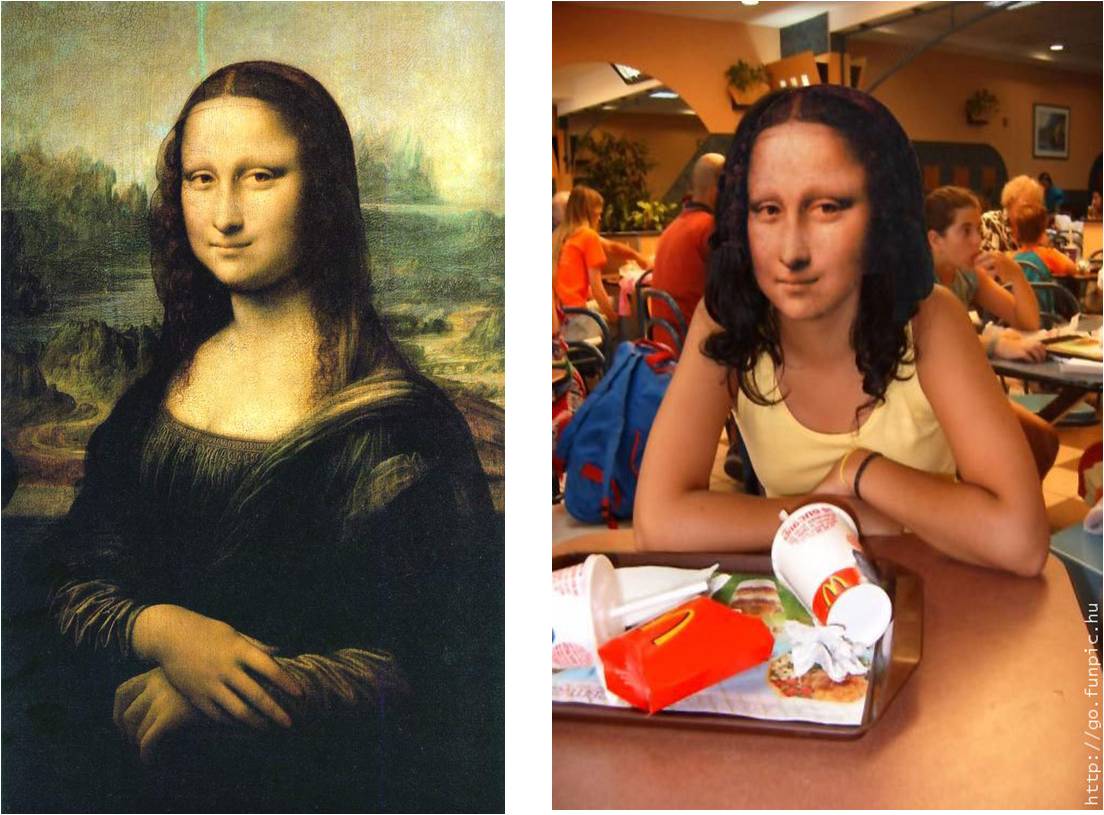
Mona Lisa’s Change  

Oh, Mona Lisa
Pure and pretty woman
You’re born in a palace
And you end in the Mc Donald’s
Why you change your life?
I know well, my Mona
You don’t like the servants
You just wish a coca- cola!

(By Spanish participant)

……………………………….

What eyes she has,

What eyes!

It’s hardly a surprise

That millions have looked into them –

She looks so calm and wise.

But if, by some strange chance

We passed with a quick glance

Today,

Would we even spare the time

To ask her for a dance?

Or simply walk away?

(Alan)

………

And my friendly souvenir to you:

Let’s Smile!

Nothing to pay
When you smile.
So, let’s smile.

Something you gain
Is friendship
Hope
Joy
Peace
So, let’s smile.

Anything makes you pain,
Forget it awhile.
So, let’s smile.
Smile! Smile! Smile!
(Kanokon Opasmongkonchai)

Pictures used in the workshop:

Picture1

To my mind, participants were quite active and confident of doing the activity with me. They had proudly presented their writings. It was very nice that they had different views-points to write, so it made the workshop more interesting, making me feel that they could secure their own space for potential writers to grow out of them! Best Wishes!!

After the paper presentations on the first day, we got back to the Town Hall to observe the cultural program held by cute school boys and girls. Several times they got me to feel like singing and dancing next to them. They sang songs and danced so well that I couldn’t at all feel how swiftly time had flown away. I also learnt about the diverse cultures in the country through their dresses.

On the second day just before the closing ceremony we had another literary taste. It was a poetry recitation. Several participants including Prof. Maley, Dr. Branch, Prof. Bhattarai, Dr. Rai recited their poems in different languages – English, Nepali, Bhojpuri, Maithili, etc. Although I could not understand the poems in the languages other than in English, yet I could perceive their elegance through the ways they were recited. It was really a good example of multi-lingual harmony in Nepal.

In my view, creative writing is the best challenge to accept if you are learning to write. It requires a great deal of patience as well as love to do that. Maybe love should come first. Self-discipline to practice writing with figurative languages together with observing things around us deeply and correctly with imagination is a very important qualification of being a good creative writer. It is certain that it gives us pain when the idea doesn’t come out and in particular when we write in English, which is not our mother tongue. But, when the good result ripens, I dare say it’s worth it, indeed!

Before taking leave, what I am feeling now is:

Loneliness is…

Loneliness

Is

Fungus:

It’s fast to grow

It’s hard to heal

Its root

Is too deep

To eradicate

And

Ready

To come back

Terrible!

(Kanokon  Opasmongkonchai)

Stay in touch to ward off the feeling of loneliness.

Cheerio!