Book Review:
Reviewed by: Shiv Raj Paudel

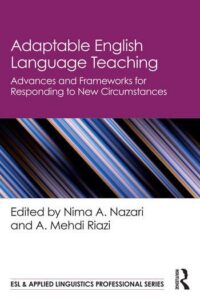 Nazari, N. A., & Riazi, A. M. (Eds.). (2025). Adaptable English language teaching: Advanced frameworks for responding to new circumstances. Routledge. 292 Pages 2 Color & 9 B/W Illustrations, Price: £37.59 paperback, ISBN 9781032414294
The book titled Adaptable English Language Teaching: Advanced Frameworks for Responding to New Circumstances, edited by Nima A. Nazari and A. Mehdi Riazi and published by Routledge in 2024, explores how English language teaching (ELT) can adapt and respond to changing educational circumstances. Its central argument is that teachers should not remain confined to established teaching practices but should be prepared to modify their pedagogical approaches, instructional tools, and professional perspectives in response to changing contexts and learners’ needs. The book is part of the Applied Linguistics Professional Series and consists of fifteen chapters contributed by scholars and researchers from different countries, including Hong Kong, Australia, New Zealand, the United States, the United Kingdom, and Macau. Each chapter addresses a particular dimension of ELT and examines how teaching practices can be adapted to emerging circumstances. The book is organised into four major sections covering curriculum, assessment, language teaching skills, and technology in ELT.
The central message of the book is that adaptability is an essential characteristic of effective English language teaching. Teachers need to be prepared to respond to changing circumstances by reconsidering their teaching methods, instructional resources, and pedagogical assumptions. According to the editors, adaptability should be understood not merely as a professional skill but also as a mindset that enables teachers to respond flexibly to emerging challenges. They emphasise the importance of adapting teaching practices across face-to-face, online, and hybrid learning environments while making thoughtful use of technological resources. Equally important is teachers’ ability to understand, respect, and respond to their students’ needs. The book therefore advocates a learner-centred approach in which students remain at the centre of the teaching-learning process. Primarily intended for ELT practitioners, teachers, teacher educators, students, and researchers, it combines theoretical discussions with practical insights into contemporary challenges and developments in language education.
Sections I and II (Chapters 1–7) focus on the need to adapt curricula, teaching approaches, and assessment practices in response to changing educational contexts. Macalister emphasises the importance of understanding the teaching-learning context, identifying learners’ needs, and periodically reviewing and revising courses. Similarly, Reed, Kharchenko, and Bodis highlight the need for teacher education programmes to prepare teachers to navigate future challenges and uncertainties. These chapters collectively emphasise the importance of understanding learners’ needs, expectations, and educational experiences. Light, Lo, and Guardado, for instance, discuss the academic needs of international students learning English for Academic Purposes (EAP), while Bao challenges conventional interpretations of classroom silence by suggesting that silence can also represent a positive form of learner participation. Section II further explores emerging approaches to assessing English as an additional language, including technology-assisted assessment, feedback practices, and classroom management in changing educational environments. Overall, these chapters demonstrate that curriculum development, pedagogical decisions, and assessment practices need to remain responsive to changing social, educational, and technological conditions.
The teaching of language skills and the integration of technology are explored in Sections III and IV (Chapters 8–15). Section III primarily sheds light on approaches to teaching listening, reading, speaking, and writing, alongside language components such as grammar, vocabulary, and pronunciation. A common theme across these chapters is that technological developments, online learning environments, and changing modes of communication have significantly influenced how language skills and components are taught and learned. Section IV places greater emphasis on the role of technology in contemporary language education. Spiro examines the significance of teachers’ values and professional perspectives in online learning, while Kessler, Marino, and Farrell explore recent developments and challenges in computer-assisted language learning (CALL). Similarly, O’Hanlon and O’Keeffe reconsider the design and implementation of role-play activities and suggest ways of adapting them to support speaking instruction in online classrooms. Collectively, these chapters present technology as an important facilitator of language teaching and learning rather than a substitute for teachers’ professional judgement, pedagogical guidance, and interpersonal engagement.
One of the major strengths of the book is its logical organisation. Its four sections follow a coherent progression from curriculum and learners to assessment, language skills, and technology. This arrangement enables readers to develop a broader understanding of adaptability across different dimensions of ELT. Furthermore, the chapters generally provide a structured discussion of past developments, current practices, and future possibilities within their respective areas. Such an approach helps readers understand how and why established teaching practices need to evolve in response to emerging circumstances. Likewise, the second strength is the diversity of topics addressed. In addition to examining the four major language skills, the book considers less frequently discussed issues, such as learner silence and the academic needs of international EAP students. The contributions of scholars from different geographical and educational contexts further broaden its scope and provide an international perspective on contemporary ELT practices. This diversity makes the book relevant to readers working in different educational settings and encourages them to reconsider established assumptions about language teaching. The third strength of the book is its balanced perspective on technology. Rather than presenting technological innovation as an unquestionable solution to educational challenges, the book recognises the continuing importance of human involvement in teaching and assessment. For example, Chapter 13 highlights the significance of human values and teacher engagement in online learning. Similarly, Chapter 5 examines the potential of automation in assessment while acknowledging the need for human oversight and professional judgement. This critical yet constructive perspective makes the book particularly useful for educators seeking to integrate technology into their teaching practices without overlooking the pedagogical and interpersonal dimensions of education.
Despite these strengths, the book has some limitations. First, several chapters rely considerably on theoretical discussions and reviews of existing literature. Although these discussions provide useful overviews of relevant research and developments, the inclusion of more detailed classroom-based examples and practical demonstrations would have strengthened the book’s pedagogical relevance. This is particularly important in areas such as assessment, feedback, and language skills, where teachers often need concrete illustrations of how theoretical principles can be translated into classroom practices. Consequently, some chapters may be more useful for understanding conceptual developments than for directly guiding classroom implementation. Second, the book gives insufficient attention to the diversity of teaching contexts, particularly resource-constrained educational settings. Although its overall perspective suggests relevance to challenging and resource-limited environments, much of the discussion of educational technology appears to assume reliable internet connectivity, access to appropriate digital devices, and adequate institutional support. While the digital divide is acknowledged, its implications for teachers and learners in disadvantaged contexts are not explored in sufficient depth. Consequently, some of the suggested approaches may be difficult to implement in resource-constrained educational settings, including many schools in Nepal. Teachers working in such contexts may therefore need to modify the proposed approaches in accordance with their available resources, institutional conditions, and learners’ needs. Greater attention to these contextual differences would have enhanced the book’s global relevance and practical applicability. The third limitation concerns the limited discussion of generative artificial intelligence (AI). The book was published in 2024, a period when AI tools were rapidly transforming writing practices, feedback mechanisms, and task design in English Language Teaching (ELT). However, it offers limited practical guidance on how generative AI can be effectively integrated into these areas. Consequently, readers may need to consult more recent research to understand the latest developments and explore effective approaches to incorporating AI into English language teaching.
Overall, the book makes a valuable contribution to the literature on English Language Teaching (ELT). Its key strengths include a coherent structure, a diverse range of topics, and a balanced perspective on the use of technology in language teaching. Nevertheless, several limitations are evident, including the limited provision of practical classroom examples, insufficient attention to resource-constrained teaching contexts, and a lack of in-depth discussion of artificial intelligence (AI). Despite these limitations, the book highlights the importance of adaptability and flexibility in today’s rapidly changing educational landscape. It is a useful resource for language educators, students, researchers, and policymakers. Teachers, in particular, can draw inspiration from the ideas and approaches presented in the book and consider adapting them to their own teaching contexts.
About the reviewer: Shiv Raj Paudel is an MPhil scholar in English Language Education at Kathmandu University and an experienced English language teacher who has taught at various schools and public campuses across Nepal. He is currently affiliated with Siddhajyoti Education Campus and Janajyoti Secondary School in Sindhuli. He has published several research papers and presented his work at numerous national conferences. His primary research interests include AI ethics in ELT, English as a Medium of Instruction (EMI), learner autonomy, and technology integration in ELT.
