Category Archives: Teacher Training

Action Research for EFL Teacher’s Professional Development

Manita Karki

M.Phil. in ELE

Kathmandu University

School of Education

In recent years, action research has become increasingly popular as a form of professional development for teachers. The reason is, action research helps teachers to “look behind” what they did and  provides space for teachers to correct their past mistakes and analyze needs of the students. Such work significantly helps teachers to grow as professional teachers. So doing action research is one way to solve the faced problems while teaching and to develop teachers’ professional carrier too.

For me the category “Action Research” is not new but the meaning has  changed a little bit recently.  Action Research usually refers to “the researcher doing their research in the field” . Before taking the course “Action Research and Teacher Development,” I thought action research meant  going to the  field, observing the situation and finding out the real problem among the students regarding their study (learning) and then trying to solve those problems by applying different teaching-learning techniques, methods, and strategies. But now I have realized that after completing the process, the researchers should continually look for other difficulties among the same or different level of students. What I used to think was not completely wrong but that was  just the narrow sense of my understanding , which I noticed only after completing course on “Action Research and Teacher Development.”

Action research mainly consists of self reflection as its central tenet. McNiff (2002) opines that “Action Research is a term which refers to a practical way of looking at own work to check that it is as one would like it to be or not.” Because action research is done by self, the practitioner, it is often referred to as practitioner based research and because it involves thinking about owns work, it can also be called a form of self reflective practice. “In traditional forms of research/empirical research, researchers do research on other people but now they do research on themselves” (McNiff, 2002).

Here with the help of McNiff’s idea I can say that action research is mainly based on self-enquiry: conducting research by the self about the self. For example “YOU” as a practitioner can think about  your own life and work and this involves you asking yourself why the way you work is different?, why you are the way that you are? In this way you can translate your research into practice. However,  systematic investigation into your own behavior and the reasons for that behavior is quite essential. Achieving a  better understanding of yourself can further help you to grow personally and professionally.

Action research is an open ended  research and does not begin with some sort of fixed hypothesis because researchers generate knowledge while conducting research  and they keep on thinking and (re)designing what to do next. “The research process is the developmental process of following through the idea, seeing how it goes and continually checking whether it is in line with what you wish to happen” (Norton; 2009). What we can say then is that action research is a process of a form of self evaluation.

Therefore, importance of  applying it in teaching and learning field can be immense. If we  continuously involve  in  thinking about the tasks we do, in checking what went right and what went wrong and keep ourselves busy with reflection, we will be able to see  areas of weaknesses and areas of our strengths.  In the words of Smith and Gillespie (2007), in addition to “knowing what” and “knowing how” teachers must also be competent in “knowing why” and “knowing when”. The capacity to reflect and then develop a culture of questioning (ones practice) helps a teacher to be professionally competent and practically good at teaching because it furnishes positive impact on how and what students learn, and motivates to keep learning further.

So from my own experience now I can say that doing action research is very useful for the teachers to develop his/her teaching style because when the teachers involve in doing action research while teaching then they can look behind what, how, when and why they teach and what they are missing. With the help of the knowledge of weaknesses in their teaching and of the level of students, they can develop their own best pedagogies. In this way doing action research helps  teachers to be a professionals and enhance their teaching learning activities. Because of these reasons I can say that “Action Research plays vital role in teacher’s professional development”.

References

McNiff, J. (2002). Action research for professional development: Concise advice for new action researchers.

http://edavula.co.cc/web_documents/ar_jean_mcniff_-_per_studentet_e_ma.pdf

Norton S. L. (2009). Action Research in Teaching and Learning: A practical guide to conducting pedagogical research in universities. London: Routledge.

Smith, C. & Gillespie, M. (2007). Research on professional development and teacher change: Implications for adult basic education.

http://www.ed.gov/teachers/how/tools/initiative/factsheet.pdf.

Writing workshop: A Report

Praveen Kumar Yadav

Nepal English Language Teachers’ Association (NELTA) started publishing its journal annually after three years of its inception in 1993 AD. So far NELTA has published twelve volumes of its journal till 2011. All the journals are not peer reviewed, however. The Journal of NELTA became a peer reviewed journal in 2010 only. It has been an integral part of NELTA’s mission for ‘enhancing the quality of English language teaching and learning through professional networking, supporting and collaboration’. It is also a means towards achieving NELTA’s goal of providing a ‘forum for exchanges of ideas and experiences at national, regional and international levels’.

Following the NELTA’s announcement for the call for articles for the upcoming volume of the Journal of NELTA 2012, Mr. Bal Krishna Sharma, one of the editors of the journals and a former EWC fellow, who is currently doing his PhD in Applied Linguistics at the University of Hawaii, USA, facilitated the workshop cum presentation organized by NELTA Central Committee at its office in Kamaladi, Kathmandu on 4th Aug, 2012. Altogether fifty members of NELTA, who are interested to get their articles published in a peer reviewed journal, had enthusiastically participated in the workshop.

Mr. Sharma discussed the following issues during the presentation.

  • Things we should consider before submitting a manuscript to a journal.
  • How to Avoid Plagiarism
  • Why are manuscripts rejected?
  • Where do you find more recent academic resources?
  • What do the reviewers focus on while reviewing your manuscript?
  • How to respond to editor and reviewer comments? And many more such questions

In order to contextualize his presentation, he drew samples from the NELTA journal manuscripts and showed the audience examples of papers that were not accepted or publication. Contrary to my expectation, there were examples of research reports that cited from different sources but did not acknowledge the source. In addition, there were manuscripts that did not read like a research paper, but like a textbook chapter or a class note.

Mr. Sharma focused on two different themes in order to address these agenda: (1) formatting a research paper, (2) avoiding plagiarism

Formatting a research paper

A research paper/article usually follows an IMRD (Introduction, Methods, Results, Discussion) format although there are variations and different labels/names for that.

1.      Title:

The title of the article should be concise. An author should use the key terms that s/he are going to use in the paper/article. The title should be written in such a way that helps readers to predict the purpose and content of the article. A good title helps the readers predict the content of the article.

2.      Abstract:

The abstract of the research paper/article should include three moves: Purpose/objective; methods; and major findings.

 3.   Keywords 

keywords refer to technical and conceptual terms used in our paper. The keywords help readers find our article in google.com. These are the words typed to find our paper/article.

4.      Introduction (funnel shape— moving from general to specific)

  • Introduction
  • Background
  • Literature review
  • Theoretical/conceptual framework
  • Niche/hole and significance of the study
  • Research questions

5. Methods

  • To describe the theoretical approach, the material analysed and the procedure applied (Swales and Feak, 2004).
  1. is explicit about what the author(s) did;
  2. gives reasons for actions, explains procedures, specifies categories etc., may give examples;
  3. procedures normally written in the past tense;
  4. packed with terminology
  5. sometimes subdivided into sections:
  6.     Context/site of research
    1. Participants
      1. Tools and data collection
      2. Analytical procedure

6. Results/Findings

–     To describe the findings with “variable amounts of commentary” (Swales and Feak, 2004: 157).

–     Answer our research questions

–     Arrange sub-headings according to the order of our RQs

–     Do not set out to answer that you did not propose

–     Double-check if you answered all RQs.

–     Note: It  may merge into discussion

  • It goes beyond factual recount of the findings;
  • It may involve a discussion section as well as the following:

–     Justifying the methodology;

–     Interpreting the results;

–     Citing agreement with previous studies;

–     Commenting on the data;

–     Admitting difficulties in interpretation;

–     Pointing out discrepancies (Swales and Feak, 2004: 171).

7.      Discussion (Conclusion)


  1. to offer “an increasinglygeneralized account of what has been learned in the study” (Swales and Feak, 2004: 157).

i.      must go back to the research question(s) asked in the introduction;

ii.      focuses on points rather than facts;

iii.      is interpretive rather than descriptive.

8.      Conclusion (Concluding or Final remarks/Direction for future research..)

Move 1: consolidate your research space (obligatory)

Move 2: indicate the limitations of your study (optional)

Move 3: identify useful areas of further research (optional)

9.      Reference

  • Use the suggested style, e.g. APA
  • Use alphabetical order
  • Cross-check all in-text citations are in the reference section and vice versa
  • Use the latest available resources

How to Avoid Plagiarism

Plagiarism is a form of academic dishonesty. Acts of academic dishonesty include Plagiarism (representing the words or ideas of someone else as one’s own), Cheating (getting credit by deceptive means), Fabrication (making up information), Falsification (altering information/records), Multiple Submissions (using the same work to receive multiple instances of credit) and Complicity (in any of the forms of academic dishonesty above)

People often plagiarize when they do not know about plagiarism and they do not feel their language skills are good enough. Those who are do not have enough time, people often plagiarize. Dishonesty and laziness and cultural differences are also responsible factor for plagiarism.

As consequences of plagiarism, we may defame our names.  We do not get published and we may be expelled from a college. Our thesis may not be accepted and we may not be promoted in our job. Therefore, we need to avoid plagiarism.

To avoid plagiarism what we need to do is to be honest of ourselves. The strategies that can help us to avoid plagiarism are as follows.

• Summarize (and cite the source) = general meaning + our words           + citation

• Paraphrase (and cite the source) = exact words         + our words           +            citation

• Quote (and cite the source + page N) = exact words+ quotation marks+ citation +page no (APA)


Paraphrasing is used when we want to report all of the meaning of a sentence or passage, quotation should not be used while summarizing is probably the most common method used when we only want to report the main points of a passage or paper. Both paraphrasing and summarizing are similar in the way that they both involve putting information into our own words.

Quoting can be useful for showing exactly what someone has said about our topic, or when an author’s exact words are very important or interesting. While quoting, we must not quote too much but 10% of total paper –or less-in many fields. We can use quotes as the original words sound better than my words.”


Conclusions

Mr. Sharma concluded the workshop cum presentation with Do’s and Don’t’s in publication.

Do’s in Publishing

Don’t’s in Publishing
  • Plan ahead
  • Read and follow submission guidelines thoroughly
  • Review the most recent research on the topic; Review journal articles
  • Find some gap/hole in research
  • Write to the editors if you need resources or suggestions on your research
  • Show the paper to your colleague before you submit; Extra pair of eyes are useful
  • Write to the authors if you did not hear from them
  • If your manuscript goes through the review process, read the reviewer and editor comments carefully; they have spent a lot of time for your paper. Editors ‘never’ say they accept your paper without any changes.
  • Write to them for clarification or any possible conflicting suggestions from reviewers
  • Submit the revision; mention in the email what major changes you have made to the revised version
  • Wait patiently for the final decision; Make further revisions whenever necessary
  • Do not draft your paper overnight!
  • Do not plagiarize. We have softwares and techniques to trace that.
  • Do not write a fake research report. Editors can ask real data and can scrutinize further on methodology. Fake research reads fake.
  • Do not submit a paper that you wrote 10  years ago. Update it.
  • Do not include sources in references that you did not mention in the text, and vice versa
  • Do not submit a thesis chapter!
  • Do not submit a paper that is more like a text-book chapter; Journals publish ARTICLES.  (data-based; empirical)
  • Do not submit one paper simultaneously in two journals
  • Do not challenge editors!

Bal Krishna Sharma and Prem Phyak

On May 15, 2012, we facilitated a one-day workshop on ‘critical literacy in teaching English’ for secondary level teachers in Lalitpur. We had an enthusiastic group of 16 participants for the workshop organized by NELTA Lalitpur. There were two major goals of the workshop:

—  To understand the ways of linking authentic materials to local contexts in order to develop the students’ critical literacy skills.

—  To prepare and demonstrate a lesson plan that includes the use of locally available materials, addressing a critical social issue in Nepalese society, and demonstrates the teaching of language structure(s) (e.g. grammar, vocabulary, communication skills, etc.) based on the mandated secondary school level curriculum/textbook.

We went through the following stages in order to deliver the workshop.

  1. Materials preparation and evaluation: We (Bal Krishna Sharma and Prem Phyak) first independently worked on preparing materials. Bal Krishna prepared three English language lessons for teaching critical literacy: Domestic Child Labor, Women and Girls in Education and Dowry Practice. Pictures and essays were drawn from newspapers, magazines and other online sources. Prem drew on experiences from his previous workshop on critical literacy at NELTA Conference and a published article on NELTA’s Proceedings (co-authored with Rachel Bowden). Prem himself took a number of pictures of street children in Nepal, environment pollution in Kathmandu and prepared materials and lessons following OSDE methodology in order to train teachers at the workshop. Drawing ideas and materials from these two sources, we decided to train English teachers who were teaching English at secondary and post-secondary levels.
  2. Input: Before we engage the participants in actual activities and tasks, we thought that some theoretical and conceptual information on ‘critical’ pedagogy and literacy was essential. Our experience with similar workshops shows that the participants do want to ‘learn about’ recent developments and innovative ideas on English language teaching. Some of the questions that we asked the teachers to contemplate on as we worked on during the workshop were:
    • What are some critical issues in teaching English as an international language?
    • Are we isolating the students from or making them familiar with critical social issues while teaching English?
    •  Do the activities/texts/ methods we introduce in classrooms really encourage students to engage in dialogs?
    • Do we try to explore diverse ideas or single (so-called right) idea from the students?
    • Are we imposing teachers’ power or liberating students to come up with their own ideas?

    We talked about Paulo Freire’s ideas on critical pedagogy and his criticisms of banking model of education (Freire, 1970).  We made a distinction between traditional transmission model of education and relatively modern view of student-centered teaching. With the help of powerpoint slides, we explained different technical terms used in the field: critical pedagogy, feminist pedagogy, radical pedagogy, transformative pedagogy, and pedagogy of hope/possibility/empowerment (Wallace, 2003).

    3. Issue Elicitation: It was necessary for the participants to remember that English teachers should not only be teaching grammar or vocabulary or language skills, but also be putting language in a broader Nepalese societal context and teaching critical social issues.  We asked a question ‘What are some critical social issues in your locality?’ The participating teachers volunteered to mention social issues that are very much concerned about and are interested in addressing their English lessons.  As they said, we noted them down on the board:

    Gender inequality in education; Domestic violence; Dowry in marriage; Discrimination of gender at and after birth; Caste/ethnicity/class discrimination; Brain drain; Human trafficking; Cultural pollution/ degradation/ imperialism; kidnapping ; Poverty; Child labor; drug addiction; superstition; sexual harassment; global warming; bullying; cyber bullying; corruption; unemployment; price hike; energy crisis

    Then, as part of a mini-task, we asked the participants to read a text on child labor from a national daily The Kathmandu Post: No festive season cheer for domestic child workers  and gave the following instructions:

    -Read the text and prepare one critical reading question that you can ask your students.

    -Share with your group members and discuss how you can make your questions more engaging and critical.

    -Choose one question to share with the whole group.

    We visited individual groups and overheard what they were talking about. They were discussing how they could make the questions more ‘critical’. Following are the questions that each group shared.

    —  How could you react if a similar situation happens to you at the age of 16?

—  Why is Sanju Shrestha unable to go home to celebrate Dashain?

—  Why do you think Sanju does not feel good?

—  Is the mistress doing good for Sanju? Why (not)?

In addition to these questions, group discussions showed that the following language items can be taught:

—  vocabulary: fragrance, activities, leisure, privilege, monitor, flashcards, phonetics, meaning, synonyms, use in a sentence

—  narration/reported speech: underline,

—  voice: helping verbs and active and passive: underline;

—  Expressing likes and dislikes: elicitation; underline; compare and make them work in pair or group

We followed a similar process using the following picture asked a similar question: “How will you use this picture in your class? What language item can you teach?”

Image

4. Reading a Sample Lesson Plan on Critical Literacy:

Then we asked the participants to read a lesson plan on Gender differences in schooling and occupation. Since we wanted the participants to have a thorough reading of the lesson plan, we prepared a set of guidelines to help them focus on each component:

—  What are the teaching items for this lesson? (page 1 top)

—  What are the SLOs and instructional materials?

—  What are the main components of the lesson plan?

—  What activities, materials, and SLOs are mentioned in the lesson?

—  What do pre-reading activities include (page 2-4)? Fill out some slots in page 2, 3 and 4.

—  What activities are used for the reading text?

—  What grammar items are focused in this lesson?

—  What makes this lesson more interactive? How does this address critical literacy issue?

This sample lesson plan reading activity started with an individual reading followed by pair and group discussions. We visited individual groups to see if they have any questions.

5. Preparation of a Lesson Plan:

Obviously we wanted to let the participants choose a critical social issue on their own and prepare a lesson plan based on that. However, neither we nor the participants had materials necessary for any open-ended issues. We grouped the participants into four and provided them with the pictures (one example is given below.  We took this picture from The Kathmandu Post) and reading texts. Here are four themes and some pictures we provided: street children, elderly population, pollution, witchcraft practice. Image

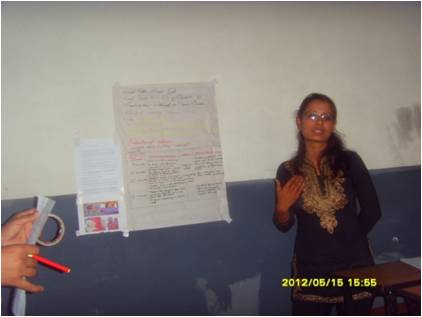
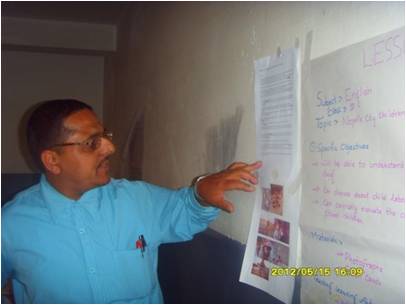
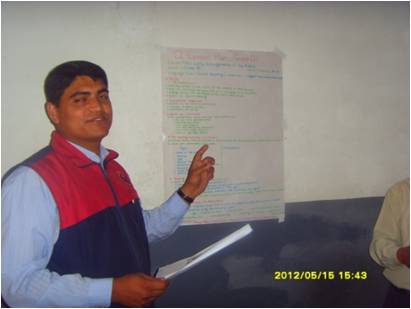
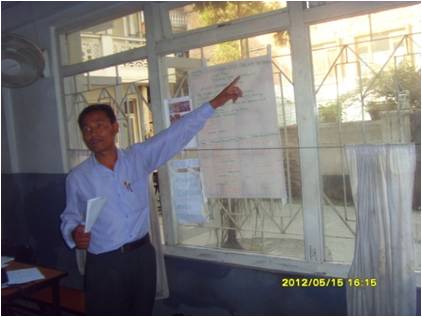
The participants were expected to start with Student Learning Outcomes and work on detailed components of a lesson plan for a 45-minute class, keeping the language and social background of their students. Each group engaged in discussions and each decided to teach different language skills/aspects while simultaneously teaching a critical social issue. Here are some pictures from the event: ImageImageImageImage

6. Why This?

Classroom teaching in Nepal strictly follows prescribed textbooks because students are tested from the textbooks at the end of the academic year. While the English medium private schools make use of textbooks published by international publishing houses like Oxford, Cambridge and Longman, government-aided public schools use textbooks approved and published by the Ministry of Education. These textbooks make very little attempt to encourage local teachers to design their own materials that supplement the textbook topics. There is enough room to contextualize the materials and activities in the textbooks that make connection with the learner’s everybody life in their community. This workshop illustrates that it is possible to teach, for example, vocabulary and grammar and other language skills by linking them to broader societal contexts that the learners are part of. When the teachers include a critical literacy component in their teaching, students do not only engage with language practice; they in fact can constantly take part in making discourses that question or negotiate the power and hegemony persistent in their societies.

Here is a response from one of the participants.

I learned how to make students active and enthusiastic to read a text themselves. I knew how to engage students in asking and responding critical questions. …. I learned how to organize group works to promote classroom interaction. We can teach grammar from the text (which is related to a critical social issue). We can collect the individual report and share their knowledge among their friends through critical discussion. It helps them to experience a friendly environment in the classroom. I learned how to make an effective lesson plan within a fixed time. The workshop provided me an opportunity with designing a lesson plan in collaboration with friends. I also learned how to make lesson plans objective oriented and demonstrate them before they are really used in the classroom.   Now I feel comfortable to teach in classroom with a lot of contextualization. My students too feel so happy to read actively and creatively. It makes my students curious to know more about their society and interested to share their views in the classroom.

References

Freire, P. (1970). Pedagogy of the oppressed (MB Ramos, Trans.). New York: Continuum2007.

Wallace, C. (2003). Critical Pedagogy for language teaching. In Critical Reading in Language Education (pp. 49-78). Palgrave Macmillan, London.

Advanced Reading Courses: New Aspirations and Challenges

                                                                                     Bal Ram Adhikari

                                                                                    Mahendra Ratna Campus, Tahachal

The contribution of reading to the development of overall language proficiency cannot be overrated, especially in the EFL contexts like ours where students’ contact with English is almost what they read in and outside the classroom. Our students often end up with reading, and with some vocabulary and grammar practice activities that follow. Sometimes, the position the reading skill has enjoyed in the course, classroom practice and examination is at the expense of other vital skills of English, namely listening and speaking. Despite this, written texts are the most accessible, reliable and structured source of English input for the majority of our students, who, in their attempt to appropriate the foreign tongue, are struggling in the under-resourced academic environment. The challenge that looms large in front of university teachers teaching the reading courses is how to assist their students in exploiting the reading materials at the fullest for multiple purposes. The purposes range from reading for gist, specific information, and language awareness to extensive reading for one’ pleasure as well as professional development.

Having students read a variety of texts in the classroom and encouraging them to do the same outside are motivated by the twin-goals of knowledge acquisition and language acquisition. That is, the ideal combination of knowledge component and language component leads to the organic development of language in students. It is possible when the latter is subservient to the former. The focus on the knowledge component engages students in the comprehension, analysis, synthesis, application, evaluation and most importantly creation of knowledge by employing the linguistic and non-linguistic resources at their disposal.   The courses Reading Writing and Critical Thinking, Expanding Horizons in English, Readings in English, prescribed by Tribhuvan University for its B Ed and M Ed English students reflect the emphasis on the combination of knowledge and language components, and the integration of language skills backed up by the critical thinking component. For this, the reading textbooks under these courses consist of authentic texts from the diverse fields of knowledge such as humanities, pure and medical sciences, social sciences, environment science, psychology, religion and mythology, spiritualism, language and society, gender studies, cultural studies,  mass communication and technology, to name but a few. Obviously, it is our first experience of being exposed to such a vast array of authentic texts from different fields.  As a result, the teachers and students both are overwhelmed by the demand made by the courses. The challenges they have been facing since the implementation of the courses in 2010 are many. The teachers express mixed feelings about the nature of the courses and possibility of their effective implementation.

Against this backdrop, I’d like to shed light on some of the challenges that teachers and students of these courses are facing. Also, I’d like to make some workable suggestions to overcome them.   To serve this purpose, I have drawn on my own experience of working in these course books as a contributor and trainer.  Some of the insights into the challenges faced by the teachers and students are also based on my personal communication with the teachers during the different training programs. I begin with the common aspirations expressed in these reading materials, then move to underlying theoretical assumptions before I discuss the common challenges and ways of overcoming them.

Common aspirations expressed in the course books

The prescribed books, namely, New Directions: Reading, Writing and Critical Thinking (ed. Gardner, 2005), Expanding Horizons (eds. Awasthi, Bhattarai and Khaniya, 2010) are prescribed for Bachelor’s first and second year students majoring in English education, and Reading Beyond Borders (eds. Awasthi, Bhattarai and Khaniya, 2011) is for Master’s second year students. These books contain the authentic reading materials from the diverse fields of study. The aspirations expressed by the editors of can be summarized in the following points:

  • Enriching students’ vocabulary through implicit and explicit exposure to authentic written texts.
  • Fostering critical thinking in the reading and writing process.
  • Emphasizing the role of the critical thinking component  in the English for Academic Purpose
  • Training students in reading and writing strategies through intensive reading activities in the classroom so that they can transfer such strategies to out-of-classroom reading and writing.
  • Fostering simultaneous development of English language acquisition and subject matter acquisition.
  • Encouraging students to use English as a means of accessing content information on the diverse fields of contemporary world.
  • Integration of all language skills and language aspects.

The editors are also aware of the fact that academic or advanced reading is incomplete without academic writing. That is, the tasks for students are developed in such a way that reading and writing feed off each other and the critical thinking component backs up these two processes.

Theoretical assumptions of the courses

The following theoretical assumptions seem to underpin the reading courses:

  • Reading is an interactive process.
  • Reading is a purposive process.
  • Reading is a critical process.
  • Reading proficiency calls for extensive reading habit.

Of them reading as interactive and critical processes deserve a special mention, for they challenge the traditional notion of reading as a passive skill and the reader as the mere recipient of information. Contrary to the passivity of the reader and mere receptivity of information, these two assumptions redefine reading as a highly productive, interactive and dynamic process. To be more specific, reading as a critical process has been the prime focus of the courses, at least in theory.

Reading as a critical process

Any reading which is critical is also purposive and interactive. Reading as a critical process can be interpreted from the two dominant perspectives. The first perspective deals with the cognitive aspect of reading that requires readers to engage in the higher order thinking as postulated in the Bloom’s Taxonomy (Bloom 1956, and Grondlund, 1970, as cited in Law and Gautam, 2012,  p. III).  The second perspective takes reading as “a social process” (Kress, 1985, as cited in Hedge, 2000, p.197). According to Hedge “from this perspective, texts are constructed in certain ways by writers in order to shape the perceptions of readers towards acceptance of the underlying ideology of the text” (ibid.). A text is a dynamic space where the ideology (i.e. socio-cultural, political and professional beliefs and values) of the reader comes in direct contact with that of the writer often in the form of either resistance or  submission. Critical reading in both cases calls for the active interaction between conscious readers and the writer. Such interaction can take place in two different but interrelated modes.

a)      Interaction with the text

In this mode of interaction, the reader interacts directly with the text. It can also be termed as the outer-projected interaction in which the reader interacts with the textual features: its theme, characters, linguistic features, cultural elements and writer’s style. This mode of interaction is active mainly, but not necessarily exclusive to, the while reading phase, which focuses on the extraction of the required information and comprehension of the gist. The strategies employed by the reader can be receptive reading, skimming, scanning and intensive reading.

b)     Interaction with the Self

Comprehension is necessary but not sufficient. Readers have to transcend the mere extraction and comprehension of information. They should relate what they have comprehended from the text to their experiential world, reflecting on what they have learned, what it means to them, and pondering how they can use it. This mode of interaction can also be termed as the inner-projected interaction. Readers who do not relate textual information to their purpose, experiential zone and existing knowledge fail to move upward in the higher order thinking skills such as analysis, synthesis, evaluation and creation. It is also difficult for them to challenge the writers’ viewpoints and maintain critical distance from them. This mode of interaction is active mainly, but not necessarily exclusive to,  pre-reading and post-reading phases. The reading strategies employed can be reflective and refractive.

Organization of the textbooks

The texts from different sources are structured under different thematic headings. The overall organizations of the materials can be divided into macro- and micro-levels. At macro-level, each book is thematically organized under different headings such as Intercultural Communication, Education, Mass Media and Technology, Gender Roles and Work (New Directions, 2005),  Humanities, Social Sciences, Human Rights and Freedom, Education and Language Teaching, Globalization and Postmodernism, East and West, Masterpieces, War and Piece, Travel and Adventure, Health and Medical Science, Sports and Entertainments, Science and Technology, Nature, Ecology and Environment ( Expanding Horizons in English, 2010), and Literature and Art, Democracy and Freedom, Multiculturalism, Globalization and Postmodernism, Philosophy and Ideology, Memoire and Revelation, Science and Technology, Sports and Entertainments, and so on (Reading Beyond Borders, 2011).  Each thematic heading is fleshed out with different relevant texts.  The variation in the macro-level organization seems to be the matter of choice, interest, and focus of the editors. At micro-level, each chapter is structured under the different headings such as Unit Opener, Core Readings, Making Connections, Additional Readings, and Easy Topics (New Directions); Before You Read, Vocabulary, Dealing with the Text, and    Beyond the Text (Expanding Horizons in English); Dealing with the Text, and Beyond the Text (Readings Beyond the Borders).

Classroom pedagogy

The classroom pedagogy suggested in all these course books is an integrated approach. The teachers are supposed to interpret the term integration from two perspectives: integration of content areas with the English language, and integration of major language skills and language aspects. The first implies that learning English with relevant content areas leads to deeper processing and hence ensures better output. The second implies that integration of two or more language skills is a natural phenomenon in real life language use, and vocabulary and grammar are integral components of language skills. Hence, “students might read and take notes, listen and write a summary, or respond orally to things they have read or written (Richards and Rodgers, 2001, p. 208).

Major challenges

The type and the magnitude of challenges faced by teachers and students vary depending on the nature of texts and the amount of schematic knowledge the readers bring in, and resources available to approach these texts.  The common challenges can be discussed under the following headings:

1)      Nature of the texts

The text is what students interact with for the enrichment of language and subject matter knowledge. The output from this interaction cannot be high if the the text itself poses a problem for students.  The interaction between students and texts can be negatively affected if the text has its origin in the culture almost unknown to the students and if its language and subject matter are too taxing for them to process. Povey (1979, as cited in Celce-Murcia and Hilles, 1988, p.123) has used the terms cultural, linguistic and intellectual humps or barriers for these constraints imposed by the reading text itself.

a)      Cultural barriers: Cultural barriers include imagery, tone and allusion (Celce-Murcia and Hilles, 1988, p. 123), along with myths, folk tradition, religion, national history and a way of life embedded in the text. The reading materials which belong to foreign cultures are more difficult to interpret than those belonging to readers’ national or regional cultures. Because of the cultural elements embedded in them, the chapters such as Paradise Lost, Contemporary Writing in Arab Countries, Death Valley, and Iliad from Expanding Horizons are obviously more challenging for our students than OM, The Bhagvat Gita and The Necessity of Religion. The texts with foreign cultural elements require sufficient contextualization before students deal with them.

b)      Linguistic barriers: Linguistic barriers include complexity of syntax, lexicon and style of the text. Language used in the text can be seen as one of the major barriers to the effective interaction between text and students. This barrier seems formidable, especially for those (both students and teachers) who lack extensive reading in English. The chapters such as The New Age of Connectivity, What is a Novel? , Contemporary Writing in Arab Countries, The Birth of Sex Hormones, etc. from Expanding Horizons do not lend themselves to easy interpretation because of their jargon, complex sentences and formal style.  Similar is the case with the chapters like  Post-structuralism, Asymmetries of Commerce and Culture, Religious Tolerance- Peacemaker for Cultural Rights, and Japan included in Reading Beyond Borders. Because of area-specific words, lengthy and complex sentence structures, and highly formal style, many texts in the course books are linguistically too challenging for the readers to process the content. These texts call for a lot of language preparation work before making entry into them.

c)      Intellectual barriers: Intellectual barriers occur when the reader lacks “intellectual maturity and sophistication necessary to appreciate, relate to, and comprehend the subject matter” (Celce-Murcia and Hilles, 1988, p. 123).  The texts such as The Birth of Sex Hormones, The Science of Heredity, The Promise of Global Institutions, The Age of Connectivity and Cubism are not intended for general readers. These texts represent the recent findings in their respective fields. The editors seem to presuppose that students have sufficient knowledge in the fields like genetics and anthropology, Information Technology, and painting and sculpture. The teachers during the training often complained that the issues discussed in these texts are too difficult for them to understand, let alone their students.

2)      Attitudes to reading skill

The prevailing attitude towards reading as a receptive skill has also remained as one of the major barriers to the successful implementation of the courses. As discussed above, the courses embrace the recent trends in teaching reading as an interactive and critical process while the prevailing classroom practice shows that all that a good reader needs is the ability to answer the comprehension questions given in the course book. Similarly, there seems to be a gap between what the teachers and students expect from each other. The teachers expect their students to read the text and answer the questions that follow. Students, on the other hand, expect their teachers to read the text for them and supply summary and answers.  This classroom practice fails to see the value of pre-reading and post-reading activities and is almost confined to the comprehension phase of reading. As a result, the integration of other language skills with reading is missing.   For such teachers and students the reading activity begins from and ends with the given text itself, i.e. for them the text is the end not the means.

3)      Text as an end: Those we consider reading as a mere receptive process tend to take the text as an end to itself. Such a view undervalues the multiple purposes that the prescribed reading materials can serve. A text should be taken as a means to access information and language resources. In other words, a text is a means to   activate the reader’s schematic and language knowledge, to play with various writing styles and strategies, and to create another text that either conforms to or resist the writer’s stance. Its classroom implication is that readers should begin from and end with the non-textual world vial the textual one.

4)      Institutional constrains

Lack of adequately trained teachers, sufficient orientation to them, sufficient preparation time available for them, and the large class size have remained other challenges to the teachers and students.

Insights into the nature of the courses, organization of the reading materials, the suggested classroom pedagogy, and challenges faced by the students and teachers in the actual classroom can help us to think of the areas to be addressed and design effective classroom procedures.

Some basic questions to be addressed

It is important that the teachers address the following issues before engaging students in the actual act of classroom reading:

  • What to do before, during and after students read the text.
  • How to guide students   through the text to read meaningfully, purposively and critically.
  • How to have students read/learn cooperatively in pairs and groups.
  • How to assist students in connecting what they already know to the text and what they have learned from the text to the real world.
  • How to integrate the reading skill with other skills.

Classroom procedures

The prescribed course books Expanding Horizons in English and New Directions have followed the established practice of the three-phase procedure: Pre-, While-, and Post-reading. These phases can also be termed as anticipation phase, building knowledge phase and consolidation phase respectively (Crawford et al., 2005). Crawford et al.  have used the organic metaphors to highlight the value of these phases of critical thinking and productive learning. In the anticipation phase a wheat seed is planted in rich soil, the seed sprouts and a plant grows in the building knowledge phase, and finally in  the consolidation phase the head of wheat is mature, and contains seeds of many other plants (2005, p. 4-5.)

New Directions and Expanding Horizons both are rich in the variety of reading tasks under each phase. However, Reading Beyond the Borders has skipped the Pre-reading phase, leading the students to an abrupt confrontation with the text. If not handled by an experienced and trained teacher, the students are likely to experience a sense of bewilderment for want of background information required to enter the text.

a)      Pre-reading phase

This is the preparation or schemata activation phase. While engaging students in the pre-reading or anticipation tasks given in the books and teacher’s manuals or designed by the teacher himself, the he should

  • respect and capitalize on the student’s experiences, knowledge and language resources.
  • assess informally what they already know, including misconceptions (Crawford et al, 2005, p. 2).
  • provide a context for understanding new ideas.
  •  ask them to write down what they Know about the topic and what they Want to learn or expect from it.

b)     While Reading Phase

The students in this phase deal with the text. The teacher should set tasks that require them to inquire, find out and make sense of the reading materials. The while reading tasks should encourage students

  • to indentify the main points and their supporting details.
  • to find new pieces of information from the text.
  • to compare their expectations with what is being learned, and to revise them or raise new ones (Crawford, et al. 2005, p.3).
  • to react to the opinions expressed, ask themselves questions, and to predict the next part of the text from various clues (Hedge, 2000, p.210).

c)      Post-reading Phase

This phase takes the students beyond the text. However, the tasks in this phase should be tied up with pre-, and while-reading phases, and should lead to writing and speaking tasks.  That is, this phase has both backward-looking and forward-looking purposes.  The instructor in this phase should set the tasks that require the students:

  • to reflect on what they have learned by summarizing the main ideas in their own words.
  • to interpret the main ideas.
  • to share opinions in groups
  • to agree or disagree with the writer’s stance.
  • to role-play major situations or characters given in the text.
  • to create a parallel text.

Although the classroom reading procedures are divided into the three different phases for the theoretical convenience, these phases and activities under them lie in the continuum. In the actual classroom practice, it is almost impossible to say when one ends and another begins. Such compartmentalization is not desirable either.

Conclusion

Compared with the previous ones, the courses Reading, Writing and Critical Thinking, Expanding Horizons, and Readings in English prescribed by Tibhuvan University for its Bachelor’ and Master’s programs mark a paradigm shift in English Education . The reading texts under these courses have embraced current trends in ELT that gives priority in flooding ESL/EFL learners with relevant, contextualized and authentic texts.  However, it goes without saying that the effectiveness of these courses depends on how the course books are exploited in line with the aspirations expressed in them. Both teachers and students should bear in mind that there is no easy and direct route to journey into the textual world.  Much depends on how clear we are about our destination, how well prepared we are for it and how skilled and experienced we guides are.

Awasthi, Bhattarai and Khaniya (Eds.) (2010). Expanding horizons in English. Kathmandu: Vdhyarthi Prakashan.

Awasthi, Bhattarai and Khaniya (Eds.) (2011). Reading beyond borders. Kathmandu: Vdhyarthi Prakashan.

Celce-Murcia, M. and Hilles, S. (1988).  Techniques and resources in teaching grammar. Oxford: OUP.

Crawford, A.,  Saul, E.W., Mathews, S. and Mkinster, J. (2005). Teaching and learning   strategies for thinking classroom.  Nepal: Alliance for Social Dialogue

Gardner, P.S. (Ed.) (2005).  New directions: Reading writing and critical thinking. Cambridge: CUP.

Hedge, T. (2000). Teaching and learning in the language classroom. Oxford: OUP.

Law, Barbara, and Gautam, G. R (2012). Teachers’ manual: Expanding Horizons. Kathmandu: NELTA.


[1]  I am grateful to Dr. Barbara Law and Ganga Ram Gautam with whom I had an opportunity to work as a contributor to the teachers’ manual for Expanding Horizons.  The basic outline of this article was developed during the training we (Barbara and I) conducted together in Gulmi.

The Training and Trainees!


Suresh Shrestha

Executive Member

NELTA Birgunj

Training!!! There are two inter-related ways of defining it. One – “What is training?” and the other – “What do you mean by training?” The answer to the first question is widely explored, rigorously developed with a broader coverage, so it is supposed to be authentic unless and until something related but a newer one is unearthed in the same way. And, the answer to the second question is self-centered, self-experienced and self-explained, so it may differ from person to person based on the individual insight. And, what is worth-emphasizing is that the second case has much higher practicality that directly affects the upshot of training which evaluates training itself. As a simple example, some training is given to some targeted group with a view to causing some expected change, but as a baffling surprise, the result may not be what may have been expected to happen – just opposite! Why so? Trainees’ perception may act as a pivot to rotate the training to the desired effect. The training might be of great importance and trainers might hold great expertise, yet the result may be poor. It is crystal clear that it is all because of how trainees mean training, i.e. the way of getting leave granted, enjoying some gossip and receiving some allowance – that’s it! But, it may not occur so in each case because the trainees’ perception may not remain the same all the time. Yes, I had the same experience in the second week of April.

It was on the 8th  and 9th of April that US Embassy Regional English Language Office (RELO) and Nepal English Language Teachers’ Association (NELTA) jointly organized a two-day training for +2 English teachers in the premises of Birgunj Public College in Birgunj with the theme “English Language Enhancement for Teacher Professional Development”. It was facilitated by Ms. Jocelyn White, holding the outstanding 32-year experience of teaching in the United States and around the world, being engaged in the fields of international education systems and intercultural education environments and Dr. Meg E. Infiorati, a multifaceted personality, working as a facilitator of various seminars in organizational teamwork, disaster management, personality types, leadership styles, program management and conflict management, and as a teacher at several local colleges as well. It was a part of nearly one-month training schedule across the country. Luckily or unluckily, I was assigned to co-ordinate the program. I felt lucky because it was a good opportunity for me to grasp and learn a lot. But, on the other hand, I felt unlucky since it was the first time I had had such a responsibility and those who had already had the experience of co-ordination were not physically present for instant support and suggestion. Several times I asked myself what was going to come about. And I consoled myself recollecting someone saying whatever was to happen would turn fair at the cost of our ‘true attempts’, and brushed off all the anxieties. There is a wise saying: a problem appears with its solution following behind. So was the case in that regard. In spite of being away from Birgunj, Sajan Sir initiated the co-ordination by letting us know about the program and giving due guidance about what to do and how to. To be frank, I was reluctant to holding the program owing to mainly two factors: first, most of the executive members were so busy with their own jobs that it felt me quite odd and alone; second, it was time to publish the exam results at several schools so it was a big challenge to collect enough participants even from secondary and +2 levels, whereas the training was mainly focused on +2 level. Anyway, I must congratulate myself on receiving warm support from Kedar Sir, Praveen, Kamalesh, Jyoti and Preksha. We managed to have over thirty participants. It was in fact a good indication of positive attitude towards such training of professional enhancement. Enthusiastic participants from Rautahat, Bara and Parsa turned up to mark the training with a good success.

In the inaugural session on the first day of the program presided by Mr. Kedar Prasad Sah, Chair of NELTA, Birgunj, as our token of love and honor, we offered ‘Gamchha’, the invaluable cultural recognition of Tarai dwellers, to the Chief Guest Mr. Yugalkishor Prasad Sah, Academic Director of Birgunj Public College, the Guest of Honor, trainer duo, Ms. Jocelyn White and Dr. Meg E. Infiorati, and the Distinguished Guest Mrs Shobha Benargee, retired Reader of English of TU. And, the session was closed with the vote of thanks by Mr. Prveen Kumar Yadav, executive member of NELTA, Birgunj.

The first-day sessions included reading, personality types and graphic organizers. I understood reading as something interactive to gain energy that fuels the continuity of our action. Reading doesn’t mean merely reading some written stuff, but also trying to decipher some drawings and some facial expressions in different situations. So it refers to reading something else. Introverts are supposed to energize themselves by means of their thoughts that they gain by reading different matters, whereas extroverts gain energy from the environment, i.e. by ‘reading’ the surroundings. ‘If so, are you an introvert or extrovert?’ The question may really put anyone into a dilemma. But, what about the answer ‘Both’? One may explain ‘When I am alone in my room I am an introvert, and when I am in a gathering, I am an extrovert!’ Such a clever answer had no space there when we took a test to chalk out what personality type we had. There were sixteen types of personality based on eight factors: E – Extraversion, I – Introversion, S – Sensing Perception, N – Intuitive Perception, T – Thinking Judgment, F – Feeling Judgment, J – Judging and P – Perceiving. It helped us to find out what type of personality we have. I was interestingly useful to judge ourselves psychologically and act and improve ourselves accordingly. The next one – graphic organizers – was focused on the way we may explain what we perceive through reading. It was indeed implemental in our teaching field. It was all about how we make a graphical presentation of what we have read and understood. Selecting several chapters from the books “The Magic of Words” and “The Heritage of Words” and offering different graphic organizers namely Web, Tree, Flowchart, Fishbone Map and Venn Diagram, the participants in different groups were made to select the organizer that might suit the particular chapter chosen and to simplify the complex information into different small easy-to-understand bits of information. It laid emphasis on the various ways of learning learners may adopt according to their different perspectives. It was of course of great use for teachers to conduct a big class by dividing the students into different groups, engaging them in interaction on certain reading, and reflecting their understanding logically.

On the second and last day, the program was to begin at 8:30 A.M. Although it was delayed by about one hour, almost all the participants attended it with good spirit. From teaching view-point, many more found the session effective. It was all about the different levels of knowledge in Bloom’s Taxonomy: Remember Understand, Apply, Analyze, Evaluate and Create, arranged from the basic level to the advanced one. They were explained how to apply to form right questions from easy ones for the students’ comprehension to challenging ones for their analysis and creativity. Each pair of participants selected a new topic, read it, made several related questions according to the levels of knowledge and arranged main pieces of information on cardboard paper using a suitable graphic organizer. All observed each other’s and interacted how clear and consistent the presentations were. It gave lots of space for us to put our logics, dispel doubts and mark the shifts in understanding having discussions with each other and with the trainers directly. Since we had to wrap up the program by 1 pm or so, we had to shorten it; yet we could grasp the gist of each and every presentation. Had we had more time, we could have enjoyed broader workshop practice. The facilitators-cum-trainers were so amicable and conscious about our moves and inclination to the learning. Personally, Meg asked me how long we could run the program. Had we been allowed to hold the program two weeks later, each of us would have had enough time to enjoy the training in its full length with much better arrangement and Meg and Jocelyn would have been much happier by benefiting us much more. But, sorrowfully, they were scheduled to fly back to the capital so we could not make any instant decision to extend the program. Anyway, it was so wonderful, fascinating enough for the participants to realize the genuine aspect of the workshop training.

One thing that has been sensed noteworthy is that the concept of training among young energetic people seems to have had its own impression. They seem to have understood the value of such trainings and seminars. Previously there were some bitter experiences of trainings and their implications. They were the sources of income and opportunities to have leaves granted. So the outcomes of such trainings used to have several shortcomings. But, nowadays, especially young teachers or would-be teachers are getting ahead to spend money willingly in participating in trainings, since I am optimistic that they are now more serious about their professional step-up through all-around talent. They seem to have realized that degrees and jobs might be secured but the talent is something they must hunt rigorously. I can’t help thanking them for the rise in their perception, those dedicated trainers-cum-facilitators-mentors, and all the contributors!

Could I hope for the same helpful hands from you all on the pedagogical journey ahead?

Thank you all so much!

Teacher training: for money or for professionalism?

                       -Ram Abadhesh Ray

      In this piece of writing, I hope to discuss English teaching profession. Teaching, professionally, is a very precarious and sturdy job. In the context of Nepal, teaching has become inferior or substandard one due to politicization on it. Because of unstable government system and its fragile education policy, the teaching career has become in miserable condition. The government of Nepal trained almost all the teachers but the teachers are still ‘literate but not educated’ , following Sajan Karn’s argument. I think most of the teachers are trained but they are resourcefully untrained because they are still facing lots of problems for effective teaching and for bringing drastic progress in the students. This article also begins with the current teaching trend of the government schools teachers’ i.e. Old Fashioned Method of teaching. Then it also mentions some solutions to the problems that are faced by the teachers.

                          Under School Improvement Program (SIP), the Educational Manpower Development Centre has prepared various instructional materials, scientific and innovative technique to make the teaching livelier in order to develop the teacher’s capability in effective teaching.  The Conceptual Framework has been prepared on the basis of the received feedbacks from national and international level workshops. At first, so many ideas and experiences were gathered from almost one hundred and fifty teachers from different seven districts. Not only this but also from the trainers of these centers, from the DEOs (District Education Officers) and from professors of related field, the ideas and experiences has been accumulated for the preparation of this TPD.

                          Due to fragile and ineffective accomplishment of teaching policies of Nepal, there has not been found more achievements in the field of training system of TPD. Though it has commenced all over Nepal, it is not in its entire height. One of the main cause of its being letdown is also due to lack of wakefulness in teachers of Nepal. Most of the teachers of remote and semi urban areas are still surviving with their old weapons of teaching in the class room for just passing the time anyway for the sake of the government’s obligation and for the sake of their earning. Generally, teachers in the context of Nepal especially in far remote areas have been junked due to lack of innovative teaching technique and due to lack of their activeness to learn something worthy for their professional development. The same means of teaching i.e. after five or ten minutes of ringing the bell of first period, they with attendance register and a stout stick go to class room as they are forcefully being sent to the class. As soon they enter the class, they as usual do the attendance and instruct the students read themselves and they instead of teaching the students with their daily lesson plan, sit on the chair outside the gate comfortably thinking and waiting for the next period. They don’t want to change themselves into modern era of teaching. They look as if they have been worried and seriously ill. Actually the system of providing training in the context of Nepal is not an apt. Here, instead of providing training the teachers are given a very handsome allowance that becomes their additional income. Their salary is not deducted from the government side so they get double benefit. It has become a sort of tendency for the government schools’ teachers to get allowance and then participate in any sort of training. When there is less allowance in any training then the teachers don’t seem even talk about such training. By this, we can assume that such teachers can never transform themselves for learning in any sort of training if it is even giving a large sum of allowance to them. They always have intension to be present in the training and after the break, they go for shopping and again next day same thing happen.

I can still remember the very first NELTA training held in the then SEDU and now ETC by Dr. Bal Mukund Bhandari, the then treasurer of NELTA, Center when I was in  M. ED. First year. Almost 60 English teachers participated in the training session. Dr. Bhandari inaugurated the session and his facilitator was Mr. Sajan Kumar Karn, the then teaching assistant of English M.ED. Program of Thakur Ram Multiple Campus, Birganj and secretary of NELTA, Birganj. The program was successfully commenced and all the teachers were very much curious to listen the speech by Dr. Bhandari. As soon as Dr. Bhandari announced that the training was without allowance, the faces of the reputed teachers of the government school were to see. They started feeling disappointment and as there was break for half an hour and then after break no government teachers were seen in training session and Dr. Bhandari was amazed and we too. Just after a year, I got another opportunity to be participated in a workshop provided by the Examination Control Office, Sanothimi, Bhaktpur at the same venue and there was a large gathering of the government school teachers but there were limited seats for participants. Everyone was wishing to be the participants and I was stunned to see that and thought it a very good workshop. But the reality was something else, I felt myself very fortunate to be one of the participant. I at that time was in Mount Edmund English Secondary School, Birganj and I was sent to participate in the training. The workshop was run for three days and on the last day, one of the head teachers said forcefully to the trainers to stop training and distribute the allowance. The trainers also agreed and within some minutes training program was postponed and then the time of receiving allowance came and asked whether I would also get something. One of the teacher asked if I was new fellow to go there and I agreed. My name was also called and I went to receive the allowance. I couldn’t believe myself that how all teachers were very much curious to take participate in training. It was all for the allowance not for learning point of view.

Now you can easily conclude that where there is allowance the teachers go there and where there is no such facilities the teachers won’t go. Since then I deduced that teachers participated in training only for earning, not for learning. Among such teachers, some bad concepts have emerged about training that government is compelled to train them and then why should they care for such training. They always ask about the facilities i.e. lodging and dining a very common term in training and then only they are ready for participating. Sometimes the teachers surprise me by asking the questions if the training is going to take place in any grand hotel or not. If it is so they are ok and vice versa. The tendency of providing allowance to the teachers by government has created lots of problems for NELTA fellows to conduct any sort of conference in local level for the teachers here demand the same too.

                            In the context of Nepal the teaching doesn’t take place as it is shown in the model  in  every nook and the corner of the nation but in some part of urban areas of Nepal, there is such teaching which is very expensive and the common people are not going to bear that. However, we can make our teaching effective by our entire effort and honesty with the help of the teaching aids which are locally available. But most of the teachers of our country have been fossilized from very beginning in the traditional way of teaching. For them the teaching aids are stout stick and ruthless sound in the classroom while teaching. Look and just imagine how the teachers in the European countries are teaching their students with great fun, scientific equipment and hovering around the students with great love and affection.

The entire teacher should be like a professional teacher and enjoy his/her work every now and then and then after there will be something new changes in the field of effective teaching. A teacher should go in training not for allowances rather for learning and being refreshed for removing their junk old traditional method of teaching. If one has to be a professional then he/she has to revolutionize his/her attitude towards scientific teaching from that of traditional one. They must understand their responsibility being honest in their teaching.

Conclusively, I can state that some of the old fashioned teachers and even some new who have been habituated to act in their teaching learning activities are to change themselves for their satisfaction in teaching. For that very purpose, the government should also take any massive action against such dead habits of teachers by improving in the education policy according to the change in pace of time. Then only something worth can be expected in the field of scientific and innovative teaching. Unless there is drastic modification in the trend and attitude of such teachers, the government, education policy maker cannot bring change in them and in their profession.

 ——————————————————

The author is an English Teacher at Shree Nepal National Higher Secondary School, Kalaiya, Bara, Secretary, NELTA, Birganj Branch  

Knowing your role as a teacher: The teaching metaphor project

Bal Krishna Sharma

There are several ways of learning and development for language teachers. For example, you can read articles/chapters and research reports published in journals and books, critically understand the ideas there, and import them to your classroom teaching. You adopt and adapt the textbook ideas rather than picking them up and trying to implement them wholesale. You can also talk to your peer teachers, share teaching stories and experiences, or observe each other’s class and borrow some ideas from there. A third way, which I have recently been relying heavily on is a reflection of my own teaching, critically assessing what worked and what did not in my class, and focus on improving my teaching and tasks next semester.

I taught an academic reading course to international students last year. In order to train myself in teaching reading lessons effectively, I took a second language reading course from a professor at the University of Hawaii at Manoa. This class had several mini-assignments that proved instrumental in bridging my academic knowledge with my teaching experience in Nepal. I will explain to you one of those mini-assignments here, which was called a ‘reading metaphor project’.

Around the beginning of the semester, my professor asked all the students to think of a metaphor that would represent our role as a reading teacher. Many of us chose such metaphors as ‘mid-wife’, ‘football coach’, ‘driver’, and so on. Then the professor asked us to think about refining the metaphor and its meaning, or shifting to a more appropriate metaphor by the time we finish the course at the end of the semester. Following is a description of my metaphor:

I chose two metaphors during this semester. Metaphors are a useful way to compare the teacher’s roles and duties in a reading class. First, I compared a reading teacher with a tour guide. A tour guide shows ways to the tourists who otherwise would have a hard time to travel on their own. A guide shows ways to the visitors, takes to new places, explains the history and importance of those places, and also suggests other places to visit or stay. Then I thought this metaphor is too simplistic. Comparing a reading teacher with a tourist guide is very straightforward and gives more power to the teacher. When I believe in student-centered teaching, I thought I would need to find a metaphor that would minimize the role of the teacher. Then I compared a reading teacher with a ‘walking stick’. I remembered my childhood days and I remembered the tourists from different countries visiting our places inNepal. Everybody had a walking stick with them. Then I also remembered my reading class taught by my teacher. I also reflected on how I taught reading to my students. Obviously, there were differences in my and my teacher’s teaching styles and roles. However, a common thread I could think of was the role of a ‘facilitator’ or a ‘supporter’. A walking stick thus is a support; it does not walk in itself. Second language readers can take the support of the stick. Learning to read is a long journey. I compared reading journey with a trekking of several days. While trekking inNepalone has to climb up the hills through small trails and rarely through steps. There come plain and flat places as well. In case of those straight ways, the role of the walking stick is minimized or sometimes neutralized. Learners of reading are also similar. When there are difficult texts and words, there is a teacher to help the learners in some way: direct explanation of the meaning or teaching the students the reading strategies, for example. But when there are easier texts, the students can read on their own, teacher’s role is minimized.

So what?

Writers in NeltaChoutari have discussed the need to be careful against lifting pedagogical ideas that have been proven effective in different contexts than our own without necessary appropriation, so the concept has floated here as well quite often. I hope that you will find this concrete activity valuable towards implementing the idea into practice. Such reflective practice is useful whether we are novice or experienced because reflection and critical assessment are important for any efficient language teacher. If you are a teacher educator, or a teacher trainer, please try this out in practice and respond to this post with your thoughts so the rest of will learn from actual practice. I am always eager to hear more.


Teacher Training in ELT: Where does it Go Wrong?

By Laxman Gnawali

Senior Vice President, NELTA

Whenever the issue of teacher training comes up, I start visualizing an event which I witnessed as a student in 1976 when I was a student at Grade VI. This event left an indelible question in my mind. As an inquisitive student I used to listen to what my teachers said and observe what they did to find a correlation between their words and deeds. Once our English teacher told us in class that he was going to Kathmandu for a three month training course; there he would gain knowledge. He returned after three months and resumed his work. Intuitively, I had developed an expectation that when he came back, he would teach us in a different way. I did not expect a better way as I had no idea of what good teaching was, but I expected some difference in his activities in his classroom teaching. To my disappointment, he started with the same method of translating the texts, giving us grammar exercises and asking us the Nepali equivalents of English terms. There was no difference in him and his practice. A question struck me: what had he been doing for three months? I thought training meant learning new things. What had he learnt then? For years the question lingered: What difference did the training make to my teacher?

In 2000 I went to the College of St Mark and St John Plymouth (now, University College Plymouth St Mark St John)  to a Master’s course in Teacher Development, the interactions with my tutors and other professionals, professional literature, visits to different institutes and conferences answered the question that haunted me for years. Then I realised that any training that does not relate to the real classroom world, examination system, local context, and trainees’ mental constructs, their needs and expectations cannot achieve the desired goals. Training that takes place away from the school environment without monitored school-based practice or follow–up cannot be transferred to the classroom. Training contents based on trainees’ needs and participant-centred experiential learning approach in the training can make a difference in teacher learning. For teachers to develop in the job, they need to constantly reflect on their practice. As Burns (1999:12) says

‘reflective analysis of one’s own teaching develops a greater understanding of the dynamics of classroom practice and leads to curriculum change and that enhances learning outcomes for students’.

Appropriate ways to structure the reflection are classroom observation and collaborative action research. Justifying the role of classroom investigation for professional growth Burns (1999:12) writes,

‘researching one’s own classrooms and teaching contexts is something which can, and should, be considered by language teachers, as a realistic extension of professional practice’.

Now I understood why my teacher did not show any difference in his classroom practice.

In the dissertation I submitted to the College, I tried to justify my view on the role of classroom observation and classroom action research for teacher development. I also discussed my belief that in-service training can be an important step to guide teachers towards their self-directed developmental activities. Based on these discussions, I proposed a course which incorporated training-centre-based activities and school-based practice.

Since my return, I have invested all my energy to implement what I proposed in the dissertation through the MED and PGDE programmes at Kathmandu University and NELTA-led in-service training and the results have been positive. However, as there is so much to be done in this area, I keep reciting Robert Frost’s lines:

The woods are lovely, dark, and deep,
But I have promises to keep,
And miles to go before I sleep,
And miles to go before I sleep.

(Modified excerpt from the Introduction to my dissertation Investigating Classroom Practices: A Proposal for Teacher Development for the Secondary School: Teachers of English in Nepal submitted to the College of St mark and St John, Plymouth, UK, 2001)

July 09: Needs Analysis and Teacher Training

Dear NeltaChoutari Readers,

Let us post our Choutari and other ELT discussions on blog form, because this platform will make our interaction globally accessible and help us join the global ELT professional community as well.

JULY ISSUE

Below are some quick comments on the article attached on Nelta Mail: “Implementing ELT Innovations: A Needs Analysis Framework” by Waters and Vilches. In case you didn’t get to read that article in full, these brief remarks should help you post a response here.

One great point raised by Waters and Vilches article is that of giving teachers the sense of ownership in implementing any curricular innovation: “… the trainers’ role is not simply to ‘teach’ the content of the innovation, but to maximize the potential for ownership of the innovation by the teachers” (139). When teachers are given training in a new approach or methods, it is extremely important to make them feel that the method/approach benefits them, makes sense to them, and motivates them to take the new challenges involved. Teachers ultimately implement the innovation at the level of the classroom, so if they don’t feel a sense of ownership, and therefore satisfaction, the new pedagogy will remain an idea, an obligation, or a misunderstood something.

Another important issue the article considers is the need to take into account not only the interest of teachers who implement the innovation, or the administration that makes the innovation possible on a larger scale, but also students and a whole spectrum of stakeholders in the process of making the innovation in curriculum and pedagogy.

A third point worth our discussion in this article is that of the need for educating teachers about the rationale for the innovation, and not just train them with new skills or content: “Any attempt to change the curriculum—whether indirectly through changes in teaching materials, for example, or more directly, through changes in teaching methods—implies a need for teacher learning, i.e. opportunities for teachers to learn about the rationale for the new form of teaching, to critically evaluate, and understand how to get the best out of it” (137). The Choutari team looks at discussions that we are having on NELTA mail as motivated by that particular need to discuss ELT issues at the conceptual level. But at the same time, we urge readers/contributors to relate the general/theoretical readings and posts to practical classroom teaching as much as possible because what we all want is a balance of concept and practice.

Based on the article, let us extend the great discussion on the issue of Needs Analysis and Teacher Training raised by Kate’s initial call for feedback and the following series of posts. The issue of training and innovation in ELT in general, or that of how to make new ideas and approaches to ELT productive in the classroom as well as relevant to our local society in particular, is potentially inexhaustible. We certainly haven’t had enough discussion on this subject, and we hope to hear more from you.

Finally, here is one specific issue that has come up in our discussion since last month but hasn’t been followed up very much. On the issue of teaching basic sounds to beginners, Nepalese ELT community obviously needs to think in terms of thorough innovation: there is a need to make a paradigm shift from teaching letter names  to teaching sounds at the same time or subsequently, from teaching words starting with letters to teaching words that represent sounds, and from teaching only pronunciation of words to enabling students to “hear” the unique sounds and then produce them with the correct (approximate) vocal features. Specifically, this would mean something like teaching a beginner not the “A for ‘e-pal’…” but A-æ, as in “apple”; A-a:, as in “arm”; A-Ə, as in “Anil”; B-b, as in “boy”; etc). The innovation, to connect this problem with the issue in the article, should start by familiarizing teachers with the concept that English letters DO (most often) correspond to particular sounds, within the sound system of the language (against the myth that they do not, or rarely do so). The Waters and Vilches article makes that great point in its conceptual framework of needs analysis that includes both horizontal and vertical layers of issues to be addressed by any training or innovation project in education.

Besides the scholarly article, there are also the following items in this issue:
b. Teacher anecdote
(by Dhruba Neupane)

c. ELT resource on the web (videos on pronunciation):

d. ELT humour (funny videos about pronunciation):

PLEASE LEAVE A COMMENT
(you will see either a comment box or link below)!

pronunciation

<!–