Category Archives: Education in General

Too many knowers?

SHYAM SHARMA

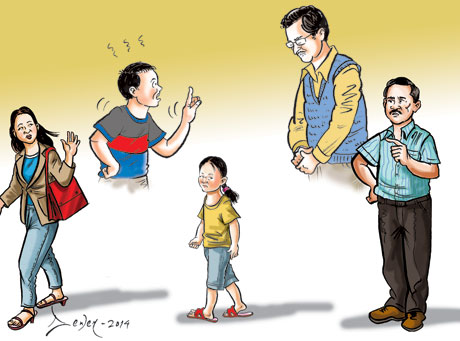
I came home from school one day to find my father and uncle Padam sitting beside the beautifully decorated Tulasi platform in the front yard that my mother, sister, and I had built the day before.

Uncle Padam [speaking to my dad]: Brother, you have such great artistic skills, you know. Look how beautiful that muth is!

Daddy: [smiles and continues to smoke]

Me: No, uncle, dad didn’t build that. Mom did, and sister and I helped her decorate it.

Uncle: Hey, phuchche [little kid], don’t be a janne [knower]. Go to play.

The social condition where some people are expected to be “knowers” and others are not—which I call socio-epistemic structure—has drastically changed in our society today. Thanks to democratic revolutions, increased education, and most recently and perhaps most significantly, the rise of alternative social spaces where (seemingly) anyone can say what they like, Uncle Padams aren’t likely to be able to shut down twelve year olds (or others with less power/privilege in society for that matter) that easily anymore.

Unfortunately, as I argue in this piece, the disruption of the traditional socio-epistemic structure has not always translated into general productivity of knowledge, benefit to social institutions such as education, and the enhancement of social justice in areas such as gender equity and intercultural harmony.

In the traditional society, the priest was literally called the knower (janne, who knew the scriptures, rituals, and higher learning). The shaman was another janne (who had direct knowledge about the cause of people’s sickness, as well as their past and future) from the gods. Older people were supposed to be jannes in front of the youth; men were jannes in the presence of women; rich men in relation to the poor; and upper caste in relation to the lower. More recently, the teacher in formal/modern education systems (even if the person is not an older, upper-case, richer) has been added to the list of jannes (though the word is no longer explicitly applied now).

By contrast, in our time, traditional jannes have lost their exclusive privilege over knowledge. Some of them (such as members of the upper caste) now acknowledge the knowledge of others as legitimate, and yet others (such as men, relative to women) don’t seem to have visible advantage in certain domains and contexts. Disruption is in the air today. The new democratic environment, the alternative virtual spaces, the communities of discourse that cross national and cultural borders, and newly visible groups (such as the LGBT community) have all contributed to the disruption of the socio-epistemic structure of Nepali society. Children learn from many more sources than school, college students can create their own purpose-driven communities, and people involved in political and social action can reach out to many more people and make far greater impact with what they know. In a society that leapfrogs from word of mouth to microblogging in a matter of a few years, the bypassing of socio-epistemic order is fast becoming the new norm. While the affordances information technologies provide are also new in developed societies, their impact on the socio-epistemic structure is much more striking in less developed societies like Nepal.
29615
Photo: Republica

The most obvious scenario where we can see the uncertainty of benefit from the disruption of socio-epistemic structure is social media. As research on social media use has shown in other societies, increased access to alternative avenues of knowledge and knowledge-making does not in itself translate into social consequences. For example, Facebook hasn’t made people “connect to the world” as many assume or claim. Instead of crossing national and cultural borders to learn about other societies and cultures, and increase empathy and understanding, most Facebook users “deepen” rather than “broaden” their network and may become more entrenched in their worldviews. Indeed, the company has rolled out features that increasingly emphasize family connections, like-mindedness, and a monocultural worldview through design and content selection.

In the field of education, increasing irreverence toward figures of authority could and should have translated into more and more productive generations of scholars and professionals. But we haven’t seen such a difference. The problem here lies not just with younger people’s inability to be productive but the society’s failure to tap their energy to transform educational institutions. Schools continue to teach for exams even when they don’t have to, universities don’t allow younger scholars to lead the charge, and older men continue to dominate almost all fields of knowledge. Whatever boost in epistemological agency (or the ability to create new knowledge) that we see among younger generations, we see it unable to translate into change in the system. Instead, increased knowledge seems to lead many people into increased negativity and nonchalance.

The social and cultural spheres seem to be no exception. In place of a society based on objectionable hierarchy, discrimination, and prejudice—a society where the upper caste the aristocrats, and newly rich blatantly dominated the rest of the people—we now have a nation where those structures of power are replaced with ethnic disharmony and multifaceted conflict among different social and cultural groups. Instead of a society dominated by speakers of one language, followers of one religion, and a socio-economic minority dominating most of the social institutions, we now have a society where linguistic, religious, and social/cultural groups clash for power (rather than work together toward common national/social goals).

Often, groups that are just becoming visible (such as individuals who want to pursue their “personal freedom” of walking around with piercings and tattoos all over their bodies—and therefore evoke responses ranging from confusion to fear among the general public) reject the very notion of tolerance toward others. More alarmingly, in place of “traditional” value systems (which certainly needed updating), many groups just try to impose values from what they believe are more “advanced” societies, never considering if they could draw on the best from both sides. Their knowledge about the outside world, their irreverence for the local society and culture, and their ability to challenge tradition doesn’t seem to make them contribute anything positive to society: they just reject the local and never question the “global” (which is often local somewhere else).

Just a few years ago, when social media was gaining traction (and access to tools and networks was rapidly spreading) across Nepal, I presented a paper at a national convention of literary scholars in the US, describing the disruption of the traditional socio-epistemic structure in Nepal as a possibly ideal model of social change in the twenty-first century—one that may be worth studying. I am not so sure anymore.

The author, one of founders of ELT Choutari, is an assistant professor of Writing and Rhetoric at Stony Brook University (State University of New York)

Ditch it: SLC Exams

central ideaShyam Sharma

I now teach at a prestigious university within the largest and one of the best American public university systems, the State University of New York.

But twenty-four years ago, when I first appeared the SLC, I failed.

Now, I am not about to tell you a wonderful story. Sorry, there are more stories of suicide than of success in this regard. I am instead telling my story, for the first time beyond my family, in order to make a very broad point about the SLC exam and our society. Continue reading Ditch it: SLC Exams

Reflections on TSC written test

Praveen Kumar Yadav

After a gap of nearly 17 years, recently Teacher Service Commission (TSC), the government body to appoint teachers for community schools, has recruited teachers for Secondary, Lower Secondary and Primary levels across the country. The process consisted of both written and oral examinations. For written examinations, a total of a total of 413,000 examinees across the country had appeared. Based on results of the written examinations, those successful candidates were called for the interview.

NeltaChoutari would like to congratulate all those who succeeded in TSC exams and have recently become teachers in government owned community schools.  

Out of those successful teachers, the three have shared their experience and reflections through this blog entry. They have been  appointed by the government to teach English in secondary levels. Specifically, they have presented their reflections under three different sections included in the written test. Continue reading Reflections on TSC written test

This Year’s SLC Exams: Melodrama Continues

Praveen Kumar Yadav

The Office of the Controller of Examination (OCE) declared another “successful” SLC this year, despite multiple incidents of violating exam code of conduct. SLC was held across the country this year from March 20 to 28, 2014. Over half million students appeared in the SLC exams, which many of them still perceive as the Iron Gate, which is cruelly known to have slammed on more young individuals than it has opened up life opportunities for. 

According to OCE, 1,836 exam centers were set up across the country in order to conduct the SLC exams for 566,085 students, including 419,352 regular and 146,733 exempted this year. However, some students were disqualified to appear in the exams this year since their attendance in grade 10 was below 75 per cent. Only students with 75 per cent attendance in grade 10 are eligible to take the SLC examinations, as per the Education Act. For instance, 162 students, including 88 boys and 74 girls in Khotang, and 644 in Rupandehi district were not eligible to sit in the exams, according to District Education Offices. Compared to private schools, the number of those disqualified for the examinations is higher in community schools.

This year’s SLC exams witnessed few changes in previous practice such as restriction of the provision for home centers in the schools. The government had allowed home centers for the SLC exams during the Maoist insurgency, with an aim to prevent unpleasant happenings. But, at many home centers a large number of incidents of violence were reported and consequently, the OCE had amended the Examination Management Regulations 2011 a few months ago, before the exams began.

Some days earlier than the exams began, the OCE had circulated that the exams would be conducted in a disciplined and a sober manner this year. Conversely, the irregularities during the exams, though lesser in comparison to the previous ones, were witnessed in different places as the trend of breaching the exams code continued.

The cheating trend and irregularities in the exams continued this year too in eight districts of the Tarai (Parsa, Bara, Rautahat, Sarlahi, Mahattari, Dhanusha, Siraha and Saptari), which are mostly eyed on for various reasons and also termed as sensitive ones. Many students and invigilators were expelled for their misconduct. In Dhanusha, one of those sensitive districts, police had to open several rounds of bullets in the air to disperse the mob of agitating examinees and guardians, following a scuffle between the students and police personnel on March 24, 2014. In the incident, two examinees and a policewoman had sustained serious injuries. As a result, the test of social studies paper was cancelled at three exam centers on the fifth day of this year’s SLC exams.

The Terai is not the only region where irregularities in the SLC exams were reported from, there were reports from the Hills as well. 11 exam invigilators were expelled in Humla district after they were found involving in violating the exam regulations, i.e., helping students to answer the question papers.

But this year, unlike previously, the OCE has declared the provision of conducting no re-exams for the students in those centers where locals, guardians, teachers or the students themselves disrupted the exams for whatsoever reason.

The students heavily rely on textbooks or guess papers for the exams and most portion of the evaluation system except in few weightage in practical test of compulsory subjects like English, population studies and optional subjects like computer is written. Again, the practical test in those subjects is seen to have been ineffectiveness and raise a question mark due to lack of proper conduct and effective monitoring mechanism.

Now let us give a glance over the results of the SLC Exams. Last year the country witnessed the dismal results of the Iron Gate for higher studies (41.57 per cent), which is five per cent lower when compared to 2012. This is the lowest percentage results in the last five years. The statistics shows that 90% out of those who fail their SLC exams, fail in core subjects such as Mathematics, English and Science. In this gloomy situation in the backdrop, the Ministry of Education (MoE) had argued that the teachers are to blame for the decline in the public education sector. However, the issue of teacher accountability is not that straightforward. Based on need assessment, the teachers needs to be trained and supervised properly before they are made accountable.

To conclude, conducting fair exams is still a challenging job in Nepal, which is yet to adopt other alternative modes of evaluation system than written exam in secondary schooling system. Although our SLC doesn’t seem to be serving any different purpose than the Chinese “gao kao” or American “SAT”, it is high time we started conversation on how we can make it unique, more acceptable, and more respectable. Until and unless teachers, students, test makers, policy makers, and guardians and other counterparts do not opt for the easiest and the most reliable way to conduct exams with creative techniques, keeping in mind the students enjoy while appearing in the tests, the exams will always remain to be the IRON GATE for the examinees. It is high time the government of Nepal and concerning stakeholders pay due attention to rectify the exam system, which is an integral part of the education system.

praveen

Praveen Kumar Yadav
Editor
Nelta Choutari