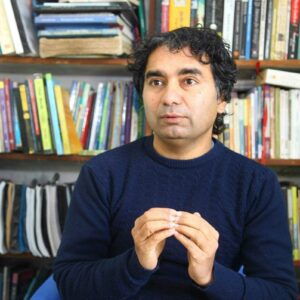
ELT Choutari is pleased to present an intellectually stimulating dialogue between Mr. Chandra Lama, an emerging scholar and dedicated educator, and Dr. Bal Ram Adhikari, a prolific poet, critic, translator, essayist, and Assistant Professor of English Education at Tribhuvan University (Mahendra Ratna Campus, Tahachal).
Dr. Adhikari’s scholarly and literary contributions have significantly enriched Nepali academia, particularly in the domains of translation studies, literary criticism, and the pedagogy of reading. His reflections in this interview offer critical insights into the role of reading skills in language education, their theoretical underpinnings, and their practical applications in the classroom. These perspectives hold immense value for teachers, researchers, and learners invested in refining their approaches to English language teaching and literary engagement.
Beyond his academic work, Dr. Adhikari is an award-winning translator and writer, with numerous publications in national and international journals. His accolades include the Nepal Academy Translation Prize (2025) and the Nepali Talent Prize, England (2018), underscoring his profound influence on Nepali-English literary discourse. A passionate advocate for reading culture, he consistently bridges theory and practice through his research, teaching, and creative writing.
This interview, titled “Reading as a Log in the Ocean: A Life Shaped by Words,” not only illuminates Dr. Adhikari’s intellectual journey but also catalyses deeper reflection on pedagogical practices in ELT. We invite readers to engage with this thought-provoking exchange and explore its implications for their own professional and academic endeavours. The full extract of an interview about reading is presented below.
Let’s begin with something close to your heart. You’ve often told us in class how deeply reading has shaped your life. Could you share why reading matters so much to you as a student and now as an English language educator?”
I see the world in words and words in the world. Reading has always been something that shaped how I think, feel, and connect with life around me. I had an early infatuation with literature, especially through Hindi and Nepali magazines. As a child, I grew up reading Hindi literary and semi-literary magazines like Saras Salil, and Nepali ones like Garima and Madhupark. English literature came into my life much later, around my intermediate level. At first, I read it through translations. Only in my bachelor’s did I start reading English texts in their original form.
So, for me, reading multilingual literature has been a part of both my academic path and my personal identity. It’s never been a luxury but a necessity. I remember asking myself years ago, “Why do I spend so much time reading?” And the answer that echoed from deep within me was:
“When my life was fraught with frustration,
When my inner world was sinking into the ocean of depression,
The only log I found in that fathomless ocean was the book to which I was clinging.”
That’s what reading meant to me as a student.
And now, as an English language educator, reading matters to me professionally as well. I read to explore other perspectives, to experience diverse lives and thoughts, and to better express myself through writing and speech. In essence, reading is how I connect with the world and help my students do the same.
That’s deeply moving, sir. I still remember in your class, you often reminded us that reading is seeing. Given your own experience, how do you view the place of reading in the University English language curricula?
The English education program, under the Faculty of Education at Tribhuvan University, has mainly focused on producing professional English teachers and teacher educators. For a long time, the curriculum was more theoretical with its prime focus on linguistics, applied linguistics and language pedagogy, giving limited space to reading-focused courses. Until around 2010, students were learning about English rather than exploring and experiencing English through authentic readings. But after the political changes in the country, education reforms followed, and the B.Ed. English curriculum was revised. A big change was the inclusion of reading as a core component, to expose future English teachers to authentic literary and non-literary texts. Current B.Ed. and M.Ed. English curricula are rich in readings across disciplines and genres.
In our reading classes, I recall you used to say reading is more than just “finishing a chapter.” You often taught us specific strategies for reading, like underlining difficult words, trying to guess their meaning, jotting down our understanding in the margins and even encouraging us to ‘talk’ to the characters in the text, among other things. What, in your view, does teaching reading really involve?
That’s exactly it. Reading is so much more than just “finishing a chapter,” and those strategies you remember are a big part of a much larger picture. Teaching reading is a layered process. It’s not just about recognising words or finishing a chapter. It’s about helping students understand why reading matters for learning, thinking and developing their language skills. It’s about guiding students to become thoughtful, strategic and curious readers. Let me break it down:
a) Orient students to the importance of reading
Reading isn’t just for passing exams. It builds language, sharpens thinking and opens up new ideas and worlds. Once students realise this, they enjoy it and make it a habit.
b) Open up linguistic, contextual, cultural and basic content information
Sometimes students struggle with a text not because it’s hard but because they don’t understand the context: the culture, setting or certain vocabulary. So, we need to unpack that before they start reading.
c) Train students in reading strategies and demonstrate them
We need to train students in strategies like skimming, scanning, predicting or guessing meanings from context. And we should model these strategies for them: show, not tell.
d). Connect reading with other productive skills: writing, speaking and translating
What they read can inspire writing, spark discussions or even lead to translation tasks. This makes reading more purposeful and connects it to real communication.
e) Inculcate the habit of reading through extensive reading
And finally, let students choose what they want to read, like stories, comics, articles, anything they enjoy. Reading widely and for pleasure is what really helps them grow as readers, thinkers and individuals.
What stayed with me was the way you made silence a part of the reading process, letting us sit with words before rushing to analysis. In your view, why does reading matter, particularly in our ESL/EFL context of Nepal?
I’m really glad that the practice of silence resonated with you deeply. Before rushing into analysis, I believe it’s important to sit with the words for a while—to contemplate them, to absorb their essence, and to give them time to speak to us.
Now, coming back to your question: why reading matters.
To begin with, if we talk about Academic Communicative Competence, reading is irreplaceable. It’s central not just to language learning but to students’ daily lives and academic performance.
There’s a mountain of research in second-language reading that shows how important reading is. Scholars like Carrell, Grabe and Krashen have pointed out that reading isn’t just about decoding words. It’s become a survival skill in today’s world. It touches almost everything: our education, employment, daily tasks, even how we participate in politics and social life.
Reading affects a person’s ability to access knowledge, grow economically and socially. It builds imagination and creativity. Many researchers have said that good reading and writing skills open doors to better life opportunities. It’s been said that literacy, especially through reading, reduces poverty, lowers crime rates and even shapes a person’s moral compass.
One of the strongest advocates of reading, Stephen Krashen who says that reading is the only real path to literacy. In his studies, he shows how free voluntary reading, like just picking up books out of interest, can have a profound effect on language acquisition. It not only improves reading but also enhances writing, grammar, vocabulary, and even overall cognitive development. He asserts that it gives students the content, style and motivation they need for writing too.
Interestingly, the U.S. Department of Education has concluded that avid, independent reading leads to better skills, higher academic achievement and more desirable outcomes in terms of income and professional life.
Other educators like Brozo and Guthrie have also said that students who read widely perform much better academically than those who don’t. Reading exposes learners to new vocabulary, sentence structures, and fresh ideas. It fuels their imagination, motivates them, and helps them shape their perspectives and worldview. Although reading is often treated as the third skill after listening and speaking, in reality, especially in the educational context, it’s a primary skill, absolutely crucial. Richards and Renandya, two respected names in this field, have pointed out why reading is so central in ESL/EFL settings. First, many learners learn English mainly to be able to read English texts and get information. Second, written texts are their main sources of input for both in terms of language and content. These texts also serve as good models for their writing.
In countries like Nepal, where English is not used much in daily oral communication, either in or outside the classroom, reading becomes even more important. Students get exposed to written English much earlier and far more often than spoken English. So, written texts don’t just help. They compensate for the lack of spoken input.
If we believe in Krashen’s idea of comprehensible input, accessible written texts are the tools for language learning. A researcher from Nepal, Dr. Vishnu S. Rai, surveyed Asian universities and found that most students in Asia learn English through reading. Based on this, he recommends more space for reading in our classrooms.
Our education system also supports this. If we look at our secondary level English curriculum, reading has the highest weightage, i.e., 40%, compared to writing, listening and speaking. At the university level, reading is gaining more importance.
So, in short, reading isn’t just another language skill in Nepal’s ESL/EFL context; it’s the main gateway through which students learn, grow and access opportunities.
That gives a whole new weight to the term “reading culture.” But I’m curious – what are some common misconceptions about reading that you’ve encountered?
A major misconception is that reading is often understood as a third skill, secondary to listening and speaking. This is especially flawed in contexts like ours, where English is primarily learned through reading, particularly in academic or instructional settings.
People tend to see reading as merely a receptive skill, but it’s much more than that in reality. In academic contexts, reading becomes highly productive because the reader isn’t just absorbing information but is actively constructing his/her meaning from the text. Reading is not a passive activity. It’s an active, dynamic process. The reader engages with the text, questions it, and reflects on it. There’s an ongoing interaction. I would even say it’s a critical engagement. Readers must maintain a certain distance to interpret, evaluate, and negotiate meaning.
This reminds me of Hans-Georg Gadamer’s Truth and Method. He talks about how reading involves a twin process: prediction and post-diction. Prediction means the reader is constantly looking ahead, anticipating what might come next based on the cues in the text, whether it’s the title, the context, or the structure. It’s a forward-looking process that activates the reader’s expectations and imagination. On the other hand, post-diction involves looking back, revisiting what has already been read in light of new information. It’s a process of reevaluation and reinterpretation. As we read more, earlier parts of the text may take on new meanings. This continuous back-and-forth is what makes reading deeply interactive and thoughtful. So, the reader is not a passive recipient, but an active meaning-maker. The agency of the reader is very high in this process. Reading, then, is a creative, critical and reflective process.
In your opinion, how can we expand the students’ reading process?
I see the reading process in three levels: reading the lines, reading between the lines, and reading beyond the lines. Most students tend to stop at the first level – just understanding the literal meaning. It’s essential, but not enough. The second level, reading between the lines, is about interpreting what’s implied, grasping the author’s intent, connecting ideas, and uncovering hidden meanings. The third level, which is reading beyond the lines, is even more crucial. Here, readers connect the text to its wider socio-cultural or historical context, think critically, question the author’s purpose, and assess bias or credibility.
Unfortunately, what I often see is that reading remains sub-standard, inadequate, or even defective. We must help students move beyond just decoding words and support them in engaging deeply with what they read, both intellectually and emotionally.
Over the years, you’ve worked with diverse groups of learners and experimented with different approaches to reading. Drawing from all that, what do you think makes for an ideal pedagogy for reading?
That’s a thoughtful question. I believe the pedagogy for reading should involve three concentric zones, what I like to call the core, peripheral, and expanding zones of reading.
Could you explain what the core zone includes?
The core zone of reading primarily refers to intensive classroom reading, especially reading of the prescribed textbooks. This kind of reading is essential as it directly impacts students’ academic performance and also serves as a foundation for deeper learning. But here’s a problem: the way we usually conduct classroom reading often kills students’ interest. It becomes boring, repetitive, and demotivating. As Lewis Thomas once said, “Science is an adventure within, a wilderness of mystery,” yet so many science classes are dull. This happens across subjects. Most of our teaching and students’ reading get stuck in this core zone. But we need to remind ourselves: textbooks are not end books; they are means. They should open doors to further reading and exploration.
So, are you suggesting that we need to move beyond the core zone?
Exactly. That brings us to the peripheral zone of reading. This involves connecting the classroom reading to related materials- maybe an article, a story, a biography, or even a visual text. It’s about taking the topic one step further, making the reading experience freer, more student-centred, and creative. In essence, this means we shift from purely explanatory reading to exploratory reading. Students start seeing the broader context of a topic, and reading becomes a discovery rather than a duty.
And what about the expanding zone?
Ah, that’s my favourite part. The expanding zone of reading is about cultivating a lifelong habit of reading. It’s not just for exams, but for information, pleasure, and vision. Here, students might read for facts or fantasy, explore different genres, or dive into books that awaken both sensitivity and sensibility. Sensitivity means the ability to feel and sense the world through words. And, sensibility is the ability to make meaning out of what they read.
To support this, schools and teachers can take many steps, like starting book reading clubs, discussion groups, or inviting local writers and journalists to share their reading journeys. Even something as simple as teachers sharing the books they love, or celebrating a book-giving day, can create an inspiring culture around reading.
Finally, looking back on your years of teaching reading, what is one lesson or insight you wish you had learned earlier?
I wish I had been trained on how to read rather than just explaining the content of the text. During our time, texts were mostly explained, summarised, or interpreted for us. The entire approach was exam-oriented. We were taught what to remember, not how to explore or question what we read. Now, I realise that if students are guided through the actual process of reading, developing skills like critical thinking, engaging with the text emotionally and intellectually, asking questions, making connections, then they not only understand better, but they also become more independent, reflective readers. That kind of reading stays with them for life.
Interviewee’s Bio: Bal Ram Adhikari, PhD, is a lecturer in English Education at Tribhuvan University, Nepal. An award-winning translator and writer, Dr. Adhikari has more than a dozen translations and numerous scholarly articles published in national and international
journals. His contributions to Nepali-English translation and Nepali literature have
earned him several honours, including the Nepal Academy Translation Prize (2025)
and the Nepali Talent Prize, England (2018). Apart from teaching, training,
researching and translating, Dr. Adhikari loves writing poems in English and essays
in Nepali.
Interviewer’s Bio: Chandra Bahadur Lama is an emerging and active writer, poet, and translator in the field of Nepali literature and translation. In addition to teaching English, he is also actively involved as an executive member of the Nepal Translators’ Society. His poems, essays, translations, and articles have been published in various literary and online magazines. His deep love for literature and passion for travel have shaped a profound philosophical perspective in his creations. Recently, his English translation of the anthology of poetry Premko Aadim Geet has been published, further establishing his contribution to the field of literary translation.
